Section 8a SUZUKI GRAND VITARA 2001 2.G Workshop Manual
[x] Cancel search | Manufacturer: SUZUKI, Model Year: 2001, Model line: GRAND VITARA, Model: SUZUKI GRAND VITARA 2001 2.GPages: 656, PDF Size: 14.31 MB
Page 105 of 656
4B-2 PROPELLER SHAFTS
On-Vehicle Service
Propeller Shaft
For the descriptions other than those mentioned below, refer to
the same item in the same section of the Service Manual men-
tioned in the FOREWORD of this manual.
INSTALLATION
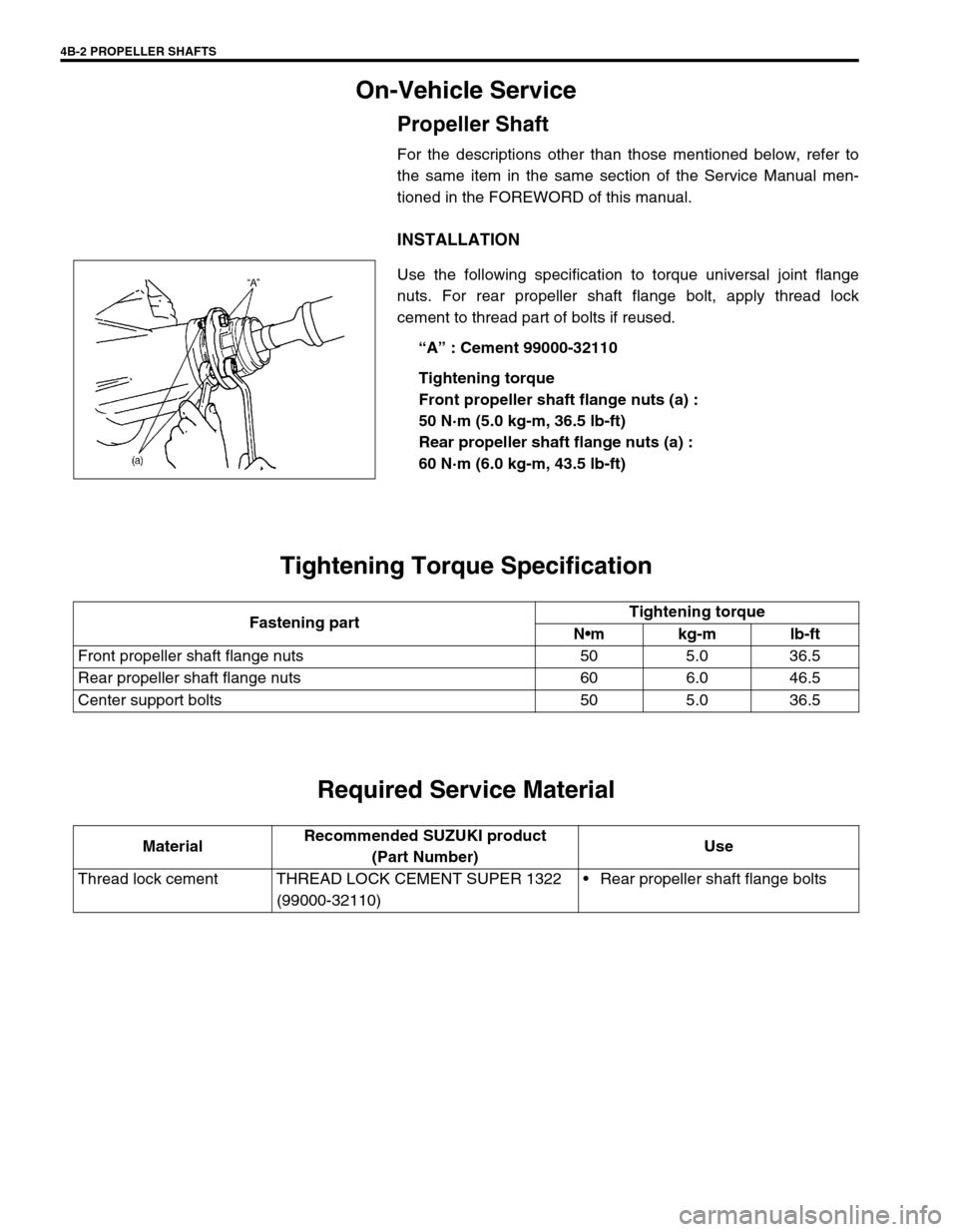
Use the following specification to torque universal joint flange
nuts. For rear propeller shaft flange bolt, apply thread lock
cement to thread part of bolts if reused.
“A” : Cement 99000-32110
Tightening torque
Front propeller shaft flange nuts (a) :
50 N·m (5.0 kg-m, 36.5 lb-ft)
Rear propeller shaft flange nuts (a) :
60 N·m (6.0 kg-m, 43.5 lb-ft)
Tightening Torque Specification
Required Service Material
Fastening partTightening torque
Nm kg-m lb-ft
Front propeller shaft flange nuts 50 5.0 36.5
Rear propeller shaft flange nuts 60 6.0 46.5
Center support bolts 50 5.0 36.5
MaterialRecommended SUZUKI product
(Part Number)Use
Thread lock cement THREAD LOCK CEMENT SUPER 1322
(99000-32110)Rear propeller shaft flange bolts
Page 106 of 656
BRAKES 5-1
5
SECTION 5
BRAKES
CONTENTS
Diagnosis .......................................................... 5-2
Diagnosis Table ............................................. 5-2
WARNING:
For vehicles equipped with Supplemental Restraint (Air Bag) System:
Service on and around the air bag system components or wiring must be performed only by an
authorized SUZUKI dealer. Refer to “Air Bag System Components and Wiring Location View” under
“General Description” in air bag system section in order to confirm whether you are performing ser-
vice on or near the air bag system components or wiring. Please observe all WARNINGS and “Ser-
vice Precautions” under “On-Vehicle Service” in air bag system section before performing service
on or around the air bag system components or wiring. Failure to follow WARNINGS could result in
unintentional activation of the system or could render the system inoperative. Either of these two
conditions may result in severe injury.
Technical service work must be started at least 90 seconds after the ignition switch is turned to the
“LOCK” position and the negative cable is disconnected from the battery. Otherwise, the system
may be activated by reserve energy in the Sensing and Diagnostic Module (SDM).
NOTE:
For the description (items) not found in this section refer to the same section of the Service Manual
mentioned in the FOREWORD of this manual.
When inspecting and servicing vehicle equipped with ABS, be sure to refer to section 5E2 first.
All brake fasteners are important attaching parts in that they could affect the performance of vital
parts and systems, and/or could result in major repair expense. They must be replaced with one of
same part number or with an equivalent part if replacement becomes necessary. Do not use a
replacement part of lesser quality or substitute design. Torque values must be used as specified
during reassembly to assure proper retention of all parts. There is to be no welding as it may result
in extensive damage and weakening of the metal.
Page 107 of 656
5-2 BRAKES
Diagnosis
Diagnosis Table
For the item not found in this column, refer to the same item of the same section in the service manual men-
tioned in the FOREWORD of this manual.
Condition Possible Cause Correction
Brake warning light
turns on after engine
startParking brake applied Release parking brake and check
that brake warning light turns off.
Insufficient amount of brake fluid Add brake fluid.
Brake fluid leaking from brake line Investigate leaky point, correct it
and add brake fluid.
Brake warning light circuit faulty Repair circuit.
Malfunctioning EBD system Check system referring to “DIAG-
NOSIS” of Section 5E2.
ABS warning light
does not turn on for 2
– 3 sec. after ignition
switch has turned ON.Bulb burnt out Replace bulb.
ABS warning light circuit open (including check
relay)Check system referring to “DIAG-
NOSIS” in Section 5E2.
ABS warning light
remains on after igni-
tion switch has turned
on for 2 – 3 sec.Malfunctioning ABS Check system referring to “DIAG-
NOSIS” in Section 5E2.
Page 108 of 656
BRAKES PIPE/HOSE/MASTER CYLINDER 5A-1
5A
SECTION 5A
BRAKES PIPE/HOSE/MASTER CYLINDER
CONTENTS
General Description ....................................... 5A-2
Master Cylinder Assembly............................ 5A-2
On-Vehicle Service......................................... 5A-3
Front Brake Hose/Pipe ................................. 5A-3
Master Cylinder Reservoir ............................ 5A-6Master Cylinder Assembly ........................... 5A-7
Brake Booster .............................................. 5A-8
Tightening Torque Specification ................ 5A-10
Special Tool .................................................. 5A-10
WARNING:
For vehicles equipped with Supplemental Restraint (Air Bag) System:
Service on and around the air bag system components or wiring must be performed only by an
authorized SUZUKI dealer. Refer to “Air Bag System Components and Wiring Location View” under
“General Description” in air bag system section in order to confirm whether you are performing ser-
vice on or near the air bag system components or wiring. Please observe all WARNINGS and “Ser-
vice Precautions” under “On-Vehicle Service” in air bag system section before performing service
on or around the air bag system components or wiring. Failure to follow WARNINGS could result in
unintentional activation of the system or could render the system inoperative. Either of these two
conditions may result in severe injury.
Technical service work must be started at least 90 seconds after the ignition switch is turned to the
“LOCK” position and the negative cable is disconnected from the battery. Otherwise, the system
may be activated by reserve energy in the Sensing and Diagnostic Module (SDM).
NOTE:
For the descriptions (items) not found in this section, refer to the same section of the Service Man-
ual mentioned in the FOREWORD of this manual.
All brake fasteners are important attaching parts in that they could affect the performance of vital
parts and systems, and/or could result in major repair expense. They must be replaced with one of
same part number or with an equivalent part if replacement becomes necessary. Do not use a
replacement part of lesser quality or substitute design. Torque values must be used as specified
during reassembly to assure proper retention of all parts. There is to be no welding as it may result
in extensive damage and weakening of the metal.
Page 113 of 656
5A-6 BRAKES PIPE/HOSE/MASTER CYLINDER
Master Cylinder Reservoir
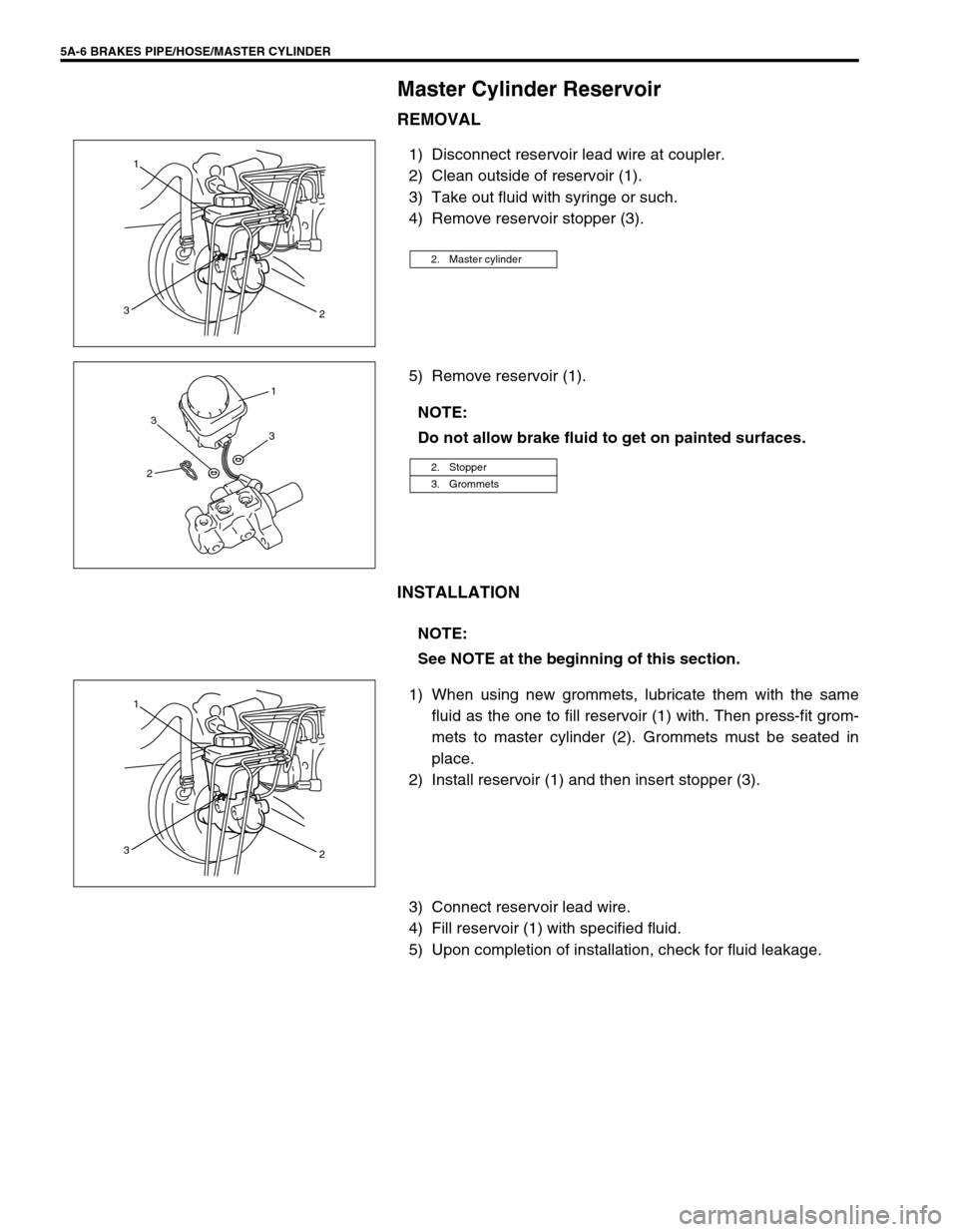
REMOVAL
1) Disconnect reservoir lead wire at coupler.
2) Clean outside of reservoir (1).
3) Take out fluid with syringe or such.
4) Remove reservoir stopper (3).
5) Remove reservoir (1).
INSTALLATION
1) When using new grommets, lubricate them with the same
fluid as the one to fill reservoir (1) with. Then press-fit grom-
mets to master cylinder (2). Grommets must be seated in
place.
2) Install reservoir (1) and then insert stopper (3).
3) Connect reservoir lead wire.
4) Fill reservoir (1) with specified fluid.
5) Upon completion of installation, check for fluid leakage.
2. Master cylinder
1
3
2
NOTE:
Do not allow brake fluid to get on painted surfaces.
2. Stopper
3. Grommets
3
31
2
NOTE:
See NOTE at the beginning of this section.
1
3
2
Page 114 of 656
BRAKES PIPE/HOSE/MASTER CYLINDER 5A-7
Master Cylinder Assembly
REMOVAL
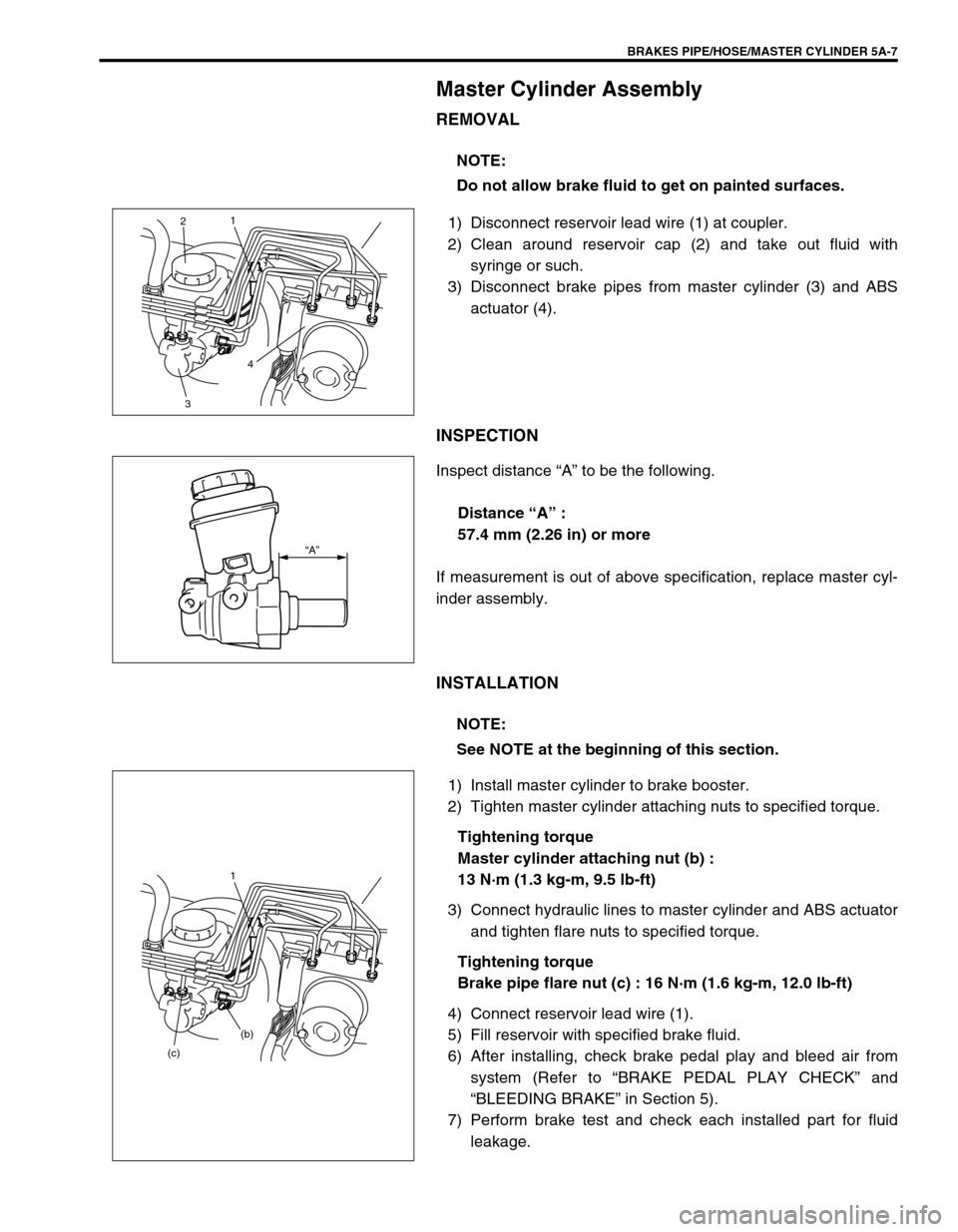
1) Disconnect reservoir lead wire (1) at coupler.
2) Clean around reservoir cap (2) and take out fluid with
syringe or such.
3) Disconnect brake pipes from master cylinder (3) and ABS
actuator (4).
INSPECTION
Inspect distance “A” to be the following.
Distance “A” :
57.4 mm (2.26 in) or more
If measurement is out of above specification, replace master cyl-
inder assembly.
INSTALLATION
1) Install master cylinder to brake booster.
2) Tighten master cylinder attaching nuts to specified torque.
Tightening torque
Master cylinder attaching nut (b) :
13 N·m (1.3 kg-m, 9.5 lb-ft)
3) Connect hydraulic lines to master cylinder and ABS actuator
and tighten flare nuts to specified torque.
Tightening torque
Brake pipe flare nut (c) : 16 N·m (1.6 kg-m, 12.0 lb-ft)
4) Connect reservoir lead wire (1).
5) Fill reservoir with specified brake fluid.
6) After installing, check brake pedal play and bleed air from
system (Refer to “BRAKE PEDAL PLAY CHECK” and
“BLEEDING BRAKE” in Section 5).
7) Perform brake test and check each installed part for fluid
leakage. NOTE:
Do not allow brake fluid to get on painted surfaces.
21
4
3
“A”
NOTE:
See NOTE at the beginning of this section.
1
(b)
(c)
Page 118 of 656
PARKING AND REAR BRAKE 5C-1
5C
SECTION 5C
PARKING AND REAR BRAKE
CONTENTS
General Description ....................................... 5C-2
Drum Brake Assembly ................................. 5C-2
On-Vehicle Service......................................... 5C-3
Parking Brake Cable .................................... 5C-3Brake Drum .................................................. 5C-3
Wheel Cylinder............................................. 5C-5
Brake Back Plate ......................................... 5C-5
Tightening Torque Specification .................. 5C-7
WARNING:
For vehicles equipped with Supplemental Restraint (Air Bag) System:
Service on and around the air bag system components or wiring must be performed only by an
authorized SUZUKI dealer. Refer to “Air Bag System Components and Wiring Location View” under
“General Description” in air bag system section in order to confirm whether you are performing ser-
vice on or near the air bag system components or wiring. Please observe all WARNINGS and “Ser-
vice Precautions” under “On-Vehicle Service” in air bag system section before performing service
on or around the air bag system components or wiring. Failure to follow WARNINGS could result in
unintentional activation of the system or could render the system inoperative. Either of these two
conditions may result in severe injury.
Technical service work must be started at least 90 seconds after the ignition switch is turned to the
“LOCK” position and the negative cable is disconnected from the battery. Otherwise, the system
may be activated by reserve energy in the Sensing and Diagnostic Module (SDM).
NOTE:
For the descriptions (items) not found in this section, refer to the same section of the Service Man-
ual mentioned in the FOREWORD of this manual.
All brake fasteners are important attaching parts in that they could affect the performance of vital
parts and systems, and/or could result in major repair expense. They must be replaced with one of
same part number or with an equivalent part if replacement becomes necessary. Do not use a
replacement part of lesser quality or substitute design. Torque values must be used as specified
during reassembly to assure proper retention of all parts. There is to be no welding as it may result
in extensive damage and weakening of the metal.
Page 121 of 656
5C-4 PARKING AND REAR BRAKE
Cracked, scored, or grooved drum
A cracked, drum is unsafe for further service and must be
replaced.
Do not attempt to weld a cracked drum.
Smooth up any slight scores. Heavy or extensive scoring will
cause excessive brake lining wear and it will probably be neces-
sary to resurface drum braking surface.
If brake linings are slightly worn and drum is grooved, drum
should be polished with fine emery cloth but should no be turned.
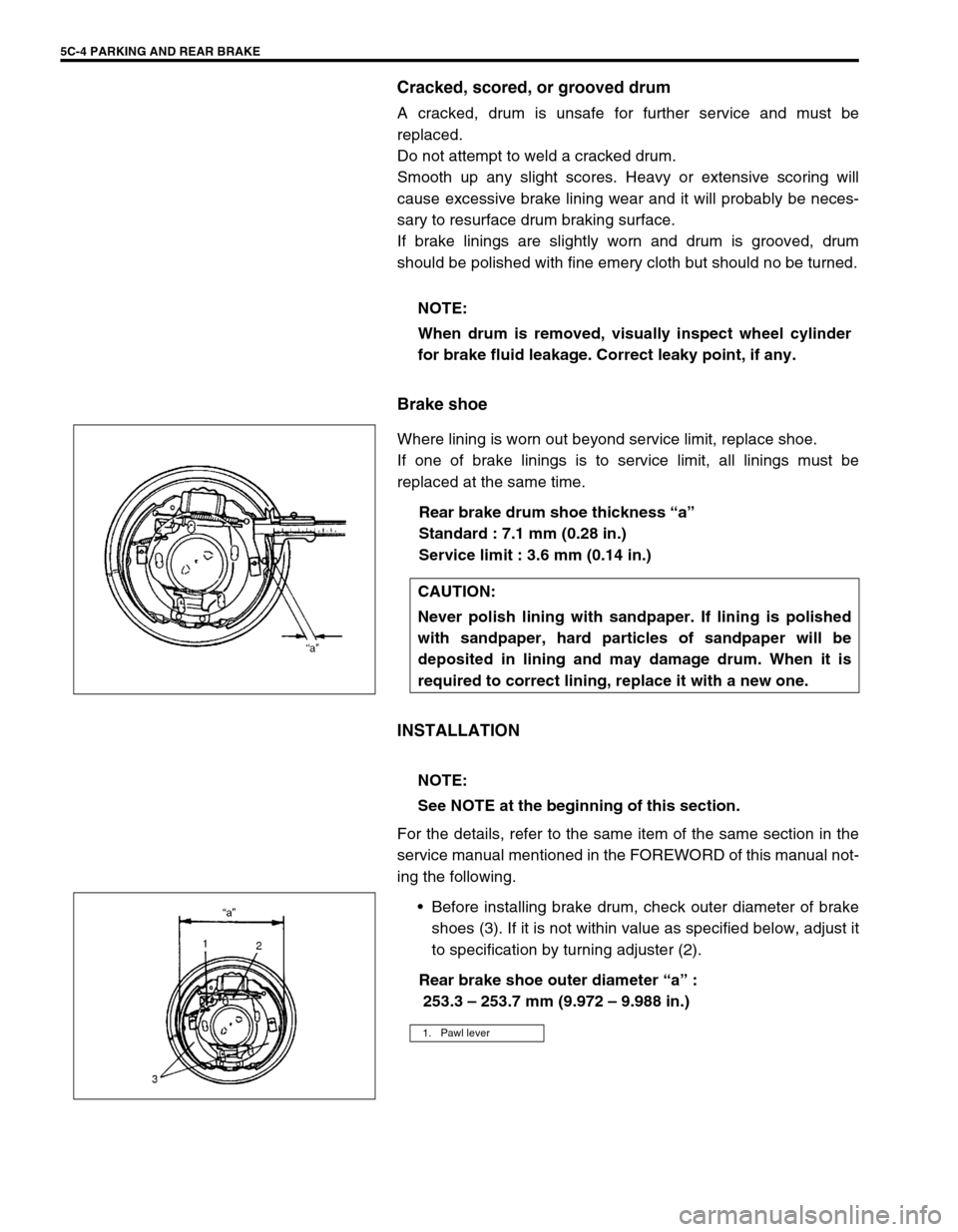
Brake shoe
Where lining is worn out beyond service limit, replace shoe.
If one of brake linings is to service limit, all linings must be
replaced at the same time.
Rear brake drum shoe thickness “a”
Standard : 7.1 mm (0.28 in.)
Service limit : 3.6 mm (0.14 in.)
INSTALLATION
For the details, refer to the same item of the same section in the
service manual mentioned in the FOREWORD of this manual not-
ing the following.
Before installing brake drum, check outer diameter of brake
shoes (3). If it is not within value as specified below, adjust it
to specification by turning adjuster (2).
Rear brake shoe outer diameter “a” :
253.3 – 253.7 mm (9.972 – 9.988 in.) NOTE:
When drum is removed, visually inspect wheel cylinder
for brake fluid leakage. Correct leaky point, if any.
CAUTION:
Never polish lining with sandpaper. If lining is polished
with sandpaper, hard particles of sandpaper will be
deposited in lining and may damage drum. When it is
required to correct lining, replace it with a new one.
NOTE:
See NOTE at the beginning of this section.
1. Pawl lever
Page 122 of 656
PARKING AND REAR BRAKE 5C-5
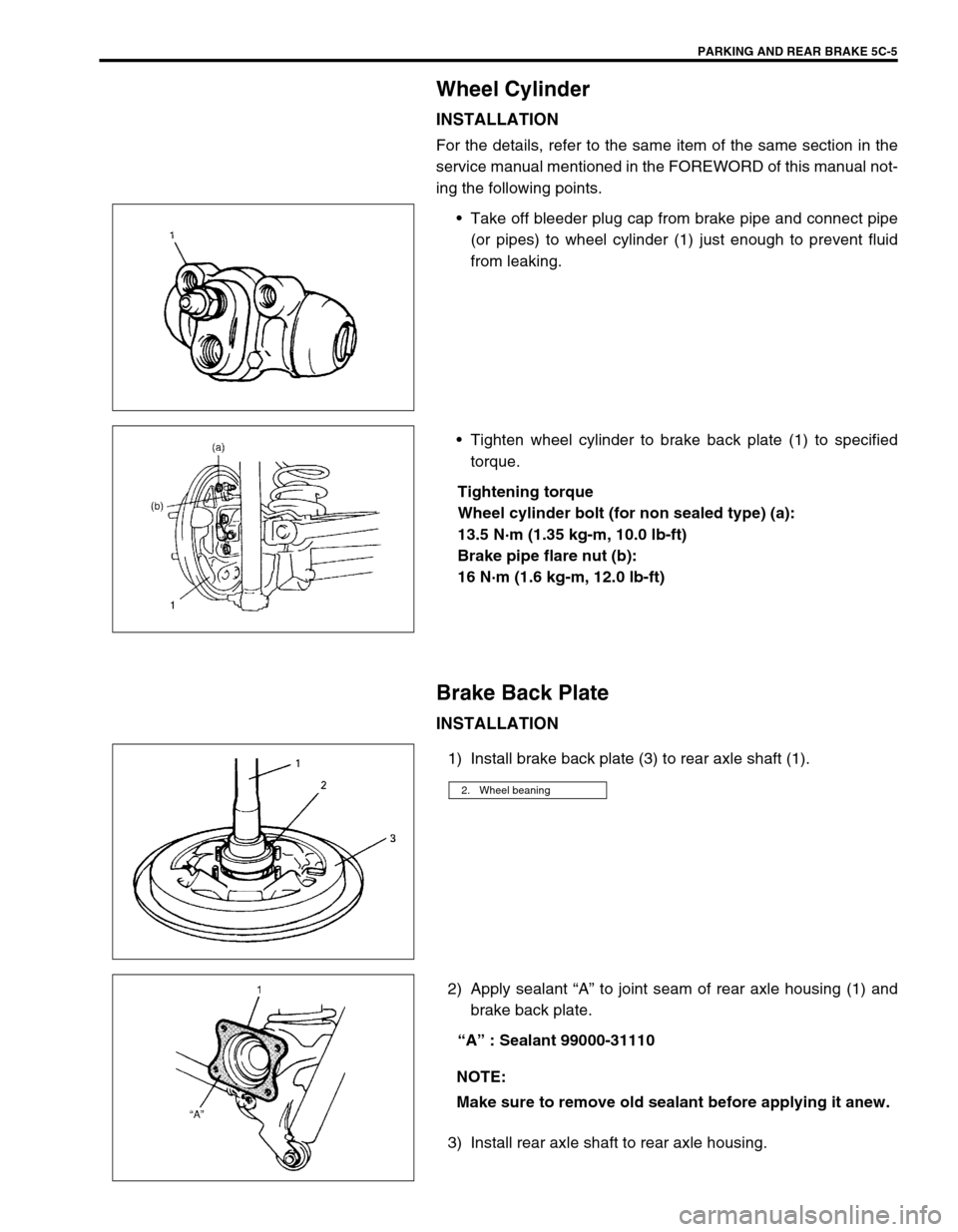
Wheel Cylinder
INSTALLATION
For the details, refer to the same item of the same section in the
service manual mentioned in the FOREWORD of this manual not-
ing the following points.
Take off bleeder plug cap from brake pipe and connect pipe
(or pipes) to wheel cylinder (1) just enough to prevent fluid
from leaking.
Tighten wheel cylinder to brake back plate (1) to specified
torque.
Tightening torque
Wheel cylinder bolt (for non sealed type) (a):
13.5 N·m (1.35 kg-m, 10.0 lb-ft)
Brake pipe flare nut (b):
16 N·m (1.6 kg-m, 12.0 lb-ft)
Brake Back Plate
INSTALLATION
1) Install brake back plate (3) to rear axle shaft (1).
2) Apply sealant “A” to joint seam of rear axle housing (1) and
brake back plate.
“A” : Sealant 99000-31110
3) Install rear axle shaft to rear axle housing.
2. Wheel beaning
NOTE:
Make sure to remove old sealant before applying it anew.
Page 123 of 656
5C-6 PARKING AND REAR BRAKE
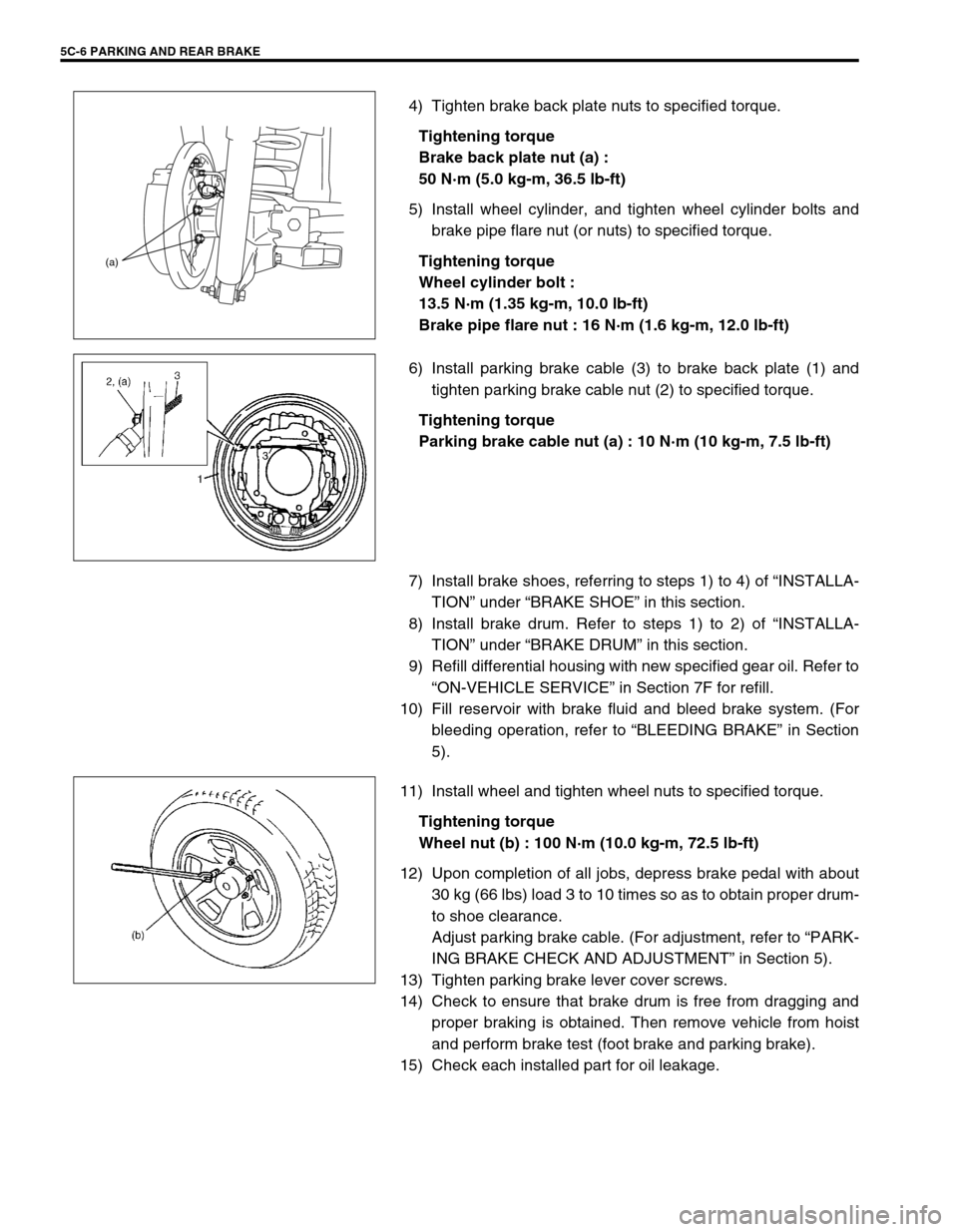
4) Tighten brake back plate nuts to specified torque.
Tightening torque
Brake back plate nut (a) :
50 N·m (5.0 kg-m, 36.5 lb-ft)
5) Install wheel cylinder, and tighten wheel cylinder bolts and
brake pipe flare nut (or nuts) to specified torque.
Tightening torque
Wheel cylinder bolt :
13.5 N·m (1.35 kg-m, 10.0 lb-ft)
Brake pipe flare nut : 16 N·m (1.6 kg-m, 12.0 lb-ft)
6) Install parking brake cable (3) to brake back plate (1) and
tighten parking brake cable nut (2) to specified torque.
Tightening torque
Parking brake cable nut (a) : 10 N·m (10 kg-m, 7.5 lb-ft)
7) Install brake shoes, referring to steps 1) to 4) of “INSTALLA-
TION” under “BRAKE SHOE” in this section.
8) Install brake drum. Refer to steps 1) to 2) of “INSTALLA-
TION” under “BRAKE DRUM” in this section.
9) Refill differential housing with new specified gear oil. Refer to
“ON-VEHICLE SERVICE” in Section 7F for refill.
10) Fill reservoir with brake fluid and bleed brake system. (For
bleeding operation, refer to “BLEEDING BRAKE” in Section
5).
11) Install wheel and tighten wheel nuts to specified torque.
Tightening torque
Wheel nut (b) : 100 N·m (10.0 kg-m, 72.5 lb-ft)
12) Upon completion of all jobs, depress brake pedal with about
30 kg (66 lbs) load 3 to 10 times so as to obtain proper drum-
to shoe clearance.
Adjust parking brake cable. (For adjustment, refer to “PARK-
ING BRAKE CHECK AND ADJUSTMENT” in Section 5).
13) Tighten parking brake lever cover screws.
14) Check to ensure that brake drum is free from dragging and
proper braking is obtained. Then remove vehicle from hoist
and perform brake test (foot brake and parking brake).
15) Check each installed part for oil leakage.
(a)