Section 8a SUZUKI GRAND VITARA 2001 2.G Owners Manual
[x] Cancel search | Manufacturer: SUZUKI, Model Year: 2001, Model line: GRAND VITARA, Model: SUZUKI GRAND VITARA 2001 2.GPages: 656, PDF Size: 14.31 MB
Page 552 of 656
BODY SERVICE 9-7
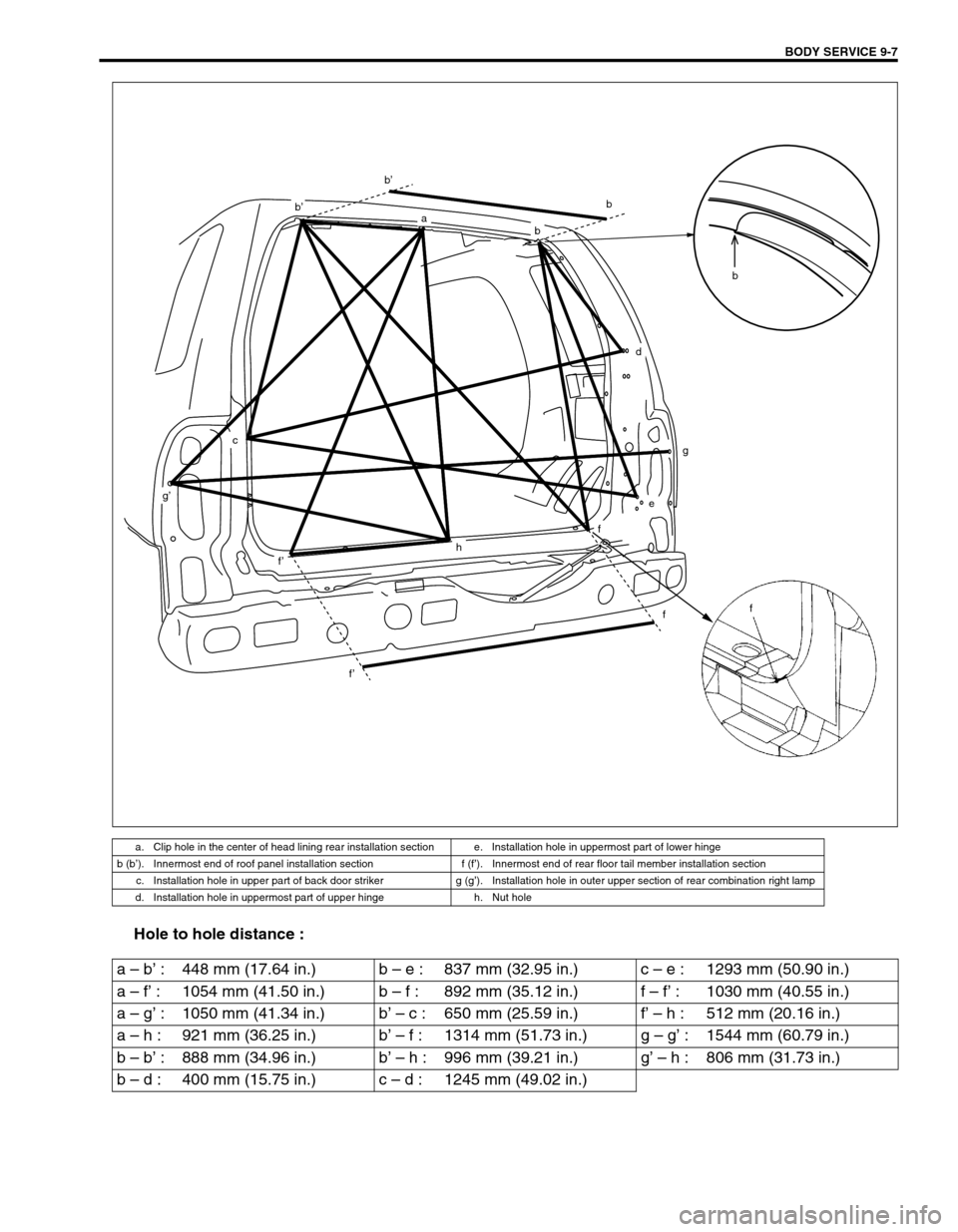
Hole to hole distance :
a. Clip hole in the center of head lining rear installation section e. Installation hole in uppermost part of lower hinge
b (b’). Innermost end of roof panel installation section f (f’). Innermost end of rear floor tail member installation section
c. Installation hole in upper part of back door striker g (g’). Installation hole in outer upper section of rear combination right lamp
d. Installation hole in uppermost part of upper hinge h. Nut hole
b
ba
b’
b’
c
g’
f’
f’
h
f
f
e
g
d
f
b
a – b’ : 448 mm (17.64 in.) b – e : 837 mm (32.95 in.) c – e : 1293 mm (50.90 in.)
a – f’ : 1054 mm (41.50 in.) b – f : 892 mm (35.12 in.) f – f’ : 1030 mm (40.55 in.)
a – g’ : 1050 mm (41.34 in.) b’ – c : 650 mm (25.59 in.) f’ – h : 512 mm (20.16 in.)
a – h : 921 mm (36.25 in.) b’ – f : 1314 mm (51.73 in.) g – g’ : 1544 mm (60.79 in.)
b – b’ : 888 mm (34.96 in.) b’ – h : 996 mm (39.21 in.) g’ – h : 806 mm (31.73 in.)
b – d : 400 mm (15.75 in.) c – d : 1245 mm (49.02 in.)
Page 559 of 656
9-14 BODY SERVICE
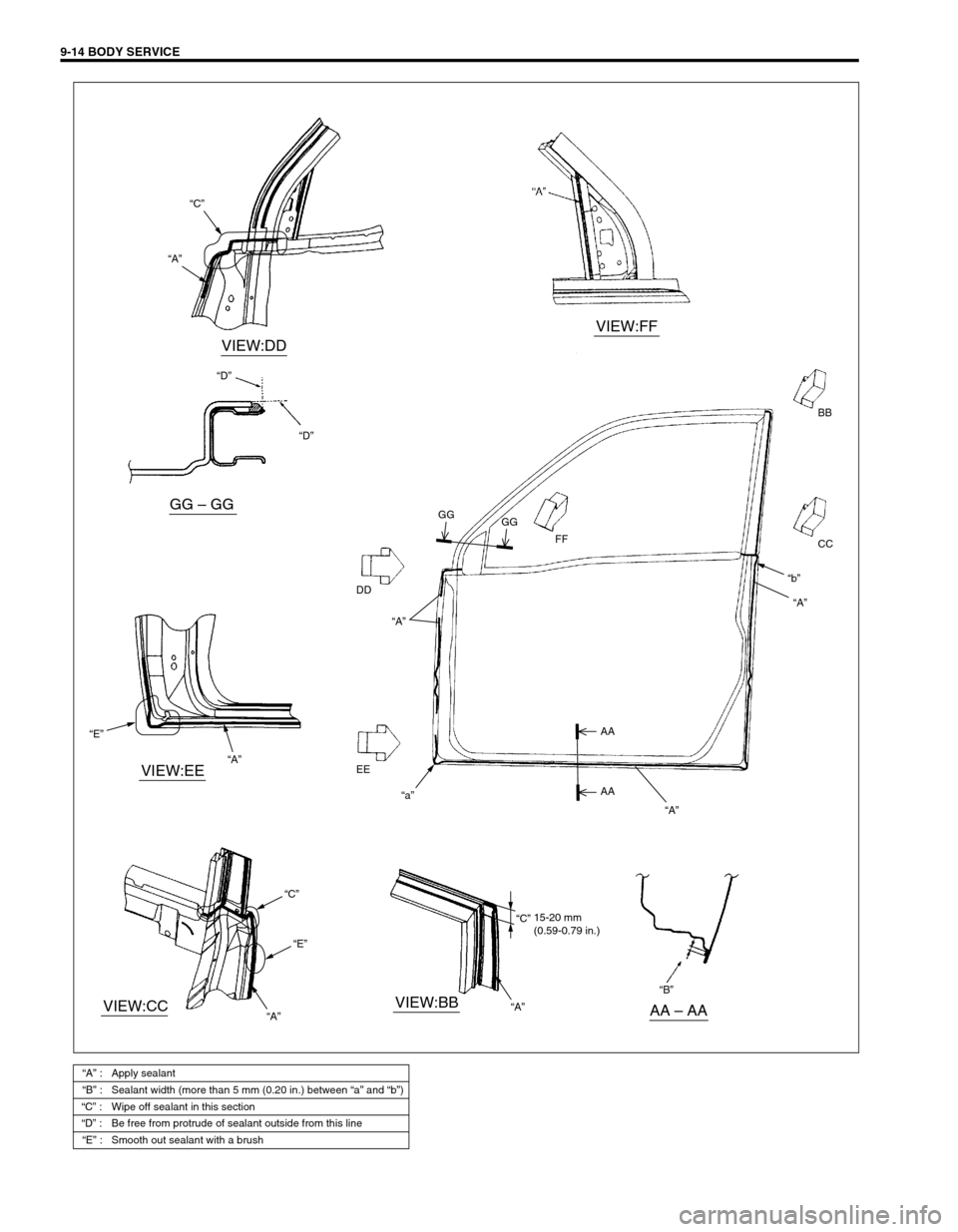
“A” : Apply sealant
“B” : Sealant width (more than 5 mm (0.20 in.) between “a” and “b”)
“C” : Wipe off sealant in this section
“D” : Be free from protrude of sealant outside from this line
“E” : Smooth out sealant with a brush
“A”“C”
VIEW:DD
VIEW:FF
VIEW:BBVIEW:CC
VIEW:EE
GG – GG
AA – AA
“D”
“D”
“B”“A”
“B” “a”“b”
“E”
“A”
“b”
“C”
“E”
“A”
“A”
“C”
DDFF
CC BB
EE
AA
AA GG
GG
15-20 mm
(0.59-0.79 in.)
“B”
“A” “B”
“A”
Page 560 of 656
BODY SERVICE 9-15
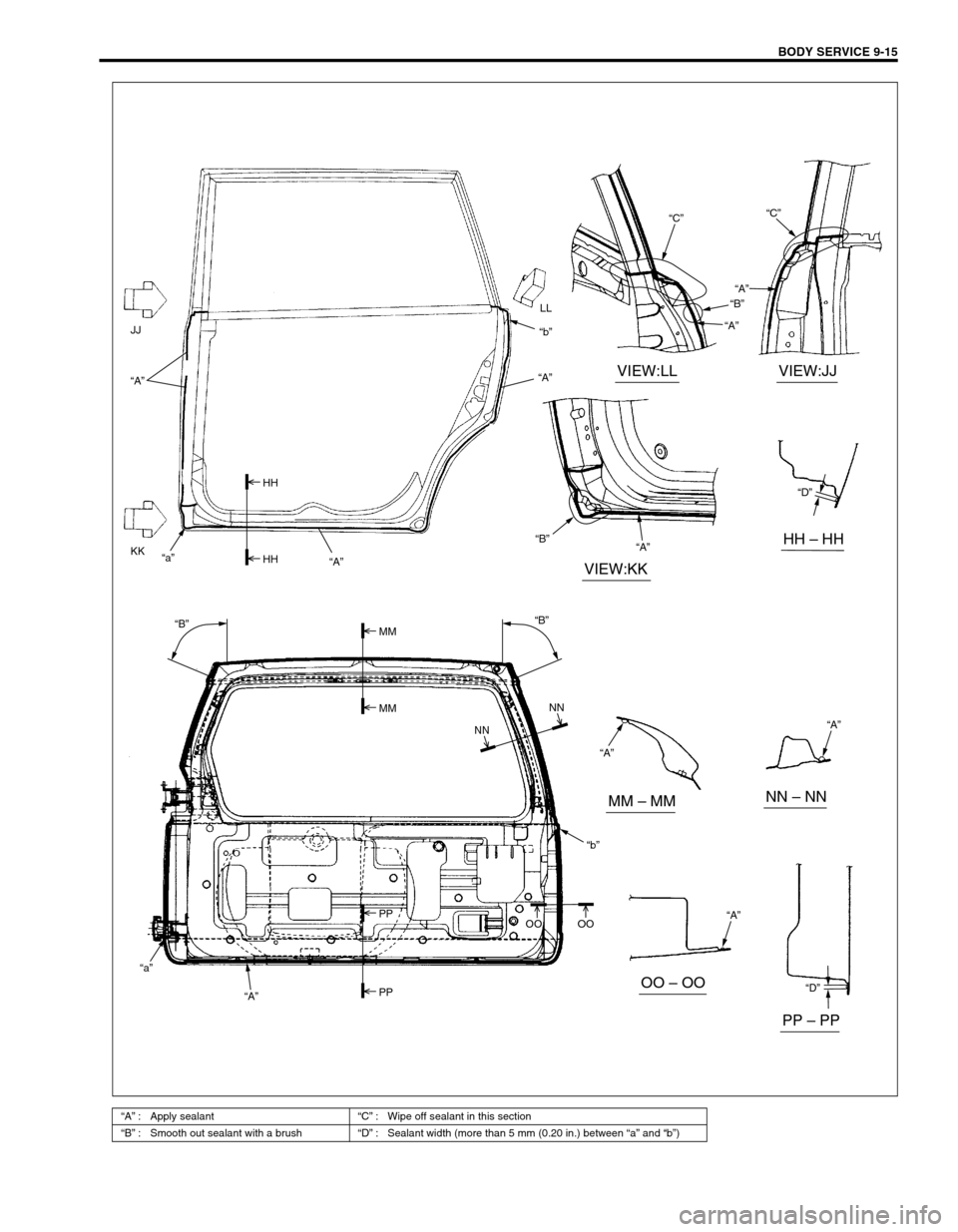
“A” : Apply sealant“C” : Wipe off sealant in this section
“B” : Smooth out sealant with a brush“D” : Sealant width (more than 5 mm (0.20 in.) between “a” and “b”)
“C”
“B”
“A”
“b”
“b”
“a”
“A”
“A”
“A”
“a”
“A”
“A”
“B” “A”
“C”
“D”
“D”
JJ
KKLL
“A”
“A”
“A”
PP PP
MM
NNNN
MM
HH
HH
“B”“B”
OO OO
PP – PP
OO – OO
NN – NNMM – MM
HH – HH
VIEW:KK
VIEW:LLVIEW:JJ
Page 564 of 656
BODY SERVICE 9-19
Exterior and Interior Trim
Floor Carpet
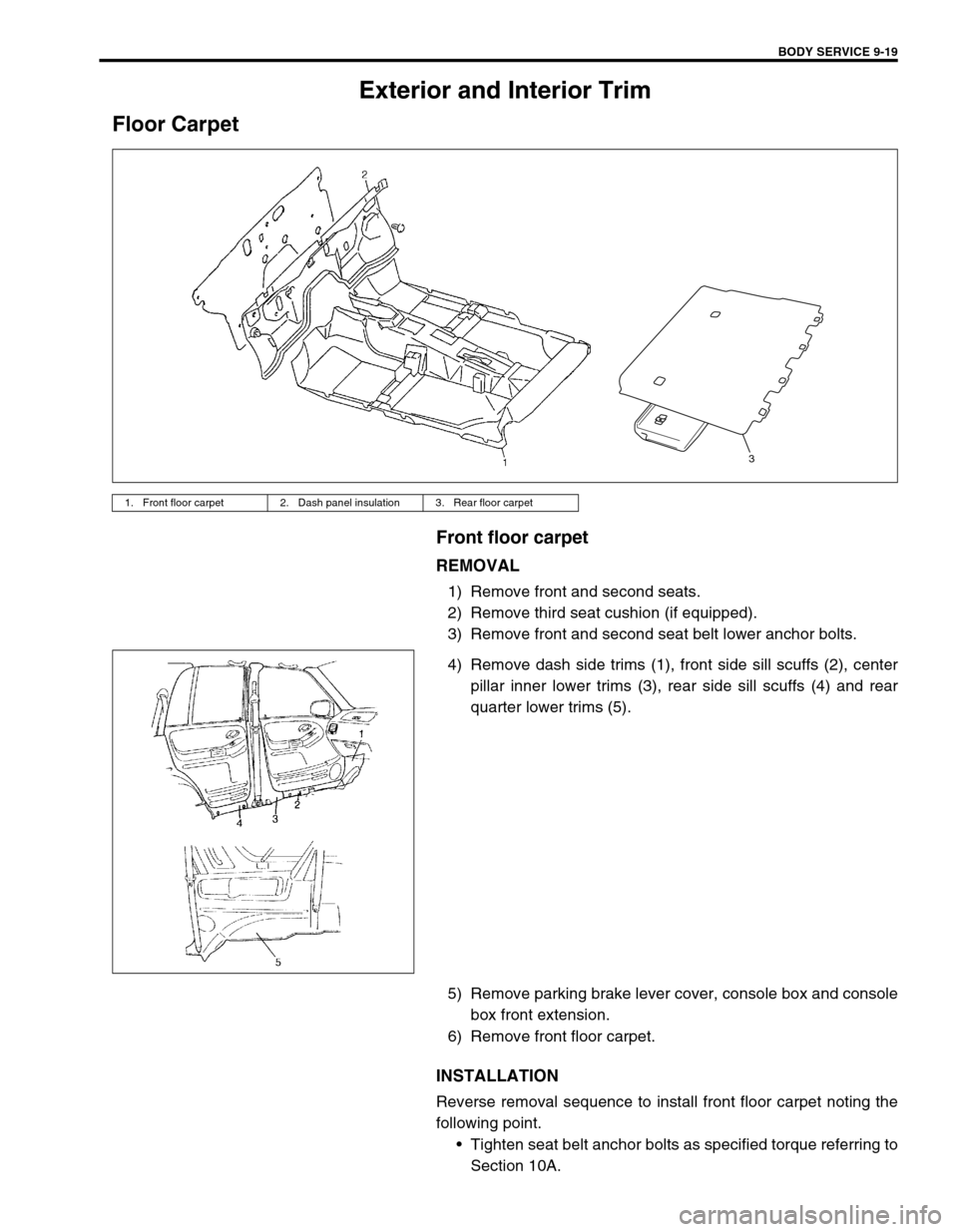
Front floor carpet
REMOVAL
1) Remove front and second seats.
2) Remove third seat cushion (if equipped).
3) Remove front and second seat belt lower anchor bolts.
4) Remove dash side trims (1), front side sill scuffs (2), center
pillar inner lower trims (3), rear side sill scuffs (4) and rear
quarter lower trims (5).
5) Remove parking brake lever cover, console box and console
box front extension.
6) Remove front floor carpet.
INSTALLATION
Reverse removal sequence to install front floor carpet noting the
following point.
•Tighten seat belt anchor bolts as specified torque referring to
Section 10A.
1. Front floor carpet 2. Dash panel insulation 3. Rear floor carpet
3
Page 566 of 656
BODY SERVICE 9-21
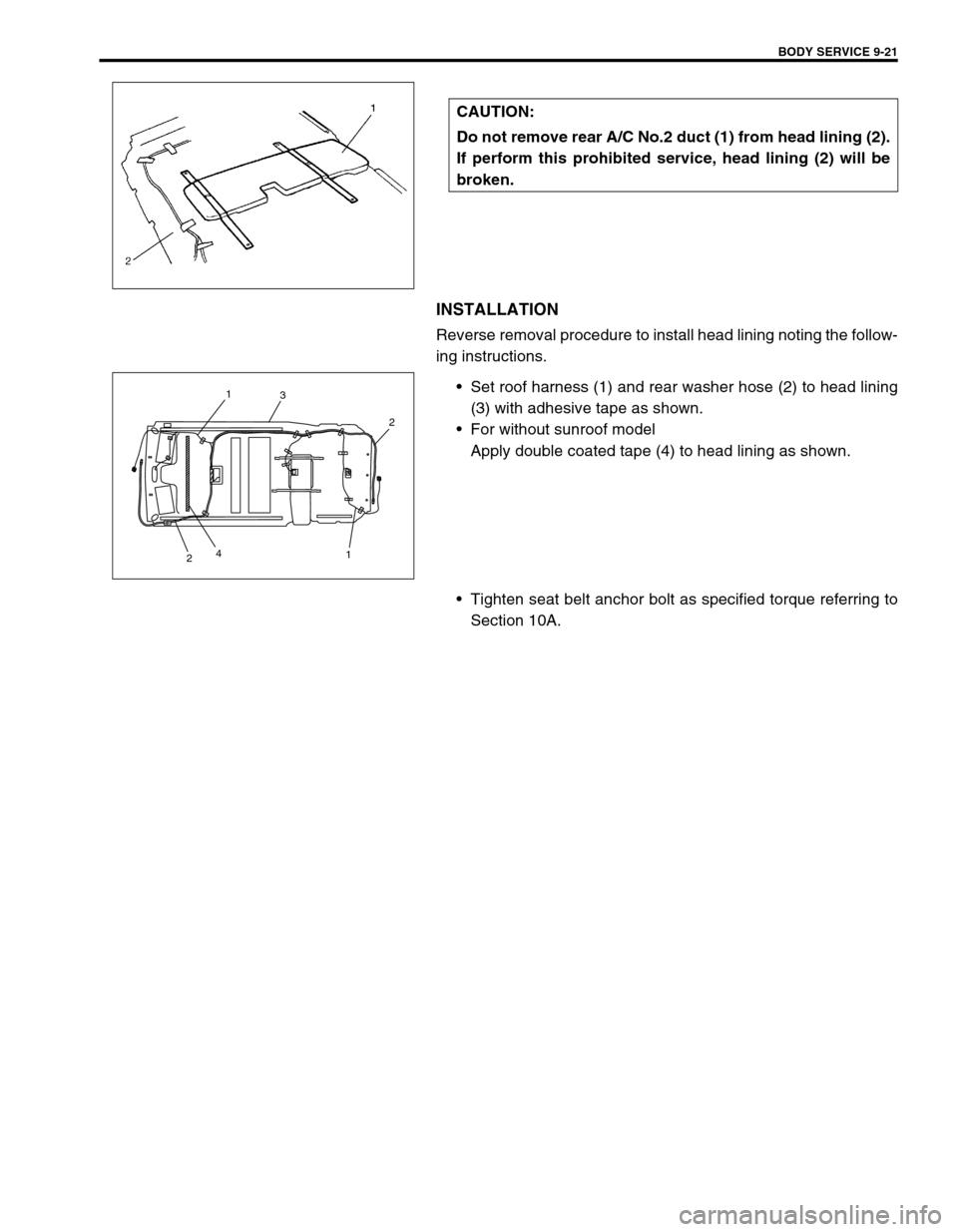
INSTALLATION
Reverse removal procedure to install head lining noting the follow-
ing instructions.
•Set roof harness (1) and rear washer hose (2) to head lining
(3) with adhesive tape as shown.
•For without sunroof model
Apply double coated tape (4) to head lining as shown.
•Tighten seat belt anchor bolt as specified torque referring to
Section 10A. CAUTION:
Do not remove rear A/C No.2 duct (1) from head lining (2).
If perform this prohibited service, head lining (2) will be
broken.
13
2
1 4
2
Page 568 of 656

RESTRAINT SYSTEM 10-1
10
SECTION 10
RESTRAINT SYSTEM
Seat Belt ......................................................................................................................................... Section 10A
Air Bag System.............................................................................................................................. Section 10B
CONTENTS
General Description ....................................... 10-2
WARNING:
For vehicles equipped with Supplemental Restraint (Air Bag) System:
Service on and around the air bag system components or wiring must be performed only by an
authorized SUZUKI dealer. Refer to “Air Bag System Components and Wiring Location View” under
“General Description” in air bag system section in order to confirm whether you are performing ser-
vice on or near the air bag system components or wiring. Please observe all WARNINGS and “Ser-
vice Precautions” under “On-Vehicle Service” in air bag system section before performing service
on or around the air bag system components or wiring. Failure to follow WARNINGS could result in
unintentional activation of the system or could render the system inoperative. Either of these two
conditions may result in severe injury.
Technical service work must be started at least 90 seconds after the ignition switch is turned to the
“LOCK” position and the negative cable is disconnected from the battery. Otherwise, the system
may be activated by reserve energy in the Sensing and Diagnostic Module (SDM).
Page 569 of 656
10-2 RESTRAINT SYSTEM
General Description
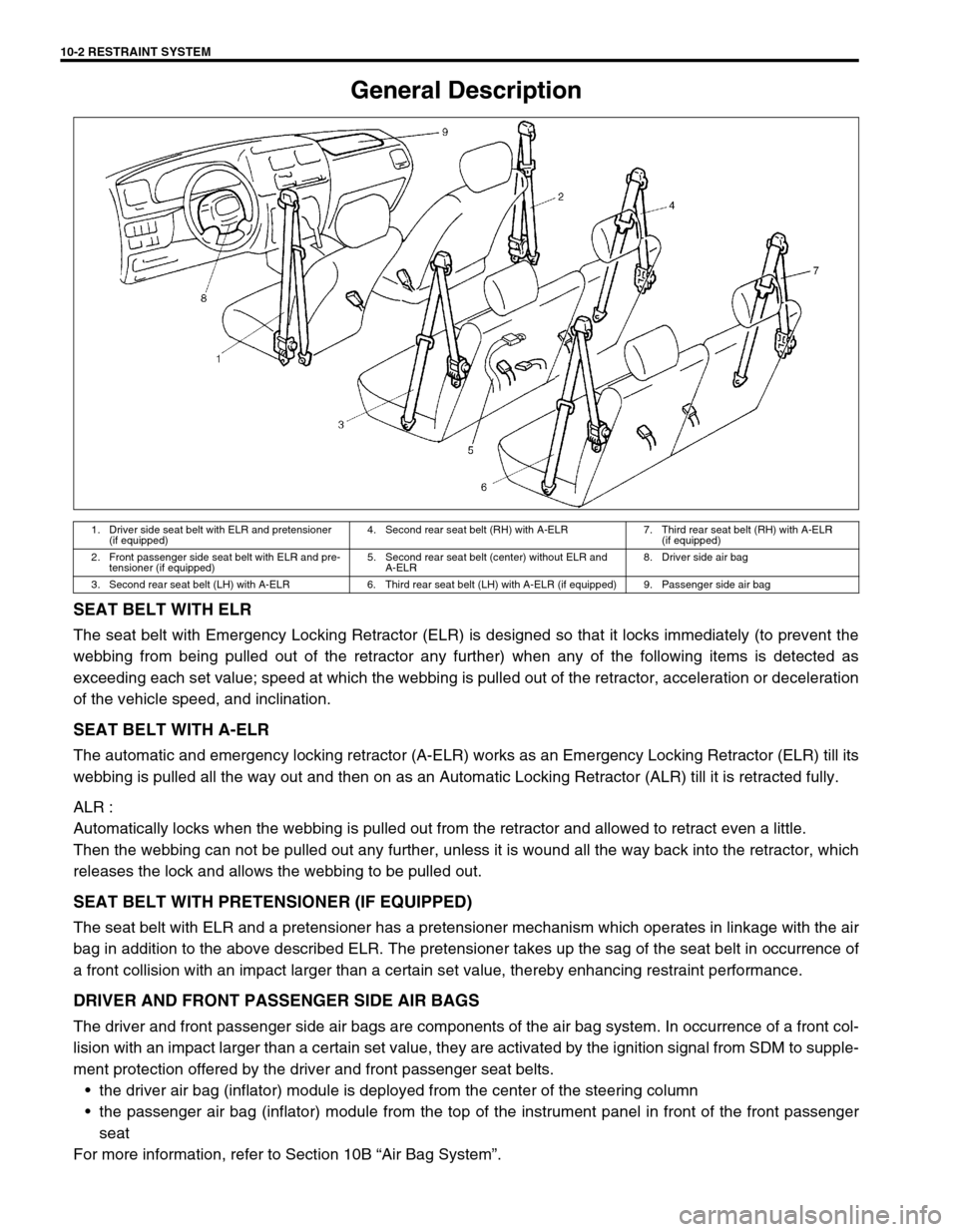
SEAT BELT WITH ELR
The seat belt with Emergency Locking Retractor (ELR) is designed so that it locks immediately (to prevent the
webbing from being pulled out of the retractor any further) when any of the following items is detected as
exceeding each set value; speed at which the webbing is pulled out of the retractor, acceleration or deceleration
of the vehicle speed, and inclination.
SEAT BELT WITH A-ELR
The automatic and emergency locking retractor (A-ELR) works as an Emergency Locking Retractor (ELR) till its
webbing is pulled all the way out and then on as an Automatic Locking Retractor (ALR) till it is retracted fully.
ALR :
Automatically locks when the webbing is pulled out from the retractor and allowed to retract even a little.
Then the webbing can not be pulled out any further, unless it is wound all the way back into the retractor, which
releases the lock and allows the webbing to be pulled out.
SEAT BELT WITH PRETENSIONER (IF EQUIPPED)
The seat belt with ELR and a pretensioner has a pretensioner mechanism which operates in linkage with the air
bag in addition to the above described ELR. The pretensioner takes up the sag of the seat belt in occurrence of
a front collision with an impact larger than a certain set value, thereby enhancing restraint performance.
DRIVER AND FRONT PASSENGER SIDE AIR BAGS
The driver and front passenger side air bags are components of the air bag system. In occurrence of a front col-
lision with an impact larger than a certain set value, they are activated by the ignition signal from SDM to supple-
ment protection offered by the driver and front passenger seat belts.
•the driver air bag (inflator) module is deployed from the center of the steering column
•the passenger air bag (inflator) module from the top of the instrument panel in front of the front passenger
seat
For more information, refer to Section 10B “Air Bag System”.
1. Driver side seat belt with ELR and pretensioner
(if equipped) 4. Second rear seat belt (RH) with A-ELR 7. Third rear seat belt (RH) with A-ELR
(if equipped)
2. Front passenger side seat belt with ELR and pre-
tensioner (if equipped) 5. Second rear seat belt (center) without ELR and
A-ELR8. Driver side air bag
3. Second rear seat belt (LH) with A-ELR 6. Third rear seat belt (LH) with A-ELR (if equipped) 9. Passenger side air bag
Page 570 of 656
SEAT BELT 10A-1
10A
SECTION 10A
SEAT BELT
CONTENTS
On-Vehicle Service....................................... 10A-2
Service Precautions ................................... 10A-2
Service and diagnosis ............................ 10A-2
Disabling air bag system ........................ 10A-2
Enabling air bag system ......................... 10A-2
Handling and storage ............................. 10A-2Disposal ................................................. 10A-2
Front Seat Belt ........................................... 10A-3
Second Rear Seat Belt .............................. 10A-6
Third Rear Seat Belt (If Equipped) ............. 10A-7
Tightening Torque Specification ................ 10A-8
WARNING:
For vehicles equipped with Supplemental Restraint (Air Bag) System:
Service on and around the air bag system components or wiring must be performed only by an
authorized SUZUKI dealer. Refer to “Air Bag System Components and Wiring Location View” under
“General Description” in air bag system section in order to confirm whether you are performing ser-
vice on or near the air bag system components or wiring. Please observe all WARNINGS and “Ser-
vice Precautions” under “On-Vehicle Service” in air bag system section before performing service
on or around the air bag system components or wiring. Failure to follow WARNINGS could result in
unintentional activation of the system or could render the system inoperative. Either of these two
conditions may result in severe injury.
Technical service work must be started at least 90 seconds after the ignition switch is turned to the
“LOCK” position and the negative cable is disconnected from the battery. Otherwise, the system
may be activated by reserve energy in the Sensing and Diagnostic Module (SDM).
CAUTION:
When fasteners are removed, always reinstall them at the same location from which they were
removed. If a fastener needs to be replaced, use the correct part number fastener for that application.
If the correct part number fastener is not available, a fastener of equal size and strength (or stronger)
may be used. Fasteners that are not reused, and those requiring thread-locking compound, will be
called out. The correct torque value must be used when installing fasteners that require it. If the above
procedures are not followed, parts or system damage could result.
Page 571 of 656
10A-2 SEAT BELT
On-Vehicle Service
Service Precautions
Service and diagnosis
Before servicing or replacing seat belts, refer to following precautionary items.
•Seat belts should be normal relative to strap retractor and buckle portions.
•Keep sharp edges and damaging objects away from belts. Avoid bending or damaging any portion of belt
buckle, latch plate and ELR.
•Do not bleach or dye belt webbing. (Use only mild soap and lukewarm water to clean it.)
•When installing a seat belt anchor bolt, start bolt by hand to prevent cross-threading.
•Use only the correct seat belt anchor bolts and screws and tighten to the correct torque value.
•Do not attempt any repairs on retractor mechanisms or retractor covers. Replace defective assemblies with
new replacement parts.
•Keep belts dry and clean at all times.
•If there exist any parts in question, replace such parts.
•Replace belts whose webbing is cut or otherwise damaged.
•Do not put anything into trim panel opening which seat belt webbing passes through.
For Seat Belt with Pretensioner
Refer to “SERVICE AND DIAGNOSIS” of “SERVICE PRECAUTIONS” under “ON-VEHICLE SERVICE” in Sec-
tion 10B.
Disabling air bag system
Refer to “DISABLING AIR BAG SYSTEM” of “SERVICE PRECAUTIONS” under “ON-VEHICLE SERVICE” in
Section 10B.
Enabling air bag system
Refer to “ENABLING AIR BAG SYSTEM” of “SERVICE PRECAUTIONS” under “ON-VEHICLE SERVICE” in
Section 10B.
Handling and storage
Refer to “HANDLING AND STORAGE” of “SERVICE PRECAUTIONS” under “ON-VEHICLE SERVICE” in Sec-
tion 10B.
Disposal
Refer to “DISPOSAL” of “SERVICE PRECAUTIONS” under “ON-VEHICLE SERVICE” in Section 10B. WARNING:
If replacing seat belt is necessary, replace buckle and ELR (or webbing) together as a set. This is for
the reason of ensuring locking of tongue plate with buckle. If these parts are replaced individually,
such a locking condition may become unreliable. For this reason, SUZUKI will supply only the spare
buckle and ELR (or webbing) in a set part.
WARNING:
When performing service on or around air bag system components or air bag system wiring, disable
the air bag system. Refer to “DISABLING AIR BAG SYSTEM” of “SERVICE PRECAUTIONS” under
“ON-VEHICLE SERVICE” in Section 10B.
Failure to follow procedures could result in possible air bag activation, personal injury or unneeded
air bag system repairs.
Page 573 of 656
10A-4 SEAT BELT
REMOVAL
1) Disconnect negative cable at battery.
2) Disable air bag system referring to “DISABLING AIR BAG SYSTEM” of “SERVICE PRECAUTIONS” under
“ON-VEHICLE SERVICE” in Section 10B, if necessary.
3) Remove front pillar lower trim.
4) Disconnect Yellow connector for seat belt pretensioner, if necessary.
a) Release locking of lock lever.
b) After unlocking, disconnect to connector.
5) Remove front seat belts from the vehicle.
INSPECTION
Seat belts and attaching parts can affect the vital components and systems of a vehicle. Therefore, they should
be inspected carefully and replaced with genuine parts only.
Seat belt
•The seat belt webbing or strap should be free from damage.
•Fully extend the seat belt to make sure there are no twists or tears in it.
Retractor assembly
1) Let the seat belt retract fully to confirm its easy retraction.
•The retractor assembly should lock webbing when pulled quickly.
•The retractor assembly should lock webbing even when tilted (approx. 15°) toward the fore and aft or right
and left directions.
2) Check retractor assembly with seat belt pretensioner appearance visually for following symptoms and if any
one of them is applicable, replace it with a new one as an assembly.
•Pretensioner has activated.
•There is a crack in seat belt pretensioner (retractor assembly).
•Wire harness or connector is damage.
•Seat belt pretensioner (retractor assembly) is damaged or a strong impact (e.g., dropping) was applied to it.
Anchor bolt
•Inspect all seat belt anchor bolts to verify that they are secure.
•All anchor bolts should be secure and torqued to specification.
Belt latch
•Belt latch should be secure when latched.
•Inspect the seat belt buckle, ensuring that it locks and unlocks easily.
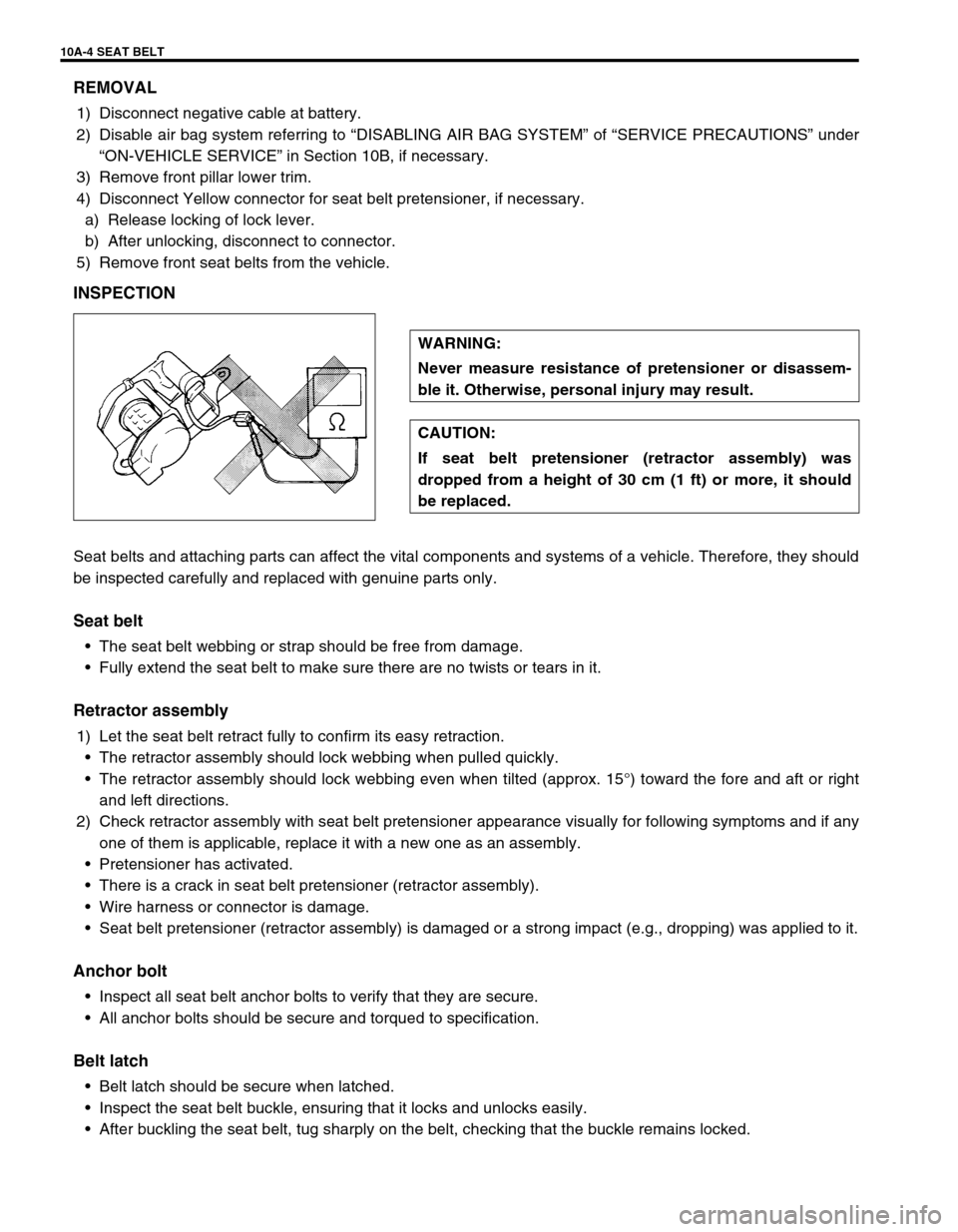
•After buckling the seat belt, tug sharply on the belt, checking that the buckle remains locked.WARNING:
Never measure resistance of pretensioner or disassem-
ble it. Otherwise, personal injury may result.
CAUTION:
If seat belt pretensioner (retractor assembly) was
dropped from a height of 30 cm (1 ft) or more, it should
be replaced.