Section 8a SUZUKI GRAND VITARA 2001 2.G Owners Manual
[x] Cancel search | Manufacturer: SUZUKI, Model Year: 2001, Model line: GRAND VITARA, Model: SUZUKI GRAND VITARA 2001 2.GPages: 656, PDF Size: 14.31 MB
Page 574 of 656
SEAT BELT 10A-5
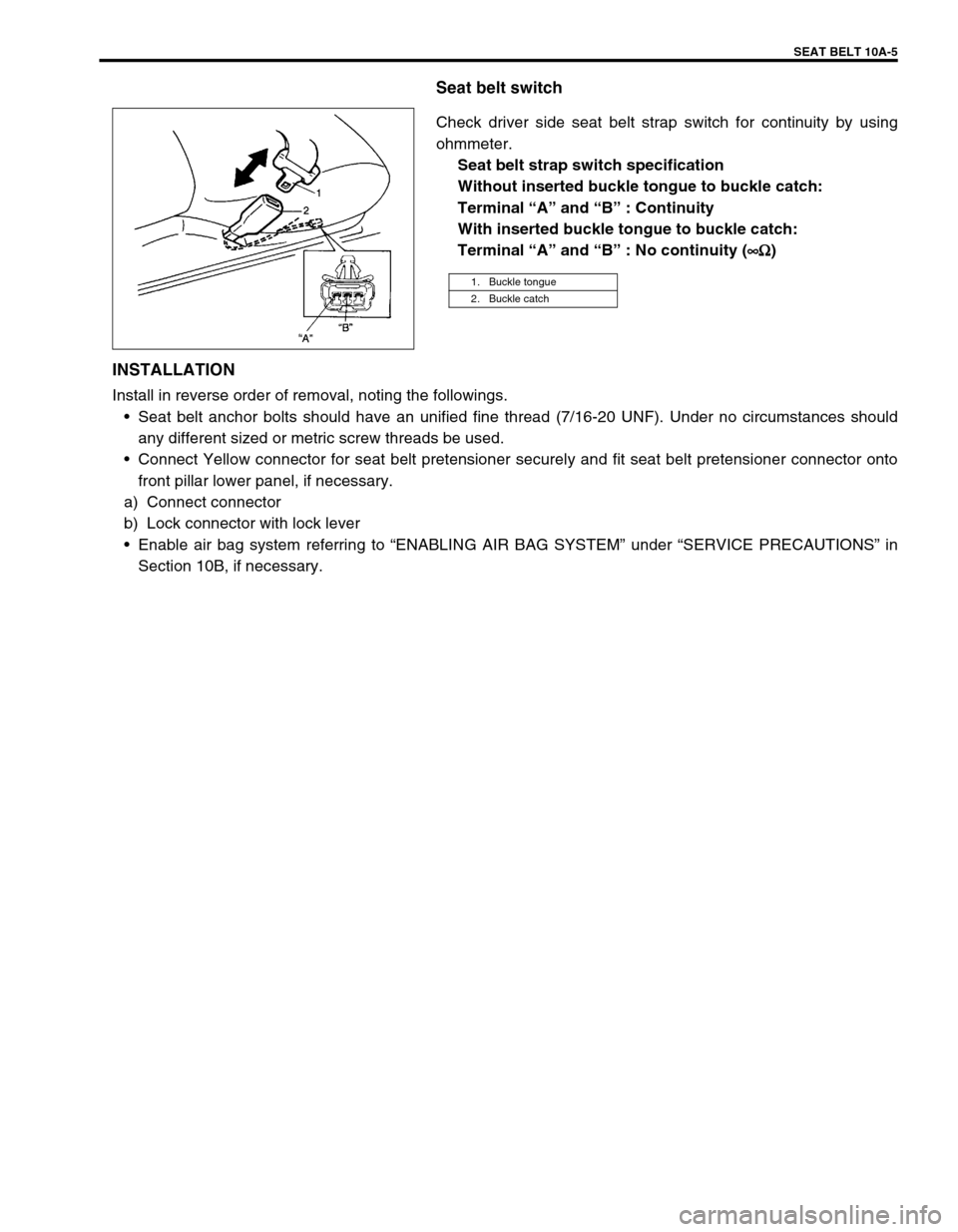
Seat belt switch
Check driver side seat belt strap switch for continuity by using
ohmmeter.
Seat belt strap switch specification
Without inserted buckle tongue to buckle catch:
Terminal “A” and “B” : Continuity
With inserted buckle tongue to buckle catch:
Terminal “A” and “B” : No continuity (∞Ω
∞Ω∞Ω ∞Ω)
INSTALLATION
Install in reverse order of removal, noting the followings.
•Seat belt anchor bolts should have an unified fine thread (7/16-20 UNF). Under no circumstances should
any different sized or metric screw threads be used.
•Connect Yellow connector for seat belt pretensioner securely and fit seat belt pretensioner connector onto
front pillar lower panel, if necessary.
a) Connect connector
b) Lock connector with lock lever
•Enable air bag system referring to “ENABLING AIR BAG SYSTEM” under “SERVICE PRECAUTIONS” in
Section 10B, if necessary.
1. Buckle tongue
2. Buckle catch
Page 575 of 656
10A-6 SEAT BELT
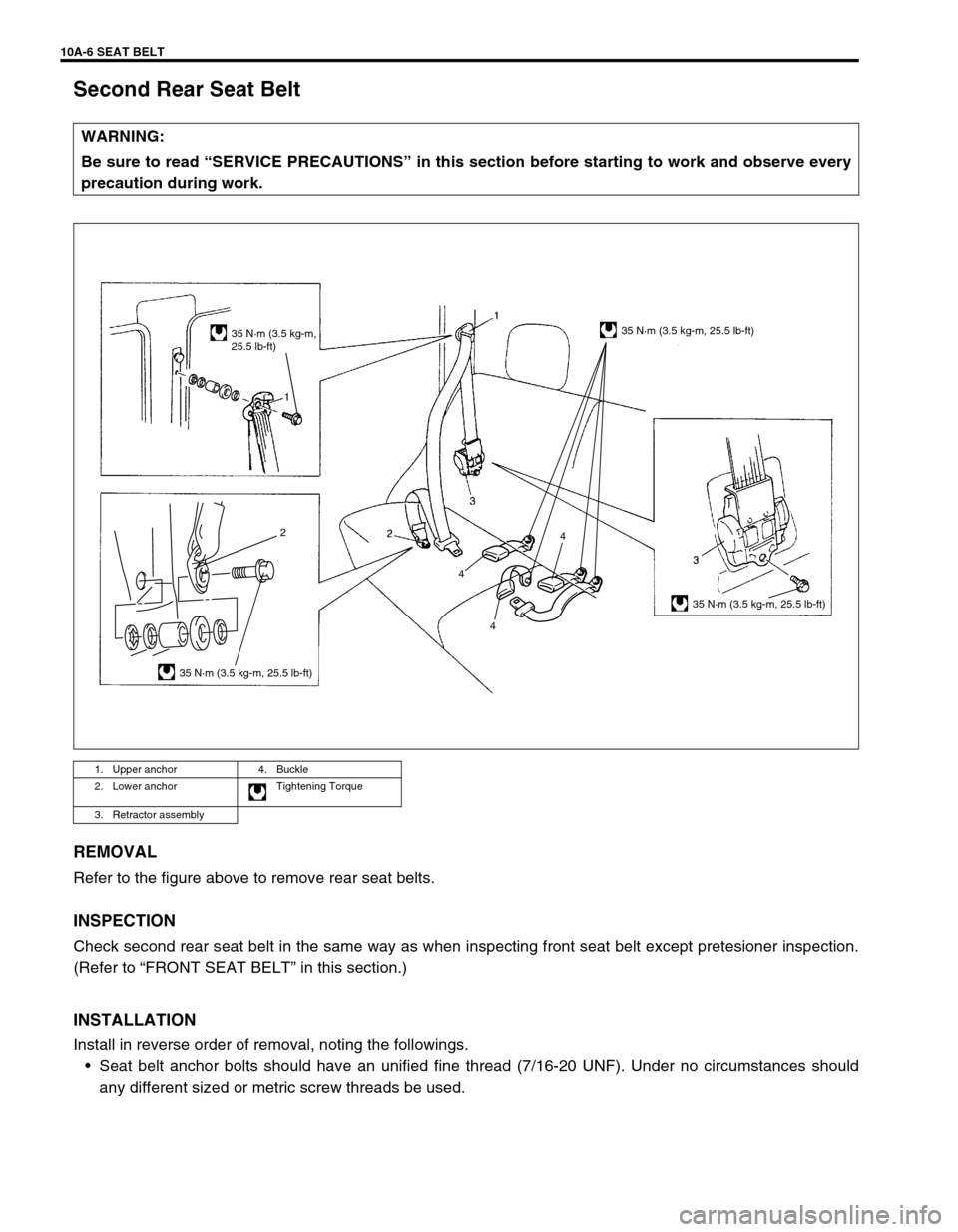
Second Rear Seat Belt
REMOVAL
Refer to the figure above to remove rear seat belts.
INSPECTION
Check second rear seat belt in the same way as when inspecting front seat belt except pretesioner inspection.
(Refer to “FRONT SEAT BELT” in this section.)
INSTALLATION
Install in reverse order of removal, noting the followings.
•Seat belt anchor bolts should have an unified fine thread (7/16-20 UNF). Under no circumstances should
any different sized or metric screw threads be used. WARNING:
Be sure to read “SERVICE PRECAUTIONS” in this section before starting to work and observe every
precaution during work.
1. Upper anchor 4. Buckle
2. Lower anchor Tightening Torque
3. Retractor assembly
2
35 N·m (3.5 kg-m, 25.5 lb-ft)
35 N·m (3.5 kg-m, 25.5 lb-ft)
35 N·m (3.5 kg-m, 25.5 lb-ft)
35 N·m (3.5 kg-m,
25.5 lb-ft)
4
4
4
Page 576 of 656
SEAT BELT 10A-7
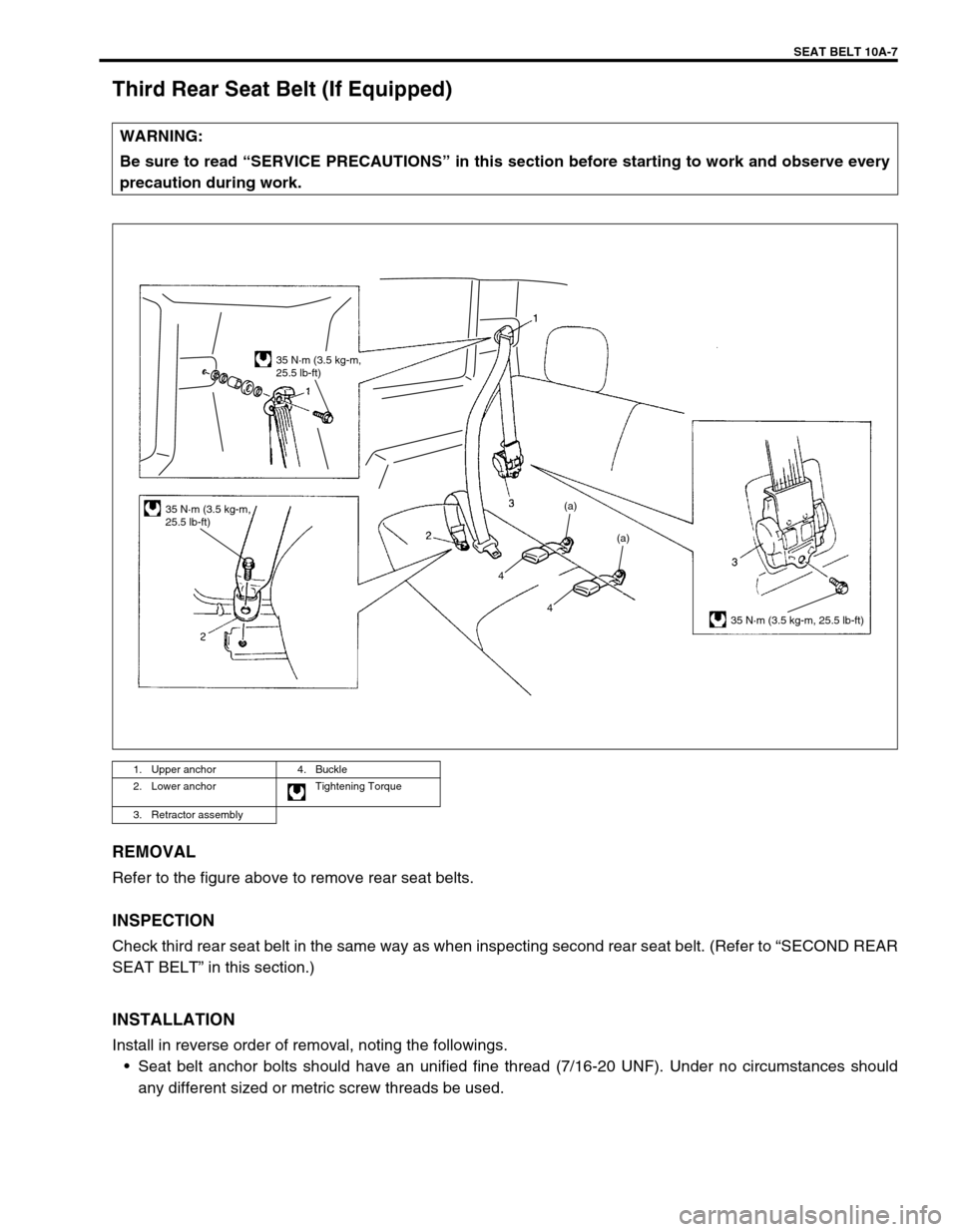
Third Rear Seat Belt (If Equipped)
REMOVAL
Refer to the figure above to remove rear seat belts.
INSPECTION
Check third rear seat belt in the same way as when inspecting second rear seat belt. (Refer to “SECOND REAR
SEAT BELT” in this section.)
INSTALLATION
Install in reverse order of removal, noting the followings.
•Seat belt anchor bolts should have an unified fine thread (7/16-20 UNF). Under no circumstances should
any different sized or metric screw threads be used. WARNING:
Be sure to read “SERVICE PRECAUTIONS” in this section before starting to work and observe every
precaution during work.
1. Upper anchor 4. Buckle
2. Lower anchor Tightening Torque
3. Retractor assembly
35 N·m (3.5 kg-m,
25.5 lb-ft)
35 N·m (3.5 kg-m,
25.5 lb-ft)
35 N·m (3.5 kg-m, 25.5 lb-ft)
4
4
(a)
(a)
Page 578 of 656
AIR BAG SYSTEM 10B-1
10B
SECTION 10B
AIR BAG SYSTEM
CONTENTS
General Description ......................................10B-3
System Components and Wiring Location
View and Connectors .................................. 10B-4
System Wiring Diagram............................... 10B-5
Diagnosis .......................................................10B-6
Diagnostic Trouble Code (DTC) .................. 10B-6
Use of Special Tool ..................................... 10B-6
Intermittents and Poor Connections ............ 10B-8
Air Bag Diagnostic System Check............... 10B-9
Air Bag Diagnostic System Check Flow
Table ......................................................... 10B-10
DTC Check ................................................ 10B-11
DTC Clearance ......................................... 10B-12
DTC Table ................................................. 10B-14
Table A - “AIR BAG” Warning Lamp
Comes ON Steady .................................... 10B-16
Table B - “AIR BAG” Warning Lamp Does
Not Come ON ............................................ 10B-16
Table C - “AIR BAG” Warning Lamp
Flashes ...................................................... 10B-16Table D - “AIR BAG” Warning Lamp
Cannot Indicate Flashing Pattern of DTC . 10B-16
Table E - SDM Cannot Communicate
through The Serial Data Circuit................. 10B-21
DTC B1015 - Passenger Air Bag Initiator
Circuit Resistance High............................. 10B-23
DTC B1016 - Passenger Air Bag Initiator
Circuit Resistance Low ............................. 10B-23
DTC B1018 - Passenger Air Bag Initiator
Circuit Short to Ground ............................. 10B-23
DTC B1019 - Passenger Air Bag Initiator
Circuit Short to Power Circuit .................... 10B-23
DTC B1021 – Driver Air Bag Initiator
Circuit Resistance High............................. 10B-28
DTC B1022 – Driver Air Bag Initiator
Circuit Resistance Low ............................. 10B-28
DTC B1024 – Driver Air Bag Initiator
Circuit Short to Ground ............................. 10B-28
DTC B1025 – Driver Air Bag Initiator
Circuit Short to Power Circuit .................... 10B-28 WARNING:
Service on or around the air bag system components or wiring must be performed only by an
authorized SUZUKI dealer. Please observe all WARNINGS and “Service Precautions” under “On-
Vehicle Service” in this section before performing service on or around the air bag system compo-
nents or wiring. Failure to follow WARNINGS could result in unintended activation of the system or
could render the system inoperative. Either of these two conditions may result in severe injury.
The procedures in this section must be followed in the order listed to disable the air bag system
temporarily and prevent false diagnostic trouble codes from setting. Failure to follow procedures
could result in possible activation of the air bag system, personal injury or otherwise unneeded air
bag system repairs.
CAUTION:
When fasteners are removed, always reinstall them at the same location from which they were
removed. If a fastener needs to be replaced, use the correct part number fastener for that application.
If the correct part number fastener is not available, a fastener of equal size and strength (or stronger)
may be used. Fasteners that are not reused, and those requiring thread-locking compound, will be
called out. The correct torque value must be used when installing fasteners that require it. If the above
conditions are not followed, parts or system damage could result.
NOTE:
For the descriptions (items) not found in this section, refer to the same section of the Service Manual
mentioned in the FOREWORD of this manual.
Page 583 of 656
10B-6 AIR BAG SYSTEM
Diagnosis
Diagnostic Trouble Code (DTC)
The AIR BAG DIAGNOSTIC SYSTEM CHECK must always be the starting point of any air bag system diagno-
sis. The AIR BAG DIAGNOSTIC SYSTEM CHECK checks for proper “AIR BAG” warning lamp operation and
checks for air bag diagnostic trouble codes (DTCs) using on-board diagnosis function or SUZUKI scan tool.
Use of Special Tool
You should be familiar with the tools listed in this section under the heading SPECIAL TOOLS. You should be
able to measure voltage and resistance. You should be familiar with proper use of a scan tool such as Air Bag
Driver/Passenger Load Tool, Connector Test Adapter Kit and the Digital Multimeter.
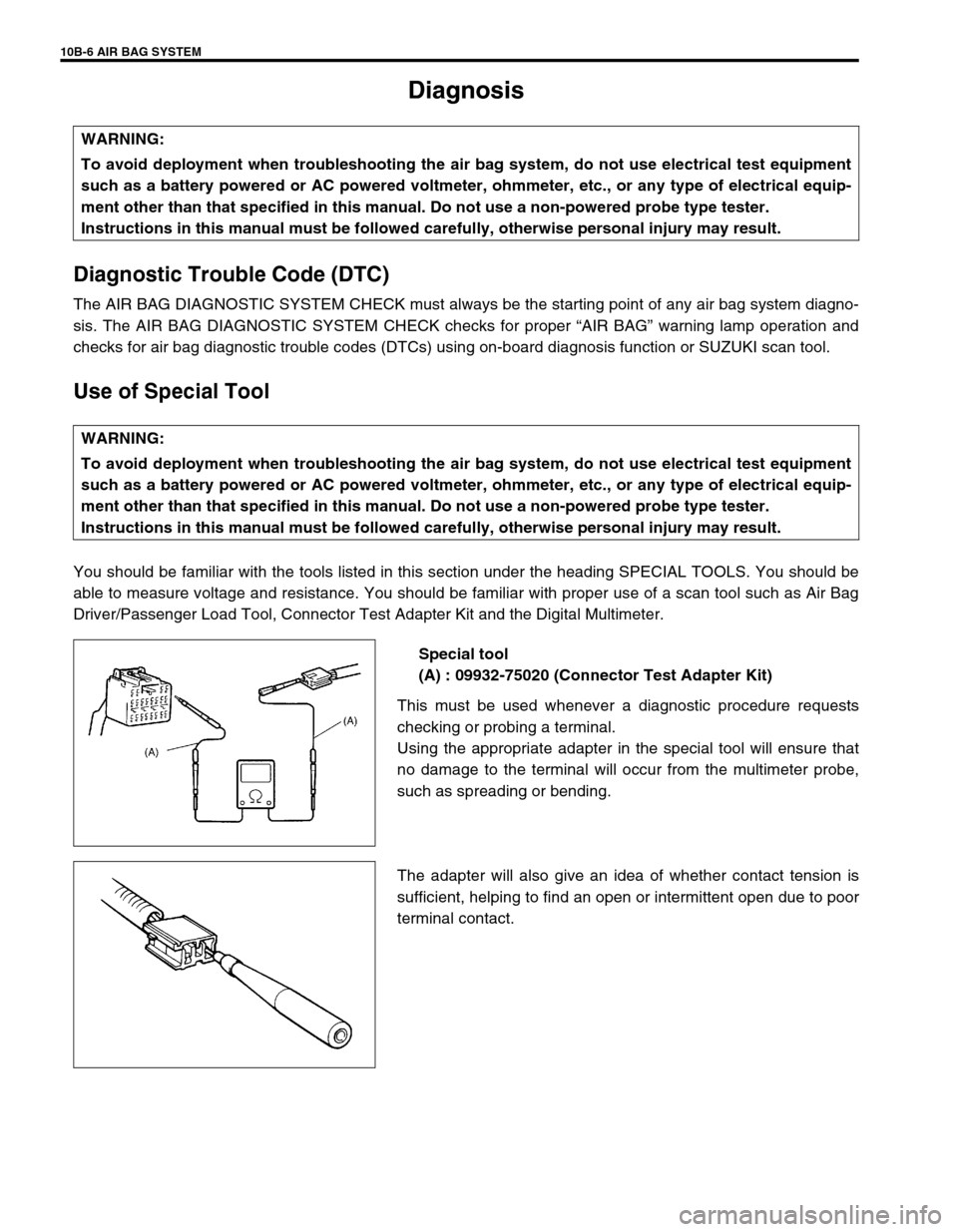
Special tool
(A) : 09932-75020 (Connector Test Adapter Kit)
This must be used whenever a diagnostic procedure requests
checking or probing a terminal.
Using the appropriate adapter in the special tool will ensure that
no damage to the terminal will occur from the multimeter probe,
such as spreading or bending.
The adapter will also give an idea of whether contact tension is
sufficient, helping to find an open or intermittent open due to poor
terminal contact. WARNING:
To avoid deployment when troubleshooting the air bag system, do not use electrical test equipment
such as a battery powered or AC powered voltmeter, ohmmeter, etc., or any type of electrical equip-
ment other than that specified in this manual. Do not use a non-powered probe type tester.
Instructions in this manual must be followed carefully, otherwise personal injury may result.
WARNING:
To avoid deployment when troubleshooting the air bag system, do not use electrical test equipment
such as a battery powered or AC powered voltmeter, ohmmeter, etc., or any type of electrical equip-
ment other than that specified in this manual. Do not use a non-powered probe type tester.
Instructions in this manual must be followed carefully, otherwise personal injury may result.
Page 584 of 656

AIR BAG SYSTEM 10B-7
Special tool
(B) : 09932-75010 (Air Bag Driver/Passenger Load Tool)
This tool is used only when called for in this section. It is used as
a diagnostic aid and safety device to prevent inadvertent air bag
(inflator) module deployment.
The load tool has three connectors attached to its case which are
electrically functional and serve as resistive load substitutions.
No more than two connectors are used at any time.
One of connectors (“STEERING WHEEL”) is used to substitute
the load of followings.
•Driver air bag (inflator) module when it is connected at the
top of the column to the contact coil assembly.
•Passenger air bag (inflator) module when it is connected to
the air bag harness connector for passenger air bag (inflator)
module.
•Each of driver and passenger seat belt pretensioners when it
is connected to air bag harness connector for driver and pas-
senger seat belt pretensioner (if equipped).
Another connector (“BASE OF COLUMN”) is used to substitute
the load of the driver air bag (inflator) module and the contact coil
assembly when it is connected at the base of the column to the air
bag wire harness.
The third connector (“PASSENGER INFLATOR”) is not used.
By substituting the resistance of the load tool when called for, a
determination can be made as to whether an inflator circuit com-
ponent is causing system malfunction and which component is
causing the malfunction.
The load tool should be used only when specifically called for in
the diagnostic procedures.
1. Connector for contact coil and driver air bag (inflator) module
(Located near the base of the steering column)
2. Connector for driver, passenger air bag (inflator) module and driver and
passenger seat belt pretensioners
3. Not used
Page 586 of 656
AIR BAG SYSTEM 10B-9
Air Bag Diagnostic System Check
The diagnostic procedures used in this section are designed to find and repair air bag system malfunctions.
To get the best results, it is important to use the diagnostic flow tables and follow the sequence listed below.
1) Perform the AIR BAG DIAGNOSTIC SYSTEM CHECK FLOW TABLE.
(The AIR BAG DIAGNOSTIC SYSTEM CHECK FLOW TABLE must be the starting point of any air bag sys-
tem diagnosis.
The AIR BAG DIAGNOSTIC SYSTEM CHECK FLOW TABLE checks for proper “AIR BAG” warning lamp
operation through “AIR BAG” warning lamp and whether air bag diagnostic trouble codes exist.)
2) Refer to the proper diagnostic table as directed by the AIR BAG DIAGNOSTIC SYSTEM CHECK FLOW
TABLE.
(The AIR BAG DIAGNOSTIC SYSTEM CHECK FLOW TABLE will lead you to the correct table to diagnose
any air bag system malfunctions. Bypassing these procedures may result in extended diagnostic time, incor-
rect diagnosis and incorrect parts replacement.)
3) Repeat the AIR BAG DIAGNOSTIC SYSTEM CHECK FLOW TABLE after any repair or diagnostic proce-
dures have been performed.
(Performing the AIR BAG DIAGNOSTIC SYSTEM CHECK FLOW TABLE after all repair or diagnostic pro-
cedures will ensure that the repair has been made correctly and that no other malfunctions exist.)
FLOW TABLE TEST DESCRIPTION
STEP 1 : Check that “AIR BAG” warning lamp lights.
STEP 2 : Check that “AIR BAG” warning lamp lights.
STEP 3 : Check diagnosis switch circuit.
STEP 4 : Check that “AIR BAG” warning lamp flashes 6 times after ignition switch is turned ON.
STEP 6 : Check that history codes are in SDM memory. (using SUZUKI scan tool)
STEP 7 : Check that history codes are in SDM memory. (using monitor coupler)
STEP 9 : Check that current code is in SDM memory. (using SUZUKI scan tool)
STEP 10 : Check that current code is in SDM memory. (using monitor coupler)WARNING:
To avoid deployment when troubleshooting the air bag system, do not use electrical test equipment
such as a battery powered or AC powered voltmeter, ohmmeter, etc., or any type of electrical equip-
ment other than that specified in this manual. Do not use a non-powered probe type tester.
Instructions in this manual must be followed carefully, otherwise personal injury may result.
CAUTION:
The order in which diagnostic trouble codes are diagnosed is very important. Failure to diagnose the
diagnostic trouble codes in the order specified may result in extended diagnostic time, incorrect diag-
nosis and incorrect parts replacement.
Page 593 of 656
10B-16 AIR BAG SYSTEM
Table A - “AIR BAG” Warning Lamp Comes ON Steady
Table B - “AIR BAG” Warning Lamp Does Not Come ON
Table C - “AIR BAG” Warning Lamp Flashes
Table D - “AIR BAG” Warning Lamp Cannot Indicate Flashing Pattern of DTC
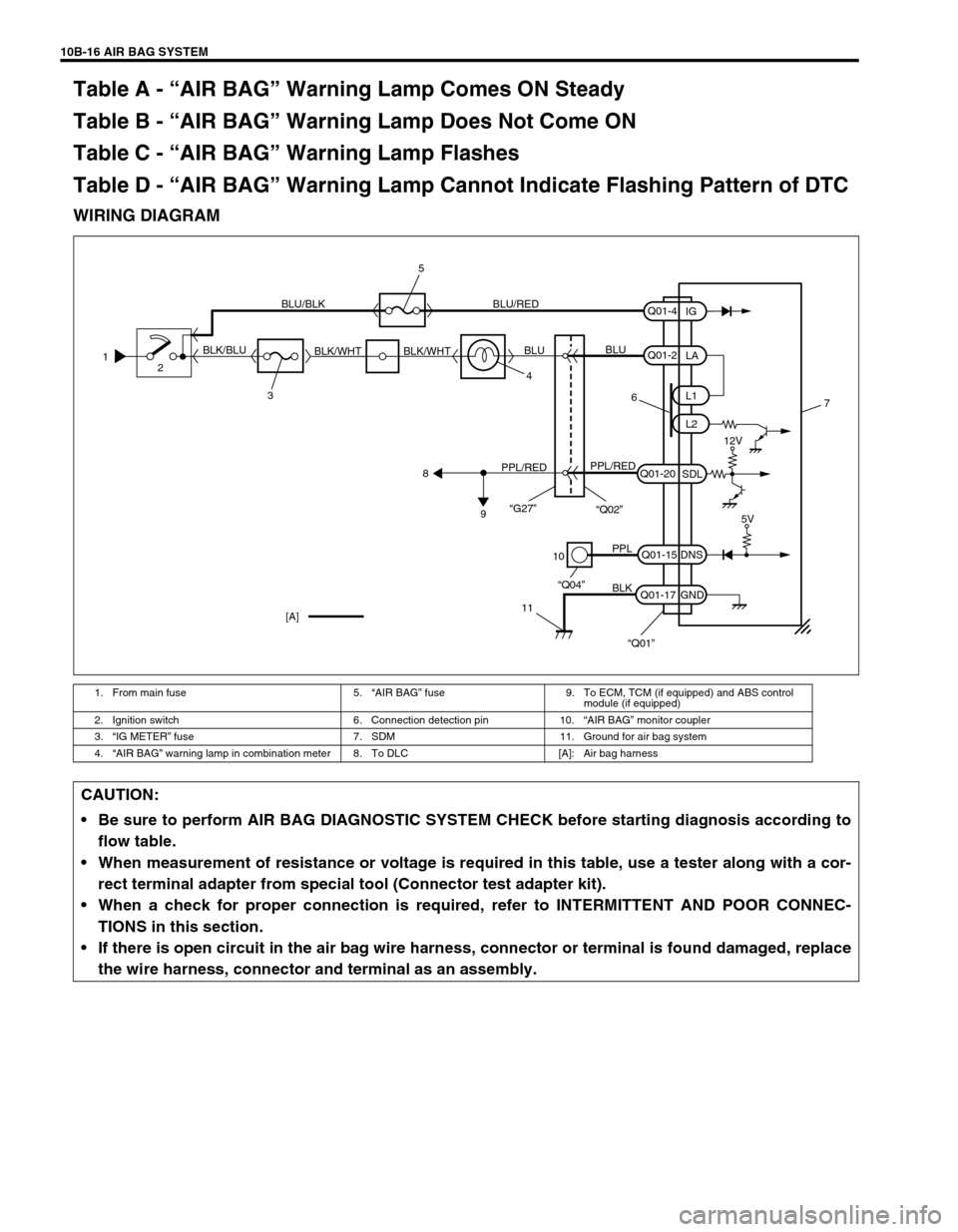
WIRING DIAGRAM
1. From main fuse 5.“AIR BAG” fuse 9. To ECM, TCM (if equipped) and ABS control
module (if equipped)
2. Ignition switch 6. Connection detection pin 10.“AIR BAG” monitor coupler
3.“IG METER” fuse 7. SDM 11. Ground for air bag system
4.“AIR BAG” warning lamp in combination meter 8. To DLC [A]: Air bag harness
1
2
34 BLK/BLUBLU/BLK BLU/RED
BLK/WHT BLK/WHTBLUBLU
6
PPL/REDPPL/RED
8
9
10
11
PPL
BLK
“Q04”
“Q01”
Q01-2
Q01-20
Q01-15
Q01-17L1
L2
SDL
DNS
GNDLA
Q01-4
IG
7
[A]
12V
5V
“G27”“Q02”
5
CAUTION:
Be sure to perform AIR BAG DIAGNOSTIC SYSTEM CHECK before starting diagnosis according to
flow table.
When measurement of resistance or voltage is required in this table, use a tester along with a cor-
rect terminal adapter from special tool (Connector test adapter kit).
When a check for proper connection is required, refer to INTERMITTENT AND POOR CONNEC-
TIONS in this section.
If there is open circuit in the air bag wire harness, connector or terminal is found damaged, replace
the wire harness, connector and terminal as an assembly.
Page 594 of 656
AIR BAG SYSTEM 10B-17
TABLE TEST DESCRIPTION
Table A :
STEP 1 : Check “AIR BAG” fuse.
STEP 2 : Check power source circuit.
STEP 3 : Check “AIR BAG” warning lamp circuit.
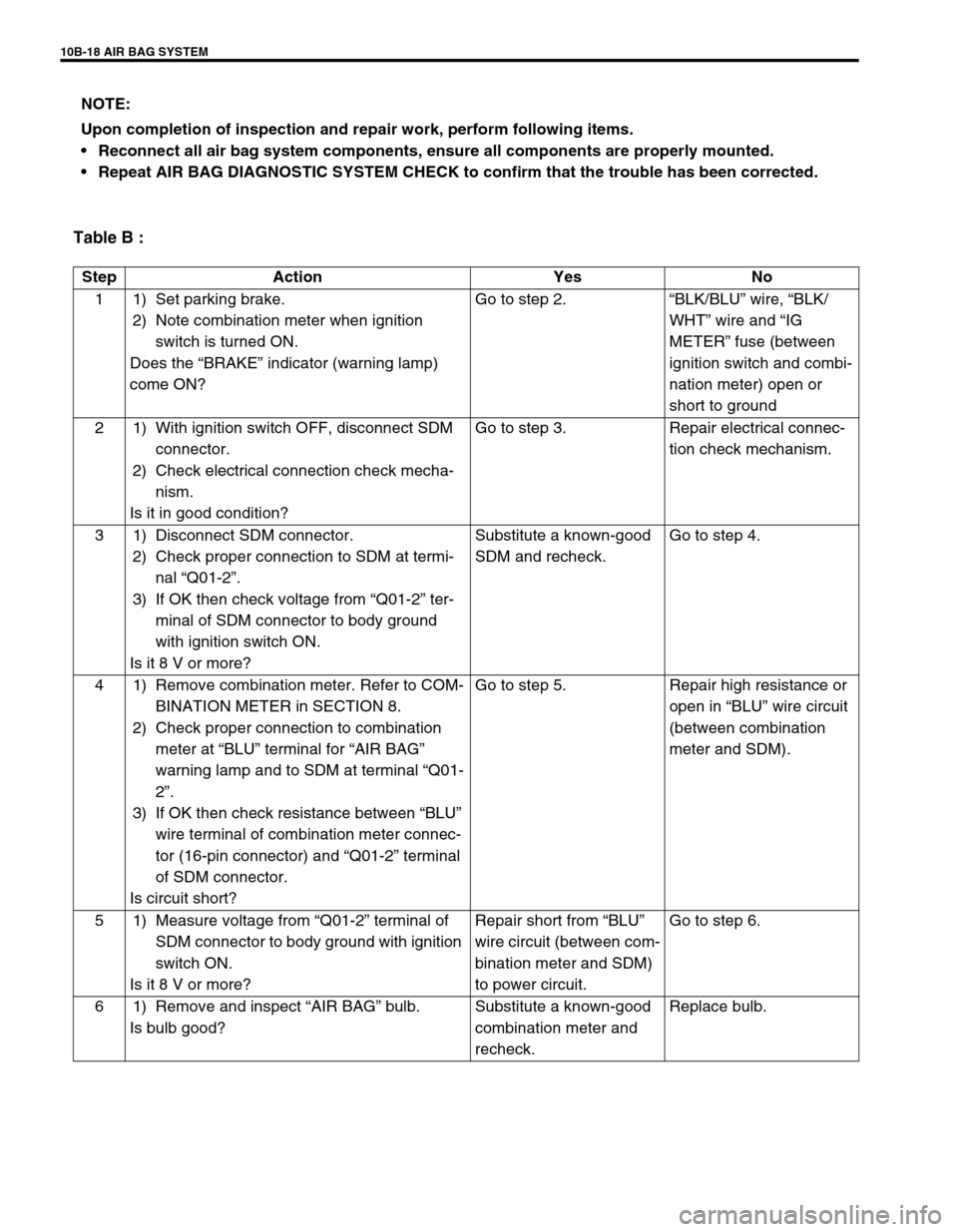
Table B :
STEP 1 : Check combination meter power feed circuit.
STEP 2 : Check electrical connection check mechanism in SDM connector.
STEP 3 : Check “AIR BAG” warning lamp circuit.
STEP 4 : Check open in “AIR BAG” warning lamp circuit.
STEP 5 : Check short from “AIR BAG” warning lamp circuit to power circuit.
STEP 6 : Check “AIR BAG” bulb.
Table C and D :
STEP 1 : Check “AIR BAG” monitor coupler.
STEP 2 : Check diagnosis switch circuit for air bag system.
DIAGNOSTIC FLOW TABLE
Table A :
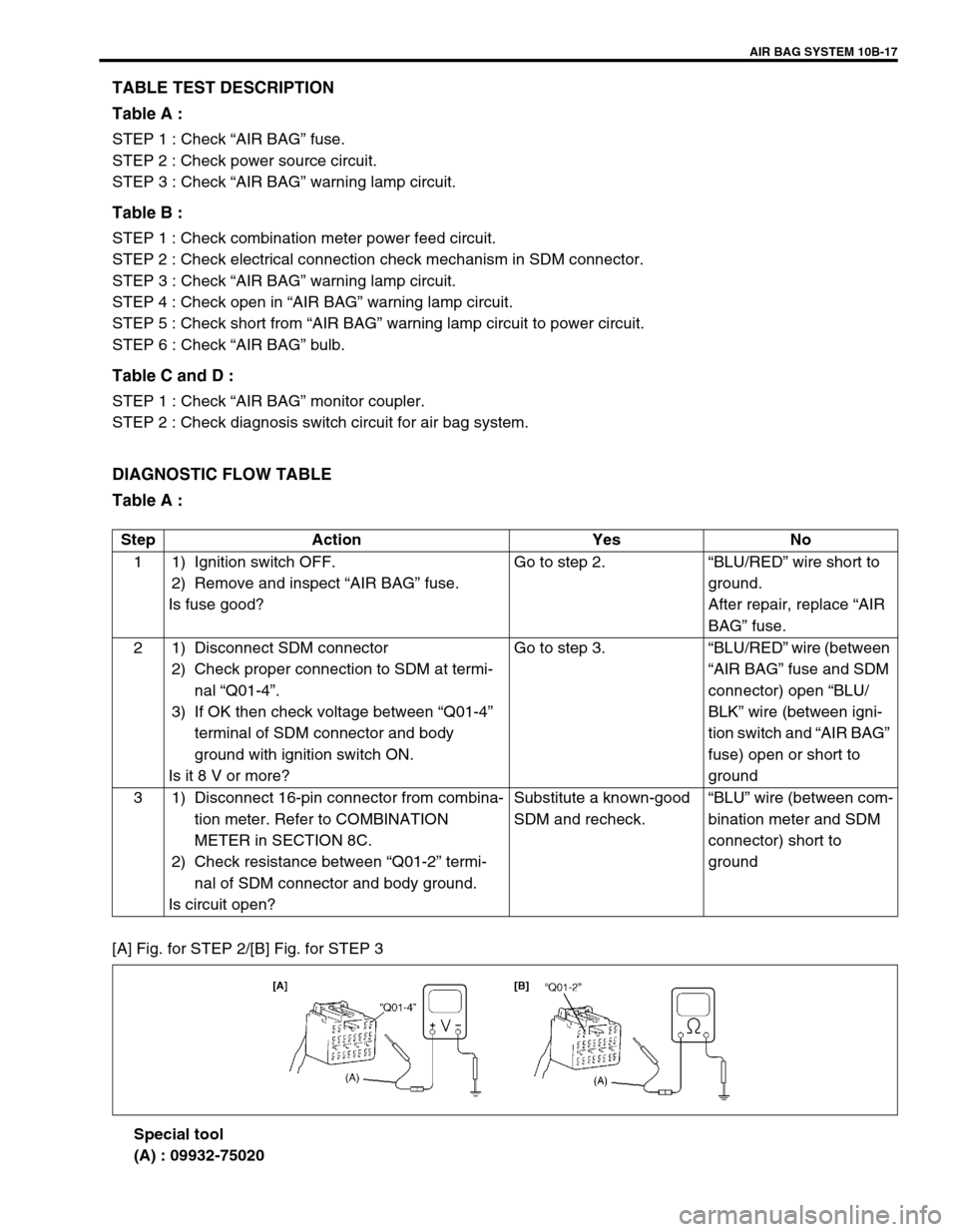
[A] Fig. for STEP 2/[B] Fig. for STEP 3
Special tool
(A) : 09932-75020 Step Action Yes No
1 1) Ignition switch OFF.
2) Remove and inspect “AIR BAG” fuse.
Is fuse good?Go to step 2.“BLU/RED” wire short to
ground.
After repair, replace “AIR
BAG” fuse.
2 1) Disconnect SDM connector
2) Check proper connection to SDM at termi-
nal “Q01-4”.
3) If OK then check voltage between “Q01-4”
terminal of SDM connector and body
ground with ignition switch ON.
Is it 8 V or more?Go to step 3.“BLU/RED” wire (between
“AIR BAG” fuse and SDM
connector) open “BLU/
BLK” wire (between igni-
tion switch and “AIR BAG”
fuse) open or short to
ground
3 1) Disconnect 16-pin connector from combina-
tion meter. Refer to COMBINATION
METER in SECTION 8C.
2) Check resistance between “Q01-2” termi-
nal of SDM connector and body ground.
Is circuit open?Substitute a known-good
SDM and recheck.“BLU” wire (between com-
bination meter and SDM
connector) short to
ground
Page 595 of 656
10B-18 AIR BAG SYSTEM
Table B :
NOTE:
Upon completion of inspection and repair work, perform following items.
Reconnect all air bag system components, ensure all components are properly mounted.
Repeat AIR BAG DIAGNOSTIC SYSTEM CHECK to confirm that the trouble has been corrected.
Step Action Yes No
1 1) Set parking brake.
2) Note combination meter when ignition
switch is turned ON.
Does the “BRAKE” indicator (warning lamp)
come ON?Go to step 2.“BLK/BLU” wire, “BLK/
WHT” wire and “IG
METER” fuse (between
ignition switch and combi-
nation meter) open or
short to ground
2 1) With ignition switch OFF, disconnect SDM
connector.
2) Check electrical connection check mecha-
nism.
Is it in good condition?Go to step 3. Repair electrical connec-
tion check mechanism.
3 1) Disconnect SDM connector.
2) Check proper connection to SDM at termi-
nal “Q01-2”.
3) If OK then check voltage from “Q01-2” ter-
minal of SDM connector to body ground
with ignition switch ON.
Is it 8 V or more?Substitute a known-good
SDM and recheck.Go to step 4.
4 1) Remove combination meter. Refer to COM-
BINATION METER in SECTION 8.
2) Check proper connection to combination
meter at “BLU” terminal for “AIR BAG”
warning lamp and to SDM at terminal “Q01-
2”.
3) If OK then check resistance between “BLU”
wire terminal of combination meter connec-
tor (16-pin connector) and “Q01-2” terminal
of SDM connector.
Is circuit short?Go to step 5. Repair high resistance or
open in “BLU” wire circuit
(between combination
meter and SDM).
5 1) Measure voltage from “Q01-2” terminal of
SDM connector to body ground with ignition
switch ON.
Is it 8 V or more?Repair short from “BLU”
wire circuit (between com-
bination meter and SDM)
to power circuit.Go to step 6.
6 1) Remove and inspect “AIR BAG” bulb.
Is bulb good?Substitute a known-good
combination meter and
recheck.Replace bulb.