Engine removal SUZUKI GRAND VITARA 2001 2.G Owner's Manual
[x] Cancel search | Manufacturer: SUZUKI, Model Year: 2001, Model line: GRAND VITARA, Model: SUZUKI GRAND VITARA 2001 2.GPages: 656, PDF Size: 14.31 MB
Page 370 of 656
ENGINE AND EMISSION CONTROL SYSTEM (SEQUENTIAL MULTIPORT FUEL INJECTION FOR H27 ENGINE) 6E2-37
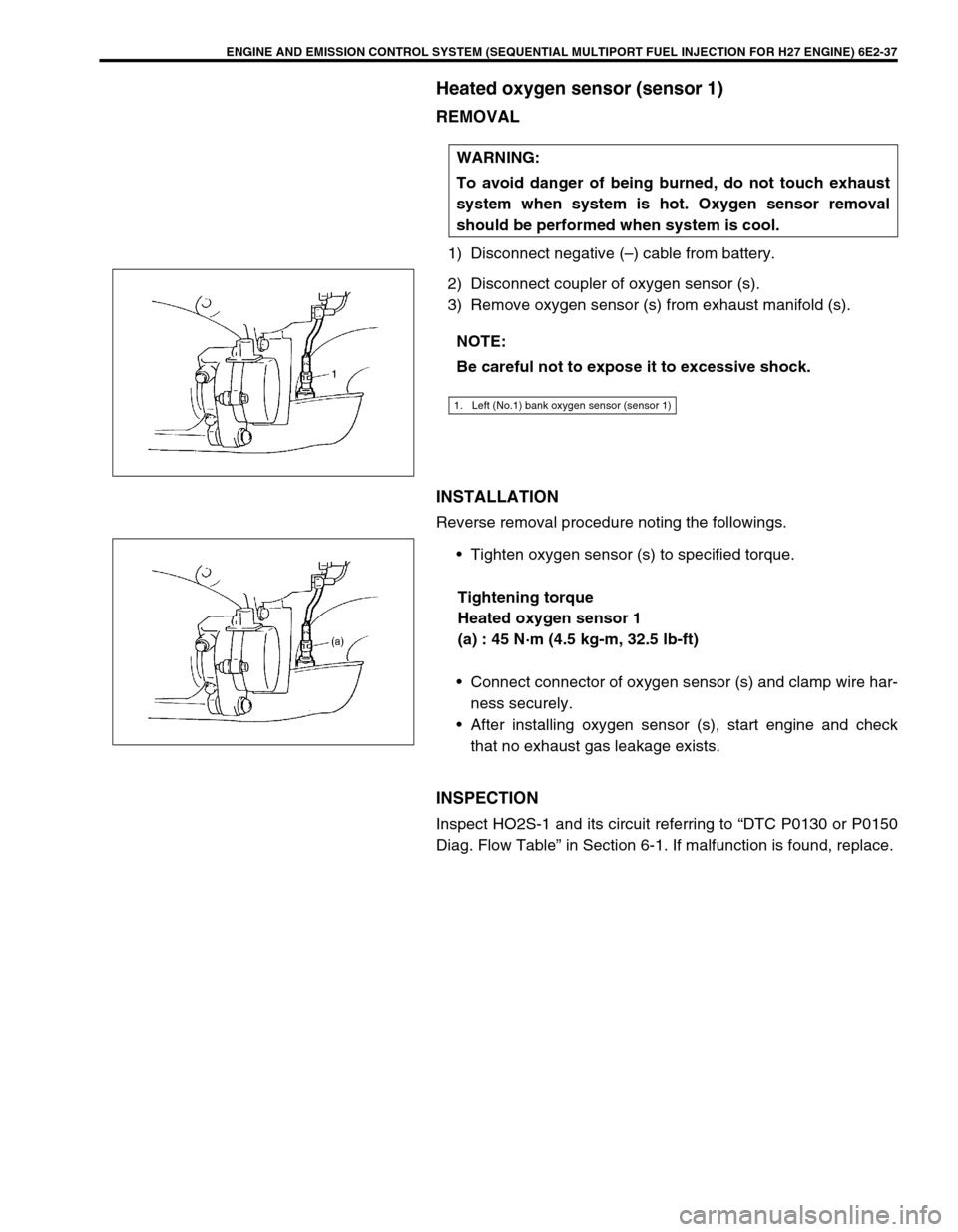
Heated oxygen sensor (sensor 1)
REMOVAL
1) Disconnect negative (–) cable from battery.
2) Disconnect coupler of oxygen sensor (s).
3) Remove oxygen sensor (s) from exhaust manifold (s).
INSTALLATION
Reverse removal procedure noting the followings.
•Tighten oxygen sensor (s) to specified torque.
Tightening torque
Heated oxygen sensor 1
(a) : 45 N·m (4.5 kg-m, 32.5 lb-ft)
•Connect connector of oxygen sensor (s) and clamp wire har-
ness securely.
•After installing oxygen sensor (s), start engine and check
that no exhaust gas leakage exists.
INSPECTION
Inspect HO2S-1 and its circuit referring to “DTC P0130 or P0150
Diag. Flow Table” in Section 6-1. If malfunction is found, replace. WARNING:
To avoid danger of being burned, do not touch exhaust
system when system is hot. Oxygen sensor removal
should be performed when system is cool.
NOTE:
Be careful not to expose it to excessive shock.
1. Left (No.1) bank oxygen sensor (sensor 1)
Page 371 of 656
6E2-38 ENGINE AND EMISSION CONTROL SYSTEM (SEQUENTIAL MULTIPORT FUEL INJECTION FOR H27 ENGINE)
HEATER INSPECTION
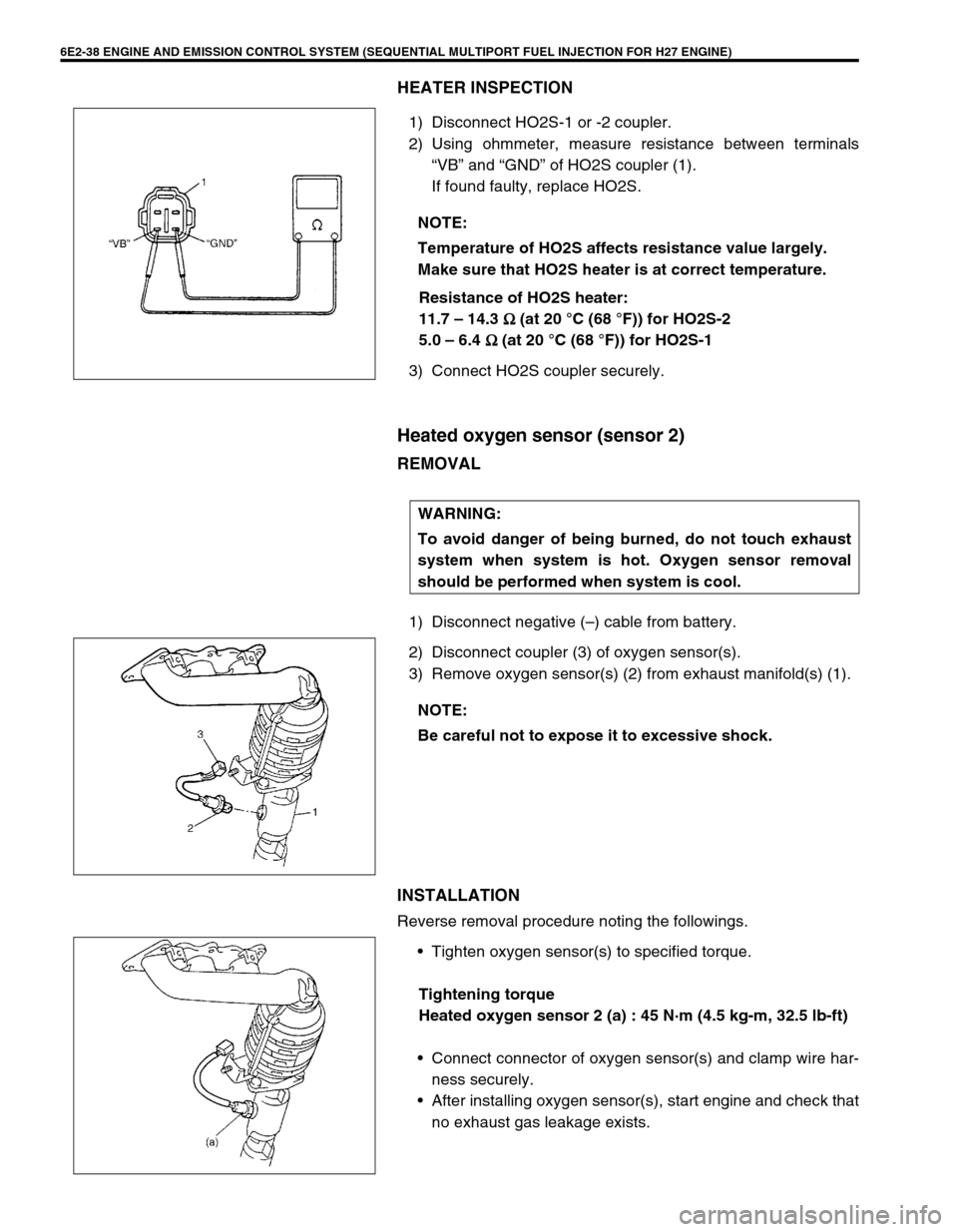
1) Disconnect HO2S-1 or -2 coupler.
2) Using ohmmeter, measure resistance between terminals
“VB” and “GND” of HO2S coupler (1).
If found faulty, replace HO2S.
Resistance of HO2S heater:
11.7 – 14.3 Ω
ΩΩ Ω (at 20 °C (68 °F)) for HO2S-2
5.0 – 6.4 Ω
ΩΩ Ω (at 20 °C (68 °F)) for HO2S-1
3) Connect HO2S coupler securely.
Heated oxygen sensor (sensor 2)
REMOVAL
1) Disconnect negative (–) cable from battery.
2) Disconnect coupler (3) of oxygen sensor(s).
3) Remove oxygen sensor(s) (2) from exhaust manifold(s) (1).
INSTALLATION
Reverse removal procedure noting the followings.
•Tighten oxygen sensor(s) to specified torque.
Tightening torque
Heated oxygen sensor 2 (a) : 45 N·m (4.5 kg-m, 32.5 lb-ft)
•Connect connector of oxygen sensor(s) and clamp wire har-
ness securely.
•After installing oxygen sensor(s), start engine and check that
no exhaust gas leakage exists. NOTE:
Temperature of HO2S affects resistance value largely.
Make sure that HO2S heater is at correct temperature.
WARNING:
To avoid danger of being burned, do not touch exhaust
system when system is hot. Oxygen sensor removal
should be performed when system is cool.
NOTE:
Be careful not to expose it to excessive shock.
Page 372 of 656
ENGINE AND EMISSION CONTROL SYSTEM (SEQUENTIAL MULTIPORT FUEL INJECTION FOR H27 ENGINE) 6E2-39
HEATER INSPECTION
Refer to “HEATED OXYGEN SENSOR (SENSOR 1) HEATER
INSPECTION”
Vehicle speed sensor (VSS)
ON-VEHICLE INSPECTION
1) Hoist vehicle.
2) Release parking brake lever, set transmission in neutral and
transfer in “2H”.
3) Remove ECM (PCM) cover.
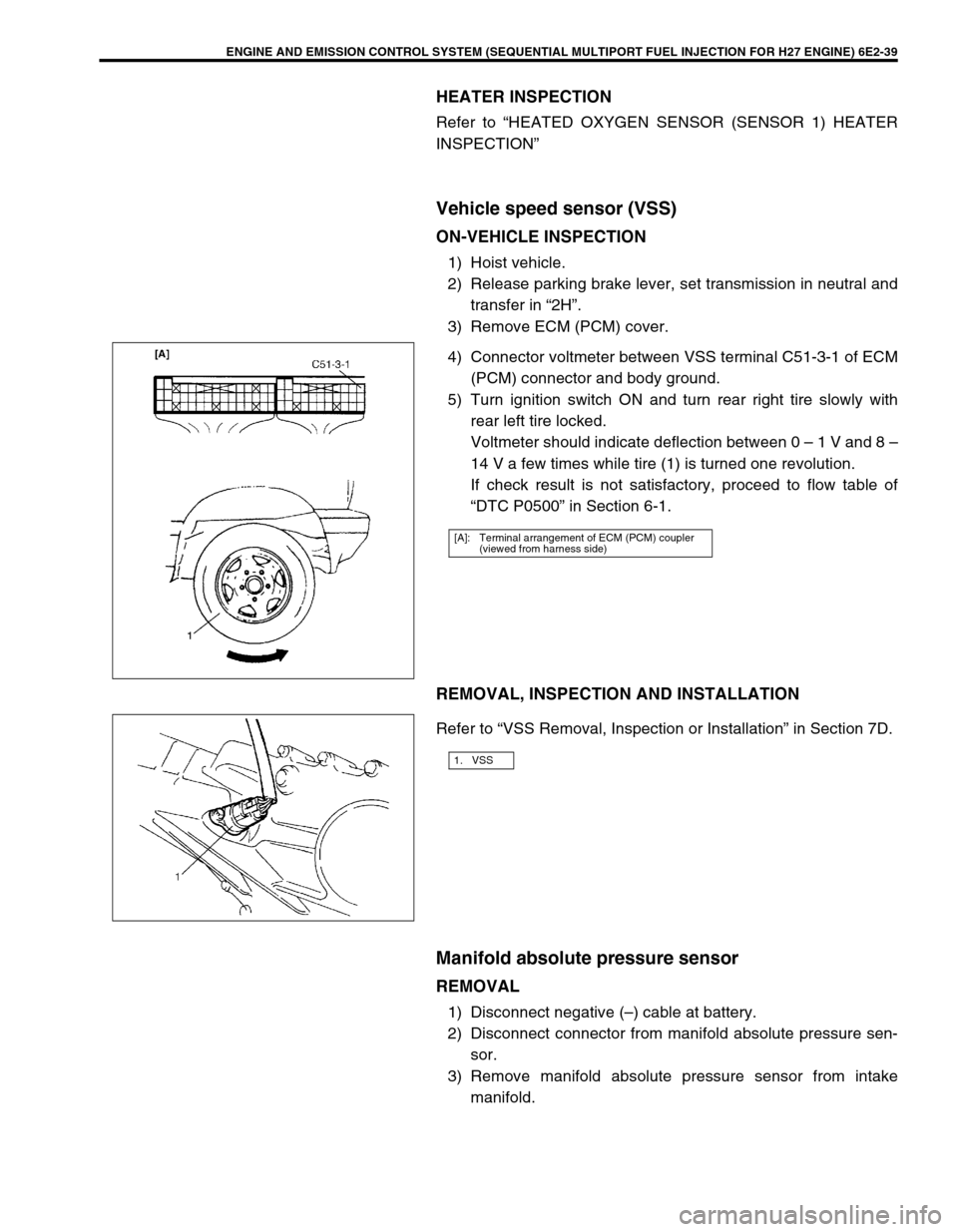
4) Connector voltmeter between VSS terminal C51-3-1 of ECM
(PCM) connector and body ground.
5) Turn ignition switch ON and turn rear right tire slowly with
rear left tire locked.
Voltmeter should indicate deflection between 0 – 1 V and 8 –
14 V a few times while tire (1) is turned one revolution.
If check result is not satisfactory, proceed to flow table of
“DTC P0500” in Section 6-1.
REMOVAL, INSPECTION AND INSTALLATION
Refer to “VSS Removal, Inspection or Installation” in Section 7D.
Manifold absolute pressure sensor
REMOVAL
1) Disconnect negative (–) cable at battery.
2) Disconnect connector from manifold absolute pressure sen-
sor.
3) Remove manifold absolute pressure sensor from intake
manifold.
[A]: Terminal arrangement of ECM (PCM) coupler
(viewed from harness side)
1. VSS
Page 374 of 656
ENGINE AND EMISSION CONTROL SYSTEM (SEQUENTIAL MULTIPORT FUEL INJECTION FOR H27 ENGINE) 6E2-41
INSTALLATION
1) Confirm that vacuum passage on intake manifold is free from
clog.
2) Apply engine oil to O-ring of sensor.
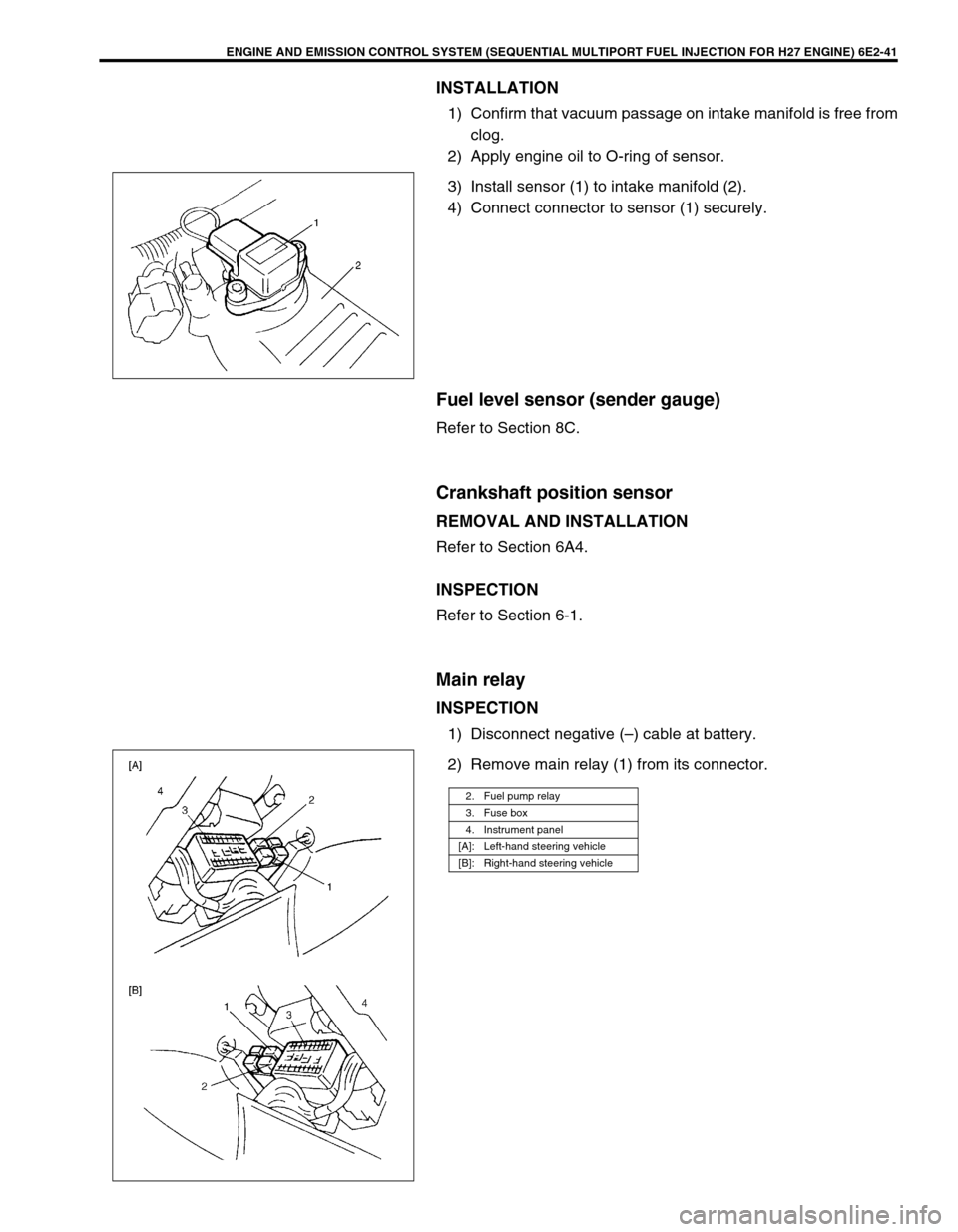
3) Install sensor (1) to intake manifold (2).
4) Connect connector to sensor (1) securely.
Fuel level sensor (sender gauge)
Refer to Section 8C.
Crankshaft position sensor
REMOVAL AND INSTALLATION
Refer to Section 6A4.
INSPECTION
Refer to Section 6-1.
Main relay
INSPECTION
1) Disconnect negative (–) cable at battery.
2) Remove main relay (1) from its connector.
2. Fuel pump relay
3. Fuse box
4. Instrument panel
[A]: Left-hand steering vehicle
[B]: Right-hand steering vehicle
Page 377 of 656
6E2-44 ENGINE AND EMISSION CONTROL SYSTEM (SEQUENTIAL MULTIPORT FUEL INJECTION FOR H27 ENGINE)
Emission Control System
EGR system (if equipped)
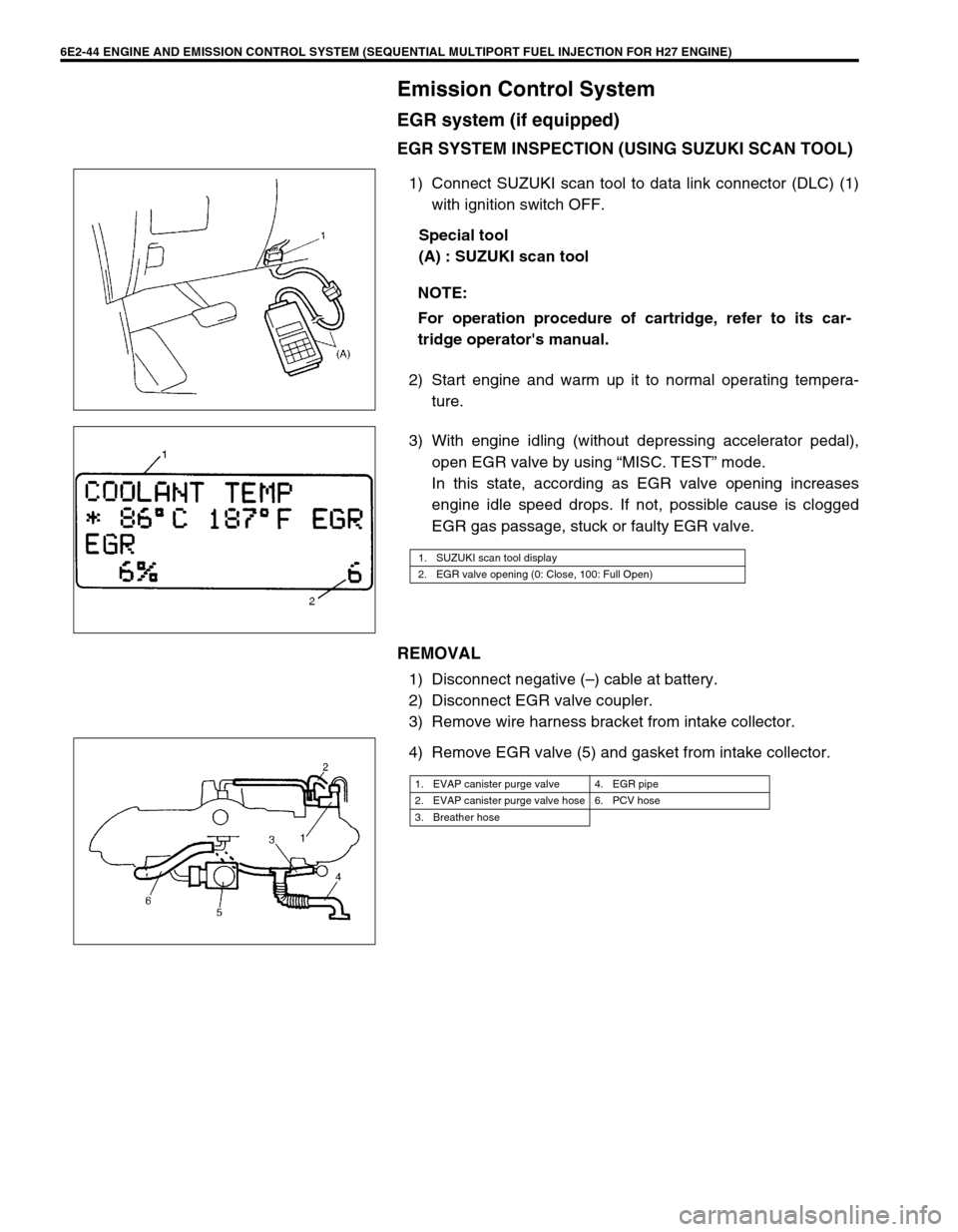
EGR SYSTEM INSPECTION (USING SUZUKI SCAN TOOL)
1) Connect SUZUKI scan tool to data link connector (DLC) (1)
with ignition switch OFF.
Special tool
(A) : SUZUKI scan tool
2) Start engine and warm up it to normal operating tempera-
ture.
3) With engine idling (without depressing accelerator pedal),
open EGR valve by using “MISC. TEST” mode.
In this state, according as EGR valve opening increases
engine idle speed drops. If not, possible cause is clogged
EGR gas passage, stuck or faulty EGR valve.
REMOVAL
1) Disconnect negative (–) cable at battery.
2) Disconnect EGR valve coupler.
3) Remove wire harness bracket from intake collector.
4) Remove EGR valve (5) and gasket from intake collector.NOTE:
For operation procedure of cartridge, refer to its car-
tridge operator's manual.
1. SUZUKI scan tool display
2. EGR valve opening (0: Close, 100: Full Open)
1. EVAP canister purge valve 4. EGR pipe
2. EVAP canister purge valve hose 6. PCV hose
3. Breather hose
Page 378 of 656
ENGINE AND EMISSION CONTROL SYSTEM (SEQUENTIAL MULTIPORT FUEL INJECTION FOR H27 ENGINE) 6E2-45
INSPECTION
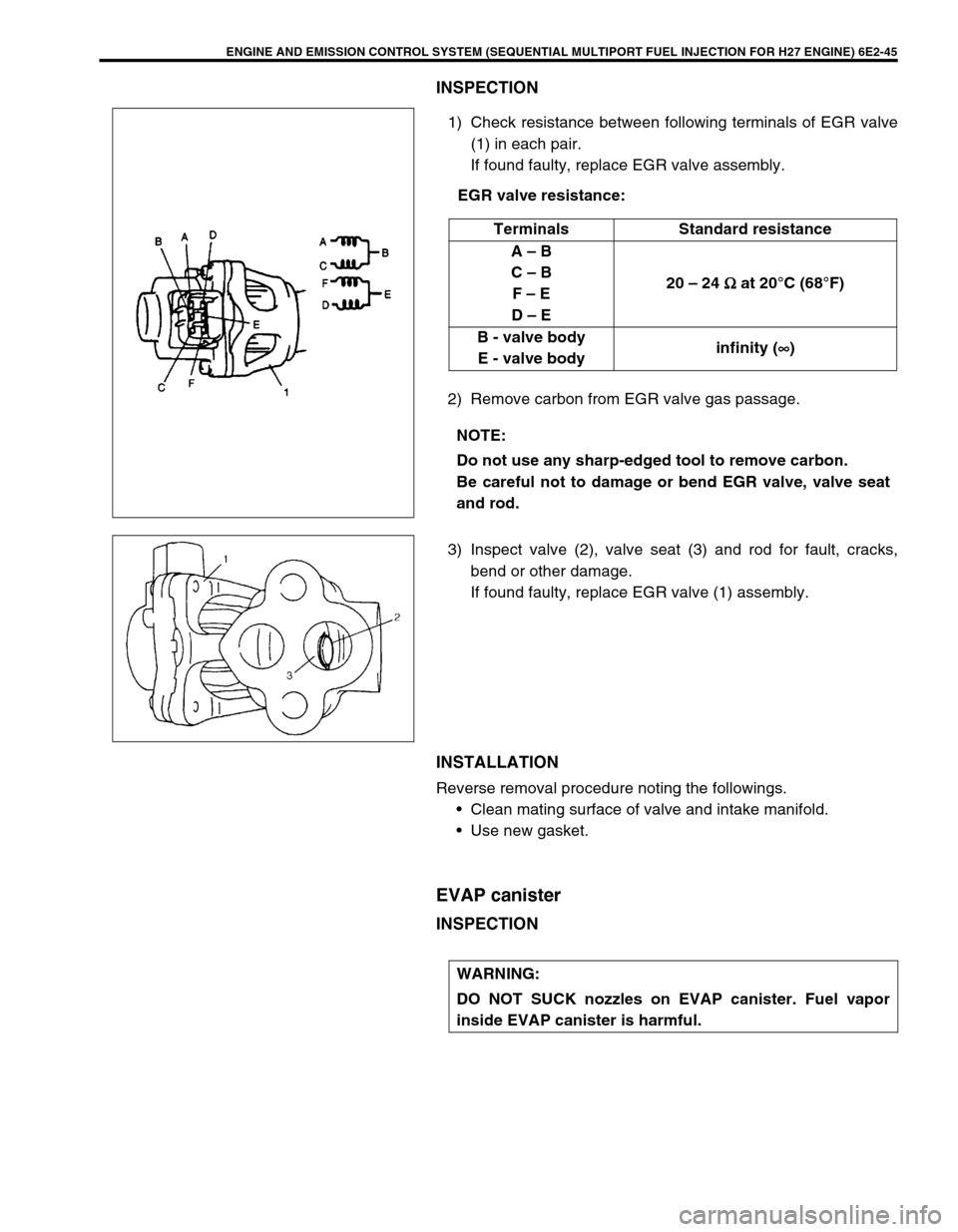
1) Check resistance between following terminals of EGR valve
(1) in each pair.
If found faulty, replace EGR valve assembly.
EGR valve resistance:
2) Remove carbon from EGR valve gas passage.
3) Inspect valve (2), valve seat (3) and rod for fault, cracks,
bend or other damage.
If found faulty, replace EGR valve (1) assembly.
INSTALLATION
Reverse removal procedure noting the followings.
•Clean mating surface of valve and intake manifold.
•Use new gasket.
EVAP canister
INSPECTION
Terminals Standard resistance
A – B
C – B
F – E
D – E20 – 24 Ω
ΩΩ Ω at 20°C (68°F)
B - valve body
E - valve bodyinfinity (∞
∞∞ ∞)
NOTE:
Do not use any sharp-edged tool to remove carbon.
Be careful not to damage or bend EGR valve, valve seat
and rod.
WARNING:
DO NOT SUCK nozzles on EVAP canister. Fuel vapor
inside EVAP canister is harmful.
Page 391 of 656
6F2-8 IGNITION SYSTEM (FOR H27 ENGINE)
On-Vehicle Service
Ignition Coil Assembly (Igniter and Ignition
Coil)
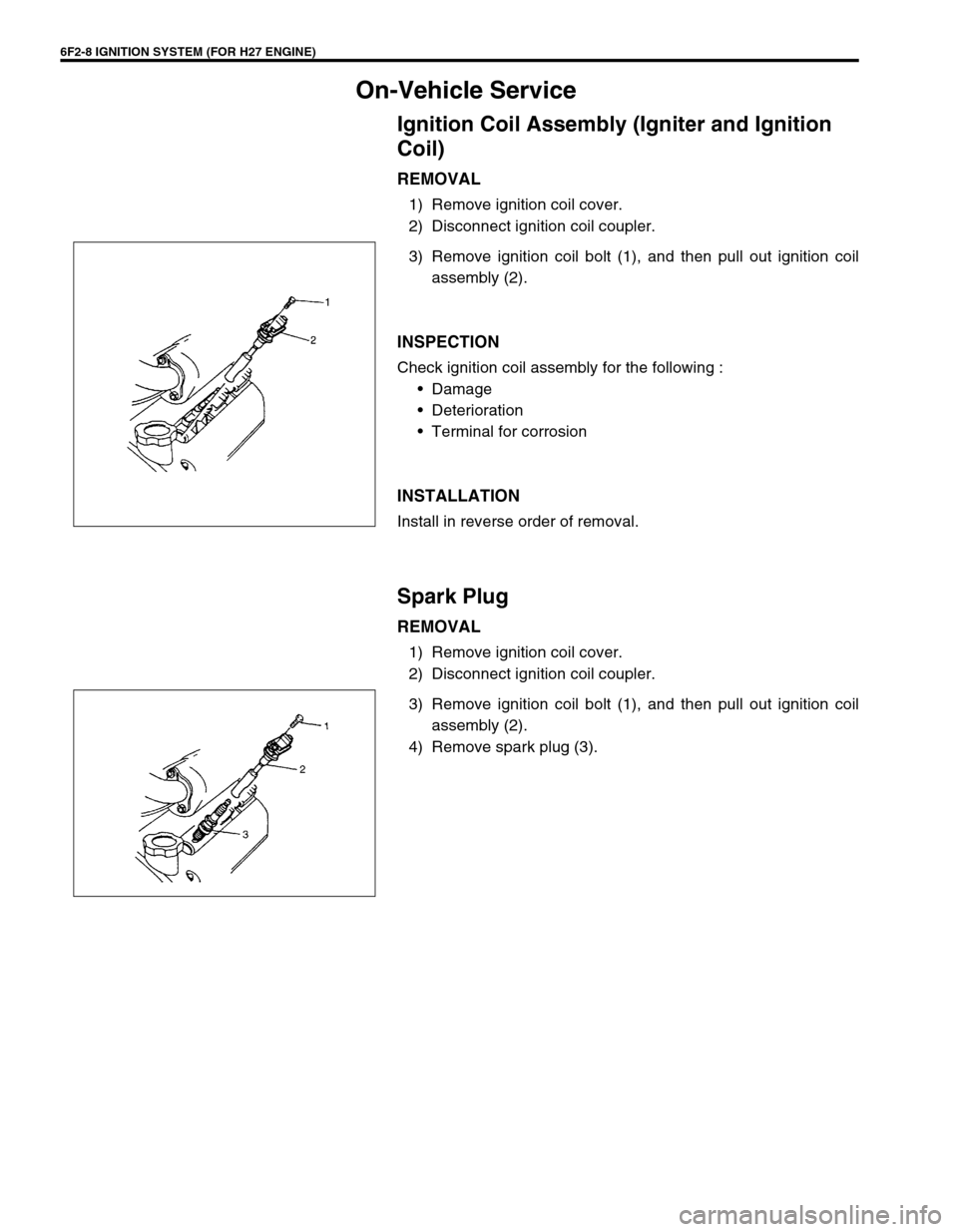
REMOVAL
1) Remove ignition coil cover.
2) Disconnect ignition coil coupler.
3) Remove ignition coil bolt (1), and then pull out ignition coil
assembly (2).
INSPECTION
Check ignition coil assembly for the following :
•Damage
•Deterioration
•Terminal for corrosion
INSTALLATION
Install in reverse order of removal.
Spark Plug
REMOVAL
1) Remove ignition coil cover.
2) Disconnect ignition coil coupler.
3) Remove ignition coil bolt (1), and then pull out ignition coil
assembly (2).
4) Remove spark plug (3).
Page 393 of 656
6F2-10 IGNITION SYSTEM (FOR H27 ENGINE)
CMP Sensor
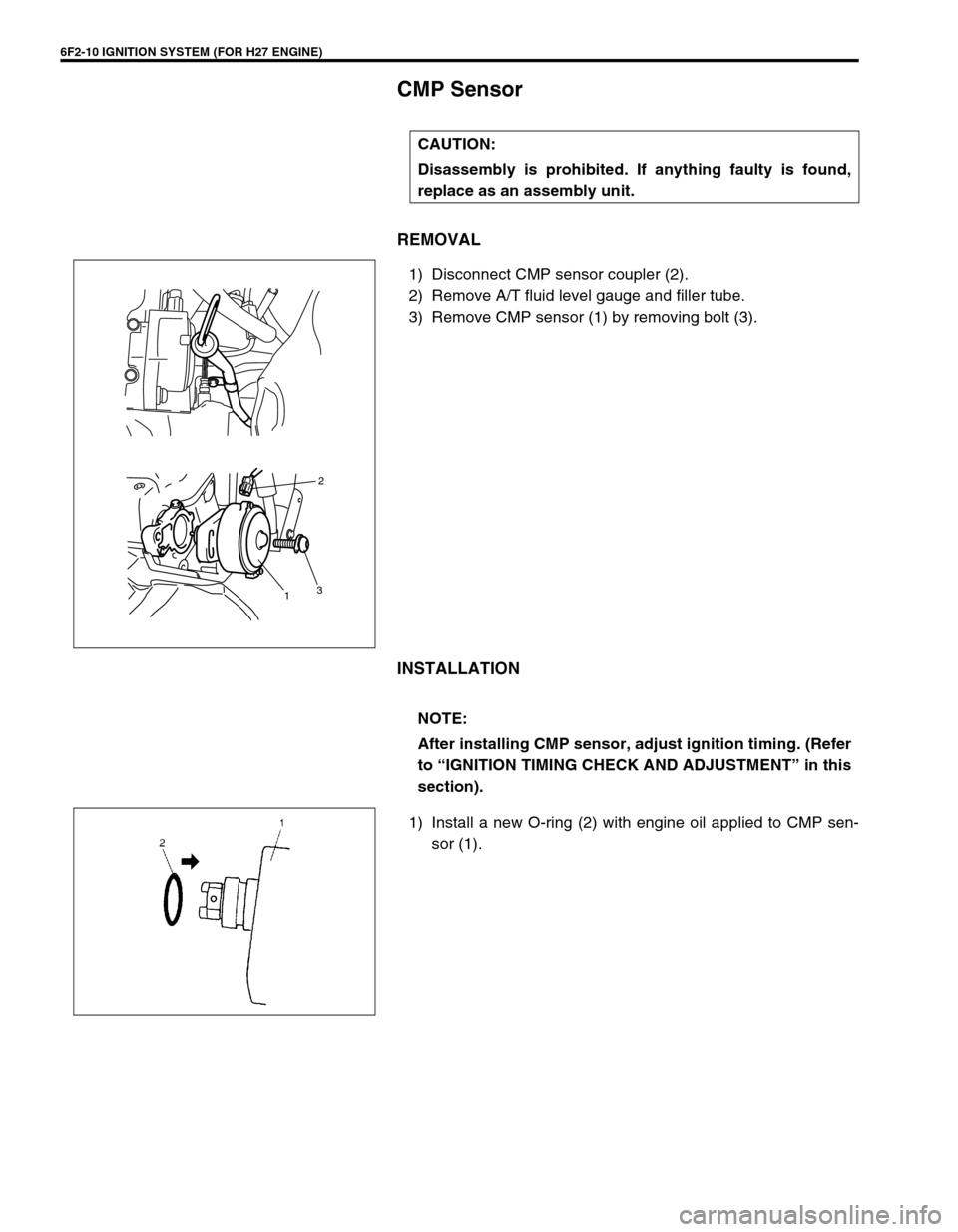
REMOVAL
1) Disconnect CMP sensor coupler (2).
2) Remove A/T fluid level gauge and filler tube.
3) Remove CMP sensor (1) by removing bolt (3).
INSTALLATION
1) Install a new O-ring (2) with engine oil applied to CMP sen-
sor (1). CAUTION:
Disassembly is prohibited. If anything faulty is found,
replace as an assembly unit.
2
3
1
NOTE:
After installing CMP sensor, adjust ignition timing. (Refer
to “IGNITION TIMING CHECK AND ADJUSTMENT” in this
section).
Page 395 of 656
6F2-12 IGNITION SYSTEM (FOR H27 ENGINE)
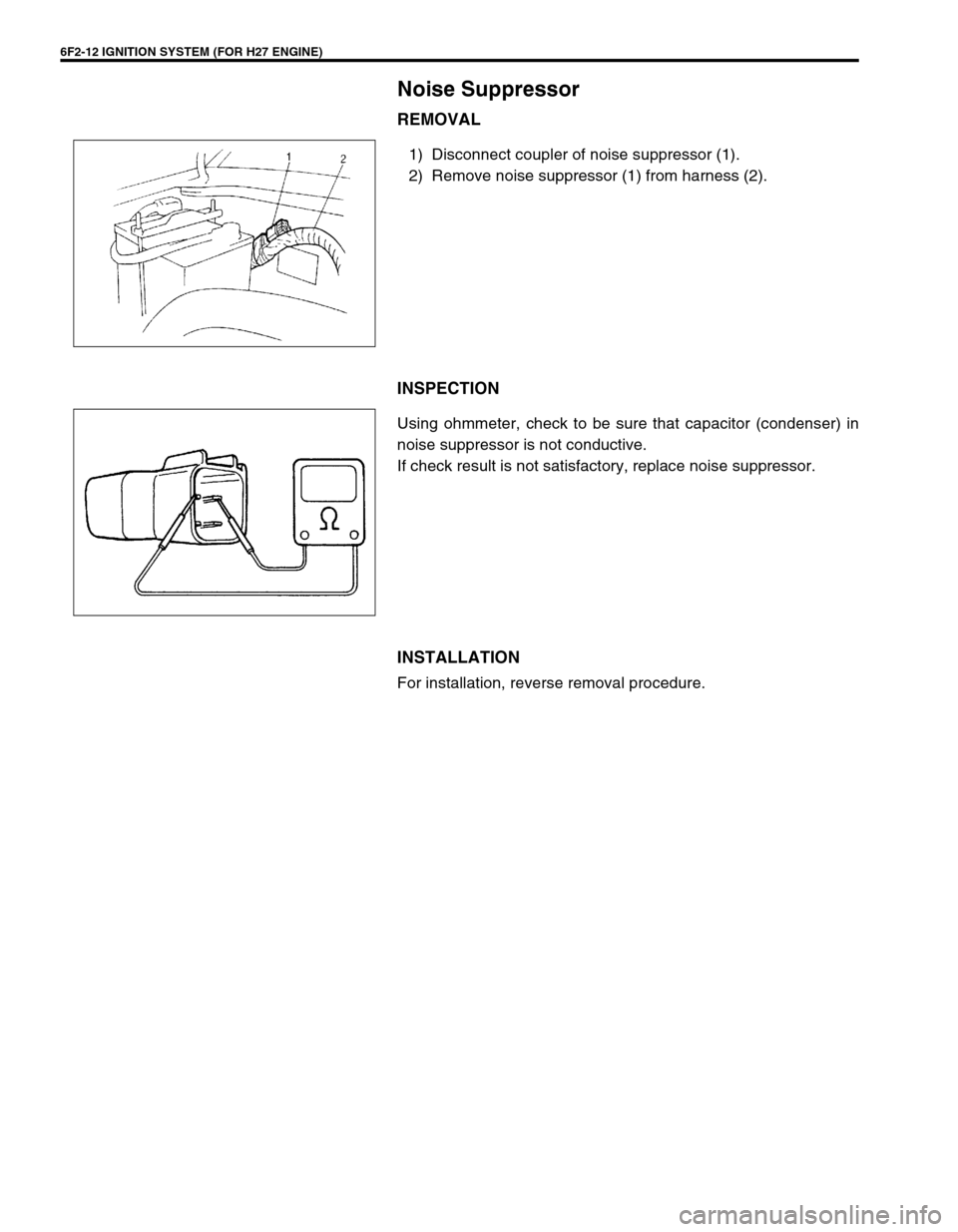
Noise Suppressor
REMOVAL
1) Disconnect coupler of noise suppressor (1).
2) Remove noise suppressor (1) from harness (2).
INSPECTION
Using ohmmeter, check to be sure that capacitor (condenser) in
noise suppressor is not conductive.
If check result is not satisfactory, replace noise suppressor.
INSTALLATION
For installation, reverse removal procedure.
Page 516 of 656
INSTRUMENTATION/DRIVER INFORMATION 8C-5
Engine Coolant Temperature (ECT) Meter and
Sensor
Engine coolant temperature sensor
REMOVAL AND INSTALLATION
Refer to “ECT SENSOR” in Section 6E2.
Oil Pressure Light
Oil pressure switch
REMOVAL AND INSTALLATION
Refer to “OIL PRESSURE CHECK” in Section 6A2.
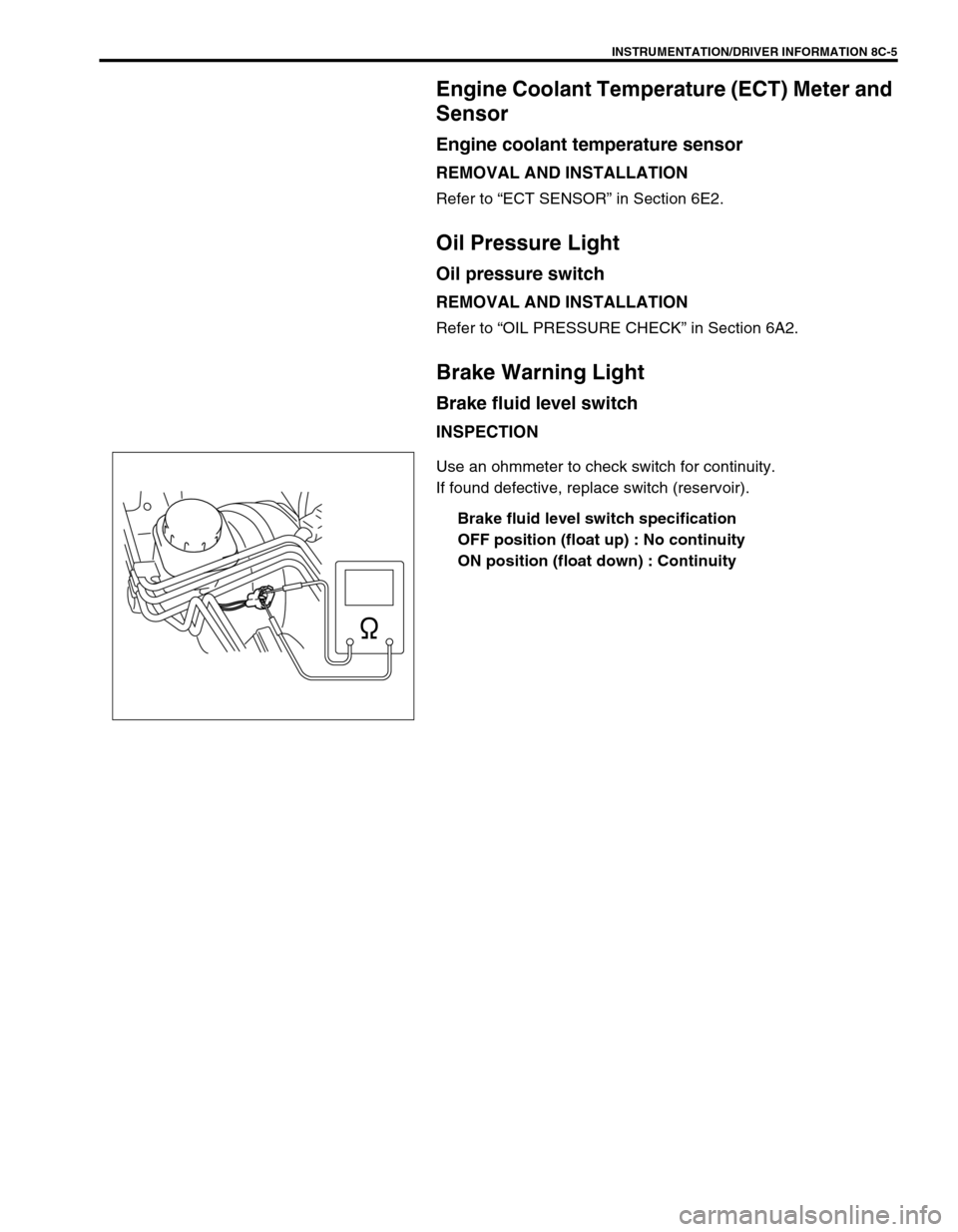
Brake Warning Light
Brake fluid level switch
INSPECTION
Use an ohmmeter to check switch for continuity.
If found defective, replace switch (reservoir).
Brake fluid level switch specification
OFF position (float up) : No continuity
ON position (float down) : Continuity