diff SUZUKI GRAND VITARA 2001 2.G User Guide
[x] Cancel search | Manufacturer: SUZUKI, Model Year: 2001, Model line: GRAND VITARA, Model: SUZUKI GRAND VITARA 2001 2.GPages: 656, PDF Size: 14.31 MB
Page 103 of 656
4A2-4 FRONT DRIVE SHAFT/SHAFT BEARING, OIL SEAL
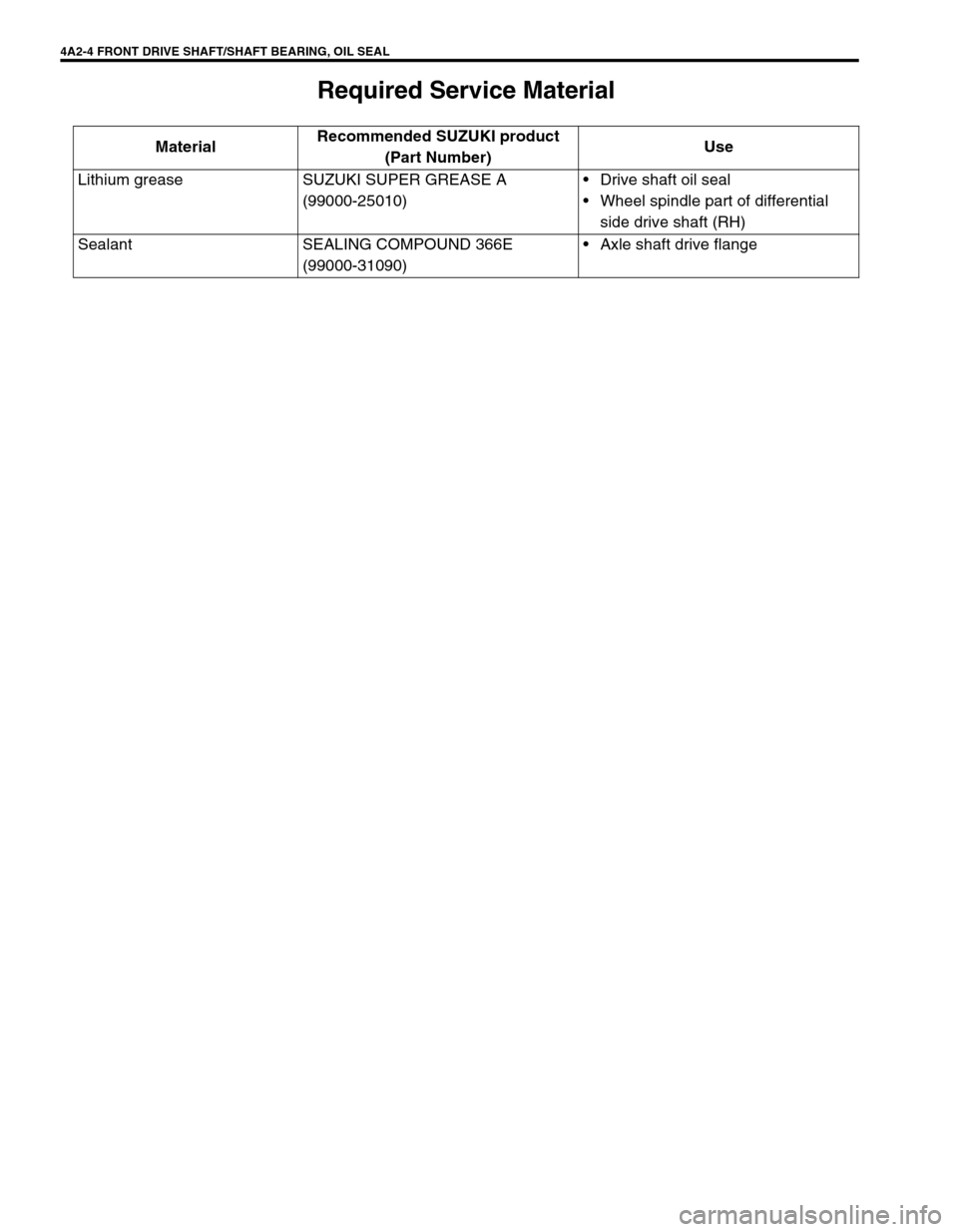
Required Service Material
MaterialRecommended SUZUKI product
(Part Number)Use
Lithium grease SUZUKI SUPER GREASE A
(99000-25010)Drive shaft oil seal
Wheel spindle part of differential
side drive shaft (RH)
Sealant SEALING COMPOUND 366E
(99000-31090)Axle shaft drive flange
Page 123 of 656
5C-6 PARKING AND REAR BRAKE
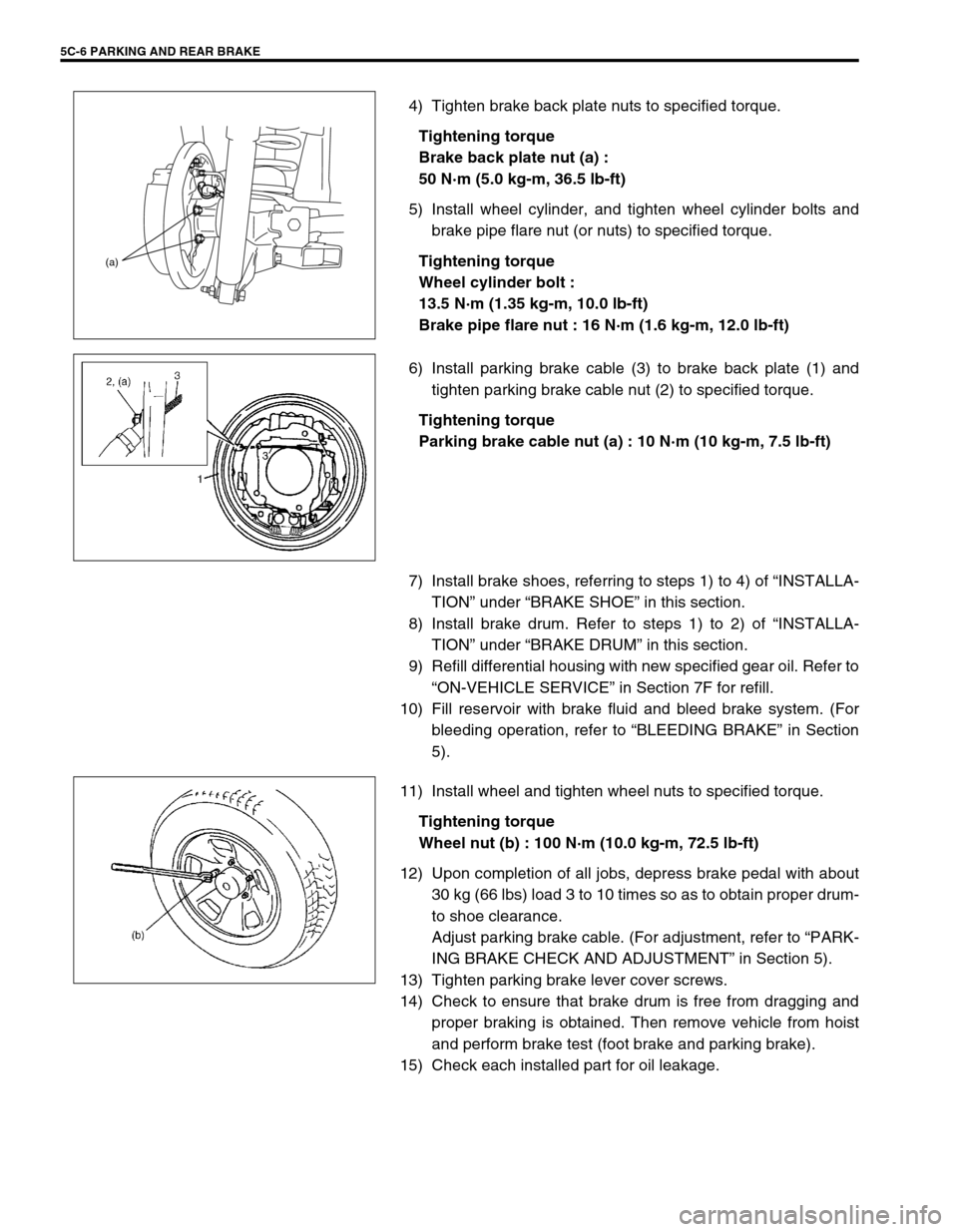
4) Tighten brake back plate nuts to specified torque.
Tightening torque
Brake back plate nut (a) :
50 N·m (5.0 kg-m, 36.5 lb-ft)
5) Install wheel cylinder, and tighten wheel cylinder bolts and
brake pipe flare nut (or nuts) to specified torque.
Tightening torque
Wheel cylinder bolt :
13.5 N·m (1.35 kg-m, 10.0 lb-ft)
Brake pipe flare nut : 16 N·m (1.6 kg-m, 12.0 lb-ft)
6) Install parking brake cable (3) to brake back plate (1) and
tighten parking brake cable nut (2) to specified torque.
Tightening torque
Parking brake cable nut (a) : 10 N·m (10 kg-m, 7.5 lb-ft)
7) Install brake shoes, referring to steps 1) to 4) of “INSTALLA-
TION” under “BRAKE SHOE” in this section.
8) Install brake drum. Refer to steps 1) to 2) of “INSTALLA-
TION” under “BRAKE DRUM” in this section.
9) Refill differential housing with new specified gear oil. Refer to
“ON-VEHICLE SERVICE” in Section 7F for refill.
10) Fill reservoir with brake fluid and bleed brake system. (For
bleeding operation, refer to “BLEEDING BRAKE” in Section
5).
11) Install wheel and tighten wheel nuts to specified torque.
Tightening torque
Wheel nut (b) : 100 N·m (10.0 kg-m, 72.5 lb-ft)
12) Upon completion of all jobs, depress brake pedal with about
30 kg (66 lbs) load 3 to 10 times so as to obtain proper drum-
to shoe clearance.
Adjust parking brake cable. (For adjustment, refer to “PARK-
ING BRAKE CHECK AND ADJUSTMENT” in Section 5).
13) Tighten parking brake lever cover screws.
14) Check to ensure that brake drum is free from dragging and
proper braking is obtained. Then remove vehicle from hoist
and perform brake test (foot brake and parking brake).
15) Check each installed part for oil leakage.
(a)
Page 133 of 656
5E2-8 ANTILOCK BRAKE SYSTEM (ABS)
b) Problem Symptom Confirmation
Check if what the customer claimed in “CUSTOMER QUESTIONNAIRE” is actually found in the vehicle
and if that symptom is found, whether it is identified as a failure. (This step should be shared with the cus-
tomer if possible.) Check warning lamps related to brake system referring to “EBD WARNING LAMP
(BRAKE WARNING LAMP) CHECK” and “ABS WARNING LAMP CHECK” in this section.
c) Diagnostic Trouble Code (DTC) Check, Record and Clearance
Perform “DIAGNOSTIC TROUBLE CODE CHECK” procedure in this section, record it and then clear it
referring to “DIAGNOSTIC TROUBLE CODE CLEARANCE” in this section.
If the malfunction DTC which was once displayed and then cleared cannot be detected (indicated) again
when the ignition switch is turned ON, attempt to diagnose the trouble based on the DTC recorded in this
step may mislead the diagnosis or make diagnosing difficult. Proceed to Step 2) to check control module for
proper self-diagnosis function.
If the malfunction DTC which was once displayed and then cleared can be detected (indicated) again when
ignition switch is turned ON, proceed to Step 3).
2) DRIVING TEST
Test drive the vehicle at 40 km/h for more than a minute and check if any trouble symptom (such as abnor-
mal lighting of ABS warning light) exists.
If the malfunction DTC is confirmed again at ignition switch ON, driving test as described in above is not nec-
essary. Proceed to Step 3).
3) DIAGNOSTIC TROUBLE CODE CHECK
Recheck diagnostic trouble code referring to “DTC CHECK” as shown in the following page.
4) DIAGNOSTIC TROUBLE CODE FLOW TABLE
According to Diagnostic flow table for the diagnostic trouble code confirmation in Step 3), locate the cause of
the trouble, namely in a sensor, switch, wire harness, connector, actuator assembly or other part and repair
or replace faulty parts.
5)“DIAGNOSIS” IN “BRAKES” SECTION
Check the parts or system suspected as a possible cause referring to “DIAGNOSIS” in “BRAKES” section
and based on symptoms appearing on the vehicle (symptom obtained through Steps 1)-a, 1)-b and 2) and
repair or replace faulty parts, if any).
6) CHECK FOR INTERMITTENT PROBLEM
Check parts where an intermittent trouble is easy to occur (e.g., wire harness, connector, etc.), referring to
“INTERMITTENT TROUBLE” in “GENERAL INFORMATION” section and related circuit of trouble code
recorded in Step 1)-c.
7) FINAL CONFIRMATION TEST
Confirm that the problem symptom has gone and the ABS is free from any abnormal conditions. If what has
been repaired is related to the malfunction DTC, clear the DTC once and perform test driving and confirm
that no DTC is indicated.
Page 145 of 656
5E2-20 ANTILOCK BRAKE SYSTEM (ABS)
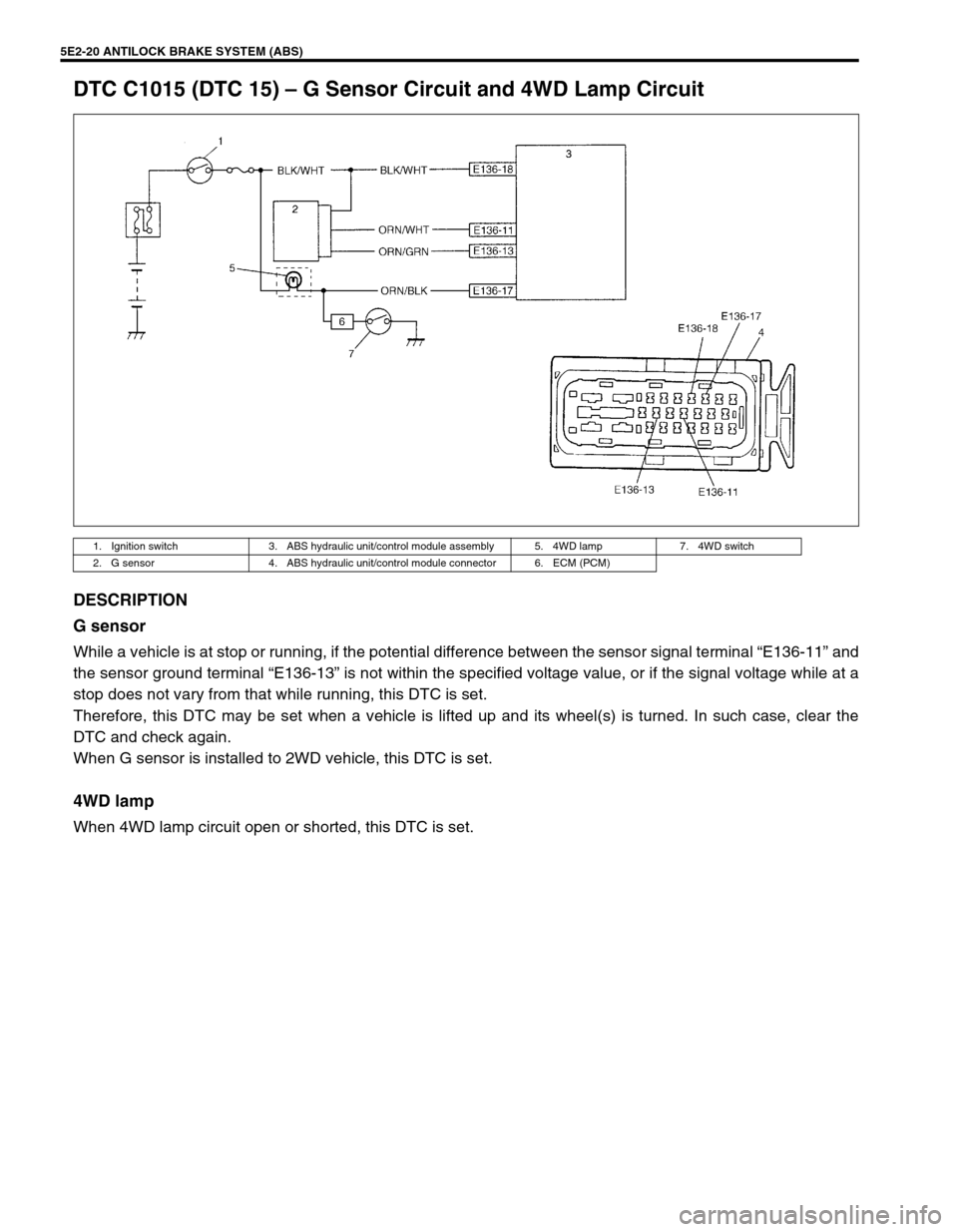
DTC C1015 (DTC 15) – G Sensor Circuit and 4WD Lamp Circuit
DESCRIPTION
G sensor
While a vehicle is at stop or running, if the potential difference between the sensor signal terminal “E136-11” and
the sensor ground terminal “E136-13” is not within the specified voltage value, or if the signal voltage while at a
stop does not vary from that while running, this DTC is set.
Therefore, this DTC may be set when a vehicle is lifted up and its wheel(s) is turned. In such case, clear the
DTC and check again.
When G sensor is installed to 2WD vehicle, this DTC is set.
4WD lamp
When 4WD lamp circuit open or shorted, this DTC is set.
1. Ignition switch 3. ABS hydraulic unit/control module assembly 5. 4WD lamp 7. 4WD switch
2. G sensor 4. ABS hydraulic unit/control module connector 6. ECM (PCM)
Page 168 of 656
ENGINE GENERAL INFORMATION AND DIAGNOSIS (H27 ENGINE) 6-1-7
WARM-UP CYCLE
A warm-up cycle means sufficient vehicle operation such that the
coolant temperature has risen by at least 22°C (40°F) from
engine starting and reaches a minimum temperature of 70 °C
(160 °F).
DRIVING CYCLE
A “Driving Cycle” consists of engine startup, driving mode where
a malfunction would be detected if present and engine shutoff.
2 DRIVING CYCLE DETECTION LOGIC
The malfunction detected in the first driving cycle is stored in
ECM (PCM) memory (in the form of pending DTC) but the mal-
function indicator lamp does not light at this time. It lights up at the
second detection of same malfunction also in the next driving
cycle.
PENDING DTC
Pending DTC means a DTC detected and stored temporarily at 1
driving cycle of the DTC which is detected in the 2 driving cycle
detection logic.
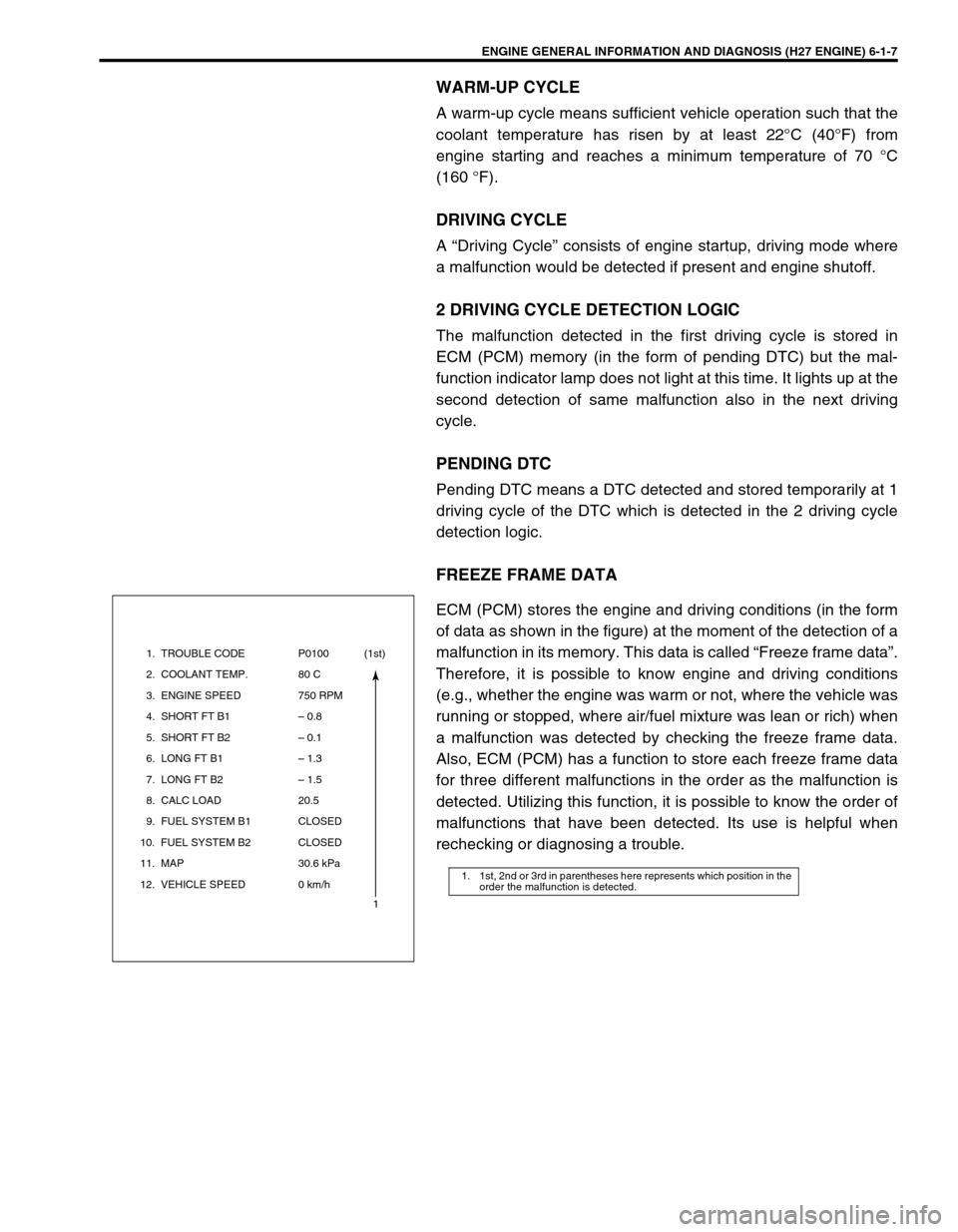
FREEZE FRAME DATA
ECM (PCM) stores the engine and driving conditions (in the form
of data as shown in the figure) at the moment of the detection of a
malfunction in its memory. This data is called “Freeze frame data”.
Therefore, it is possible to know engine and driving conditions
(e.g., whether the engine was warm or not, where the vehicle was
running or stopped, where air/fuel mixture was lean or rich) when
a malfunction was detected by checking the freeze frame data.
Also, ECM (PCM) has a function to store each freeze frame data
for three different malfunctions in the order as the malfunction is
detected. Utilizing this function, it is possible to know the order of
malfunctions that have been detected. Its use is helpful when
rechecking or diagnosing a trouble.
1. 1st, 2nd or 3rd in parentheses here represents which position in the
order the malfunction is detected.
1. TROUBLE CODE
2. COOLANT TEMP.
3. ENGINE SPEED
4. SHORT FT B1
5. SHORT FT B2
6. LONG FT B1
7. LONG FT B2
8. CALC LOAD
9. FUEL SYSTEM B1
10. FUEL SYSTEM B2
11. MAP
12. VEHICLE SPEEDP0100
80 C
750 RPM
– 0.8
– 0.1
– 1.3
– 1.5
20.5
CLOSED
CLOSED
30.6 kPa
0 km/h(1st)
1
Page 174 of 656
ENGINE GENERAL INFORMATION AND DIAGNOSIS (H27 ENGINE) 6-1-13
STEP 2. DIAGNOSTIC TROUBLE CODE (DTC)/FREEZE FRAME DATA CHECK
First, check DTC, referring to “DIAGNOSTIC TROUBLE CODE CHECK” in this section. If DTC is indicated,
record DTC and freeze frame data.
After that clear DTC referring to “DIAGNOSTIC TROUBLE CODE CLEARANCE” in this section. DTC indicates
malfunction that occurred in the system but does not indicate whether it exists now or it occurred in the past and
the normal condition has been restored now. To check which case applies, check the symptom in question
according to Step 5 and recheck DTC according to Step 6, 7.
Attempt to diagnose a trouble based on DTC in this step only or failure to clear the DTC (including pending DTC)
in this step will lead to incorrect diagnosis, trouble diagnosis of a normal circuit or difficulty in troubleshooting.
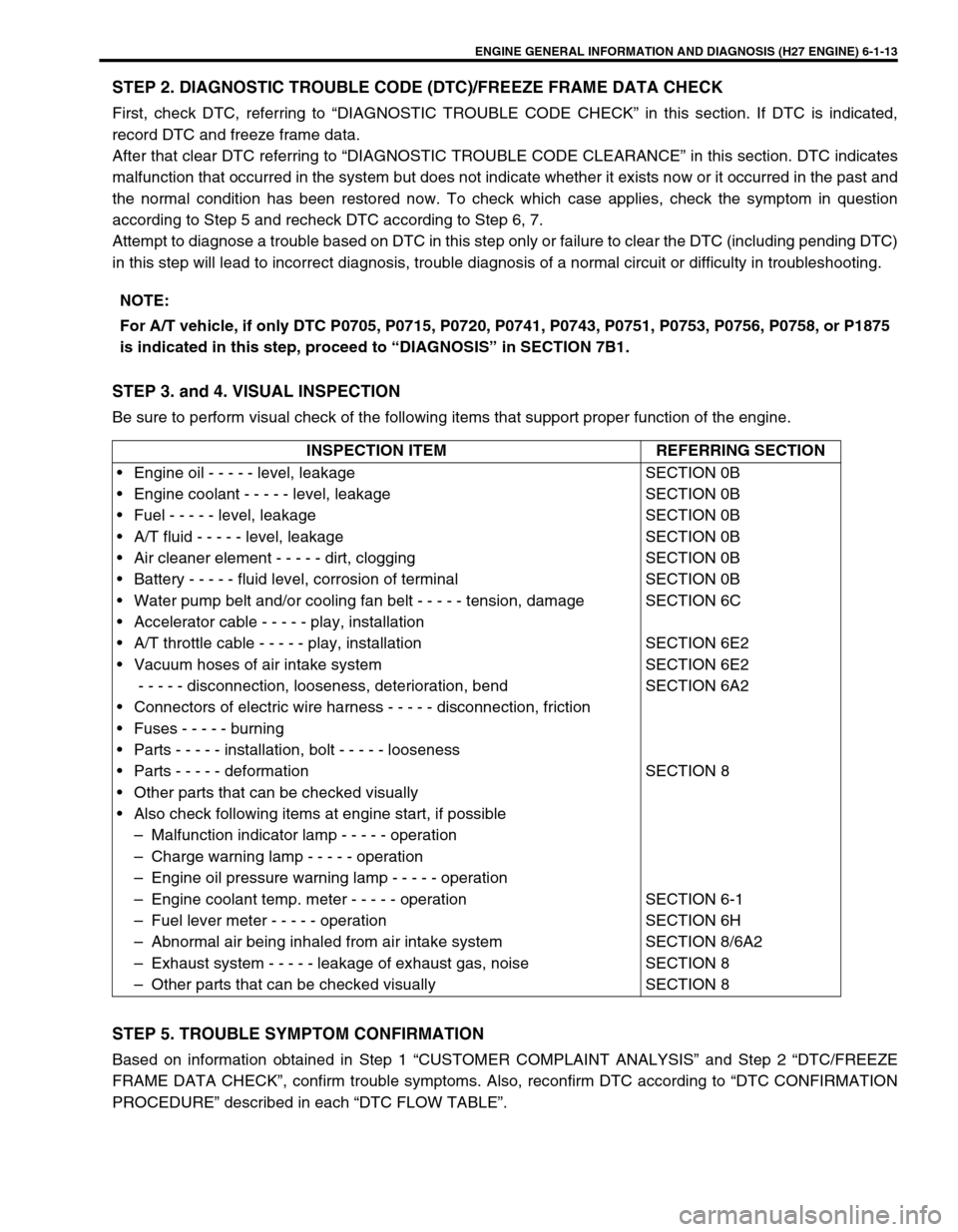
STEP 3. and 4. VISUAL INSPECTION
Be sure to perform visual check of the following items that support proper function of the engine.
STEP 5. TROUBLE SYMPTOM CONFIRMATION
Based on information obtained in Step 1 “CUSTOMER COMPLAINT ANALYSIS” and Step 2 “DTC/FREEZE
FRAME DATA CHECK”, confirm trouble symptoms. Also, reconfirm DTC according to “DTC CONFIRMATION
PROCEDURE” described in each “DTC FLOW TABLE”.NOTE:
For A/T vehicle, if only DTC P0705, P0715, P0720, P0741, P0743, P0751, P0753, P0756, P0758, or P1875
is indicated in this step, proceed to “DIAGNOSIS” in SECTION 7B1.
INSPECTION ITEM REFERRING SECTION
• Engine oil - - - - - level, leakage
• Engine coolant - - - - - level, leakage
• Fuel - - - - - level, leakage
• A/T fluid - - - - - level, leakage
• Air cleaner element - - - - - dirt, clogging
• Battery - - - - - fluid level, corrosion of terminal
• Water pump belt and/or cooling fan belt - - - - - tension, damage
• Accelerator cable - - - - - play, installation
• A/T throttle cable - - - - - play, installation
• Vacuum hoses of air intake system
- - - - - disconnection, looseness, deterioration, bend
• Connectors of electric wire harness - - - - - disconnection, friction
• Fuses - - - - - burning
• Parts - - - - - installation, bolt - - - - - looseness
• Parts - - - - - deformation
• Other parts that can be checked visually
• Also check following items at engine start, if possible
– Malfunction indicator lamp - - - - - operation
– Charge warning lamp - - - - - operation
– Engine oil pressure warning lamp - - - - - operation
– Engine coolant temp. meter - - - - - operation
– Fuel lever meter - - - - - operation
– Abnormal air being inhaled from air intake system
– Exhaust system - - - - - leakage of exhaust gas, noise
– Other parts that can be checked visuallySECTION 0B
SECTION 0B
SECTION 0B
SECTION 0B
SECTION 0B
SECTION 0B
SECTION 6C
SECTION 6E2
SECTION 6E2
SECTION 6A2
SECTION 8
SECTION 6-1
SECTION 6H
SECTION 8/6A2
SECTION 8
SECTION 8
Page 182 of 656
ENGINE GENERAL INFORMATION AND DIAGNOSIS (H27 ENGINE) 6-1-21
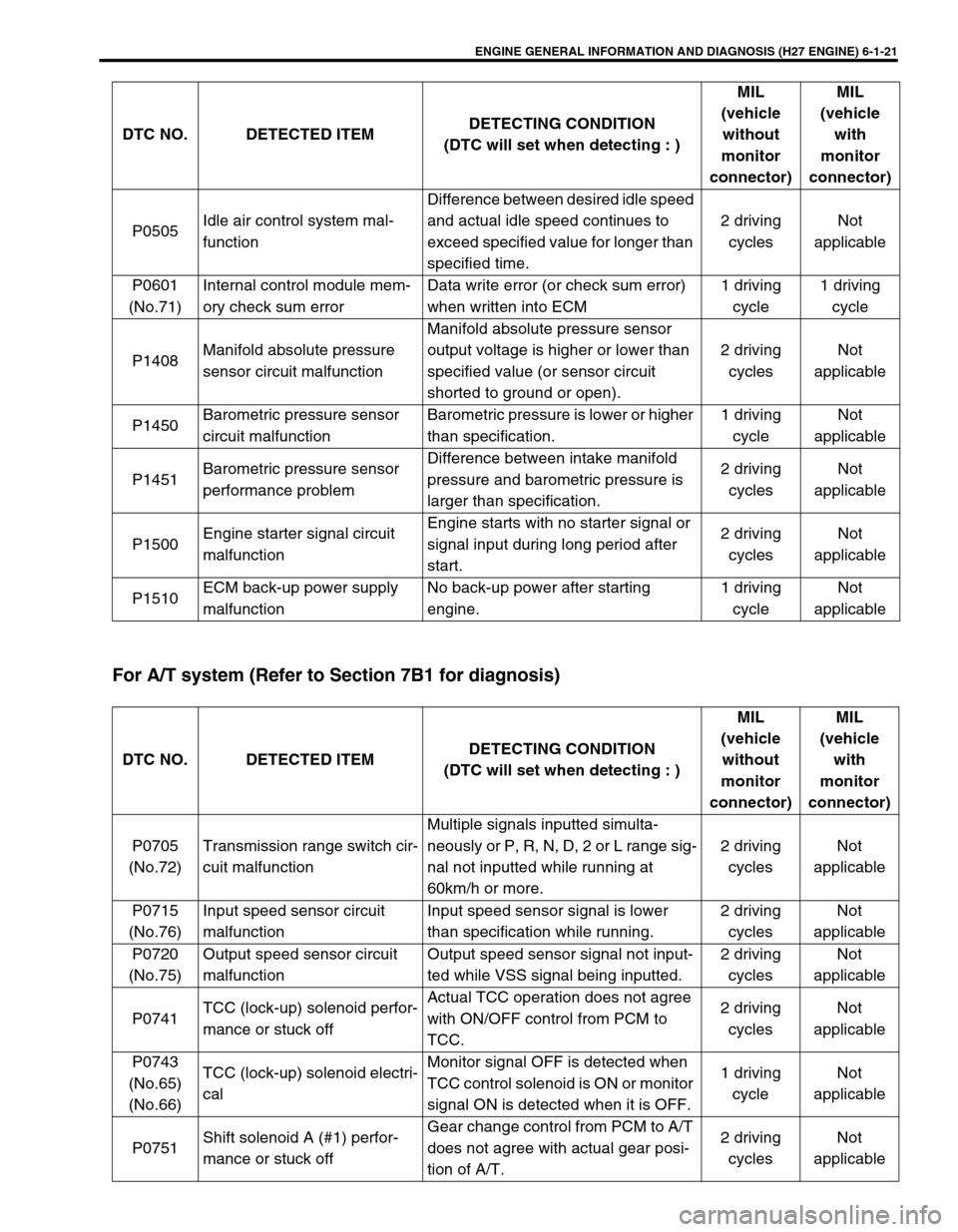
For A/T system (Refer to Section 7B1 for diagnosis)
P0505Idle air control system mal-
functionDifference between desired idle speed
and actual idle speed continues to
exceed specified value for longer than
specified time.2 driving
cyclesNot
applicable
P0601
(No.71)Internal control module mem-
ory check sum errorData write error (or check sum error)
when written into ECM1 driving
cycle1 driving
cycle
P1408Manifold absolute pressure
sensor circuit malfunctionManifold absolute pressure sensor
output voltage is higher or lower than
specified value (or sensor circuit
shorted to ground or open).2 driving
cyclesNot
applicable
P1450Barometric pressure sensor
circuit malfunctionBarometric pressure is lower or higher
than specification.1 driving
cycleNot
applicable
P1451Barometric pressure sensor
performance problemDifference between intake manifold
pressure and barometric pressure is
larger than specification.2 driving
cyclesNot
applicable
P1500Engine starter signal circuit
malfunctionEngine starts with no starter signal or
signal input during long period after
start.2 driving
cyclesNot
applicable
P1510ECM back-up power supply
malfunctionNo back-up power after starting
engine.1 driving
cycleNot
applicable DTC NO. DETECTED ITEMDETECTING CONDITION
(DTC will set when detecting : )MIL
(vehicle
without
monitor
connector)MIL
(vehicle
with
monitor
connector)
DTC NO. DETECTED ITEMDETECTING CONDITION
(DTC will set when detecting : )MIL
(vehicle
without
monitor
connector)MIL
(vehicle
with
monitor
connector)
P0705
(No.72)Transmission range switch cir-
cuit malfunctionMultiple signals inputted simulta-
neously or P, R, N, D, 2 or L range sig-
nal not inputted while running at
60km/h or more.2 driving
cyclesNot
applicable
P0715
(No.76)Input speed sensor circuit
malfunctionInput speed sensor signal is lower
than specification while running.2 driving
cyclesNot
applicable
P0720
(No.75)Output speed sensor circuit
malfunctionOutput speed sensor signal not input-
ted while VSS signal being inputted.2 driving
cyclesNot
applicable
P0741TCC (lock-up) solenoid perfor-
mance or stuck offActual TCC operation does not agree
with ON/OFF control from PCM to
TCC.2 driving
cyclesNot
applicable
P0743
(No.65)
(No.66)TCC (lock-up) solenoid electri-
calMonitor signal OFF is detected when
TCC control solenoid is ON or monitor
signal ON is detected when it is OFF.1 driving
cycleNot
applicable
P0751Shift solenoid A (#1) perfor-
mance or stuck offGear change control from PCM to A/T
does not agree with actual gear posi-
tion of A/T.2 driving
cyclesNot
applicable
Page 183 of 656
6-1-22 ENGINE GENERAL INFORMATION AND DIAGNOSIS (H27 ENGINE)
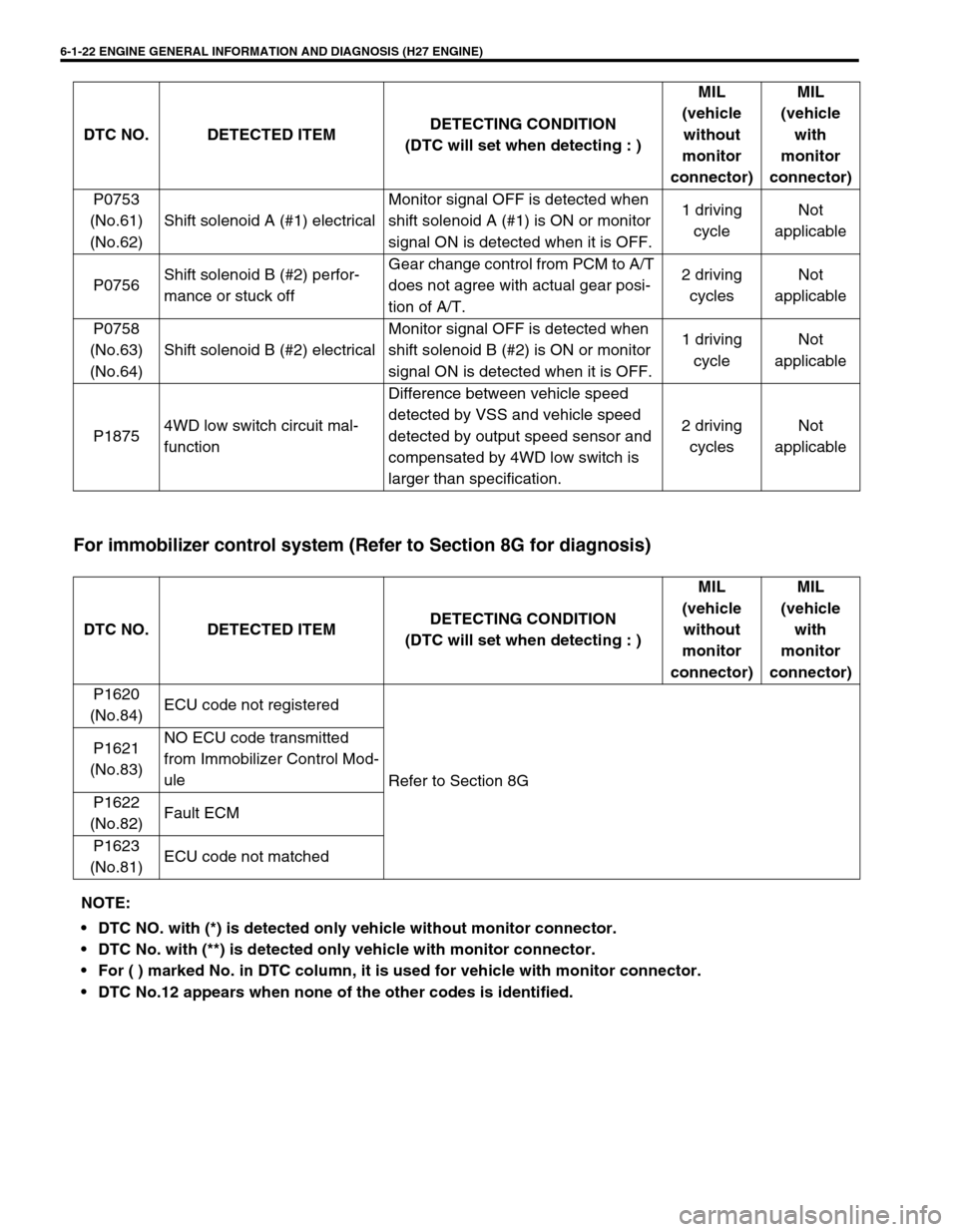
For immobilizer control system (Refer to Section 8G for diagnosis)
P0753
(No.61)
(No.62)Shift solenoid A (#1) electricalMonitor signal OFF is detected when
shift solenoid A (#1) is ON or monitor
signal ON is detected when it is OFF.1 driving
cycleNot
applicable
P0756Shift solenoid B (#2) perfor-
mance or stuck offGear change control from PCM to A/T
does not agree with actual gear posi-
tion of A/T.2 driving
cyclesNot
applicable
P0758
(No.63)
(No.64)Shift solenoid B (#2) electricalMonitor signal OFF is detected when
shift solenoid B (#2) is ON or monitor
signal ON is detected when it is OFF.1 driving
cycleNot
applicable
P18754WD low switch circuit mal-
functionDifference between vehicle speed
detected by VSS and vehicle speed
detected by output speed sensor and
compensated by 4WD low switch is
larger than specification.2 driving
cyclesNot
applicable DTC NO. DETECTED ITEMDETECTING CONDITION
(DTC will set when detecting : )MIL
(vehicle
without
monitor
connector)MIL
(vehicle
with
monitor
connector)
DTC NO. DETECTED ITEMDETECTING CONDITION
(DTC will set when detecting : )MIL
(vehicle
without
monitor
connector)MIL
(vehicle
with
monitor
connector)
P1620
(No.84)ECU code not registered
Refer to Section 8G P1621
(No.83)NO ECU code transmitted
from Immobilizer Control Mod-
ule
P1622
(No.82)Fault ECM
P1623
(No.81)ECU code not matched
NOTE:
DTC NO. with (*) is detected only vehicle without monitor connector.
DTC No. with (**) is detected only vehicle with monitor connector.
For ( ) marked No. in DTC column, it is used for vehicle with monitor connector.
DTC No.12 appears when none of the other codes is identified.
Page 247 of 656
6-1-86 ENGINE GENERAL INFORMATION AND DIAGNOSIS (H27 ENGINE)
DTC P0340 (DTC No.42) Camshaft Position Sensor Circuit Malfunction
WIRING DIAGRAM
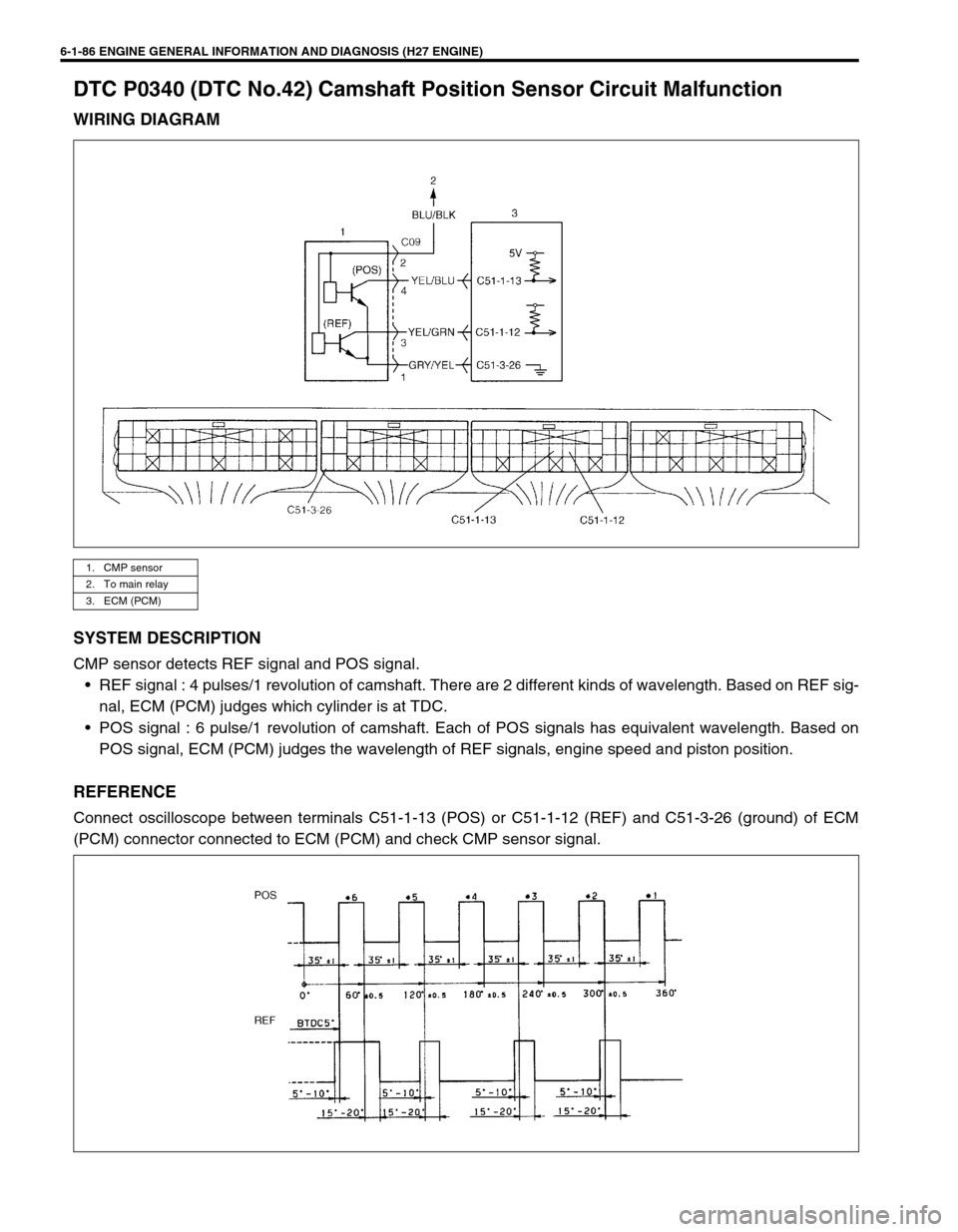
SYSTEM DESCRIPTION
CMP sensor detects REF signal and POS signal.
• REF signal : 4 pulses/1 revolution of camshaft. There are 2 different kinds of wavelength. Based on REF sig-
nal, ECM (PCM) judges which cylinder is at TDC.
• POS signal : 6 pulse/1 revolution of camshaft. Each of POS signals has equivalent wavelength. Based on
POS signal, ECM (PCM) judges the wavelength of REF signals, engine speed and piston position.
REFERENCE
Connect oscilloscope between terminals C51-1-13 (POS) or C51-1-12 (REF) and C51-3-26 (ground) of ECM
(PCM) connector connected to ECM (PCM) and check CMP sensor signal.
1. CMP sensor
2. To main relay
3. ECM (PCM)
Page 251 of 656
6-1-90 ENGINE GENERAL INFORMATION AND DIAGNOSIS (H27 ENGINE)
DTC DETECTING CONDITION AND TROUBLE AREA
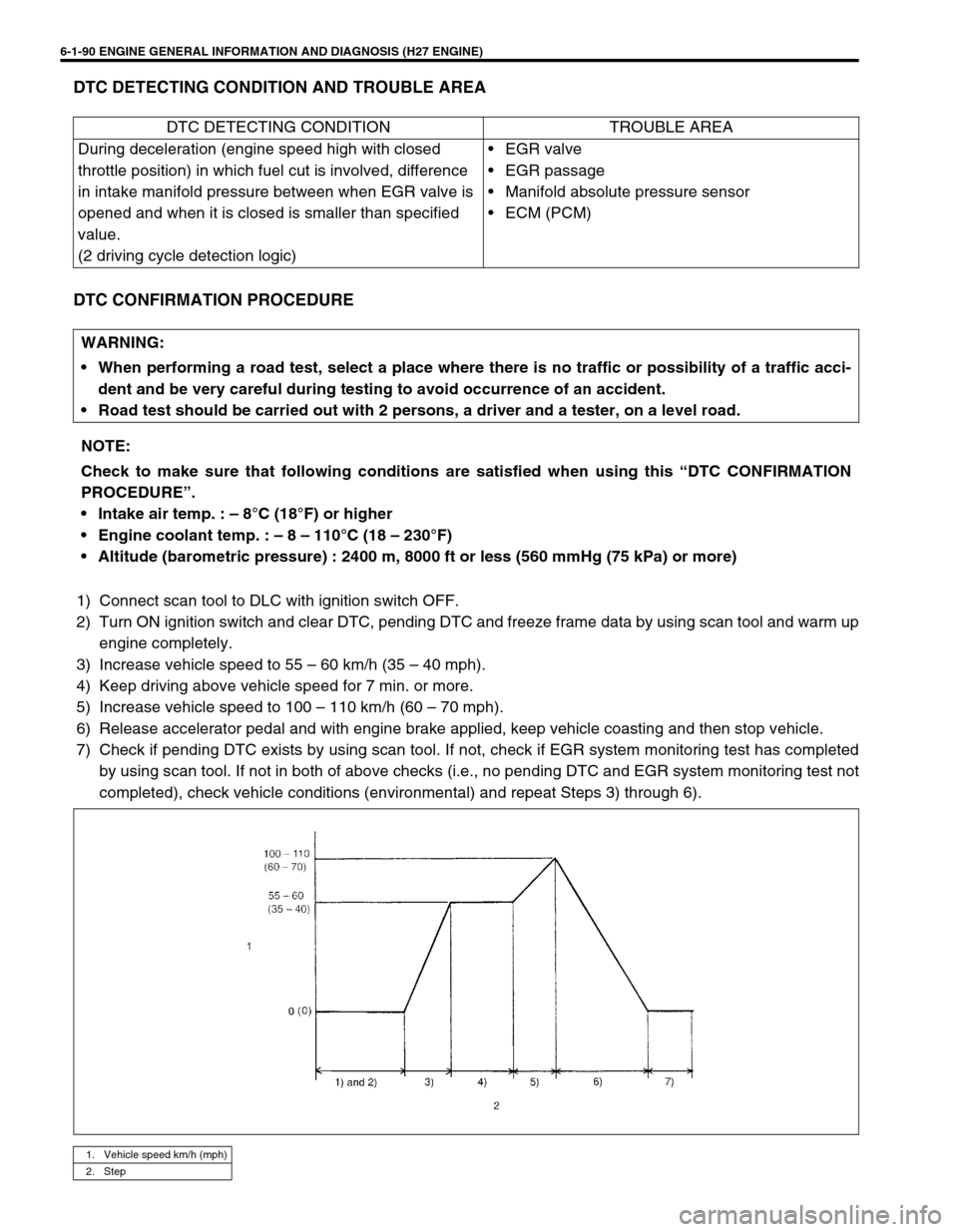
DTC CONFIRMATION PROCEDURE
1) Connect scan tool to DLC with ignition switch OFF.
2) Turn ON ignition switch and clear DTC, pending DTC and freeze frame data by using scan tool and warm up
engine completely.
3) Increase vehicle speed to 55 – 60 km/h (35 – 40 mph).
4) Keep driving above vehicle speed for 7 min. or more.
5) Increase vehicle speed to 100 – 110 km/h (60 – 70 mph).
6) Release accelerator pedal and with engine brake applied, keep vehicle coasting and then stop vehicle.
7) Check if pending DTC exists by using scan tool. If not, check if EGR system monitoring test has completed
by using scan tool. If not in both of above checks (i.e., no pending DTC and EGR system monitoring test not
completed), check vehicle conditions (environmental) and repeat Steps 3) through 6).DTC DETECTING CONDITION TROUBLE AREA
During deceleration (engine speed high with closed
throttle position) in which fuel cut is involved, difference
in intake manifold pressure between when EGR valve is
opened and when it is closed is smaller than specified
value.
(2 driving cycle detection logic)•EGR valve
• EGR passage
• Manifold absolute pressure sensor
•ECM (PCM)
WARNING:
When performing a road test, select a place where there is no traffic or possibility of a traffic acci-
dent and be very careful during testing to avoid occurrence of an accident.
Road test should be carried out with 2 persons, a driver and a tester, on a level road.
NOTE:
Check to make sure that following conditions are satisfied when using this “DTC CONFIRMATION
PROCEDURE”.
Intake air temp. : – 8°C (18°F) or higher
Engine coolant temp. : – 8 – 110°C (18 – 230°F)
Altitude (barometric pressure) : 2400 m, 8000 ft or less (560 mmHg (75 kPa) or more)
1. Vehicle speed km/h (mph)
2. Step