Lock SUZUKI GRAND VITARA 2001 2.G Workshop Manual
[x] Cancel search | Manufacturer: SUZUKI, Model Year: 2001, Model line: GRAND VITARA, Model: SUZUKI GRAND VITARA 2001 2.GPages: 656, PDF Size: 14.31 MB
Page 153 of 656
5E2-28 ANTILOCK BRAKE SYSTEM (ABS)
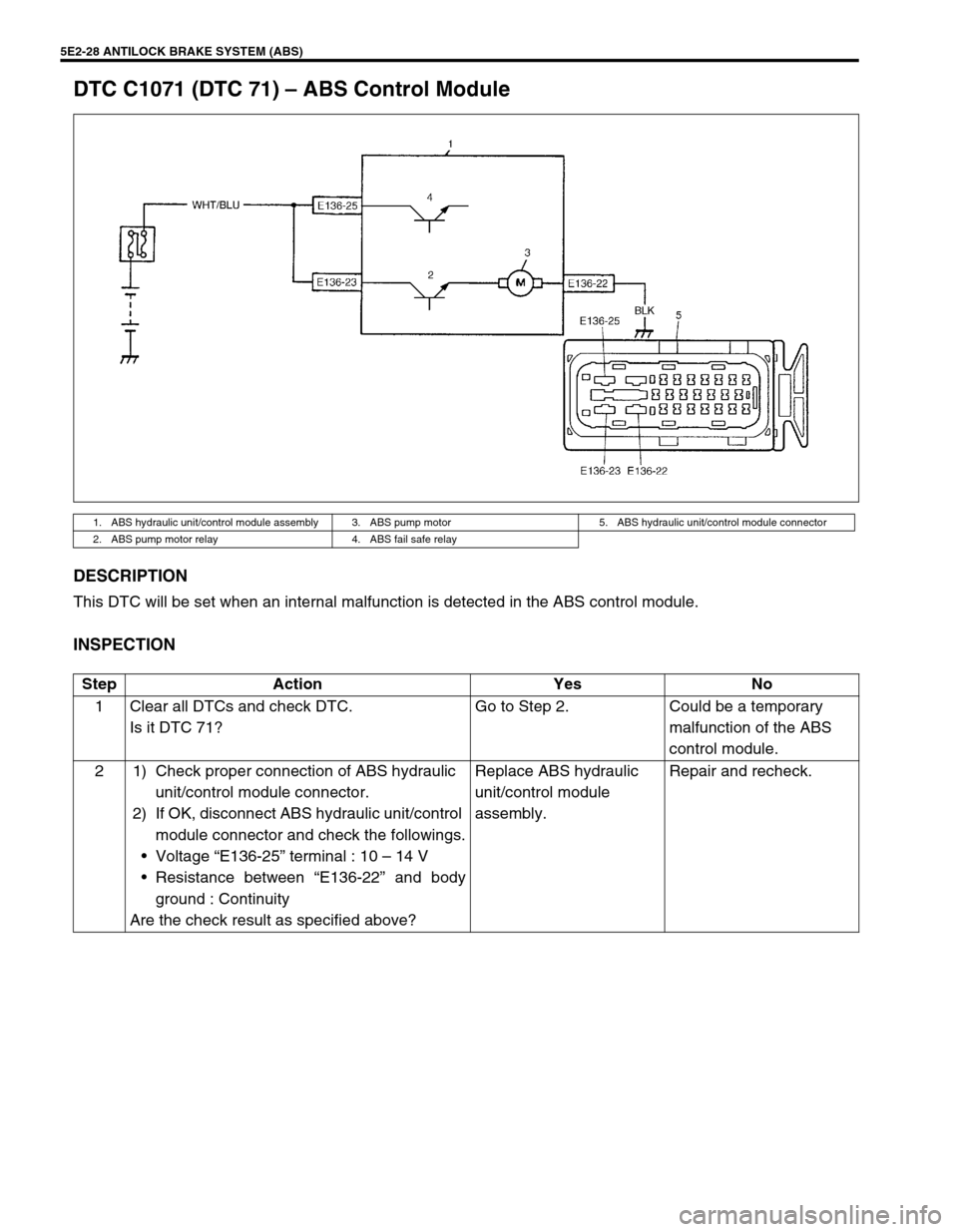
DTC C1071 (DTC 71) – ABS Control Module
DESCRIPTION
This DTC will be set when an internal malfunction is detected in the ABS control module.
INSPECTION
1. ABS hydraulic unit/control module assembly 3. ABS pump motor 5. ABS hydraulic unit/control module connector
2. ABS pump motor relay 4. ABS fail safe relay
Step Action Yes No
1 Clear all DTCs and check DTC.
Is it DTC 71?Go to Step 2. Could be a temporary
malfunction of the ABS
control module.
2 1) Check proper connection of ABS hydraulic
unit/control module connector.
2) If OK, disconnect ABS hydraulic unit/control
module connector and check the followings.
Voltage “E136-25” terminal : 10 – 14 V
Resistance between “E136-22” and body
ground : Continuity
Are the check result as specified above?Replace ABS hydraulic
unit/control module
assembly.Repair and recheck.
Page 154 of 656
ANTILOCK BRAKE SYSTEM (ABS) 5E2-29
On-Vehicle Service
Precautions
When connector are connected to ABS hydraulic unit/control
module assembly, do not disconnect connectors of sensors and
turn ignition switch ON. Then DTC will be set in ABS control mod-
ule.
ABS Hydraulic Unit Operation Check (Using
SUZUKI Scan Tool)
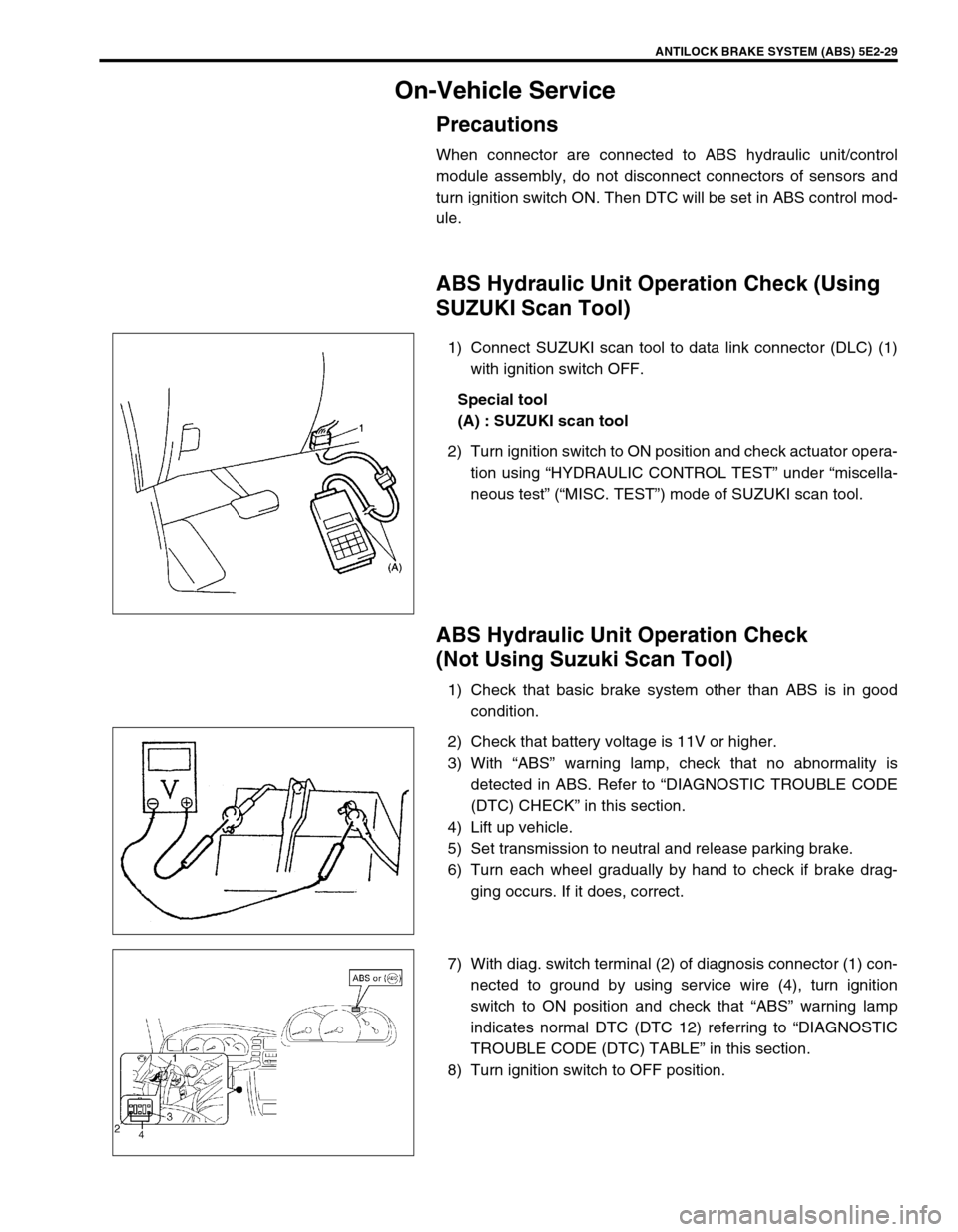
1) Connect SUZUKI scan tool to data link connector (DLC) (1)
with ignition switch OFF.
Special tool
(A) : SUZUKI scan tool
2) Turn ignition switch to ON position and check actuator opera-
tion using “HYDRAULIC CONTROL TEST” under “miscella-
neous test” (“MISC. TEST”) mode of SUZUKI scan tool.
ABS Hydraulic Unit Operation Check
(Not Using Suzuki Scan Tool)
1) Check that basic brake system other than ABS is in good
condition.
2) Check that battery voltage is 11V or higher.
3) With “ABS” warning lamp, check that no abnormality is
detected in ABS. Refer to “DIAGNOSTIC TROUBLE CODE
(DTC) CHECK” in this section.
4) Lift up vehicle.
5) Set transmission to neutral and release parking brake.
6) Turn each wheel gradually by hand to check if brake drag-
ging occurs. If it does, correct.
7) With diag. switch terminal (2) of diagnosis connector (1) con-
nected to ground by using service wire (4), turn ignition
switch to ON position and check that “ABS” warning lamp
indicates normal DTC (DTC 12) referring to “DIAGNOSTIC
TROUBLE CODE (DTC) TABLE” in this section.
8) Turn ignition switch to OFF position.
Page 155 of 656
5E2-30 ANTILOCK BRAKE SYSTEM (ABS)
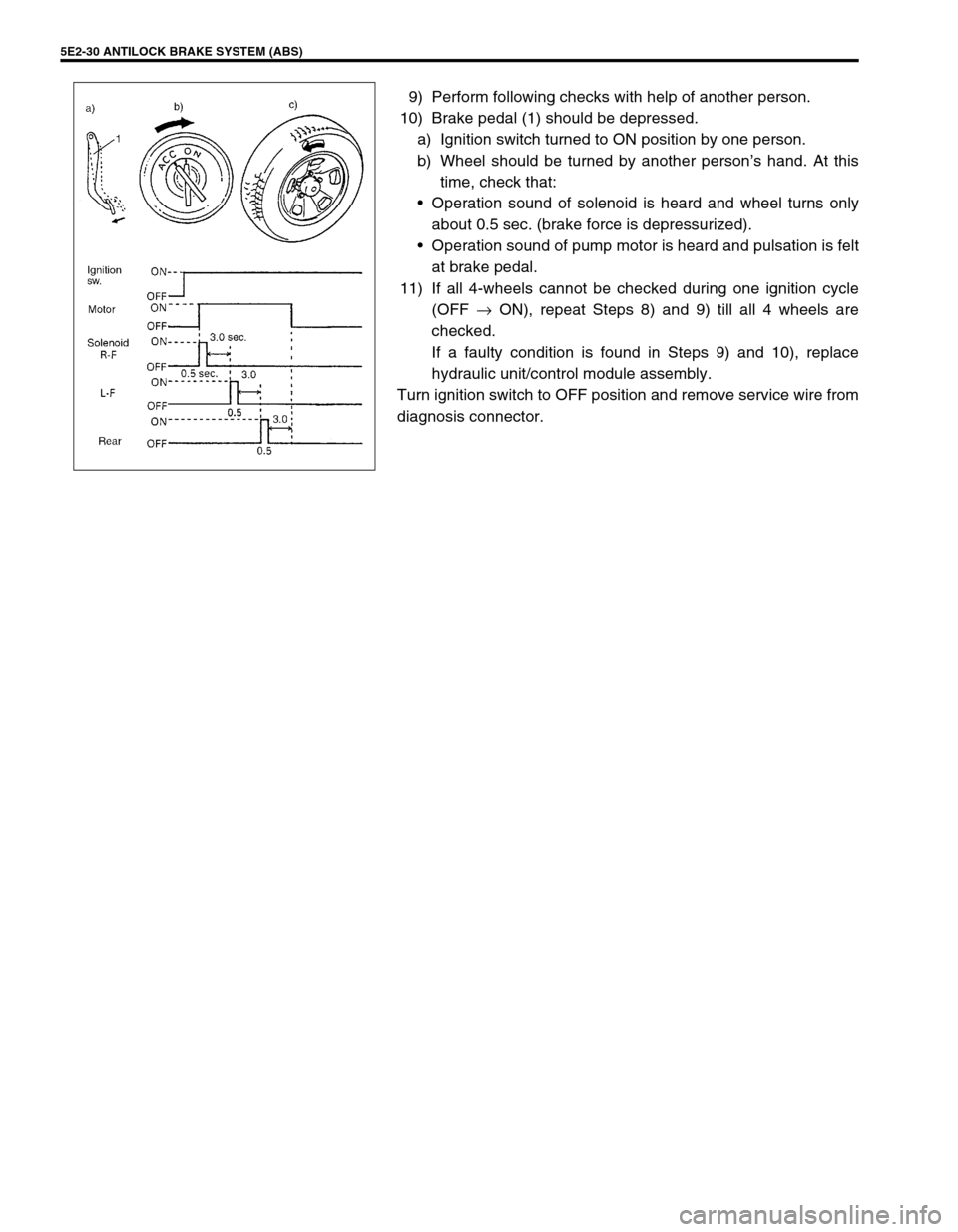
9) Perform following checks with help of another person.
10) Brake pedal (1) should be depressed.
a) Ignition switch turned to ON position by one person.
b) Wheel should be turned by another person’s hand. At this
time, check that:
Operation sound of solenoid is heard and wheel turns only
about 0.5 sec. (brake force is depressurized).
Operation sound of pump motor is heard and pulsation is felt
at brake pedal.
11) If all 4-wheels cannot be checked during one ignition cycle
(OFF → ON), repeat Steps 8) and 9) till all 4 wheels are
checked.
If a faulty condition is found in Steps 9) and 10), replace
hydraulic unit/control module assembly.
Turn ignition switch to OFF position and remove service wire from
diagnosis connector.
Page 156 of 656
ANTILOCK BRAKE SYSTEM (ABS) 5E2-31
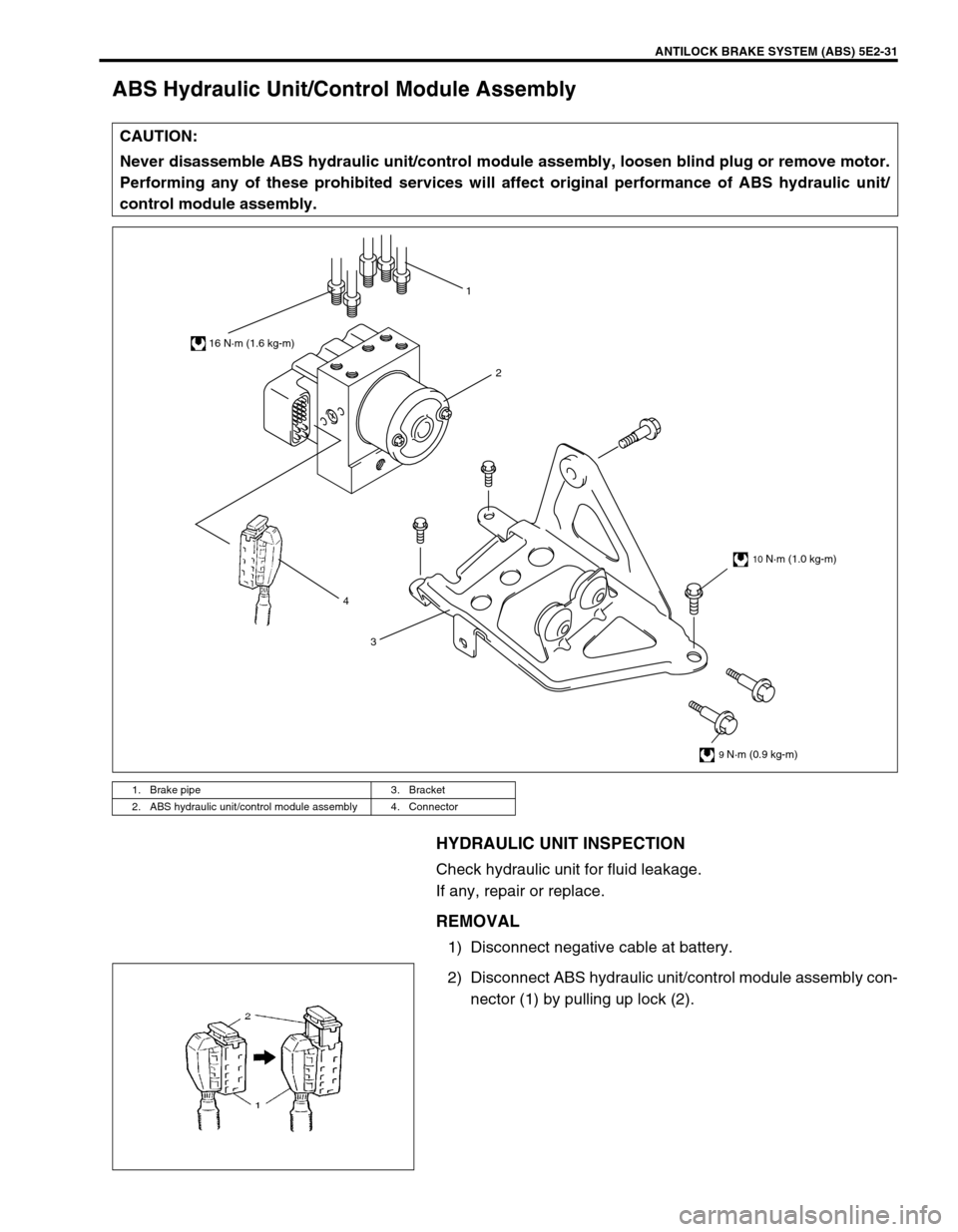
ABS Hydraulic Unit/Control Module Assembly
HYDRAULIC UNIT INSPECTION
Check hydraulic unit for fluid leakage.
If any, repair or replace.
REMOVAL
1) Disconnect negative cable at battery.
2) Disconnect ABS hydraulic unit/control module assembly con-
nector (1) by pulling up lock (2). CAUTION:
Never disassemble ABS hydraulic unit/control module assembly, loosen blind plug or remove motor.
Performing any of these prohibited services will affect original performance of ABS hydraulic unit/
control module assembly.
1. Brake pipe 3. Bracket
2. ABS hydraulic unit/control module assembly 4. Connector
4
32 1
16 N·m (1.6 kg-m)
10 N·m (1.0 kg-m)
9 N·m (0.9 kg-m)
Page 157 of 656
5E2-32 ANTILOCK BRAKE SYSTEM (ABS)
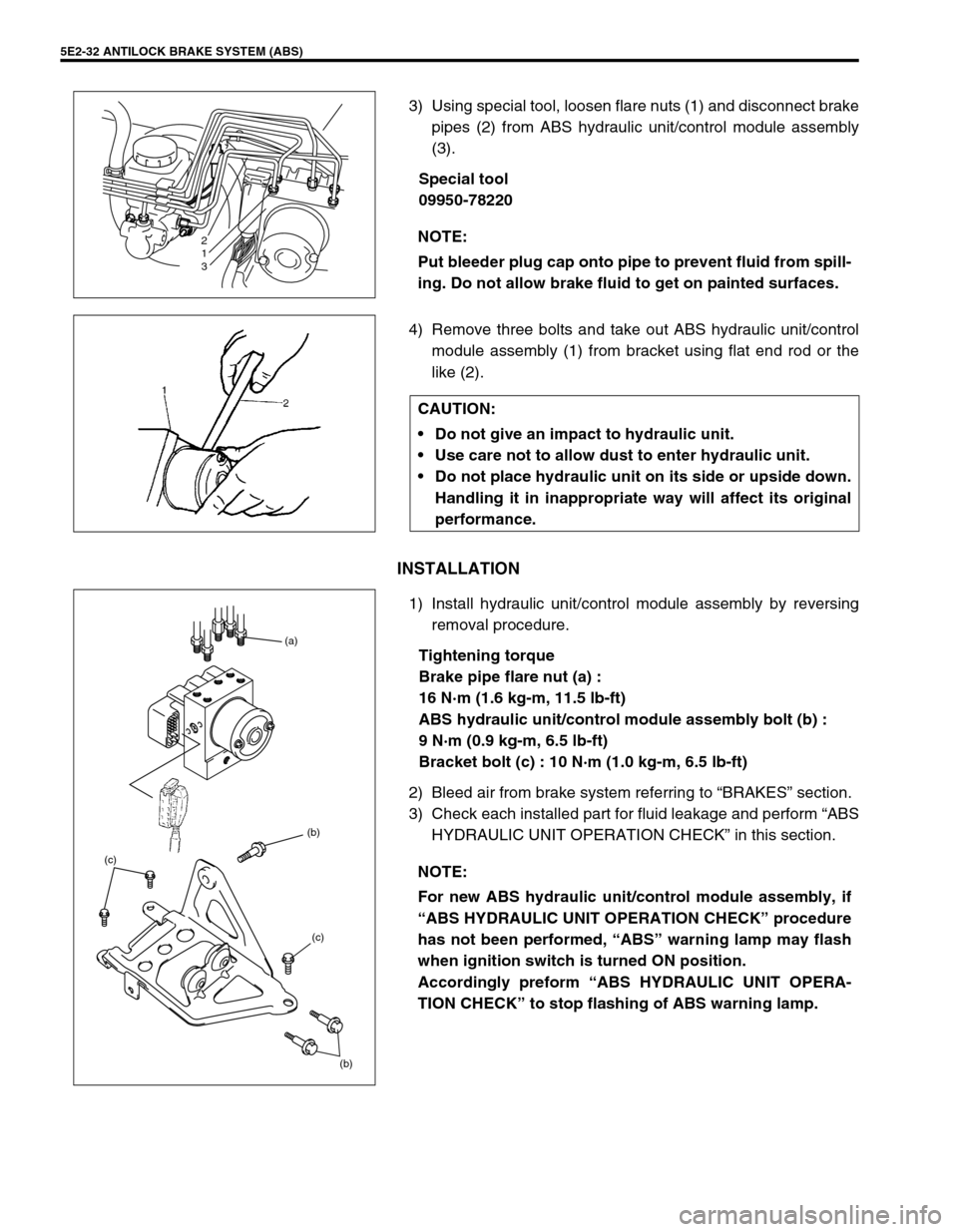
3) Using special tool, loosen flare nuts (1) and disconnect brake
pipes (2) from ABS hydraulic unit/control module assembly
(3).
Special tool
09950-78220
4) Remove three bolts and take out ABS hydraulic unit/control
module assembly (1) from bracket using flat end rod or the
like (2).
INSTALLATION
1) Install hydraulic unit/control module assembly by reversing
removal procedure.
Tightening torque
Brake pipe flare nut (a) :
16 N·m (1.6 kg-m, 11.5 lb-ft)
ABS hydraulic unit/control module assembly bolt (b) :
9 N·m (0.9 kg-m, 6.5 lb-ft)
Bracket bolt (c) : 10 N·m (1.0 kg-m, 6.5 lb-ft)
2) Bleed air from brake system referring to “BRAKES” section.
3) Check each installed part for fluid leakage and perform “ABS
HYDRAULIC UNIT OPERATION CHECK” in this section. NOTE:
Put bleeder plug cap onto pipe to prevent fluid from spill-
ing. Do not allow brake fluid to get on painted surfaces.
2
1
3
CAUTION:
Do not give an impact to hydraulic unit.
Use care not to allow dust to enter hydraulic unit.
Do not place hydraulic unit on its side or upside down.
Handling it in inappropriate way will affect its original
performance.
NOTE:
For new ABS hydraulic unit/control module assembly, if
“ABS HYDRAULIC UNIT OPERATION CHECK” procedure
has not been performed, “ABS” warning lamp may flash
when ignition switch is turned ON position.
Accordingly preform “ABS HYDRAULIC UNIT OPERA-
TION CHECK” to stop flashing of ABS warning lamp.
(b) (b) (a)
(c) (c)
Page 158 of 656
ANTILOCK BRAKE SYSTEM (ABS) 5E2-33
Rear Sensor Rotor (Retainer Ring)
REMOVAL
1) Remove rear axle shaft assembly. Refer to “REAR AXLE
SHAFT” in Section 3E.
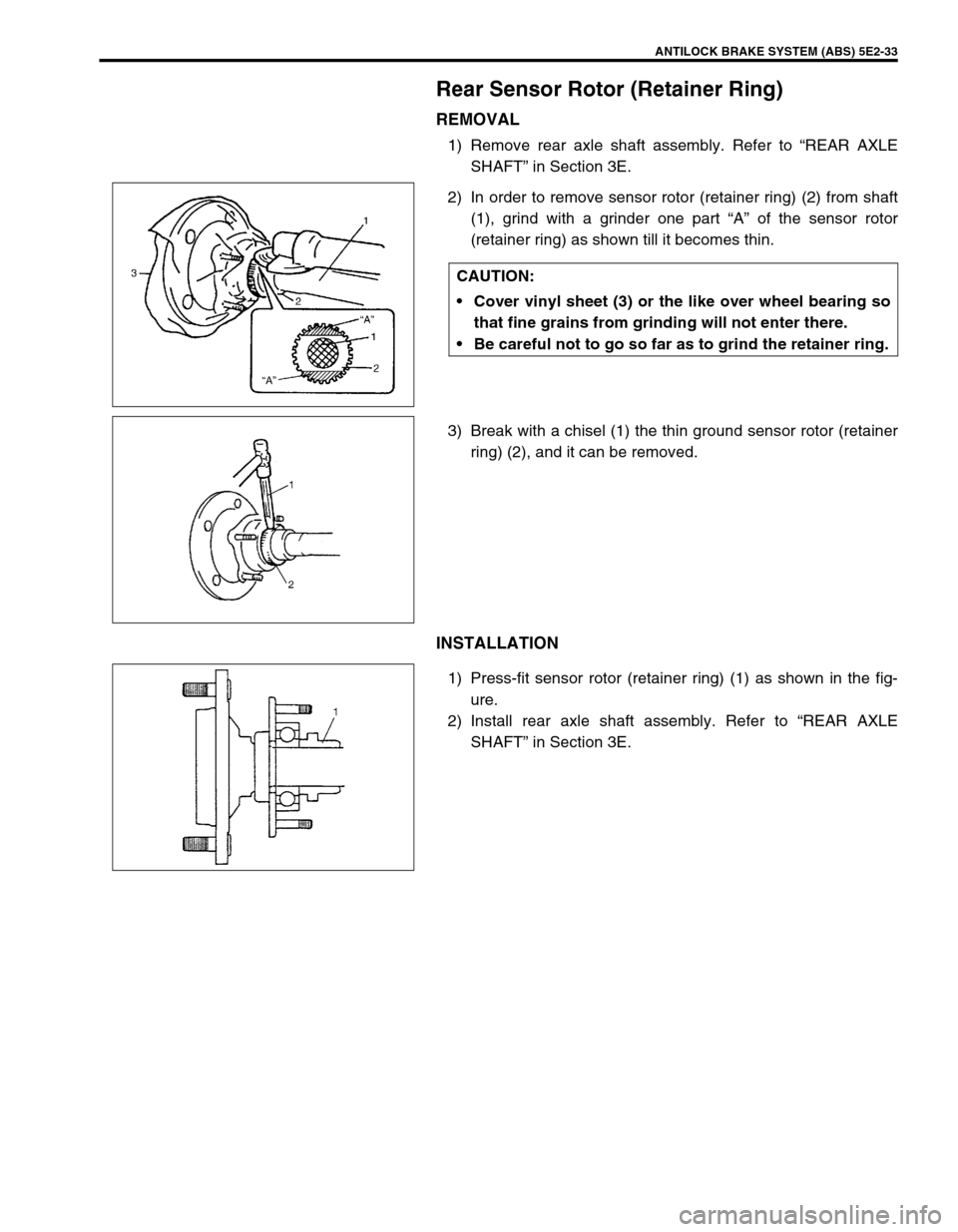
2) In order to remove sensor rotor (retainer ring) (2) from shaft
(1), grind with a grinder one part “A” of the sensor rotor
(retainer ring) as shown till it becomes thin.
3) Break with a chisel (1) the thin ground sensor rotor (retainer
ring) (2), and it can be removed.
INSTALLATION
1) Press-fit sensor rotor (retainer ring) (1) as shown in the fig-
ure.
2) Install rear axle shaft assembly. Refer to “REAR AXLE
SHAFT” in Section 3E. CAUTION:
Cover vinyl sheet (3) or the like over wheel bearing so
that fine grains from grinding will not enter there.
Be careful not to go so far as to grind the retainer ring.
Page 159 of 656
5E2-34 ANTILOCK BRAKE SYSTEM (ABS)
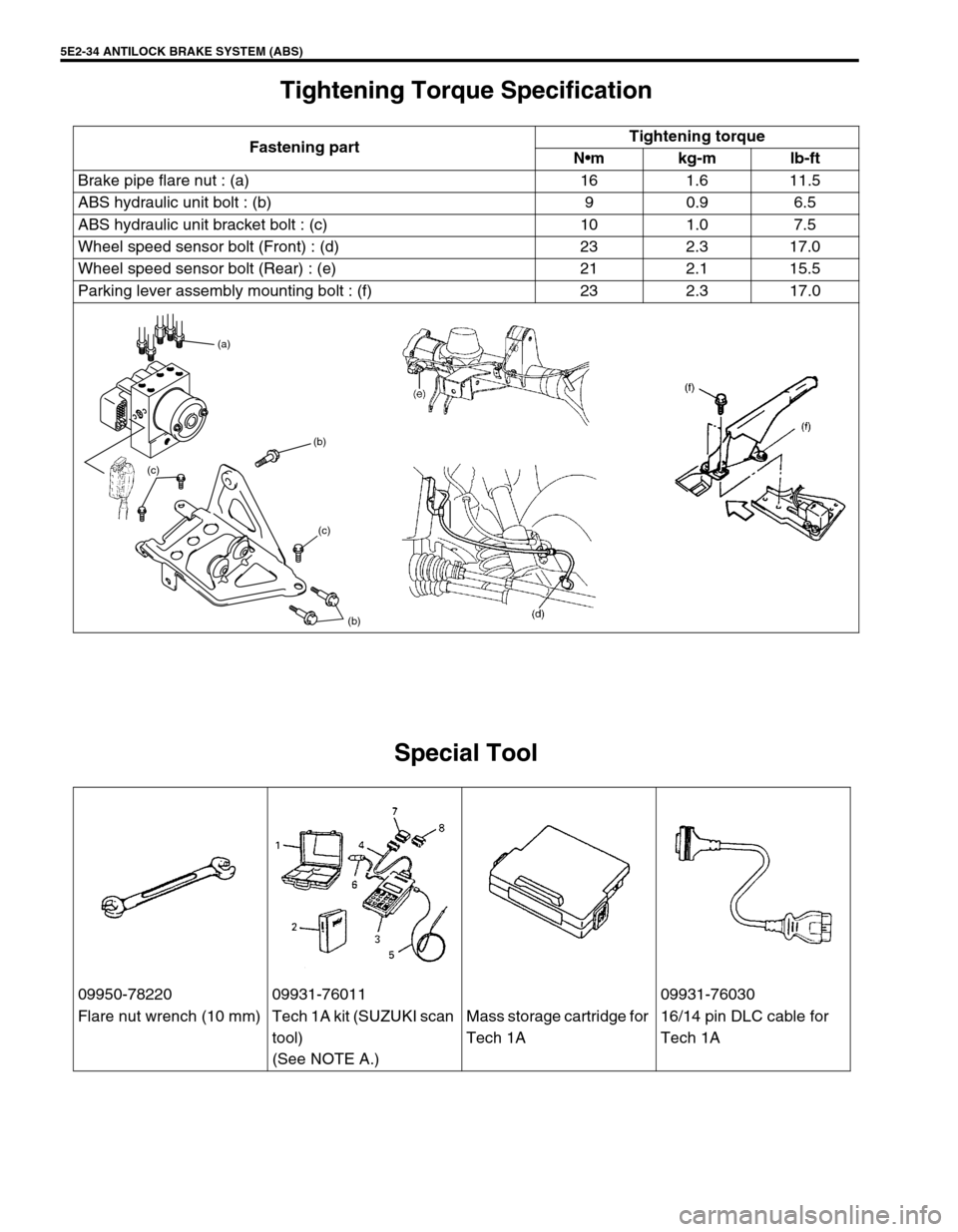
Tightening Torque Specification
Special Tool
Fastening partTightening torque
Nm kg-m lb-ft
Brake pipe flare nut : (a) 16 1.6 11.5
ABS hydraulic unit bolt : (b) 9 0.9 6.5
ABS hydraulic unit bracket bolt : (c) 10 1.0 7.5
Wheel speed sensor bolt (Front) : (d) 23 2.3 17.0
Wheel speed sensor bolt (Rear) : (e) 21 2.1 15.5
Parking lever assembly mounting bolt : (f) 23 2.3 17.0
(b) (b) (a)
(c) (c)
09950-78220 09931-76011 09931-76030
Flare nut wrench (10 mm) Tech 1A kit (SUZUKI scan
tool)
(See NOTE A.)Mass storage cartridge for
Tech 1A16/14 pin DLC cable for
Tech 1A
Page 160 of 656
ANTILOCK BRAKE SYSTEM (ABS) 5E2-35
Tech 2 kit (SUZUKI scan
tool) (See NOTE B.)
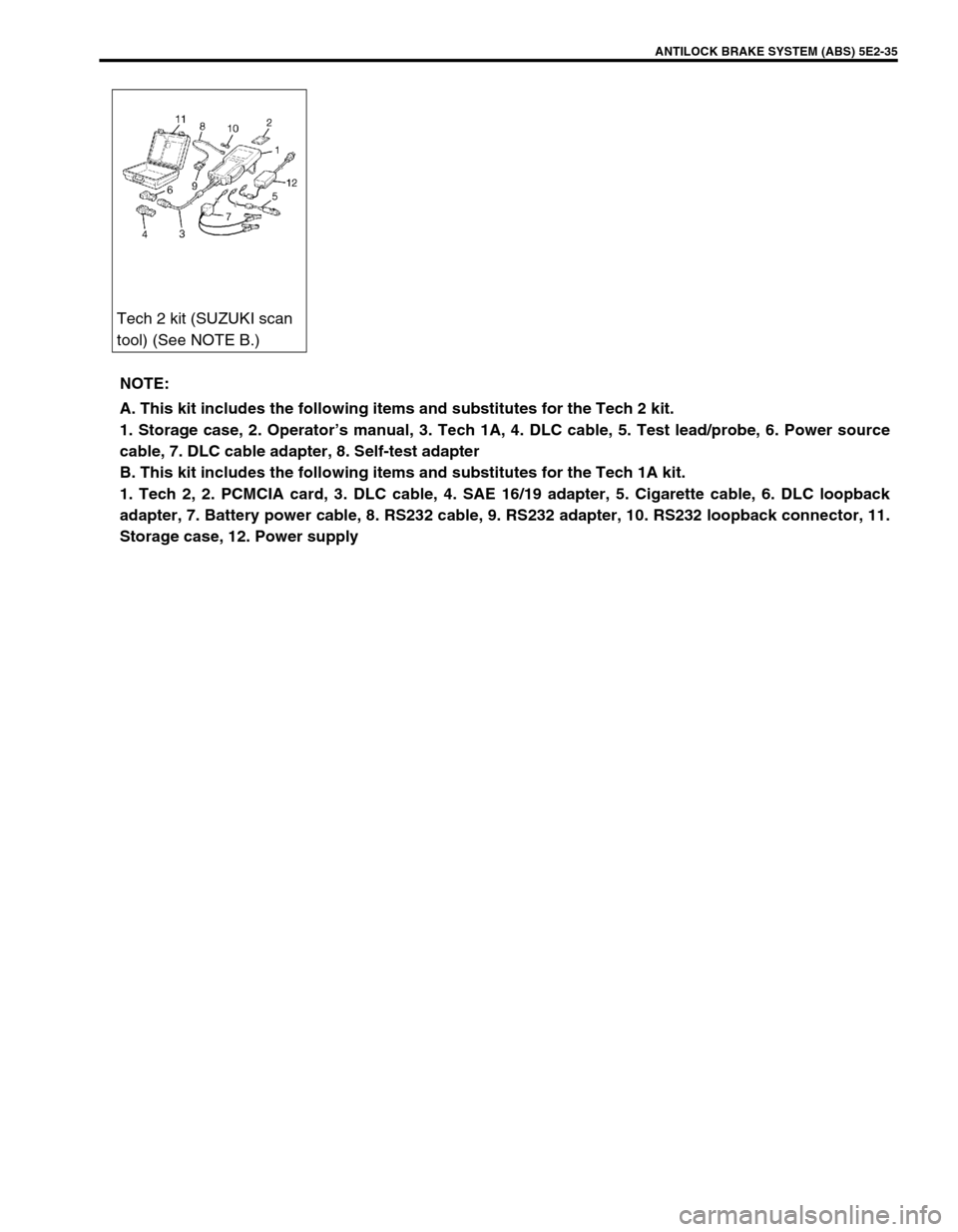
NOTE:
A. This kit includes the following items and substitutes for the Tech 2 kit.
1. Storage case, 2. Operator’s manual, 3. Tech 1A, 4. DLC cable, 5. Test lead/probe, 6. Power source
cable, 7. DLC cable adapter, 8. Self-test adapter
B. This kit includes the following items and substitutes for the Tech 1A kit.
1. Tech 2, 2. PCMCIA card, 3. DLC cable, 4. SAE 16/19 adapter, 5. Cigarette cable, 6. DLC loopback
adapter, 7. Battery power cable, 8. RS232 cable, 9. RS232 adapter, 10. RS232 loopback connector, 11.
Storage case, 12. Power supply
Page 161 of 656

5E2-36 ANTILOCK BRAKE SYSTEM (ABS)
Page 162 of 656
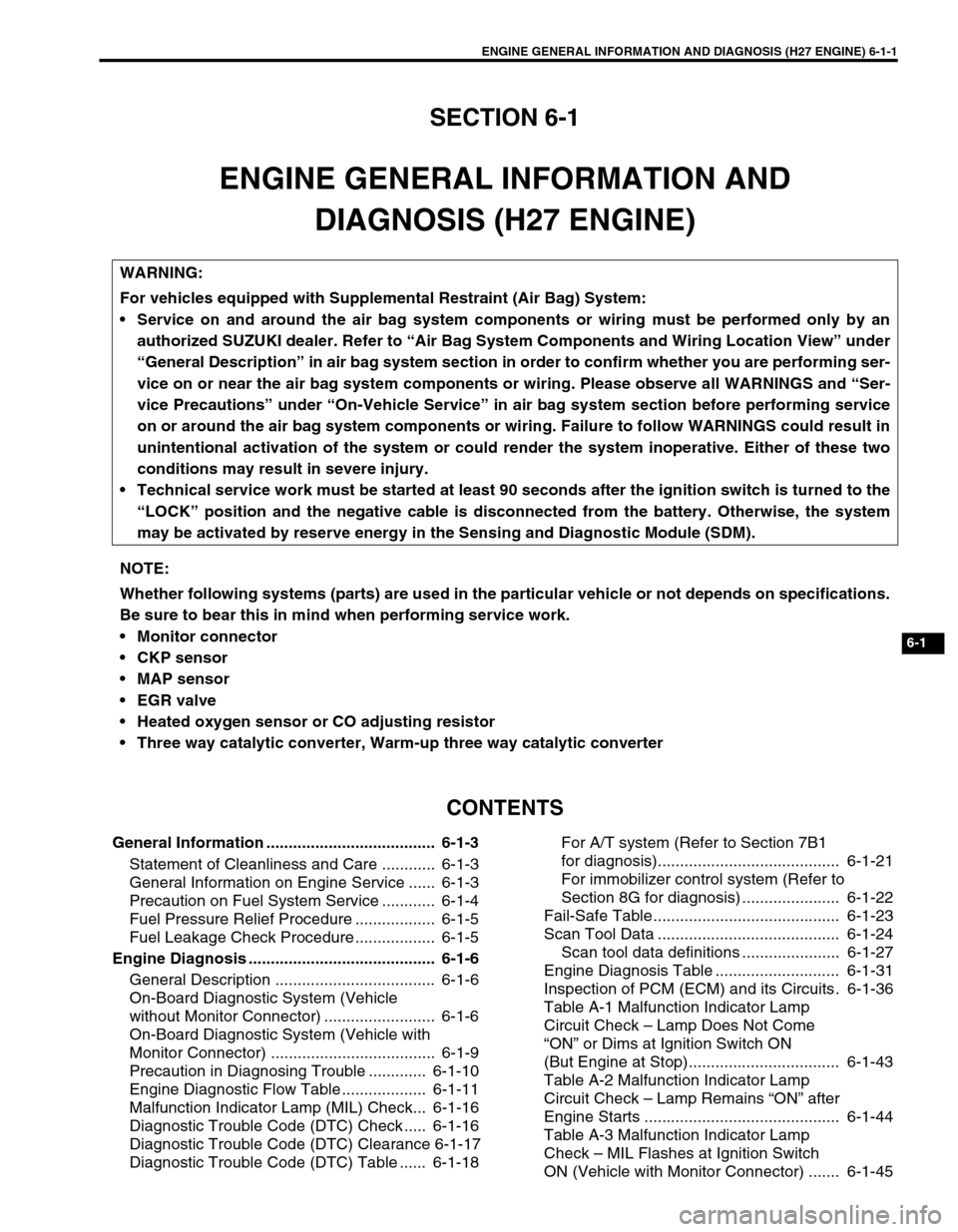
ENGINE GENERAL INFORMATION AND DIAGNOSIS (H27 ENGINE) 6-1-1
6-1
SECTION 6-1
ENGINE GENERAL INFORMATION AND
DIAGNOSIS (H27 ENGINE)
CONTENTS
General Information ...................................... 6-1-3
Statement of Cleanliness and Care ............ 6-1-3
General Information on Engine Service ...... 6-1-3
Precaution on Fuel System Service ............ 6-1-4
Fuel Pressure Relief Procedure .................. 6-1-5
Fuel Leakage Check Procedure .................. 6-1-5
Engine Diagnosis .......................................... 6-1-6
General Description .................................... 6-1-6
On-Board Diagnostic System (Vehicle
without Monitor Connector) ......................... 6-1-6
On-Board Diagnostic System (Vehicle with
Monitor Connector) ..................................... 6-1-9
Precaution in Diagnosing Trouble ............. 6-1-10
Engine Diagnostic Flow Table ................... 6-1-11
Malfunction Indicator Lamp (MIL) Check... 6-1-16
Diagnostic Trouble Code (DTC) Check ..... 6-1-16
Diagnostic Trouble Code (DTC) Clearance 6-1-17
Diagnostic Trouble Code (DTC) Table ...... 6-1-18For A/T system (Refer to Section 7B1
for diagnosis)......................................... 6-1-21
For immobilizer control system (Refer to
Section 8G for diagnosis) ...................... 6-1-22
Fail-Safe Table.......................................... 6-1-23
Scan Tool Data ......................................... 6-1-24
Scan tool data definitions ...................... 6-1-27
Engine Diagnosis Table ............................ 6-1-31
Inspection of PCM (ECM) and its Circuits. 6-1-36
Table A-1 Malfunction Indicator Lamp
Circuit Check – Lamp Does Not Come
“ON” or Dims at Ignition Switch ON
(But Engine at Stop).................................. 6-1-43
Table A-2 Malfunction Indicator Lamp
Circuit Check – Lamp Remains “ON” after
Engine Starts ............................................ 6-1-44
Table A-3 Malfunction Indicator Lamp
Check – MIL Flashes at Ignition Switch
ON (Vehicle with Monitor Connector) ....... 6-1-45 WARNING:
For vehicles equipped with Supplemental Restraint (Air Bag) System:
Service on and around the air bag system components or wiring must be performed only by an
authorized SUZUKI dealer. Refer to “Air Bag System Components and Wiring Location View” under
“General Description” in air bag system section in order to confirm whether you are performing ser-
vice on or near the air bag system components or wiring. Please observe all WARNINGS and “Ser-
vice Precautions” under “On-Vehicle Service” in air bag system section before performing service
on or around the air bag system components or wiring. Failure to follow WARNINGS could result in
unintentional activation of the system or could render the system inoperative. Either of these two
conditions may result in severe injury.
Technical service work must be started at least 90 seconds after the ignition switch is turned to the
“LOCK” position and the negative cable is disconnected from the battery. Otherwise, the system
may be activated by reserve energy in the Sensing and Diagnostic Module (SDM).
NOTE:
Whether following systems (parts) are used in the particular vehicle or not depends on specifications.
Be sure to bear this in mind when performing service work.
Monitor connector
CKP sensor
MAP sensor
EGR valve
Heated oxygen sensor or CO adjusting resistor
Three way catalytic converter, Warm-up three way catalytic converter