Lock SUZUKI GRAND VITARA 2001 2.G Owners Manual
[x] Cancel search | Manufacturer: SUZUKI, Model Year: 2001, Model line: GRAND VITARA, Model: SUZUKI GRAND VITARA 2001 2.GPages: 656, PDF Size: 14.31 MB
Page 414 of 656
AUTOMATIC TRANSMISSION (4 A/T) 7B1-5
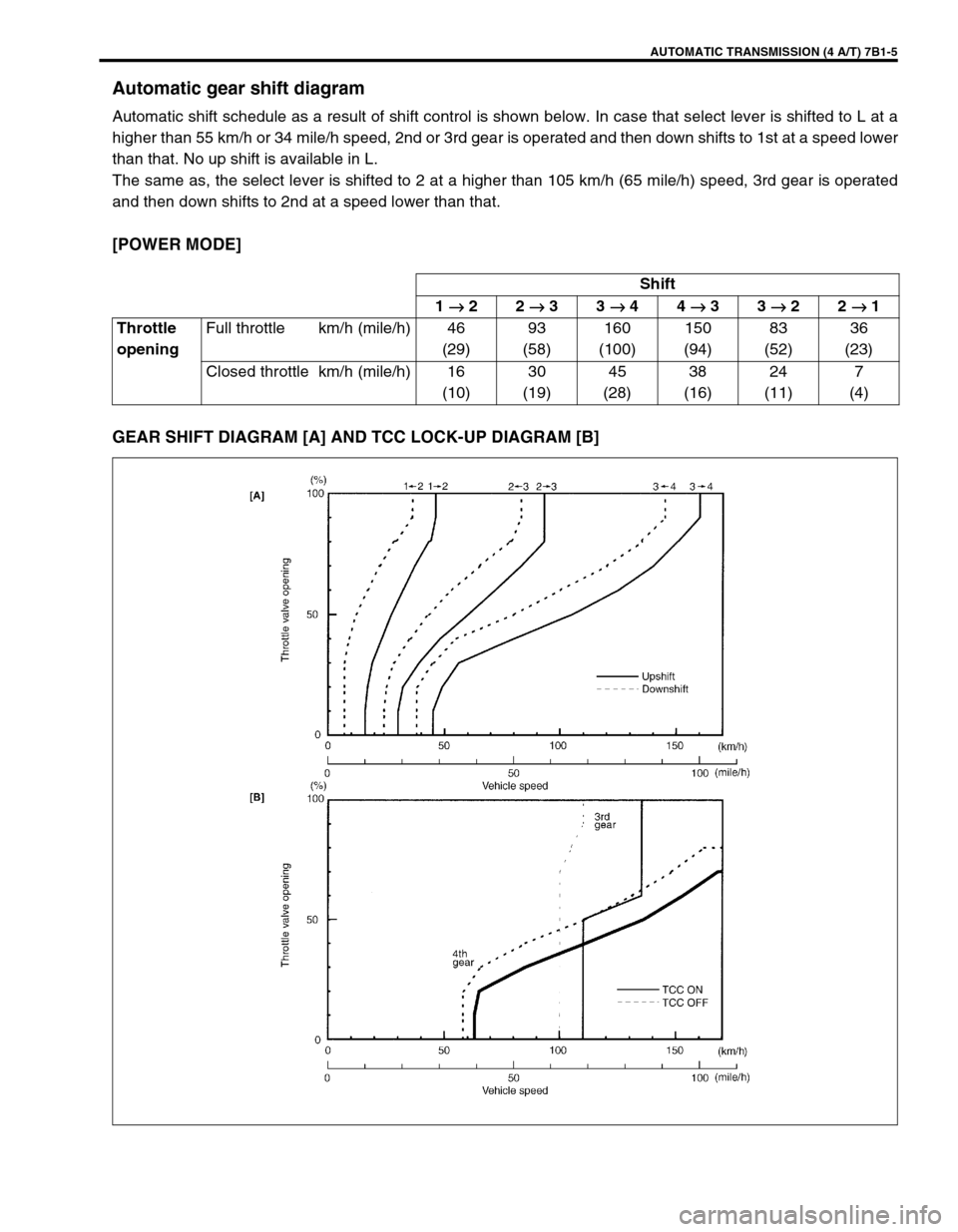
Automatic gear shift diagram
Automatic shift schedule as a result of shift control is shown below. In case that select lever is shifted to L at a
higher than 55 km/h or 34 mile/h speed, 2nd or 3rd gear is operated and then down shifts to 1st at a speed lower
than that. No up shift is available in L.
The same as, the select lever is shifted to 2 at a higher than 105 km/h (65 mile/h) speed, 3rd gear is operated
and then down shifts to 2nd at a speed lower than that.
[POWER MODE]
GEAR SHIFT DIAGRAM [A] AND TCC LOCK-UP DIAGRAM [B]
Shift
1 →
→→ → 22 →
→→ → 33 →
→→ → 44 →
→→ → 33 →
→→ → 22 →
→→ → 1
Throttle
openingFull throttle km/h (mile/h) 46
(29)93
(58)160
(100)150
(94)83
(52)36
(23)
Closed throttle km/h (mile/h) 16
(10)30
(19)45
(28)38
(16)24
(11)7
(4)
Page 415 of 656
![SUZUKI GRAND VITARA 2001 2.G Owners Manual 7B1-6 AUTOMATIC TRANSMISSION (4 A/T)
[NORMAL MODE]
GEAR SHIFT DIAGRAM [A] AND TCC LOCK-UP DIAGRAM [B]
Shift
1 →
→→ → 22 →
→→ → 33 →
→→ → 44 →
→→ → 33 →
→→ → 22](/img/20/7584/w960_7584-414.png "SUZUKI GRAND VITARA 2001 2.G Owners Manual 7B1-6 AUTOMATIC TRANSMISSION (4 A/T)
[NORMAL MODE]
GEAR SHIFT DIAGRAM [A] AND TCC LOCK-UP DIAGRAM [B]
Shift
1 →
→→ → 22 →
→→ → 33 →
→→ → 44 →
→→ → 33 →
→→ → 22")
7B1-6 AUTOMATIC TRANSMISSION (4 A/T)
[NORMAL MODE]
GEAR SHIFT DIAGRAM [A] AND TCC LOCK-UP DIAGRAM [B]
Shift
1 →
→→ → 22 →
→→ → 33 →
→→ → 44 →
→→ → 33 →
→→ → 22 →
→→ → 1
Throttle
openingFull throttle km/h (mile/h) 46
(29)93
(58)160
(100)150
(94)83
(52)36
(23)
Closed throttle km/h (mile/h) 11
(7)27
(17)40
(25)35
(22)21
(13)7
(4)
Page 425 of 656
7B1-16 AUTOMATIC TRANSMISSION (4 A/T)
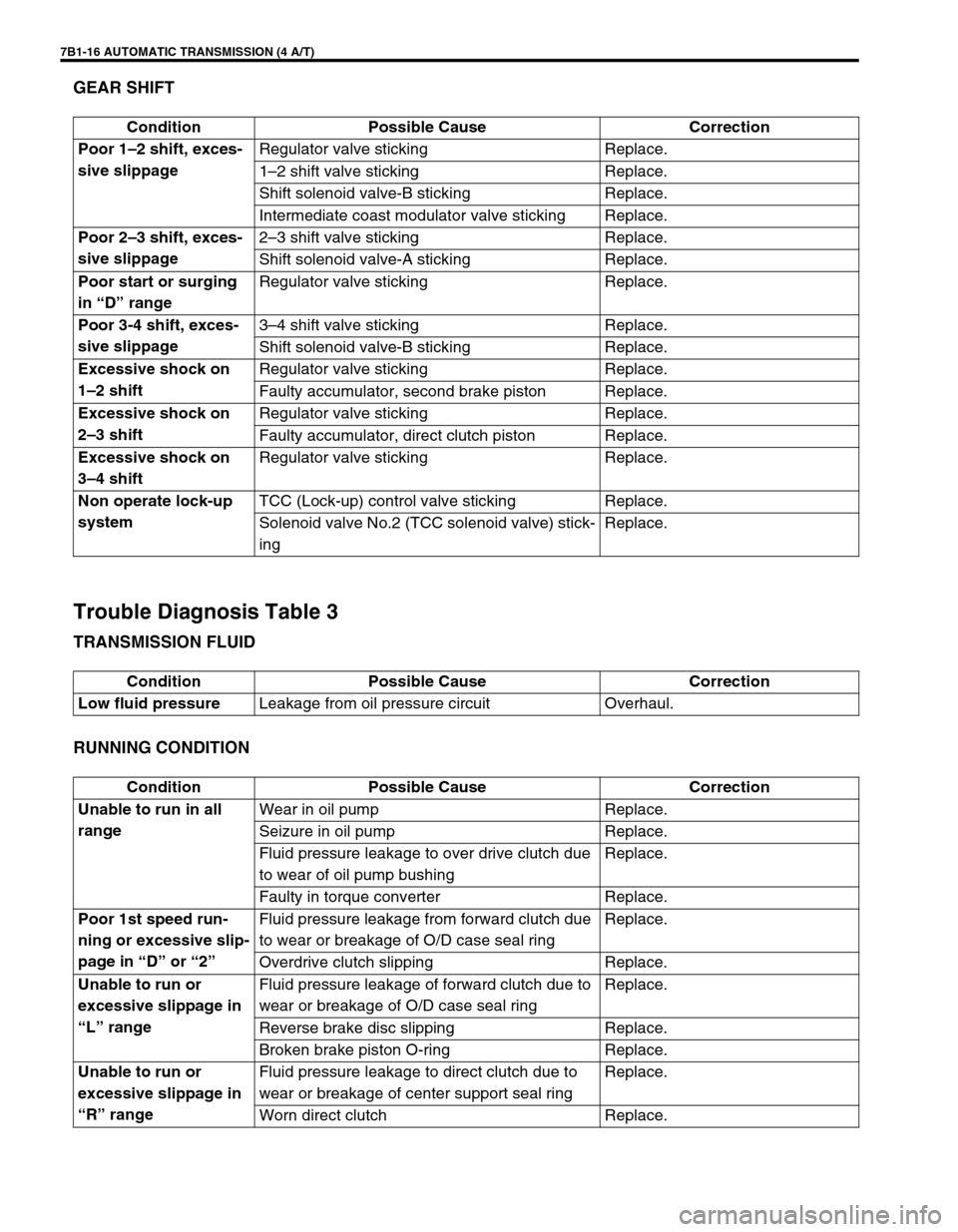
GEAR SHIFT
Trouble Diagnosis Table 3
TRANSMISSION FLUID
RUNNING CONDITION
Condition Possible Cause Correction
Poor 1–2 shift, exces-
sive slippageRegulator valve sticking Replace.
1–2 shift valve sticking Replace.
Shift solenoid valve-B sticking Replace.
Intermediate coast modulator valve sticking Replace.
Poor 2–3 shift, exces-
sive slippage2–3 shift valve sticking Replace.
Shift solenoid valve-A sticking Replace.
Poor start or surging
in “D” rangeRegulator valve sticking Replace.
Poor 3-4 shift, exces-
sive slippage3–4 shift valve sticking Replace.
Shift solenoid valve-B sticking Replace.
Excessive shock on
1–2 shiftRegulator valve sticking Replace.
Faulty accumulator, second brake piston Replace.
Excessive shock on
2–3 shiftRegulator valve sticking Replace.
Faulty accumulator, direct clutch piston Replace.
Excessive shock on
3–4 shiftRegulator valve sticking Replace.
Non operate lock-up
systemTCC (Lock-up) control valve sticking Replace.
Solenoid valve No.2 (TCC solenoid valve) stick-
ingReplace.
Condition Possible Cause Correction
Low fluid pressureLeakage from oil pressure circuit Overhaul.
Condition Possible Cause Correction
Unable to run in all
rangeWear in oil pump Replace.
Seizure in oil pump Replace.
Fluid pressure leakage to over drive clutch due
to wear of oil pump bushingReplace.
Faulty in torque converter Replace.
Poor 1st speed run-
ning or excessive slip-
page in “D” or “2”Fluid pressure leakage from forward clutch due
to wear or breakage of O/D case seal ringReplace.
Overdrive clutch slipping Replace.
Unable to run or
excessive slippage in
“L” rangeFluid pressure leakage of forward clutch due to
wear or breakage of O/D case seal ringReplace.
Reverse brake disc slipping Replace.
Broken brake piston O-ring Replace.
Unable to run or
excessive slippage in
“R” rangeFluid pressure leakage to direct clutch due to
wear or breakage of center support seal ringReplace.
Worn direct clutch Replace.
Page 426 of 656
AUTOMATIC TRANSMISSION (4 A/T) 7B1-17
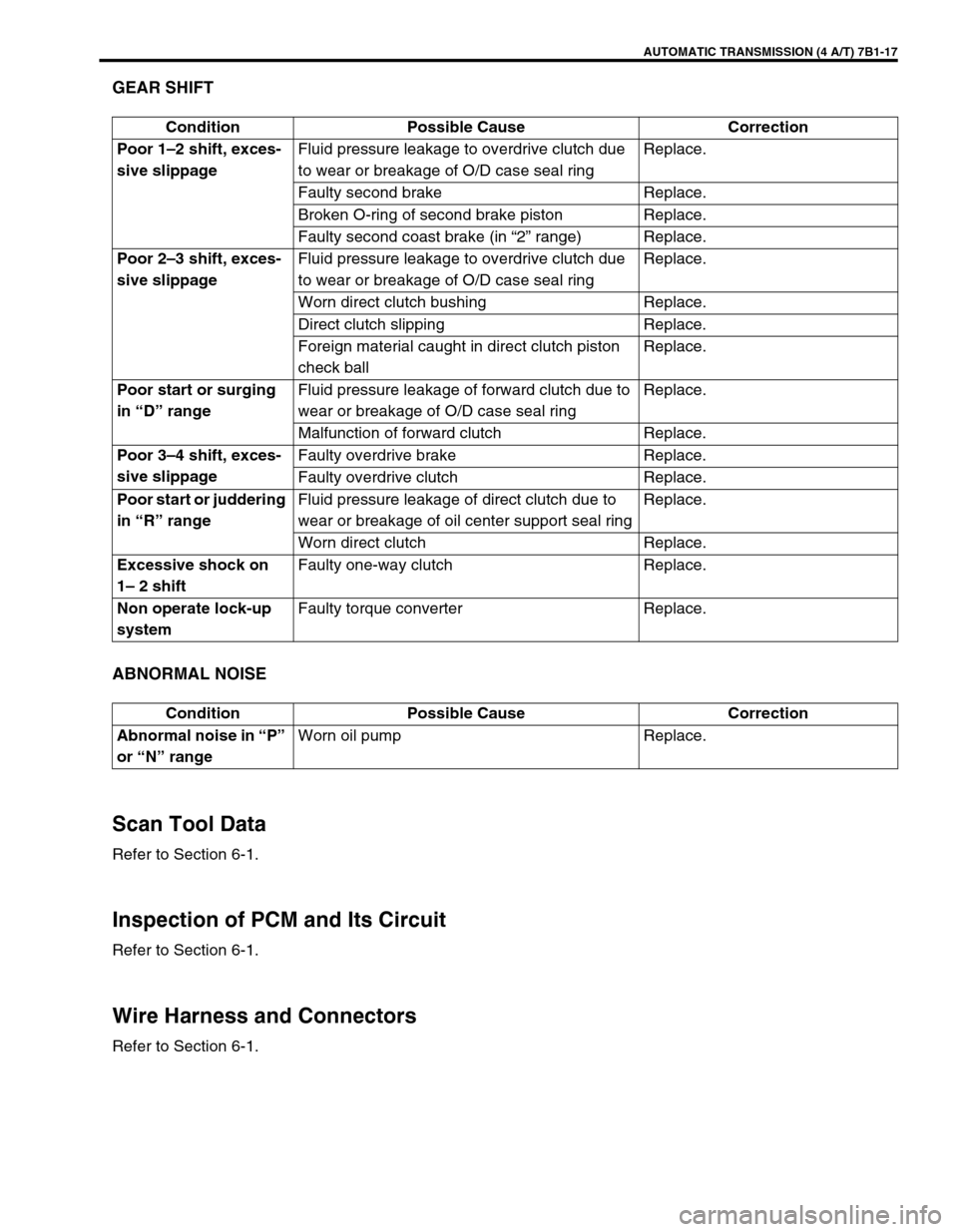
GEAR SHIFT
ABNORMAL NOISE
Scan Tool Data
Refer to Section 6-1.
Inspection of PCM and Its Circuit
Refer to Section 6-1.
Wire Harness and Connectors
Refer to Section 6-1.Condition Possible Cause Correction
Poor 1–2 shift, exces-
sive slippageFluid pressure leakage to overdrive clutch due
to wear or breakage of O/D case seal ringReplace.
Faulty second brake Replace.
Broken O-ring of second brake piston Replace.
Faulty second coast brake (in “2” range) Replace.
Poor 2–3 shift, exces-
sive slippageFluid pressure leakage to overdrive clutch due
to wear or breakage of O/D case seal ringReplace.
Worn direct clutch bushing Replace.
Direct clutch slipping Replace.
Foreign material caught in direct clutch piston
check ballReplace.
Poor start or surging
in “D” rangeFluid pressure leakage of forward clutch due to
wear or breakage of O/D case seal ringReplace.
Malfunction of forward clutch Replace.
Poor 3–4 shift, exces-
sive slippageFaulty overdrive brake Replace.
Faulty overdrive clutch Replace.
Poor start or juddering
in “R” rangeFluid pressure leakage of direct clutch due to
wear or breakage of oil center support seal ringReplace.
Worn direct clutch Replace.
Excessive shock on
1– 2 shiftFaulty one-way clutch Replace.
Non operate lock-up
systemFaulty torque converter Replace.
Condition Possible Cause Correction
Abnormal noise in “P”
or “N” rangeWorn oil pump Replace.
Page 427 of 656
7B1-18 AUTOMATIC TRANSMISSION (4 A/T)
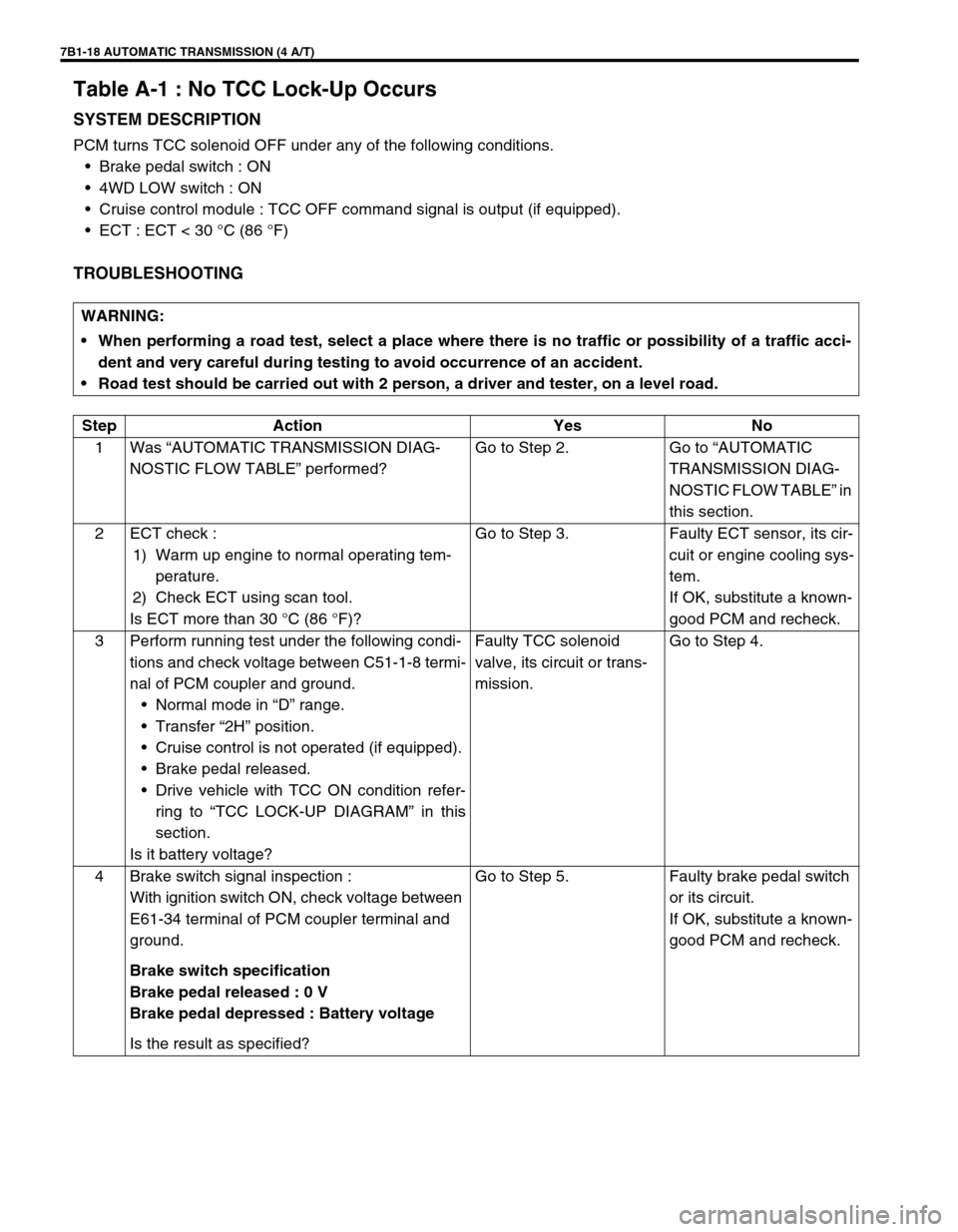
Table A-1 : No TCC Lock-Up Occurs
SYSTEM DESCRIPTION
PCM turns TCC solenoid OFF under any of the following conditions.
•Brake pedal switch : ON
•4WD LOW switch : ON
•Cruise control module : TCC OFF command signal is output (if equipped).
•ECT : ECT < 30 °C (86 °F)
TROUBLESHOOTING
WARNING:
When performing a road test, select a place where there is no traffic or possibility of a traffic acci-
dent and very careful during testing to avoid occurrence of an accident.
Road test should be carried out with 2 person, a driver and tester, on a level road.
Step Action Yes No
1Was “AUTOMATIC TRANSMISSION DIAG-
NOSTIC FLOW TABLE” performed?Go to Step 2. Go to “AUTOMATIC
TRANSMISSION DIAG-
NOSTIC FLOW TABLE” in
this section.
2 ECT check :
1) Warm up engine to normal operating tem-
perature.
2) Check ECT using scan tool.
Is ECT more than 30 °C (86 °F)?Go to Step 3. Faulty ECT sensor, its cir-
cuit or engine cooling sys-
tem.
If OK, substitute a known-
good PCM and recheck.
3 Perform running test under the following condi-
tions and check voltage between C51-1-8 termi-
nal of PCM coupler and ground.
•Normal mode in “D” range.
•Transfer “2H” position.
•Cruise control is not operated (if equipped).
•Brake pedal released.
•Drive vehicle with TCC ON condition refer-
ring to “TCC LOCK-UP DIAGRAM” in this
section.
Is it battery voltage?Faulty TCC solenoid
valve, its circuit or trans-
mission.Go to Step 4.
4 Brake switch signal inspection :
With ignition switch ON, check voltage between
E61-34 terminal of PCM coupler terminal and
ground.
Brake switch specification
Brake pedal released : 0 V
Brake pedal depressed : Battery voltage
Is the result as specified?Go to Step 5. Faulty brake pedal switch
or its circuit.
If OK, substitute a known-
good PCM and recheck.
Page 443 of 656
7B1-34 AUTOMATIC TRANSMISSION (4 A/T)
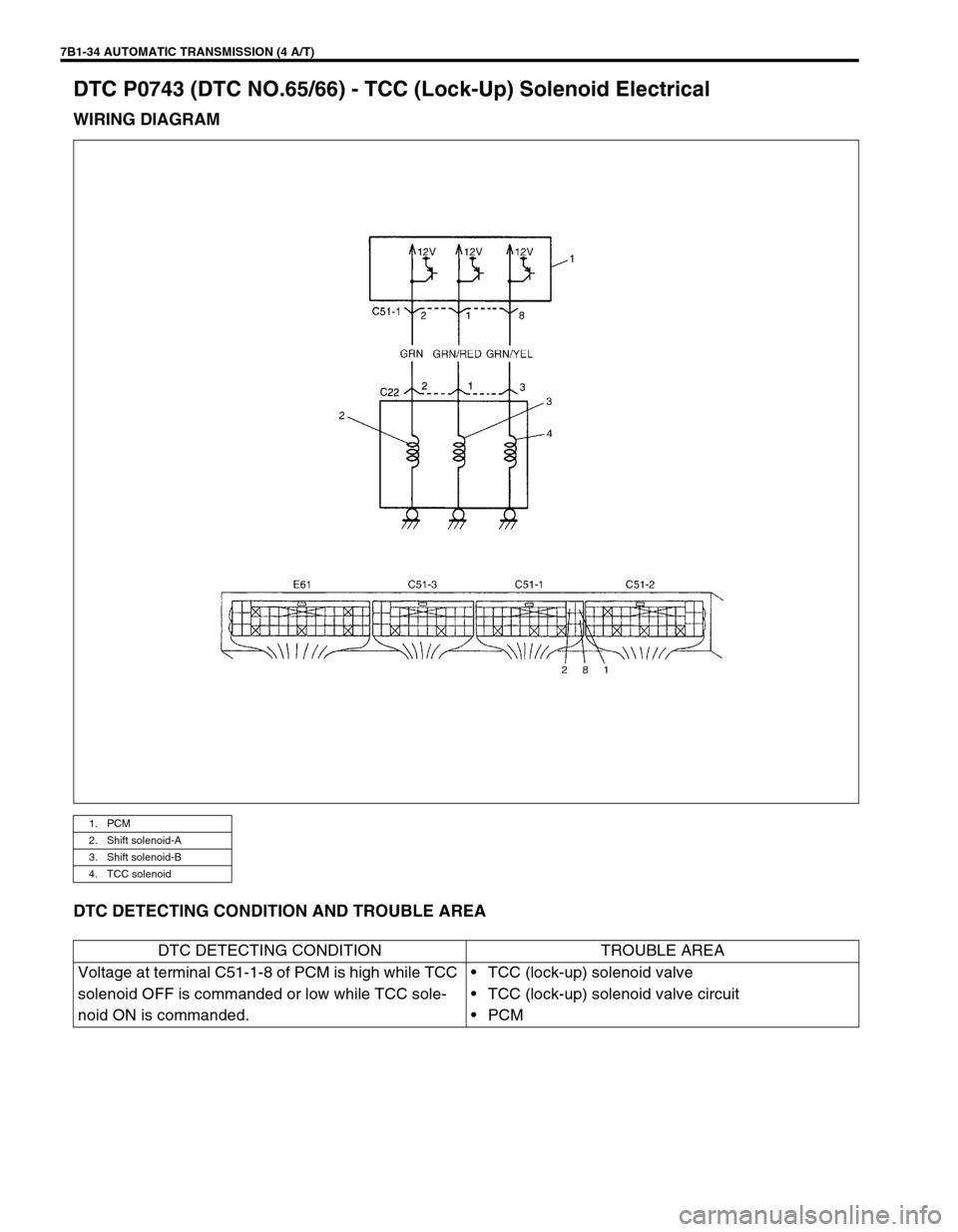
DTC P0743 (DTC NO.65/66) - TCC (Lock-Up) Solenoid Electrical
WIRING DIAGRAM
DTC DETECTING CONDITION AND TROUBLE AREA
1. PCM
2. Shift solenoid-A
3. Shift solenoid-B
4. TCC solenoid
DTC DETECTING CONDITION TROUBLE AREA
Voltage at terminal C51-1-8 of PCM is high while TCC
solenoid OFF is commanded or low while TCC sole-
noid ON is commanded.•TCC (lock-up) solenoid valve
•TCC (lock-up) solenoid valve circuit
•PCM
Page 447 of 656
7B1-38 AUTOMATIC TRANSMISSION (4 A/T)
Stall Test
This test is to check overall performance of automatic transmission and engine by measuring stall speed at “D”
and “R” ranges. Be sure to perform this test only when transmission fluid is at normal operating temperature and
its level is between FULL and LOW marks.
1) Apply parking brake and block wheels.
2) Install tachometer.
3) Start engine with select lever shifted to “P”.
4) Depress brake pedal fully.
5) Shift select lever to “D” and depress accelerator pedal fully while watching tachometer. Read engine rpm
quickly when it has become constant (stall speed).
6) Release accelerator pedal immediately after stall speed is checked.
7) In the same way, check stall speed in “R” range.
8) Stall speed should be within the following specification.
Stall speed :
2,460 – 2,760 r/min.
TROUBLESHOOTING
CAUTION:
Do not run engine at stall more than 5 seconds continuously, for fluid temperature may rise exces-
sively high.
After performing stall test, be sure to leave engine running at idle for longer than 30 seconds before
another stall test.
Condition Possible cause
Lower than standard level•Faulty engine output
•Defective torque converter
Higher than standard level in “D” range•Slippery O/D clutch
•Slippery forward clutch
•Malfunctioning O/D one-way clutch
•Malfunctioning one-way clutch No. 2
•Low line pressure
Higher than standard level in “R” range•Slippery direct clutch
•Slippery reverse brake
•Low fluid pressure
•Slippery O/D clutch
•Defective O/D one-way clutch
Page 454 of 656
AUTOMATIC TRANSMISSION (4 A/T) 7B1-45
A/T Throttle Cable
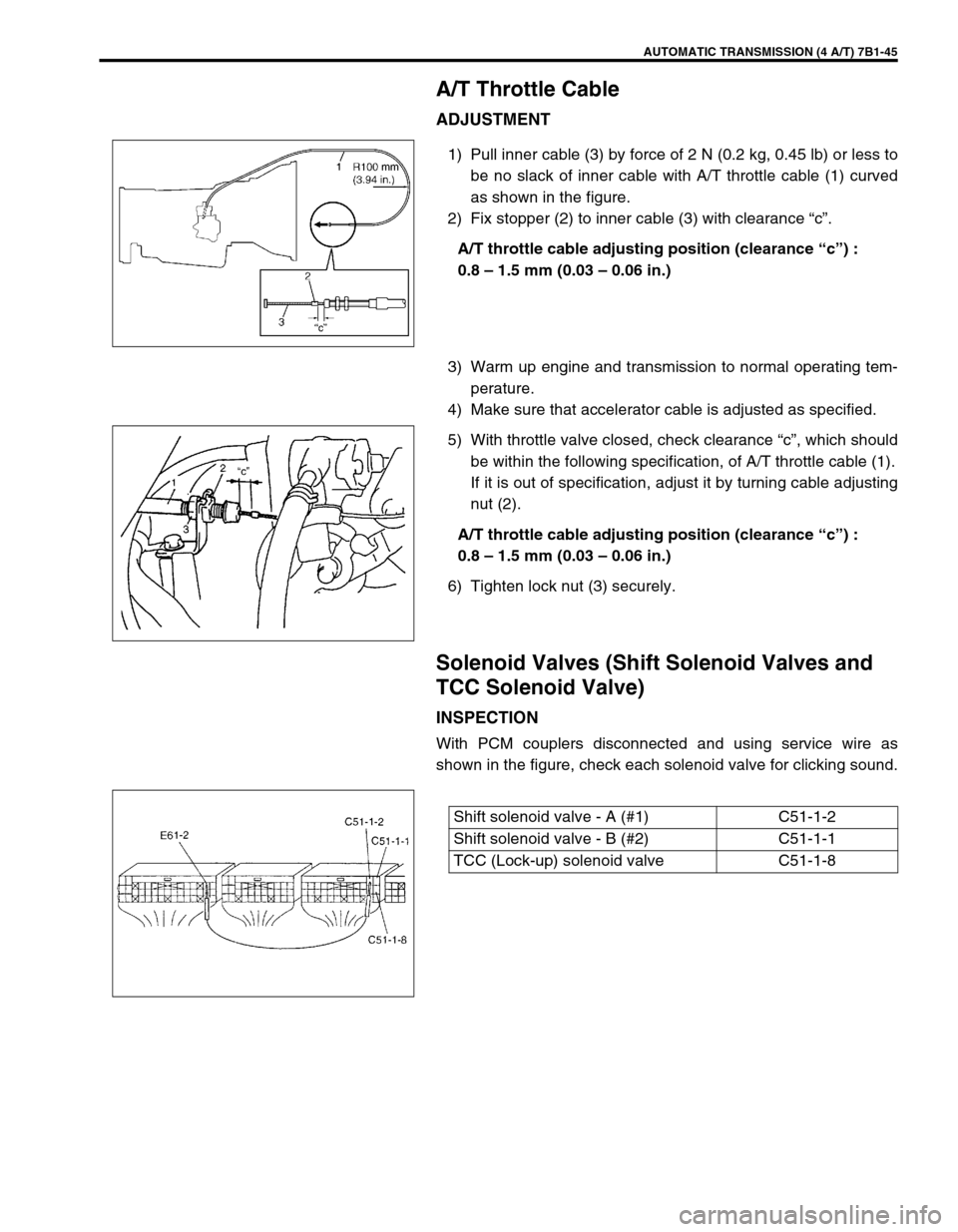
ADJUSTMENT
1) Pull inner cable (3) by force of 2 N (0.2 kg, 0.45 lb) or less to
be no slack of inner cable with A/T throttle cable (1) curved
as shown in the figure.
2) Fix stopper (2) to inner cable (3) with clearance “c”.
A/T throttle cable adjusting position (clearance “c”) :
0.8 – 1.5 mm (0.03 – 0.06 in.)
3) Warm up engine and transmission to normal operating tem-
perature.
4) Make sure that accelerator cable is adjusted as specified.
5) With throttle valve closed, check clearance “c”, which should
be within the following specification, of A/T throttle cable (1).
If it is out of specification, adjust it by turning cable adjusting
nut (2).
A/T throttle cable adjusting position (clearance “c”) :
0.8 – 1.5 mm (0.03 – 0.06 in.)
6) Tighten lock nut (3) securely.
Solenoid Valves (Shift Solenoid Valves and
TCC Solenoid Valve)
INSPECTION
With PCM couplers disconnected and using service wire as
shown in the figure, check each solenoid valve for clicking sound.
Shift solenoid valve - A (#1) C51-1-2
Shift solenoid valve - B (#2) C51-1-1
TCC (Lock-up) solenoid valve C51-1-8
Page 455 of 656
7B1-46 AUTOMATIC TRANSMISSION (4 A/T)
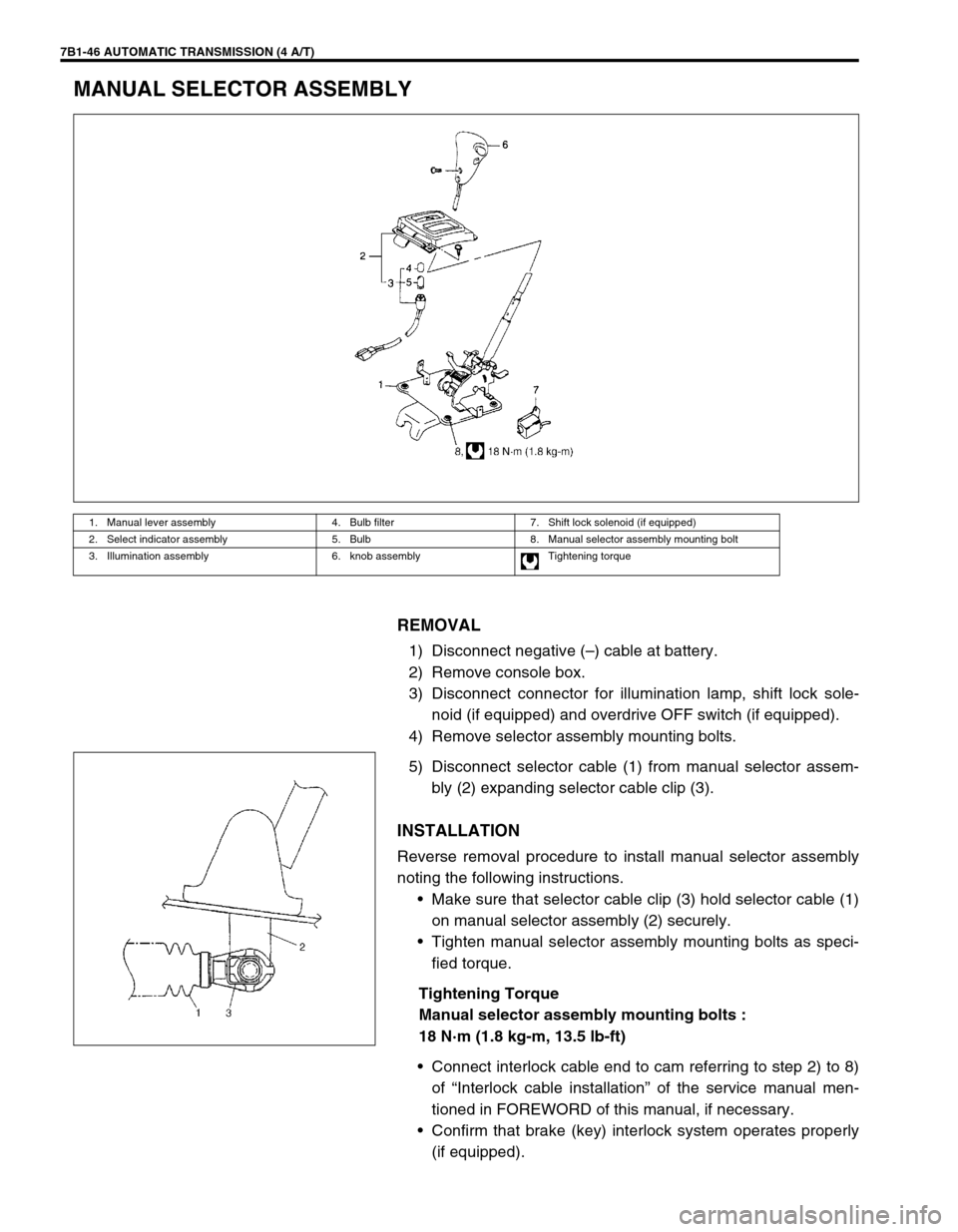
MANUAL SELECTOR ASSEMBLY
REMOVAL
1) Disconnect negative (–) cable at battery.
2) Remove console box.
3) Disconnect connector for illumination lamp, shift lock sole-
noid (if equipped) and overdrive OFF switch (if equipped).
4) Remove selector assembly mounting bolts.
5) Disconnect selector cable (1) from manual selector assem-
bly (2) expanding selector cable clip (3).
INSTALLATION
Reverse removal procedure to install manual selector assembly
noting the following instructions.
•Make sure that selector cable clip (3) hold selector cable (1)
on manual selector assembly (2) securely.
•Tighten manual selector assembly mounting bolts as speci-
fied torque.
Tightening Torque
Manual selector assembly mounting bolts :
18 N·m (1.8 kg-m, 13.5 lb-ft)
•Connect interlock cable end to cam referring to step 2) to 8)
of “Interlock cable installation” of the service manual men-
tioned in FOREWORD of this manual, if necessary.
•Confirm that brake (key) interlock system operates properly
(if equipped).
1. Manual lever assembly 4. Bulb filter 7. Shift lock solenoid (if equipped)
2. Select indicator assembly 5. Bulb 8. Manual selector assembly mounting bolt
3. Illumination assembly 6. knob assembly Tightening torque
Page 457 of 656
7B1-48 AUTOMATIC TRANSMISSION (4 A/T)
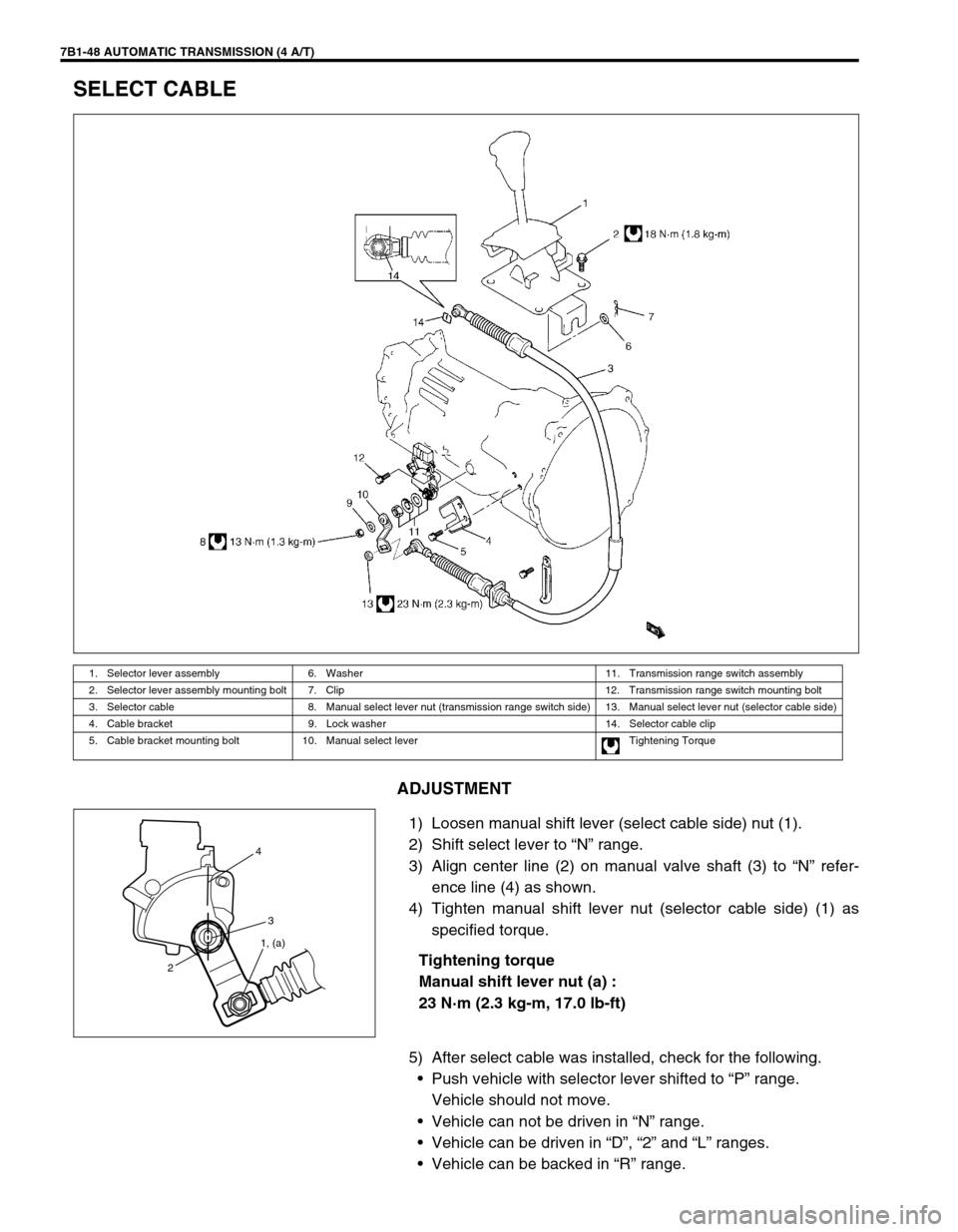
SELECT CABLE
ADJUSTMENT
1) Loosen manual shift lever (select cable side) nut (1).
2) Shift select lever to “N” range.
3) Align center line (2) on manual valve shaft (3) to “N” refer-
ence line (4) as shown.
4) Tighten manual shift lever nut (selector cable side) (1) as
specified torque.
Tightening torque
Manual shift lever nut (a) :
23 N·m (2.3 kg-m, 17.0 lb-ft)
5) After select cable was installed, check for the following.
•Push vehicle with selector lever shifted to “P” range.
Vehicle should not move.
•Vehicle can not be driven in “N” range.
•Vehicle can be driven in “D”, “2” and “L” ranges.
•Vehicle can be backed in “R” range.
1. Selector lever assembly 6. Washer 11. Transmission range switch assembly
2. Selector lever assembly mounting bolt 7. Clip 12. Transmission range switch mounting bolt
3. Selector cable 8. Manual select lever nut (transmission range switch side) 13. Manual select lever nut (selector cable side)
4. Cable bracket 9. Lock washer 14. Selector cable clip
5. Cable bracket mounting bolt 10. Manual select lever Tightening Torque
24
3
1, (a)