Lock SUZUKI GRAND VITARA 2001 2.G Repair Manual
[x] Cancel search | Manufacturer: SUZUKI, Model Year: 2001, Model line: GRAND VITARA, Model: SUZUKI GRAND VITARA 2001 2.GPages: 656, PDF Size: 14.31 MB
Page 165 of 656
6-1-4 ENGINE GENERAL INFORMATION AND DIAGNOSIS (H27 ENGINE)
When disconnecting couplers, don’t pull wire harness but
make sure to hold coupler itself. With lock type coupler, be
sure to unlock before disconnection. Attempt to disconnect
coupler without unlocking may result in damage to coupler.
When connecting lock type coupler, insert it till clicking
sound is heard and connect it securely.
Precaution on Fuel System Service
Work must be done with no smoking, in a well-ventilated area and away from any open flames.
As fuel feed line (between fuel pump and fuel pressure regulator) is still under high fuel pressure even after
engine was stopped, loosening or disconnecting fuel feed line directly may cause dangerous spout of fuel to
occur where loosened or disconnected. Before loosening or disconnecting fuel feed line, make sure to
release fuel pressure according to “FUEL PRESSURE RELIEF PROCEDURE” in this section.
A small amount of fuel may be released after the fuel line is disconnected.
In order to reduce the chance of personal injury, cover the fitting to be disconnected with a shop cloth. Put
that cloth in an approved container when disconnection is completed.
Never run engine with fuel pump relay disconnected when engine and exhaust system are hot.
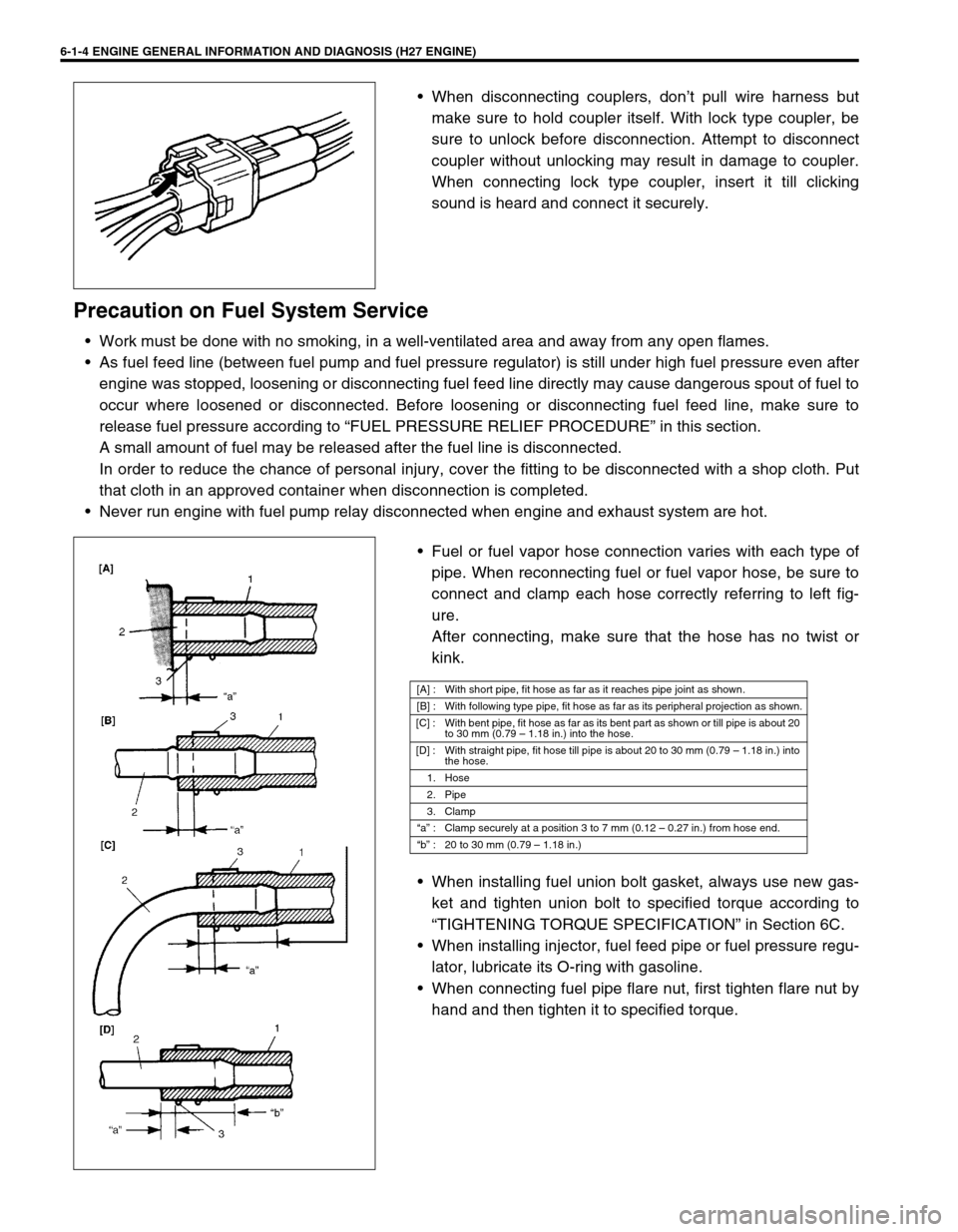
Fuel or fuel vapor hose connection varies with each type of
pipe. When reconnecting fuel or fuel vapor hose, be sure to
connect and clamp each hose correctly referring to left fig-
ure.
After connecting, make sure that the hose has no twist or
kink.
When installing fuel union bolt gasket, always use new gas-
ket and tighten union bolt to specified torque according to
“TIGHTENING TORQUE SPECIFICATION” in Section 6C.
When installing injector, fuel feed pipe or fuel pressure regu-
lator, lubricate its O-ring with gasoline.
When connecting fuel pipe flare nut, first tighten flare nut by
hand and then tighten it to specified torque.
[A] : With short pipe, fit hose as far as it reaches pipe joint as shown.
[B] : With following type pipe, fit hose as far as its peripheral projection as shown.
[C] : With bent pipe, fit hose as far as its bent part as shown or till pipe is about 20
to 30 mm (0.79 – 1.18 in.) into the hose.
[D] : With straight pipe, fit hose till pipe is about 20 to 30 mm (0.79 – 1.18 in.) into
the hose.
1. Hose
2. Pipe
3. Clamp
“a” : Clamp securely at a position 3 to 7 mm (0.12 – 0.27 in.) from hose end.
“b” : 20 to 30 mm (0.79 – 1.18 in.)
Page 166 of 656
ENGINE GENERAL INFORMATION AND DIAGNOSIS (H27 ENGINE) 6-1-5
Fuel Pressure Relief Procedure
After making sure that engine is cold, relief fuel pressure as fol-
lows.
1) Place transmission gear shift lever in “Neutral” (shift selector
lever to “P” range for A/T vehicle), set parking brake, and
block drive wheels.
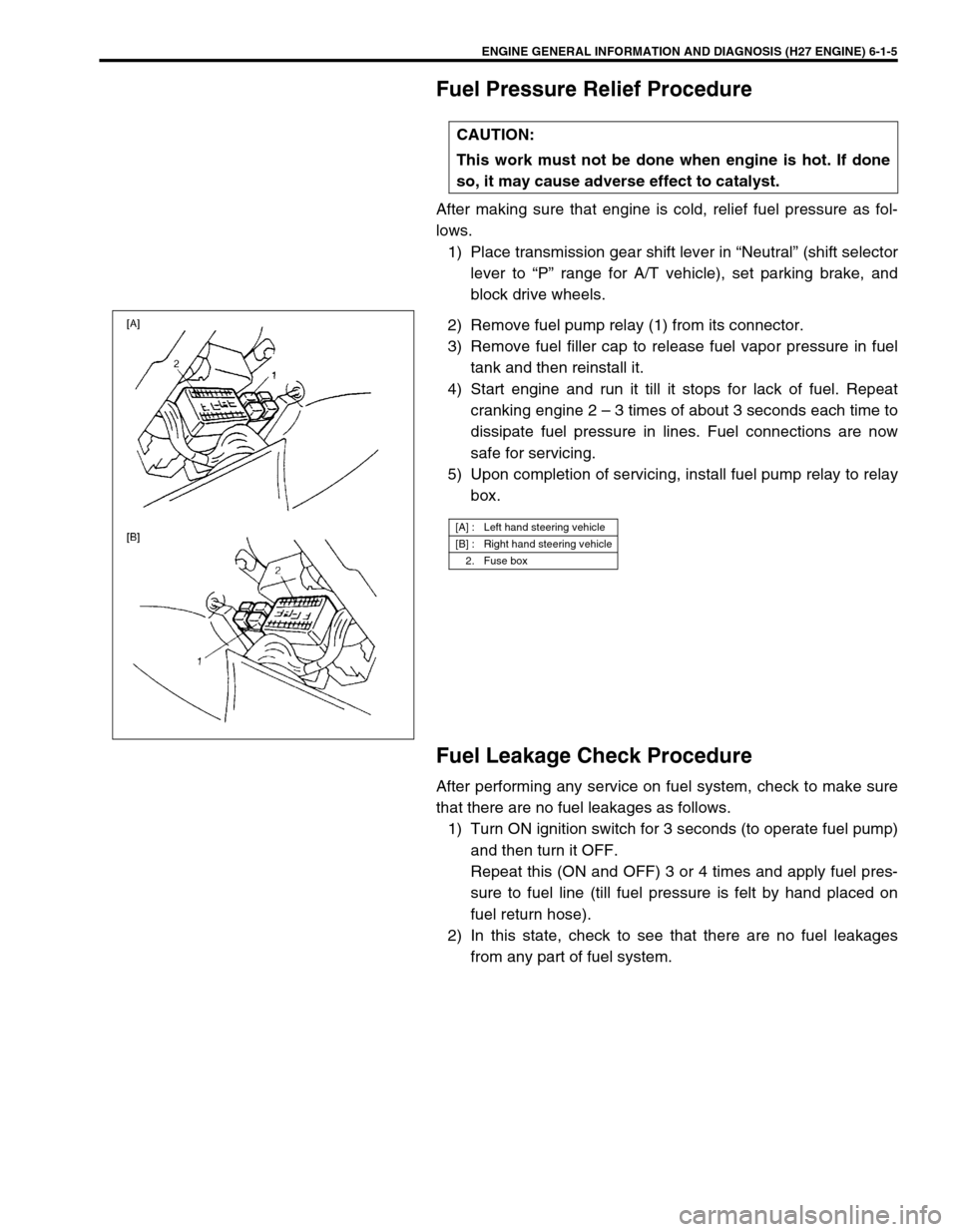
2) Remove fuel pump relay (1) from its connector.
3) Remove fuel filler cap to release fuel vapor pressure in fuel
tank and then reinstall it.
4) Start engine and run it till it stops for lack of fuel. Repeat
cranking engine 2 – 3 times of about 3 seconds each time to
dissipate fuel pressure in lines. Fuel connections are now
safe for servicing.
5) Upon completion of servicing, install fuel pump relay to relay
box.
Fuel Leakage Check Procedure
After performing any service on fuel system, check to make sure
that there are no fuel leakages as follows.
1) Turn ON ignition switch for 3 seconds (to operate fuel pump)
and then turn it OFF.
Repeat this (ON and OFF) 3 or 4 times and apply fuel pres-
sure to fuel line (till fuel pressure is felt by hand placed on
fuel return hose).
2) In this state, check to see that there are no fuel leakages
from any part of fuel system. CAUTION:
This work must not be done when engine is hot. If done
so, it may cause adverse effect to catalyst.
[A] : Left hand steering vehicle
[B] : Right hand steering vehicle
2. Fuse box
Page 182 of 656
ENGINE GENERAL INFORMATION AND DIAGNOSIS (H27 ENGINE) 6-1-21
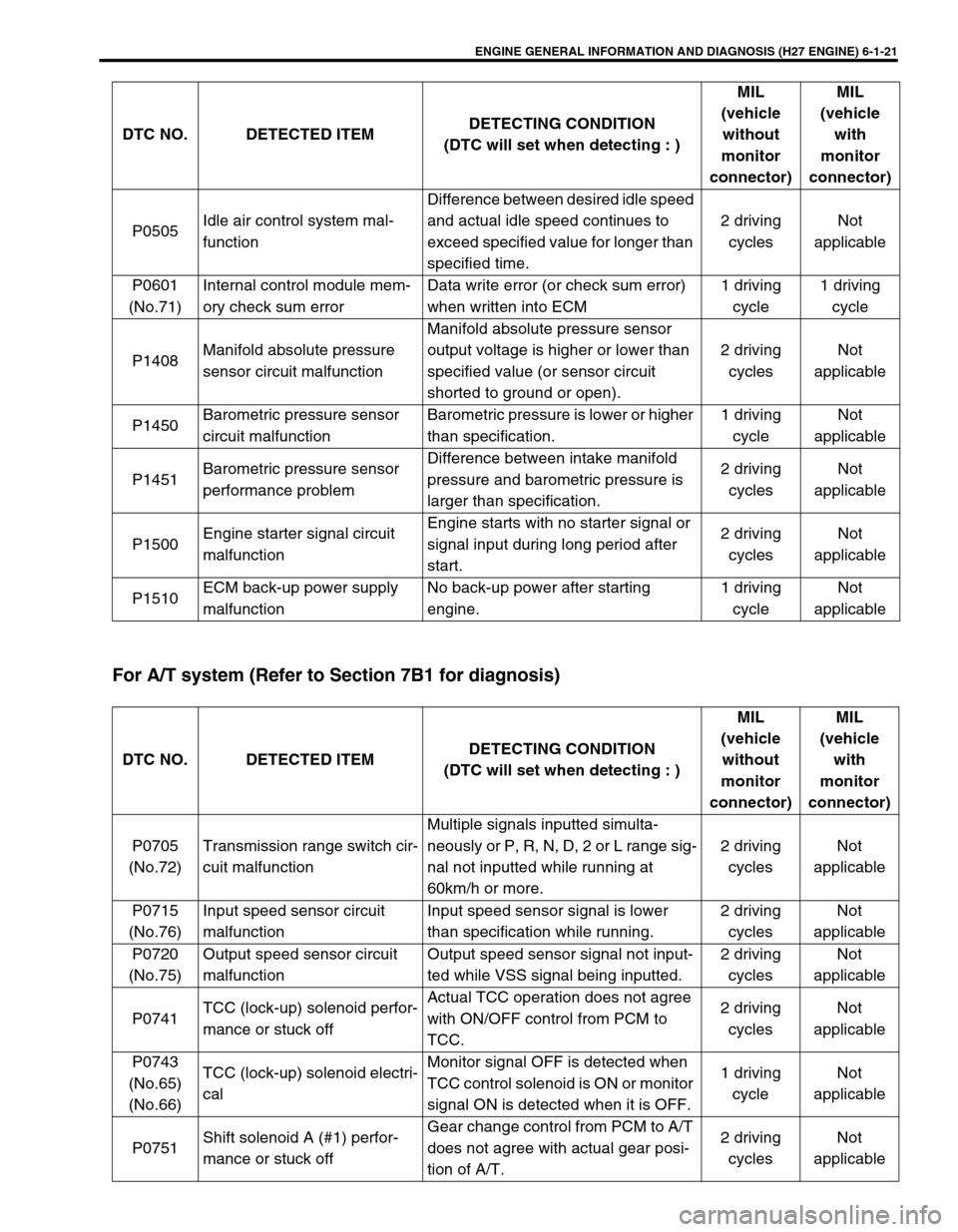
For A/T system (Refer to Section 7B1 for diagnosis)
P0505Idle air control system mal-
functionDifference between desired idle speed
and actual idle speed continues to
exceed specified value for longer than
specified time.2 driving
cyclesNot
applicable
P0601
(No.71)Internal control module mem-
ory check sum errorData write error (or check sum error)
when written into ECM1 driving
cycle1 driving
cycle
P1408Manifold absolute pressure
sensor circuit malfunctionManifold absolute pressure sensor
output voltage is higher or lower than
specified value (or sensor circuit
shorted to ground or open).2 driving
cyclesNot
applicable
P1450Barometric pressure sensor
circuit malfunctionBarometric pressure is lower or higher
than specification.1 driving
cycleNot
applicable
P1451Barometric pressure sensor
performance problemDifference between intake manifold
pressure and barometric pressure is
larger than specification.2 driving
cyclesNot
applicable
P1500Engine starter signal circuit
malfunctionEngine starts with no starter signal or
signal input during long period after
start.2 driving
cyclesNot
applicable
P1510ECM back-up power supply
malfunctionNo back-up power after starting
engine.1 driving
cycleNot
applicable DTC NO. DETECTED ITEMDETECTING CONDITION
(DTC will set when detecting : )MIL
(vehicle
without
monitor
connector)MIL
(vehicle
with
monitor
connector)
DTC NO. DETECTED ITEMDETECTING CONDITION
(DTC will set when detecting : )MIL
(vehicle
without
monitor
connector)MIL
(vehicle
with
monitor
connector)
P0705
(No.72)Transmission range switch cir-
cuit malfunctionMultiple signals inputted simulta-
neously or P, R, N, D, 2 or L range sig-
nal not inputted while running at
60km/h or more.2 driving
cyclesNot
applicable
P0715
(No.76)Input speed sensor circuit
malfunctionInput speed sensor signal is lower
than specification while running.2 driving
cyclesNot
applicable
P0720
(No.75)Output speed sensor circuit
malfunctionOutput speed sensor signal not input-
ted while VSS signal being inputted.2 driving
cyclesNot
applicable
P0741TCC (lock-up) solenoid perfor-
mance or stuck offActual TCC operation does not agree
with ON/OFF control from PCM to
TCC.2 driving
cyclesNot
applicable
P0743
(No.65)
(No.66)TCC (lock-up) solenoid electri-
calMonitor signal OFF is detected when
TCC control solenoid is ON or monitor
signal ON is detected when it is OFF.1 driving
cycleNot
applicable
P0751Shift solenoid A (#1) perfor-
mance or stuck offGear change control from PCM to A/T
does not agree with actual gear posi-
tion of A/T.2 driving
cyclesNot
applicable
Page 184 of 656
ENGINE GENERAL INFORMATION AND DIAGNOSIS (H27 ENGINE) 6-1-23
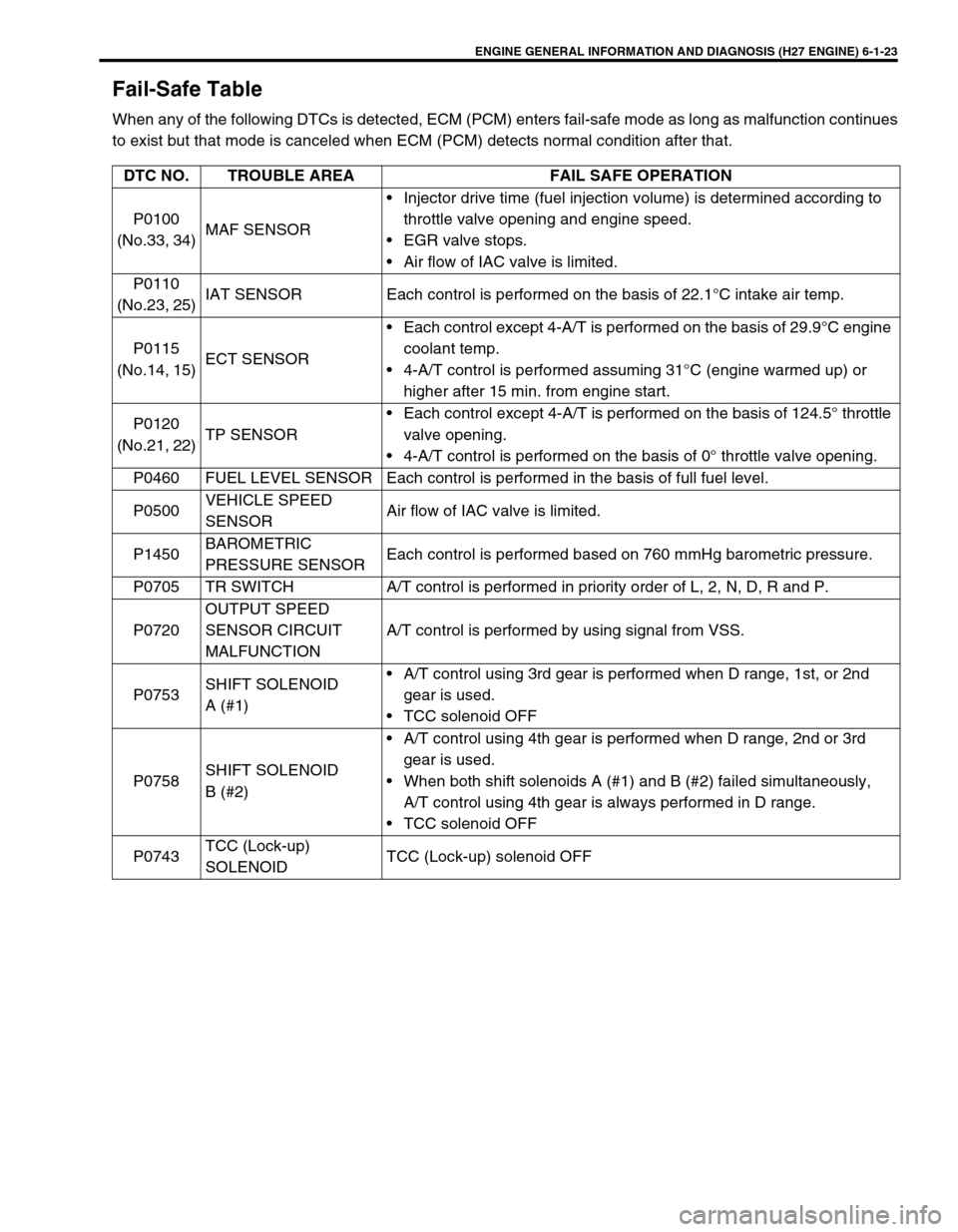
Fail-Safe Table
When any of the following DTCs is detected, ECM (PCM) enters fail-safe mode as long as malfunction continues
to exist but that mode is canceled when ECM (PCM) detects normal condition after that.
DTC NO. TROUBLE AREA FAIL SAFE OPERATION
P0100
(No.33, 34)MAF SENSOR• Injector drive time (fuel injection volume) is determined according to
throttle valve opening and engine speed.
• EGR valve stops.
• Air flow of IAC valve is limited.
P0110
(No.23, 25)IAT SENSOR Each control is performed on the basis of 22.1°C intake air temp.
P0115
(No.14, 15)ECT SENSOR• Each control except 4-A/T is performed on the basis of 29.9°C engine
coolant temp.
• 4-A/T control is performed assuming 31°C (engine warmed up) or
higher after 15 min. from engine start.
P0120
(No.21, 22)TP SENSOR• Each control except 4-A/T is performed on the basis of 124.5° throttle
valve opening.
• 4-A/T control is performed on the basis of 0° throttle valve opening.
P0460 FUEL LEVEL SENSOR Each control is performed in the basis of full fuel level.
P0500VEHICLE SPEED
SENSORAir flow of IAC valve is limited.
P1450BAROMETRIC
PRESSURE SENSOREach control is performed based on 760 mmHg barometric pressure.
P0705 TR SWITCH A/T control is performed in priority order of L, 2, N, D, R and P.
P0720OUTPUT SPEED
SENSOR CIRCUIT
MALFUNCTIONA/T control is performed by using signal from VSS.
P0753SHIFT SOLENOID
A (#1)• A/T control using 3rd gear is performed when D range, 1st, or 2nd
gear is used.
• TCC solenoid OFF
P0758SHIFT SOLENOID
B (#2)• A/T control using 4th gear is performed when D range, 2nd or 3rd
gear is used.
• When both shift solenoids A (#1) and B (#2) failed simultaneously,
A/T control using 4th gear is always performed in D range.
• TCC solenoid OFF
P0743TCC (Lock-up)
SOLENOIDTCC (Lock-up) solenoid OFF
Page 201 of 656
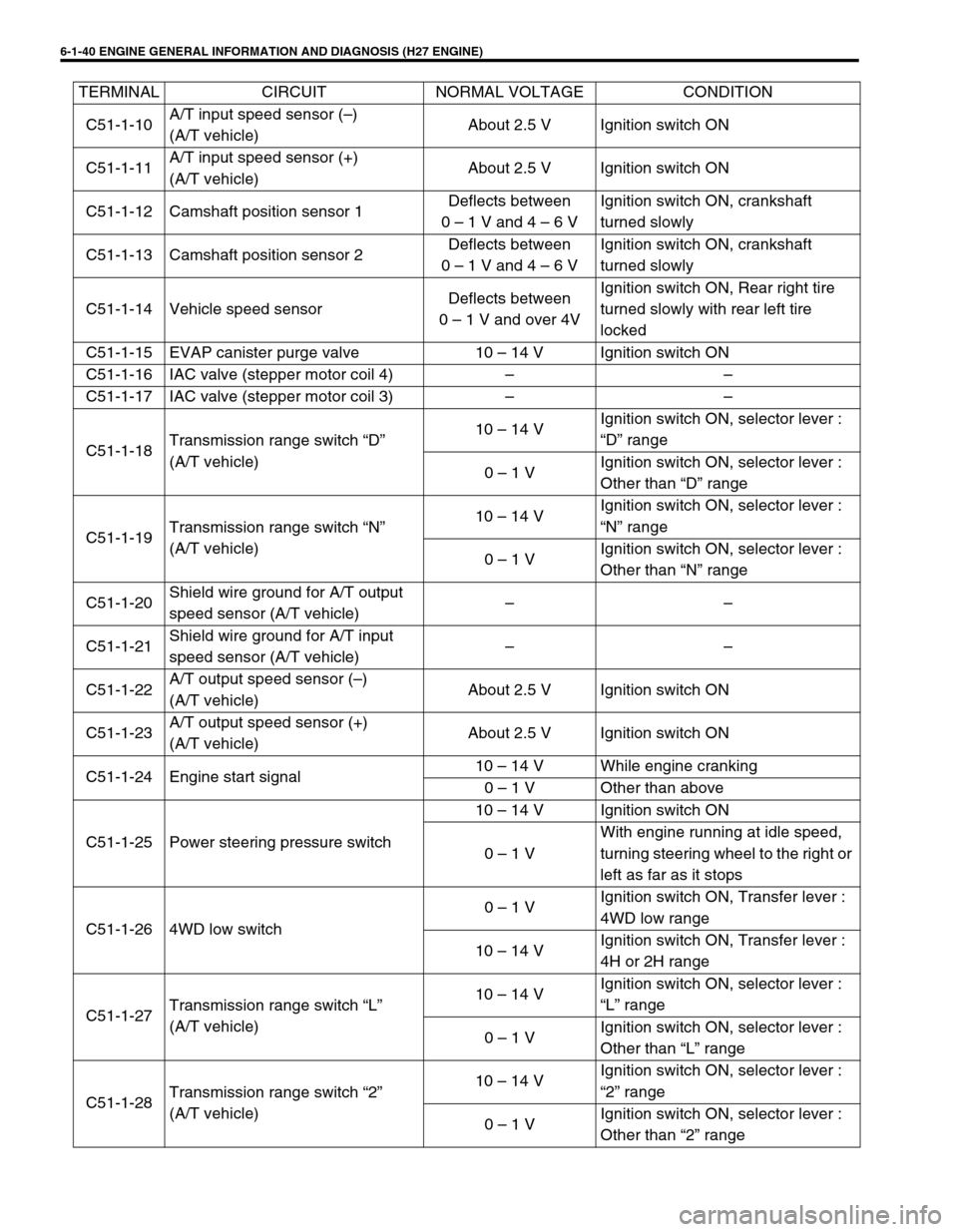
6-1-40 ENGINE GENERAL INFORMATION AND DIAGNOSIS (H27 ENGINE)
C51-1-10A/T input speed sensor (–)
(A/T vehicle)About 2.5 V Ignition switch ON
C51-1-11A/T input speed sensor (+)
(A/T vehicle)About 2.5 V Ignition switch ON
C51-1-12 Camshaft position sensor 1Deflects between
0 – 1 V and 4 – 6 VIgnition switch ON, crankshaft
turned slowly
C51-1-13 Camshaft position sensor 2Deflects between
0 – 1 V and 4 – 6 VIgnition switch ON, crankshaft
turned slowly
C51-1-14 Vehicle speed sensorDeflects between
0 – 1 V and over 4VIgnition switch ON, Rear right tire
turned slowly with rear left tire
locked
C51-1-15 EVAP canister purge valve 10 – 14 V Ignition switch ON
C51-1-16 IAC valve (stepper motor coil 4) – –
C51-1-17 IAC valve (stepper motor coil 3) – –
C51-1-18Transmission range switch “D”
(A/T vehicle)10 – 14 VIgnition switch ON, selector lever :
“D” range
0 – 1 VIgnition switch ON, selector lever :
Other than “D” range
C51-1-19Transmission range switch “N”
(A/T vehicle)10 – 14 VIgnition switch ON, selector lever :
“N” range
0 – 1 VIgnition switch ON, selector lever :
Other than “N” range
C51-1-20Shield wire ground for A/T output
speed sensor (A/T vehicle)––
C51-1-21Shield wire ground for A/T input
speed sensor (A/T vehicle)––
C51-1-22A/T output speed sensor (–)
(A/T vehicle)About 2.5 V Ignition switch ON
C51-1-23A/T output speed sensor (+)
(A/T vehicle)About 2.5 V Ignition switch ON
C51-1-24 Engine start signal10 – 14 V While engine cranking
0 – 1 V Other than above
C51-1-25 Power steering pressure switch10 – 14 V Ignition switch ON
0 – 1 VWith engine running at idle speed,
turning steering wheel to the right or
left as far as it stops
C51-1-26 4WD low switch0 – 1 VIgnition switch ON, Transfer lever :
4WD low range
10 – 14 VIgnition switch ON, Transfer lever :
4H or 2H range
C51-1-27Transmission range switch “L”
(A/T vehicle)10 – 14 VIgnition switch ON, selector lever :
“L” range
0 – 1 VIgnition switch ON, selector lever :
Other than “L” range
C51-1-28Transmission range switch “2”
(A/T vehicle)10 – 14 VIgnition switch ON, selector lever :
“2” range
0 – 1 VIgnition switch ON, selector lever :
Other than “2” range TERMINAL CIRCUIT NORMAL VOLTAGE CONDITION
Page 281 of 656
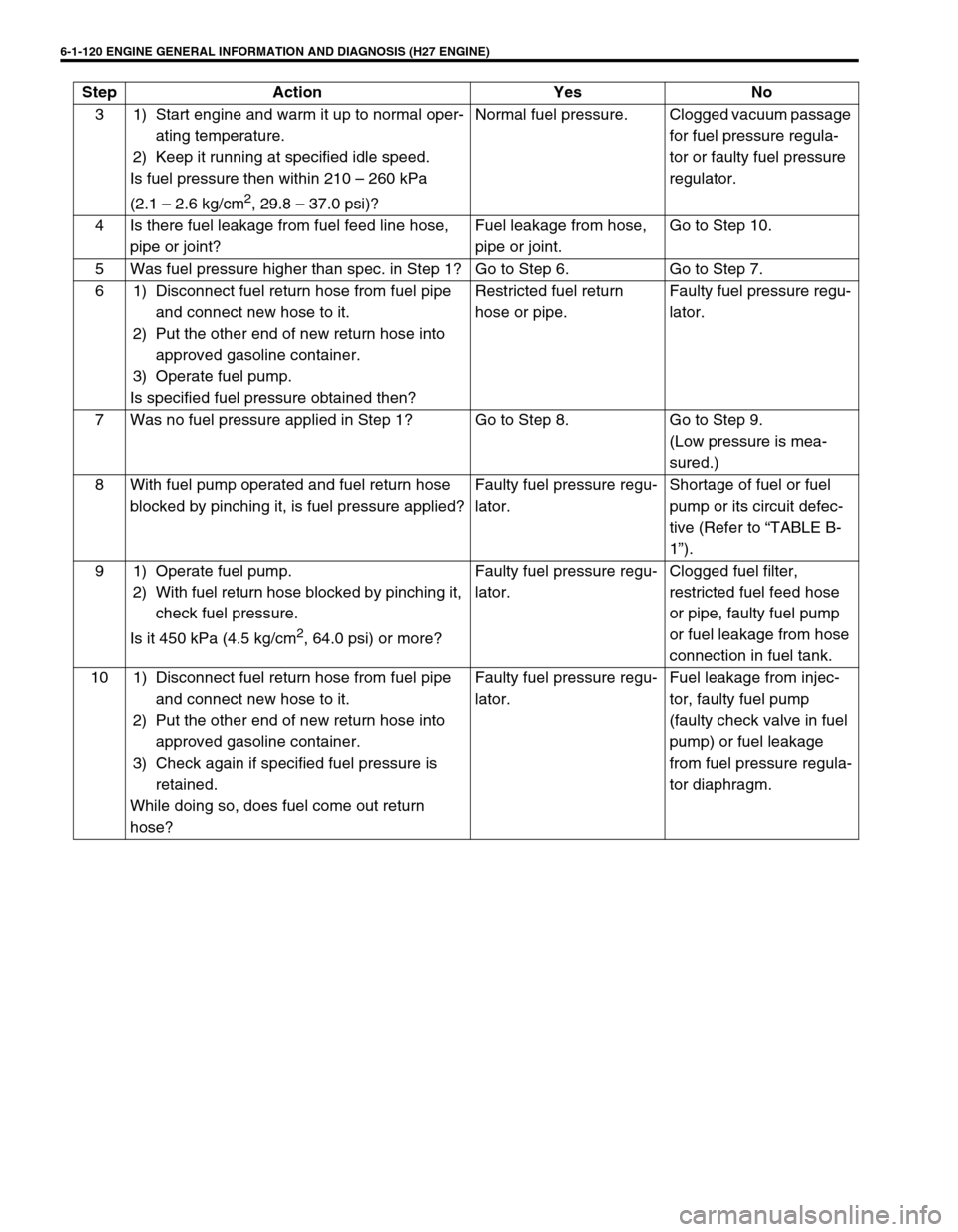
6-1-120 ENGINE GENERAL INFORMATION AND DIAGNOSIS (H27 ENGINE)
3 1) Start engine and warm it up to normal oper-
ating temperature.
2) Keep it running at specified idle speed.
Is fuel pressure then within 210 – 260 kPa
(2.1 – 2.6 kg/cm
2, 29.8 – 37.0 psi)?Normal fuel pressure. Clogged vacuum passage
for fuel pressure regula-
tor or faulty fuel pressure
regulator.
4 Is there fuel leakage from fuel feed line hose,
pipe or joint?Fuel leakage from hose,
pipe or joint.Go to Step 10.
5 Was fuel pressure higher than spec. in Step 1? Go to Step 6. Go to Step 7.
6 1) Disconnect fuel return hose from fuel pipe
and connect new hose to it.
2) Put the other end of new return hose into
approved gasoline container.
3) Operate fuel pump.
Is specified fuel pressure obtained then?Restricted fuel return
hose or pipe.Faulty fuel pressure regu-
lator.
7 Was no fuel pressure applied in Step 1? Go to Step 8. Go to Step 9.
(Low pressure is mea-
sured.)
8 With fuel pump operated and fuel return hose
blocked by pinching it, is fuel pressure applied?Faulty fuel pressure regu-
lator.Shortage of fuel or fuel
pump or its circuit defec-
tive (Refer to “TABLE B-
1”).
9 1) Operate fuel pump.
2) With fuel return hose blocked by pinching it,
check fuel pressure.
Is it 450 kPa (4.5 kg/cm
2, 64.0 psi) or more?Faulty fuel pressure regu-
lator.Clogged fuel filter,
restricted fuel feed hose
or pipe, faulty fuel pump
or fuel leakage from hose
connection in fuel tank.
10 1) Disconnect fuel return hose from fuel pipe
and connect new hose to it.
2) Put the other end of new return hose into
approved gasoline container.
3) Check again if specified fuel pressure is
retained.
While doing so, does fuel come out return
hose?Faulty fuel pressure regu-
lator.Fuel leakage from injec-
tor, faulty fuel pump
(faulty check valve in fuel
pump) or fuel leakage
from fuel pressure regula-
tor diaphragm. Step Action Yes No
Page 288 of 656
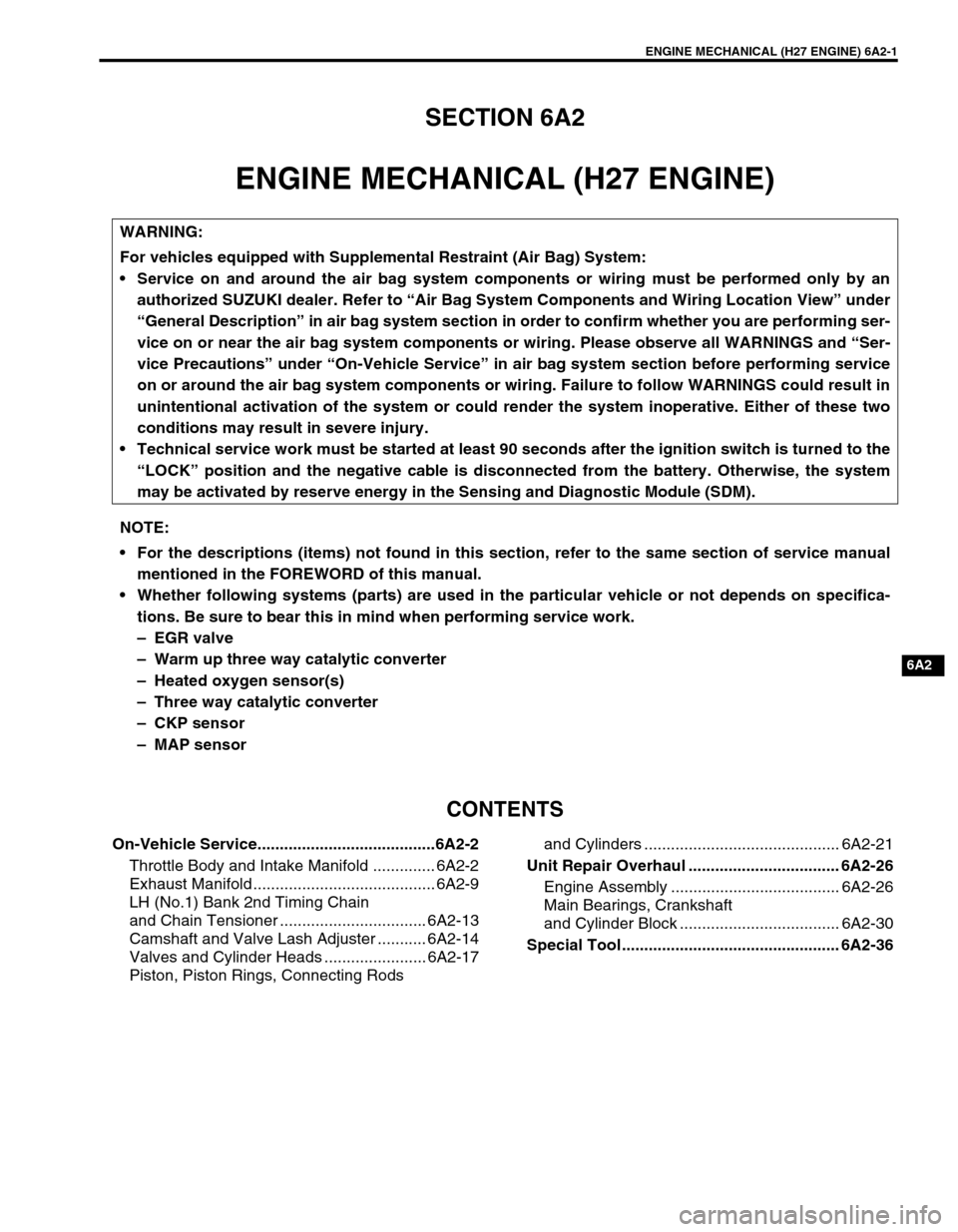
ENGINE MECHANICAL (H27 ENGINE) 6A2-1
6A2
SECTION 6A2
ENGINE MECHANICAL (H27 ENGINE)
CONTENTS
On-Vehicle Service........................................6A2-2
Throttle Body and Intake Manifold .............. 6A2-2
Exhaust Manifold ......................................... 6A2-9
LH (No.1) Bank 2nd Timing Chain
and Chain Tensioner ................................. 6A2-13
Camshaft and Valve Lash Adjuster ........... 6A2-14
Valves and Cylinder Heads ....................... 6A2-17
Piston, Piston Rings, Connecting Rodsand Cylinders ............................................ 6A2-21
Unit Repair Overhaul .................................. 6A2-26
Engine Assembly ...................................... 6A2-26
Main Bearings, Crankshaft
and Cylinder Block .................................... 6A2-30
Special Tool ................................................. 6A2-36
WARNING:
For vehicles equipped with Supplemental Restraint (Air Bag) System:
Service on and around the air bag system components or wiring must be performed only by an
authorized SUZUKI dealer. Refer to “Air Bag System Components and Wiring Location View” under
“General Description” in air bag system section in order to confirm whether you are performing ser-
vice on or near the air bag system components or wiring. Please observe all WARNINGS and “Ser-
vice Precautions” under “On-Vehicle Service” in air bag system section before performing service
on or around the air bag system components or wiring. Failure to follow WARNINGS could result in
unintentional activation of the system or could render the system inoperative. Either of these two
conditions may result in severe injury.
Technical service work must be started at least 90 seconds after the ignition switch is turned to the
“LOCK” position and the negative cable is disconnected from the battery. Otherwise, the system
may be activated by reserve energy in the Sensing and Diagnostic Module (SDM).
NOTE:
For the descriptions (items) not found in this section, refer to the same section of service manual
mentioned in the FOREWORD of this manual.
Whether following systems (parts) are used in the particular vehicle or not depends on specifica-
tions. Be sure to bear this in mind when performing service work.
–EGR valve
–Warm up three way catalytic converter
–Heated oxygen sensor(s)
–Three way catalytic converter
–CKP sensor
–MAP sensor
Page 297 of 656
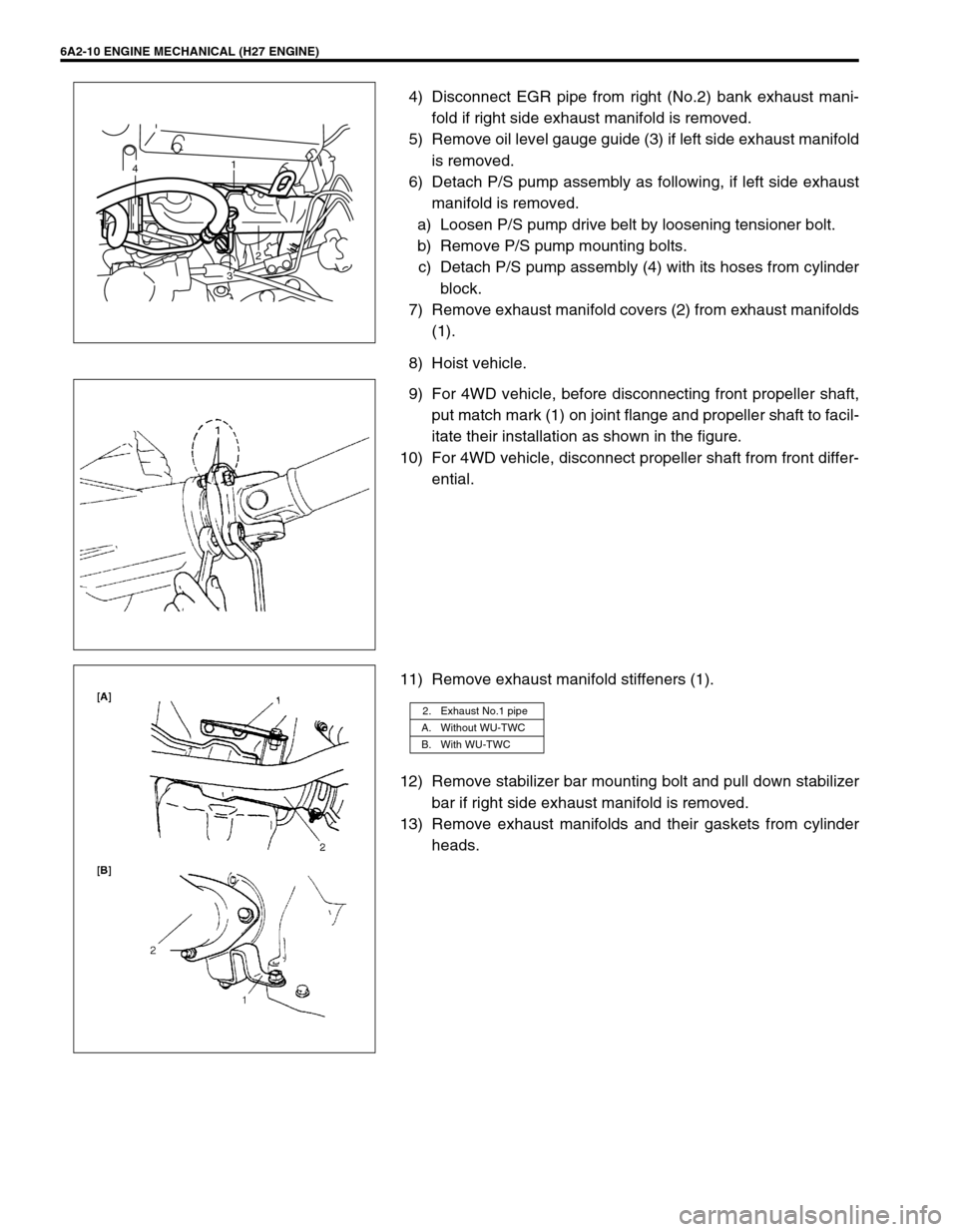
6A2-10 ENGINE MECHANICAL (H27 ENGINE)
4) Disconnect EGR pipe from right (No.2) bank exhaust mani-
fold if right side exhaust manifold is removed.
5) Remove oil level gauge guide (3) if left side exhaust manifold
is removed.
6) Detach P/S pump assembly as following, if left side exhaust
manifold is removed.
a) Loosen P/S pump drive belt by loosening tensioner bolt.
b) Remove P/S pump mounting bolts.
c) Detach P/S pump assembly (4) with its hoses from cylinder
block.
7) Remove exhaust manifold covers (2) from exhaust manifolds
(1).
8) Hoist vehicle.
9) For 4WD vehicle, before disconnecting front propeller shaft,
put match mark (1) on joint flange and propeller shaft to facil-
itate their installation as shown in the figure.
10) For 4WD vehicle, disconnect propeller shaft from front differ-
ential.
11) Remove exhaust manifold stiffeners (1).
12) Remove stabilizer bar mounting bolt and pull down stabilizer
bar if right side exhaust manifold is removed.
13) Remove exhaust manifolds and their gaskets from cylinder
heads.
1
4
32
2. Exhaust No.1 pipe
A. Without WU-TWC
B. With WU-TWC
Page 302 of 656
ENGINE MECHANICAL (H27 ENGINE) 6A2-15
INSPECTION
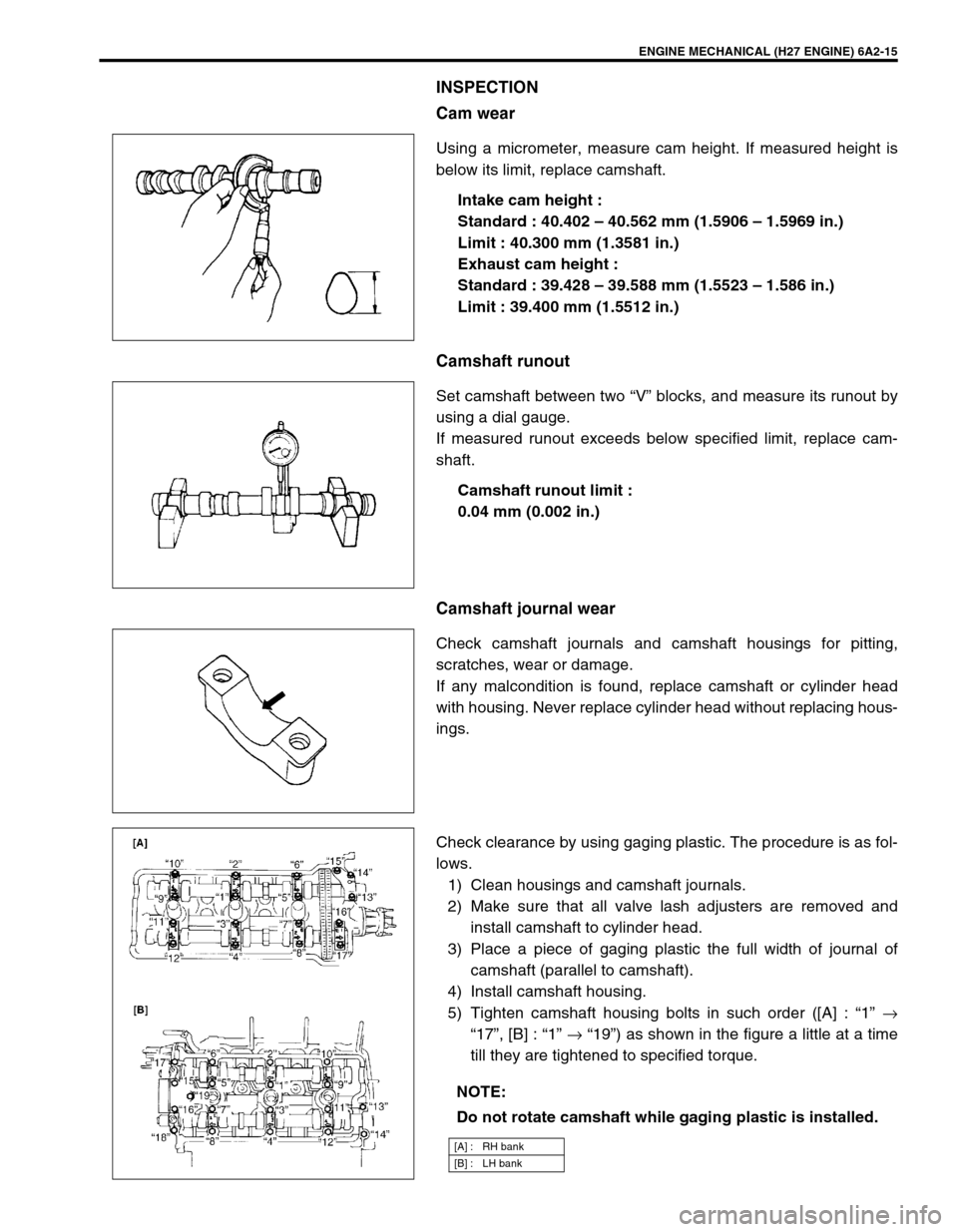
Cam wear
Using a micrometer, measure cam height. If measured height is
below its limit, replace camshaft.
Intake cam height :
Standard : 40.402 – 40.562 mm (1.5906 – 1.5969 in.)
Limit : 40.300 mm (1.3581 in.)
Exhaust cam height :
Standard : 39.428 – 39.588 mm (1.5523 – 1.586 in.)
Limit : 39.400 mm (1.5512 in.)
Camshaft runout
Set camshaft between two “V” blocks, and measure its runout by
using a dial gauge.
If measured runout exceeds below specified limit, replace cam-
shaft.
Camshaft runout limit :
0.04 mm (0.002 in.)
Camshaft journal wear
Check camshaft journals and camshaft housings for pitting,
scratches, wear or damage.
If any malcondition is found, replace camshaft or cylinder head
with housing. Never replace cylinder head without replacing hous-
ings.
Check clearance by using gaging plastic. The procedure is as fol-
lows.
1) Clean housings and camshaft journals.
2) Make sure that all valve lash adjusters are removed and
install camshaft to cylinder head.
3) Place a piece of gaging plastic the full width of journal of
camshaft (parallel to camshaft).
4) Install camshaft housing.
5) Tighten camshaft housing bolts in such order ([A] : “1” →
“17”, [B] : “1” → “19”) as shown in the figure a little at a time
till they are tightened to specified torque.
NOTE:
Do not rotate camshaft while gaging plastic is installed.
[A] : RH bank
[B] : LH bank
Page 304 of 656
ENGINE MECHANICAL (H27 ENGINE) 6A2-17
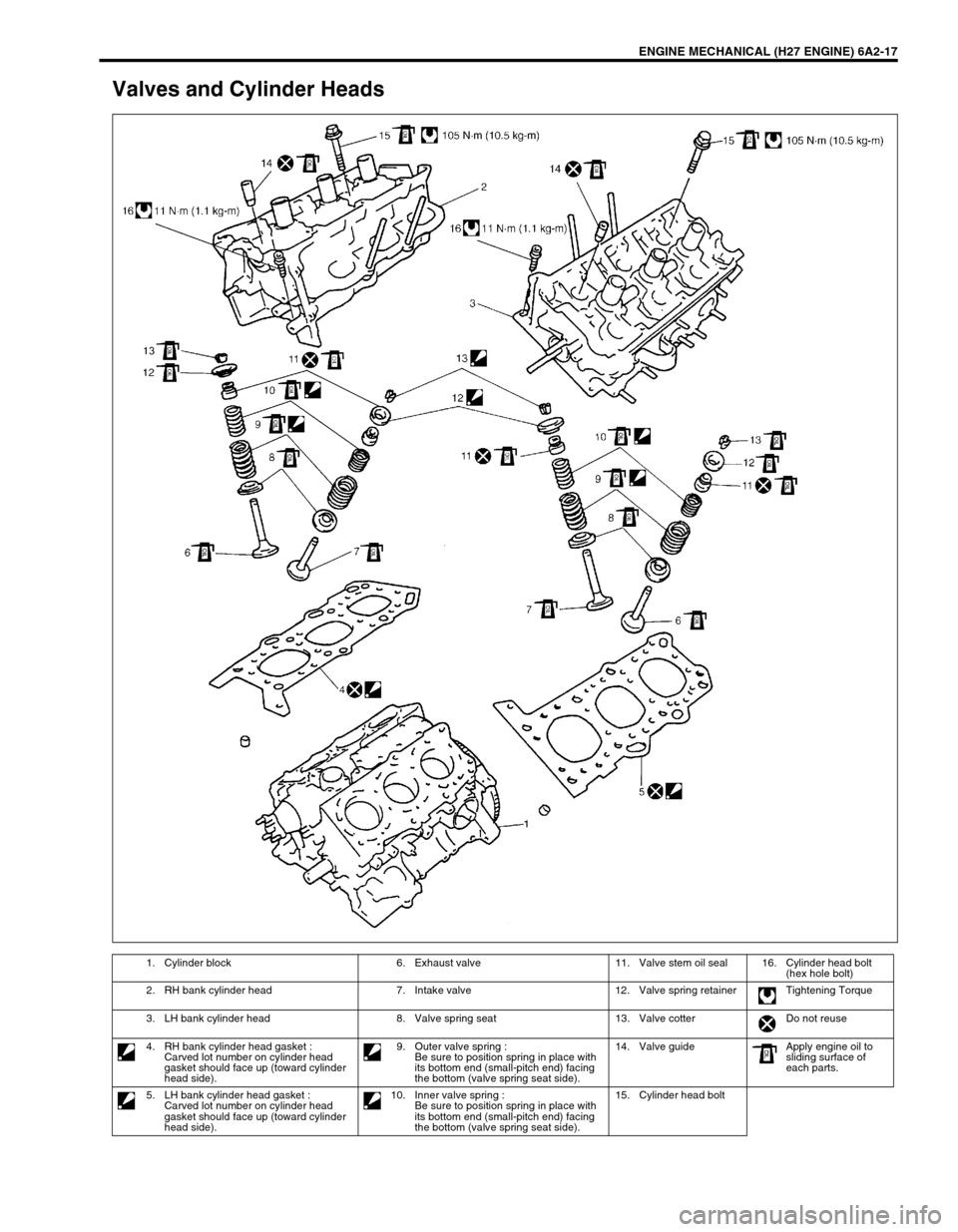
Valves and Cylinder Heads
1. Cylinder block 6. Exhaust valve 11. Valve stem oil seal 16. Cylinder head bolt
(hex hole bolt)
2. RH bank cylinder head 7. Intake valve 12. Valve spring retainer Tightening Torque
3. LH bank cylinder head 8. Valve spring seat 13. Valve cotter Do not reuse
4. RH bank cylinder head gasket :
Carved lot number on cylinder head
gasket should face up (toward cylinder
head side).9. Outer valve spring :
Be sure to position spring in place with
its bottom end (small-pitch end) facing
the bottom (valve spring seat side).14. Valve guide Apply engine oil to
sliding surface of
each parts.
5. LH bank cylinder head gasket :
Carved lot number on cylinder head
gasket should face up (toward cylinder
head side).10. Inner valve spring :
Be sure to position spring in place with
its bottom end (small-pitch end) facing
the bottom (valve spring seat side).15. Cylinder head bolt