SPEED SUZUKI GRAND VITARA 2012 Repair Manual
[x] Cancel search | Manufacturer: SUZUKI, Model Year: 2012, Model line: GRAND VITARA, Model: SUZUKI GRAND VITARA 2012Pages: 337, PDF Size: 6.21 MB
Page 280 of 337
7-31INSPECTION AND MAINTENANCE
79K21-03E Tire Rotation
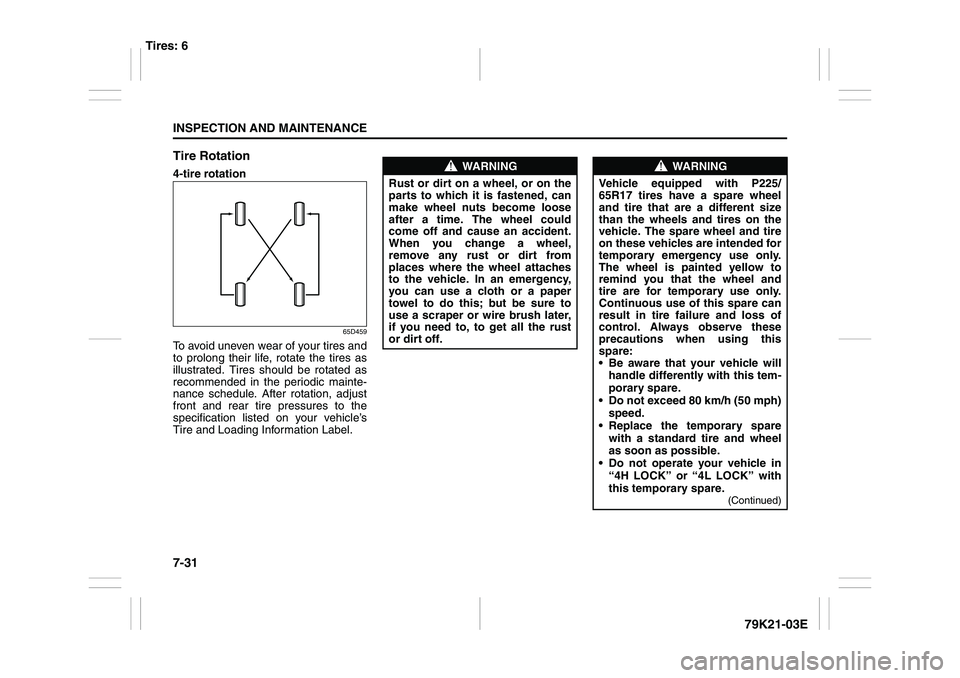
4-tire rotation
65D459
To avoid uneven wear of your tires and
to prolong their life, rotate the tires as
illustrated. Tires should be rotated as
recommended in the periodic mainte-
nance schedule. After rotation, adjust
front and rear tire pressures to the
specification listed on your vehicle’s
Tire and Loading Information Label.
WARNING
Rust or dirt on a wheel, or on the
parts to which it is fastened, can
make wheel nuts become loose
after a time. The wheel could
come off and cause an accident.
When you change a wheel,
remove any rust or dirt from
places where the wheel attaches
to the vehicle. In an emergency,
you can use a cloth or a paper
towel to do this; but be sure to
use a scraper or wire brush later,
if you need to, to get all the rust
or dirt off.
WARNING
Vehicle equipped with P225/
65R17 tires have a spare wheel
and tire that are a different size
than the wheels and tires on the
vehicle. The spare wheel and tire
on these vehicles are intended for
temporary emergency use only.
The wheel is painted yellow to
remind you that the wheel and
tire are for temporary use only.
Continuous use of this spare can
result in tire failure and loss of
control. Always observe these
precautions when using this
spare:
Be aware that your vehicle will
handle differently with this tem-
porary spare.
Do not exceed 80 km/h (50 mph)
speed.
Replace the temporary spare
with a standard tire and wheel
as soon as possible.
Do not operate your vehicle in
“4H LOCK” or “4L LOCK” with
this temporary spare.
(Continued)
Tires: 6
Page 305 of 337
8-6
EMERGENCY SERVICE
79K21-03E
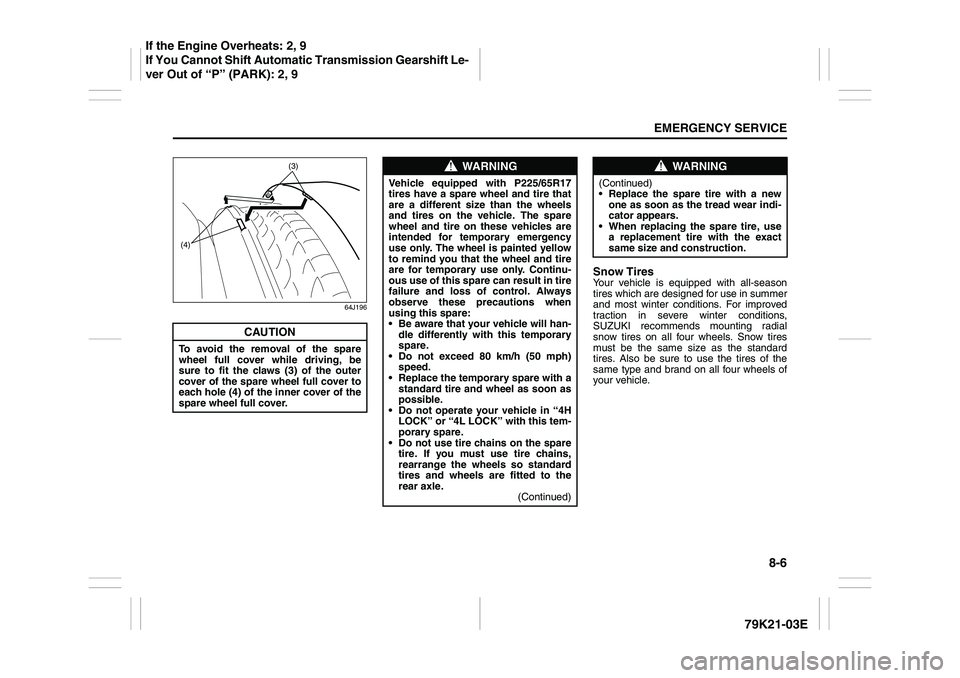
64J196
Snow TiresYour vehicle is equipped with all-season
tires which are designed for use in summer
and most winter conditions. For improved
traction in severe winter conditions,
SUZUKI recommends mounting radial
snow tires on all four wheels. Snow tires
must be the same size as the standard
tires. Also be sure to use the tires of the
same type and brand on all four wheels of
your vehicle.
CAUTION
To avoid the removal of the spare
wheel full cover while driving, be
sure to fit the claws (3) of the outer
cover of the spare wheel full cover to
each hole (4) of the inner cover of the
spare wheel full cover.
(3)
(4)
WARNING
Vehicle equipped with P225/65R17
tires have a spare wheel and tire that
are a different size than the wheels
and tires on the vehicle. The spare
wheel and tire on these vehicles are
intended for temporary emergency
use only. The wheel is painted yellow
to remind you that the wheel and tire
are for temporary use only. Continu-
ous use of this spare can result in tire
failure and loss of control. Always
observe these precautions when
using this spare:
Be aware that your vehicle will han-
dle differently with this temporary
spare.
Do not exceed 80 km/h (50 mph)
speed.
Replace the temporary spare with a
standard tire and wheel as soon as
possible.
Do not operate your vehicle in “4H
LOCK” or “4L LOCK” with this tem-
porary spare.
Do not use tire chains on the spare
tire. If you must use tire chains,
rearrange the wheels so standard
tires and wheels are fitted to the
rear axle.
(Continued)
WARNING
(Continued)
Replace the spare tire with a new
one as soon as the tread wear indi-
cator appears.
When replacing the spare tire, use
a replacement tire with the exact
same size and construction.
If the Engine Overheats: 2, 9
If You Cannot Shift Automatic Transmission Gearshift Le-
ver Out of “P” (PARK): 2, 9
Page 307 of 337
8-8
EMERGENCY SERVICE
79K21-03E
3) Make jumper cable connections as fol-
lows:
1. Connect one end of the first jumper
cable to the positive (+) terminal of
the discharged battery (1).
2. Connect the other end to the positive
(+) terminal of the booster battery
(2).
3. Connect one end of the second
jumper cable to the negative (–) ter-
minal of the booster battery (2).
4. Make the final connection to an
unpainted, heavy metal part (i.e.
engine hook (3)) of the engine of the
vehicle with the discharged battery
(1).
4) If the booster battery you are using is
installed on another vehicle, start the
engine of the vehicle with the booster
battery. Run the engine at moderate
speed.
5) Start the engine of the vehicle with the
discharged battery.
6) Remove the jumper cables in the exact
reverse order in which you connected
them.
Towing a Disabled VehicleEmergency TowingIf your vehicle is disabled, it may be towed
by a tow truck using one of the following
methods:
1) Tow the vehicle with two wheels lifted
by the tow truck and the other two
wheels on a towing dolly.
2) Use the appropriate towing method
specified for your vehicle in the “Towing
Your Vehicle (recreational towing)” sec-
tion, but with the wheels lifted by the
tow truck instead of on a towing dolly.
Be sure to carefully follow the specific
instructions provided in the “Towing
Your Vehicle (recreational towing)” sec-
tion.
If the Starter Does Not
Operate1) Try turning the ignition switch to the
“START” position with the headlights
turned on to determine the battery con-
dition. If the headlights go excessively
dim or go off, it usually means that
either the battery has run down or bat-
tery terminal contact is poor. Recharge
the battery or correct battery terminal
contact if necessary.
2) If the headlights remain bright, check
the fuses. If the reason for failure of the
starter is not obvious, there may be a
major electrical problem. Have the vehi-
cle inspected by your authorized
SUZUKI dealer.
WARNING
Never connect the jumper cable
directly to the negative (–) terminal of
the discharged battery, or an explo-
sion may occur.
CAUTION
If vehicle damage (such as steering
or drivetrain damage, inability to
operate free axle mechanism, etc.)
prevent normal use of the towing pro-
cedures for your vehicle described in
the “Towing Your Vehicle (recre-
ational towing)” section, have your
vehicle towed with two wheels lifted
by the tow truck and the other two
wheels on a towing dolly.
Page 308 of 337
8-9EMERGENCY SERVICE
79K21-03E
If the Engine is FloodedIf the engine is flooded with gasoline, it
may be hard to start. If this happens, press
the accelerator pedal all the way to the
floor and hold it there while cranking the
engine. (Do not operate the starter motor
for more than 15 seconds).
If the Engine OverheatsThe engine could overheat temporarily
under severe driving conditions. If the
engine coolant temperature gauge indi-
cates overheating during driving:
1) Turn off the air conditioner, if equipped.
2) Take the vehicle to a safe place and
park.
3) Let the engine run at normal idle speed
for a few minutes until the indicator is
within the normal, acceptable tempera-
ture range shown by the white band
between “H” and “C”.If the temperature indication does not
come down to within the normal, accept-
able range:
1) Turn off the engine and check that the
water pump belt and pulleys are not
damaged or slipping. If any abnormality
is found, correct it.
2) Check the coolant level in the reservoir.
If it is found to be lower than the “LOW”
line, look for leaks at the radiator, water
pump and radiator and heater hoses. If
you locate any leaks that may have
caused the overheating, do not run the
engine until these problems have been
corrected.
3) If you do not find a leak, carefully add
coolant to the reservoir and then the
radiator, if necessary. (Refer to “Engine
Coolant” in the “INSPECTION AND
MAINTENANCE” section.)
WARNING
If you see or hear escaping steam,
stop the vehicle in a safe place and
immediately turn off the engine to let
it cool. Do not open the hood when
steam is present. When the steam
can no longer be seen or heard, open
the hood to see if the coolant is still
boiling. If it is, you must wait until it
stops boiling before you proceed.
Also, be careful not to touch hot
engine parts (radiator, water hoses,
engine etc.).
Page 320 of 337
10-3GENERAL INFORMATION
79K21-03E
On-Board Vehicle Computers
and Event Data RecordersYour vehicle is equipped with on-board
computer systems which monitor and
control several aspects of vehicle per-
formance, including the following:
Emission-related components and
engine parameters such as engine
speed and throttle position are moni-
tored to provide emissions control
and to provide optimum fuel econ-
omy. Your vehicle also has an on-
board diagnostic system which mon-
itors and records information about
emission-related malfunctions.
Signals from various sensors are
monitored to provide air bag deploy-
ment.
If your vehicle is equipped with
antilock brakes, conditions such as
vehicle speed and brake perfor-
mance are monitored, so that the
ABS system can provide effective
antilock braking. If your vehicle has
an Electronic Stability Program
(ESP
®) system, conditions such as
yaw rate, lateral acceleration, and
brake fluid pressure are monitored,
so that the ESP
® system can help
the driver control the vehicle in diffi-
cult driving situations.
Some information may be stored by
the on-board computers during normaloperation of the vehicle. This stored
information can assist technicians in
repairing the vehicle when malfunc-
tions occur. Other information is stored
only in the event of crash, by computer
systems that are commonly called
Event Data Recorders (EDRs).
In a crash event, EDRs such as the
Airbag Sensing and Diagnostic Mod-
ule (SDM) in your vehicle may record
information about the condition of the
vehicle and how it was operated, such
as data related to airbag readiness,
airbag performance, safety belt usage,
and the severity of the collision. These
data can help provide a better under-
standing of the circumstances in which
crashes and injuries occur and lead to
the designing of safer vehicles. The
SDM in your vehicle does not collect
or store personal information.
To read the stored information, special
equipment is needed and access to
the vehicle or storage device is
required. SUZUKI will not access infor-
mation about a crash event or share it
with others other than with the consent
of the vehicle owner or lessee, in
response to an official request from
the police or similar government office,
as part of SUZUKI’s defense of litiga-
tion through the discovery process, or
as required by law.In addition, once SUZUKI collects or
receives data, SUZUKI may use the
data for research conducted by
SUZUKI, make the data available for
outside research if need is shown and
confidentiality is assured, or make
summary data which does not identify
specific vehicles available for outside
research.
Others, such as law enforcement per-
sonnel, may have access to the spe-
cial equipment that can read the
information if they have access to the
vehicle or storage device.
Reporting Safety Defects: NO
Page 331 of 337
13-1
INDEX
13
79K21-03E
INDEXSymbols“AIR BAG” Light
..................................................................2-61
“CRUISE” Indicator Light
...................................................2-62
“ESP OFF” Indicator Light ........................................ 2-59
, 3-33
“ESP” (Electronic Stability Program) Warning Light
.......2-59
“ESP” Warning Light
...........................................................3-33
“SET” Indicator Light ..........................................................2-62
Numerics4-Speed Automatic Transmission
......................................3-13
5-Speed Automatic Transmission ......................................3-11
AA/T Selector Position
..........................................................2-68
Accelerator Pedal
................................................................3-8
Accessory Socket ................................................................5-66
Adding Engine Coolant
.......................................................7-14
Adjusting Seat Position ......................................................2-19
Adjusting Seatbacks
................................................. 2-19
, 2-22
Air Cleaner
...........................................................................7-16
Air Conditioning System
.....................................................7-49
Anti-Lock Brake System (ABS)
..........................................3-29
Anti-Lock Brake System (ABS) Warning Light
.................2-58
Anti-Lock Braking System (ABS)
.......................................3-32
Armrest
.................................................................................5-73
Assist Grips
.........................................................................5-70
Audio Systems (type A)
......................................................5-8
Audio Systems (type B) ......................................................5-36
Automatic Heating and Air Conditioning System
(Climate Control)
.................................................................5-1Automatic Locking Retractor (ALR)
.................................. 2-28
Automatic Transmission Fluid
.......................................... 7-20
Auto-On Headlight System
................................................ 2-77
Average Speed
.................................................................... 2-68
BBasic Operations
.......................................................5-11
, 5-38
Battery
.................................................................................. 7-36
Brake Assist System
.......................................................... 3-29
Brake Fluid
.......................................................................... 7-22
Brake Pedal ..................................................................3-8
, 7-23
Brake System Warning Light
............................................. 2-57
Brakes
.................................................................................. 7-22
Braking ................................................................................. 3-28
Break-In ................................................................................ 4-2
Brightness Control
............................................................. 2-66
Bulb Replacement ............................................................... 7-40
CCatalytic Converter
............................................................. 4-2
Changing Engine Oil and Filter
......................................... 7-11
Changing Wheels
................................................................ 8-3
Charging Light
.................................................................... 2-60
Child Lock System (rear doors)
......................................... 2-3
Child Restraint Systems
..................................................... 2-33
Cigarette Lighter and Ashtray
........................................... 5-67
Clutch Pedal
.................................................................3-8
, 7-20
Coat Hooks
.......................................................................... 5-70
Corrosion Prevention
......................................................... 9-1
Cruise Control
..................................................................... 3-26
Page 334 of 337
13-4INDEX
79K21-03E
On-Pavement Driving
..........................................................4-4
Open Door Warning Light
...................................................2-62
Outside Rearview Mirrors ...................................................2-17
Overhead Console Box
.......................................................5-71
PParking Brake Lever
.................................................... 3-7
, 7-24
Pedals
...................................................................................3-8
Periodic Maintenance Schedule
.........................................7-3
Power Assisted Brakes
.......................................................3-29
Power Door Locking System
..............................................2-2
Power Mirror Control
...........................................................2-18
Power Steering
....................................................................7-24
Power Steering Fluid
...........................................................7-24
Power Window Controls
.....................................................2-15
RRadio Antenna
.....................................................................5-8
Rear Seats
............................................................................2-22
Rear Window Defroster and Outside Rearview Mirrors
Defroster Switch
..................................................................2-82
Rear Window Wiper/Washer Switch
..................................2-81
Refill with Oil and Check for Leaks ....................................7-12
Remote Audio Controls
............................................ 5-30
, 5-56
Replace the Oil Filter
...........................................................7-12
Replacing Tires and/or Wheels
..........................................3-41
Reporting Safety Defects
....................................................10-4
Roof Rails or Roof Rack Anchors
......................................5-78
SSafety Certification Label
...................................................10-2
Seat Adjustment
........................................................ 2-18
, 2-22
Seat Belt Extender
...............................................................2-41
Seat Belt Inspection ............................................................2-33Seat Belt Pretensioner System
.......................................... 2-42
Seat Belt Reminder
............................................................. 2-30
Seat Belts and Child Restraint Systems
........................... 2-26
Selection of Coolant
........................................................... 7-13
Shopping Hook
................................................................... 5-73
Shoulder anchor height adjuster
....................................... 2-32
Side Air Bags and Side Curtain Air Bags
......................... 2-46
Side Door Locks
.................................................................. 2-1
SLIP Indicator Light
...................................................2-58
, 3-32
Snow Tires
..................................................................7-32
, 8-6
Spare Tire Nut Lock
............................................................ 8-1
Spark Plugs
......................................................................... 7-16
SPECIFICATIONS
................................................................ 12-1
Specified Fluid
.................................................................... 7-20
Specified Gear Oil ............................................................... 7-17
Specified Oil
........................................................................ 7-10
Speedometer ....................................................................... 2-65
Spot Light
............................................................................ 5-66
Stability Control System
.................................................... 3-31
Starting the Engine
............................................................. 3-9
Steering Wheel
.................................................................... 7-24
Sun Visor
............................................................................. 5-64
Sunroof
................................................................................ 5-68
Supplemental Restraint System (air bags)
....................... 2-43
TTachometer
.......................................................................... 2-65
Tailgate
................................................................................ 2-3
Temperature Gauge
............................................................ 2-66
Theft Deterrent Light .......................................................... 2-15
Thermometer
....................................................................... 2-70
Tilt Steering Lock Lever
..................................................... 2-82