engine SUZUKI GRAND VITARA 2017 Owners Manual
[x] Cancel search | Manufacturer: SUZUKI, Model Year: 2017, Model line: GRAND VITARA, Model: SUZUKI GRAND VITARA 2017Pages: 482, PDF Size: 21 MB
Page 364 of 482
7-26
INSPECTION AND MAINTENANCE
54P00-01E
Refill with oil and oil leakage check
1) Pour oil through the filler hole and
install the filler cap.
For the approximate capacity of the oil,
refer to “Capacities” in “SPECIFICA-
TIONS” section.
2) Start the engine and carefully check the
oil filter and the drain plug for leakage.
Run the engine at various speeds for at
least 5 minutes.
3) Stop the engine and wait about 5 min-
utes. Check the oil level again and add
oil if necessary. Check for leakage
again.
Engine coolant
Selection of coolant
To maintain optimum performance and
durability of your engine, use SUZUKI gen-
uine coolant or equivalent.
NOTE:
If you replace the engine coolant with cool-
ant other than “SUZUKI LLC: Super
(Blue)”, follow the schedule of “SUZUKI
LLC: Standard (Green)”. To see the detail
of the maintenance schedule, refer to
“Maintenance schedule” in this section.
This type of coolant is the best for cooling
system for the following reasons:
• The coolant helps maintain proper
engine temperature.
• It gives proper protection against freez-
ing and boiling.
• It gives proper protection against corro-
sion and rust.
Failure to use the proper coolant can dam-
age your cooling system. Your authorizedSUZUKI dealer can help you select the
proper coolant.
NOTICE
• When replacing the oil filter, it is
recommended that you use a genu-
ine SUZUKI replacement filter. If
you use an aftermarket filter, check
that it is of equivalent quality and
follow the manufacturer’s instruc-
tions.
• Oil leakage from the periphery of
the oil filter or drain plug indicate
incorrect installation or gasket
damage. If you find any leakage or
are not sure that the filter has been
properly tightened, have the vehi-
cle inspected by your SUZUKI
dealer.
NOTICE
“SUZUKI LLC: Super (Blue) coolant”;
This coolant is already diluted to the
proper percentage. Do not dilute with
distilled water additionally. Doing so
may result in the possibility of freez-
ing and/or overheating coolant.
NOTICE
To avoid damaging your cooling sys-
tem:
• Always use a high quality ethylene
glycol base non-silicate type cool-
ant diluted with distilled water at
the correct mixture concentration.
• Check that the proper mix is 50/50
coolant to distilled water and in no
case higher than 70/30. Concentra-
tions greater than 70/30 coolant to
distilled water will cause overheat-
ing conditions.
• Do not use straight coolant nor
plain water (except “SUZUKI LLC:
Super (Blue)”).
• Do not add extra inhibitors or addi-
tives. They may not be compatible
with your cooling system.
• Do not mix different types of base
coolants. Doing so may result in
accelerated seal wear and/or the
possibility of severe overheating
and extensive engine damage.
Page 365 of 482
7-27
INSPECTION AND MAINTENANCE
54P00-01E
Coolant level check
Check the coolant level at the reservoir
tank, not at the radiator. With the engine
cool, the coolant level should be between
“FULL” and “LOW” marks.
Adding coolant
(For gasoline engine model)
61MM2A001
If the coolant level is below “LOW” mark,
more coolant should be added. Remove
the reservoir tank cap and add coolant until
the reservoir tank level reaches “FULL”
mark. Never fill the reservoir tank above
“FULL” mark.
(For diesel engine model)
61MM0A125
WA R N I N G
Engine coolant is harmful or fatal if
swallowed or inhaled. Do not drink
antifreeze or coolant solution. If swal-
lowed, do not induce vomiting. Imme-
diately contact a poison control
center or a physician. Avoid inhaling
mist or hot vapors; if inhaled, exhale
and move to where there is fresh air.
If coolant gets in eyes, flush eyes
with water and seek medical atten-
tion. Wash thoroughly after handling.
Solution can be poisonous to ani-
mals. Keep out of the reach of chil-
dren and animals.
NOTICE
“SUZUKI LLC: Super (Blue) coolant”;
This coolant is already diluted to the
proper percentage. Do not dilute with
distilled water additionally. Doing so
may result in the possibility of freez-
ing and/or overheating coolant.
NOTICE
“SUZUKI LLC: Standard (Green) cool-
ant”;
• The mixture you use should con-
tain 50% concentration of anti-
freeze.
• If the lowest ambient temperature
in your area is expected to be –35°C
(–31°F) or below, use higher con-
centrations up to 60% following the
instructions on the antifreeze con-
tainer.
FULL
LOW
NOTICE
When putting the cap on the reser-
voir tank, line up the mark on the cap
and the mark on the tank. Failure to
follow this can result in coolant leak-
age.
FULL
LOW
Page 366 of 482
7-28
INSPECTION AND MAINTENANCE
54P00-01E
If the coolant level is below “LOW” mark,
more coolant should be added. When the
engine is cool, remove the degassing tank
cap by turning it counterclockwise slowly to
release any pressure. And add coolant
until the degassing tank level reaches
“FULL” mark. Never fill the degassing tank
above “FULL” mark.
Coolant replacement
Since special procedures are required, ask
your authorized SUZUKI dealer for this job.
Air cleaner
If the air cleaner is clogged with dust, there
will be greater intake resistance, resulting
in decreased power output and increased
fuel consumption.
(For gasoline engine model)
61MM0B063
1) Remove the air cleaner inlet hose (1).
2) Remove the bolts (2), loosen the bolt
(3) and lift the air cleaner case (4)
directly above.
61MM0B064
3) Unclamp the side clamps, and remove
the element from the air cleaner case. If
it appears to be dirty, replace it with a
new one.
4) Clamp the side clamps or tighten the
bolts securely.
WA R N I N G
It is hazardous to remove the reser-
voir tank cap (degassing tank cap) for
a diesel engine when the water tem-
perature is high, because scalding
fluid and steam may be blown out
under pressure. Wait until the coolant
temperature has lowered before
removing the cap.
NOTICE
When lifting the air cleaner, check that
the air cleaner does not interfere with
the engine oil dipstick (5) to avoid
damage the dipstick.
(4)(5)
(1) (2)
(3)
Page 367 of 482
7-29
INSPECTION AND MAINTENANCE
54P00-01E
(For diesel engine model)
61MM0A126
1) Unclamp the side clamps and remove
the element from the air cleaner case. If
it appears to be dirty, replace it with a
new one.
2) Clamp the side clamps securely.
Spark plugs
Spark plug replacement and inspec-
tion
(For gasoline engine model)
80JM125
To access the spark plug:
1) Remove the air cleaner case. Refer to
“Air cleaner” in this section.
2) If necessary, disconnect the coupler (1)
while pushing the release lever.
3) Remove the bolts.
4) Pull out the ignition coils straight.NOTE:
During installation, check that the wires,
couplers, sealing rubber of air cleaner
chassis and washers, are correctly
returned in place.
78K179
(1)
EXAMPLE
NOTICE
• When pulling out the ignition coils,
do not pull on the cable. Pulling on
the cable can damage it.
• When servicing the iridium/plati-
num spark plugs (slender center
electrode type plugs), do not touch
the center electrode, as it is easy to
be damaged.
EXAMPLE
Correct Wrong
Page 368 of 482
7-30
INSPECTION AND MAINTENANCE
54P00-01E
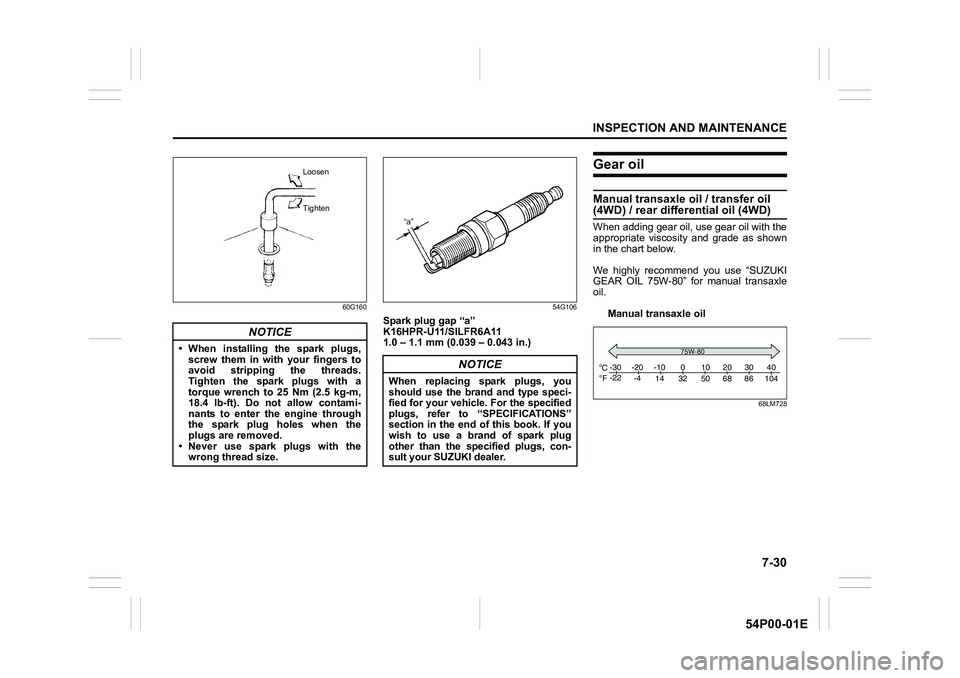
60G160 54G106
Spark plug gap “a”
K16HPR-U11/SILFR6A11
1.0 – 1.1 mm (0.039 – 0.043 in.)
Gear oil
Manual transaxle oil / transfer oil
(4WD) / rear differential oil (4WD)
When adding gear oil, use gear oil with the
appropriate viscosity and grade as shown
in the chart below.
We highly recommend you use “SUZUKI
GEAR OIL 75W-80” for manual transaxle
oil.
Manual transaxle oil
68LM728
NOTICE
• When installing the spark plugs,
screw them in with your fingers to
avoid stripping the threads.
Tighten the spark plugs with a
torque wrench to 25 Nm (2.5 kg-m,
18.4 lb-ft). Do not allow contami-
nants to enter the engine through
the spark plug holes when the
plugs are removed.
• Never use spark plugs with the
wrong thread size.
Loosen
Tighten
NOTICE
When replacing spark plugs, you
should use the brand and type speci-
fied for your vehicle. For the specified
plugs, refer to “SPECIFICATIONS”
section in the end of this book. If you
wish to use a brand of spark plug
other than the specified plugs, con-
sult your SUZUKI dealer.
C
Fo o-30
-22-20
-4-10
14 32 50 68 86 104010203040
75W-80
Page 370 of 482
7-32
INSPECTION AND MAINTENANCE
54P00-01E
To check the gear oil level, use the fol-
lowing procedure:
1) Park the vehicle on a level surface with
the parking brake applied. Then, stop
the engine.
2) Remove the oil filler and level plug.
For the manual transaxle;
3) If gear oil flows from the plug hole, the
oil level is correct. Reinstall the plug. If
gear oil does not flow from the plug
hole, add oil through the filler plug hole
until oil flows a little from the plug hole.
For the transfer and rear differential;
3) Check the inside of the hole with your
finger. If the oil level comes up to the
bottom of the plug hole, the oil level is
correct. If so, reinstall the plug.
4) If the oil level is low, add gear oil
through the oil filler and level plug hole
until the oil level reaches the bottom of
the filler hole, and then reinstall the
plug.
Tightening torque for oil filler and level
plug
Manual transaxle (1) or (2):
21 Nm (2.1 kg-m, 15.5 lb-ft)
Transfer (3) / Rear differential (4):
23 Nm (2.3 kg-m, 17.0 lb-ft)
Gear oil change
Since special procedures, materials and
tools are required, ask your authorized
SUZUKI dealer for this job.
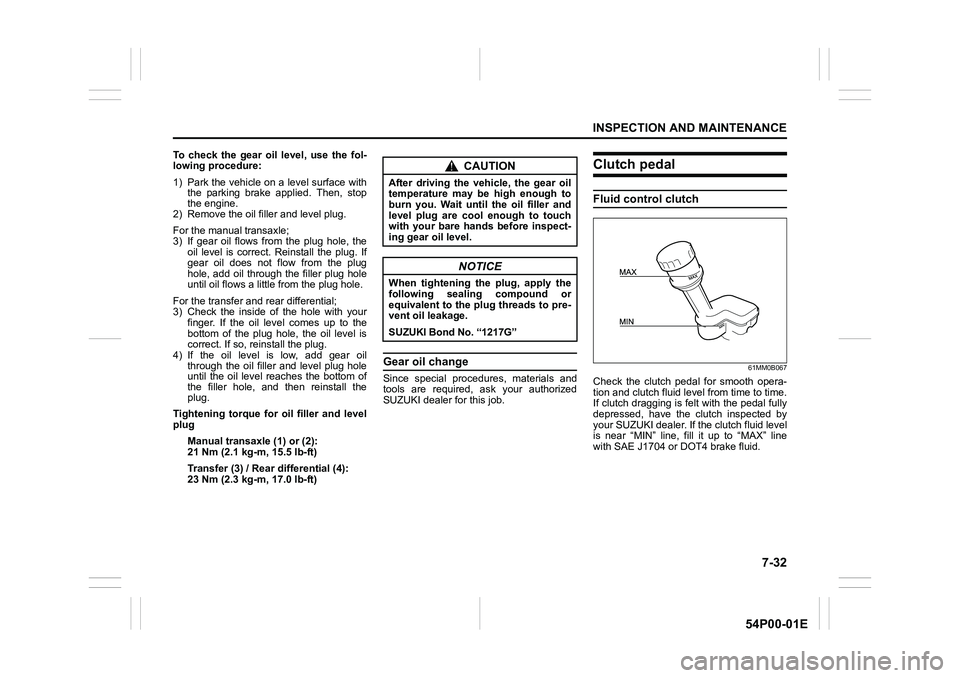
Clutch pedal
Fluid control clutch
61MM0B067
Check the clutch pedal for smooth opera-
tion and clutch fluid level from time to time.
If clutch dragging is felt with the pedal fully
depressed, have the clutch inspected by
your SUZUKI dealer. If the clutch fluid level
is near “MIN” line, fill it up to “MAX” line
with SAE J1704 or DOT4 brake fluid.
CAUTION
After driving the vehicle, the gear oil
temperature may be high enough to
burn you. Wait until the oil filler and
level plug are cool enough to touch
with your bare hands before inspect-
ing gear oil level.
NOTICE
When tightening the plug, apply the
following sealing compound or
equivalent to the plug threads to pre-
vent oil leakage.
SUZUKI Bond No. “1217G”
Page 371 of 482
7-33
INSPECTION AND MAINTENANCE
54P00-01E
Fuel filter (diesel engine)
If the fuel filter warning light comes on
when driving, there is a possibility that
water is in the fuel filter. Drain water as
soon as possible. Have your vehicle
inspected by an authorized SUZUKI
dealer.
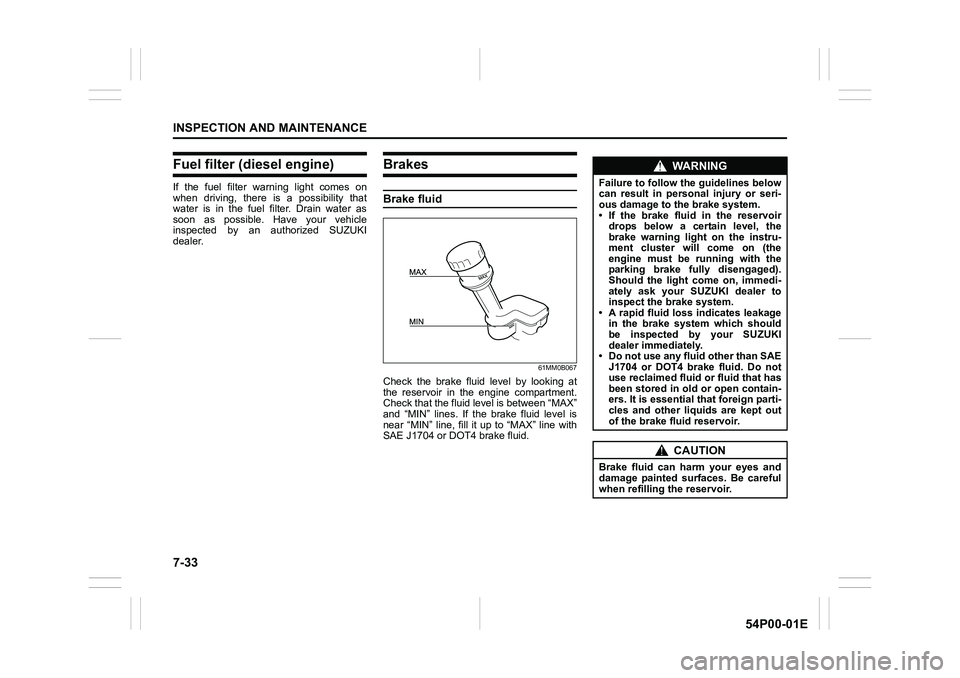
Brakes
Brake fluid
61MM0B067
Check the brake fluid level by looking at
the reservoir in the engine compartment.
Check that the fluid level is between “MAX”
and “MIN” lines. If the brake fluid level is
near “MIN” line, fill it up to “MAX” line with
SAE J1704 or DOT4 brake fluid.
WA R N I N G
Failure to follow the guidelines below
can result in personal injury or seri-
ous damage to the brake system.
• If the brake fluid in the reservoir
drops below a certain level, the
brake warning light on the instru-
ment cluster will come on (the
engine must be running with the
parking brake fully disengaged).
Should the light come on, immedi-
ately ask your SUZUKI dealer to
inspect the brake system.
• A rapid fluid loss indicates leakage
in the brake system which should
be inspected by your SUZUKI
dealer immediately.
• Do not use any fluid other than SAE
J1704 or DOT4 brake fluid. Do not
use reclaimed fluid or fluid that has
been stored in old or open contain-
ers. It is essential that foreign parti-
cles and other liquids are kept out
of the brake fluid reservoir.
CAUTION
Brake fluid can harm your eyes and
damage painted surfaces. Be careful
when refilling the reservoir.
Page 372 of 482
7-34
INSPECTION AND MAINTENANCE
54P00-01E
NOTE:
With disc brakes, the fluid level can be
expected to gradually fall as the brake
pads wear.
Brake pedal
Check brake pedal stroke. If the stroke is
so large, have the brake system inspected
by your SUZUKI dealer. If you doubt the
brake pedal is at its normal height, check it
as follows:
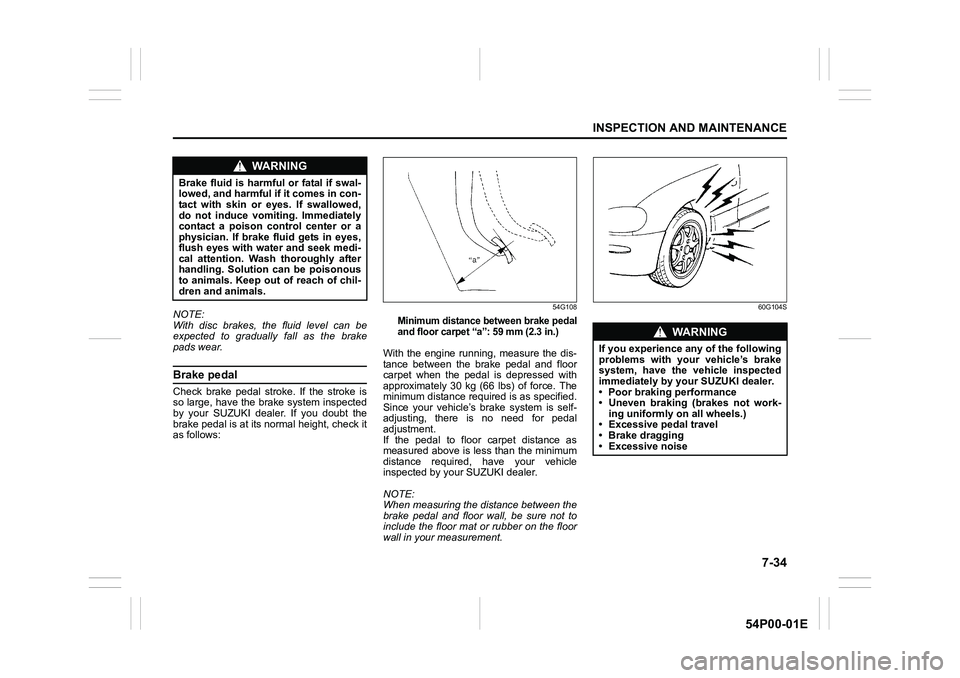
54G108
Minimum distance between brake pedal
and floor carpet “a”: 59 mm (2.3 in.)
With the engine running, measure the dis-
tance between the brake pedal and floor
carpet when the pedal is depressed with
approximately 30 kg (66 lbs) of force. The
minimum distance required is as specified.
Since your vehicle’s brake system is self-
adjusting, there is no need for pedal
adjustment.
If the pedal to floor carpet distance as
measured above is less than the minimum
distance required, have your vehicle
inspected by your SUZUKI dealer.
NOTE:
When measuring the distance between the
brake pedal and floor wall, be sure not to
include the floor mat or rubber on the floor
wall in your measurement.
60G104S
WA R N I N G
Brake fluid is harmful or fatal if swal-
lowed, and harmful if it comes in con-
tact with skin or eyes. If swallowed,
do not induce vomiting. Immediately
contact a poison control center or a
physician. If brake fluid gets in eyes,
flush eyes with water and seek medi-
cal attention. Wash thoroughly after
handling. Solution can be poisonous
to animals. Keep out of reach of chil-
dren and animals.
WA R N I N G
If you experience any of the following
problems with your vehicle’s brake
system, have the vehicle inspected
immediately by your SUZUKI dealer.
• Poor braking performance
• Uneven braking (brakes not work-
ing uniformly on all wheels.)
• Excessive pedal travel
• Brake dragging
• Excessive noise
Page 377 of 482
7-39
INSPECTION AND MAINTENANCE
54P00-01E
Battery
52KM160
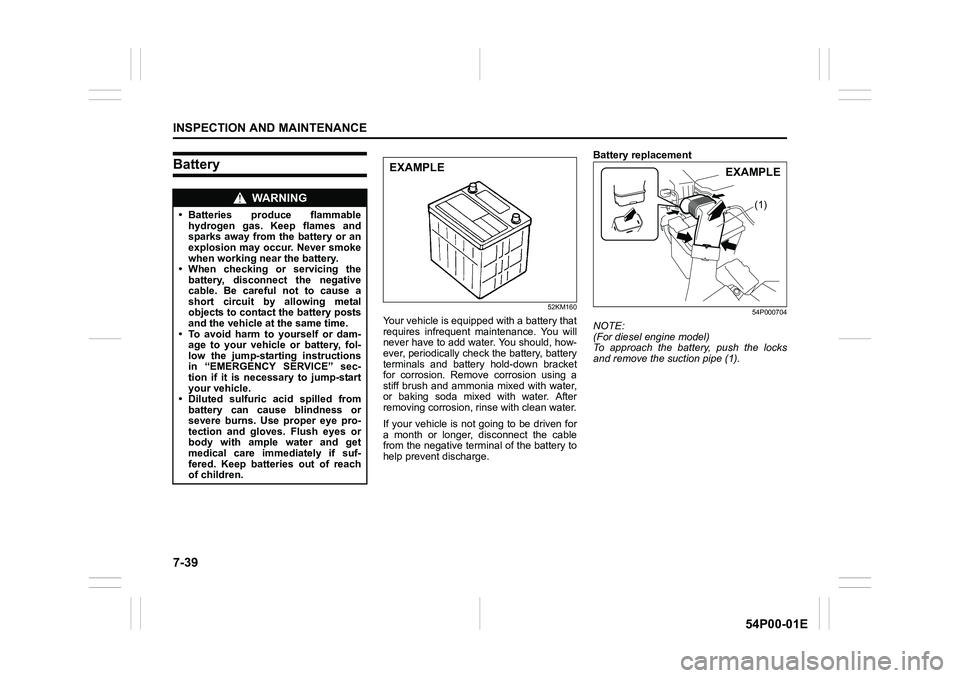
Your vehicle is equipped with a battery that
requires infrequent maintenance. You will
never have to add water. You should, how-
ever, periodically check the battery, battery
terminals and battery hold-down bracket
for corrosion. Remove corrosion using a
stiff brush and ammonia mixed with water,
or baking soda mixed with water. After
removing corrosion, rinse with clean water.
If your vehicle is not going to be driven for
a month or longer, disconnect the cable
from the negative terminal of the battery to
help prevent discharge.Battery replacement54P000704
NOTE:
(For diesel engine model)
To approach the battery, push the locks
and remove the suction pipe (1).
WA R N I N G
• Batteries produce flammable
hydrogen gas. Keep flames and
sparks away from the battery or an
explosion may occur. Never smoke
when working near the battery.
• When checking or servicing the
battery, disconnect the negative
cable. Be careful not to cause a
short circuit by allowing metal
objects to contact the battery posts
and the vehicle at the same time.
• To avoid harm to yourself or dam-
age to your vehicle or battery, fol-
low the jump-starting instructions
in “EMERGENCY SERVICE” sec-
tion if it is necessary to jump-start
your vehicle.
• Diluted sulfuric acid spilled from
battery can cause blindness or
severe burns. Use proper eye pro-
tection and gloves. Flush eyes or
body with ample water and get
medical care immediately if suf-
fered. Keep batteries out of reach
of children.
EXAMPLE
(1)
EXAMPLE
Page 379 of 482
7-41
INSPECTION AND MAINTENANCE
54P00-01E
Fuses
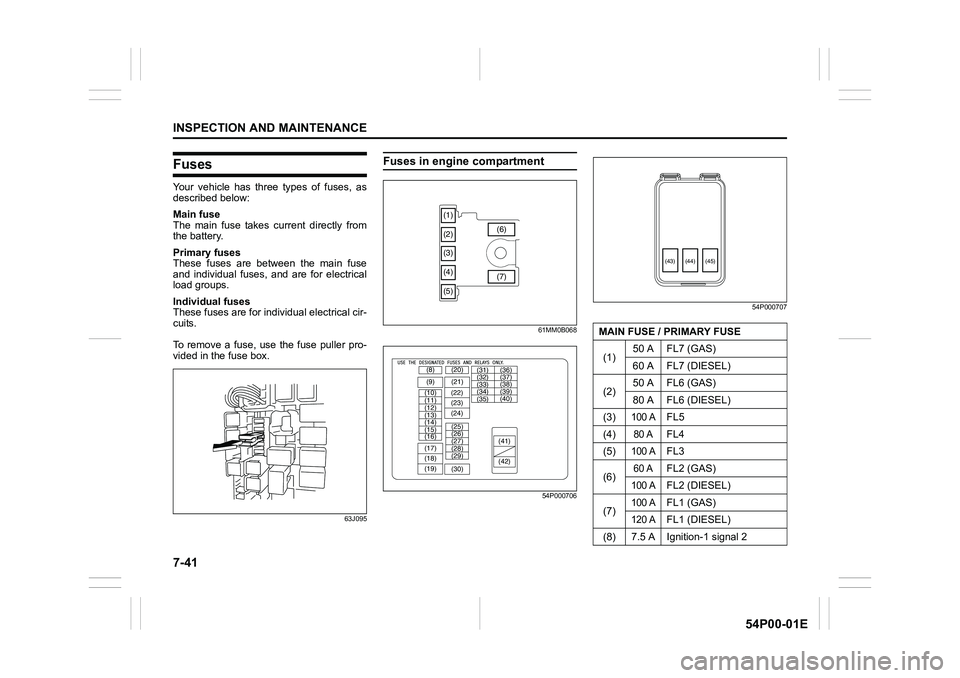
Your vehicle has three types of fuses, as
described below:
Main fuse
The main fuse takes current directly from
the battery.
Primary fuses
These fuses are between the main fuse
and individual fuses, and are for electrical
load groups.
Individual fuses
These fuses are for individual electrical cir-
cuits.
To remove a fuse, use the fuse puller pro-
vided in the fuse box.
63J095
Fuses in engine compartment
61MM0B068
54P00070654P000707
(1)
(2)
(3)
(4)
(5)(6)
(7)
(8) (20)
(9)
(10)
(11)
(12)
(13)
(14)
(15)
(16)
(17)
(18)
(19)(21)
(22)
(23)
(24)
(25)
(26)(33)
(34)
(35)
(27)
(28)
(29)(36)
(30)(37) (31)
(32)
(38)
(39)
(40)
(41)
(42)
MAIN FUSE / PRIMARY FUSE
(1)50 A FL7 (GAS)
60 A FL7 (DIESEL)
(2)50 A FL6 (GAS)
80 A FL6 (DIESEL)
(3)
100 AFL5
(4)
80 AFL4
(5)
100 AFL3
(6)
60 AFL2 (GAS)
100 AFL2 (DIESEL)
(7)
100 AFL1 (GAS)
120 AFL1 (DIESEL)
(8) 7.5 A Ignition-1 signal 2
(43) (44) (45)