engine SUZUKI GRAND VITARA 2017 Owners Manual
[x] Cancel search | Manufacturer: SUZUKI, Model Year: 2017, Model line: GRAND VITARA, Model: SUZUKI GRAND VITARA 2017Pages: 482, PDF Size: 21 MB
Page 408 of 482
8-8
EMERGENCY SERVICE
54P00-01E
not use the tire and consult a SUZUKI
dealer or a roadside assistance service.Using compressor to inflate a tire
1) Place the vehicle on level, hard ground.
Set the parking brake firmly and shift
into “R” (Reverse).
2) Take out the compressor.
3) Unscrew the valve cap from the tire
valve.
4) Connect the air hose of the compressor
to the tire valve.
5) Connect the power plug of the com-
pressor to the accessory socket. Start
the engine. Switch on the compressor.
Inflate the tire to the required air pres-
sure.
Jump-starting instructions
WA R N I N G
Check the tire pressure and confirm
the completion of the emergency
repair after 10 km (6 mile) of running.
NOTICE
Have the tire renewed at the nearest
SUZUKI dealer. When reusing the
sealed tire, consult a tire repair shop.
The wheel can be reused after wiping
sealant off completely with cloth in
order to prevent rust, but the tire
valve and tire pressure monitoring
system (TPMS) sensor must be
renewed.
Dispose of the sealant bottle at a
SUZUKI dealer or in accordance with
your regional codes and practices.
After using the sealant bottle, replace
it with a new bottle from your SUZUKI
dealer.
NOTICE
Do not operate the compressor for
longer than 10 minutes. It can cause
overheating of the compressor.
WA R N I N G
• Never attempt to jump-start your
vehicle if the battery appears to be
frozen. Batteries in this condition
may explode.
• When making jump lead connec-
tions, check that your hands and
the jump leads remain clear from
pulleys, belts or fans.
• Batteries produce flammable
hydrogen gas. Keep flames and
sparks away from the battery or an
explosion may occur. Never smoke
when working near the battery.
• If the booster battery you use for
jump-starting is installed in another
vehicle, check that the two vehicles
are not touching each other.
• If your battery discharges repeat-
edly, for no apparent reason, have
your vehicle inspected by an
authorized SUZUKI dealer.
• To avoid harm to yourself or dam-
age to your vehicle or battery, fol-
low the jump-starting instructions
below.
If you are in doubt, call for qualified
road service.
Page 409 of 482
8-9
EMERGENCY SERVICE
54P00-01E
1) Use only a 12-volt battery to jump-start
your vehicle. Position the good 12-volt
battery close to your vehicle so that the
jump leads will reach both batteries.
When using a battery installed on
another vehicle, check that two vehicles
do not touch each other. Set the park-
ing brakes fully on both vehicles.
2) Turn off all vehicle accessories, except
those necessary for safety reasons (for
example, headlights or hazard lights).
54P000804
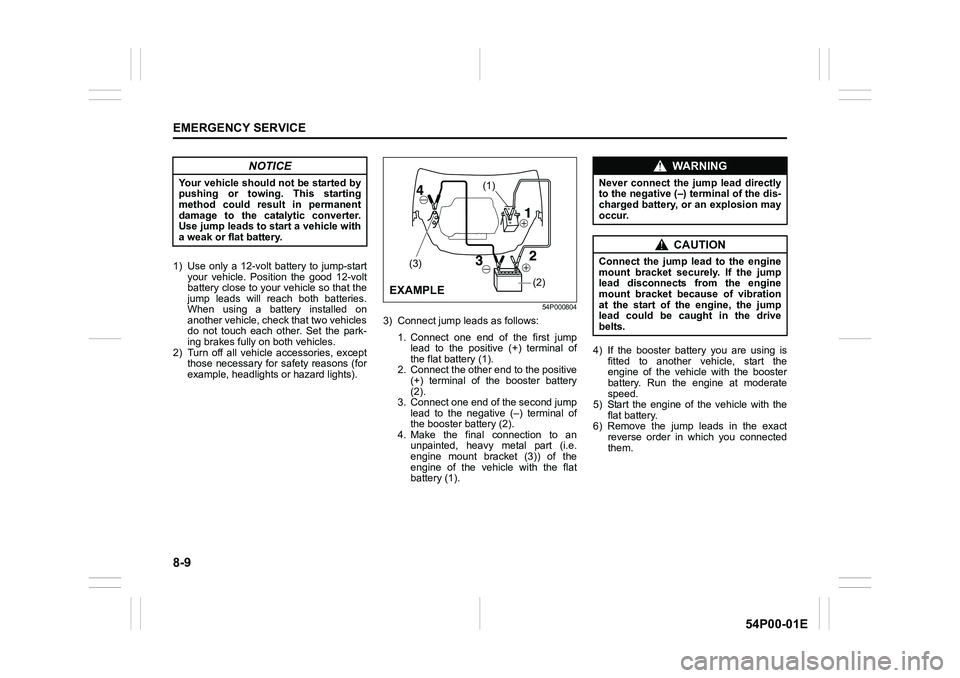
3) Connect jump leads as follows:
1. Connect one end of the first jump
lead to the positive (+) terminal of
the flat battery (1).
2. Connect the other end to the positive
(+) terminal of the booster battery
(2).
3. Connect one end of the second jump
lead to the negative (–) terminal of
the booster battery (2).
4. Make the final connection to an
unpainted, heavy metal part (i.e.
engine mount bracket (3)) of the
engine of the vehicle with the flat
battery (1).4) If the booster battery you are using is
fitted to another vehicle, start the
engine of the vehicle with the booster
battery. Run the engine at moderate
speed.
5) Start the engine of the vehicle with the
flat battery.
6) Remove the jump leads in the exact
reverse order in which you connected
them.
NOTICE
Your vehicle should not be started by
pushing or towing. This starting
method could result in permanent
damage to the catalytic converter.
Use jump leads to start a vehicle with
a weak or flat battery.
(2)
(1)
(3)
EXAMPLE
WA R N I N G
Never connect the jump lead directly
to the negative (–) terminal of the dis-
charged battery, or an explosion may
occur.
CAUTION
Connect the jump lead to the engine
mount bracket securely. If the jump
lead disconnects from the engine
mount bracket because of vibration
at the start of the engine, the jump
lead could be caught in the drive
belts.
Page 410 of 482
8-10
EMERGENCY SERVICE
54P00-01E
Towing
If you need to have your vehicle towed,
contact a professional service. Your dealer
can provide you with detailed towing
instructions.
2-wheel drive (2WD) manual tran-saxle
Manual transaxle vehicles may be towed
using either of the following methods.
1) From the front, with the front wheels
lifted and the rear wheels on the
ground. Before towing, check that the
parking brake is released.
2) From the rear, with the rear wheels
lifted and the front wheels on the
ground, provided the steering and
drivetrain are in operational condition.
Before towing, check that transaxle is in
neutral, the steering wheel is unlocked
(vehicle without keyless push start sys-
tem - the ignition key should be in
“ACC” position) (vehicle with keyless
push start system - the ignition mode is
“ACC”), and the steering wheel is
secured with a clamping device
designed for towing service.
4-wheel drive (4WD)
Your vehicle should be towed under one of
the following conditions:
1) With all four wheels on a flat-bed truck.
2) With the front or rear wheels lifted and a
dolly under the other wheels.
WA R N I N G
For vehicles equipped with the radar
brake support system, if your vehicle
is towed with the engine on, press
radar brake support OFF switch and
turn off the radar brake support sys-
tem. If not, unexpected accidents
related to the system being turned on
may occur.
NOTICE
Observe the following instructions
when towing your vehicle.
• To help avoid damage to your vehi-
cle during towing, proper equip-
ment and towing procedures must
be used.
• Using the frame hook, tow your
vehicle on paved roads for short
distances at low speed.
NOTICE
The steering column is not strong
enough to withstand shocks trans-
mitted from the front wheels during
towing. Always unlock the steering
wheel before towing.
Page 411 of 482
8-11
EMERGENCY SERVICE
54P00-01E
Engine trouble: Starter does
not operate
1) Try turning the ignition switch to
“START” position or try pressing the
engine switch to change the ignition
mode to “START” with the headlights
turned on to determine the battery con-
dition. If the headlights go excessively
dim or go off, it usually means that
either the battery is flat or the battery
terminal contact is poor. Recharge the
battery or correct battery terminal con-
tact as necessary.
2) If the headlights remain bright, check
the fuses. If the reason for failure of the
starter is not obvious, there may be a
major electrical problem. Have the vehi-
cle inspected by your authorized
SUZUKI dealer.
Engine trouble: Flooded
engine
(Vehicle without keyless push start sys-
tem)
If the engine is flooded with gasoline, it
may be hard to start. If this happens, press
the accelerator pedal all the way to the
floor and hold it there while cranking the
engine.
• For gasoline engine model, do not oper-
ate the starter motor for more than 12
seconds.
• For diesel engine model, do not operate
the starter motor for more than 30 sec-
onds.
(Vehicle with keyless push start sys-
tem)
If the engine is flooded with gasoline, it
may be hard to start. If this happens, press
the accelerator pedal all the way to the
floor and hold it there while cranking the
engine.
• For gasoline engine model, do not oper-
ate the starter motor for more than 12
seconds.
• For diesel engine model, do not operate
the starter motor for more than 30 sec-
onds.
NOTE:
If the engine refuses to start, the starter
motor automatically stops after a certain
period of time. After the starter motor hasautomatically stopped or if there is any-
thing abnormal in the engine starting sys-
tem, the starter motor runs only while the
engine switch is held pressed.
Page 412 of 482
8-12
EMERGENCY SERVICE
54P00-01E
Engine trouble: Overheating
The engine could overheat temporarily
under severe driving conditions. If the
engine coolant temperature gauge indi-
cates overheating during driving:
1) Turn off the air conditioner, if equipped.
2) Take the vehicle to a safe place and
park.
3) Run the engine at a normal idle speed
for a few minutes until the indicator is
within the normal, acceptable tempera-
ture range between “H” and “C”.If the temperature indication does not
come down to within the normal, accept-
able range:
1) Turn off the engine and check that the
water pump belt and pulleys are not
damaged or slipping. If any abnormality
is found, correct it.
2) Check the coolant level in the reservoir.
If it is found to be lower than “LOW”
line, check radiator, water pump, radia-
tor hoses and heater hoses for leakage.
If leakage that may cause overheating
is found, do not run the engine until
these problems have been corrected.
3) If leakage is not found, carefully add
coolant to the reservoir and then the
radiator, if necessary. (Refer to “Engine
coolant” in “INSPECTION AND MAIN-
TENANCE” section.)
NOTE:
If engine overheats and you are not sure
what to do, contact your SUZUKI dealer.
79J007
WA R N I N G
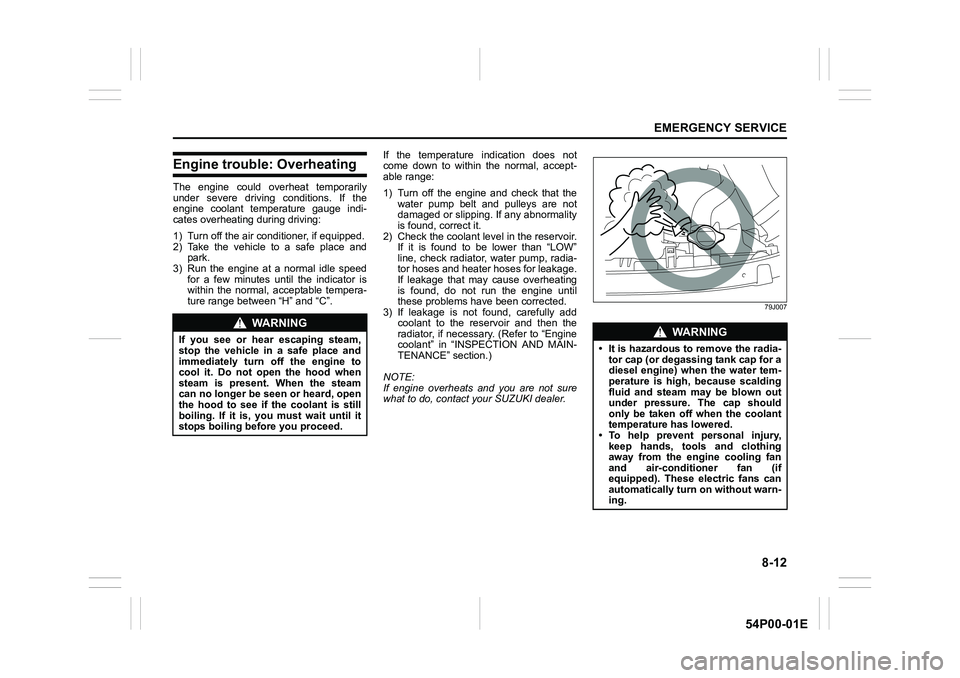
If you see or hear escaping steam,
stop the vehicle in a safe place and
immediately turn off the engine to
cool it. Do not open the hood when
steam is present. When the steam
can no longer be seen or heard, open
the hood to see if the coolant is still
boiling. If it is, you must wait until it
stops boiling before you proceed.WA R N I N G
• It is hazardous to remove the radia-
tor cap (or degassing tank cap for a
diesel engine) when the water tem-
perature is high, because scalding
fluid and steam may be blown out
under pressure. The cap should
only be taken off when the coolant
temperature has lowered.
• To help prevent personal injury,
keep hands, tools and clothing
away from the engine cooling fan
and air-conditioner fan (if
equipped). These electric fans can
automatically turn on without warn-
ing.
Page 418 of 482
9-4
APPEARANCE CARE
54P00-01E
Washing
60B212S
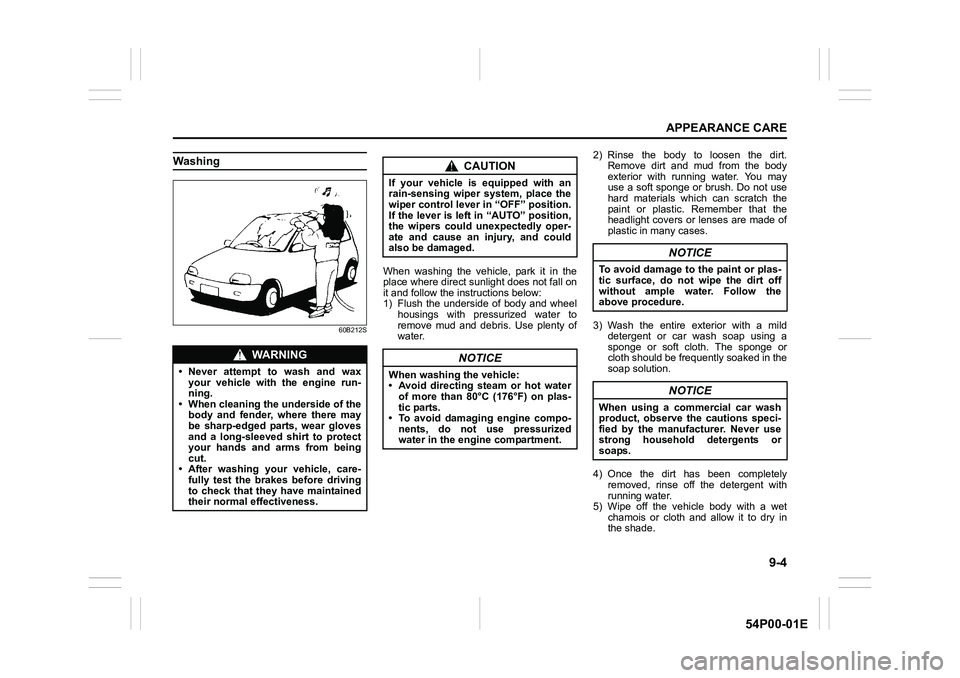
When washing the vehicle, park it in the
place where direct sunlight does not fall on
it and follow the instructions below:
1) Flush the underside of body and wheel
housings with pressurized water to
remove mud and debris. Use plenty of
water.2) Rinse the body to loosen the dirt.
Remove dirt and mud from the body
exterior with running water. You may
use a soft sponge or brush. Do not use
hard materials which can scratch the
paint or plastic. Remember that the
headlight covers or lenses are made of
plastic in many cases.
3) Wash the entire exterior with a mild
detergent or car wash soap using a
sponge or soft cloth. The sponge or
cloth should be frequently soaked in the
soap solution.
4) Once the dirt has been completely
removed, rinse off the detergent with
running water.
5) Wipe off the vehicle body with a wet
chamois or cloth and allow it to dry in
the shade.
WA R N I N G
• Never attempt to wash and wax
your vehicle with the engine run-
ning.
• When cleaning the underside of the
body and fender, where there may
be sharp-edged parts, wear gloves
and a long-sleeved shirt to protect
your hands and arms from being
cut.
• After washing your vehicle, care-
fully test the brakes before driving
to check that they have maintained
their normal effectiveness.
CAUTION
If your vehicle is equipped with an
rain-sensing wiper system, place the
wiper control lever in “OFF” position.
If the lever is left in “AUTO” position,
the wipers could unexpectedly oper-
ate and cause an injury, and could
also be damaged.
NOTICE
When washing the vehicle:
• Avoid directing steam or hot water
of more than 80°C (176°F) on plas-
tic parts.
• To avoid damaging engine compo-
nents, do not use pressurized
water in the engine compartment.
NOTICE
To avoid damage to the paint or plas-
tic surface, do not wipe the dirt off
without ample water. Follow the
above procedure.
NOTICE
When using a commercial car wash
product, observe the cautions speci-
fied by the manufacturer. Never use
strong household detergents or
soaps.
Page 421 of 482
10-1
GENERAL INFORMATION
54P00-01E
Vehicle identification
Chassis serial number
63J10468LM101
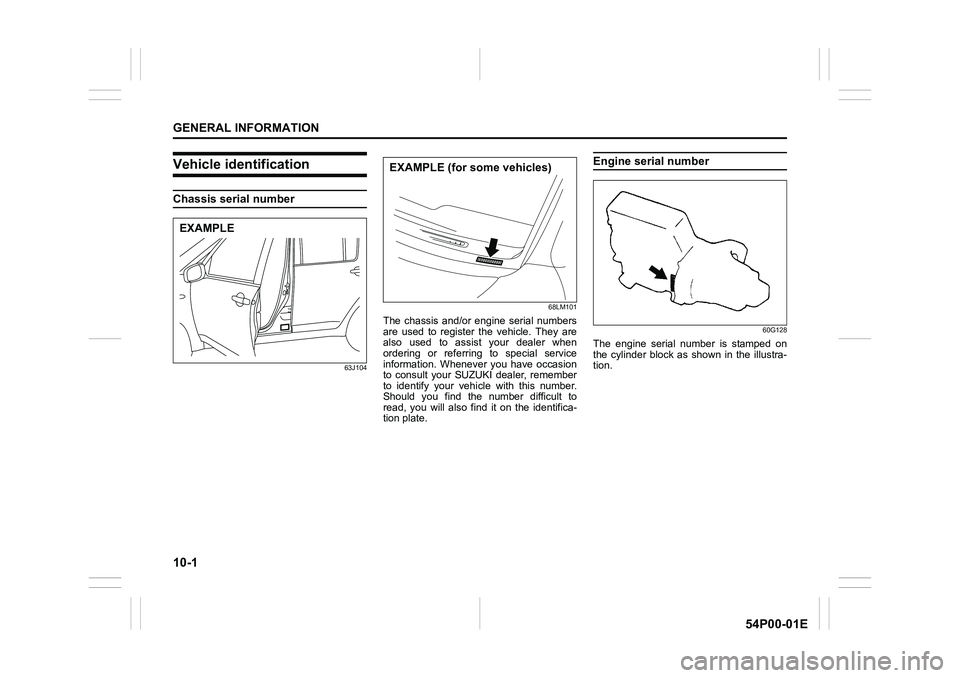
The chassis and/or engine serial numbers
are used to register the vehicle. They are
also used to assist your dealer when
ordering or referring to special service
information. Whenever you have occasion
to consult your SUZUKI dealer, remember
to identify your vehicle with this number.
Should you find the number difficult to
read, you will also find it on the identifica-
tion plate.
Engine serial number
60G128
The engine serial number is stamped on
the cylinder block as shown in the illustra-
tion.
EXAMPLE
EXAMPLE (for some vehicles)
Page 424 of 482
11-1
SPECIFICATIONS
54P00-01E
11
SPECIFICATIONS
NOTE:
Specifications are subject to change without notice.
M/T: Manual transaxle Gasoline: Gasoline engine model
Diesel: Diesel engine model2WD: 2-wheel drive
4WD: 4-wheel drive
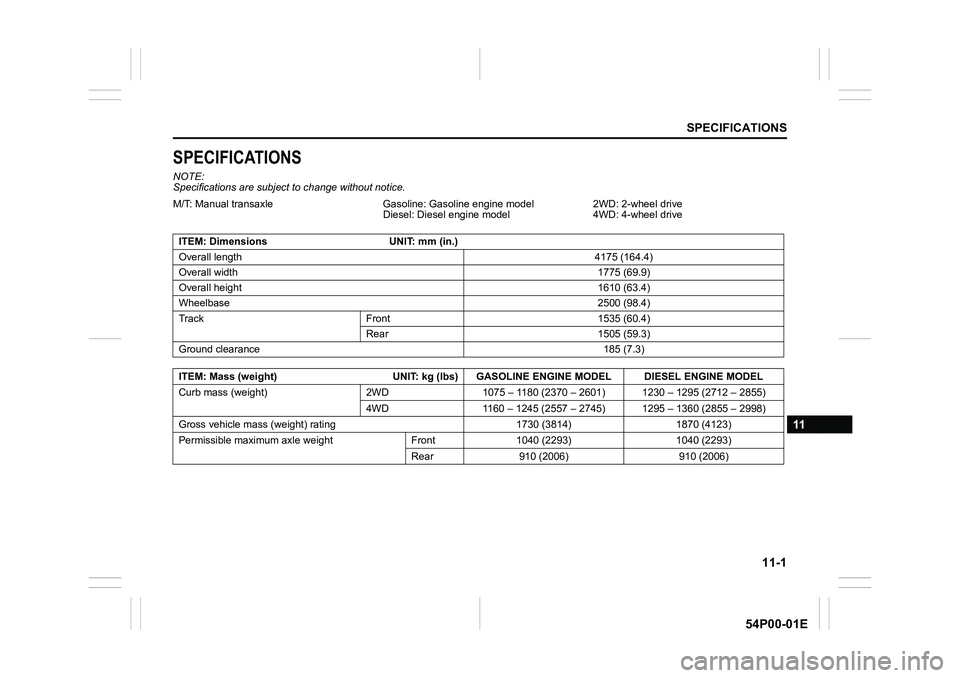
ITEM: Dimensions UNIT: mm (in.)
Overall length4175 (164.4)
Overall width1775 (69.9)
Overall height1610 (63.4)
Wheelbase2500 (98.4)
Track Front 1535 (60.4)
Rear 1505 (59.3)
Ground clearance185 (7.3)
ITEM: Mass (weight) UNIT: kg (lbs) GASOLINE ENGINE MODEL DIESEL ENGINE MODEL
Curb mass (weight) 2WD 1075 – 1180 (2370 – 2601) 1230 – 1295 (2712 – 2855)
4WD 1160 – 1245 (2557 – 2745) 1295 – 1360 (2855 – 2998)
Gross vehicle mass (weight) rating 1730 (3814) 1870 (4123)
Permissible maximum axle weight Front 1040 (2293) 1040 (2293)
Rear 910 (2006) 910 (2006)
Page 425 of 482
11-2
SPECIFICATIONS
54P00-01E
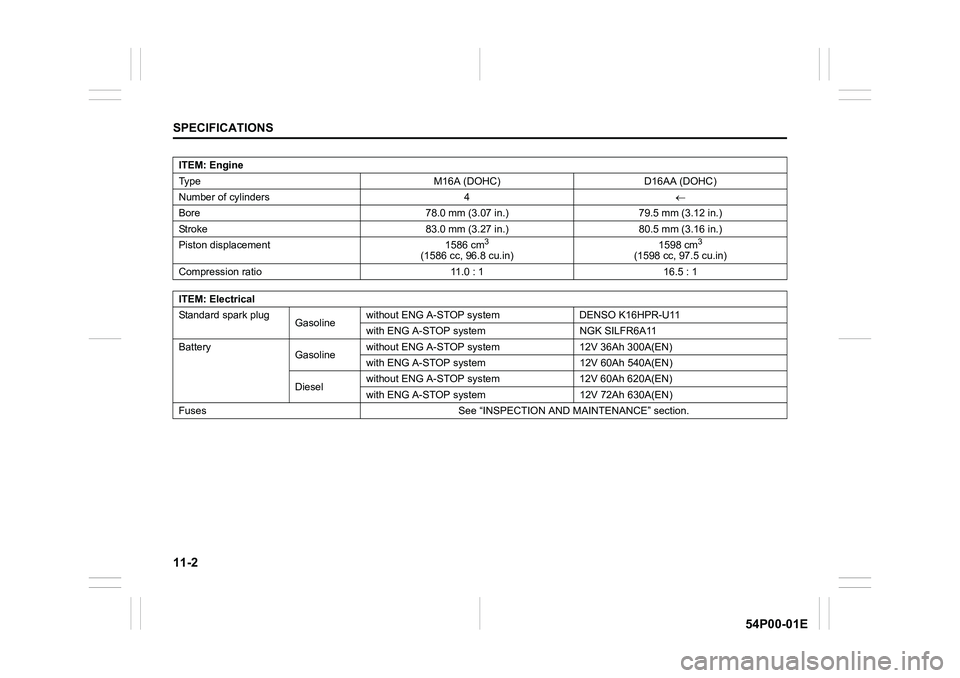
ITEM: Engine
Type M16A (DOHC) D16AA (DOHC)
Number of cylinders 4
Bore 78.0 mm (3.07 in.) 79.5 mm (3.12 in.)
Stroke 83.0 mm (3.27 in.) 80.5 mm (3.16 in.)
Piston displacement 1586 cm
3
(1586 cc, 96.8 cu.in)1598 cm3
(1598 cc, 97.5 cu.in)
Compression ratio 11.0 : 1 16.5 : 1
ITEM: Electrical
Standard spark plug
Gasolinewithout ENG A-STOP system DENSO K16HPR-U11
with ENG A-STOP system NGK SILFR6A11
Battery
Gasolinewithout ENG A-STOP system 12V 36Ah 300A(EN)
with ENG A-STOP system 12V 60Ah 540A(EN)
Dieselwithout ENG A-STOP system 12V 60Ah 620A(EN)
with ENG A-STOP system 12V 72Ah 630A(EN)
Fuses See “INSPECTION AND MAINTENANCE” section.
Page 428 of 482
11-5
SPECIFICATIONS
54P00-01E
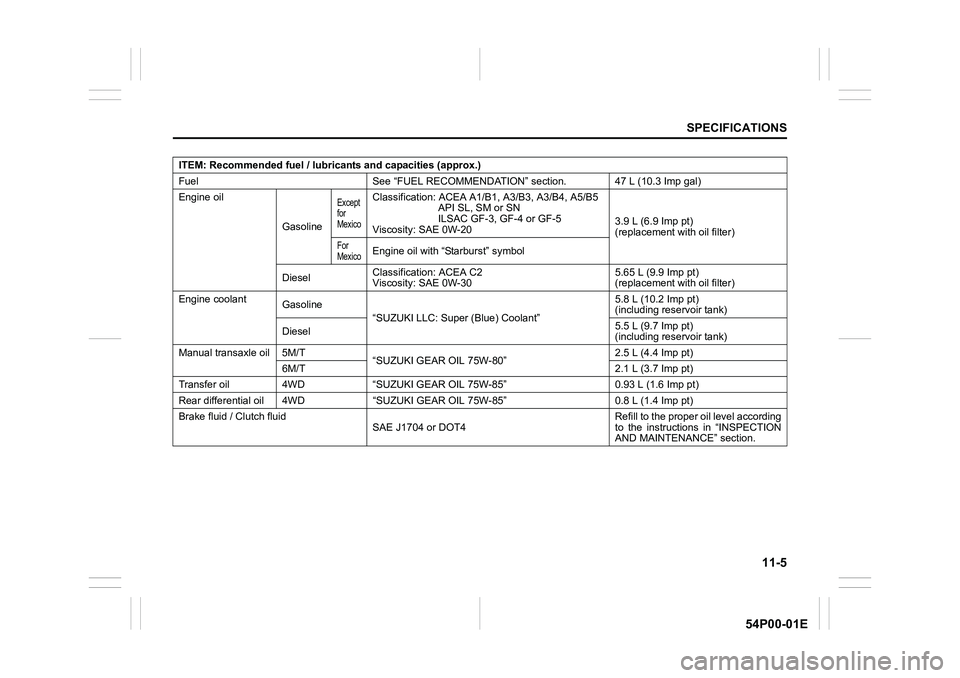
ITEM: Recommended fuel / lubricants and capacities (approx.)
Fuel See “FUEL RECOMMENDATION” section. 47 L (10.3 Imp gal)
Engine oil
Gasoline
Except
for
MexicoClassification: ACEA A1/B1, A3/B3, A3/B4, A5/B5
API SL, SM or SN
ILSAC GF-3, GF-4 or GF-5
Viscosity: SAE 0W-203.9 L (6.9 Imp pt)
(replacement with oil filter)
For
MexicoEngine oil with “Starburst” symbol
DieselClassification: ACEA C2
Viscosity: SAE 0W-305.65 L (9.9 Imp pt)
(replacement with oil filter)
Engine coolant
Gasoline
“SUZUKI LLC: Super (Blue) Coolant”5.8 L (10.2 Imp pt)
(including reservoir tank)
Diesel5.5 L (9.7 Imp pt)
(including reservoir tank)
Manual transaxle oil 5M/T
“SUZUKI GEAR OIL 75W-80”2.5 L (4.4 Imp pt)
6M/T 2.1 L (3.7 Imp pt)
Transfer oil 4WD “SUZUKI GEAR OIL 75W-85” 0.93 L (1.6 Imp pt)
Rear differential oil 4WD “SUZUKI GEAR OIL 75W-85” 0.8 L (1.4 Imp pt)
Brake fluid / Clutch fluid
SAE J1704 or DOT4Refill to the proper oil level according
to the instructions in “INSPECTION
AND MAINTENANCE” section.