tire SUZUKI GRAND VITARA 2017 Owner's Guide
[x] Cancel search | Manufacturer: SUZUKI, Model Year: 2017, Model line: GRAND VITARA, Model: SUZUKI GRAND VITARA 2017Pages: 482, PDF Size: 21 MB
Page 335 of 482
6-3
VEHICLE LOADING AND TOWING
54P00-01E
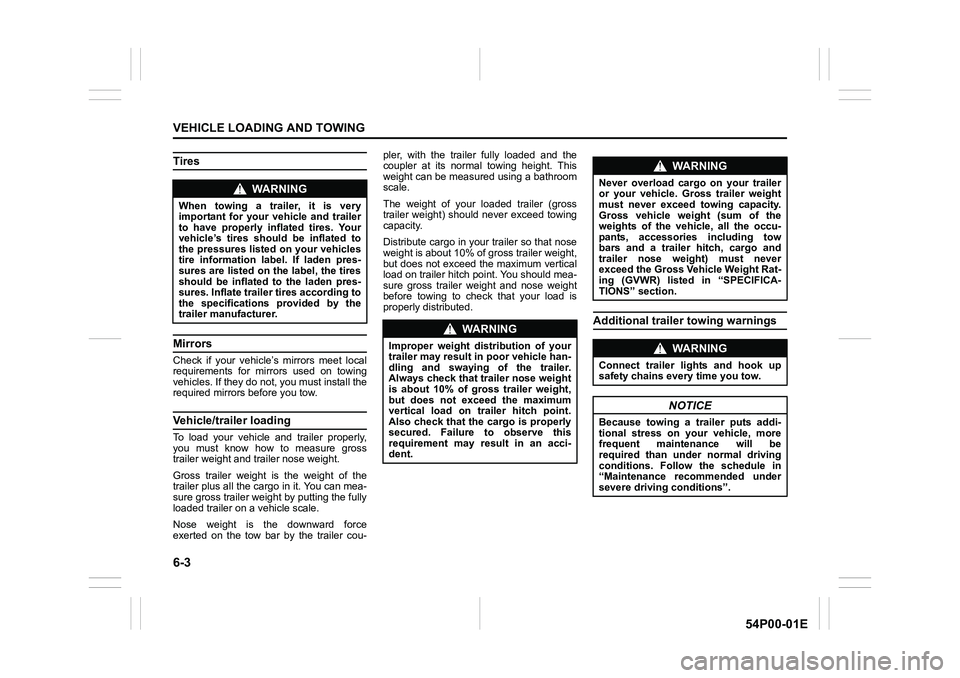
Tires
Mirrors
Check if your vehicle’s mirrors meet local
requirements for mirrors used on towing
vehicles. If they do not, you must install the
required mirrors before you tow.
Vehicle/trailer loading
To load your vehicle and trailer properly,
you must know how to measure gross
trailer weight and trailer nose weight.
Gross trailer weight is the weight of the
trailer plus all the cargo in it. You can mea-
sure gross trailer weight by putting the fully
loaded trailer on a vehicle scale.
Nose weight is the downward force
exerted on the tow bar by the trailer cou-pler, with the trailer fully loaded and the
coupler at its normal towing height. This
weight can be measured using a bathroom
scale.
The weight of your loaded trailer (gross
trailer weight) should never exceed towing
capacity.
Distribute cargo in your trailer so that nose
weight is about 10% of gross trailer weight,
but does not exceed the maximum vertical
load on trailer hitch point. You should mea-
sure gross trailer weight and nose weight
before towing to check that your load is
properly distributed.
Additional trailer towing warnings
WA R N I N G
When towing a trailer, it is very
important for your vehicle and trailer
to have properly inflated tires. Your
vehicle’s tires should be inflated to
the pressures listed on your vehicles
tire information label. If laden pres-
sures are listed on the label, the tires
should be inflated to the laden pres-
sures. Inflate trailer tires according to
the specifications provided by the
trailer manufacturer.
WA R N I N G
Improper weight distribution of your
trailer may result in poor vehicle han-
dling and swaying of the trailer.
Always check that trailer nose weight
is about 10% of gross trailer weight,
but does not exceed the maximum
vertical load on trailer hitch point.
Also check that the cargo is properly
secured. Failure to observe this
requirement may result in an acci-
dent.
WA R N I N G
Never overload cargo on your trailer
or your vehicle. Gross trailer weight
must never exceed towing capacity.
Gross vehicle weight (sum of the
weights of the vehicle, all the occu-
pants, accessories including tow
bars and a trailer hitch, cargo and
trailer nose weight) must never
exceed the Gross Vehicle Weight Rat-
ing (GVWR) listed in “SPECIFICA-
TIONS” section.
WA R N I N G
Connect trailer lights and hook up
safety chains every time you tow.
NOTICE
Because towing a trailer puts addi-
tional stress on your vehicle, more
frequent maintenance will be
required than under normal driving
conditions. Follow the schedule in
“Maintenance recommended under
severe driving conditions”.
Page 338 of 482
INSPECTION AND MAINTENANCE
7
54P00-01E
60G410
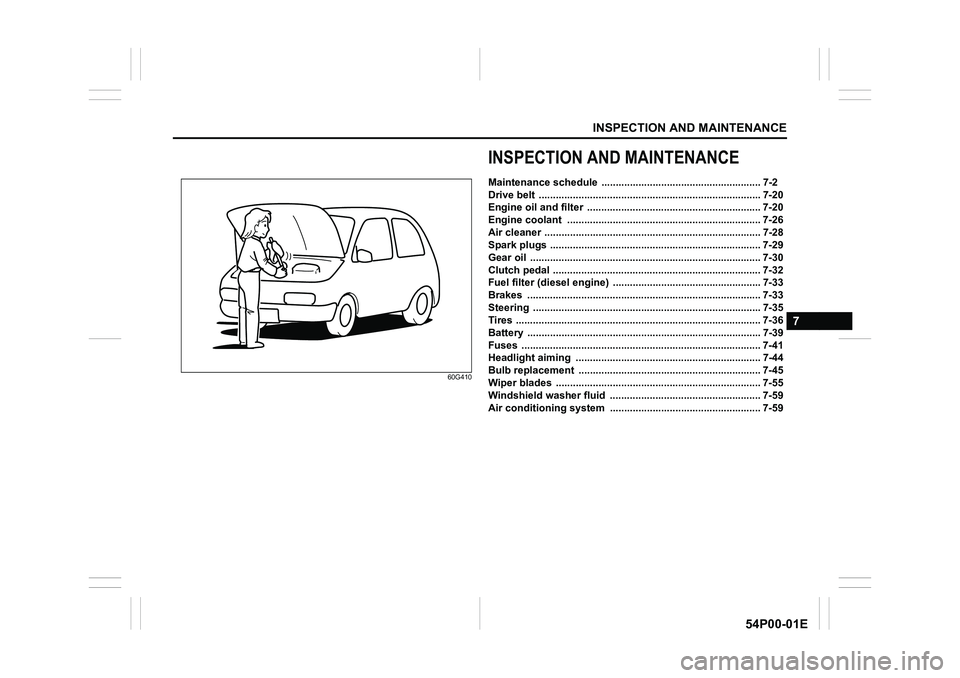
INSPECTION AND MAINTENANCE
Maintenance schedule ........................................................ 7-2
Drive belt .............................................................................. 7-20
Engine oil and filter ............................................................. 7-20
Engine coolant .................................................................... 7-26
Air cleaner ............................................................................ 7-28
Spark plugs .......................................................................... 7-29
Gear oil ................................................................................. 7-30
Clutch pedal ......................................................................... 7-32
Fuel filter (diesel engine) .................................................... 7-33
Brakes .................................................................................. 7-33
Steering ................................................................................ 7-35
Tires ...................................................................................... 7-36
Battery .................................................................................. 7-39
Fuses .................................................................................... 7-41
Headlight aiming ................................................................. 7-44
Bulb replacement ................................................................ 7-45
Wiper blades ........................................................................ 7-55
Windshield washer fluid ..................................................... 7-59
Air conditioning system ..................................................... 7-59
Page 346 of 482
7-8
INSPECTION AND MAINTENANCE
54P00-01E
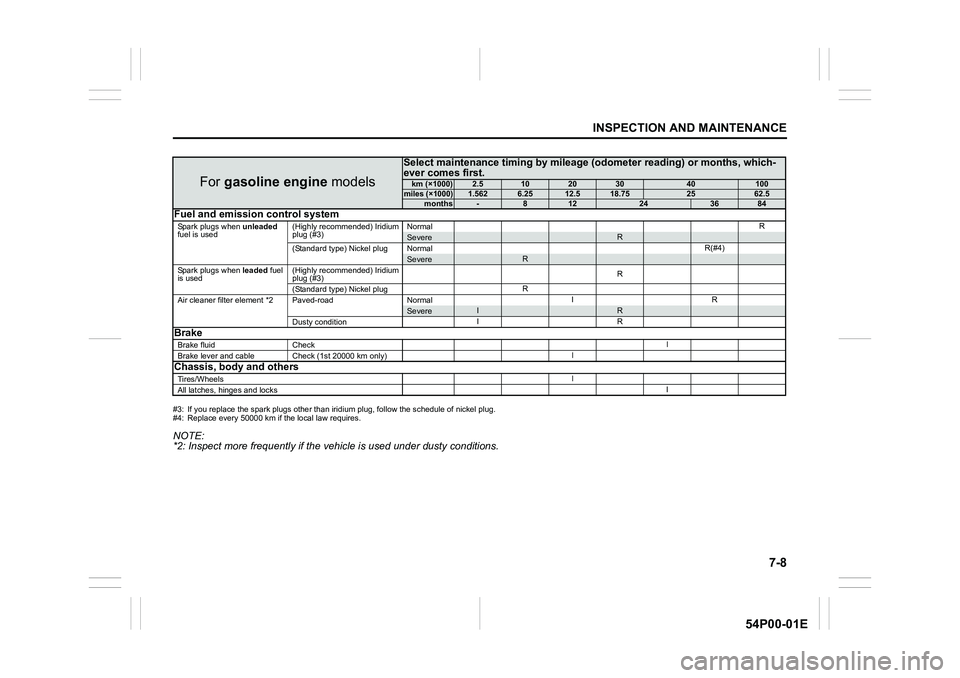
#3: If you replace the spark plugs other than iridium plug, follow the schedule of nickel plug.
#4: Replace every 50000 km if the local law requires.
NOTE:
*2: Inspect more frequently if the vehicle is used under dusty conditions.
For gasoline engine models
Select maintenance timing by mileage (odometer reading) or months, which-
ever comes first.
km (×1000)2.510203040100miles (×1000)1.5626.2512.518.752562.5months-812243684Fuel and emission control system
Spark plugs when unleaded
fuel is used(Highly recommended) Iridium
plug (#3)NormalRSevereR
(Standard type) Nickel plug NormalR(#4)SevereR
Spark plugs when leaded fuel
is used(Highly recommended) Iridium
plug (#3)R
(Standard type) Nickel plugR
Air cleaner filter element *2 Paved-road NormalIR
SevereIR
Dusty conditionIRBrake
Brake fluid CheckI
Brake lever and cable Check (1st 20000 km only)I
Chassis, body and others
Tires/WheelsI
All latches, hinges and locksI
Page 349 of 482
7-11
INSPECTION AND MAINTENANCE
54P00-01E
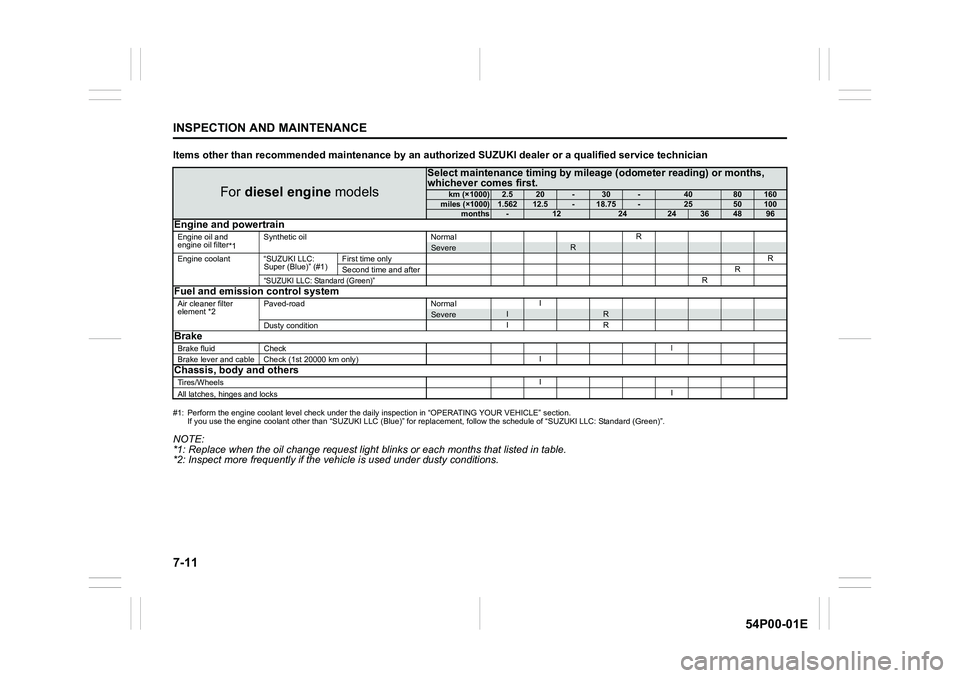
Items other than recommended maintenance by an authorized SUZUKI dealer or a qualified service technician
#1: Perform the engine coolant level check under the daily inspection in “OPERATING YOUR VEHICLE” section.
If you use the engine coolant other than “SUZUKI LLC (Blue)” for replacement, follow the schedule of “SUZUKI LLC: Standard (Green)”.
NOTE:
*1: Replace when the oil change request light blinks or each months that listed in table.
*2: Inspect more frequently if the vehicle is used under dusty conditions.
For diesel engine models
Select maintenance timing by mileage (odometer reading) or months,
whichever comes first.
km (×1000)2.520-30-4080160miles (×1000)1.56212.5-18.75-2550100months-122424364896Engine and powertrain
Engine oil and
engine oil filter
*1Synthetic oil NormalRSevereR
Engine coolant “SUZUKI LLC:
Super (Blue)” (#1)First time onlyR
Second time and afterR
“SUZUKI LLC: Standard (Green)”R
Fuel and emission control system
Air cleaner filter
element *2Paved-road NormalISevereIR
Dusty conditionIRBrake
Brake fluid CheckI
Brake lever and cable Check (1st 20000 km only)IChassis, body and others
Tires/WheelsI
All latches, hinges and locksI
Page 354 of 482
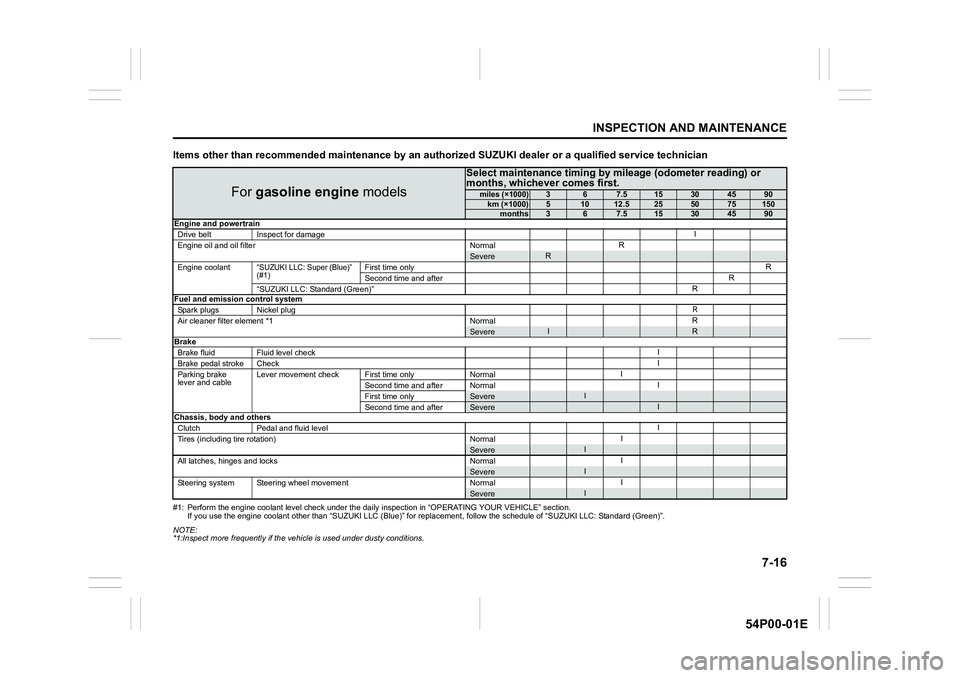
7-16
INSPECTION AND MAINTENANCE
54P00-01E
Items other than recommended maintenance by an authorized SUZUKI dealer or a qualified service technician
#1: Perform the engine coolant level check under the daily inspection in “OPERATING YOUR VEHICLE” section.
If you use the engine coolant other than “SUZUKI LLC (Blue)” for replacement, follow the schedule of “SUZUKI LLC: Standard (Green)”.
NOTE:
*1:Inspect more frequently if the vehicle is used under dusty conditions.
For gasoline engine models
Select maintenance timing by mileage (odometer reading) or
months, whichever comes first.
miles (×1000)367.515304590km (×1000)51012.5255075150months367.515304590
Engine and powertrain
Drive belt Inspect for damageI
Engine oil and oil filter NormalR
SevereR
Engine coolant“SUZUKI LLC: Super (Blue)”
(#1)First time onlyR
Second time and afterR
“SUZUKI LLC: Standard (Green)”R
Fuel and emission control system
Spark plugs Nickel plug
R
Air cleaner filter element *1 NormalRSevereIRBrake
Brake fluid Fluid level checkI
Brake pedal stroke CheckI
Parking brake
lever and cableLever movement check First time only NormalI
Second time and after NormalI
First time only
SevereI
Second time and afterSevereIChassis, body and others
Clutch Pedal and fluid levelI
Tires (including tire rotation) NormalI
SevereI
All latches, hinges and locks NormalISevereI
Steering system Steering wheel movement NormalISevereI
Page 357 of 482
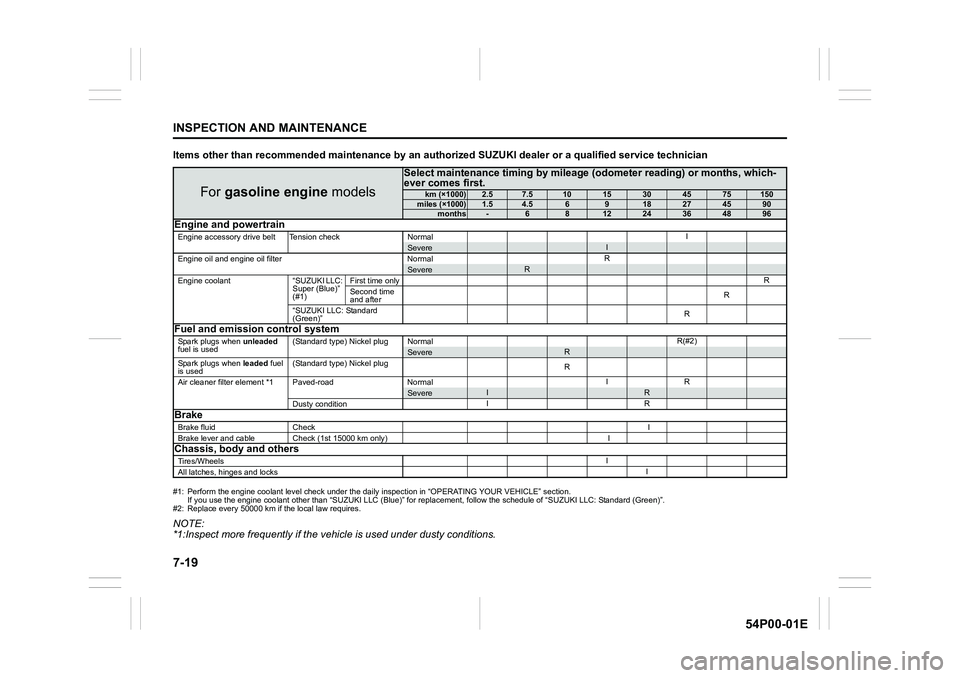
7-19
INSPECTION AND MAINTENANCE
54P00-01E
Items other than recommended maintenance by an authorized SUZUKI dealer or a qualified service technician
#1: Perform the engine coolant level check under the daily inspection in “OPERATING YOUR VEHICLE” section.
If you use the engine coolant other than “SUZUKI LLC (Blue)” for replacement, follow the schedule of “SUZUKI LLC: Standard (Green)”.
#2: Replace every 50000 km if the local law requires.
NOTE:
*1:Inspect more frequently if the vehicle is used under dusty conditions.
For gasoline engine models
Select maintenance timing by mileage (odometer reading) or months, which-
ever comes first.
km (×1000)2.57.51015304575150miles (×1000)1.54.56918274590months-681224364896Engine and powertrain
Engine accessory drive belt Tension check NormalISevereI
Engine oil and engine oil filter NormalRSevereR
Engine coolant “SUZUKI LLC:
Super (Blue)”
(#1)First time onlyR
Second time
and afterR
“SUZUKI LLC: Standard
(Green)”R
Fuel and emission control system
Spark plugs when unleaded
fuel is used(Standard type) Nickel plug NormalR(#2)SevereR
Spark plugs when leaded fuel
is used(Standard type) Nickel plug
R
Air cleaner filter element *1 Paved-road NormalIR
SevereIR
Dusty conditionIRBrake
Brake fluid CheckI
Brake lever and cable Check (1st 15000 km only) I
Chassis, body and others
Tires/WheelsI
All latches, hinges and locksI
Page 374 of 482
7-36
INSPECTION AND MAINTENANCE
54P00-01E
Tires
80JS025
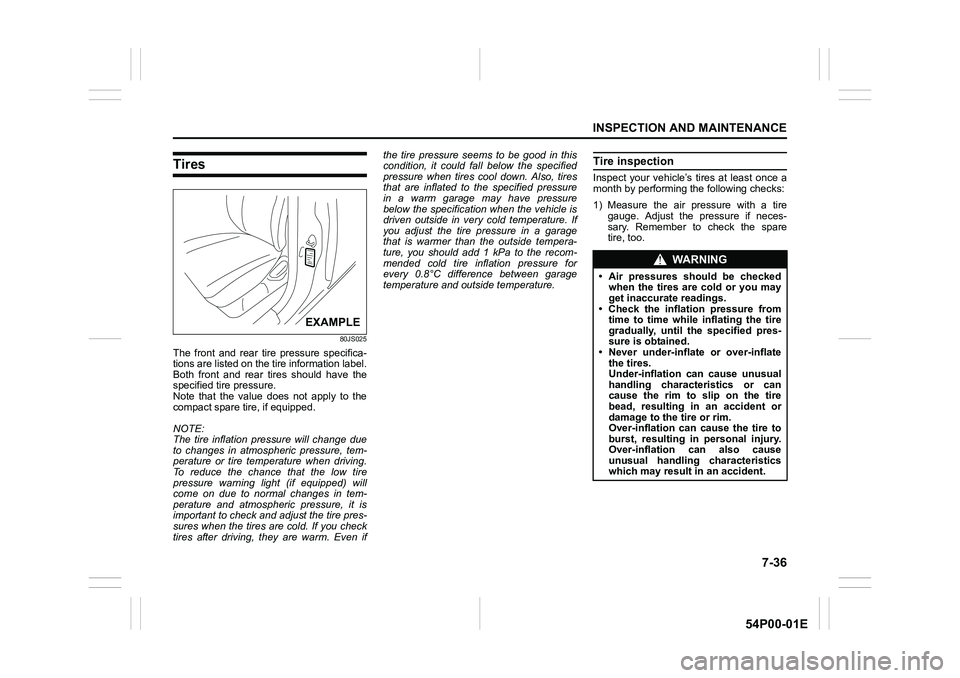
The front and rear tire pressure specifica-
tions are listed on the tire information label.
Both front and rear tires should have the
specified tire pressure.
Note that the value does not apply to the
compact spare tire, if equipped.
NOTE:
The tire inflation pressure will change due
to changes in atmospheric pressure, tem-
perature or tire temperature when driving.
To reduce the chance that the low tire
pressure warning light (if equipped) will
come on due to normal changes in tem-
perature and atmospheric pressure, it is
important to check and adjust the tire pres-
sures when the tires are cold. If you check
tires after driving, they are warm. Even ifthe tire pressure seems to be good in this
condition, it could fall below the specified
pressure when tires cool down. Also, tires
that are inflated to the specified pressure
in a warm garage may have pressure
below the specification when the vehicle is
driven outside in very cold temperature. If
you adjust the tire pressure in a garage
that is warmer than the outside tempera-
ture, you should add 1 kPa to the recom-
mended cold tire inflation pressure for
every 0.8°C difference between garage
temperature and outside temperature.
Tire inspection
Inspect your vehicle’s tires at least once a
month by performing the following checks:
1) Measure the air pressure with a tire
gauge. Adjust the pressure if neces-
sary. Remember to check the spare
tire, too.
EXAMPLE
WA R N I N G
• Air pressures should be checked
when the tires are cold or you may
get inaccurate readings.
• Check the inflation pressure from
time to time while inflating the tire
gradually, until the specified pres-
sure is obtained.
• Never under-inflate or over-inflate
the tires.
Under-inflation can cause unusual
handling characteristics or can
cause the rim to slip on the tire
bead, resulting in an accident or
damage to the tire or rim.
Over-inflation can cause the tire to
burst, resulting in personal injury.
Over-inflation can also cause
unusual handling characteristics
which may result in an accident.
Page 375 of 482
7-37
INSPECTION AND MAINTENANCE
54P00-01E
54G136
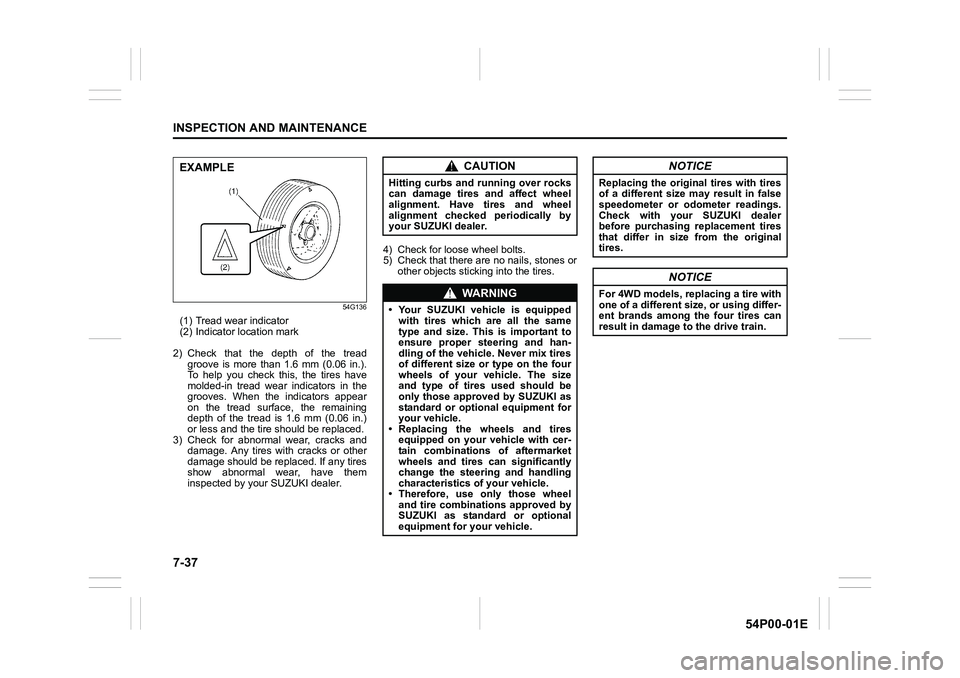
(1) Tread wear indicator
(2) Indicator location mark
2) Check that the depth of the tread
groove is more than 1.6 mm (0.06 in.).
To help you check this, the tires have
molded-in tread wear indicators in the
grooves. When the indicators appear
on the tread surface, the remaining
depth of the tread is 1.6 mm (0.06 in.)
or less and the tire should be replaced.
3) Check for abnormal wear, cracks and
damage. Any tires with cracks or other
damage should be replaced. If any tires
show abnormal wear, have them
inspected by your SUZUKI dealer.4) Check for loose wheel bolts.
5) Check that there are no nails, stones or
other objects sticking into the tires.
EXAMPLECAUTION
Hitting curbs and running over rocks
can damage tires and affect wheel
alignment. Have tires and wheel
alignment checked periodically by
your SUZUKI dealer.
WA R N I N G
• Your SUZUKI vehicle is equipped
with tires which are all the same
type and size. This is important to
ensure proper steering and han-
dling of the vehicle. Never mix tires
of different size or type on the four
wheels of your vehicle. The size
and type of tires used should be
only those approved by SUZUKI as
standard or optional equipment for
your vehicle.
• Replacing the wheels and tires
equipped on your vehicle with cer-
tain combinations of aftermarket
wheels and tires can significantly
change the steering and handling
characteristics of your vehicle.
• Therefore, use only those wheel
and tire combinations approved by
SUZUKI as standard or optional
equipment for your vehicle.
NOTICE
Replacing the original tires with tires
of a different size may result in false
speedometer or odometer readings.
Check with your SUZUKI dealer
before purchasing replacement tires
that differ in size from the original
tires.
NOTICE
For 4WD models, replacing a tire with
one of a different size, or using differ-
ent brands among the four tires can
result in damage to the drive train.
Page 376 of 482
7-38
INSPECTION AND MAINTENANCE
54P00-01E
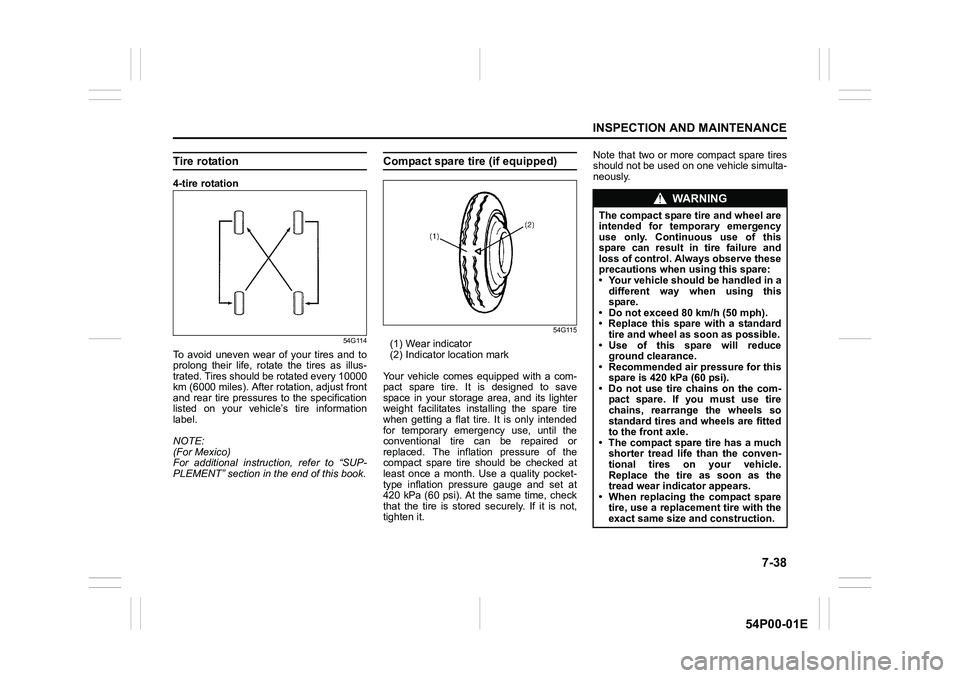
Tire rotation
4-tire rotation
54G114
To avoid uneven wear of your tires and to
prolong their life, rotate the tires as illus-
trated. Tires should be rotated every 10000
km (6000 miles). After rotation, adjust front
and rear tire pressures to the specification
listed on your vehicle’s tire information
label.
NOTE:
(For Mexico)
For additional instruction, refer to “SUP-
PLEMENT” section in the end of this book.
Compact spare tire (if equipped)
54G115
(1) Wear indicator
(2) Indicator location mark
Your vehicle comes equipped with a com-
pact spare tire. It is designed to save
space in your storage area, and its lighter
weight facilitates installing the spare tire
when getting a flat tire. It is only intended
for temporary emergency use, until the
conventional tire can be repaired or
replaced. The inflation pressure of the
compact spare tire should be checked at
least once a month. Use a quality pocket-
type inflation pressure gauge and set at
420 kPa (60 psi). At the same time, check
that the tire is stored securely. If it is not,
tighten it.Note that two or more compact spare tires
should not be used on one vehicle simulta-
neously.
WA R N I N G
The compact spare tire and wheel are
intended for temporary emergency
use only. Continuous use of this
spare can result in tire failure and
loss of control. Always observe these
precautions when using this spare:
• Your vehicle should be handled in a
different way when using this
spare.
• Do not exceed 80 km/h (50 mph).
• Replace this spare with a standard
tire and wheel as soon as possible.
• Use of this spare will reduce
ground clearance.
• Recommended air pressure for this
spare is 420 kPa (60 psi).
• Do not use tire chains on the com-
pact spare. If you must use tire
chains, rearrange the wheels so
standard tires and wheels are fitted
to the front axle.
• The compact spare tire has a much
shorter tread life than the conven-
tional tires on your vehicle.
Replace the tire as soon as the
tread wear indicator appears.
• When replacing the compact spare
tire, use a replacement tire with the
exact same size and construction.
Page 400 of 482
EMERGENCY SERVICE
8
54P00-01E
60G411
EMERGENCY SERVICE
Tire changing tool ............................................................... 8-1
Jacking instructions ........................................................... 8-1
Flat tire repair kit (if equipped) .......................................... 8-5
Jump-starting instructions ................................................. 8-8
Towing .................................................................................. 8-10
Engine trouble: Starter does not operate ......................... 8-11
Engine trouble: Flooded engine ........................................ 8-11
Engine trouble: Overheating .............................................. 8-12