tire SUZUKI GRAND VITARA 2017 Service Manual
[x] Cancel search | Manufacturer: SUZUKI, Model Year: 2017, Model line: GRAND VITARA, Model: SUZUKI GRAND VITARA 2017Pages: 482, PDF Size: 21 MB
Page 401 of 482
8-1
EMERGENCY SERVICE
54P00-01E
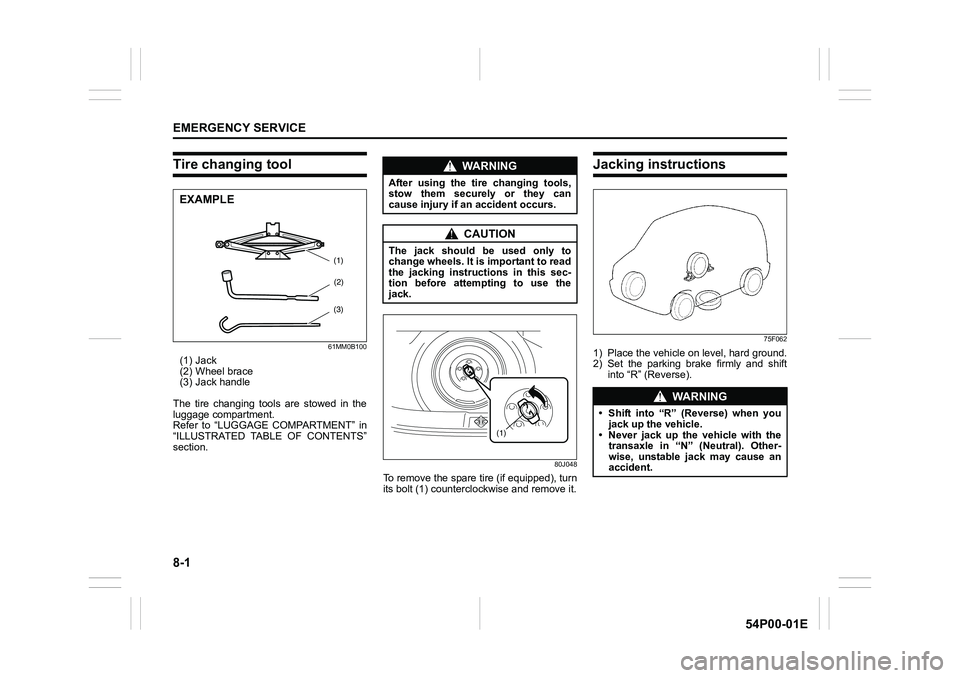
Tire changing tool
61MM0B100
(1) Jack
(2) Wheel brace
(3) Jack handle
The tire changing tools are stowed in the
luggage compartment.
Refer to “LUGGAGE COMPARTMENT” in
“ILLUSTRATED TABLE OF CONTENTS”
section.
80J048
To remove the spare tire (if equipped), turn
its bolt (1) counterclockwise and remove it.
Jacking instructions
75F062
1) Place the vehicle on level, hard ground.
2) Set the parking brake firmly and shift
into “R” (Reverse).
EXAMPLE
(3)
(2)
(1)
WA R N I N G
After using the tire changing tools,
stow them securely or they can
cause injury if an accident occurs.
CAUTION
The jack should be used only to
change wheels. It is important to read
the jacking instructions in this sec-
tion before attempting to use the
jack.
(1)
WA R N I N G
• Shift into “R” (Reverse) when you
jack up the vehicle.
• Never jack up the vehicle with the
transaxle in “N” (Neutral). Other-
wise, unstable jack may cause an
accident.
Page 402 of 482
8-2
EMERGENCY SERVICE
54P00-01E
3) Turn on the hazard warning flasher if
your vehicle is near traffic.
4) Block the front and rear of the wheel
diagonally opposite of the wheel being
lifted.
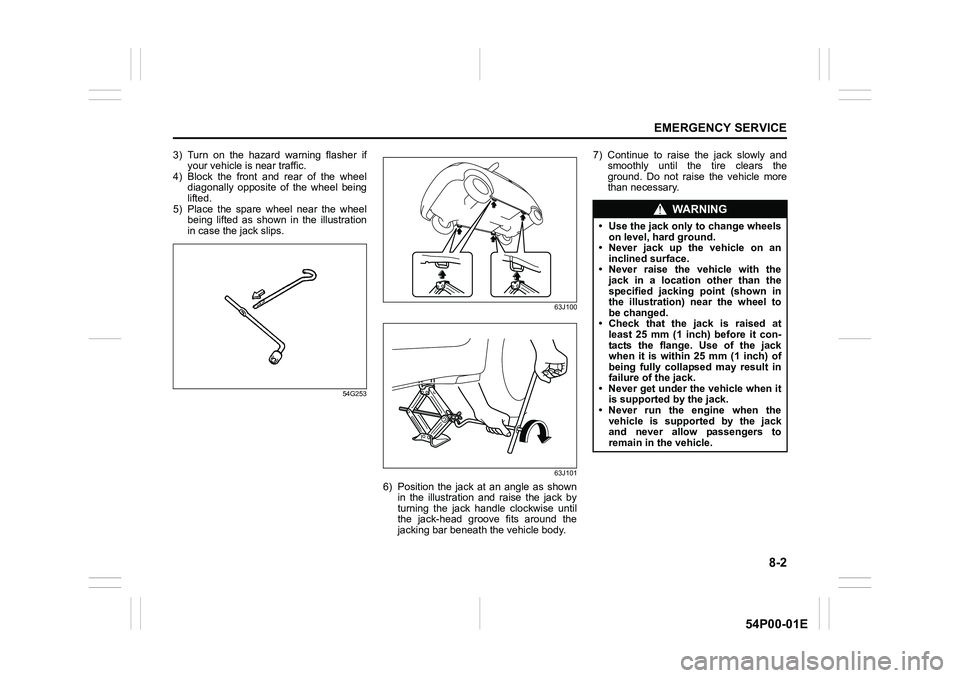
5) Place the spare wheel near the wheel
being lifted as shown in the illustration
in case the jack slips.
54G25363J100
63J101
6) Position the jack at an angle as shown
in the illustration and raise the jack by
turning the jack handle clockwise until
the jack-head groove fits around the
jacking bar beneath the vehicle body.7) Continue to raise the jack slowly and
smoothly until the tire clears the
ground. Do not raise the vehicle more
than necessary.
WA R N I N G
• Use the jack only to change wheels
on level, hard ground.
• Never jack up the vehicle on an
inclined surface.
• Never raise the vehicle with the
jack in a location other than the
specified jacking point (shown in
the illustration) near the wheel to
be changed.
• Check that the jack is raised at
least 25 mm (1 inch) before it con-
tacts the flange. Use of the jack
when it is within 25 mm (1 inch) of
being fully collapsed may result in
failure of the jack.
• Never get under the vehicle when it
is supported by the jack.
• Never run the engine when the
vehicle is supported by the jack
and never allow passengers to
remain in the vehicle.
Page 405 of 482
8-5
EMERGENCY SERVICE
54P00-01E
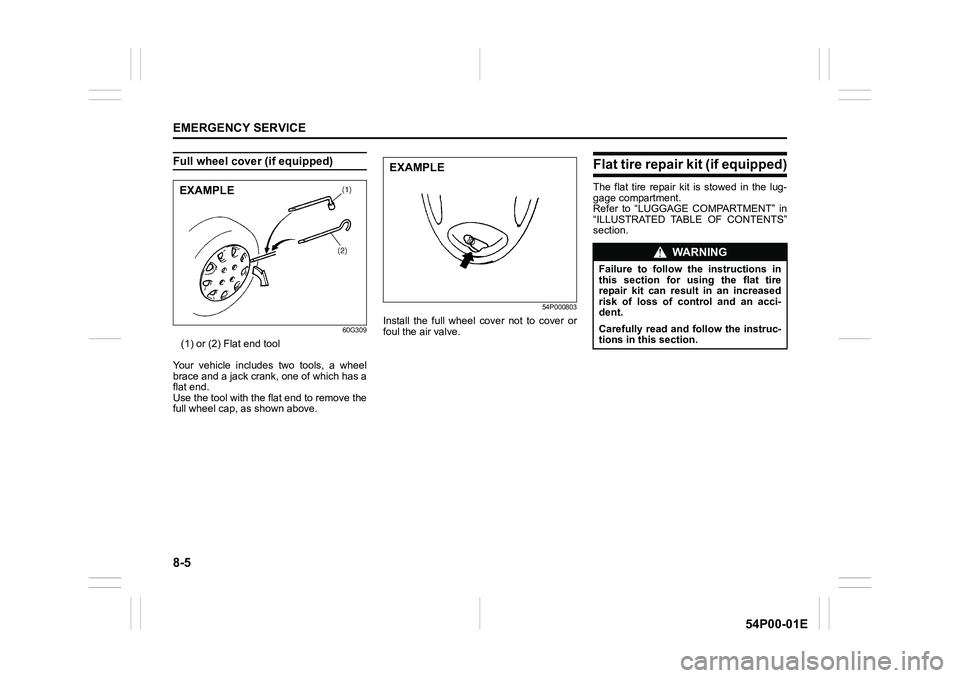
Full wheel cover (if equipped)
60G309
(1) or (2) Flat end tool
Your vehicle includes two tools, a wheel
brace and a jack crank, one of which has a
flat end.
Use the tool with the flat end to remove the
full wheel cap, as shown above.
54P000803
Install the full wheel cover not to cover or
foul the air valve.
Flat tire repair kit (if equipped)
The flat tire repair kit is stowed in the lug-
gage compartment.
Refer to “LUGGAGE COMPARTMENT” in
“ILLUSTRATED TABLE OF CONTENTS”
section.EXAMPLE
EXAMPLE
WA R N I N G
Failure to follow the instructions in
this section for using the flat tire
repair kit can result in an increased
risk of loss of control and an acci-
dent.
Carefully read and follow the instruc-
tions in this section.
Page 406 of 482
8-6
EMERGENCY SERVICE
54P00-01E
IMPORTANT
The flat tire repair kit cannot be used in
the following cases. Consult a SUZUKI
dealer or a roadside assistance service.
• Cuts or piercing in the tire tread
larger than approx. 4 mm.
• Cuts in the tire side wall.
• Tire damage caused by driving with
considerably reduced tire pressure or
even with deflated tire.
• The tire bead completely unseated
outside of the rim.
• The rim damaged.
Small punctures in the tire tread,
caused by a nail or a screw, can be
sealed with the flat tire repair kit.
Do not remove nails or screws from the
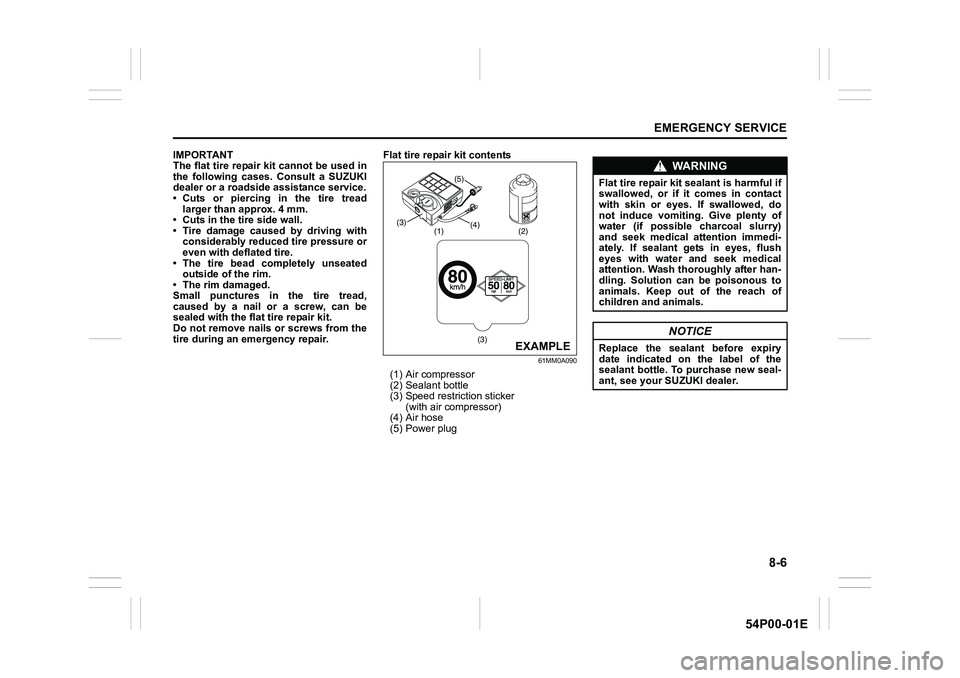
tire during an emergency repair.Flat tire repair kit contents
61MM0A090
(1) Air compressor
(2) Sealant bottle
(3) Speed restriction sticker
(with air compressor)
(4) Air hose
(5) Power plug
(1)(4) (5)
(3)(2)(3)
EXAMPLE
WA R N I N G
Flat tire repair kit sealant is harmful if
swallowed, or if it comes in contact
with skin or eyes. If swallowed, do
not induce vomiting. Give plenty of
water (if possible charcoal slurry)
and seek medical attention immedi-
ately. If sealant gets in eyes, flush
eyes with water and seek medical
attention. Wash thoroughly after han-
dling. Solution can be poisonous to
animals. Keep out of the reach of
children and animals.
NOTICE
Replace the sealant before expiry
date indicated on the label of the
sealant bottle. To purchase new seal-
ant, see your SUZUKI dealer.
Page 407 of 482
8-7
EMERGENCY SERVICE
54P00-01E
Emergency repair
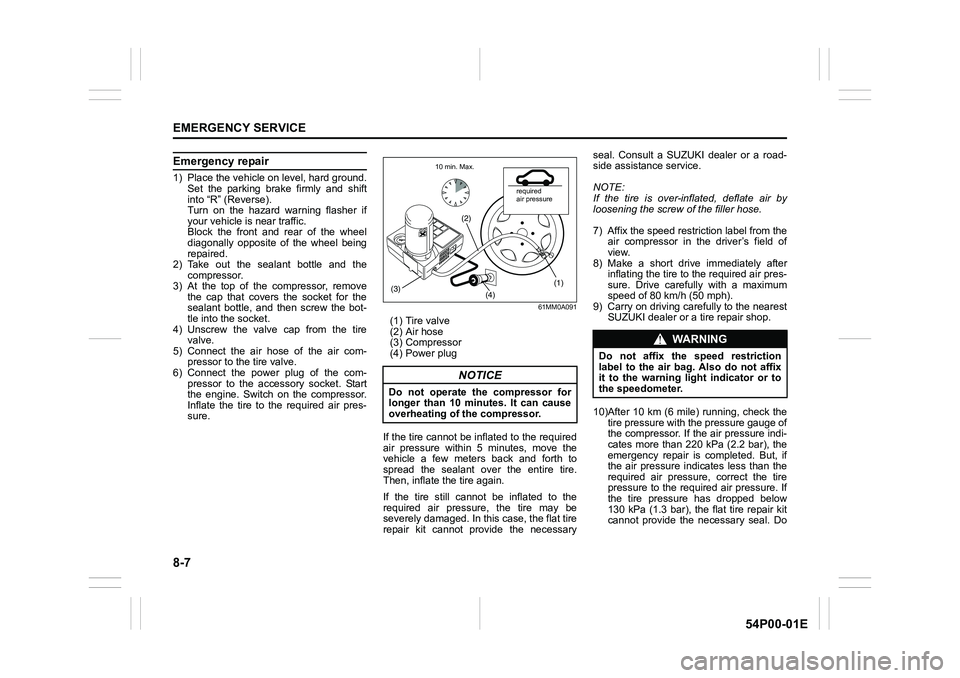
1) Place the vehicle on level, hard ground.
Set the parking brake firmly and shift
into “R” (Reverse).
Turn on the hazard warning flasher if
your vehicle is near traffic.
Block the front and rear of the wheel
diagonally opposite of the wheel being
repaired.
2) Take out the sealant bottle and the
compressor.
3) At the top of the compressor, remove
the cap that covers the socket for the
sealant bottle, and then screw the bot-
tle into the socket.
4) Unscrew the valve cap from the tire
valve.
5) Connect the air hose of the air com-
pressor to the tire valve.
6) Connect the power plug of the com-
pressor to the accessory socket. Start
the engine. Switch on the compressor.
Inflate the tire to the required air pres-
sure.
61MM0A091
(1) Tire valve
(2) Air hose
(3) Compressor
(4) Power plug
If the tire cannot be inflated to the required
air pressure within 5 minutes, move the
vehicle a few meters back and forth to
spread the sealant over the entire tire.
Then, inflate the tire again.
If the tire still cannot be inflated to the
required air pressure, the tire may be
severely damaged. In this case, the flat tire
repair kit cannot provide the necessaryseal. Consult a SUZUKI dealer or a road-
side assistance service.
NOTE:
If the tire is over-inflated, deflate air by
loosening the screw of the filler hose.
7) Affix the speed restriction label from the
air compressor in the driver’s field of
view.
8) Make a short drive immediately after
inflating the tire to the required air pres-
sure. Drive carefully with a maximum
speed of 80 km/h (50 mph).
9) Carry on driving carefully to the nearest
SUZUKI dealer or a tire repair shop.
10)After 10 km (6 mile) running, check the
tire pressure with the pressure gauge of
the compressor. If the air pressure indi-
cates more than 220 kPa (2.2 bar), the
emergency repair is completed. But, if
the air pressure indicates less than the
required air pressure, correct the tire
pressure to the required air pressure. If
the tire pressure has dropped below
130 kPa (1.3 bar), the flat tire repair kit
cannot provide the necessary seal. Do
NOTICE
Do not operate the compressor for
longer than 10 minutes. It can cause
overheating of the compressor.
(1)
(4)
(2)
(3)
required
air pressure 10 min. Max.
WA R N I N G
Do not affix the speed restriction
label to the air bag. Also do not affix
it to the warning light indicator or to
the speedometer.
Page 408 of 482
8-8
EMERGENCY SERVICE
54P00-01E
not use the tire and consult a SUZUKI
dealer or a roadside assistance service.Using compressor to inflate a tire
1) Place the vehicle on level, hard ground.
Set the parking brake firmly and shift
into “R” (Reverse).
2) Take out the compressor.
3) Unscrew the valve cap from the tire
valve.
4) Connect the air hose of the compressor
to the tire valve.
5) Connect the power plug of the com-
pressor to the accessory socket. Start
the engine. Switch on the compressor.
Inflate the tire to the required air pres-
sure.
Jump-starting instructions
WA R N I N G
Check the tire pressure and confirm
the completion of the emergency
repair after 10 km (6 mile) of running.
NOTICE
Have the tire renewed at the nearest
SUZUKI dealer. When reusing the
sealed tire, consult a tire repair shop.
The wheel can be reused after wiping
sealant off completely with cloth in
order to prevent rust, but the tire
valve and tire pressure monitoring
system (TPMS) sensor must be
renewed.
Dispose of the sealant bottle at a
SUZUKI dealer or in accordance with
your regional codes and practices.
After using the sealant bottle, replace
it with a new bottle from your SUZUKI
dealer.
NOTICE
Do not operate the compressor for
longer than 10 minutes. It can cause
overheating of the compressor.
WA R N I N G
• Never attempt to jump-start your
vehicle if the battery appears to be
frozen. Batteries in this condition
may explode.
• When making jump lead connec-
tions, check that your hands and
the jump leads remain clear from
pulleys, belts or fans.
• Batteries produce flammable
hydrogen gas. Keep flames and
sparks away from the battery or an
explosion may occur. Never smoke
when working near the battery.
• If the booster battery you use for
jump-starting is installed in another
vehicle, check that the two vehicles
are not touching each other.
• If your battery discharges repeat-
edly, for no apparent reason, have
your vehicle inspected by an
authorized SUZUKI dealer.
• To avoid harm to yourself or dam-
age to your vehicle or battery, fol-
low the jump-starting instructions
below.
If you are in doubt, call for qualified
road service.
Page 418 of 482
9-4
APPEARANCE CARE
54P00-01E
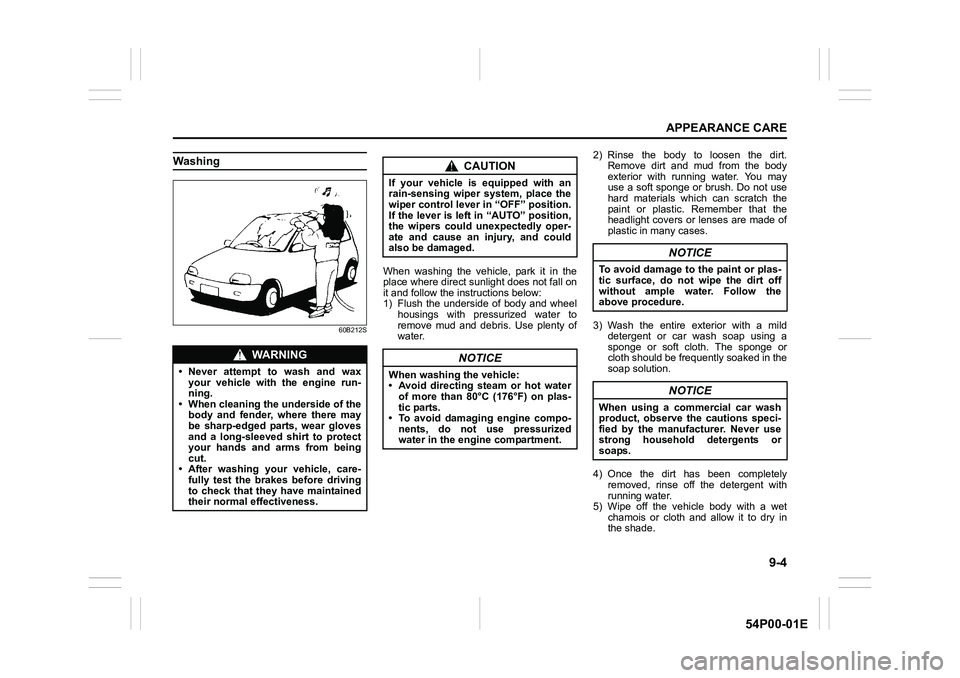
Washing
60B212S
When washing the vehicle, park it in the
place where direct sunlight does not fall on
it and follow the instructions below:
1) Flush the underside of body and wheel
housings with pressurized water to
remove mud and debris. Use plenty of
water.2) Rinse the body to loosen the dirt.
Remove dirt and mud from the body
exterior with running water. You may
use a soft sponge or brush. Do not use
hard materials which can scratch the
paint or plastic. Remember that the
headlight covers or lenses are made of
plastic in many cases.
3) Wash the entire exterior with a mild
detergent or car wash soap using a
sponge or soft cloth. The sponge or
cloth should be frequently soaked in the
soap solution.
4) Once the dirt has been completely
removed, rinse off the detergent with
running water.
5) Wipe off the vehicle body with a wet
chamois or cloth and allow it to dry in
the shade.
WA R N I N G
• Never attempt to wash and wax
your vehicle with the engine run-
ning.
• When cleaning the underside of the
body and fender, where there may
be sharp-edged parts, wear gloves
and a long-sleeved shirt to protect
your hands and arms from being
cut.
• After washing your vehicle, care-
fully test the brakes before driving
to check that they have maintained
their normal effectiveness.
CAUTION
If your vehicle is equipped with an
rain-sensing wiper system, place the
wiper control lever in “OFF” position.
If the lever is left in “AUTO” position,
the wipers could unexpectedly oper-
ate and cause an injury, and could
also be damaged.
NOTICE
When washing the vehicle:
• Avoid directing steam or hot water
of more than 80°C (176°F) on plas-
tic parts.
• To avoid damaging engine compo-
nents, do not use pressurized
water in the engine compartment.
NOTICE
To avoid damage to the paint or plas-
tic surface, do not wipe the dirt off
without ample water. Follow the
above procedure.
NOTICE
When using a commercial car wash
product, observe the cautions speci-
fied by the manufacturer. Never use
strong household detergents or
soaps.
Page 427 of 482
11-4
SPECIFICATIONS
54P00-01E
NOTE:
1) If loading over 4 people, follow the specified tire pressure listed on the tire information label.
*1 If you cannot prepare tires with the specified load index rate and speed symbol, prepare tires with higher load index rate and speed
symbol.
*2 If you prepare snow tires;
• Check that they are tires of the same size, structure and load capacity as the originally installed tires.
• Mount the snow tires on all four wheels.
• Understand that the maximum permissible speed of snow tires is generally less than the originally installed tires.
Consult your SUZUKI dealer or supplier for further information. ITEM: Wheels and tires
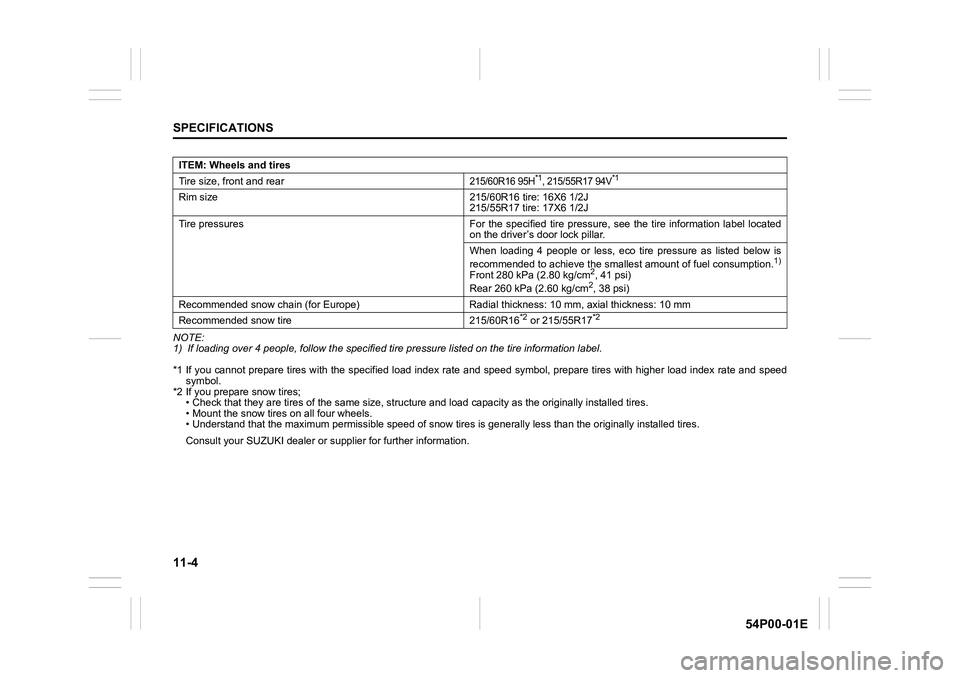
Tire size, front and rear
215/60R16 95H*1, 215/55R17 94V*1
Rim size 215/60R16 tire: 16X6 1/2J
215/55R17 tire: 17X6 1/2J
Tire pressures For the specified tire pressure, see the tire information label located
on the driver’s door lock pillar.
When loading 4 people or less, eco tire pressure as listed below is
recommended to achieve the smallest amount of fuel consumption.
1)
Front 280 kPa (2.80 kg/cm2, 41 psi)
Rear 260 kPa (2.60 kg/cm2, 38 psi)
Recommended snow chain (for Europe) Radial thickness: 10 mm, axial thickness: 10 mm
Recommended snow tire 215/60R16
*2 or 215/55R17*2
Page 431 of 482
12-1
SUPPLEMENT
54P00-01E
For Australia
Built date
Built date is located on vehicle identifica-
tion plate.
“Built Date” means – the calendar month
and the year in which the body shell and
power train sub-assemblies are conjoined
and the vehicle is driven or moved from the
production line.
Temporary-use spare tire (compact spare tire)
Temporary spare tires fitted to this vehicle
must have a maximum load rating of not
less than 850 kg, or a load index of “102”
and a speed category symbol of not less
than “M” (130 km/h).
Drive with caution when the temporary-use
spare unit is fitted. Reinstall standard unit
as soon as possible.
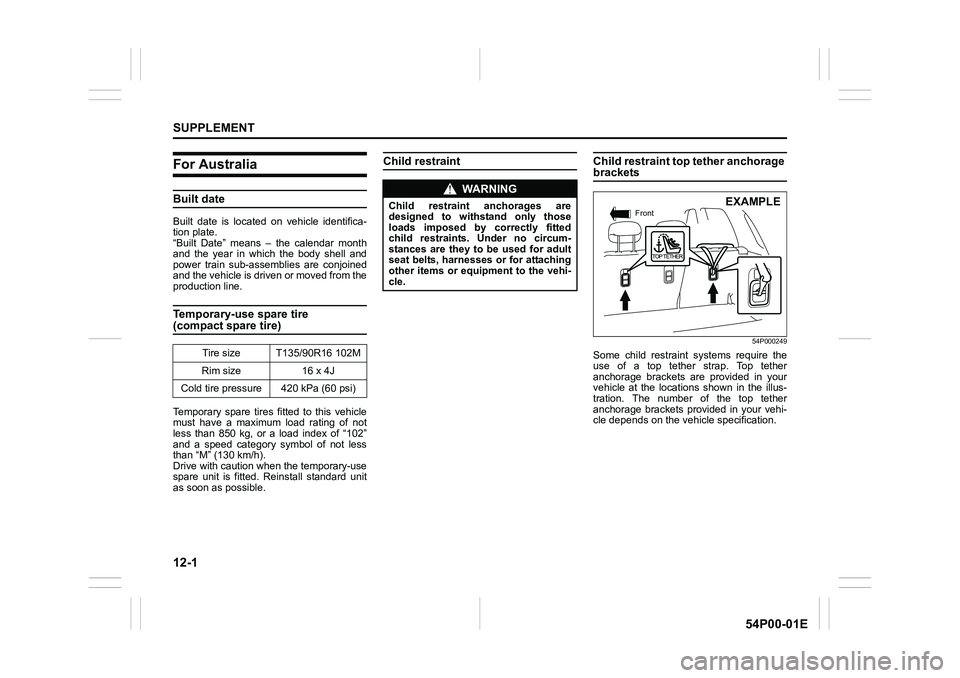
Child restraintChild restraint top tether anchorage brackets
54P000249
Some child restraint systems require the
use of a top tether strap. Top tether
anchorage brackets are provided in your
vehicle at the locations shown in the illus-
tration. The number of the top tether
anchorage brackets provided in your vehi-
cle depends on the vehicle specification. Tire size T135/90R16 102M
Rim size 16 x 4J
Cold tire pressure 420 kPa (60 psi)
WA R N I N G
Child restraint anchorages are
designed to withstand only those
loads imposed by correctly fitted
child restraints. Under no circum-
stances are they to be used for adult
seat belts, harnesses or for attaching
other items or equipment to the vehi-
cle.EXAMPLEFront
Page 433 of 482
12-3
SUPPLEMENT
54P00-01E
Seat belt warning
Follow this warning as well as the instruc-
tion for seat belt in this book.
In the case where a “Seat Belt Assembly”
incorporates an “Automatic Length Adjust-
ing and Locking Retractor” or an “Emer-
gency Locking Retractor”.
For Mexico
Fuel recommendation
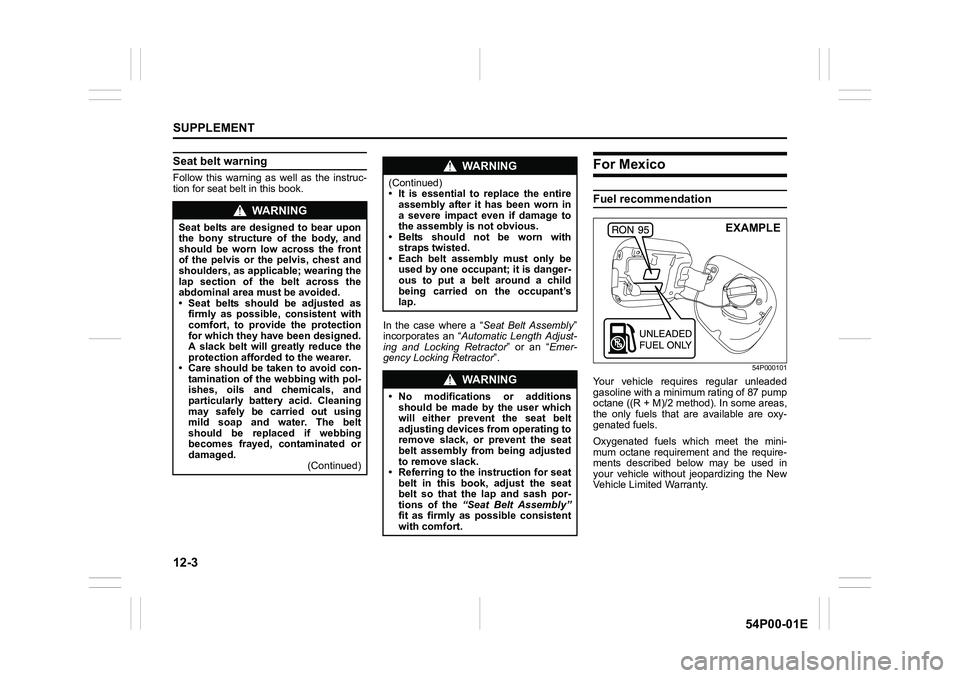
54P000101
Your vehicle requires regular unleaded
gasoline with a minimum rating of 87 pump
octane ((R + M)/2 method). In some areas,
the only fuels that are available are oxy-
genated fuels.
Oxygenated fuels which meet the mini-
mum octane requirement and the require-
ments described below may be used in
your vehicle without jeopardizing the New
Vehicle Limited Warranty.
WA R N I N G
Seat belts are designed to bear upon
the bony structure of the body, and
should be worn low across the front
of the pelvis or the pelvis, chest and
shoulders, as applicable; wearing the
lap section of the belt across the
abdominal area must be avoided.
• Seat belts should be adjusted as
firmly as possible, consistent with
comfort, to provide the protection
for which they have been designed.
A slack belt will greatly reduce the
protection afforded to the wearer.
• Care should be taken to avoid con-
tamination of the webbing with pol-
ishes, oils and chemicals, and
particularly battery acid. Cleaning
may safely be carried out using
mild soap and water. The belt
should be replaced if webbing
becomes frayed, contaminated or
damaged.
(Continued)
WA R N I N G
(Continued)
• It is essential to replace the entire
assembly after it has been worn in
a severe impact even if damage to
the assembly is not obvious.
• Belts should not be worn with
straps twisted.
• Each belt assembly must only be
used by one occupant; it is danger-
ous to put a belt around a child
being carried on the occupant’s
lap.
WA R N I N G
• No modifications or additions
should be made by the user which
will either prevent the seat belt
adjusting devices from operating to
remove slack, or prevent the seat
belt assembly from being adjusted
to remove slack.
• Referring to the instruction for seat
belt in this book, adjust the seat
belt so that the lap and sash por-
tions of the “Seat Belt Assembly”
fit as firmly as possible consistent
with comfort.
EXAMPLE