starting SUZUKI GRAND VITARA 2022 User Guide
[x] Cancel search | Manufacturer: SUZUKI, Model Year: 2022, Model line: GRAND VITARA, Model: SUZUKI GRAND VITARA 2022Pages: 482, PDF Size: 21 MB
Page 152 of 482
3-12
OPERATING YOUR VEHICLE
54P00-01E
Clutch pedal (1)
A clutch pedal is used to disengage the
drive to the wheels when starting the
engine, stopping, or shifting the gearshift
lever. Depressing the pedal disengages
the clutch.
Brake pedal (2)
Your SUZUKI vehicle is equipped with front
and rear disc brakes. Depressing a brake
pedal applies both sets of brakes.
You may hear occasional brake squeal
when you apply the brakes. This is a nor-
mal condition caused by environmental
factors such as cold, wet, snow, etc.
Accelerator pedal (3)
An accelerator pedal controls the speed of
the engine. Depressing the accelerator
pedal increases power output and speed.
Starting engine
(vehicle without keyless push
start system)
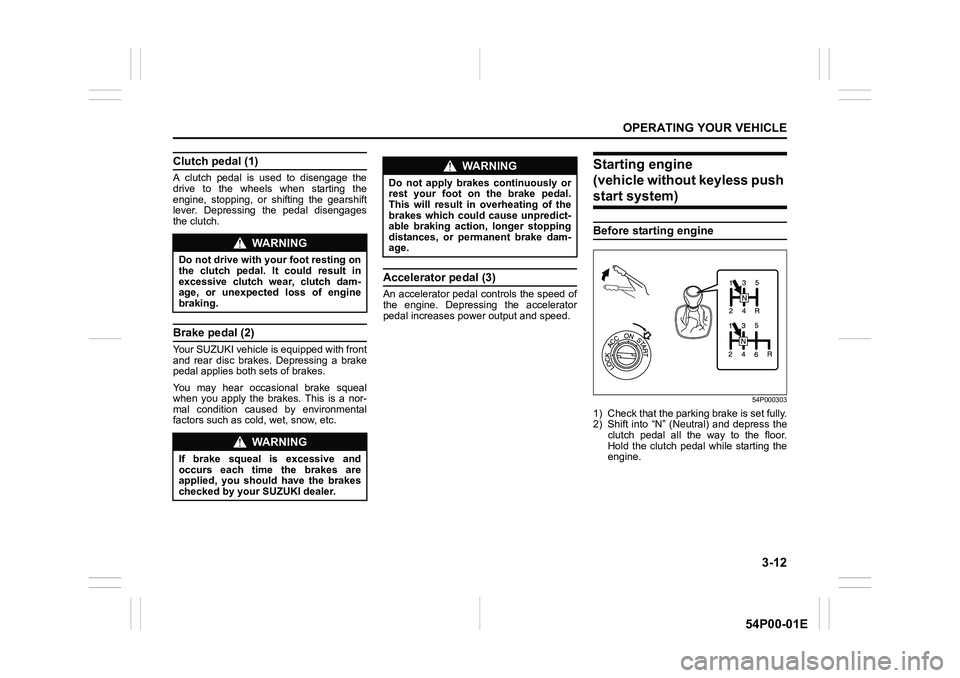
Before starting engine
54P000303
1) Check that the parking brake is set fully.
2) Shift into “N” (Neutral) and depress the
clutch pedal all the way to the floor.
Hold the clutch pedal while starting the
engine.
WA R N I N G
Do not drive with your foot resting on
the clutch pedal. It could result in
excessive clutch wear, clutch dam-
age, or unexpected loss of engine
braking.
WA R N I N G
If brake squeal is excessive and
occurs each time the brakes are
applied, you should have the brakes
checked by your SUZUKI dealer.
WA R N I N G
Do not apply brakes continuously or
rest your foot on the brake pedal.
This will result in overheating of the
brakes which could cause unpredict-
able braking action, longer stopping
distances, or permanent brake dam-
age.
Page 153 of 482
3-13
OPERATING YOUR VEHICLE
54P00-01E
Starting a cold and warm engine
(For gasoline engine model)
With your foot taken off the accelerator
pedal, crank the engine by turning the igni-
tion key to “START”. Release the key when
the engine starts.
If the engine does not start after 12 sec-
onds of cranking, wait about 15 seconds,
and then press down the accelerator pedal
to 1/3 full of capacity and try cranking the
engine again. Release the key and accel-
erator pedal when the engine starts.
If the engine still does not start, try holding
the accelerator pedal all the way to the
floor while cranking. This should clear the
engine if it is flooded.(For diesel engine model)
Cold engine
Turn the ignition switch to “ON” position
and wait until the glow plug indicator goes
out if it comes on. Crank the engine by
turning the ignition key to “START”.
Release the key when the engine starts.
Warm engine
Crank the engine by turning the ignition
key to “START”. Release the key when the
engine starts.
Caution when stopping the engine with
turbocharger
When stopping the engine after climbing or
high speed driving, let the engine idle for
about one minute or more (if it is not pro-
hibited) to cool down the turbocharger and
engine oil. This is to prevent the engine oil
from over-deteriorating. Deteriorated
engine oil will damage the bearings of the
turbocharger.
WA R N I N G
Check that the parking brake is set
fully and the transaxle is in Neutral
before attempting to start the engine.
NOTICE
• Stop turning the starter immedi-
ately after the engine has started or
the starter system can be damaged.
• Do not crank the engine for more
than 12 seconds at a time. If the
engine does not start on the first
try, wait about 15 seconds before
trying again.
NOTICE
• Stop turning the starter immedi-
ately after the engine has started or
the starter system can be damaged.
• Do not crank the engine for more
than 30 seconds at a time. If the
engine does not start on the first
try, wait about 15 seconds before
trying again.
Page 154 of 482
3-14
OPERATING YOUR VEHICLE
54P00-01E
Restarting diesel engine after fuel-
empty stop
If the engine stops and the low fuel warn-
ing light and the malfunction indicator light
come on, use the following procedure:
1) Fill the fuel tank.
2) Hold the ignition key in “ON” position for
5-10 seconds to feed fuel.
3) Perform above engine starting proce-
dure.
If the malfunction indicator light still comes
on after the engine started, there may be
some problem with the engine. Ask your
SUZUKI dealer to have the engine
inspected.Starting engine
(vehicle with keyless push
start system)
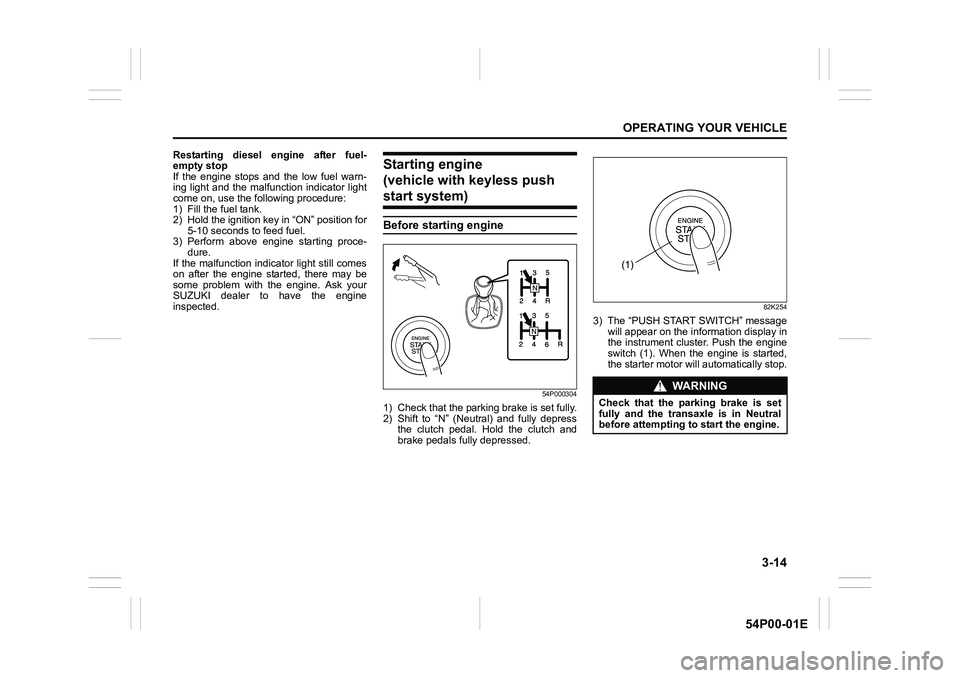
Before starting engine
54P000304
1) Check that the parking brake is set fully.
2) Shift to “N” (Neutral) and fully depress
the clutch pedal. Hold the clutch and
brake pedals fully depressed.
82K254
3) The “PUSH START SWITCH” message
will appear on the information display in
the instrument cluster. Push the engine
switch (1). When the engine is started,
the starter motor will automatically stop.
WA R N I N G
Check that the parking brake is set
fully and the transaxle is in Neutral
before attempting to start the engine.
(1)
Page 155 of 482
3-15
OPERATING YOUR VEHICLE
54P00-01E
NOTE:
• You do not need to keep the engine
switch pressed to start the engine.
• The engine will not start unless the
clutch pedal is depressed.
• During the engine starting procedure,
messages on the information display will
help you. Refer to “Information display”
in “BEFORE DRIVING” section for
details.
• You should turn off such loads as the
headlights and air conditioning system to
facilitate starting of the engine.
• Even if you fail to start the engine, the
starter motor will stop turning automati-
cally after a short time. After the starter
motor has stopped or if there is some
problem with the system, the starter
motor will rotate only while the engine
switch is being pressed.
Stopping engine
• Depress the engine switch to stop the
engine after the vehicle stopped com-
pletely.
• In case of emergency, you can stop the
engine by quickly pushing the engine
switch more than 3 times, or pushing
and holding the engine switch for more
than 2 seconds while the vehicle is in
motion.
NOTE:
Except in cases of emergency, do not stop
the engine while the vehicle is in motion.
The steering and braking operation will
require more effort when the engine is
stopped.
Refer to “Braking” in this section.
• If the engine remains stopped for while
after it was stopped unexpectedly or was
raced before stopping, a clicking sound
may be heard from around the engine
when it is restarted. This is not a mal-
function. Always let the engine idle
before stopping it.
Starting a cold and warm engine
(For gasoline engine model)
With your foot taken off the accelerator
pedal, crank the engine by pressing the
engine switch to change the ignition mode
to “START”.
After pressing the engine switch to change
the ignition mode to “START”, the starter
cranks the engine for about 12 seconds
before it can start the engine. If the engine
fails to start at the first attempt, wait about
15 seconds, and then try again while keep-
ing the engine switch pressed while press-
ing down the accelerator pedal 1/3 of full
capacity. Release the accelerator pedal
when the engine starts.
If the engine still does not start, try holding
the accelerator pedal all the way to the
floor while cranking. This should clear the
engine if it is flooded.
If you are unable to start the engine using
this procedure, consult your SUZUKI
dealer.NOTICE
• Do not depress the accelerator
during the engine starting proce-
dure.
• If the engine does not respond
when you try to start it with the
engine switch or if the engine
switch repeats cycling through
“LOCK” (OFF) - “ACC” - “ON”
mode, the vehicle battery may be
discharged. Check the voltage of
the vehicle battery before trying
again.
NOTICE
Do not crank the engine for more
than 12 seconds at a time.
If the engine does not start on the
first try, wait about 15 seconds before
trying again.
Page 156 of 482
3-16
OPERATING YOUR VEHICLE
54P00-01E
(For diesel engine model)
Cold engine
Depress the clutch and brake pedals fully
and press the engine switch to crank the
engine. If the glow plug indicator light
comes on, the engine will start automati-
cally after the glow plug indicator light goes
off up to 10 seconds afterward.
Warm engine
Crank the engine by pressing the engine
switch to change the ignition mode to
“START”.
Caution when stopping the engine with
turbocharger
When stopping the engine after climbing or
high speed driving, let the engine idle for
about one minute or more (if it is not pro-
hibited) to cool down the turbocharger and
engine oil. This is to prevent the engine oil
from over-deteriorating. Deteriorated
engine oil will damage the bearings of the
turbocharger.Restarting diesel engine after fuel-
empty stop
If the engine stops and the low fuel warn-
ing light and the malfunction indicator light
come on, use the following procedure:
1) Fill the fuel tank.
2) Press the engine switch to change the
ignition mode to “ON” for 5-10 seconds
to feed fuel.
3) Perform the above engine starting pro-
cedure to start the engine.
If the malfunction indicator light still comes
on after the engine started, there may be
some problem with the engine. Ask your
SUZUKI dealer to have the engine
inspected.
If the master warning indicator light
blinks and the engine cannot be started
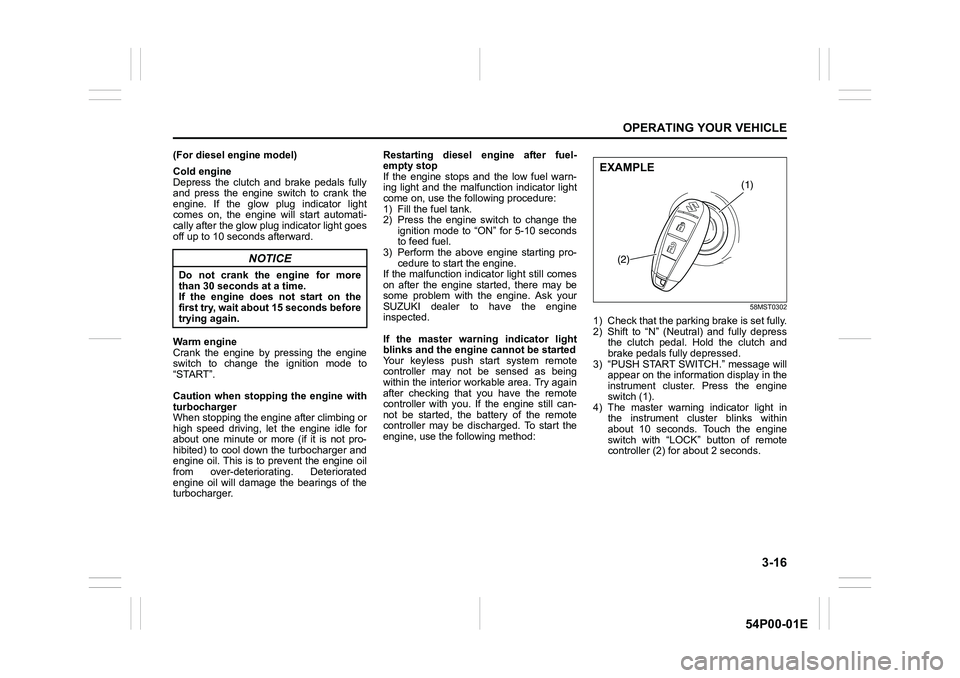
Your keyless push start system remote
controller may not be sensed as being
within the interior workable area. Try again
after checking that you have the remote
controller with you. If the engine still can-
not be started, the battery of the remote
controller may be discharged. To start the
engine, use the following method:
58MST0302
1) Check that the parking brake is set fully.
2) Shift to “N” (Neutral) and fully depress
the clutch pedal. Hold the clutch and
brake pedals fully depressed.
3) “PUSH START SWITCH.” message will
appear on the information display in the
instrument cluster. Press the engine
switch (1).
4) The master warning indicator light in
the instrument cluster blinks within
about 10 seconds. Touch the engine
switch with “LOCK” button of remote
controller (2) for about 2 seconds.
NOTICE
Do not crank the engine for more
than 30 seconds at a time.
If the engine does not start on the
first try, wait about 15 seconds before
trying again.
(1)
(2)
EXAMPLE
Page 159 of 482
3-19
OPERATING YOUR VEHICLE
54P00-01E
3) When the engine oil level exceeds the
MAX level on the dipstick, consult your
SUZUKI dealer.Using transaxle
Manual transaxle
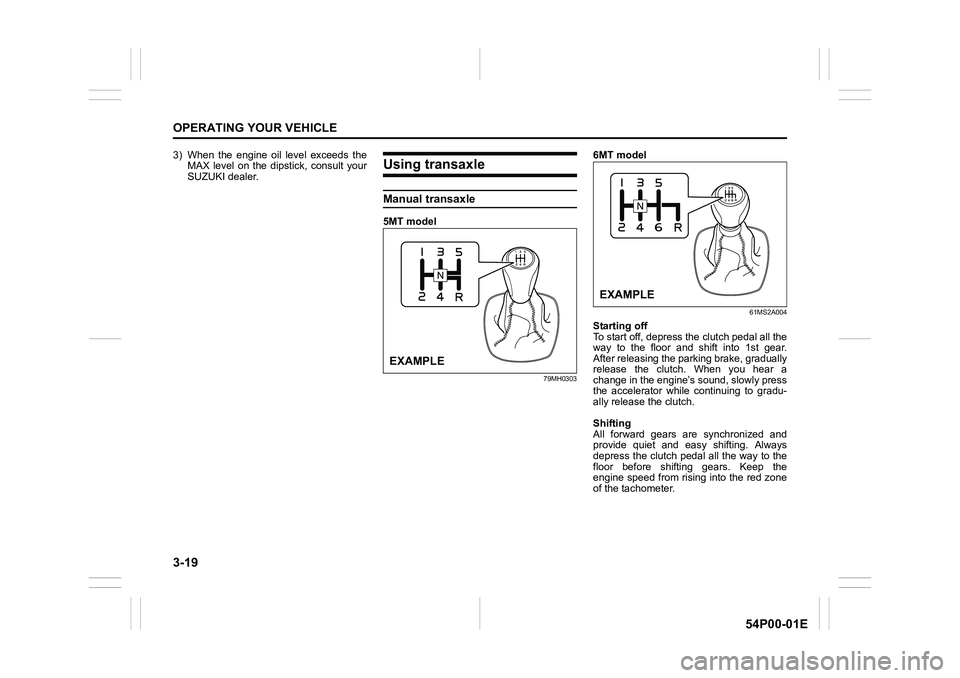
5MT model
79MH0303
6MT model
61MS2A004
Starting off
To start off, depress the clutch pedal all the
way to the floor and shift into 1st gear.
After releasing the parking brake, gradually
release the clutch. When you hear a
change in the engine’s sound, slowly press
the accelerator while continuing to gradu-
ally release the clutch.
Shifting
All forward gears are synchronized and
provide quiet and easy shifting. Always
depress the clutch pedal all the way to the
floor before shifting gears. Keep the
engine speed from rising into the red zone
of the tachometer.
EXAMPLE
EXAMPLE
Page 160 of 482
3-20
OPERATING YOUR VEHICLE
54P00-01E
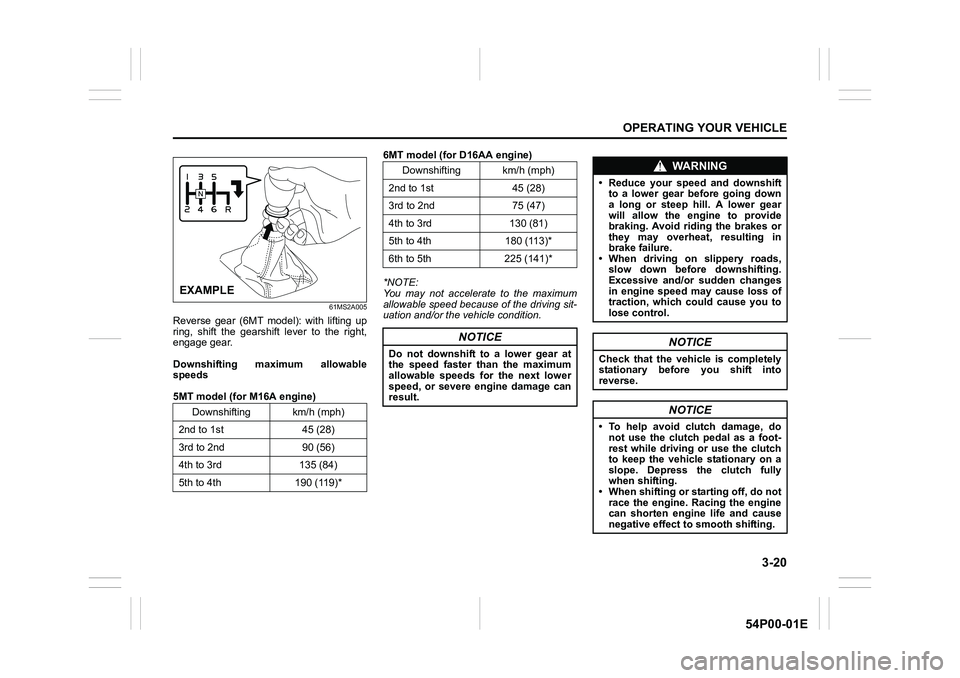
61MS2A005
Reverse gear (6MT model): with lifting up
ring, shift the gearshift lever to the right,
engage gear.
Downshifting maximum allowable
speeds
5MT model (for M16A engine)6MT model (for D16AA engine)
*NOTE:
You may not accelerate to the maximum
allowable speed because of the driving sit-
uation and/or the vehicle condition.
Downshifting km/h (mph)
2nd to 1st 45 (28)
3rd to 2nd 90 (56)
4th to 3rd 135 (84)
5th to 4th 190 (119)*
EXAMPLE
Downshifting km/h (mph)
2nd to 1st 45 (28)
3rd to 2nd 75 (47)
4th to 3rd 130 (81)
5th to 4th 180 (113)*
6th to 5th 225 (141)*
NOTICE
Do not downshift to a lower gear at
the speed faster than the maximum
allowable speeds for the next lower
speed, or severe engine damage can
result.
WA R N I N G
• Reduce your speed and downshift
to a lower gear before going down
a long or steep hill. A lower gear
will allow the engine to provide
braking. Avoid riding the brakes or
they may overheat, resulting in
brake failure.
• When driving on slippery roads,
slow down before downshifting.
Excessive and/or sudden changes
in engine speed may cause loss of
traction, which could cause you to
lose control.
NOTICE
Check that the vehicle is completely
stationary before you shift into
reverse.
NOTICE
• To help avoid clutch damage, do
not use the clutch pedal as a foot-
rest while driving or use the clutch
to keep the vehicle stationary on a
slope. Depress the clutch fully
when shifting.
• When shifting or starting off, do not
race the engine. Racing the engine
can shorten engine life and cause
negative effect to smooth shifting.
Page 171 of 482
3-31
OPERATING YOUR VEHICLE
54P00-01E
Automatically restarting the engine
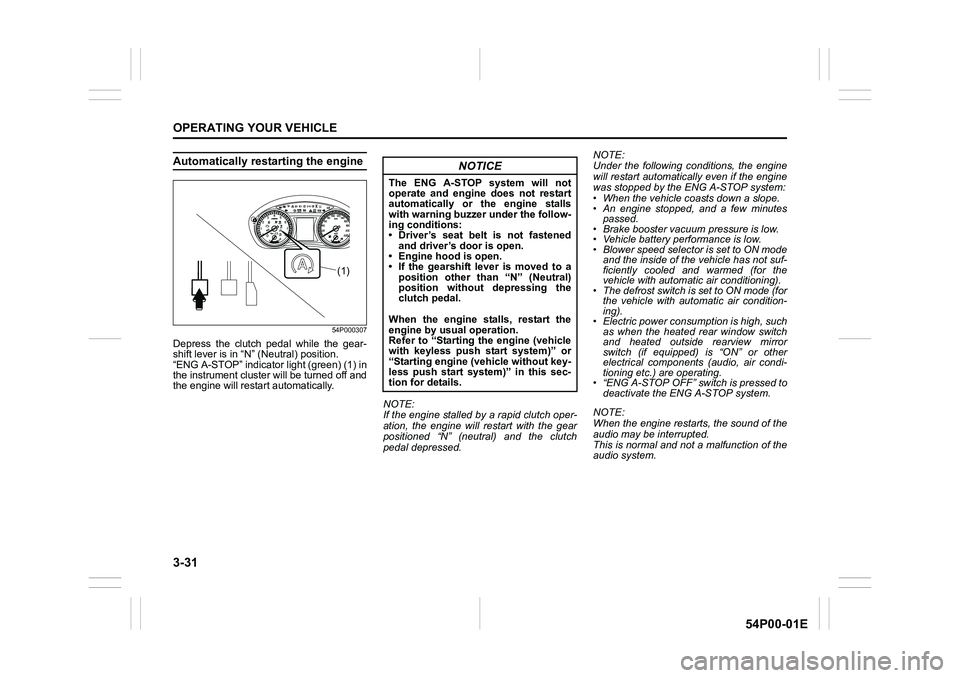
54P000307
Depress the clutch pedal while the gear-
shift lever is in “N” (Neutral) position.
“ENG A-STOP” indicator light (green) (1) in
the instrument cluster will be turned off and
the engine will restart automatically.
NOTE:
If the engine stalled by a rapid clutch oper-
ation, the engine will restart with the gear
positioned “N” (neutral) and the clutch
pedal depressed.NOTE:
Under the following conditions, the engine
will restart automatically even if the engine
was stopped by the ENG A-STOP system:
• When the vehicle coasts down a slope.
• An engine stopped, and a few minutes
passed.
• Brake booster vacuum pressure is low.
• Vehicle battery performance is low.
• Blower speed selector is set to ON mode
and the inside of the vehicle has not suf-
ficiently cooled and warmed (for the
vehicle with automatic air conditioning).
• The defrost switch is set to ON mode (for
the vehicle with automatic air condition-
ing).
• Electric power consumption is high, such
as when the heated rear window switch
and heated outside rearview mirror
switch (if equipped) is “ON” or other
electrical components (audio, air condi-
tioning etc.) are operating.
• “ENG A-STOP OFF” switch is pressed to
deactivate the ENG A-STOP system.
NOTE:
When the engine restarts, the sound of the
audio may be interrupted.
This is normal and not a malfunction of the
audio system.
(1)
NOTICE
The ENG A-STOP system will not
operate and engine does not restart
automatically or the engine stalls
with warning buzzer under the follow-
ing conditions:
• Driver’s seat belt is not fastened
and driver’s door is open.
• Engine hood is open.
• If the gearshift lever is moved to a
position other than “N” (Neutral)
position without depressing the
clutch pedal.
When the engine stalls, restart the
engine by usual operation.
Refer to “Starting the engine (vehicle
with keyless push start system)” or
“Starting engine (vehicle without key-
less push start system)” in this sec-
tion for details.
Page 222 of 482
3-82
OPERATING YOUR VEHICLE
54P00-01E
NOTE:
If any of the following conditions occur,
there may be a problem with the hill
descent control system or the ESP
® sys-
tem. Have your vehicle inspected by an
authorized SUZUKI dealer.
• The hill descent control indicator does
not come on or blink when you push the
hill descent control switch.
• The hill descent control indicator stays
on when driving without pushing the hill
descent control switch.
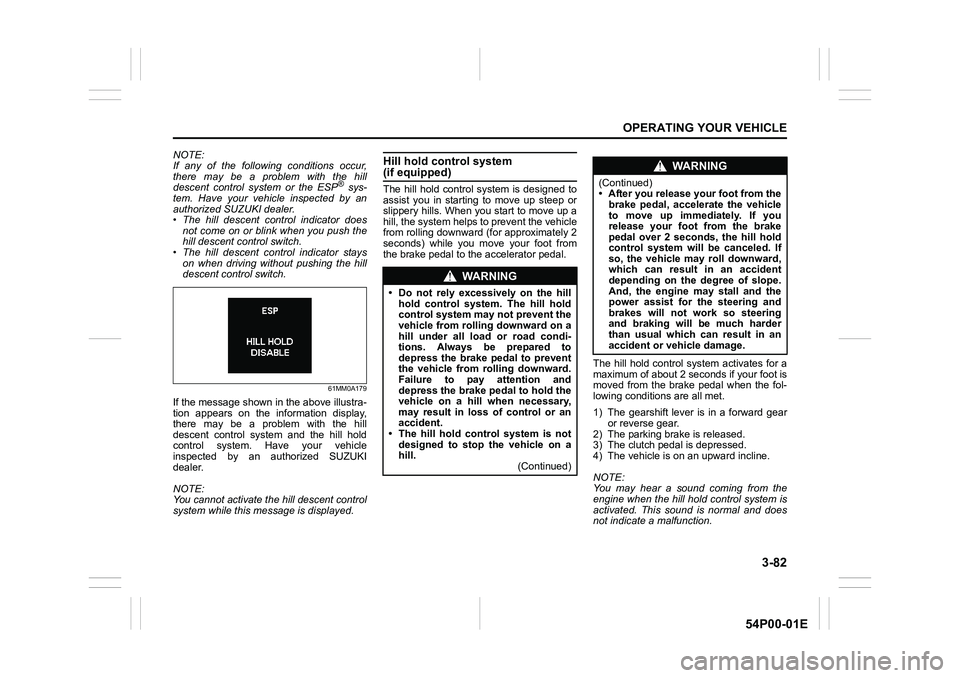
61MM0A179
If the message shown in the above illustra-
tion appears on the information display,
there may be a problem with the hill
descent control system and the hill hold
control system. Have your vehicle
inspected by an authorized SUZUKI
dealer.
NOTE:
You cannot activate the hill descent control
system while this message is displayed.
Hill hold control system (if equipped)
The hill hold control system is designed to
assist you in starting to move up steep or
slippery hills. When you start to move up a
hill, the system helps to prevent the vehicle
from rolling downward (for approximately 2
seconds) while you move your foot from
the brake pedal to the accelerator pedal.
The hill hold control system activates for a
maximum of about 2 seconds if your foot is
moved from the brake pedal when the fol-
lowing conditions are all met.
1) The gearshift lever is in a forward gear
or reverse gear.
2) The parking brake is released.
3) The clutch pedal is depressed.
4) The vehicle is on an upward incline.
NOTE:
You may hear a sound coming from the
engine when the hill hold control system is
activated. This sound is normal and does
not indicate a malfunction.
WA R N I N G
• Do not rely excessively on the hill
hold control system. The hill hold
control system may not prevent the
vehicle from rolling downward on a
hill under all load or road condi-
tions. Always be prepared to
depress the brake pedal to prevent
the vehicle from rolling downward.
Failure to pay attention and
depress the brake pedal to hold the
vehicle on a hill when necessary,
may result in loss of control or an
accident.
• The hill hold control system is not
designed to stop the vehicle on a
hill.
(Continued)
WA R N I N G
(Continued)
• After you release your foot from the
brake pedal, accelerate the vehicle
to move up immediately. If you
release your foot from the brake
pedal over 2 seconds, the hill hold
control system will be canceled. If
so, the vehicle may roll downward,
which can result in an accident
depending on the degree of slope.
And, the engine may stall and the
power assist for the steering and
brakes will not work so steering
and braking will be much harder
than usual which can result in an
accident or vehicle damage.
Page 235 of 482
4-1
DRIVING TIPS
54P00-01E
52D078S
Running-inCatalytic converter
80G106
The purpose of the catalytic converter is to
minimize the amount of harmful pollutants
in your vehicle’s exhaust. Use of leaded
fuel in vehicles equipped with catalytic
converters is prohibited, because lead
deactivates the pollutant-reducing compo-
nents of the catalyst system.
The converter is designed to last the life of
the vehicle under normal usage and when
unleaded fuel is used. No special mainte-
nance is required on the converter. How-
ever, it is very important to keep the engine
properly tuned. Engine misfiring, which can
result from an improperly tuned engine,
may cause overheating of the catalytic
converter. This may result in permanent
WA R N I N G
• Fasten your seat belts at all times.
Even though air bags are equipped
at the front seating positions, the
driver and all passengers should
be properly restrained at all times,
using the seat belts provided. Refer
to “Seat belts and child restraint
systems” section for instructions
on proper use of the seat belts.
• Never drive under the influence of
alcohol or other drugs. Alcohol and
drugs can seriously impair your
ability to drive safely, greatly
increasing the risk of injury to
yourself and others. You should
also avoid driving when you are
tired, sick, irritated or under stress.
NOTICE
The future performance and reliabil-
ity of the engine depends on the care
and restraint exercised during its
early life. It is especially important to
observe the following precautions
during the first 960 km (600 miles) of
vehicle operation.
• After starting, do not race the
engine. Warm it up gradually.
• Avoid prolonged vehicle operation
at a constant speed. Moving parts
will break in better if you vary your
speed.
• Start off from a stop slowly. Avoid
full throttle starts.
• Avoid hard braking, especially
during the first 320 km (200 miles)
of driving.
• Do not drive slowly with the trans-
axle in a high gear.
• Drive the vehicle at moderate
engine speeds.
• Do not tow a trailer during the first
960 km (600 miles) of vehicle oper-
ation.