starting SUZUKI GRAND VITARA 2022 Owner's Guide
[x] Cancel search | Manufacturer: SUZUKI, Model Year: 2022, Model line: GRAND VITARA, Model: SUZUKI GRAND VITARA 2022Pages: 482, PDF Size: 21 MB
Page 408 of 482
8-8
EMERGENCY SERVICE
54P00-01E
not use the tire and consult a SUZUKI
dealer or a roadside assistance service.Using compressor to inflate a tire
1) Place the vehicle on level, hard ground.
Set the parking brake firmly and shift
into “R” (Reverse).
2) Take out the compressor.
3) Unscrew the valve cap from the tire
valve.
4) Connect the air hose of the compressor
to the tire valve.
5) Connect the power plug of the com-
pressor to the accessory socket. Start
the engine. Switch on the compressor.
Inflate the tire to the required air pres-
sure.
Jump-starting instructions
WA R N I N G
Check the tire pressure and confirm
the completion of the emergency
repair after 10 km (6 mile) of running.
NOTICE
Have the tire renewed at the nearest
SUZUKI dealer. When reusing the
sealed tire, consult a tire repair shop.
The wheel can be reused after wiping
sealant off completely with cloth in
order to prevent rust, but the tire
valve and tire pressure monitoring
system (TPMS) sensor must be
renewed.
Dispose of the sealant bottle at a
SUZUKI dealer or in accordance with
your regional codes and practices.
After using the sealant bottle, replace
it with a new bottle from your SUZUKI
dealer.
NOTICE
Do not operate the compressor for
longer than 10 minutes. It can cause
overheating of the compressor.
WA R N I N G
• Never attempt to jump-start your
vehicle if the battery appears to be
frozen. Batteries in this condition
may explode.
• When making jump lead connec-
tions, check that your hands and
the jump leads remain clear from
pulleys, belts or fans.
• Batteries produce flammable
hydrogen gas. Keep flames and
sparks away from the battery or an
explosion may occur. Never smoke
when working near the battery.
• If the booster battery you use for
jump-starting is installed in another
vehicle, check that the two vehicles
are not touching each other.
• If your battery discharges repeat-
edly, for no apparent reason, have
your vehicle inspected by an
authorized SUZUKI dealer.
• To avoid harm to yourself or dam-
age to your vehicle or battery, fol-
low the jump-starting instructions
below.
If you are in doubt, call for qualified
road service.
Page 409 of 482
8-9
EMERGENCY SERVICE
54P00-01E
1) Use only a 12-volt battery to jump-start
your vehicle. Position the good 12-volt
battery close to your vehicle so that the
jump leads will reach both batteries.
When using a battery installed on
another vehicle, check that two vehicles
do not touch each other. Set the park-
ing brakes fully on both vehicles.
2) Turn off all vehicle accessories, except
those necessary for safety reasons (for
example, headlights or hazard lights).
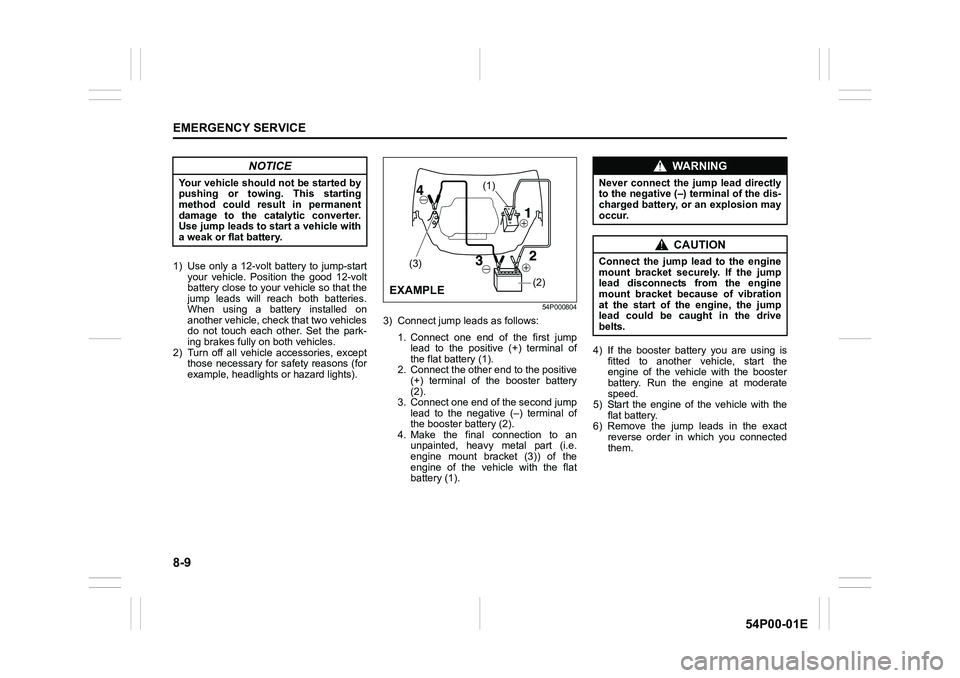
54P000804
3) Connect jump leads as follows:
1. Connect one end of the first jump
lead to the positive (+) terminal of
the flat battery (1).
2. Connect the other end to the positive
(+) terminal of the booster battery
(2).
3. Connect one end of the second jump
lead to the negative (–) terminal of
the booster battery (2).
4. Make the final connection to an
unpainted, heavy metal part (i.e.
engine mount bracket (3)) of the
engine of the vehicle with the flat
battery (1).4) If the booster battery you are using is
fitted to another vehicle, start the
engine of the vehicle with the booster
battery. Run the engine at moderate
speed.
5) Start the engine of the vehicle with the
flat battery.
6) Remove the jump leads in the exact
reverse order in which you connected
them.
NOTICE
Your vehicle should not be started by
pushing or towing. This starting
method could result in permanent
damage to the catalytic converter.
Use jump leads to start a vehicle with
a weak or flat battery.
(2)
(1)
(3)
EXAMPLE
WA R N I N G
Never connect the jump lead directly
to the negative (–) terminal of the dis-
charged battery, or an explosion may
occur.
CAUTION
Connect the jump lead to the engine
mount bracket securely. If the jump
lead disconnects from the engine
mount bracket because of vibration
at the start of the engine, the jump
lead could be caught in the drive
belts.
Page 411 of 482
8-11
EMERGENCY SERVICE
54P00-01E
Engine trouble: Starter does
not operate
1) Try turning the ignition switch to
“START” position or try pressing the
engine switch to change the ignition
mode to “START” with the headlights
turned on to determine the battery con-
dition. If the headlights go excessively
dim or go off, it usually means that
either the battery is flat or the battery
terminal contact is poor. Recharge the
battery or correct battery terminal con-
tact as necessary.
2) If the headlights remain bright, check
the fuses. If the reason for failure of the
starter is not obvious, there may be a
major electrical problem. Have the vehi-
cle inspected by your authorized
SUZUKI dealer.
Engine trouble: Flooded
engine
(Vehicle without keyless push start sys-
tem)
If the engine is flooded with gasoline, it
may be hard to start. If this happens, press
the accelerator pedal all the way to the
floor and hold it there while cranking the
engine.
• For gasoline engine model, do not oper-
ate the starter motor for more than 12
seconds.
• For diesel engine model, do not operate
the starter motor for more than 30 sec-
onds.
(Vehicle with keyless push start sys-
tem)
If the engine is flooded with gasoline, it
may be hard to start. If this happens, press
the accelerator pedal all the way to the
floor and hold it there while cranking the
engine.
• For gasoline engine model, do not oper-
ate the starter motor for more than 12
seconds.
• For diesel engine model, do not operate
the starter motor for more than 30 sec-
onds.
NOTE:
If the engine refuses to start, the starter
motor automatically stops after a certain
period of time. After the starter motor hasautomatically stopped or if there is any-
thing abnormal in the engine starting sys-
tem, the starter motor runs only while the
engine switch is held pressed.
Page 415 of 482
9-1
APPEARANCE CARE
54P00-01E
Corrosion prevention
It is important to take good care of your
vehicle to protect it from corrosion. Listed
below are instructions for how to maintain
your vehicle to prevent corrosion. Please
read and follow these instructions carefully.
Important information about corro-
sion
Common causes of corrosion
1) Accumulation of road salt, dirt, moisture
or chemicals in hard-to-reach areas of
the vehicle underbody or frame.
2) Chipping, scratches and any damage to
treated or painted metal surfaces
resulting from minor accidents or abra-
sion by stones and gravel.
Environmental conditions which accel-
erate corrosion
1) Road salt, dust control chemicals, sea
air or industrial pollution will all acceler-
ate the corrosion of metal.
2) High humidity will increase the rate of
corrosion particularly when the tem-
perature range is just above the freez-
ing point.
3) Moisture in certain areas of a vehicle
for an extended period of time may pro-
mote corrosion even though other body
sections may be completely dry.4) High temperatures will cause an accel-
erated rate of corrosion to parts of the
vehicle which are not well-ventilated to
permit quick drying.
This information illustrates the necessity of
keeping your vehicle (particularly the
underbody) as clean and dry as possible. It
is equally important to repair any damage
to the paint or protective coatings as soon
as possible.How to help prevent corrosion
Wash your vehicle frequently
The best way to preserve the finish on your
vehicle and to help avoid corrosion is to
keep it clean with frequent washing.
Wash your vehicle at least once during the
winter and once immediately after the win-
ter. Keep your vehicle, particularly the
underside, as clean and dry as possible.
If you frequently drive on salted roads,
your vehicle should be washed at least
once a month during the winter. If you live
near the ocean, your vehicle should be
washed at least once a month throughout
the year.
For washing instructions, refer to “Vehicle
cleaning” section.Remove foreign material deposits
Foreign material such as salts, chemicals,
road oil or tar, tree sap, bird droppings and
industrial fall-out may damage the finish of
your vehicle if it is left on painted surfaces.
Remove these types of deposits as quickly
as possible. If these deposits are difficult to
wash off, an additional cleaner may be
required. Check that any cleaner you use
is not harmful to painted surfaces and is
specifically intended for your purposes.
Follow the manufacturer’s directions when
using these special cleaners.
Repair finish damage
Carefully examine your vehicle for damage
to the painted surfaces. Should you find
any chips or scratches in the paint, touch
them up immediately to prevent corrosion
from starting. If the chips or scratches have
gone through to the bare metal, have a
qualified body shop make the repair.
Keep passenger and luggage compart-
ments clean
Moisture, dirt or mud can accumulate
under the floor mats and may cause corro-
sion. Occasionally, check under these
mats to ensure that this area is clean and
dry. More frequent checks are necessary if
the vehicle is used for off-road driving or in
wet weather.
Certain cargos such as chemicals, fertiliz-
ers, cleaners, salts, etc. are extremely cor-
rosive by nature. These products should
be transported in sealed containers. If they
Page 434 of 482
12-4
SUPPLEMENT
54P00-01E
NOTE:
Oxygenated fuels are fuels which contain
oxygen-carrying additives such as MTBE
or alcohol.
If “RON 95” label is attached, you must use
unleaded gasoline with a minimum rating
of 91 pump octane ((R + M)/2 method).
Gasoline containing MTBE
Unleaded gasoline containing MTBE
(methyl tertiary butyl ether) may be used in
your vehicle if the MTBE content is not
greater than 15%. This oxygenated fuel
does not contain alcohol.
Gasoline-ethanol blends
Blends of unleaded gasoline and ethanol
(grain alcohol), also known as gasohol,
may be used in your vehicle if the ethanol
content is not greater than 10%.
Gasoline-methanol blends
Fuels containing 5% or less methanol
(wood alcohol) may be suitable for use in
your vehicle if they contain cosolvents and
corrosion inhibitors. Do not use fuels con-
taining more than 5% methanol under any
circumstances. Fuel system damage or
vehicle performance problems resulting
from the use of such fuels are not the
responsibility of SUZUKI and may not be
covered under the New Vehicle Limited
Warranty.
Fuel pump labeling
In some states, pumps that dispense oxy-
genated fuels are required to be labeled
for the type and percentage of oxygenate
and whether important additives are pres-
ent. Such labels may provide enough infor-
mation for you to determine if a particular
blend of fuels meets the requirements
listed above. In other areas, pumps may
not be clearly labeled as to the content or
type of oxygenate and additives. If you are
not sure that the fuel you intend to use
meets these requirements, check with the
service station operator or the fuel sup-
plier.
NOTE:
To help clean the air, SUZUKI recom-
mends you use the oxygenated fuels.
However, if you are not satisfied with the
driveability or fuel economy of your vehicle
when you are using an oxygenated fuel,
switch back to the regular unleaded gaso-
line.
Engine oil and filter
Specified oil
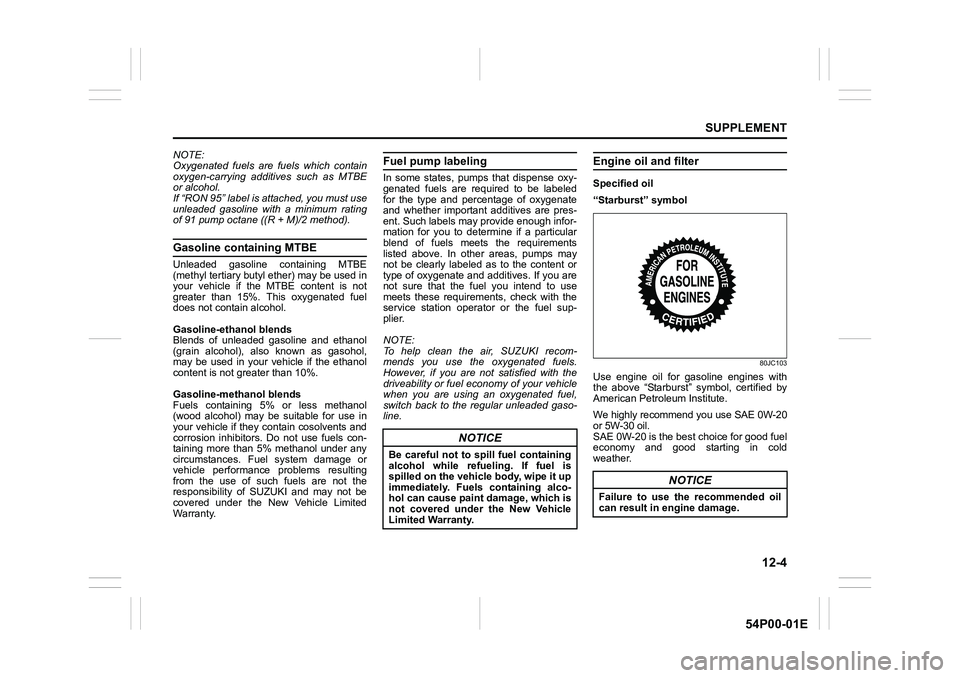
“Starburst” symbol
80JC103
Use engine oil for gasoline engines with
the above “Starburst” symbol, certified by
American Petroleum Institute.
We highly recommend you use SAE 0W-20
or 5W-30 oil.
SAE 0W-20 is the best choice for good fuel
economy and good starting in cold
weather.
NOTICE
Be careful not to spill fuel containing
alcohol while refueling. If fuel is
spilled on the vehicle body, wipe it up
immediately. Fuels containing alco-
hol can cause paint damage, which is
not covered under the New Vehicle
Limited Warranty.
NOTICE
Failure to use the recommended oil
can result in engine damage.
Page 442 of 482
13-3
INDEX
54P00-01E
Fuel gauge ............................................................................ 2-64
Fuel pump labeling .............................................................. 12-4
Fuel recommendation .................................................. 1-1, 12-3
Full wheel cover ..................................................................... 8-5
Fuses .................................................................................... 7-41
Fuses in engine compartment ............................................ 7-41
Fuses under dashboard ...................................................... 7-43
G
Gasoline containing MTBE ................................................. 12-4
Gasoline engine ..................................................................... 1-1
Gasoline-ethanol blends .............................................. 1-1, 12-4
Gasoline-methanol blends ........................................... 1-1, 12-4
Gear oil ................................................................................. 7-30
Gear oil change .................................................................... 7-32
Gear oil level check ............................................................. 7-31
Gearshift indicator ...................................................... 2-71, 3-21
Glove box ............................................................................. 5-12
Glove box light .............................................................. 5-6, 7-55
Glow plug indicator light................................................... 2-100
H
Hazard warning switch ...................................................... 2-110
Head restraints............................................................ 2-23, 2-26
Headlight leveling switch .................................................. 2-108
Heated rear window switch / heated outside
rearview mirror switch ...................................................... 2-115
Heating and air conditioning system ................................. 5-23
Heating system .................................................................... 5-25
Highway driving ..................................................................... 4-3
Hill descent control indicator light..................................... 2-92
Hill descent control switch ................................................. 3-80
Hill descent control system ................................................ 3-79Hill hold control system ...................................................... 3-82
Horn ..................................................................................... 2-115
How ABS works.................................................................... 3-76
I
Ignition key reminder ............................................................. 2-2
Ignition switch ........................................................................ 3-3
Illumination indicator light .................................................. 2-98
Immobilizer system ................................................................ 2-1
Immobilizer/keyless push start system warning light ...... 2-94
Improving fuel economy........................................................ 4-2
Information display ........................................... 2-66, 3-43, 3-46
Inside rearview mirror.......................................................... 2-20
Installation of child restraint with top tether ..................... 2-47
Installation of radio frequency transmitters ...................... 5-39
Installation with ISOFIX type anchorages.......................... 2-46
Installation with lap-shoulder seat belts ............................ 2-45
Instantaneous fuel consumption ........................................ 2-67
Instrument cluster ................................................................ 2-63
Instrument panel pocket...................................................... 5-14
Interior light ...................................................................5-5, 7-54
Interior workable area for engine starting ........................... 3-9
J
Jacking instructions .............................................................. 8-1
Jump-starting instructions.................................................... 8-8
K
Keyless entry system transmitter................................2-6, 2-13
Keyless push start system .................................................... 3-6
Keyless push start system remote controller ..............2-6, 2-7
Keys......................................................................................... 2-1
L
Lap-shoulder belt ................................................................. 2-30
Page 444 of 482
13-5
INDEX
54P00-01E
Replacing tires and/or wheels ............................................ 3-91
Reversing light ..................................................................... 7-52
Roof rails or roof rack anchors .......................................... 5-19
Running-in .............................................................................. 4-1
S
Seat adjustment .......................................................... 2-21, 2-24
Seat belt inspection ............................................................. 2-37
Seat belt pretensioner system............................................ 2-48
Seat belt reminder ............................................................... 2-34
Seat belt warning ................................................................. 12-3
Seat belts and child restraint systems .............................. 2-28
Seat height adjustment lever .............................................. 2-22
Seat position adjustment lever........................................... 2-22
Seatback angle adjustment lever .............................. 2-22, 2-25
Selection of coolant............................................................. 7-26
Selection of ignition modes .................................................. 3-7
Setting mode ........................................................................ 2-71
Shopping hook..................................................................... 5-16
Shoulder anchor height adjuster ....................................... 2-36
Side air bags and side curtain air bags ............................. 2-55
Side door locks ...................................................................... 2-2
Side turn signal light ........................................................... 7-46
Spark plugs .......................................................................... 7-29
SPECIFICATIONS................................................................. 11-1
Specified oil................................................................. 7-20, 12-4
Speed limiter ........................................................................ 3-45
Speedometer ........................................................................ 2-64
Stability control system ...................................................... 3-77
Starting engine
(vehicle with keyless push start system) .......................... 3-14Starting engine
(vehicle without keyless push start system) ..................... 3-12
Steering ................................................................................. 7-35
Stuck vehicle .......................................................................... 4-5
Sun visor ................................................................................. 5-4
Sunroof ................................................................................... 5-9
Supplemental restraint system (air bags).......................... 2-50
T
Tachometer ........................................................................... 2-64
Tailgate.................................................................................... 2-5
Temperature gauge .............................................................. 2-65
Temporary-use spare tire (compact spare tire)................. 12-1
Theft deterrent alarm system .............................................. 12-5
Theft deterrent light ............................................................. 2-16
Thermometer ........................................................................ 2-67
Tilt/telescoping steering lock lever .................................. 2-114
Tire chains .............................................................................. 4-4
Tire changing tool .................................................................. 8-1
Tire inspection...................................................................... 7-36
Tire pressure monitoring system (TPMS) .......................... 3-83
Tire rotation .......................................................................... 7-38
Tires....................................................................................... 7-36
Towing................................................................................... 8-10
Traction control system ...................................................... 3-77
Trailer hitch installation points ............................................. 6-5
Trailer towing.......................................................................... 6-1
Transfer oil............................................................................ 7-30
Trip meter.............................................................................. 2-71
Turn signal control lever ................................................... 2-108
Turn signal indicators.......................................................... 2-98
Turn signal operation ........................................................ 2-109