starting SUZUKI GRAND VITARA 2022 Owner's Manual
[x] Cancel search | Manufacturer: SUZUKI, Model Year: 2022, Model line: GRAND VITARA, Model: SUZUKI GRAND VITARA 2022Pages: 482, PDF Size: 21 MB
Page 236 of 482
4-2
DRIVING TIPS
54P00-01E
heat damage to the catalytic converter and
other vehicle components.
54G584S
Improving fuel economy
The following instructions will help you
improve fuel economy.
Avoid excessive idling
If you park your vehicle for more than one
minute, stop the engine and start it again
later. When warming up a cold engine,
allow the engine to idle until the tempera-
ture gauge pointer comes up to “C” posi-
tion (if the idling is not prohibited). In this
position, the engine is sufficiently warm for
starting off.
Avoid fast starts
Fast starts away from lights or stop signs
will consume fuel unnecessarily and
shorten engine life. Start off slowly.
Avoid unnecessary stops
Avoid unnecessary deceleration and stop-
ping. Try to maintain a slow, steady speed
whenever possible. Slowing down and
then accelerating again uses more fuel.
Keep a steady cruising speed
Drive at a constant speed that road and
traffic conditions will permit.NOTICE
To minimize the possibility of cata-
lytic converter or other vehicle dam-
age:
• Maintain the engine in the proper
operating condition.
• In the event of an engine malfunc-
tion, particularly one involving
engine misfire or other apparent
loss of performance, have the vehi-
cle serviced promptly.
• Do not turn off the engine or inter-
rupt the ignition when the transaxle
is in gear and the vehicle is in
motion.
• Do not try to start the engine by
pushing or towing the vehicle, or
coasting down a hill.
• Do not idle the engine with any
spark plug wires disconnected or
removed, such as during diagnos-
tic testing.
• Do not idle the vehicle for pro-
longed periods if idling seems
rough or there are other malfunc-
tions.
• Do not allow the fuel tank to get
near the empty level.
WA R N I N G
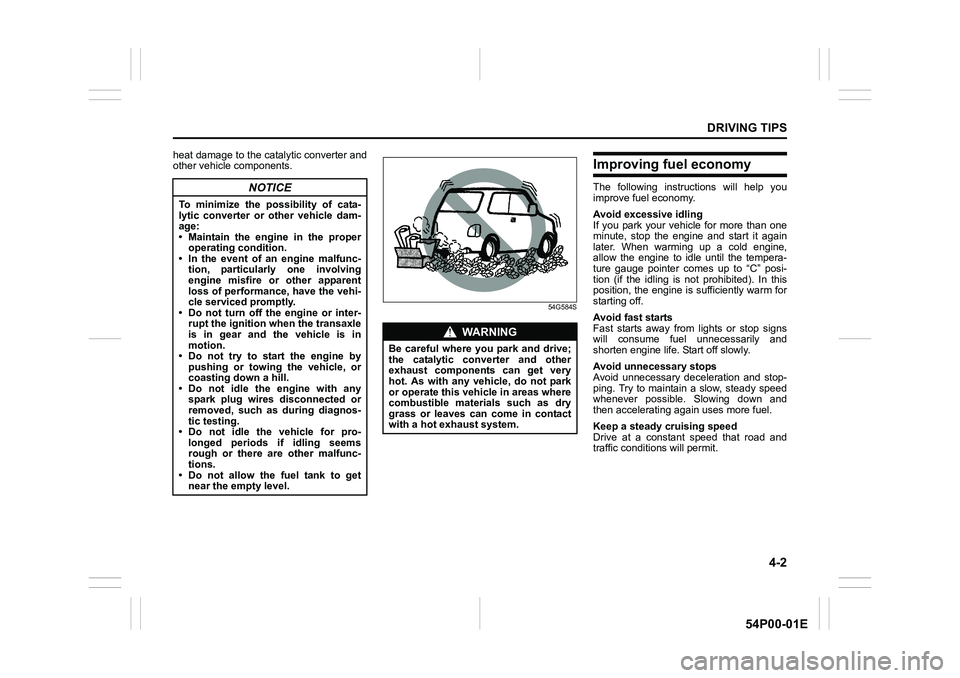
Be careful where you park and drive;
the catalytic converter and other
exhaust components can get very
hot. As with any vehicle, do not park
or operate this vehicle in areas where
combustible materials such as dry
grass or leaves can come in contact
with a hot exhaust system.
Page 293 of 482
5-51
OTHER CONTROLS AND EQUIPMENT
54P00-01E
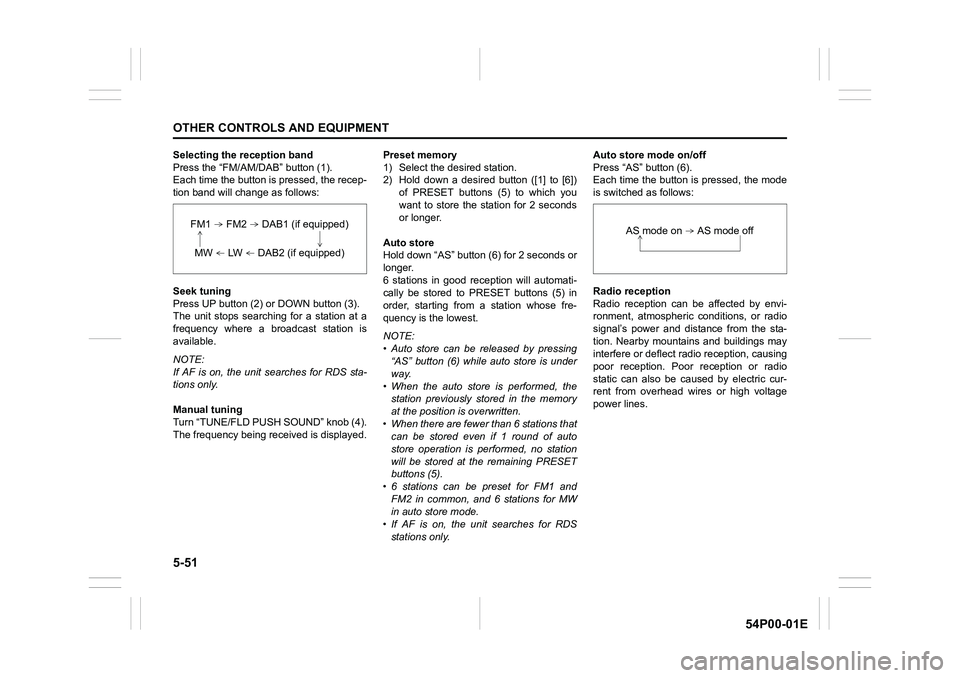
Selecting the reception band
Press the “FM/AM/DAB” button (1).
Each time the button is pressed, the recep-
tion band will change as follows:
Seek tuning
Press UP button (2) or DOWN button (3).
The unit stops searching for a station at a
frequency where a broadcast station is
available.
NOTE:
If AF is on, the unit searches for RDS sta-
tions only.
Manual tuning
Turn “TUNE/FLD PUSH SOUND” knob (4).
The frequency being received is displayed.Preset memory
1) Select the desired station.
2) Hold down a desired button ([1] to [6])
of PRESET buttons (5) to which you
want to store the station for 2 seconds
or longer.
Auto store
Hold down “AS” button (6) for 2 seconds or
longer.
6 stations in good reception will automati-
cally be stored to PRESET buttons (5) in
order, starting from a station whose fre-
quency is the lowest.
NOTE:
• Auto store can be released by pressing
“AS” button (6) while auto store is under
way.
• When the auto store is performed, the
station previously stored in the memory
at the position is overwritten.
• When there are fewer than 6 stations that
can be stored even if 1 round of auto
store operation is performed, no station
will be stored at the remaining PRESET
buttons (5).
• 6 stations can be preset for FM1 and
FM2 in common, and 6 stations for MW
in auto store mode.
• If AF is on, the unit searches for RDS
stations only.Auto store mode on/off
Press “AS” button (6).
Each time the button is pressed, the mode
is switched as follows:
Radio reception
Radio reception can be affected by envi-
ronment, atmospheric conditions, or radio
signal’s power and distance from the sta-
tion. Nearby mountains and buildings may
interfere or deflect radio reception, causing
poor reception. Poor reception or radio
static can also be caused by electric cur-
rent from overhead wires or high voltage
power lines.
FM1 FM2 DAB1 (if equipped)
MW LW DAB2 (if equipped)
AS mode on AS mode off
Page 295 of 482
5-53
OTHER CONTROLS AND EQUIPMENT
54P00-01E
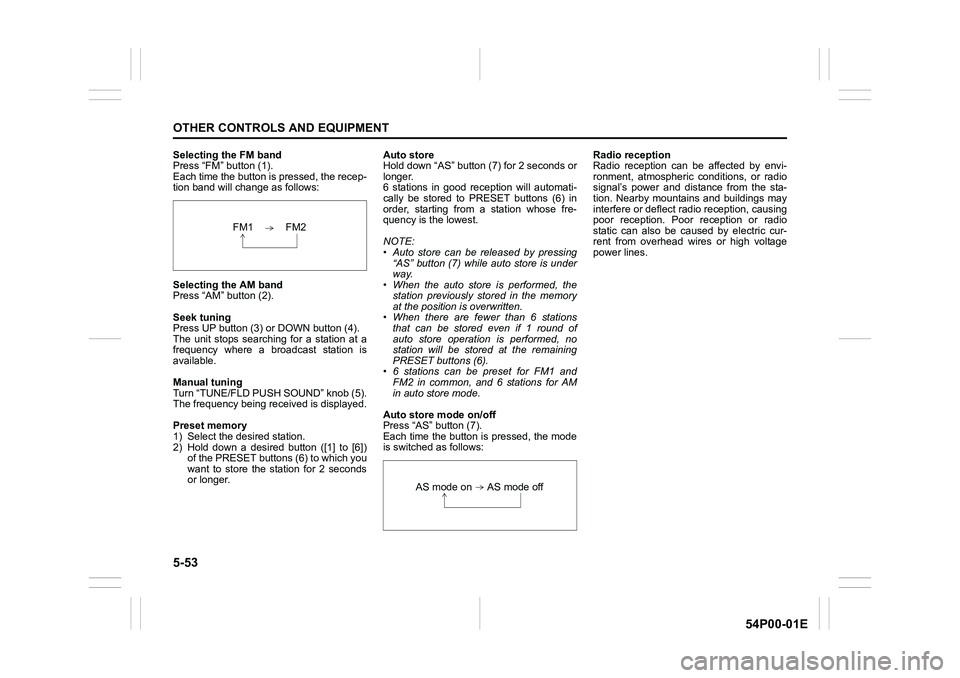
Selecting the FM band
Press “FM” button (1).
Each time the button is pressed, the recep-
tion band will change as follows:
Selecting the AM band
Press “AM” button (2).
Seek tuning
Press UP button (3) or DOWN button (4).
The unit stops searching for a station at a
frequency where a broadcast station is
available.
Manual tuning
Turn “TUNE/FLD PUSH SOUND” knob (5).
The frequency being received is displayed.
Preset memory
1) Select the desired station.
2) Hold down a desired button ([1] to [6])
of the PRESET buttons (6) to which you
want to store the station for 2 seconds
or longer.Auto store
Hold down “AS” button (7) for 2 seconds or
longer.
6 stations in good reception will automati-
cally be stored to PRESET buttons (6) in
order, starting from a station whose fre-
quency is the lowest.
NOTE:
• Auto store can be released by pressing
“AS” button (7) while auto store is under
way.
• When the auto store is performed, the
station previously stored in the memory
at the position is overwritten.
• When there are fewer than 6 stations
that can be stored even if 1 round of
auto store operation is performed, no
station will be stored at the remaining
PRESET buttons (6).
• 6 stations can be preset for FM1 and
FM2 in common, and 6 stations for AM
in auto store mode.
Auto store mode on/off
Press “AS” button (7).
Each time the button is pressed, the mode
is switched as follows:Radio reception
Radio reception can be affected by envi-
ronment, atmospheric conditions, or radio
signal’s power and distance from the sta-
tion. Nearby mountains and buildings may
interfere or deflect radio reception, causing
poor reception. Poor reception or radio
static can also be caused by electric cur-
rent from overhead wires or high voltage
power lines.
FM1 FM2
AS mode on AS mode off
Page 337 of 482
6-5
VEHICLE LOADING AND TOWING
54P00-01E
60A186
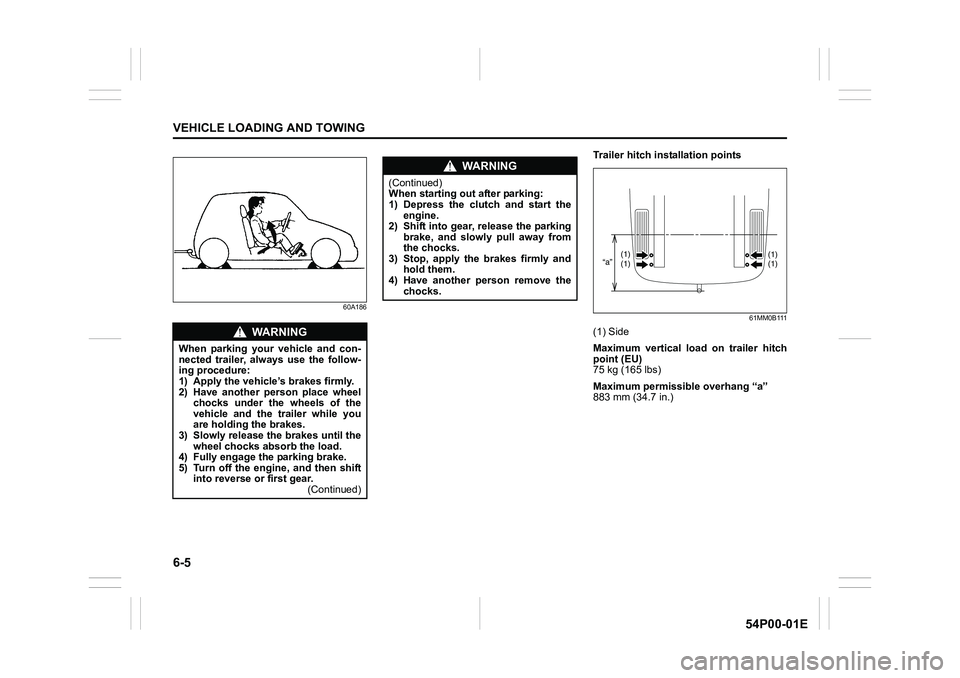
Trailer hitch installation points
61MM0B111
(1) Side
Maximum vertical load on trailer hitch
point (EU)
75 kg (165 lbs)
Maximum permissible overhang “a”
883 mm (34.7 in.)WA R N I N G
When parking your vehicle and con-
nected trailer, always use the follow-
ing procedure:
1) Apply the vehicle’s brakes firmly.
2) Have another person place wheel
chocks under the wheels of the
vehicle and the trailer while you
are holding the brakes.
3) Slowly release the brakes until the
wheel chocks absorb the load.
4) Fully engage the parking brake.
5) Turn off the engine, and then shift
into reverse or first gear.
(Continued)
WA R N I N G
(Continued)
When starting out after parking:
1) Depress the clutch and start the
engine.
2) Shift into gear, release the parking
brake, and slowly pull away from
the chocks.
3) Stop, apply the brakes firmly and
hold them.
4) Have another person remove the
chocks.
“a”(1)(1)(1) (1)
Page 339 of 482
7-1
INSPECTION AND MAINTENANCE
54P00-01E
60B128S
WA R N I N G
Take extreme care when working on
your vehicle to prevent accidental
injury. Carefully observe the follow-
ing precautions:
• To prevent damage or unintended
activation of the air bag system or
seat belt pretensioner system, check
that the battery is disconnected and
the ignition switch has been in
“LOCK” position or the ignition
mode has been “LOCK” (OFF) for at
least 90 seconds before performing
any electrical service work on your
SUZUKI vehicle. Do not touch air
bag system components, seat belt
pretensioner system components or
wires.
The wires are wrapped with yellow
tape or yellow tubing, and the cou-
plers are yellow for easy identifica-
tion.
• Do not leave the engine running in
garages or other confined areas.
(Continued)
WA R N I N G
(Continued)
• When the engine is running, keep
hands, clothing, tools, and other
objects away from the fan and drive
belt. Even though the fan may not
be moving, it can automatically
turn on without warning.
• When it is necessary to perform
service work with the engine run-
ning, check that the parking brake
is set fully and the transaxle is in
Neutral.
• Do not touch ignition wires or other
ignition system parts when starting
the engine or when the engine is
running, or you could receive an
electric shock.
• Be careful not to touch a hot
engine, exhaust manifold and
pipes, muffler, radiator and water
hoses.
• Do not allow smoking, sparks, or
flames around fuel or the battery.
Flammable fumes are present.
• Do not get under your vehicle if it is
supported only with the portable
jack provided in your vehicle.
• Be careful not to cause accidental
short circuits between the positive
and negative battery terminals.
(Continued)
WA R N I N G
(Continued)
• Keep used oil, coolant, and other
fluids away from children and pets.
Dispose of used fluids properly;
never pour them on the ground,
into sewers, etc.
Page 359 of 482
7-21
INSPECTION AND MAINTENANCE
54P00-01E
NOTE:
• (For EU countries)
The replacement timing varies with the
type of engine oil that you choose.
Refer to “Maintenance schedule” in this
section for corresponding maintenance
schedule.
• (For Mexico)
For additional instruction, refer to “SUP-
PLEMENT” section in the end of this
book.
SAE 0W-20 (1) is the best choice for good
fuel economy and good starting in cold
weather.
NOTE:
We recommend that you use SUZUKI gen-
uine oil. To purchase it, see your SUZUKI
dealer.
(For diesel engine model)
Check that the engine oil you use comes
under the quality classification of ACEA
C2.
SAE 0W-30 is the best choice for good fuel
economy and good starting in cold
weather. Oil level check
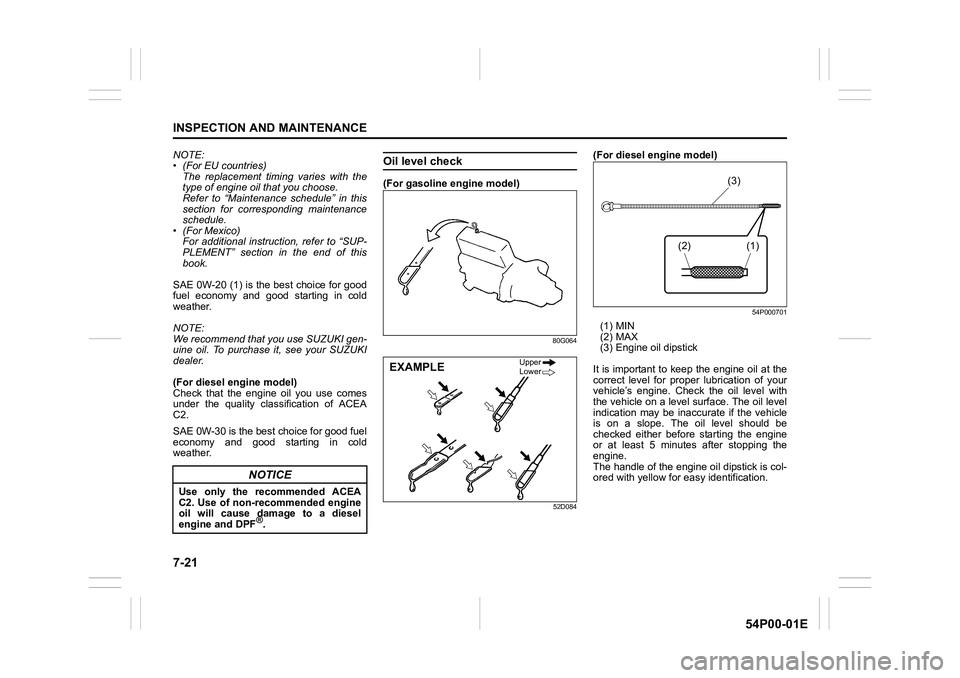
(For gasoline engine model)
80G064
52D084
(For diesel engine model)
54P000701
(1) MIN
(2) MAX
(3) Engine oil dipstick
It is important to keep the engine oil at the
correct level for proper lubrication of your
vehicle’s engine. Check the oil level with
the vehicle on a level surface. The oil level
indication may be inaccurate if the vehicle
is on a slope. The oil level should be
checked either before starting the engine
or at least 5 minutes after stopping the
engine.
The handle of the engine oil dipstick is col-
ored with yellow for easy identification.
NOTICE
Use only the recommended ACEA
C2. Use of non-recommended engine
oil will cause damage to a diesel
engine and DPF
®.
EXAMPLEUpper
Lower
(1) (3)
(2)
Page 377 of 482
7-39
INSPECTION AND MAINTENANCE
54P00-01E
Battery
52KM160
Your vehicle is equipped with a battery that
requires infrequent maintenance. You will
never have to add water. You should, how-
ever, periodically check the battery, battery
terminals and battery hold-down bracket
for corrosion. Remove corrosion using a
stiff brush and ammonia mixed with water,
or baking soda mixed with water. After
removing corrosion, rinse with clean water.
If your vehicle is not going to be driven for
a month or longer, disconnect the cable
from the negative terminal of the battery to
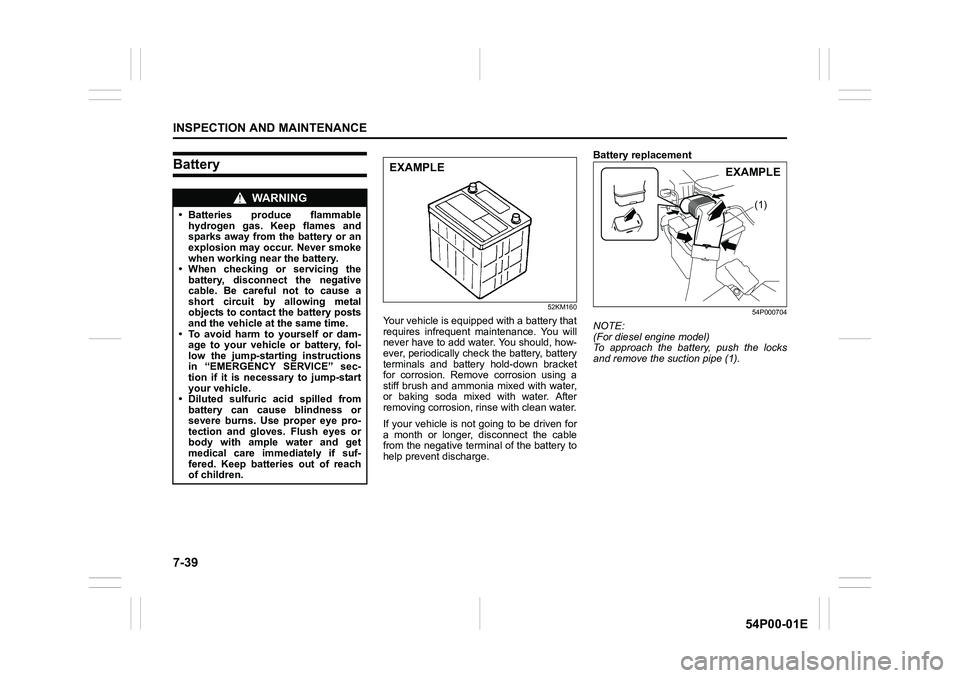
help prevent discharge.Battery replacement54P000704
NOTE:
(For diesel engine model)
To approach the battery, push the locks
and remove the suction pipe (1).
WA R N I N G
• Batteries produce flammable
hydrogen gas. Keep flames and
sparks away from the battery or an
explosion may occur. Never smoke
when working near the battery.
• When checking or servicing the
battery, disconnect the negative
cable. Be careful not to cause a
short circuit by allowing metal
objects to contact the battery posts
and the vehicle at the same time.
• To avoid harm to yourself or dam-
age to your vehicle or battery, fol-
low the jump-starting instructions
in “EMERGENCY SERVICE” sec-
tion if it is necessary to jump-start
your vehicle.
• Diluted sulfuric acid spilled from
battery can cause blindness or
severe burns. Use proper eye pro-
tection and gloves. Flush eyes or
body with ample water and get
medical care immediately if suf-
fered. Keep batteries out of reach
of children.
EXAMPLE
(1)
EXAMPLE
Page 380 of 482
7-42
INSPECTION AND MAINTENANCE
54P00-01E
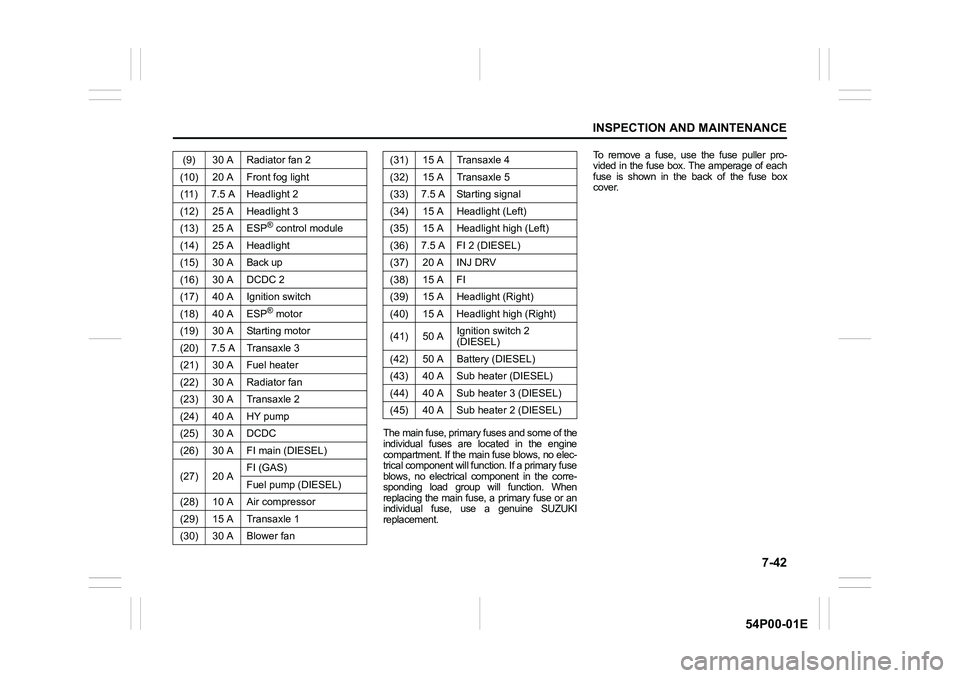
The main fuse, primary fuses and some of the
individual fuses are located in the engine
compartment. If the main fuse blows, no elec-
trical component will function. If a primary fuse
blows, no electrical component in the corre-
sponding load group will function. When
replacing the main fuse, a primary fuse or an
individual fuse, use a genuine SUZUKI
replacement.To remove a fuse, use the fuse puller pro-
vided in the fuse box. The amperage of each
fuse is shown in the back of the fuse box
cover. (9) 30 A Radiator fan 2
(10) 20 A Front fog light
(11) 7.5 A Headlight 2
(12) 25 A Headlight 3
(13) 25 A ESP
® control module
(14) 25 A Headlight
(15) 30 A Back up
(16) 30 A DCDC 2
(17) 40 A Ignition switch
(18) 40 A ESP
® motor
(19) 30 A Starting motor
(20) 7.5 A Transaxle 3
(21) 30 A Fuel heater
(22) 30 A Radiator fan
(23) 30 A Transaxle 2
(24) 40 A HY pump
(25) 30 A DCDC
(26) 30 A FI main (DIESEL)
(27) 20 AFI (GAS)
Fuel pump (DIESEL)
(28) 10 A Air compressor
(29) 15 A Transaxle 1
(30) 30 A Blower fan
(31) 15 A Transaxle 4
(32) 15 A Transaxle 5
(33) 7.5 A Starting signal
(34) 15 A Headlight (Left)
(35) 15 A Headlight high (Left)
(36) 7.5 A FI 2 (DIESEL)
(37) 20 A INJ DRV
(38) 15 A FI
(39) 15 A Headlight (Right)
(40) 15 A Headlight high (Right)
(41) 50 AIgnition switch 2
(DIESEL)
(42) 50 A Battery (DIESEL)
(43) 40 A Sub heater (DIESEL)
(44) 40 A Sub heater 3 (DIESEL)
(45) 40 A Sub heater 2 (DIESEL)
Page 381 of 482
7-43
INSPECTION AND MAINTENANCE
54P00-01E
60G111
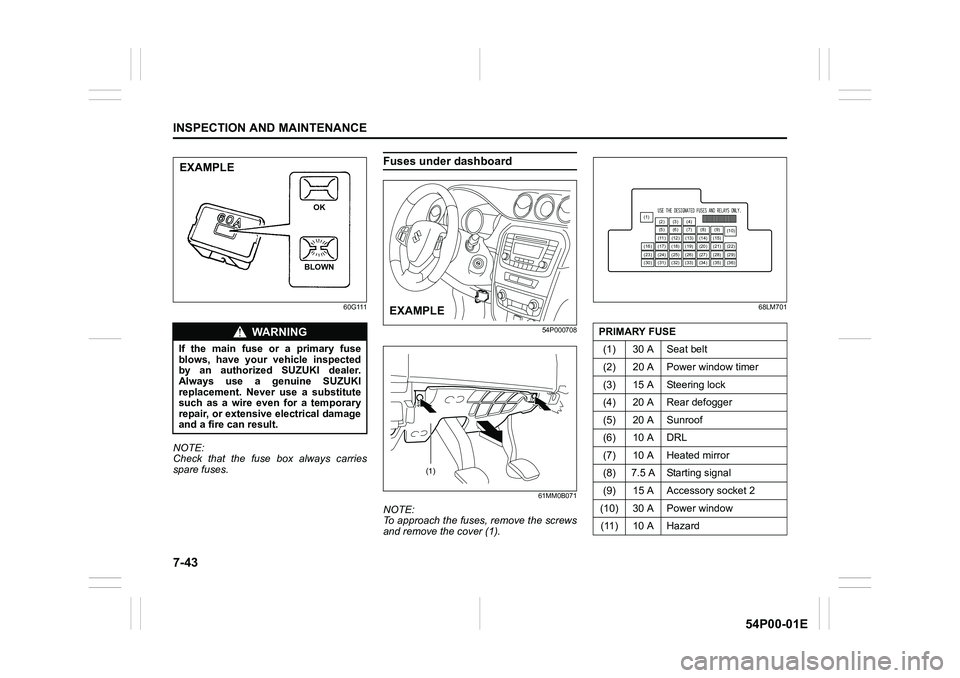
NOTE:
Check that the fuse box always carries
spare fuses.
Fuses under dashboard
54P000708
61MM0B071
NOTE:
To approach the fuses, remove the screws
and remove the cover (1).
68LM701
WA R N I N G
If the main fuse or a primary fuse
blows, have your vehicle inspected
by an authorized SUZUKI dealer.
Always use a genuine SUZUKI
replacement. Never use a substitute
such as a wire even for a temporary
repair, or extensive electrical damage
and a fire can result.
EXAMPLE
BLOWNOK
EXAMPLE
(1)
PRIMARY FUSE
(1) 30 A Seat belt
(2) 20 A Power window timer
(3) 15 A Steering lock
(4) 20 A Rear defogger
(5) 20 A Sunroof
(6) 10 A DRL
(7) 10 A Heated mirror
(8) 7.5 A Starting signal
(9) 15 A Accessory socket 2
(10) 30 A Power window
(11) 10 A Hazard
(1)
(12)(10)
(13)
(36) (2) (3)
(4)
(5)(6)
(7) (8)(9)
(11) (14) (15)
(16) (17) (18) (19) (20) (21) (22)
(23) (24) (25) (26) (27) (28) (29)
(30) (31) (32) (33) (34) (35)
Page 400 of 482
EMERGENCY SERVICE
8
54P00-01E
60G411
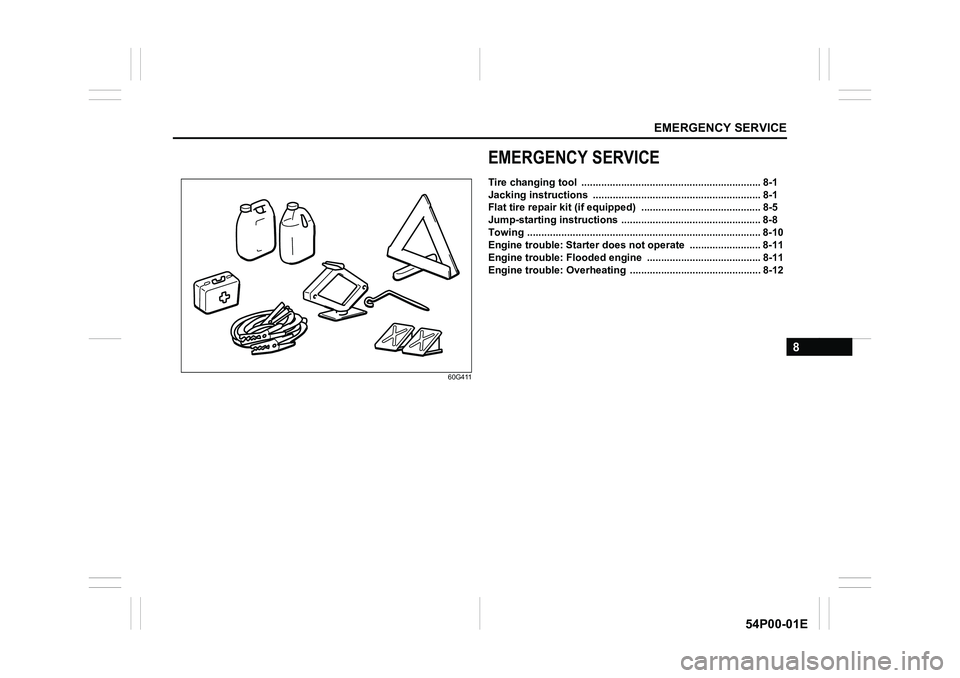
EMERGENCY SERVICE
Tire changing tool ............................................................... 8-1
Jacking instructions ........................................................... 8-1
Flat tire repair kit (if equipped) .......................................... 8-5
Jump-starting instructions ................................................. 8-8
Towing .................................................................................. 8-10
Engine trouble: Starter does not operate ......................... 8-11
Engine trouble: Flooded engine ........................................ 8-11
Engine trouble: Overheating .............................................. 8-12