CAN SUZUKI IGNIS 2018 Owners Manual
[x] Cancel search | Manufacturer: SUZUKI, Model Year: 2018, Model line: IGNIS, Model: SUZUKI IGNIS 2018Pages: 505, PDF Size: 8.36 MB
Page 428 of 505
9-3APPEARANCE CARE
75RM4-01E
Leather upholstery
Remove loose dirt with a vacuum cleaner.
Using a mild soap or saddle soap solution,
wipe dirt off with a clean damp soft cloth.
To remove soap, wipe the areas again with
a soft cloth dampened with water. Wipe the
areas dry with a soft dry cloth. Repeat this
until the dirt or stain is removed, or use a
commercial leather cleaner for tougher dirt
or stains. If you use a leather cleaner,
carefully follow the manufacturer’s instruc-
tions and precautions. Do not use solvent
type cleaners or abrasive cleaners.
NOTE:
• In order to keep leather upholstery look-ing good, it should be cleaned at least
twice a year.
• If leather upholstery becomes wet, immediately wipe it dry with tissue paper
or a soft cloth. Water may cause leather
to harden and shrink if it is not wiped off.
• When parking on sunny days, select a
shady place or use a sunshade. If
leather upholstery is exposed to direct
sunlight for a long time, it may discolor
and shrink.
• As is common with natural materials, leather is inherently irregular in grain and
cowhide has spots in its natural state.
These do not affect the performance of
the leather in any way. Seat belts
Clean seat belts with a mild soap and
water. Do not use bleach or dye on the
belts. They may weaken the fabric in the
belts.
Vinyl floor mats
Ordinary dirt can be removed from vinyl
with water or mild soap. Use a brush to
help loosen dirt. After the dirt is loosened,
rinse the mat thoroughly with water and
dry it in the shade.
Carpets
Remove dirt and soil as much as possible
with a vacuum cleaner. Using a mild soap
solution, rub stained areas with a clean
damp cloth. To remove soap, rub the areas
again with a cloth dampened with water.
Repeat this until the stain is removed, or
use a commercial carpet cleaner for
tougher stains. If you use a carpet cleaner,
carefully follow the manufacturer’s instruc-
tions and precautions.
Instrument panel and console
Remove loose dirt with a vacuum cleaner.
Gently wipe dirt off with a tightly squeezed
damp clean cloth. Repeat this until the dirt
is removed.
NOTICE
Do not use chemical products that
contain silicon to wipe electrical
components such as the air condi-
tioning system, audio, navigation
system, or other switches. These will
cause damage to the components.
NOTICE
• Liquid such as liquid aromatics,
soft drinks or juice may cause dis-
coloration, wrinkles, and cracking
to resin-based parts and textiles.
Immediately wipe it dry with tissue
paper or a soft cloth.
• Do not leave leather products with color, fur or vinyl products, etc. in
your vehicle for long periods. It
may cause discoloration or deterio-
ration of interior.
Page 429 of 505

9-4
APPEARANCE CARE
75RM4-01E
Cleaning exteriorCaring for aluminum wheels
NOTE:
• Do not use an acidic or alkaline deter-gent, or a cleaner containing petroleum
solvent to wash aluminum wheels.
These types of cleaner will cause per-
manent spots, discoloration and cracks
on finished surfaces and damage to cen-
ter caps.
• Do not use a bristle brush and soap con-
taining an abrasive material. These will
damage finished surfaces.
WashingWashing by hand
60B212S
When washing the vehicle, park it in the
place where direct sunlight does not fall on
it and follow the in structions below:
1) Flush the underside of body and wheel housings with pressurized water to
remove mud and debris. Use plenty of
water.
2) Rinse the body to loosen the dirt. Remove dirt and mud from the body
exterior with running water. You may
use a soft sponge or brush. Do not use
hard materials which can scratch the
paint or plastic. Remember that the
headlight covers or lenses are made of
plastic in m any cases.
NOTICE
It is important that your vehicle be
kept clean and free from dirt. Failure
to keep your vehicle clean may result
in fading of the paint or corrosion to
various parts of th e vehicle body.
WA R N I N G
• Never attempt to wash and wax
your vehicle with the engine run-
ning.
• When cleaning the underside of the
body and fender, where there may
be sharp-edged parts, wear gloves
and a long-sleeved shirt to protect
your hands and arms from being
cut.
• After washing your vehicle, care-
fully test the brakes before driving
to check that they have maintained
their normal effectiveness.
NOTICE
When washing the vehicle:
• Avoid directing steam or hot waterof more than 80°C (176°F) on plas-
tic parts.
• To avoid damaging engine compo- nents, do not use pressurized
water in the engine compartment.
NOTICE
To avoid damage to the paint or plas-
tic surface, do not wipe the dirt off
without ample water. Follow the
above procedure.
Page 430 of 505
9-5APPEARANCE CARE
75RM4-01E
3) Wash the entire exterior with a milddetergent or car wash soap using a
sponge or soft cloth. The sponge or
cloth should be frequently soaked in the
soap solution.
4) Once the dirt has been completely removed, rinse off the detergent with
running water.
5) Wipe off the vehicle body with a wet chamois or cloth and allow it to dry in
the shade.
6) Check carefully for damage to painted surfaces. If there is any damage, touch
up the damage following the procedure
below:
1. Clean all damaged spots and allow
them to dry.
2. Stir the paint and touch up the dam- aged spots lightly using a small
brush.
3. Allow the paint to dry completely. Washing by an automatic car wash
Washing by a high-pressure cleaner
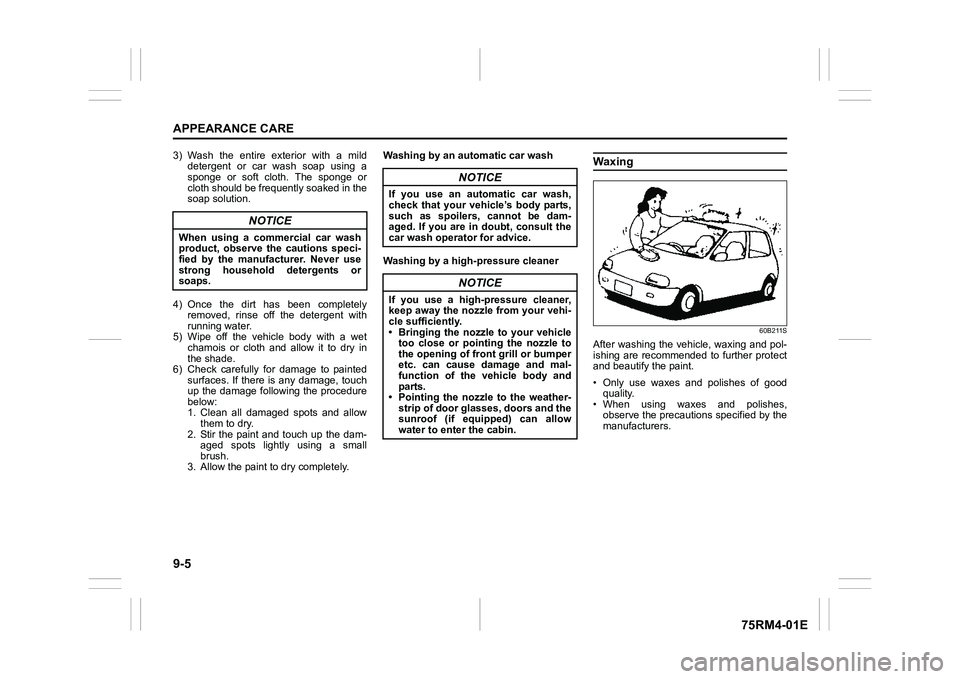
Waxing
60B211S
After washing the vehicle, waxing and pol-
ishing are recommended to further protect
and beautify the paint.
• Only use waxes and polishes of good
quality.
• When using waxes and polishes, observe the precautions specified by the
manufacturers.
NOTICE
When using a commercial car wash
product, observe the cautions speci-
fied by the manufacturer. Never use
strong household detergents or
soaps.
NOTICE
If you use an automatic car wash,
check that your vehicle’s body parts,
such as spoilers, cannot be dam-
aged. If you are in doubt, consult the
car wash operator for advice.
NOTICE
If you use a high-pressure cleaner,
keep away the nozzle from your vehi-
cle sufficiently.
• Bringing the nozzle to your vehicle
too close or pointing the nozzle to
the opening of front grill or bumper
etc. can cause damage and mal-
function of the vehicle body and
parts.
• Pointing the nozzle to the weather-
strip of door glasses, doors and the
sunroof (if equi pped) can allow
water to enter the cabin.
Page 436 of 505
11-4SPECIFICATIONS
75RM4-01E
*1 If you cannot prepare tires with the specified load index rate and speed symbol, prepare tires with higher load index rate a nd speed
symbol.
*2 If you prepare snow tires;
• Check that they are tires of the same size, structure and load capacity as the originally installed tires.
• Mount the snow tires on all four wheels.
• Understand that the maximum pe rmissible speed of snow tires is generally less than the originally installed tires.
Consult your SUZUKI dealer or su pplier for further information.
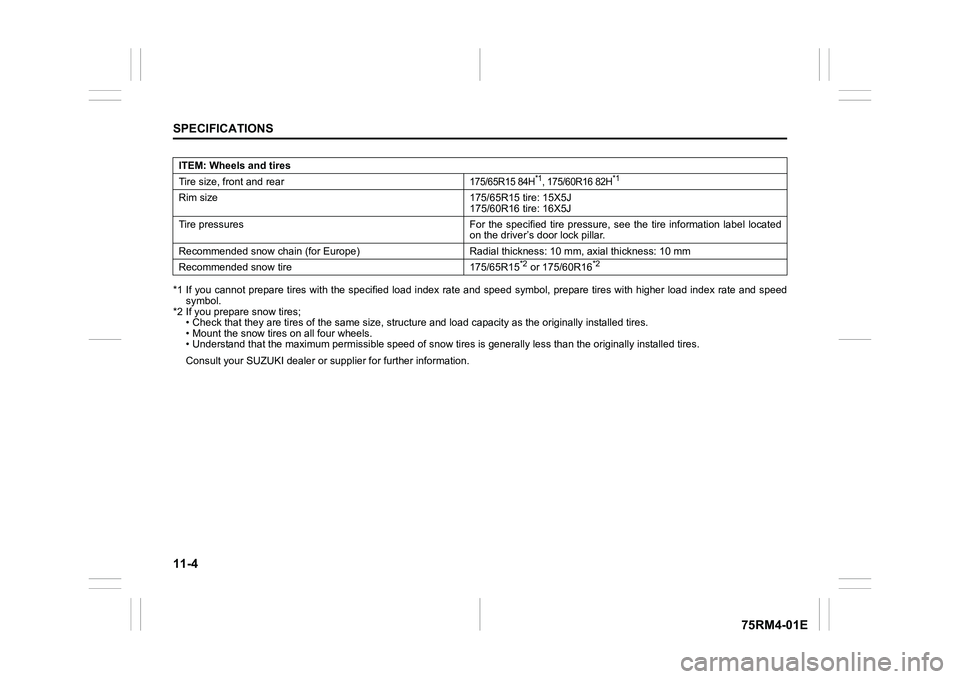
ITEM: Wheels and tires
Tire size, front and rear
175/65R15 84H
*1, 175/60R16 82H
*1
Rim size 175/65R15 tire: 15X5J
175/60R16 tire: 16X5J
Tire pressures For the specified tire pressure, see the tire information label located
on the driver’s door lock pillar.
Recommended snow chain (for Euro pe) Radial thickness: 10 mm, axi al thickness: 10 mm
Recommended snow tire 175/65R15
*2 or 175/60R16
*2
Page 437 of 505
11-5
SPECIFICATIONS
75RM4-01E
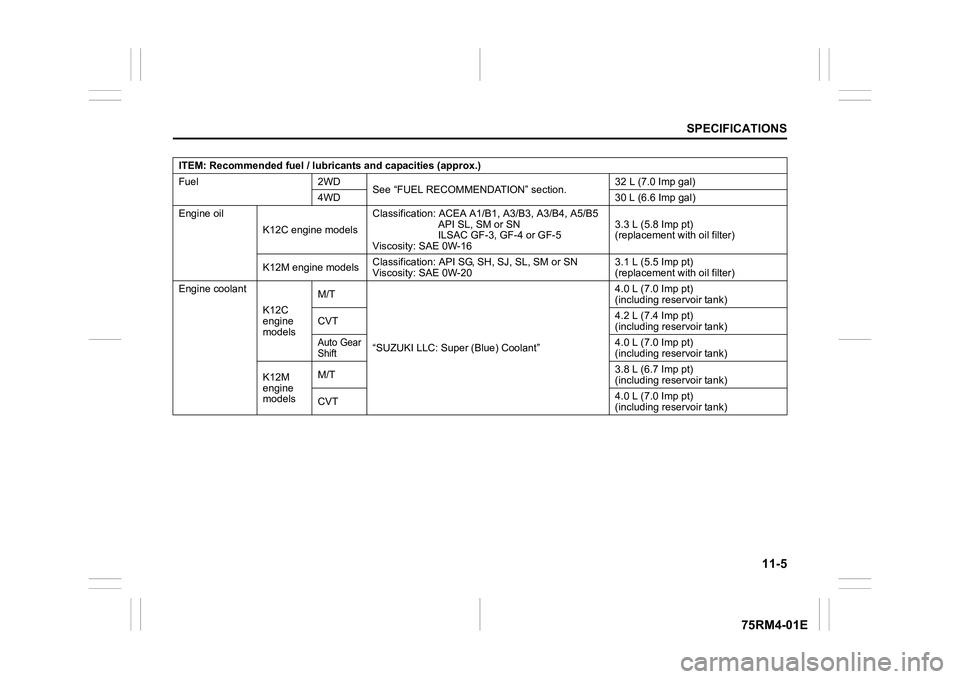
ITEM: Recommended fuel / lubricants and capacities (approx.)
Fuel 2WD See “FUEL RECOMMENDATION” section. 32 L (7.0 Imp gal)
4WD 30 L (6.6 Imp gal)
Engine oil
K12C engine models Classification: ACEA A1/B
1, A3/B3, A3/B4, A5/B5
API SL, SM or SN
ILSAC GF-3, GF-4 or GF-5
Viscosity: SAE 0W-16 3.3 L (5.8 Imp pt)
(replacement with oil filter)
K12M engine models Classification: API SG,
SH, SJ, SL, SM or SN
Viscosity: SAE 0W-20 3.1 L (5.5 Imp pt)
(replacement with oil filter)
Engine coolant
K12C
engine
modelsM/T
“SUZUKI LLC: Super (Blue) Coolant” 4.0 L (7.0 Imp pt)
(including reservoir tank)
CVT 4.2 L (7.4 Imp pt)
(including reservoir tank)
Auto Gear
Shift
4.0 L (7.0 Imp pt)
(including reservoir tank)
K12M
engine
models M/T
3.8 L (6.7 Imp pt)
(including reservoir tank)
CVT 4.0 L (7.0 Imp pt)
(including reservoir tank)
Page 438 of 505
11-6SPECIFICATIONS
75RM4-01E
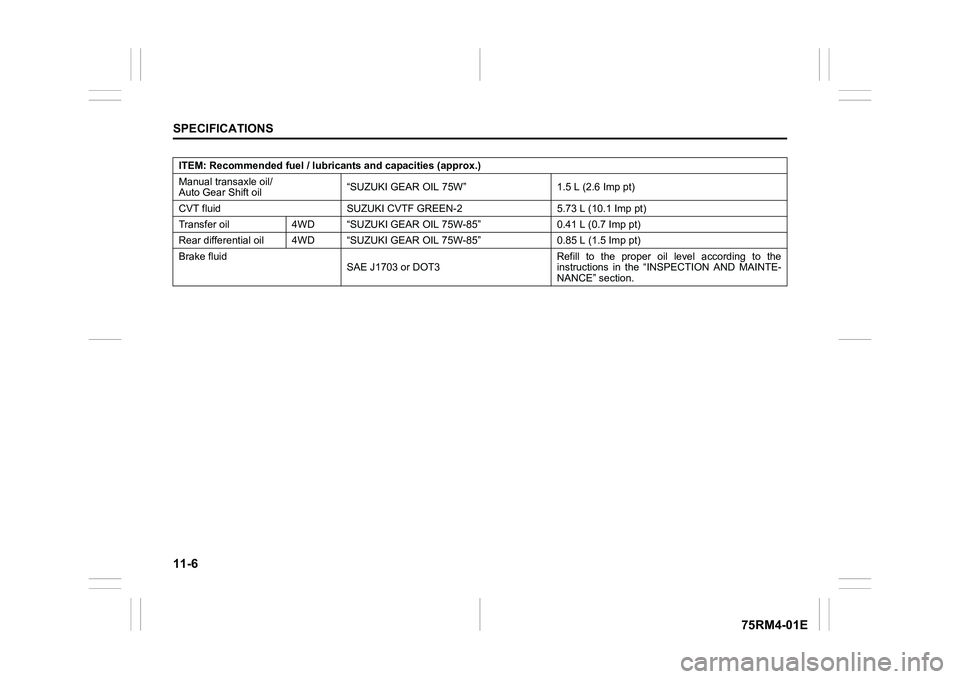
ITEM: Recommended fuel / lubricants and capacities (approx.)
Manual transaxle oil/
Auto Gear Shift oil “SUZUKI GEAR OIL 75W” 1.5 L (2.6 Imp pt)
CVT fluid SUZUKI CVTF GR EEN-2 5.73 L (10.1 Imp pt)
Transfer oil 4WD “SUZUKI GEAR OIL 75W-85” 0.41 L (0.7 Imp pt)
Rear differential oil 4WD “SUZUKI GEAR OIL 75W-85” 0.85 L (1.5 Imp pt)
Brake fluid SAE J1703 or DOT3 Refill to the proper oil level according to the
instructions in the “INSPECTION AND MAINTE-
NANCE” section.
Page 441 of 505
12-2
SUPPLEMENT
75RM4-01E
54P001207
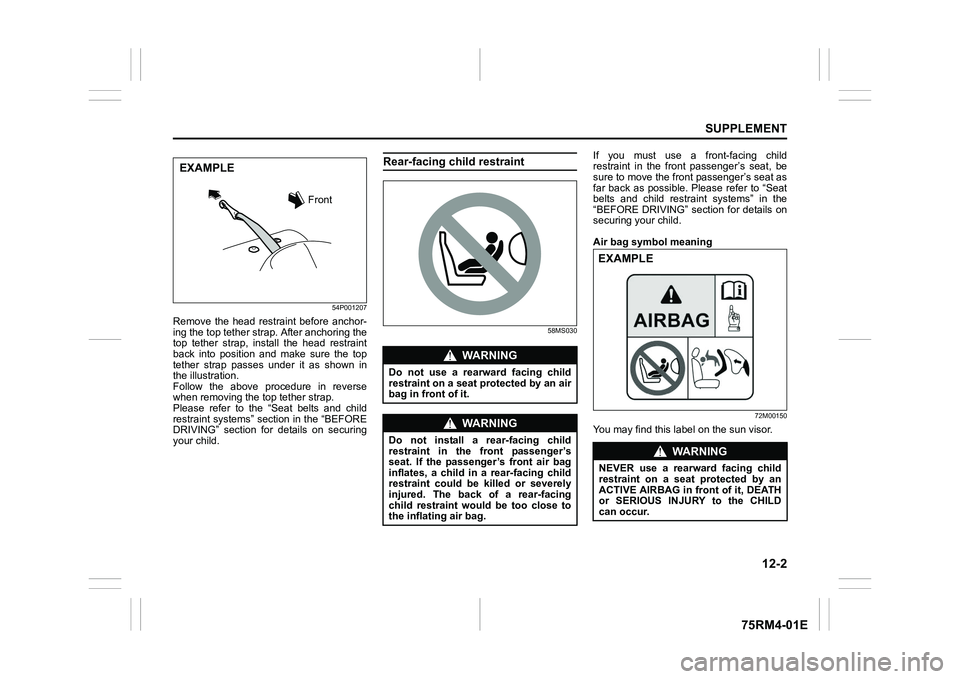
Remove the head restraint before anchor-
ing the top tether strap. After anchoring the
top tether strap, install the head restraint
back into position and make sure the top
tether strap passes under it as shown in
the illustration.
Follow the above procedure in reverse
when removing the top tether strap.
Please refer to the “Seat belts and child
restraint systems” section in the “BEFORE
DRIVING” section for details on securing
your child.
Rear-facing child restraint
58MS030
If you must use a front-facing child
restraint in the front passenger’s seat, be
sure to move the front passenger’s seat as
far back as possible. Please refer to “Seat
belts and child restraint systems” in the
“BEFORE DRIVING” section for details on
securing your child.
Air bag symbol meaning
72M00150
You may find this label on the sun visor.
Front
EXAMPLE
WA R N I N G
Do not use a rearward facing child
restraint on a seat protected by an air
bag in front of it.
WA R N I N G
Do not install a rear-facing child
restraint in the front passenger’s
seat. If the passenger’s front air bag
inflates, a child in a rear-facing child
restraint could be killed or severely
injured. The back of a rear-facing
child restraint would be too close to
the inflating air bag.
WA R N I N G
NEVER use a rearward facing child
restraint on a seat protected by an
ACTIVE AIRBAG in front of it, DEATH
or SERIOUS INJURY to the CHILD
can occur.EXAMPLE
Page 444 of 505
12-5SUPPLEMENT
75RM4-01E
For Chile and PanamaFuel recommendation
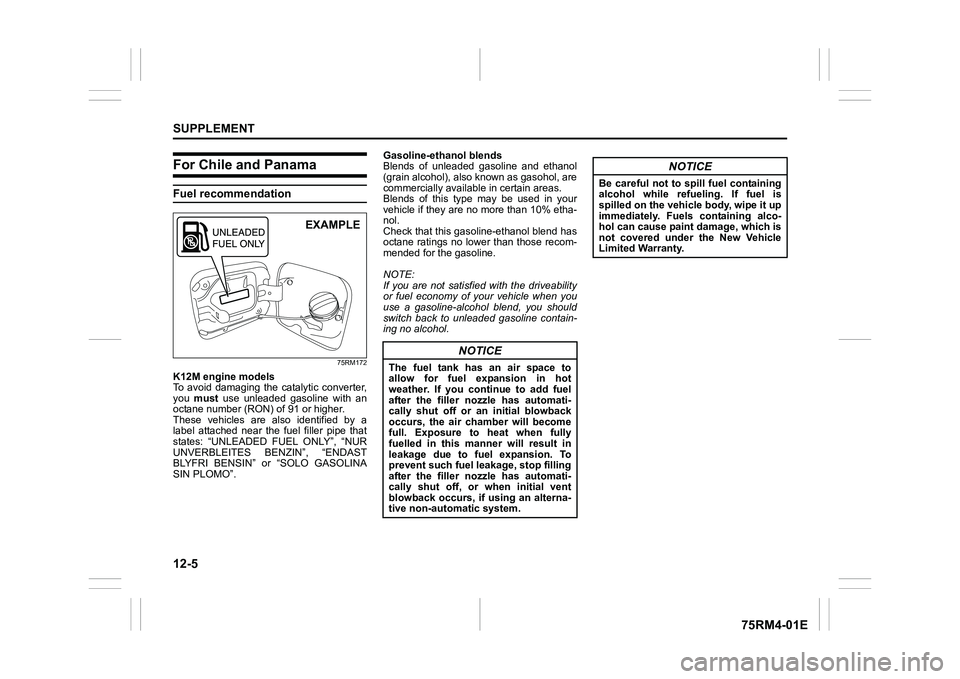
75RM172
K12M engine models
To avoid damaging the catalytic converter,
you must use unleaded gasoline with an
octane number (RON) of 91 or higher.
These vehicles are also identified by a
label attached near the fuel filler pipe that
states: “UNLEADED FUEL ONLY”, “NUR
UNVERBLEITES BENZIN”, “ENDAST
BLYFRI BENSIN” or “SOLO GASOLINA
SIN PLOMO”. Gasoline-ethanol blends
Blends of unleaded gasoline and ethanol
(grain alcohol), also known as gasohol, are
commercially available in certain areas.
Blends of this type may be used in your
vehicle if they are no more than 10% etha-
nol.
Check that this gasoline-ethanol blend has
octane ratings no lower than those recom-
mended for the gasoline.
NOTE:
If you are not satisfied with the driveability
or fuel economy of your vehicle when you
use a gasoline-alcohol blend, you should
switch back to unleaded gasoline contain-
ing no alcohol.
EXAMPLE
NOTICE
The fuel tank has an air space to
allow for fuel expansion in hot
weather. If you continue to add fuel
after the filler nozzle has automati-
cally shut off or an initial blowback
occurs, the air chamber will become
full. Exposure to heat when fully
fuelled in this manner will result in
leakage due to fuel expansion. To
prevent such fuel leakage, stop filling
after the filler nozzle has automati-
cally shut off, or when initial vent
blowback occurs, if using an alterna-
tive non-automatic system.
NOTICE
Be careful not to spill fuel containing
alcohol while refueling. If fuel is
spilled on the vehicle body, wipe it up
immediately. Fuels containing alco-
hol can cause paint damage, which is
not covered under the New Vehicle
Limited Warranty.
Page 445 of 505
12-6
SUPPLEMENT
75RM4-01E
For MexicoFuel recommendation
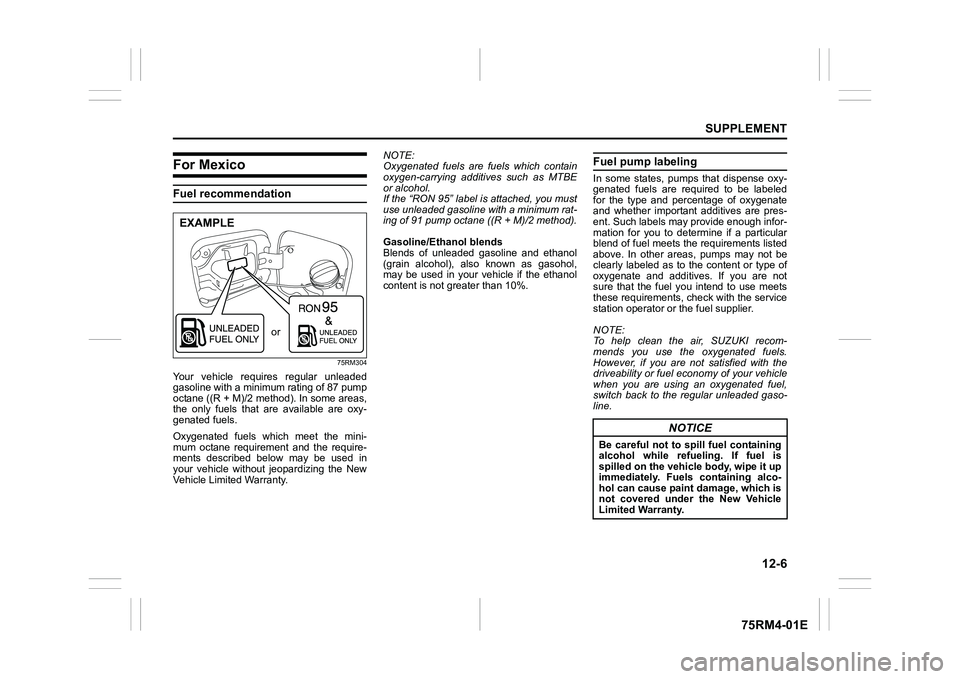
75RM304
Your vehicle requires regular unleaded
gasoline with a minimum rating of 87 pump
octane ((R + M)/2 method). In some areas,
the only fuels that are available are oxy-
genated fuels.
Oxygenated fuels which meet the mini-
mum octane requirement and the require-
ments described below may be used in
your vehicle without jeopardizing the New
Vehicle Limited Warranty. NOTE:
Oxygenated fuels are fuels which contain
oxygen-carrying additives such as MTBE
or alcohol.
If the “RON 95” label is attached, you must
use unleaded gasoline with a minimum rat-
ing of 91 pump octane ((R + M)/2 method).
Gasoline/Ethanol blends
Blends of unleaded gasoline and ethanol
(grain alcohol), also known as gasohol,
may be used in your vehicle if the ethanol
content is not gr
eater than 10%.
Fuel pump labelingIn some states, pumps that dispense oxy-
genated fuels are required to be labeled
for the type and percentage of oxygenate
and whether important additives are pres-
ent. Such labels may provide enough infor-
mation for you to determine if a particular
blend of fuel meets the requirements listed
above. In other areas, pumps may not be
clearly labeled as to the content or type of
oxygenate and additives. If you are not
sure that the fuel you intend to use meets
these requirements, check with the service
station operator or the fuel supplier.
NOTE:
To help clean the air, SUZUKI recom-
mends you use the oxygenated fuels.
However, if you are not satisfied with the
driveability or fuel economy of your vehicle
when you are using an oxygenated fuel,
switch back to the regular unleaded gaso-
line.
or
EXAMPLE
NOTICE
Be careful not to spill fuel containing
alcohol while refueling. If fuel is
spilled on the vehicle body, wipe it up
immediately. Fuels containing alco-
hol can cause paint damage, which is
not covered under the New Vehicle
Limited Warranty.
Page 446 of 505
12-7SUPPLEMENT
75RM4-01E
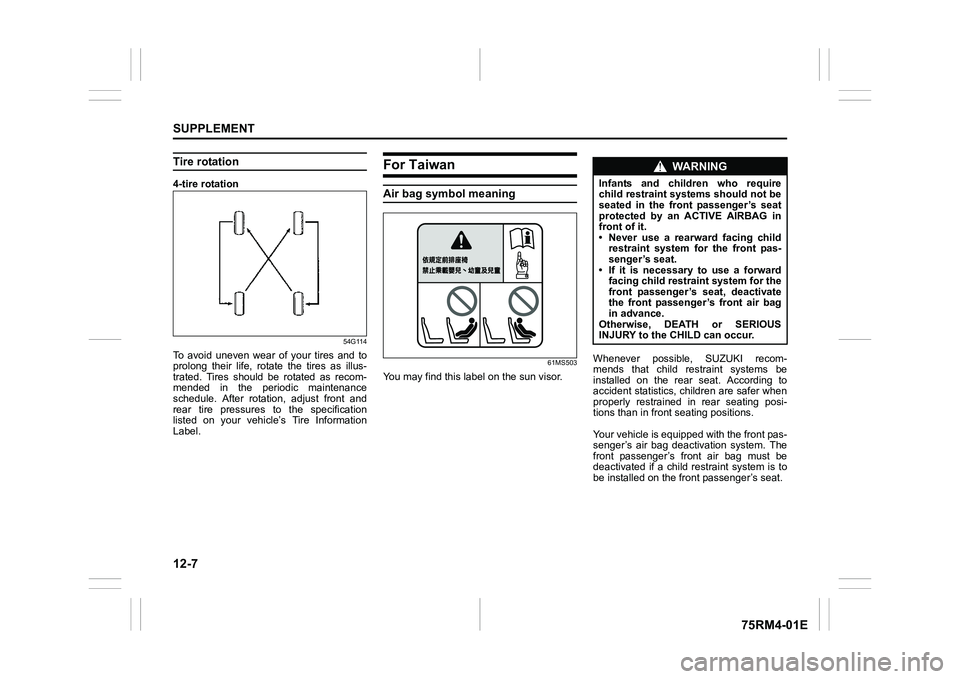
Tire rotation4-tire rotation
54G114
To avoid uneven wear of your tires and to
prolong their life, rotate the tires as illus-
trated. Tires should be rotated as recom-
mended in the periodic maintenance
schedule. After rotation, adjust front and
rear tire pressures to the specification
listed on your vehicle’s Tire Information
Label.
For TaiwanAir bag symbol meaning
61MS503
You may find this label on the sun visor.Whenever possible, SUZUKI recom-
mends that child restraint systems be
installed on the rear seat. According to
accident statistics, children are safer when
properly restrained in rear seating posi-
tions than in front seating positions.
Your vehicle is equipped with the front pas-
senger’s air bag deactivation system. The
front passenger’s front air bag must be
deactivated if a child restraint system is to
be installed on the fr
ont passenger’s seat.
WA R N I N G
Infants and children who require
child restraint systems should not be
seated in the front passenger’s seat
protected by an ACTIVE AIRBAG in
front of it.
• Never use a rearward facing child
restraint system for the front pas-
senger’s seat.
• If it is necessary to use a forward facing child restraint system for the
front passenger’s seat, deactivate
the front passenger’s front air bag
in advance.
Otherwise, DEATH or SERIOUS
INJURY to the CHILD can occur.