CAN SUZUKI IGNIS 2018 Owners Manual
[x] Cancel search | Manufacturer: SUZUKI, Model Year: 2018, Model line: IGNIS, Model: SUZUKI IGNIS 2018Pages: 505, PDF Size: 8.36 MB
Page 372 of 505
7-23INSPECTION AND MAINTENANCE
75RM4-01E
Drive beltCheck that the drive belt tension is correct.
If the belt is too loose, insufficient battery
charging, engine overheating, poor power
steering, poor air conditioning, or exces-
sive belt wear can result. When you press
the belt with your thumb midway between
the pulleys, there should be a deflection
according to the following chart.
The belts should also be examined to
ensure that they are not damaged.
If you need to replace or adjust the belt
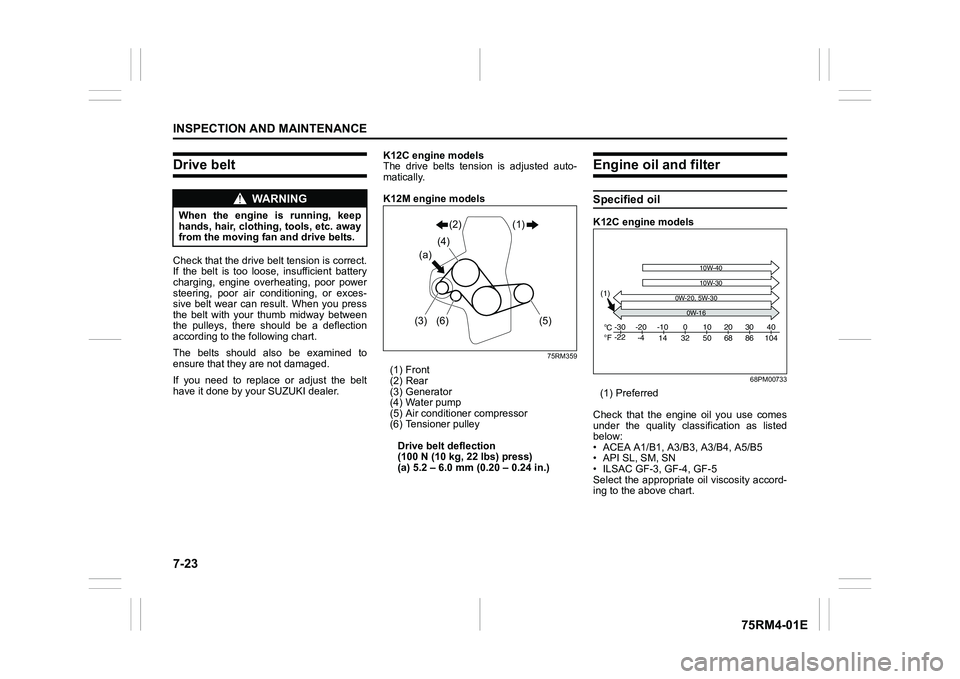
have it done by your SUZUKI dealer.K12C engine models
The drive belts tension is adjusted auto-
matically.
K12M engine models
75RM359
(1) Front
(2) Rear
(3) Generator
(4) Water pump
(5) Air conditioner compressor
(6) Tensioner pulley
Drive belt deflection
(100 N (10 kg, 22 lbs) press)
(a) 5.2 – 6.0 mm (0.20 – 0.24 in.)
Engine oil and filterSpecified oil K12C engine models
68PM00733
(1) Preferred
Check that the engine oil you use comes
under the quality classification as listed
below:
• ACEA A1/B1, A3/ B3, A3/B4, A5/B5
• API SL, SM, SN
• ILSAC GF-3, GF-4, GF-5
Select the appropriate oil viscosity accord-
ing to the above chart.
WA R N I N G
When the engine is running, keep
hands, hair, clothing, tools, etc. away
from the moving fan and drive belts.
(a) (4)(2) (1)
(3) (6) (5)
C Fo
o-30
-22
-20
10W-40
-4-10
14 32 50 68 86 104 010203040
10W-30
(1)
0W-20, 5W-30
0W-16
Page 375 of 505
7-26
INSPECTION AND MAINTENANCE
75RM4-01E
60G306
Tightening torque for drain plug:
35 Nm (3.6 kg-m, 25.8 lb-ft)4) Reinstall the drain plug with new gas-
ket. Tighten the plug with a wrench to
the specif ied torque.
NOTE:
(For models with oil change request light)
• Whenever the engine oil is changed, the oil life monitoring must be reset to moni-
tor the next oil change timing properly.
To reset the light, consult your SUZUKI
dealer. If you reset it by yourself, refer to
“Setting mode” in “Inf ormation display” in
the “BEFORE DRIVING” section.
• For more information of the oil change request light and oil life monitoring, refer
to “Oil change request light” in the
“BEFORE DRIVING” section.
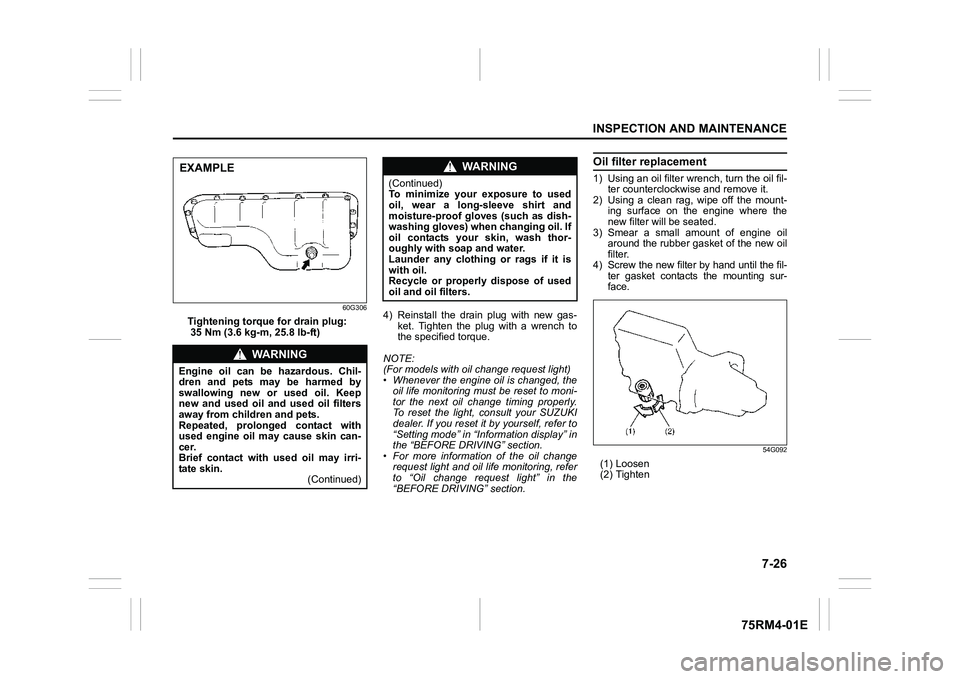
Oil filter replacement1) Using an oil filter wr ench, turn the oil fil-
ter counterclockwise and remove it.
2) Using a clean rag, wipe off the mount- ing surface on the engine where the
new filter will be seated.
3) Smear a small amount of engine oil around the rubber gasket of the new oil
filter.
4) Screw the new filter by hand until the fil- ter gasket contacts the mounting sur-
face.
54G092
(1) Loosen
(2) Tighten
WA R N I N G
Engine oil can be hazardous. Chil-
dren and pets may be harmed by
swallowing new or used oil. Keep
new and used oil and used oil filters
away from children and pets.
Repeated, prolonged contact with
used engine oil may cause skin can-
cer.
Brief contact with used oil may irri-
tate skin. (Continued)EXAMPLE
WA R N I N G
(Continued)
To minimize your exposure to used
oil, wear a long-sleeve shirt and
moisture-proof gloves (such as dish-
washing gloves) when changing oil. If
oil contacts your skin, wash thor-
oughly with soap and water.
Launder any clothing or rags if it is
with oil.
Recycle or properly dispose of used
oil and oil filters.
Page 377 of 505
7-28
INSPECTION AND MAINTENANCE
75RM4-01E
Engine coolantSelection of coolantTo maintain optimum performance and
durability of your engine, use SUZUKI gen-
uine coolant or equivalent.
NOTE:
If you use the engine coolant other than
the SUZUKI LLC: Super (Blue) for replace-
ment, follow the schedule of SUZUKI LLC:
Standard (Green). To see the detail of the
maintenance schedule, refer to “Periodic
maintenance schedule” in this section.
This type of coolant is the best for cooling
system for the following reasons:
• The coolant helps maintain properengine temperature.
• It gives proper protection against freez- ing and boiling.
• It gives proper protection against corro- sion and rust. Failure to use the proper coolant can dam-
age your cooling system. Your authorized
SUZUKI dealer can help you select the
proper coolant.
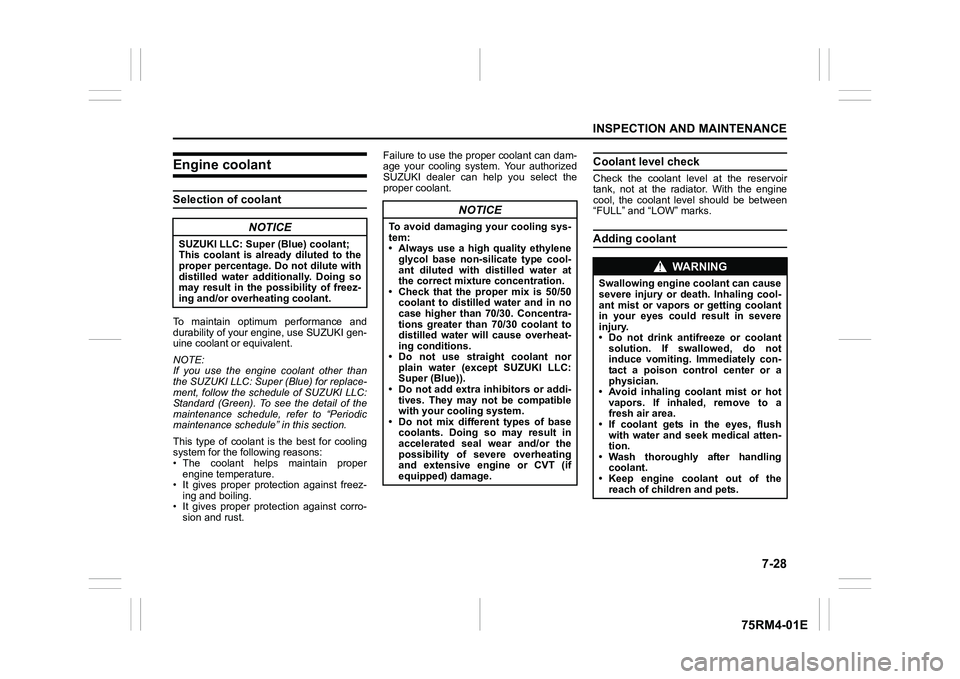
Coolant level checkCheck the coolant le
vel at the reservoir
tank, not at the radiator. With the engine
cool, the coolant level should be between
“FULL” and “LOW” marks.Adding coolant
NOTICE
SUZUKI LLC: Super (Blue) coolant;
This coolant is already diluted to the
proper percentage. Do not dilute with
distilled water additionally. Doing so
may result in the possibility of freez-
ing and/or overheating coolant.
NOTICE
To avoid damaging your cooling sys-
tem:
• Always use a high quality ethylene
glycol base non-silicate type cool-
ant diluted with distilled water at
the correct mixture concentration.
• Check that the proper mix is 50/50
coolant to distill ed water and in no
case higher than 70/30. Concentra-
tions greater than 70/30 coolant to
distilled water will cause overheat-
ing conditions.
• Do not use straight coolant nor plain water (except SUZUKI LLC:
Super (Blue)).
• Do not add extra inhibitors or addi- tives. They may not be compatible
with your cooling system.
• Do not mix different types of base coolants. Doing so may result in
accelerated seal wear and/or the
possibility of severe overheating
and extensive engine or CVT (if
equipped) damage.
WA R N I N G
Swallowing engine coolant can cause
severe injury or death. Inhaling cool-
ant mist or vapors or getting coolant
in your eyes could result in severe
injury.
• Do not drink antifreeze or coolantsolution. If swallowed, do not
induce vomiting. Immediately con-
tact a poison control center or a
physician.
• Avoid inhaling coolant mist or hot
vapors. If inhaled, remove to a
fresh air area.
• If coolant gets in the eyes, flush
with water and seek medical atten-
tion.
• Wash thoroughly after handling
coolant.
• Keep engine coolant out of the
reach of children and pets.
Page 378 of 505
7-29INSPECTION AND MAINTENANCE
75RM4-01E
81PN200
If the coolant level is below “LOW” mark,
more coolant should be added. Remove
the reservoir tank cap and add coolant until
the reservoir tank level reaches “FULL”
mark. Never fill the reservoir tank above
“FULL” mark.Coolant replacementSince special procedures are required, ask
your authorized SUZUKI dealer for this job.
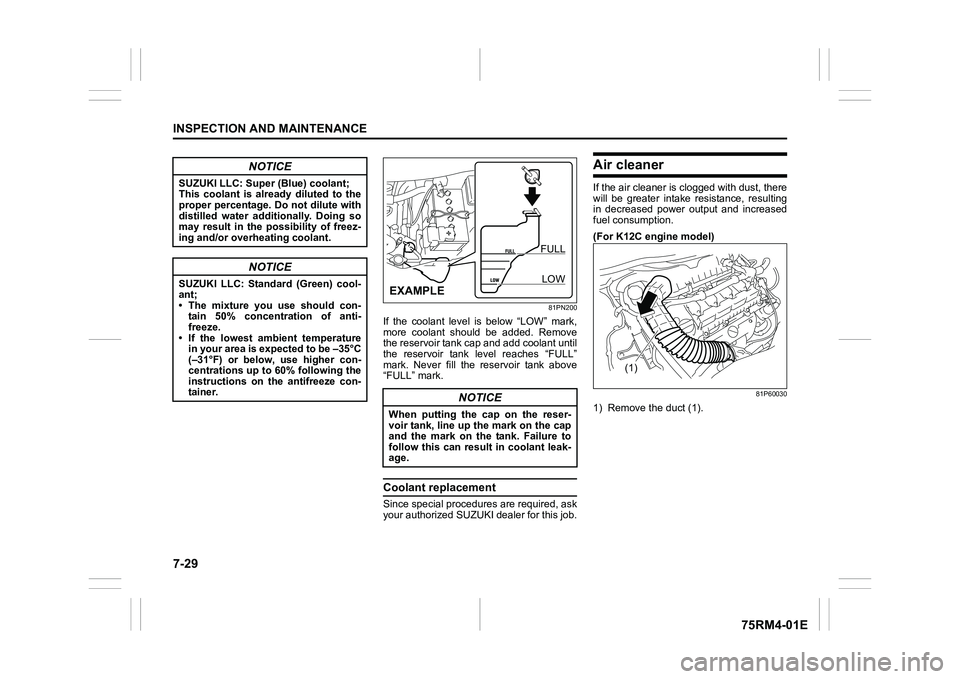
Air cleanerIf the air cleaner is clogged with dust, there
will be greater intake resistance, resulting
in decreased power output and increased
fuel consumption.
(For K12C engine model)
81P60030
1) Remove the duct (1).
NOTICE
SUZUKI LLC: Super (Blue) coolant;
This coolant is already diluted to the
proper percentage. Do not dilute with
distilled water additionally. Doing so
may result in the possibility of freez-
ing and/or overheating coolant.
NOTICE
SUZUKI LLC: Standard (Green) cool-
ant;
• The mixture you use should con-tain 50% concentration of anti-
freeze.
• If the lowest ambient temperature in your area is expected to be –35°C
(–31°F) or below, use higher con-
centrations up to 60% following the
instructions on the antifreeze con-
tainer.
NOTICE
When putting the cap on the reser-
voir tank, line up the mark on the cap
and the mark on the tank. Failure to
follow this can result in coolant leak-
age.
FULL
LOW
(ΟΝ03/(
(1)
Page 380 of 505
7-31INSPECTION AND MAINTENANCE
75RM4-01E
Spark plugsSpark plug replacement and inspec-tion(For K12C engine model)
81PN235
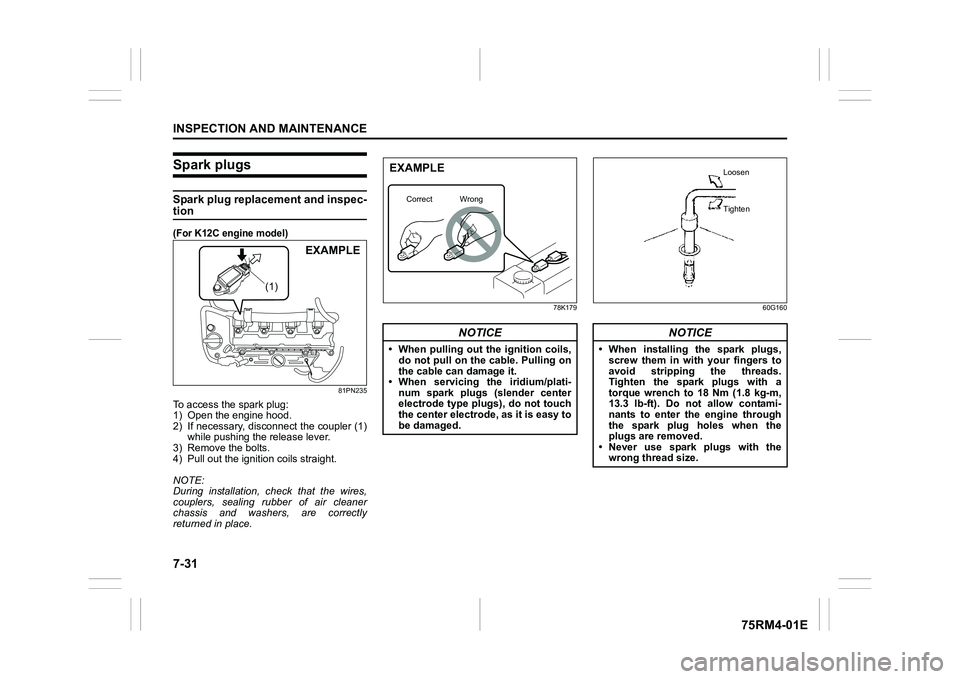
To access the spark plug:
1) Open the engine hood.
2) If necessary, disconnect the coupler (1)while pushing the release lever.
3) Remove the bolts.
4) Pull out the ignition coils straight.
NOTE:
During installation, check that the wires,
couplers, sealing rubber of air cleaner
chassis and washers, are correctly
returned in place.
78K179 60G160
(1)
EXAMPLE
NOTICE
• When pulling out the ignition coils,
do not pull on the cable. Pulling on
the cable can damage it.
• When servicing the iridium/plati-
num spark plugs (slender center
electrode type plu gs), do not touch
the center electrode, as it is easy to
be damaged.EXAMPLE
Correct Wrong
NOTICE
• When installing the spark plugs,
screw them in with your fingers to
avoid stripping the threads.
Tighten the spark plugs with a
torque wrench to 18 Nm (1.8 kg-m,
13.3 lb-ft). Do not allow contami-
nants to enter the engine through
the spark plug holes when the
plugs are removed.
• Never use spark plugs with the
wrong thread size.
Loosen
Tighten
Page 381 of 505
7-32
INSPECTION AND MAINTENANCE
75RM4-01E
54G106
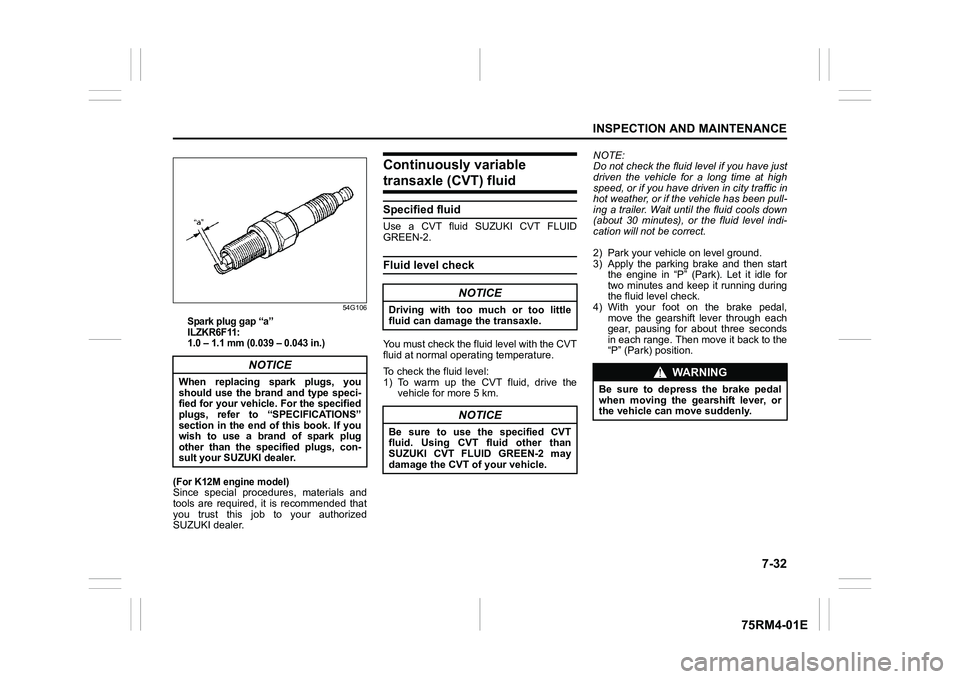
Spark plug gap “a”
ILZKR6F11:
1.0 – 1.1 mm (0.039 – 0.043 in.)
(For K12M engine model)
Since special procedures, materials and
tools are required, it is recommended that
you trust this job to your authorized
SUZUKI dealer.
Continuously variable transaxle (CVT) fluidSpecified fluidUse a CVT fluid SUZUKI CVT FLUID
GREEN-2.Fluid level checkYou must check the fluid level with the CVT
fluid at normal ope rating temperature.
To check the fluid level:
1) To warm up the CVT fluid, drive the vehicle for more 5 km. NOTE:
Do not check the fluid level if you have just
driven the vehicle for a long time at high
speed, or if you have driven in city traffic in
hot weather, or if the vehicle has been pull-
ing a trailer. Wait until the fluid cools down
(about 30 minutes), or the fluid level indi-
cation will not be correct.
2) Park your vehicle on level ground.
3) Apply the parking brake and then start
the engine in “P” (Park). Let it idle for
two minutes and keep it running during
the fluid level check.
4) With your foot on the brake pedal,
move the gearshift lever through each
gear, pausing for about three seconds
in each range. Then move it back to the
“P” (Park) position.
NOTICE
When replacing spark plugs, you
should use the brand and type speci-
fied for your vehicle. For the specified
plugs, refer to “SPECIFICATIONS”
section in the end of this book. If you
wish to use a brand of spark plug
other than the specified plugs, con-
sult your SUZUKI dealer.
NOTICE
Driving with too much or too little
fluid can damage the transaxle.
NOTICE
Be sure to use the specified CVT
fluid. Using CVT fluid other than
SUZUKI CVT FLUID GREEN-2 may
damage the CVT of your vehicle.
WA R N I N G
Be sure to depress the brake pedal
when moving the gearshift lever, or
the vehicle can move suddenly.
Page 385 of 505

7-36
INSPECTION AND MAINTENANCE
75RM4-01E
Clutch pedalCable control clutch
54G274
Clutch pedal play “d”:
10 – 15 mm (0.4 – 0.6 in.)
Measure the clutch pedal play by moving
the clutch pedal with your hand and mea-
suring the distance it moves until you feel
slight resistance. The play in the clutch
pedal should be between the specified val-
ues. If the play is more or less than the
above, or clutch dragging is felt with the
pedal fully depressed, have the clutch
inspected by your SUZUKI dealer.
BrakesBrake fluid
75RM095
Check the brake fluid level by looking at
the reservoir in the engine compartment.
Check that the fluid level is between “MAX”
and “MIN” lines.
EXAMPLE
NOTICE
If your brake fluid level is near the
“MIN” line, there is a possibility of
brake pad and/or shoe wear and brake
fluid leakage.
Consult with your authorized SUZUKI
dealer regarding this possibility
before filling the reservoir.
WA R N I N G
Failure to follow the guidelines below
can result in personal injury or seri-
ous damage to the brake system.
• If the brake fluid in the reservoir drops below a certain level, the
brake warning light on the instru-
ment cluster will come on (the
engine must be running with the
parking brake fully disengaged).
Should the light come on, immedi-
ately ask your SUZUKI dealer to
inspect the brake system.
• A rapid fluid loss indicates leakage
in the brake system which should
be inspected by your SUZUKI
dealer immediately.
• Do not use any fluid other than SAE J1703 or DOT3 brake fluid. Do not
use reclaimed fluid or fluid that has
been stored in old or open contain-
ers. It is essential that foreign parti-
cles and other liquids are kept out
of the brake fluid reservoir.
CAUTION
Brake fluid can harm your eyes and
damage painted surfaces. Be careful
when refilling the reservoir.
Page 386 of 505
7-37INSPECTION AND MAINTENANCE
75RM4-01E
NOTE:
• The fluid level can be expected to gradu-ally fall as the brake pad and/or shoe
wear.
• Brake fluid absorbs water over time and
brake fluid with high water content may
cause vapor lock or brake system mal-
function.
Replace your brake fluid in accordance
with the maintenance schedule in your
Owner’s Manual.Brake pedalCheck brake pedal stroke. If the stroke is
so large, have the brake system inspected
by your SUZUKI dealer. If you doubt the
brake pedal is at its normal height, check it
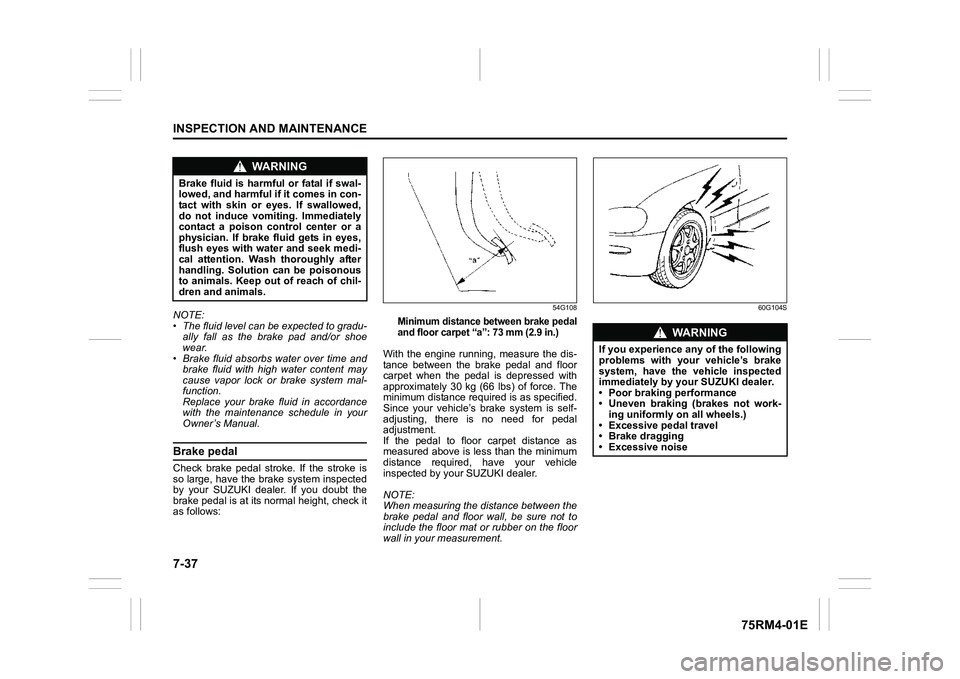
as follows:
54G108
Minimum distance between brake pedal
and floor carpet “a”: 73 mm (2.9 in.)
With the engine running, measure the dis-
tance between the brake pedal and floor
carpet when the pedal is depressed with
approximately 30 kg (66 lbs) of force. The
minimum distance required is as specified.
Since your vehicle’s brake system is self-
adjusting, there is no need for pedal
adjustment.
If the pedal to floor carpet distance as
measured above is less than the minimum
distance required, have your vehicle
inspected by your SUZUKI dealer.
NOTE:
When measuring the distance between the
brake pedal and floor wall, be sure not to
include the floor mat or rubber on the floor
wall in your measurement.
60G104S
WA R N I N G
Brake fluid is harmful or fatal if swal-
lowed, and harmful if it comes in con-
tact with skin or eyes. If swallowed,
do not induce vomiting. Immediately
contact a poison control center or a
physician. If brake fluid gets in eyes,
flush eyes with water and seek medi-
cal attention. Wash thoroughly after
handling. Solution can be poisonous
to animals. Keep out of reach of chil-
dren and animals.
WA R N I N G
If you experience any of the following
problems with your vehicle’s brake
system, have the vehicle inspected
immediately by your SUZUKI dealer.
• Poor braking performance
• Uneven braking (brakes not work- ing uniformly on all wheels.)
• Excessive pedal travel
• Brake dragging
• Excessive noise
Page 388 of 505
7-39INSPECTION AND MAINTENANCE
75RM4-01E
Tires
80JS025
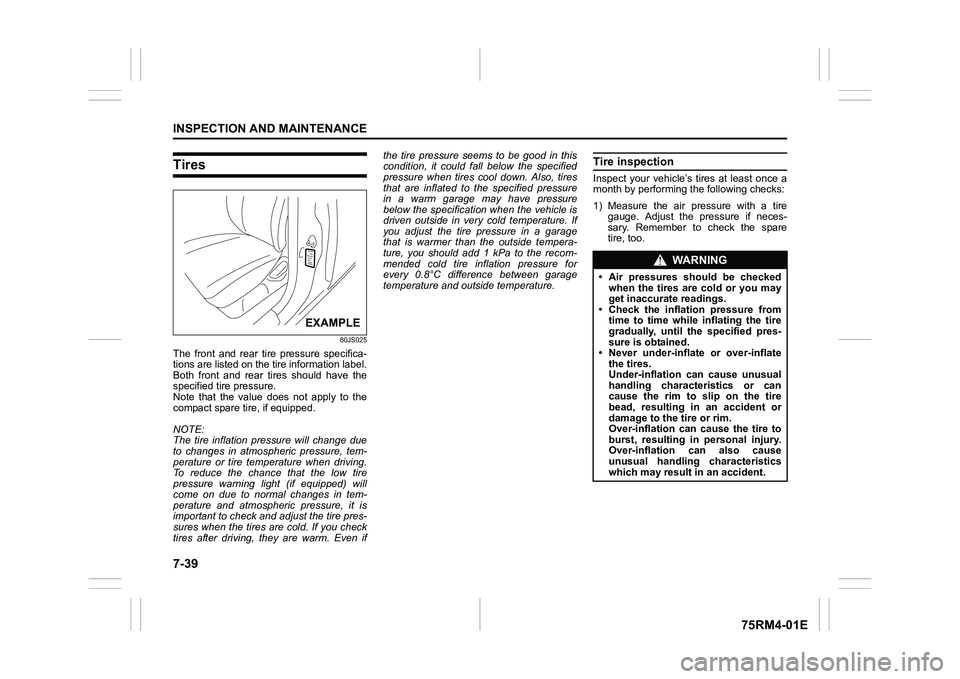
The front and rear tire pressure specifica-
tions are listed on the tire information label.
Both front and rear tires should have the
specified tire pressure.
Note that the value does not apply to the
compact spare tire, if equipped.
NOTE:
The tire inflation pressure will change due
to changes in atmospheric pressure, tem-
perature or tire temperature when driving.
To reduce the chance that the low tire
pressure warning light (if equipped) will
come on due to normal changes in tem-
perature and atmospheric pressure, it is
important to check and adjust the tire pres-
sures when the tires are cold. If you check
tires after driving, they are warm. Even ifthe tire pressure seems to be good in this
condition, it could fall below the specified
pressure when tires co
ol down. Also, tires
that are inflated to the specified pressure
in a warm garage may have pressure
below the specification when the vehicle is
driven outside in very cold temperature. If
you adjust the tire pressure in a garage
that is warmer than the outside tempera-
ture, you should add 1 kPa to the recom-
mended cold tire inflation pressure for
every 0.8°C difference between garage
temperature and outside temperature.
Tire inspectionInspect your vehicle’s tires at least once a
month by performing the following checks:
1) Measure the air pressure with a tire gauge. Adjust the pressure if neces-
sary. Remember to check the spare
tire, too.
EXAMPLE
WA R N I N G
• Air pressures should be checkedwhen the tires are cold or you may
get inaccurate readings.
• Check the inflation pressure from time to time while inflating the tire
gradually, until the specified pres-
sure is obtained.
• Never under-inflate or over-inflate the tires.
Under-inflation can cause unusual
handling characteristics or can
cause the rim to slip on the tire
bead, resulting in an accident or
damage to the tire or rim.
Over-inflation can cause the tire to
burst, resulting in personal injury.
Over-inflation c an also cause
unusual handling characteristics
which may result in an accident.
Page 389 of 505
7-40
INSPECTION AND MAINTENANCE
75RM4-01E
52KM110
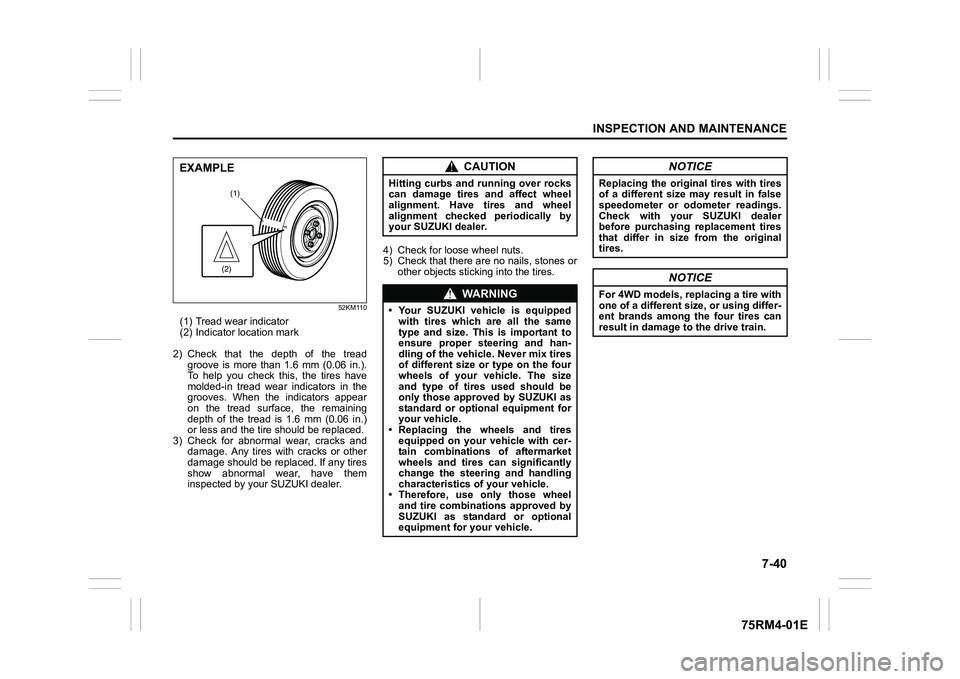
(1) Tread wear indicator
(2) Indicator location mark
2) Check that the depth of the tread groove is more than 1.6 mm (0.06 in.).
To help you check this, the tires have
molded-in tread wear indicators in the
grooves. When the indicators appear
on the tread surface, the remaining
depth of the tread is 1.6 mm (0.06 in.)
or less and the tire should be replaced.
3) Check for abnormal wear, cracks and damage. Any tires with cracks or other
damage should be replaced. If any tires
show abnormal wear, have them
inspected by your SUZUKI dealer. 4) Check for loose wheel nuts.
5) Check that there are no nails, stones or
other objects sticki ng into the tires.
(1)(2)
EXAMPLE
CAUTION
Hitting curbs and running over rocks
can damage tires and affect wheel
alignment. Have tires and wheel
alignment checked periodically by
your SUZUKI dealer.
WA R N I N G
• Your SUZUKI vehicle is equipped
with tires which are all the same
type and size. This is important to
ensure proper steering and han-
dling of the vehicle. Never mix tires
of different size or type on the four
wheels of your vehicle. The size
and type of tires used should be
only those approved by SUZUKI as
standard or optional equipment for
your vehicle.
• Replacing the wheels and tires
equipped on your vehicle with cer-
tain combinations of aftermarket
wheels and tires can significantly
change the steering and handling
characteristics of your vehicle.
• Therefore, use only those wheel
and tire combinations approved by
SUZUKI as standard or optional
equipment for your vehicle.
NOTICE
Replacing the original tires with tires
of a different size may result in false
speedometer or odometer readings.
Check with your SUZUKI dealer
before purchasing replacement tires
that differ in size from the original
tires.
NOTICE
For 4WD models, replacing a tire with
one of a different size, or using differ-
ent brands among the four tires can
result in damage to the drive train.