temperature SUZUKI IGNIS 2021 Service Manual
[x] Cancel search | Manufacturer: SUZUKI, Model Year: 2021, Model line: IGNIS, Model: SUZUKI IGNIS 2021Pages: 505, PDF Size: 8.36 MB
Page 346 of 505
6-5VEHICLE LOADING AND TOWING
75RM4-01E
60A186
WA R N I N G
(Continued)
• Be careful when overtaking othervehicles. Allow enough room for
your trailer before changing lanes,
and use turn signal lights properly
in advance.
• Slow down and shift into a lower gear before you reach long or steep
downhill grades. It is hazardous to
attempt downshifting while you are
descending a hill.
• Do not step on the brake pedal strongly. This could cause the
brakes to over-heat resulting in
reduced braking efficiency. Use
engine braking as much as possi-
ble.
• Because of the added trailer weight, your engine may overheat
on hot days when going up long or
steep hills. Pay attention to your
engine temperature. If the high
engine coolant temperature warn-
ing light (red color) indicates over-
heating, pull off the road and stop
the vehicle in a safe place. Refer to
“Engine trouble: Overheating” in
the “EMERGENCY SERVICE” sec-
tion.
WA R N I N G
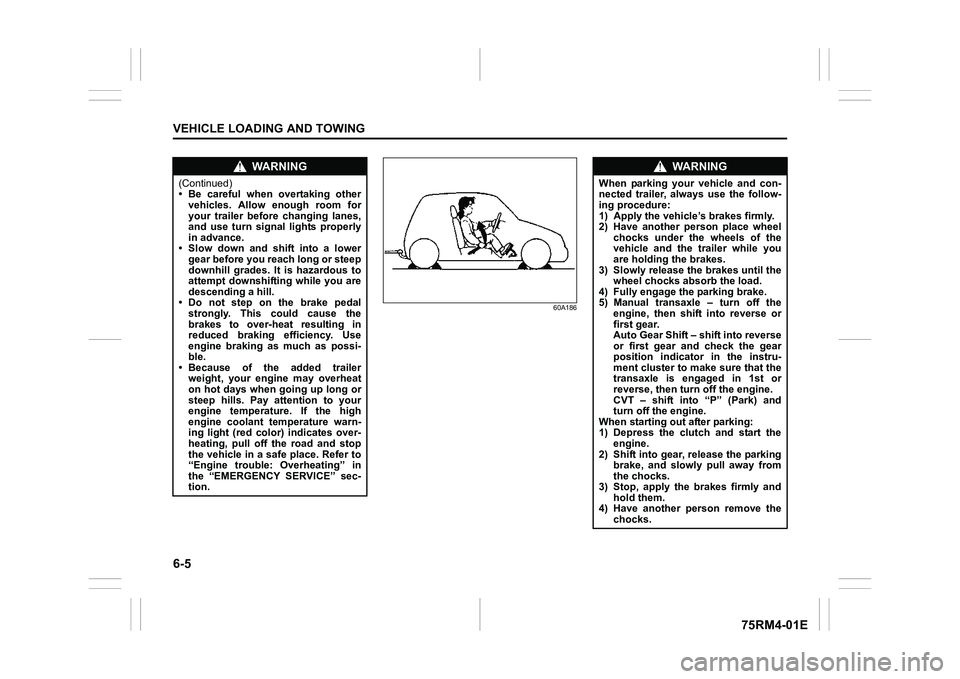
When parking your vehicle and con-
nected trailer, always use the follow-
ing procedure:
1) Apply the vehicle’s brakes firmly.
2) Have another person place wheel
chocks under the wheels of the
vehicle and the trailer while you
are holding the brakes.
3) Slowly release the brakes until the wheel chocks absorb the load.
4) Fully engage the parking brake.
5) Manual transaxle – turn off the engine, then shift into reverse or
first gear.
Auto Gear Shift – shift into reverse
or first gear and check the gear
position indicator in the instru-
ment cluster to make sure that the
transaxle is engaged in 1st or
reverse, then turn off the engine.
CVT – shift into “P” (Park) and
turn off the engine.
When starting out after parking:
1) Depress the clutch and start the engine.
2) Shift into gear, release the parking brake, and slowly pull away from
the chocks.
3) Stop, apply the brakes firmly and hold them.
4) Have another person remove the
chocks.
Page 357 of 505
7-8
INSPECTION AND MAINTENANCE
75RM4-01E
Maintenance recommended under severe driving conditions (except for EU countries and Israel)Follow this schedule if your vehicle is mainly operated under o ne or more of the following conditions:
• When most trips are le ss than 6 km (4 miles).
• When most trips are less than 16 km (10 miles) and outside temperature remains below freezing.
• Idling and/or low-speed operat ion in stop-and-go traffic.
• Operating in extremely cold we ather and/or on salted roads.
• Operating in rough and/or muddy areas.
• Operating in dusty areas.
• Repeated high speed drive or high engine revolutions.
• Towing a trailer, if admitted.
Schedule should also be followed if the vehicle is used for del ivery service, police, taxi or other commercial applications.
NOTE:
• Class 1: K12C engine
• Class 2: K12M engine
Page 367 of 505
7-18
INSPECTION AND MAINTENANCE
75RM4-01E
Maintenance recommended under severe driving conditions (for EU countries and Israel)Follow this schedule if your vehicle is mainly operated under o ne or more of the following conditions:
• When most trips are le ss than 6 km (4 miles).
• When most trips are less than 16 km (10 miles) and outside temperature remains below freezing.
• Idling and/or low-speed operat ion in stop-and-go traffic.
• Operating in extremely cold we ather and/or on salted roads.
• Operating in rough and/or muddy areas.
• Operating in dusty areas.
• Repeated high speed drive or high engine revolutions.
• Towing a trailer, if admitted.
Schedule should also be followed if the vehicle is used for del ivery service, police, taxi or other commercial applications.
Page 374 of 505
7-25INSPECTION AND MAINTENANCE
75RM4-01E
It is important to keep the engine oil at the
correct level for proper lubrication of your
vehicle’s engine. Check the oil level with
the vehicle on a level surface. The oil level
indication may be inaccurate if the vehicle
is on a slope. The oil level should be
checked either before starting the engine
or at least 5 minutes after stopping the
engine.
The handle of the engine oil dipstick is col-
ored with yellow for ea sy identification.
Pull out the oil dipstick, wipe oil off with a
clean cloth, insert the dipstick all the way
into the engine, and then remove it again.
The oil on the stick should be between the
upper and lower limits shown on the stick.
If the oil level indication is near the lower
limit, add enough oil to raise the level to
the upper limit.
Refilling
81A147
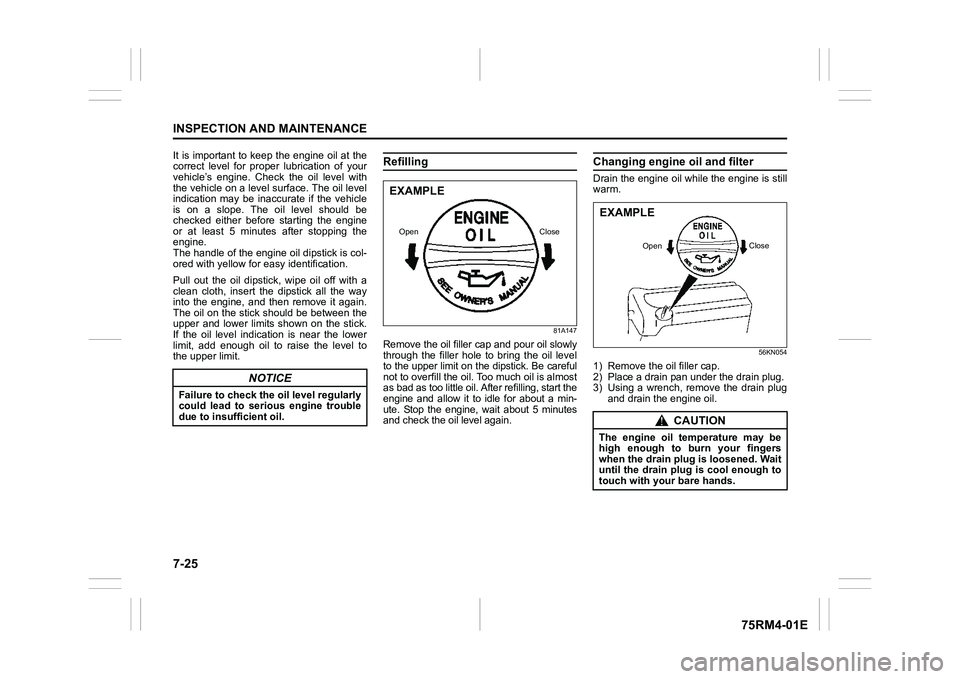
Remove the oil filler cap and pour oil slowly
through the filler hole to bring the oil level
to the upper limit on the dipstick. Be careful
not to overfill the oil. Too much oil is almost
as bad as too little oil. A fter refilling, start the
engine and allow it to idle for about a min-
ute. Stop the engine, wait about 5 minutes
and check the oil level again.
Changing engine oil and filterDrain the engine oil while the engine is still
warm.
56KN054
1) Remove the oil filler cap.
2) Place a drain pan under the drain plug.
3) Using a wrench, remove the drain plug and drain the engine oil.
NOTICE
Failure to check the oil level regularly
could lead to serious engine trouble
due to insufficient oil.
EXAMPLEOpen Close
CAUTION
The engine oil temperature may be
high enough to burn your fingers
when the drain plug is loosened. Wait
until the drain plug is cool enough to
touch with your bare hands.EXAMPLE
Open Close
Page 377 of 505
7-28
INSPECTION AND MAINTENANCE
75RM4-01E
Engine coolantSelection of coolantTo maintain optimum performance and
durability of your engine, use SUZUKI gen-
uine coolant or equivalent.
NOTE:
If you use the engine coolant other than
the SUZUKI LLC: Super (Blue) for replace-
ment, follow the schedule of SUZUKI LLC:
Standard (Green). To see the detail of the
maintenance schedule, refer to “Periodic
maintenance schedule” in this section.
This type of coolant is the best for cooling
system for the following reasons:
• The coolant helps maintain properengine temperature.
• It gives proper protection against freez- ing and boiling.
• It gives proper protection against corro- sion and rust. Failure to use the proper coolant can dam-
age your cooling system. Your authorized
SUZUKI dealer can help you select the
proper coolant.
Coolant level checkCheck the coolant le
vel at the reservoir
tank, not at the radiator. With the engine
cool, the coolant level should be between
“FULL” and “LOW” marks.Adding coolant
NOTICE
SUZUKI LLC: Super (Blue) coolant;
This coolant is already diluted to the
proper percentage. Do not dilute with
distilled water additionally. Doing so
may result in the possibility of freez-
ing and/or overheating coolant.
NOTICE
To avoid damaging your cooling sys-
tem:
• Always use a high quality ethylene
glycol base non-silicate type cool-
ant diluted with distilled water at
the correct mixture concentration.
• Check that the proper mix is 50/50
coolant to distill ed water and in no
case higher than 70/30. Concentra-
tions greater than 70/30 coolant to
distilled water will cause overheat-
ing conditions.
• Do not use straight coolant nor plain water (except SUZUKI LLC:
Super (Blue)).
• Do not add extra inhibitors or addi- tives. They may not be compatible
with your cooling system.
• Do not mix different types of base coolants. Doing so may result in
accelerated seal wear and/or the
possibility of severe overheating
and extensive engine or CVT (if
equipped) damage.
WA R N I N G
Swallowing engine coolant can cause
severe injury or death. Inhaling cool-
ant mist or vapors or getting coolant
in your eyes could result in severe
injury.
• Do not drink antifreeze or coolantsolution. If swallowed, do not
induce vomiting. Immediately con-
tact a poison control center or a
physician.
• Avoid inhaling coolant mist or hot
vapors. If inhaled, remove to a
fresh air area.
• If coolant gets in the eyes, flush
with water and seek medical atten-
tion.
• Wash thoroughly after handling
coolant.
• Keep engine coolant out of the
reach of children and pets.
Page 378 of 505
7-29INSPECTION AND MAINTENANCE
75RM4-01E
81PN200
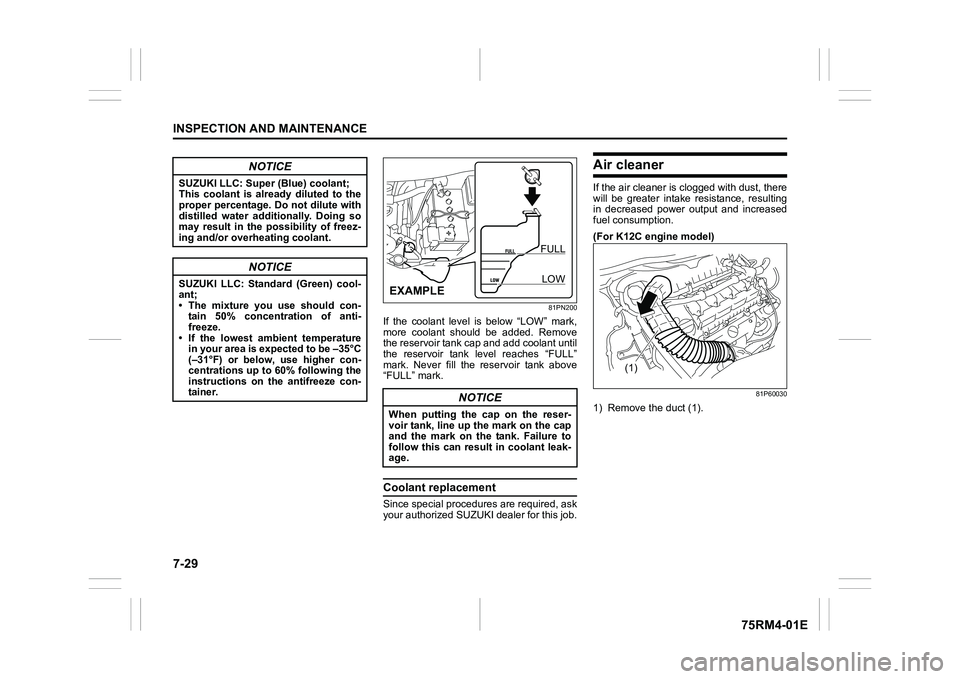
If the coolant level is below “LOW” mark,
more coolant should be added. Remove
the reservoir tank cap and add coolant until
the reservoir tank level reaches “FULL”
mark. Never fill the reservoir tank above
“FULL” mark.Coolant replacementSince special procedures are required, ask
your authorized SUZUKI dealer for this job.
Air cleanerIf the air cleaner is clogged with dust, there
will be greater intake resistance, resulting
in decreased power output and increased
fuel consumption.
(For K12C engine model)
81P60030
1) Remove the duct (1).
NOTICE
SUZUKI LLC: Super (Blue) coolant;
This coolant is already diluted to the
proper percentage. Do not dilute with
distilled water additionally. Doing so
may result in the possibility of freez-
ing and/or overheating coolant.
NOTICE
SUZUKI LLC: Standard (Green) cool-
ant;
• The mixture you use should con-tain 50% concentration of anti-
freeze.
• If the lowest ambient temperature in your area is expected to be –35°C
(–31°F) or below, use higher con-
centrations up to 60% following the
instructions on the antifreeze con-
tainer.
NOTICE
When putting the cap on the reser-
voir tank, line up the mark on the cap
and the mark on the tank. Failure to
follow this can result in coolant leak-
age.
FULL
LOW
(ΟΝ03/(
(1)
Page 381 of 505
7-32
INSPECTION AND MAINTENANCE
75RM4-01E
54G106
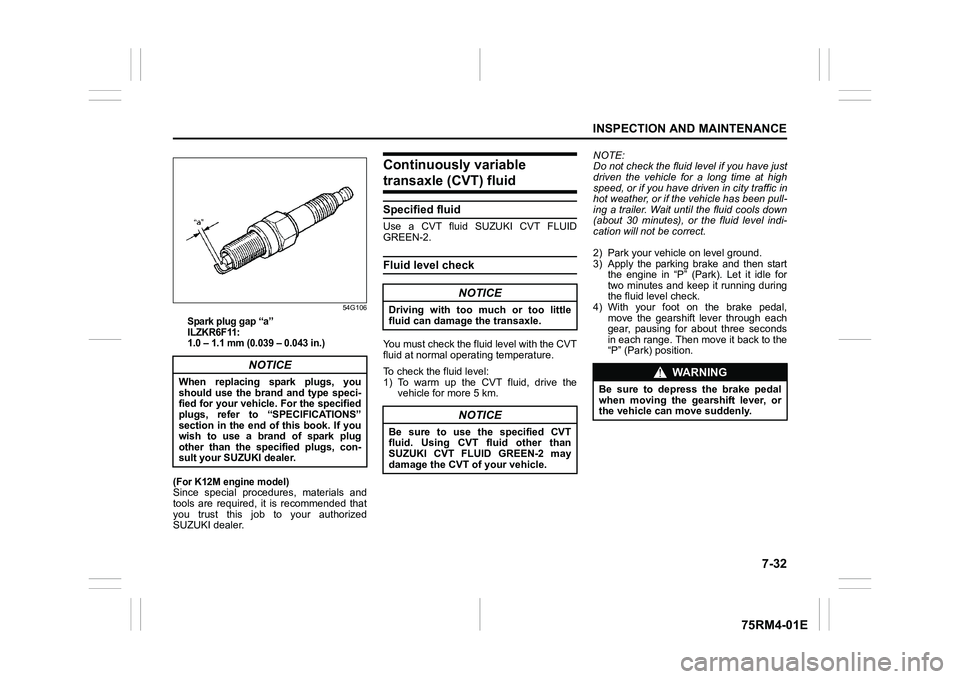
Spark plug gap “a”
ILZKR6F11:
1.0 – 1.1 mm (0.039 – 0.043 in.)
(For K12M engine model)
Since special procedures, materials and
tools are required, it is recommended that
you trust this job to your authorized
SUZUKI dealer.
Continuously variable transaxle (CVT) fluidSpecified fluidUse a CVT fluid SUZUKI CVT FLUID
GREEN-2.Fluid level checkYou must check the fluid level with the CVT
fluid at normal ope rating temperature.
To check the fluid level:
1) To warm up the CVT fluid, drive the vehicle for more 5 km. NOTE:
Do not check the fluid level if you have just
driven the vehicle for a long time at high
speed, or if you have driven in city traffic in
hot weather, or if the vehicle has been pull-
ing a trailer. Wait until the fluid cools down
(about 30 minutes), or the fluid level indi-
cation will not be correct.
2) Park your vehicle on level ground.
3) Apply the parking brake and then start
the engine in “P” (Park). Let it idle for
two minutes and keep it running during
the fluid level check.
4) With your foot on the brake pedal,
move the gearshift lever through each
gear, pausing for about three seconds
in each range. Then move it back to the
“P” (Park) position.
NOTICE
When replacing spark plugs, you
should use the brand and type speci-
fied for your vehicle. For the specified
plugs, refer to “SPECIFICATIONS”
section in the end of this book. If you
wish to use a brand of spark plug
other than the specified plugs, con-
sult your SUZUKI dealer.
NOTICE
Driving with too much or too little
fluid can damage the transaxle.
NOTICE
Be sure to use the specified CVT
fluid. Using CVT fluid other than
SUZUKI CVT FLUID GREEN-2 may
damage the CVT of your vehicle.
WA R N I N G
Be sure to depress the brake pedal
when moving the gearshift lever, or
the vehicle can move suddenly.
Page 384 of 505
7-35INSPECTION AND MAINTENANCE
75RM4-01E
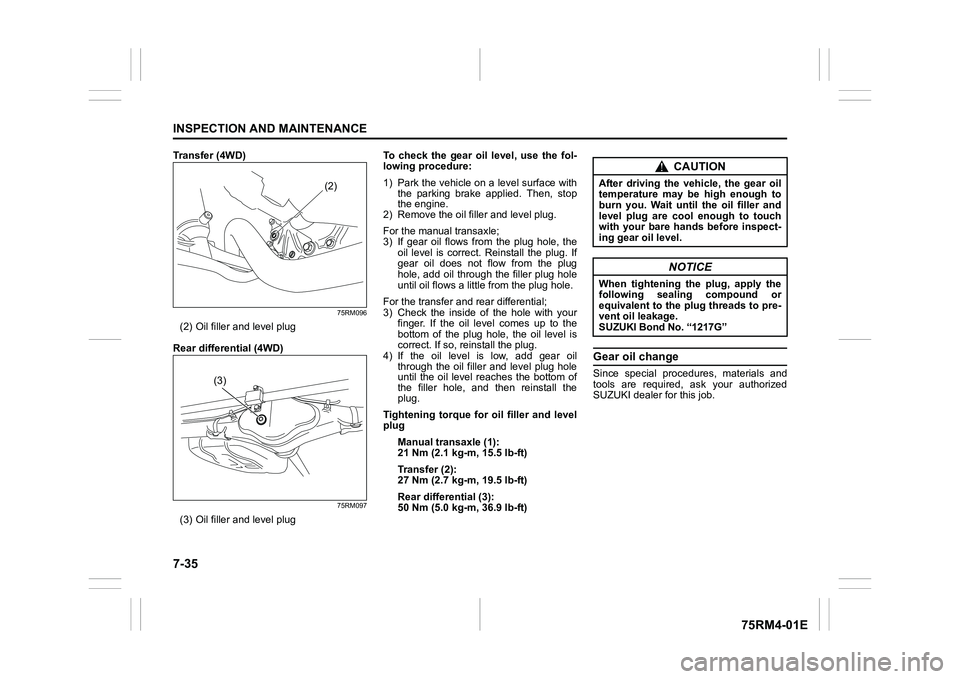
Transfer (4WD)
75RM096
(2) Oil filler and level plug
Rear differential (4WD)
75RM097
(3) Oil filler and level plug To check the gear oil level, use the fol-
lowing procedure:
1) Park the vehicle on a level surface with
the parking brake applied. Then, stop
the engine.
2) Remove the oil filler and level plug.
For the manual transaxle;
3) If gear oil flows from the plug hole, the
oil level is correct. Reinstall the plug. If
gear oil does not flow from the plug
hole, add oil through the filler plug hole
until oil flows a littl e from the plug hole.
For the transfer and rear differential;
3) Check the inside of the hole with your finger. If the oil level comes up to the
bottom of the plug hole, the oil level is
correct. If so, reinstall the plug.
4) If the oil level is low, add gear oil through the oil filler and level plug hole
until the oil level reaches the bottom of
the filler hole, and then reinstall the
plug.
Tightening torque for oil filler and level
plug
Manual transaxle (1):
21 Nm (2.1 kg-m, 15.5 lb-ft)
Transfer (2):
27 Nm (2.7 kg-m, 19.5 lb-ft)
Rear differential (3):
50 Nm (5.0 kg-m, 36.9 lb-ft)
Gear oil changeSince special procedures, materials and
tools are required, ask your authorized
SUZUKI dealer for this job.
(2)
(3)
CAUTION
After driving the vehicle, the gear oil
temperature may be high enough to
burn you. Wait until the oil filler and
level plug are cool enough to touch
with your bare hands before inspect-
ing gear oil level.
NOTICE
When tightening the plug, apply the
following sealing compound or
equivalent to the plug threads to pre-
vent oil leakage.
SUZUKI Bond No. “1217G”
Page 388 of 505
7-39INSPECTION AND MAINTENANCE
75RM4-01E
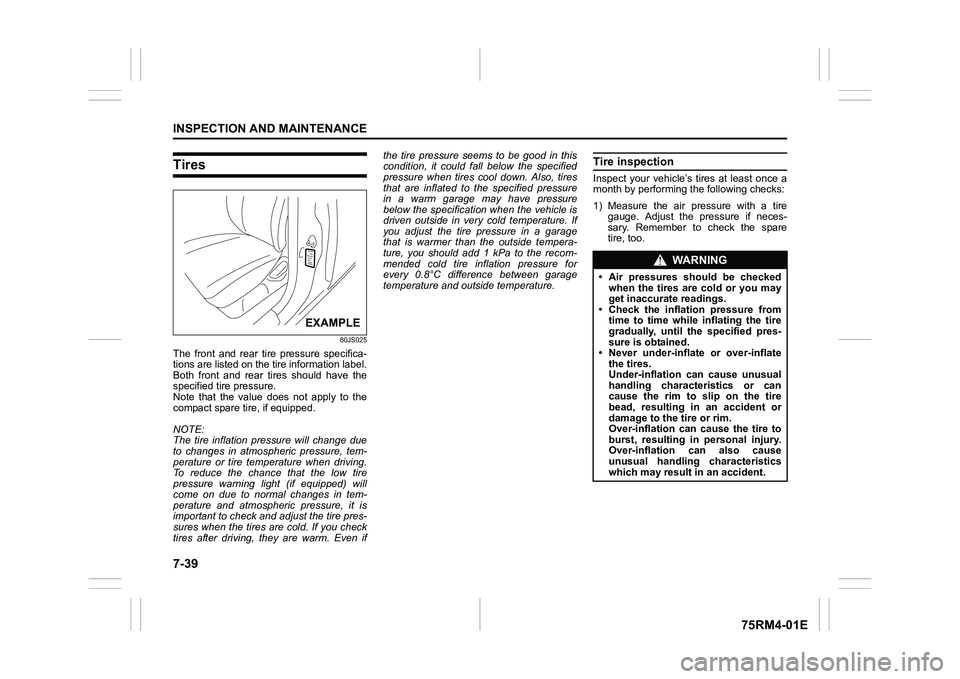
Tires
80JS025
The front and rear tire pressure specifica-
tions are listed on the tire information label.
Both front and rear tires should have the
specified tire pressure.
Note that the value does not apply to the
compact spare tire, if equipped.
NOTE:
The tire inflation pressure will change due
to changes in atmospheric pressure, tem-
perature or tire temperature when driving.
To reduce the chance that the low tire
pressure warning light (if equipped) will
come on due to normal changes in tem-
perature and atmospheric pressure, it is
important to check and adjust the tire pres-
sures when the tires are cold. If you check
tires after driving, they are warm. Even ifthe tire pressure seems to be good in this
condition, it could fall below the specified
pressure when tires co
ol down. Also, tires
that are inflated to the specified pressure
in a warm garage may have pressure
below the specification when the vehicle is
driven outside in very cold temperature. If
you adjust the tire pressure in a garage
that is warmer than the outside tempera-
ture, you should add 1 kPa to the recom-
mended cold tire inflation pressure for
every 0.8°C difference between garage
temperature and outside temperature.
Tire inspectionInspect your vehicle’s tires at least once a
month by performing the following checks:
1) Measure the air pressure with a tire gauge. Adjust the pressure if neces-
sary. Remember to check the spare
tire, too.
EXAMPLE
WA R N I N G
• Air pressures should be checkedwhen the tires are cold or you may
get inaccurate readings.
• Check the inflation pressure from time to time while inflating the tire
gradually, until the specified pres-
sure is obtained.
• Never under-inflate or over-inflate the tires.
Under-inflation can cause unusual
handling characteristics or can
cause the rim to slip on the tire
bead, resulting in an accident or
damage to the tire or rim.
Over-inflation can cause the tire to
burst, resulting in personal injury.
Over-inflation c an also cause
unusual handling characteristics
which may result in an accident.
Page 422 of 505
8-13EMERGENCY SERVICE
75RM4-01E
Engine trouble: Starter does not operate1) Try turning the ignition switch to“START” position or try pressing the
engine switch to change the ignition
mode to START with the headlights
turned on to determine the lead-acid
battery condition. If the headlights go
excessively dim or go off, it usually
means that either the lead-acid battery
is flat or the battery terminal contact is
poor. Recharge the lead-acid battery or
correct battery terminal contact as nec-
essary.
2) If the headlights remain bright, check the fuses. If the reas on for failure of the
starter is not obvious, there may be a
major electrical problem. Have the vehi-
cle inspected by your authorized
SUZUKI dealer.
Engine trouble: Flooded engine(Vehicle without keyless push start sys-
tem)
If the engine is flooded with gasoline, it
may be hard to start. If this happens, press
the accelerator pedal all the way to the
floor and hold it there while cranking the
engine.
• Do not operate the starter motor for more than 12 seconds.
(Vehicle with keyless push start system)
If the engine is flooded with gasoline, it
may be hard to start. If this happens, press
the accelerator pedal all the way to the
floor and hold it there while cranking the
engine.
• Do not operate the starter motor for more than 12 seconds.
NOTE:
If the engine refuses to start, the starter
motor automatically stops after a certain
period of time. After the starter motor has
automatically stopped or if there is any-
thing abnormal in the engine starting sys-
tem, the starter motor runs only while the
engine switch is held pressed.
Engine trouble: OverheatingThe engine could overheat temporarily
under severe driving conditions. If the high
engine coolant temperature warning light
comes on as overheating during driving:
1) Turn off the air conditioner, if equipped.
2) Take the vehicle to a safe place and park.
3) Let the engine run at the normal idle speed for a few minutes until the high
engine coolant temperature warning
light goes off.
WA R N I N G
If you see or hear escaping steam,
stop the vehicle in a safe place and
immediately turn off the engine to
cool it. Do not open the hood when
steam is present. When the steam
can no longer be seen or heard, open
the hood to see if the coolant is still
boiling. If it is, you must wait until it
stops boiling before you proceed.