battery SUZUKI IGNIS 2021 Workshop Manual
[x] Cancel search | Manufacturer: SUZUKI, Model Year: 2021, Model line: IGNIS, Model: SUZUKI IGNIS 2021Pages: 505, PDF Size: 8.36 MB
Page 350 of 505
7-1INSPECTION AND MAINTENANCE
75RM4-01E
60B128S
WA R N I N G
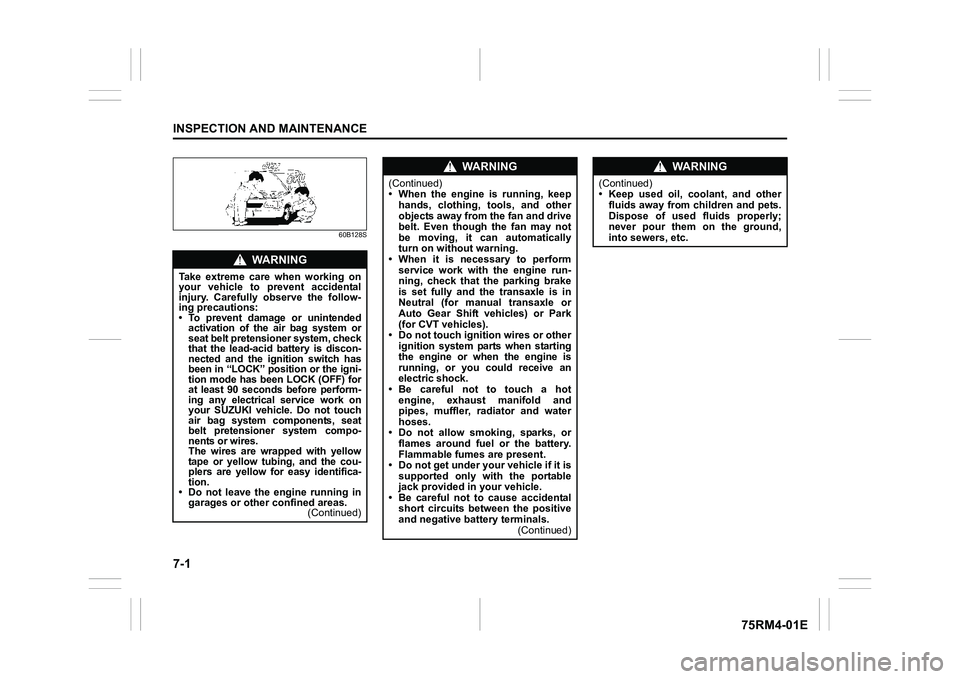
Take extreme care when working on
your vehicle to prevent accidental
injury. Carefully observe the follow-
ing precautions:
• To prevent damage or unintendedactivation of the air bag system or
seat belt pretensioner system, check
that the lead-acid battery is discon-
nected and the ignition switch has
been in “LOCK” position or the igni-
tion mode has been LOCK (OFF) for
at least 90 seconds before perform-
ing any electrical service work on
your SUZUKI vehicle. Do not touch
air bag system components, seat
belt pretensioner system compo-
nents or wires.
The wires are wrapped with yellow
tape or yellow tubing, and the cou-
plers are yellow for easy identifica-
tion.
• Do not leave the engine running in garages or other confined areas. (Continued)
WA R N I N G
(Continued)
• When the engine is running, keep
hands, clothing, tools, and other
objects away from the fan and drive
belt. Even though the fan may not
be moving, it can automatically
turn on without warning.
• When it is necessary to perform
service work with the engine run-
ning, check that the parking brake
is set fully and the transaxle is in
Neutral (for manual transaxle or
Auto Gear Shift vehicles) or Park
(for CVT vehicles).
• Do not touch ignition wires or other ignition system parts when starting
the engine or when the engine is
running, or you could receive an
electric shock.
•Be careful not to touch a hot engine, exhaust manifold and
pipes, muffler, radiator and water
hoses.
• Do not allow smoking, sparks, or flames around fuel or the battery.
Flammable fumes are present.
• Do not get under your vehicle if it is supported only with the portable
jack provided in your vehicle.
• Be careful not to cause accidental short circuits between the positive
and negative battery terminals. (Continued)
WA R N I N G
(Continued)
• Keep used oil, coolant, and other
fluids away from children and pets.
Dispose of used fluids properly;
never pour them on the ground,
into sewers, etc.
Page 372 of 505
7-23INSPECTION AND MAINTENANCE
75RM4-01E
Drive beltCheck that the drive belt tension is correct.
If the belt is too loose, insufficient battery
charging, engine overheating, poor power
steering, poor air conditioning, or exces-
sive belt wear can result. When you press
the belt with your thumb midway between
the pulleys, there should be a deflection
according to the following chart.
The belts should also be examined to
ensure that they are not damaged.
If you need to replace or adjust the belt
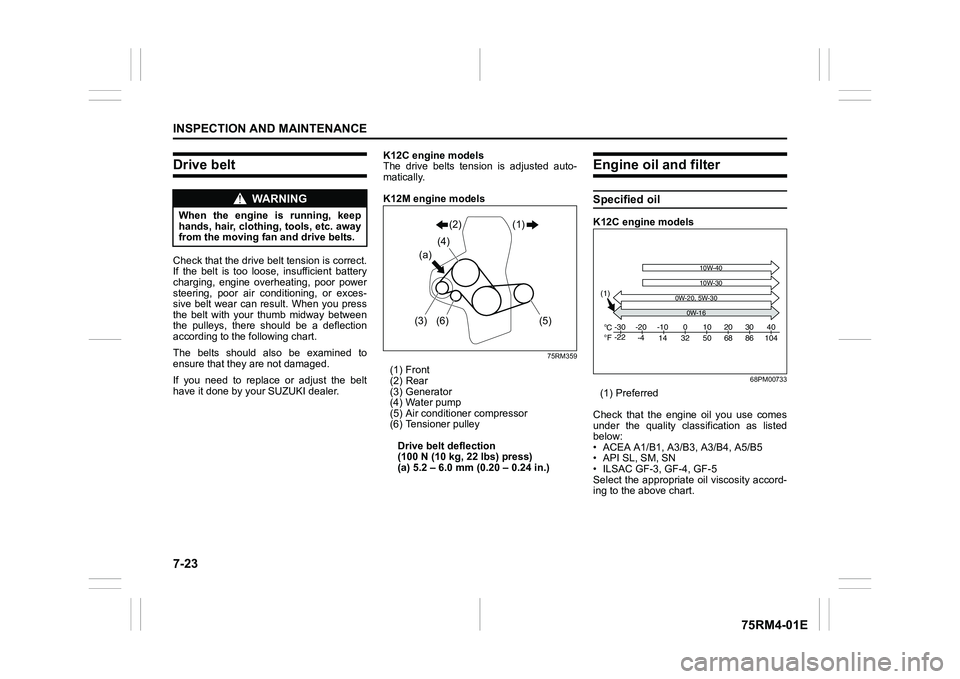
have it done by your SUZUKI dealer.K12C engine models
The drive belts tension is adjusted auto-
matically.
K12M engine models
75RM359
(1) Front
(2) Rear
(3) Generator
(4) Water pump
(5) Air conditioner compressor
(6) Tensioner pulley
Drive belt deflection
(100 N (10 kg, 22 lbs) press)
(a) 5.2 – 6.0 mm (0.20 – 0.24 in.)
Engine oil and filterSpecified oil K12C engine models
68PM00733
(1) Preferred
Check that the engine oil you use comes
under the quality classification as listed
below:
• ACEA A1/B1, A3/ B3, A3/B4, A5/B5
• API SL, SM, SN
• ILSAC GF-3, GF-4, GF-5
Select the appropriate oil viscosity accord-
ing to the above chart.
WA R N I N G
When the engine is running, keep
hands, hair, clothing, tools, etc. away
from the moving fan and drive belts.
(a) (4)(2) (1)
(3) (6) (5)
C Fo
o-30
-22
-20
10W-40
-4-10
14 32 50 68 86 104 010203040
10W-30
(1)
0W-20, 5W-30
0W-16
Page 391 of 505
7-42
INSPECTION AND MAINTENANCE
75RM4-01E
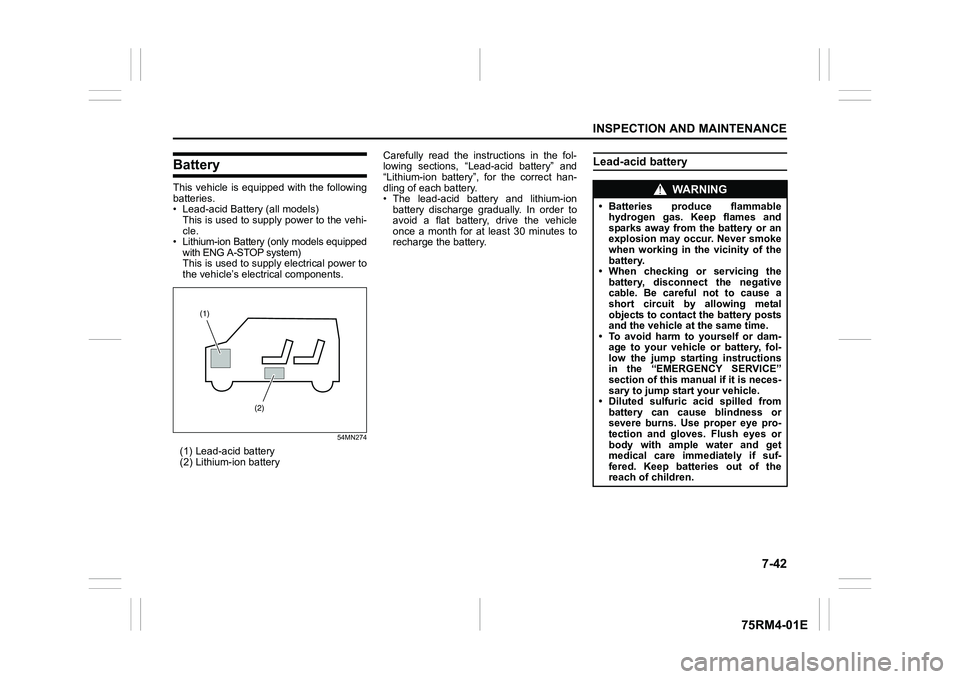
BatteryThis vehicle is equipped with the following
batteries.
• Lead-acid Battery (all models)This is used to supply power to the vehi-
cle.
• Lithium-ion Battery (only models equipped with ENG A-STOP system)
This is used to supply electrical power to
the vehicle’s electrical components.
54MN274
(1) Lead-acid battery
(2) Lithium-ion battery Carefully read the instructions in the fol-
lowing sections, “Lead-acid battery” and
“Lithium-ion battery”, for the correct han-
dling of each battery.
• The lead-acid battery and lithium-ion
battery discharge gradually. In order to
avoid a flat battery, drive the vehicle
once a month for at least 30 minutes to
recharge the battery.
Lead-acid battery
(1)
(2)
:$ 5 1 , 1 *
Page 392 of 505
7-43INSPECTION AND MAINTENANCE
75RM4-01E
76MS006
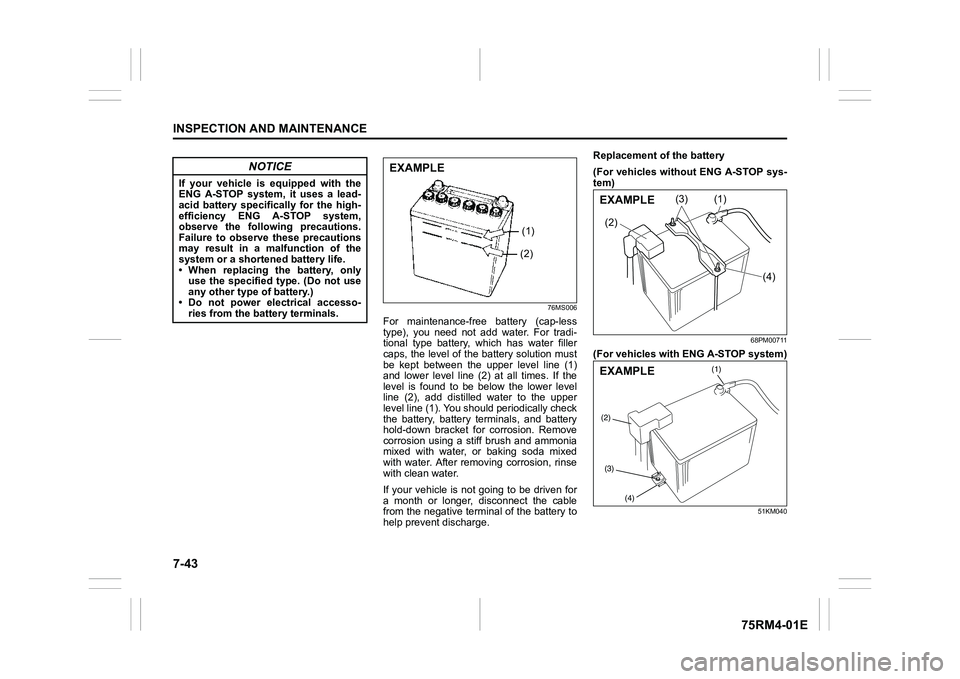
For maintenance-free battery (cap-less
type), you need not add water. For tradi-
tional type battery, which has water filler
caps, the level of the battery solution must
be kept between the upper level line (1)
and lower level line (2) at all times. If the
level is found to be below the lower level
line (2), add distilled water to the upper
level line (1). You should periodically check
the battery, battery terminals, and battery
hold-down bracket for corrosion. Remove
corrosion using a stiff brush and ammonia
mixed with water, or baking soda mixed
with water. After removing corrosion, rinse
with clean water.
If your vehicle is not going to be driven for
a month or longer, disconnect the cable
from the negative terminal of the battery to
help prevent discharge.Replacement of the battery
(For vehicles without ENG A-STOP sys-
tem)
68PM00711
(For vehicles with ENG A-STOP system)
51KM040
NOTICE
If your vehicle is equipped with the
ENG A-STOP system, it uses a lead-
acid battery specifically for the high-
efficiency ENG A-STOP system,
observe the following precautions.
Failure to observe these precautions
may result in a malfunction of the
system or a shortened battery life.
• When replacing the battery, only
use the specified type. (Do not use
any other type of battery.)
• Do not power electrical accesso- ries from the battery terminals.
EXAMPLE
(1)
(2)
(1)
(2) (3)
(4)
(ΟΝ03/((2)
(1)
(3)
(4)
(;$03/(
Page 393 of 505
7-44
INSPECTION AND MAINTENANCE
75RM4-01E
To remove the battery:
1) Disconnect the negative cable (1).
2) Disconnect the positive cable (2).
For vehicles without ENG A-STOP sys-
tem;
3) Remove the retainer nuts (3) and remove the retainer (4).
For vehicles with ENG A-STOP system ;
3) Remove the bracket bolt (3) and remove the bracket (4).
4) Remove the battery.
To install the battery:
1) Install the battery in the reverse order of removal.
2) Tighten the bracket bolt and battery cables securely.
NOTE:
When the battery is disconnected, some of
the vehicle’s function will be initialized and/
or deactivated.
These function are required to reset after
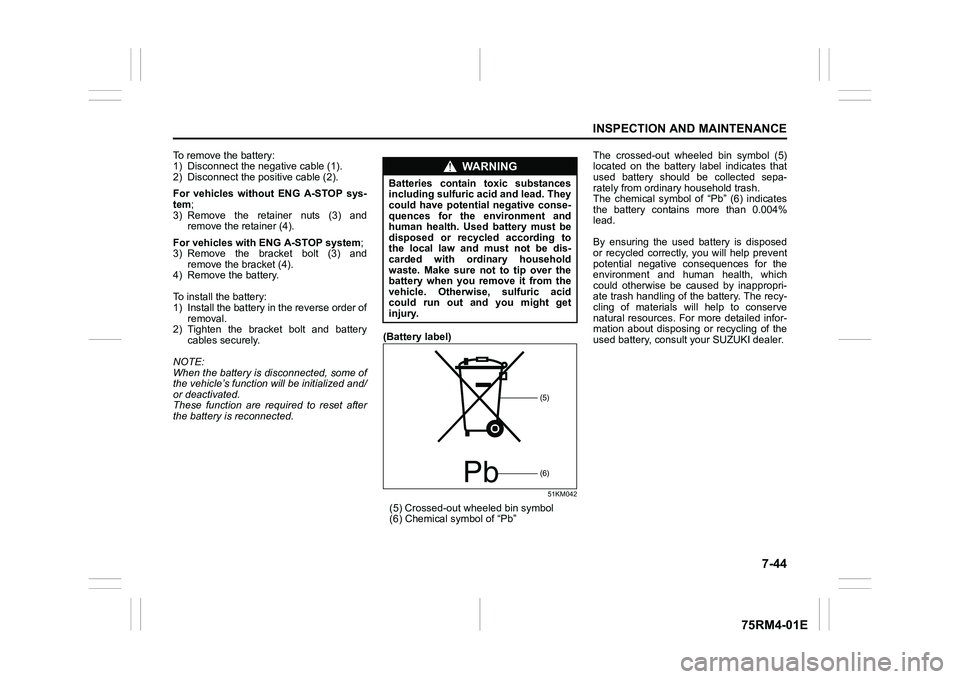
the battery is reconnected. (Battery label)
51KM042
(5) Crossed-out
wheeled bin symbol
(6) Chemical symbol of “Pb” The crossed-out wheeled bin symbol (5)
located on the battery label indicates that
used battery should be collected sepa-
rately from ordinary household trash.
The chemical symbol of “Pb” (6) indicates
the battery contains more than 0.004%
lead.
By ensuring the used battery is disposed
or recycled correctly, you will help prevent
potential negative consequences for the
environment and human health, which
could otherwise be caused by inappropri-
ate trash handling of the battery. The recy-
cling of materials will help to conserve
natural resources. For more detailed infor-
mation about disposing or recycling of the
used battery, consult your SUZUKI dealer.
WA R N I N G
Batteries contain toxic substances
including sulfuric acid and lead. They
could have potential negative conse-
quences for the environment and
human health. Used
battery must be
disposed or recycled according to
the local law and must not be dis-
carded with ordinary household
waste. Make sure not to tip over the
battery when you remove it from the
vehicle. Otherwise, sulfuric acid
could run out and you might get
injury.
Pb
(5)(6)
Page 394 of 505
7-45INSPECTION AND MAINTENANCE
75RM4-01E
Lithium-ion battery (if equipped)This battery is installed only in models
equipped with the ENG A-STOP system
and is located under the front passenger’s
seat.
• The lithium-ion battery is maintenance-free. However, in order to avoid a flat
battery, drive the vehicle once a month
for at least 30 minutes to recharge the
battery.
• When replacing or disposing of the lith- ium-ion battery, consult your authorized
SUZUKI dealer.
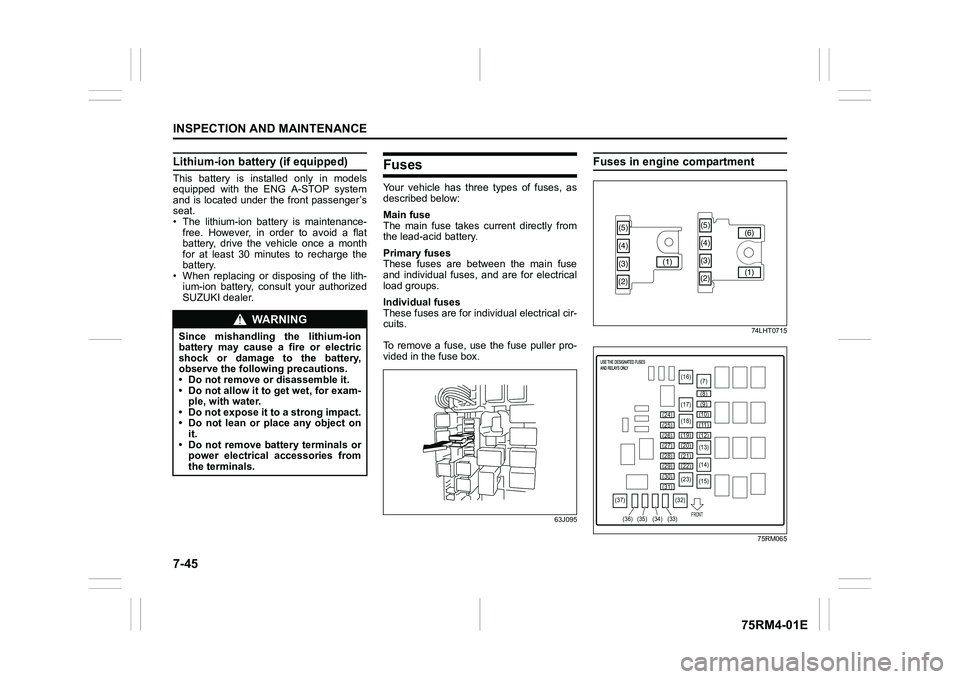
FusesYour vehicle has three types of fuses, as
described below:
Main fuse
The main fuse takes current directly from
the lead-acid battery.
Primary fuses
These fuses are between the main fuse
and individual fuses, and are for electrical
load groups.
Individual fuses
These fuses are for indi vidual electrical cir-
cuits.
To remove a fuse, use the fuse puller pro-
vided in the fuse box.
63J095
Fuses in engine compartment
74LHT0715
75RM065
WA R N I N G
Since mishandling the lithium-ion
battery may cause a fire or electric
shock or damage to the battery,
observe the following precautions.
• Do not remove or disassemble it.
• Do not allow it to get wet, for exam- ple, with water.
• Do not expose it to a strong impact.
• Do not lean or place any object on it.
• Do not remove battery terminals or power electrical accessories from
the terminals.
(5)
(3)
(4)
(2) (1)(5)
(4)
(3)
(2) (1)
(6)
(7)
(16)
(17)
(18)
(19)
(20)
(21)
(22)
(23)
(25)
(24)
(26)
(29)
(27)
(28)
(30)
(31)
(32)
(37)
(33)
(34)
(35)
(36) (8)
(9)
(10)
(11)
(12)
(13)
(14)
(15)FRONT
Page 395 of 505
7-46
INSPECTION AND MAINTENANCE
75RM4-01E
*1: Models with ENG A-STOP
*2: CVT models with ENG A-STOP
*3: Auto Gear Shift models
*4: Models with Auto-on headlight system
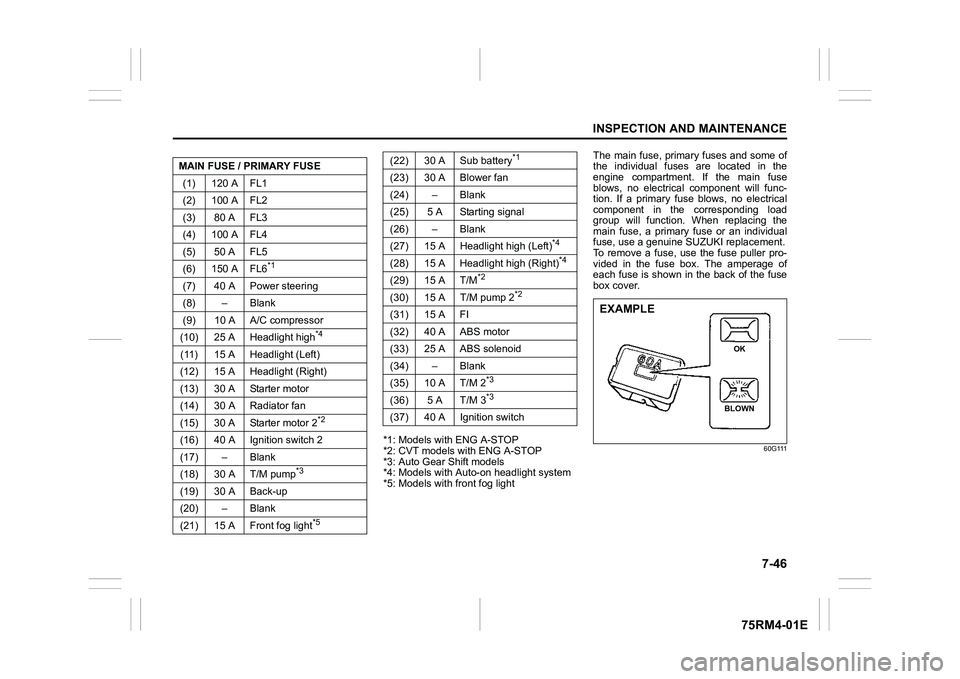
*5: Models with front fog light The main fuse, primary fuses and some of
the individual fuses are located in the
engine compartment. If the main fuse
blows, no electrical component will func-
tion. If a primary fuse blows, no electrical
component in the corresponding load
group will function. When replacing the
main fuse, a primary fuse or an individual
fuse, use a genuine S
UZUKI replacement.
To remove a fuse, use the fuse puller pro-
vided in the fuse box. The amperage of
each fuse is shown in the back of the fuse
box cover.
60G111
MAIN FUSE / PRIMARY FUSE
(1) 120 A FL1
(2) 100 A FL2
(3) 80 A FL3
(4) 100 A FL4
(5) 50 A FL5
(6) 150 A FL6
*1
(7) 40 A Power steering
(8) – Blank
(9) 10 A A/C compressor
(10) 25 A Headlight high
*4
(11) 15 A Headlight (Left)
(12) 15 A Headlight (Right)
(13) 30 A Starter motor
(14) 30 A Radiator fan
(15) 30 A Starter motor 2
*2
(16) 40 A Ignition switch 2
(17) – Blank
(18) 30 A T/M pump
*3
(19) 30 A Back-up
(20) – Blank
(21) 15 A Front fog light
*5
(22) 30 A Sub battery
*1
(23) 30 A Blower fan
(24) – Blank
(25) 5 A Starting signal
(26) – Blank
(27) 15 A Headlight high (Left)
*4
(28) 15 A Headlight high (Right)
*4
(29) 15 A T/M
*2
(30) 15 A T/M pump 2
*2
(31) 15 A FI
(32) 40 A ABS motor
(33) 25 A ABS solenoid
(34) – Blank
(35) 10 A T/M 2
*3
(36) 5 A T/M 3
*3
(37) 40 A Ignition switch
EXAMPLE
BLOWN OK
Page 419 of 505
8-10
EMERGENCY SERVICE
75RM4-01E
Using compressor to inflate a tire1) Place the vehicle on level, hard ground.
Set the parking brake firmly and shift
into “P” (Park) if your vehicle has a
CVT, or shift into “R” (Reverse) if your
vehicle has a manual transaxle or Auto
Gear Shift.
2) Take out the compressor.
3) Unscrew the valve cap from the tire valve.
4) Connect the air ho se of the compressor
to the tire valve.
5) Connect the power plug of the com- pressor to the accessory socket. For a
manual transaxle or an Auto Gear Shift
vehicle, shift from “R” (Reverse) into “N”
(Neutral). Start the engine. Switch on
the compressor. Inflate the tire to the
required air pressure.
Jump-starting instructions
1) Use only a 12-volt lead-acid battery to
jump-start your vehicle. Position the
good 12-volt lead-acid battery close to
your vehicle so that the jump leads will
reach both batteries. When using a bat-
tery installed on another vehicle, check
that two vehicles do not touch each
other. Set the parking brakes fully on
both vehicles.
2) Turn off all vehicle accessories, except those necessary for safety reasons (for
example, headlights or hazard lights).
NOTICE
Do not operate the compressor for
longer than 10 minutes. It can cause
overheating of the compressor.
WA R N I N G
• Never attempt to jump-start your
vehicle if the lead-acid battery
appears to be frozen. Batteries in
this condition may explode.
• When making jump lead connec- tions, check that your hands and
the jump leads remain clear from
pulleys, belts or fans.
• Lead-acid batteries produce flam-
mable hydrogen gas. Keep flames
and sparks away from the battery
or an explosion may occur. Never
smoke when working near the bat-
tery.
• If the booster ba ttery you use for
jump-starting is installed in another
vehicle, check that the two vehicles
are not touching each other.
• If your lead-acid battery discharges repeatedly, for no apparent reason,
have your vehicle inspected by an
authorized SUZUKI dealer.
• To avoid harm to yourself or dam- age to your vehicle or battery, fol-
low the jump-starting instructions
below.
If you are in doubt, call for qualified
road service.
NOTICE
Your vehicle should not be started by
pushing or towing. This starting
method could result in permanent
damage to the catalytic converter.
Use jump leads to start a vehicle with
a weak or flat battery.
Page 420 of 505
8-11EMERGENCY SERVICE
75RM4-01E
54P000804
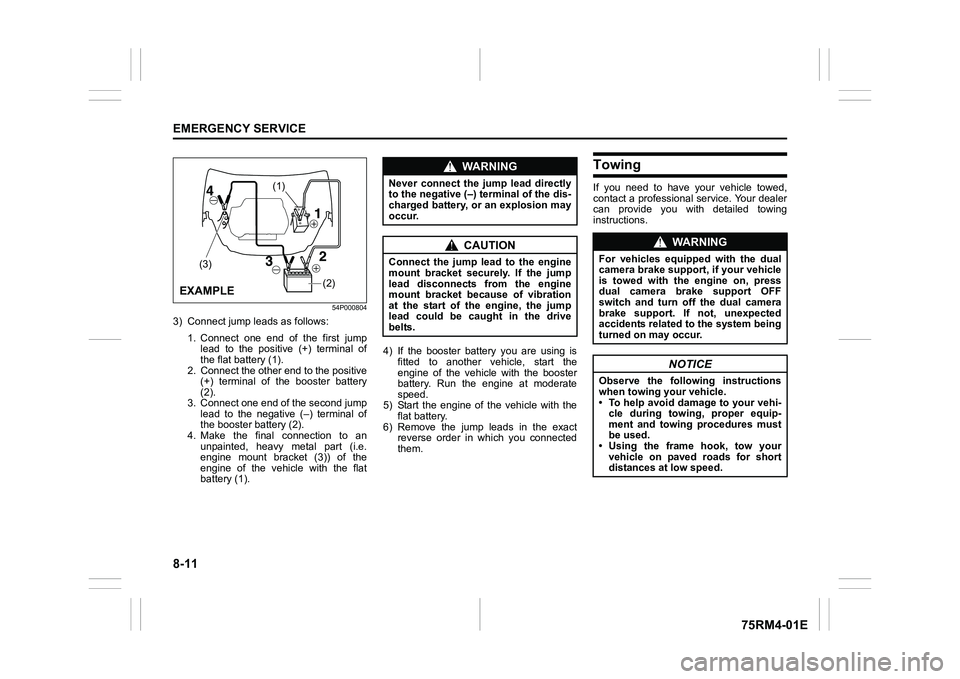
3) Connect jump leads as follows:1. Connect one end of the first jumplead to the positive (+) terminal of
the flat battery (1).
2. Connect the other end to the positive (+) terminal of the booster battery
(2).
3. Connect one end of the second jump lead to the negative (–) terminal of
the booster battery (2).
4. Make the final connection to an unpainted, heavy metal part (i.e.
engine mount bracket (3)) of the
engine of the vehicle with the flat
battery (1). 4) If the booster battery you are using is
fitted to another vehicle, start the
engine of the vehicle with the booster
battery. Run the engine at moderate
speed.
5) Start the engine of the vehicle with the flat battery.
6) Remove the jump leads in the exact reverse order in which you connected
them.
TowingIf you need to have your vehicle towed,
contact a professional service. Your dealer
can provide you with detailed towing
instructions.
(2)
(1)
(3)
EXAMPLE
WA R N I N G
Never connect the jump lead directly
to the negative (–) terminal of the dis-
charged battery, or an explosion may
occur.
CAUTION
Connect the jump l ead to the engine
mount bracket securely. If the jump
lead disconnects from the engine
mount bracket because of vibration
at the start of the engine, the jump
lead could be caught in the drive
belts.
WA R N I N G
For vehicles equipped with the dual
camera brake support, if your vehicle
is towed with the engine on, press
dual camera brake support OFF
switch and turn off the dual camera
brake support. If not, unexpected
accidents related to the system being
turned on may occur.
NOTICE
Observe the following instructions
when towing your vehicle.
• To help avoid damage to your vehi- cle during towing, proper equip-
ment and towing procedures must
be used.
• Using the frame hook, tow your
vehicle on paved roads for short
distances at low speed.
Page 422 of 505
8-13EMERGENCY SERVICE
75RM4-01E
Engine trouble: Starter does not operate1) Try turning the ignition switch to“START” position or try pressing the
engine switch to change the ignition
mode to START with the headlights
turned on to determine the lead-acid
battery condition. If the headlights go
excessively dim or go off, it usually
means that either the lead-acid battery
is flat or the battery terminal contact is
poor. Recharge the lead-acid battery or
correct battery terminal contact as nec-
essary.
2) If the headlights remain bright, check the fuses. If the reas on for failure of the
starter is not obvious, there may be a
major electrical problem. Have the vehi-
cle inspected by your authorized
SUZUKI dealer.
Engine trouble: Flooded engine(Vehicle without keyless push start sys-
tem)
If the engine is flooded with gasoline, it
may be hard to start. If this happens, press
the accelerator pedal all the way to the
floor and hold it there while cranking the
engine.
• Do not operate the starter motor for more than 12 seconds.
(Vehicle with keyless push start system)
If the engine is flooded with gasoline, it
may be hard to start. If this happens, press
the accelerator pedal all the way to the
floor and hold it there while cranking the
engine.
• Do not operate the starter motor for more than 12 seconds.
NOTE:
If the engine refuses to start, the starter
motor automatically stops after a certain
period of time. After the starter motor has
automatically stopped or if there is any-
thing abnormal in the engine starting sys-
tem, the starter motor runs only while the
engine switch is held pressed.
Engine trouble: OverheatingThe engine could overheat temporarily
under severe driving conditions. If the high
engine coolant temperature warning light
comes on as overheating during driving:
1) Turn off the air conditioner, if equipped.
2) Take the vehicle to a safe place and park.
3) Let the engine run at the normal idle speed for a few minutes until the high
engine coolant temperature warning
light goes off.
WA R N I N G
If you see or hear escaping steam,
stop the vehicle in a safe place and
immediately turn off the engine to
cool it. Do not open the hood when
steam is present. When the steam
can no longer be seen or heard, open
the hood to see if the coolant is still
boiling. If it is, you must wait until it
stops boiling before you proceed.