temperature SUZUKI JIMNY 2022 User Guide
[x] Cancel search | Manufacturer: SUZUKI, Model Year: 2022, Model line: JIMNY, Model: SUZUKI JIMNY 2022Pages: 421, PDF Size: 6.35 MB
Page 122 of 421
BEFORE DRIVING
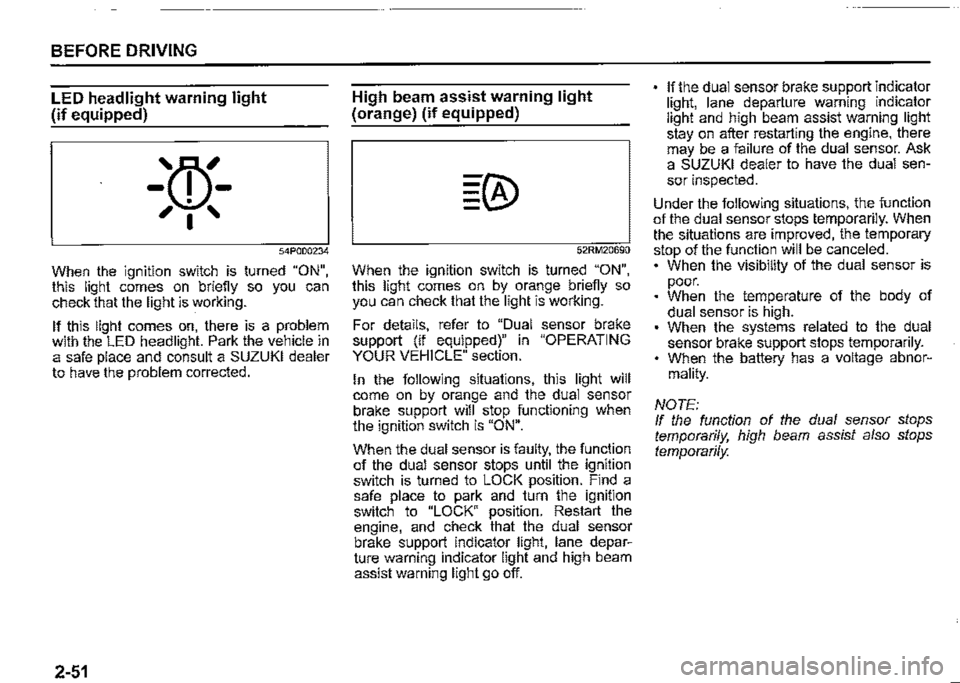
LED headlight warning light
(if equipped)
'm
-w.-, I '
54P000234
When the ignition switch is turned "ON", this light comes on briefly so you can check that the light is working.
If this light comes on, there is a problem with the LED headlight. Park the vehicle in a safe place and consult a SUZUKI dealer to have the problem corrected.
2-51
High beam assist warning light
(orange) (if equipped)
52RM20690
When the ignition switch is turned "ON", this light comes on by orange briefly so you can check that the light is working.
For details, refer to "Dual sensor brake support (if equipped)" in "OPERATING YOUR VEHICLE" section.
In the following situations, this light will come on by orange and the dual sensor brake support will stop functioning when the ignition switch is "ON".
When the dual sensor is faulty, the function of the dual sensor stops until the ignition switch is turned to LOCK position. Find a safe place to park and turn the ignition switch to "LOCK" position. Restart the engine, and check that the dual sensor brake support indicator light, lane departure warning indicator light and high beam assist warning light go off.
If the dual sensor brake support indicator light, lane departure warning indicator light and high beam assist warning light stay on after restarting the engine, there may be a failure of the dual sensor. Ask a SUZUKI dealer to have the dual sensor inspected.
Under the following situations, the function of the dual sensor stops temporarily. When the situations are improved, the temporary stop of the function will be canceled. • When the visibility of the dual sensor is poor. When the temperature of the body of dual sensor is high. When the systems related to the dual sensor brake support stops temporarily. When the battery has a voltage abnor
mality.
NOTE: If the function of the dual sensor stops temporarily, high beam assist also stops
temporarily.
Page 139 of 421
Wiper and washer operation
When the ignition switch is in "ON" position, you can use the wiper/washer lever.
When the wipers are under heavy load such as covered by snow, the breaker will be activated and the wipers will stop operating to protect the wiper motor from overheating. If the wiper stops during operation, do the following methods.
1) Stop the vehicle in a safe place, and turn the engine off. 2) Move the wiper lever and switch to "OFF" position. 3) Remove obstacles such as snow on the wipers. 4) After a while, when the temperature of the wiper motor becomes low enough, the breaker will be reset automatically and the wipers will be able to use.
If you cannot use the wipers after a while, there may be another problem. Ask a SUZUKI dealer to have the wipers inspected.
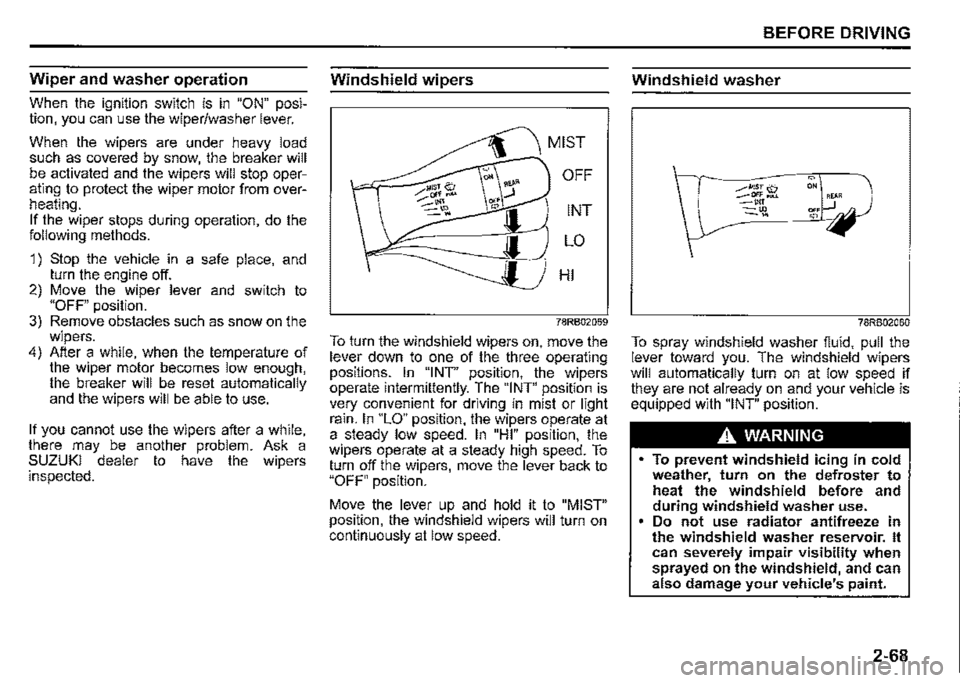
Windshield wipers
MIST
OFF
INT
LO
HI
78RB02059
To turn the windshield wipers on, move the lever down to one of the three operating positions. In "INT" position, the wipers operate intermittently. The "INT" position is very convenient for driving in mist or light rain. In "LO" position, the wipers operate at a steady low speed. In "HI" position, the wipers operate at a steady high speed. To turn off the wipers, move the lever back to "OFF" position.
Move the lever up and hold it to "MIST" position, the windshield wipers will turn on continuously at low speed.
BEFORE DRIVING
Windshield washer
78RB02060
To spray windshield washer fluid, pull the lever toward you. The windshield wipers will automatically turn on at low speed if they are not already on and your vehicle is equipped with "INT" position.
.A, WARNING
To prevent windshield icing in cold weather, turn on the defroster to heat the windshield before and during windshield washer use. Do not use radiator antifreeze in the windshield washer reservoir. It can severely impair visibility when sprayed on the windshield, and can also damage your vehicle's paint.
2-68
Page 140 of 421
BEFORE DRIVING
NOTICE
To help prevent damage to the windshield wiper and washer system components, you should take the following precautions: Do not continue to hold in the lever when there is no windshield washer fluid being sprayed or the washer motor can be damaged. • Do not attempt to remove dirt from a dry windshield with the wipers or you can damage the windshield and the wiper blades. Always wet the windshield with washer fluid before operating the wipers. Clear ice or packed snow from the wiper blades before using the wipers. Check the washer fluid level regularly. Check it often when the weather is bad. Fill a reservoir to 3/4 level with washer fluid for its expansion, if temperature falls low enough to freeze the fluid.
2-69
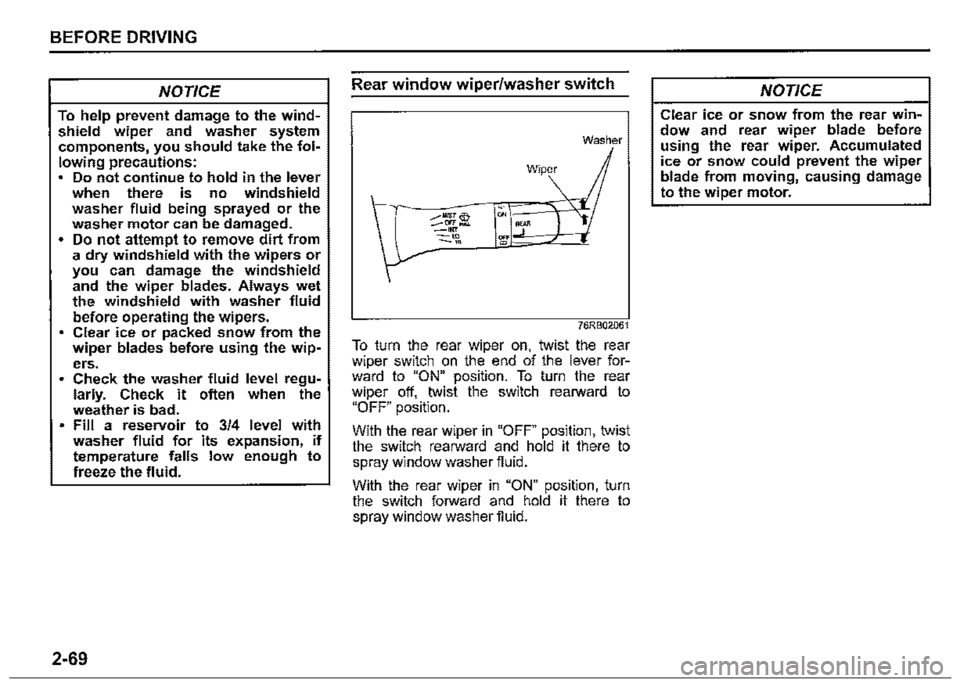
Rear window wiper/washer switch
Washer
Wiper
""'
78RB02061
To turn the rear wiper on. twist the rear wiper switch on the end of the lever forward to "ON" position. To turn the rear wiper off, twist the switch reaiward to "OFF'" position.
With the rear wiper in "OFF"" position, twist the switch reaiward and hold it there to spray window washer fluid.
With the rear wiper in "ON"" position, turn the switch foiward and hold it there to spray window washer fluid.
NOTICE
Clear ice or snow from the rear winw dow and rear wiper blade before using the rear wiper. Accumulated ice or snow could prevent the wiper blade from moving, causing damage to the wiper motor.
Page 147 of 421
A WARNING
Your vehicle should be handled in a different way when towing a trailer. For the safety of yourself and others, observe the following precautions: Practice turning, stopping, and reversing before you begin towing a trailer in traffic. Do not tow a trailer in traffic until you are confident that you can handle the vehicle and trailer safely. Never exceed local towing speed limits or 80 km/h (50 mph), whichever is lower. Never drive at a speed that causes shaking or swaying of the trailer. If you notice even the slightest sign of shaking or swaying, slow down. • When roads are wet, slippery or rough, drive at a slower speed than you would on dry or smooth roads. Failure to slow down when road conditions are bad can result in loss of control. Always have someone guide you when reversing. (Continued)
A WARNING
(Continued) Always admit greater stopping distance. Stopping distance is increased when you tow a trailer. For each 16 km/h (10 mph) of speed, allow at least one vehicle and trailer length between you and the vehicle ahead. Allow a greater stopping distance if roads are wet or slippery. If the trailer has over-run brakes, apply the brakes gradually to avoid snatching caused by the trailer wheels locking. Slow down before corners and maintain a steady speed while cornering. Deceleration or acceleration while cornering can result in loss of control. Remember that a larger than normal turning radius is needed because the trailer wheels will go inside than vehicle's wheels. Avoid sudden acceleration and stopping of the vehicle. Do not make quick maneuvers unless they are necessary. Slow down in cross winds and be prepared for gusts of wind from large passing vehicles. (Continued)
BEFORE DRIVING
A WARNING
(Continued) Be careful when overtaking other vehicles. Allow enough room for your trailer before changing lanes, and use turn signal lights properly in advance. Slow down and shift into a lower gear for better engine braking before you reach long or steep downhill grades. It is hazardous to attempt downshifting while you are descending a hill. Do not step on the brake pedal excessively. This could cause the brakes to over-heat resulting in reduced braking efficiency. Use engine braking as much as possible. Because of the added trailer weight, your engine may overheat on hot days when going up long or steep hills. Pay attention to your engine coolant temperature. If it indicates overheating, pull off the road and stop the vehicle in a safe place. Refer to "Engine trouble: Overheating" in "EMERGENCY SERVICE" section.
2-76
Page 158 of 421
OPERATING YOUR VEHICLE
Clutch pedal (1)
A clutch pedal is used to disengage the driving force to the wheels when starting the engine, stopping, or shifting the gearshift lever. Depressing the pedal disengages the clutch.
A WARNING
Do not drive with your foot resting on the clutch pedal. It could result in excessive clutch wear, clutch damage, or unexpected loss of engine braking.
Brake pedal (2)
Your vehicle is equipped with either front and rear disc brakes or front disc brakes and rear drum brakes. Depressing a brake pedal applies both sets of brakes.
You may hear occasional brake squeal when you apply the brakes. This is a normal condition caused by environmental factors such as temperature, humidity or dust, etc.
A WARNING
If brake squeal is excessive and occurs each time the brakes are applied, you should have the brakes checked by a SUZUKI dealer.
3-7
A WARNING
Do not apply brakes continuously or rest your foot on the brake pedal. This will result in overheating of the brakes which could cause unpredictable braking action, longer stopping distances, or permanent brake dam
age.
Accelerator pedal (3)
An accelerator pedal controls the speed of the engine. Depressing the accelerator pedal increases power output and speed.
Starting engine
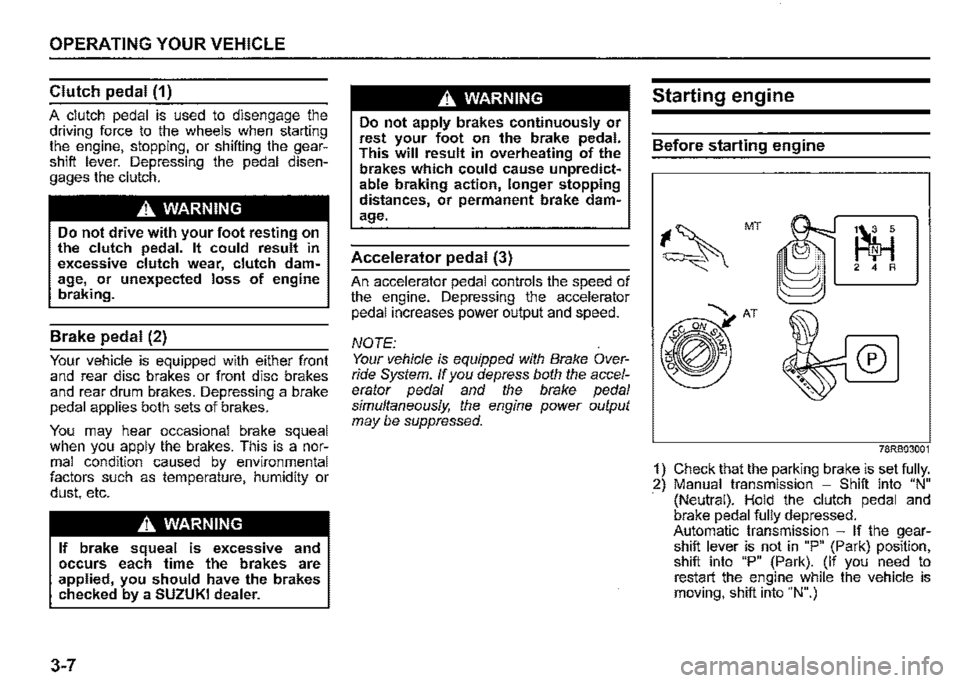
Before starting engine
~ 2 4 R
AT
NOTE: Your vehicle is equipped with Brake Over-fl..l""'"-i ® ride System. If you depress both the accelerator pedal and the brake pedal simultaneously, the engine power output may be suppressed.
78RB03001
1) Check that the parking brake is set fully. 2) Manual transmission -Shift into "N" (Neutral). Hold the clutch pedal and brake pedal fully depressed. Automatic transmission -If the gearshift lever is not in "P" (Park) position, shift into "P" (Park). (If you need to restart the engine while the vehicle is moving, shift into "N".)
Page 170 of 421
OPERATING YOUR VEHICLE
NOTE: When you select the "4L" position the ESF'® systems (other than ABS) w/11 be canceled to provide improved vehicle traction, and the ESF'® OFF indicator light, dual sensor brake support OFF indicator light and lane departure warning OFF indicator light will come on. When you select the "4L" position braketraction control can be activated'. Braketraction control brakes the spinning wheel to distribute drive power to the other wheels for increased climbing ability or for better performance on a rolling hill or a slippery surface. If dual sensor brake support OFF indicator light and lane departure warning OFF indicator light come on or go off, the intenor buzzer beeps. This is not a ma/function.
3-19
Transfer lever operation
NOTICE
Unevenly worn tyres can cause problems in the operation of the transfer lever. Be sure to rotate the tyres according to the maintenance schedule. Refer to "Tyres" and "Maintenance Schedule" in the "INSPECTION AND MAINTENANCE" section for proper tyre rotation procedures. If a problem exists during the shifting function, all lights of the 4WD indicator will blink continuously and the transfer lever operation will not work. If the shift function does not work after trying the shifting operation several times, it may be the result of a system failure. Have the system inspected by a SUZUKI dealer.
NOTE: When the temperature of 4-whee/ drive system or the transmission is not warm ':'nder the low temperature, you may feel ,t hard to shift the transfer lever or gear n01se may occur. Unless you can shift the transfer lever drive your vehicle for a while and the/2 shift the transfer lever again.
Operate the transfer lever according to the appropriate procedure described below:
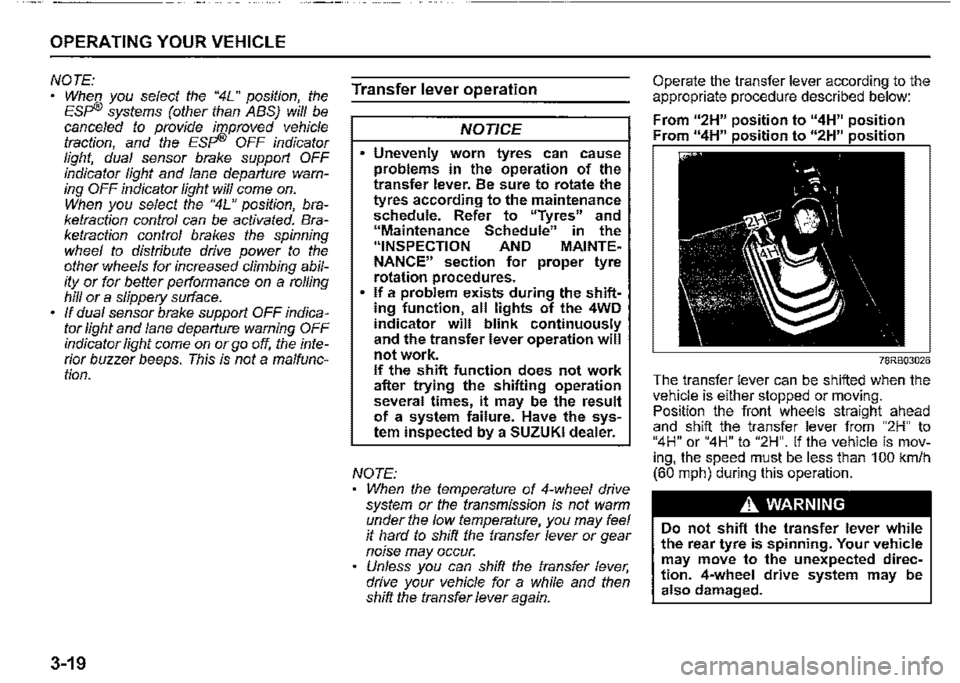
From u2H" position to "4H" position Fr " 11 • • " " • •
78RB03026
The transfer lever can be shifted when the vehi_c_le is either stopped or moving. Pos1t1on the front wheels straight ahead and shift the transfer lever from "2H" to "4H" or "4H" to "2H". If the vehicle is moving, the speed must be less than 100 km/h (60 mph) during this operation.
A WARNING
Do not shift the transfer lever while the rear tyre is spinning. Your vehicle may move to the unexpected direction. 4-wheel drive system may be also damaged.
Page 181 of 421
Situations where the system does not activate Under the following situations, the system does not activate. When the engine is off When dual sensor brake support indicator light and lane departure warning indicator light are initially lighting immediately after the ignition switch is turned to "ON". When the gearshift lever is in reverse gear When the ESP® system is activated (except the frontal collision warning) When the following switches are pushed and the system is turned off: -Dual sensor brake support OFF switch -ESP® OFF switch
When the dual sensor is temporarily stopped or malfunctioning
Situations where the system may not activate properly Under the following situations, the system may not activate. When the dual sensor cannot detect a vehicle or a pedestrian in front of your vehicle Refer to "Handling dual sensor" in the "OPERATING YOUR VEHICLE" section. When you take evasive action with the steering wheel or accelerator pedal
Situations where the vehicle may not decelerate properly Under the following situations, the vehicle may not decelerate properly even when the system is activated. When the outside temperature is low, or when the temperature of the brake is low such as right after starting When the brake is overheating and the brake effect is deteriorated due to continuing to travel on a downhill road When the brake effect is deteriorated due to passing over puddles or washing the vehicle When driving on the following roads -On sharp curves or extremely rough surfaces -On a steep slope When driving on the following slippery surfaces -Frozen or snow-covered surfaces -Over manholes or metal construction plates -Gravel When driving in a rainy day
OPERATING YOUR VEHICLE
Situations where the system may activate by chance Under the following situations, the dual sensor may judge that there is a vehicle or a pedestrian in front of you, and the system may activate. Drive carefully and calmly. When passing through a toll booth with more than recommended speeds Before the parking lot gates or railroad crossing gates are opened fully When operating on hills that have varying slopes When you suddenly accelerate and approach the vehicle in front of you or on neighboring lane Front visibility is poor due to that there is water vapor, sand or smoke or when the vehicle in front of you or on oncoming lane is surrounded by exhaust gas, water or snow When passing through masses of water vapor or smoke When stopping close to an obstacle in. front of you When passing through near a vehicle or obstacle
3-30
Page 197 of 421

When there is a large temperature gap between inside of the vehicle and outside air (such as winter), windshield is easy to fog. If the front portion of dual sensor on the windshield is fogged up or covered with condensation or ice, dual sensor brake support may not activate temporarily. In this case, use the front defroster to remove the fog, etc.
When cleaning inside of the windshield, do not adhere the glass cleaner to lens.
OPERATING YOUR VEHICLE
3-46
Page 199 of 421

NOTE: When the function of the dual sensor is temporarily stopped or malfunctioning, all of following functions will be turned off. Dual sensor brake support Lane departure warning Vehicle swaying warning High beam assist Traffic sign recognition
Temporary stop of the dual sensor Under the following situations, the function of the dual sensor stops temporarily. When the situations are improved, the temporary stop of the function will be canceled. When the visibility of the dual sensor is poor Refer to "Situations where the dual sensor may not activate properly" in this section for details. When the temperature of the body of dual sensor is high When the systems related to the dual sensor brake support are stopped temporarily When the battery has a voltage abnormality
Failure of the dual sensor When the dual sensor is faulty, the function of the dual sensor is stopped until the ignition switch is turned to "LOCK". Find a safe place to park and turn the ignition switch to "LOCK". Restart the engine, and check that the dual sensor brake support indicator light, lane departure warning indicator light, and high beam assist warning light go off. If all of the indicators stay on after restarting the engine, there may be a failure of the dual sensor. Ask a SUZUKI dealer to have the dual sensor inspected.
NOTE: Under the following situations, the dual sensor brake support indicator light, lane departure warning indicator light, and high beam assist warning light come on after the engine has been started, it does not indicate a malfunction. Once the ignition switch to is turned to "LOCK" position and then the engine is restarted, these indicators will go off. -When the automatic brake system has been operating 3 times -When the automatic brake system has been operating for long periods
OPERATING YOUR VEHICLE
The function of the dual sensor is stopped if the dual sensor brake support indicator light, lane departure warning indicator light, and high beam assist warning light come on and there may be a failure of the dual sensor, but it r}oes not hinder normal driving.
Pedestrian detection The dual sensor detects pedestrians by whose size, shape or motion.
•
•
T
(1)
75RM238
(1) About 1 -2 m (3.3 -6.6 ft)
3-48
Page 211 of 421
A WARNING
• When the hill descent control system is used continuously for a long time, the temperature of the bra~e system may increase and the hill descent control system may be deactivated temporarily to protect the device of the brake system. The hill descent control indicator blinks to let you know the system is deactivated. Depress the brake pedal and stop the vehicle in a safe place. When the temperature of the brake system goes down, the hill descent control indicator will come on and the system is activated again. • The hill descent control system may be activated when the gearshift lever is in "N" (Neutral) posi~ tion, but engine braking will not work. Always use the hill descent control system with the gearshift lever in a forward gear or reverse
gear. When using the hill descent control system, push the hill descent control switch and make sure that the hill descent control indicator light comes on and no warning message are indicated on the information display.
NOTE: You may hear a sound coming from the engine when the hill descent control system is activated. This sound is normal and does not indicate a malfunction.
To turn off the hill descent control system, push the hill descent control switch and turn off the hill descent control indicator
light.
OPERATING YOUR VEHICLE
Hill descent control indicator light
79K050
When the ignition switch is in "ON" position, this light comes on briefiy so you can check that the light is working.
When you push the hill descent control switch and the hill descent control operating conditions are fulfilled, the hill desce~t control indicator comes on. If the hill descent control indicator blinks, the hill descent control will not be activated.
If hill descent control indicator light comes on while not operating the hill descent control switch, or the indicator light does not come on after the switch is pushed, there is a problem in this system. Have your vehicle inspected by a SUZUKI dealer.
3-60