temperature SUZUKI JIMNY 2022 Service Manual
[x] Cancel search | Manufacturer: SUZUKI, Model Year: 2022, Model line: JIMNY, Model: SUZUKI JIMNY 2022Pages: 421, PDF Size: 6.35 MB
Page 345 of 421
Refill with oil and oil leakage check
1) Pour oil through the filler hole and install the filler cap. For the approximate capacity of the oil, refer to "Recommended fuel / lubricants and capacities (approx.)" in "SPECIFICATIONS" section. 2) Start the engine and carefully check the oil filter and the drain plug for leakage. Run the engine at various speeds for at least 5 minutes. 3) Stop the engine and wait about 5 minutes. Check the oil level again and add oil if necessary. Check for leakage again.
NOTICE
When replacing the oil filter, it is recommended that you use a genuine SUZUKI replacement filter. If you use an aftermarket filter, check that it is of equivalent quality and follow the manufacturer's instructions. • Oil leakage from the periphery of the oil filter or drain plug indicate incorrect installation or gasket damage. If you find any leakage or are not sure that the filter has been properly tightened, have the vehicle inspected by a SUZUKI dealer.
Engine coolant
Selection of coolant
NOTICE
SUZUKI LLC: Super (Blue) coolant; This coolant is already diluted to the proper percentage. Do not dilute with distilled water additionally. Doing so may result in the possibility of freezing and/or overheating coolant.
To maintain optimum performance and durability of your engine, use SUZUKI genuine coolant or equivalent.
NOTE: If you use the engine coolant other than the SUZUKI LLC: Super (Blue) for replacement, follow the schedule of SUZUKI LLC: Standard (Green). To see the detail of the maintenance schedule, refer to "Periodic maintenance schedule" in this section.
This type of coolant is the best for cooling system for the following reasons: • The coolant helps maintain proper engine temperature. It gives proper protection against freezing and boiling. It gives proper protection against corrosion and rust.
INSPECTION AND MAINTENANCE
Failure to use the proper coolant can damage your cooling system. Your SUZUKI dealer can help you select the proper coolant.
NOTICE
To avoid damaging your cooling system: Always use a high quality ethylene glycol base non-silicate type coolant diluted with distilled water at the correct mixture concentration. Check that the proper mix is 50/50 coolant to distilled water and in no case higher than 70/30. Concentrations greater than 70/30 coolant to distilled water will cause overheating conditions. Do not use straight coolant nor plain water (except "SUZUKI LLC: Super {Blue)"). . • Do not add extra inhibitors or additives. They may not be compatible with your cooling system. Do not mix different types of base coolants. Doing so may result in accelerated seal wear and/or the possibility of severe overheating and extensive engine/automatic transmission damage.
6-28
Page 346 of 421
INSPECTION AND MAINTENANCE
NOTE: SUZUKI highly recommends the use of ECSTAR brand coolant. ECSTAR has been specially formulated for your SUZUKI product and contributes to the desired vehicle performance and ideal driving experience.
Coolant level check
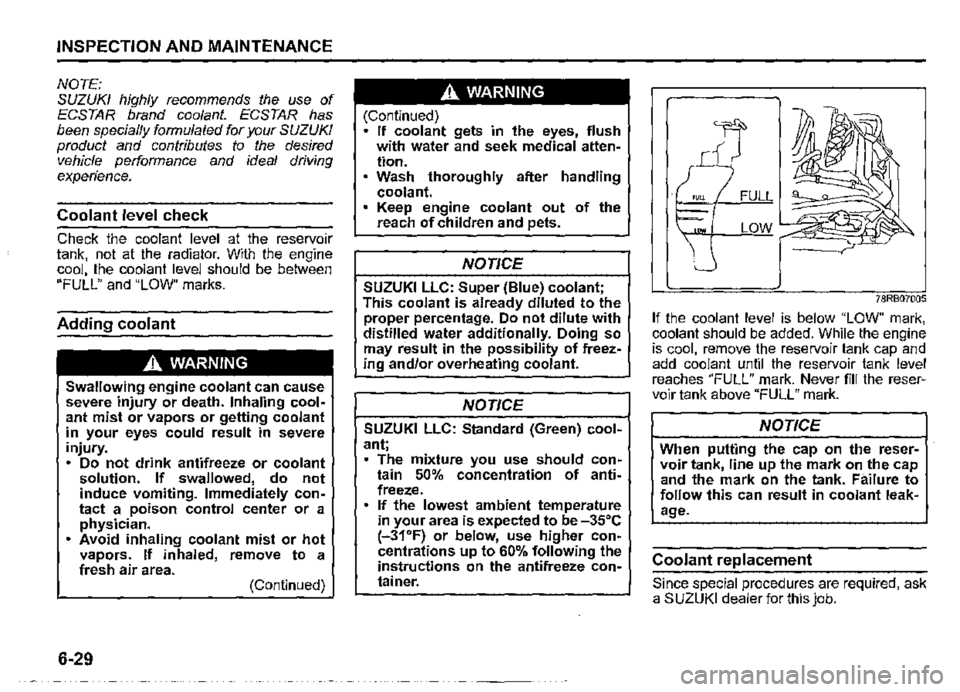
Check the coolant level at the reservoir tank, not at the radiator. With the engine cool, the coolant level should be between "FULL" and "LOW" marks.
Adding coolant
,A WARNING
Swallowing engine coolant can cause severe injury or death. Inhaling coolant mist or vapors or getting coolant in your eyes could result in severe injury. • Do not drink antifreeze or coolant solution. If swallowed, do not induce vomiting. Immediately contact a poison control center or a physician. • Avoid inhaling coolant mist or hot vapors. If inhaled, remove to a fresh air area. (Continued)
6-29
,A WARNING
(Continued) • If coolant gets in the eyes, flush with water and seek medical attention. Wash thoroughly after handling coolant. Keep engine coolant out of the reach of children and pets.
NOTICE
SUZUKI LLC: Super (Blue) coolant; This coolant is already diluted to the proper percentage. Do not dilute with distilled water additionally. Doing so may result in the possibility of freezing and/or overheating coolant.
NOTICE
SUZUKI LLC: Standard (Green) coolant; • The mixture you use should contain 50% concentration of antifreeze. If the lowest ambient temperature in your area is expected lo be -35°C (-31'F) or below, use higher concentrations up to 60% following the instructions on the antifreeze container.
78RB07005
If the coolant level is below "LOW" mark, coolant should be added. While the engine is cool, remove the reservoir tank cap and add coolant until the reservoir tank level reaches "FULL" mark. Never fill the reservoir tank above "FULL" mark.
NOTICE
When putting the cap on the reservoir tank, line up the mark on the cap and the mark on the tank. Failure to follow this can result in coolant leakage.
Coolant replacement
Since special procedures are required, ask a SUZUKI dealer for this job.
Page 350 of 421
· INSPECTION AND MAINTENANCE
A CAUTION
After driving the vehicle, the gear oil temperature may be high enough to burn you. Wait until the oil filler and level plug are cool enough to touch with your bare hands before inspecting gear oil level.
NOTICE
Be sure to use new plug with new gasket to avoid loose·ness of the plug and oil leakage.
Gear oil change
Since special procedures, materials and tools are required, ask a SUZUKI dealer for this job.
6-33
Clutch pedal
Fluid control clutch
78RB07011
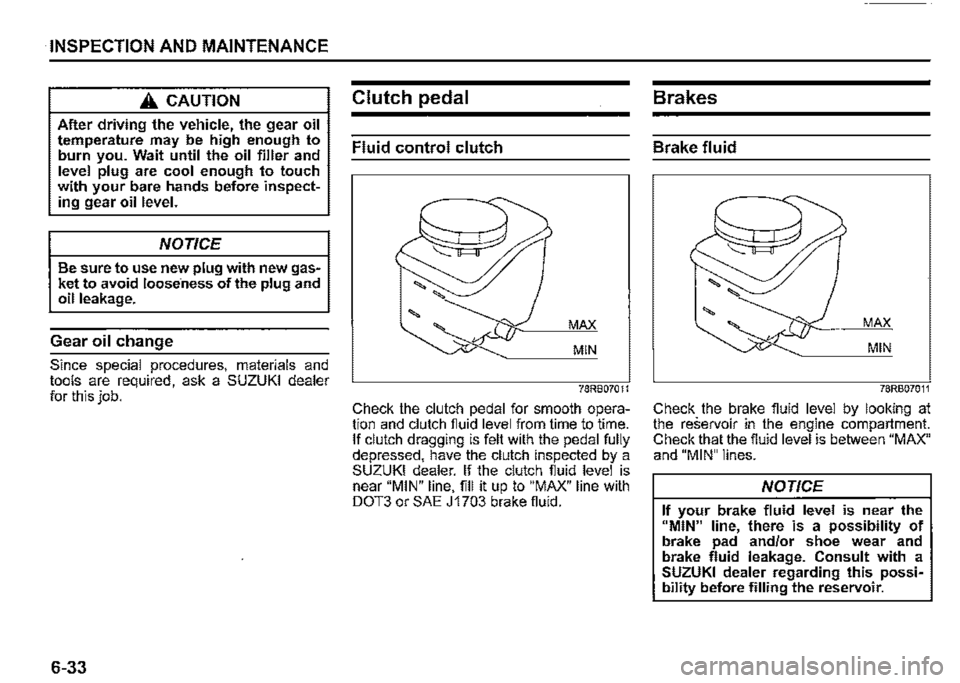
Check the clutch pedal for smooth operation and clutch fiuid level from time to time. If clutch dragging is felt with the pedal fully depressed, have the clutch inspected by a SUZUKI dealer. If the clutch fiuid level is near "MIN" line, fill it up to "MAX" line with DOT3 or SAE J1703 brake fiuid.
Brakes
Brake fluid
MAX
MIN
78RB07011
Check the brake fluid level by looking at the reservoir in the engine compartment. Check that the fiuid level is between "MAX" and "MIN" lines.
NOTICE
If your brake fluid level is near the 11MIN" line, there is a possibility of brake pad and/or shoe wear and brake fluid leakage. Consult with a SUZUKI dealer regarding this possibility before filling the reservoir.
Page 353 of 421

Brake discs and brake drums
Brake disc
Brake location Minimum thickness
Front wheels 8.0 mm (0.3 in.)
Brake drum
Brake location Maximum inner diameter
Rear wheels 222 mm (8.74 in.)
If the measured thickness or inner diameter of the most worn part falls below or exceeds the value indicated above, the parts should be replaced with a new one. The measurement involves disassembling each brake and requires the use of a micrometer or caliper, which must be done according to the instructions described in the relevant service manual or available from the relevant repair information site.
Steering wheel
78RB07012
Steering wheel play 11c": 0-30 mm (0.0 -1.2 in.)
Check the free play of the steering wheel by gently turning it from left to right and measuring the distance that it moves before you feel slight resistance. The play should be between the specified values.
Check that the steering wheel turns easily and smoothly without rattling by turning it all the way to the right and to the left while driving very slowly in an open area. If the amount of free play is not as specified or you find anything else to be wrong, an inspection must be performed by a SUZUKI dealer.
INSPECTION AND MAINTENANCE
Tyres
78RB07013
The front and rear tyre pressure specifications are listed in the tyre information label. Both front and rear tyres should have the specified tyre pressure.
NOTE: The tyre pressure will change due to changes in atmospheric pressure, temperature or tyre temperature when driving. To reduce the chance that the low tyre pressure warning light (if equipped) will come on due to normal changes in temperature and atmospheric pressure, it is important to check and adjust the tyre pressures when the tyres are cold. If you check tyres after driving, they are warm. Even if the tyre pressure seems to be good in this condition, it could fall below the
6-36
Page 354 of 421

INSPECTION AND MAINTENANCE
specified pressure when tyres cool down. Also, tyres that are inflated to the specified pressure in a warm garage may have pressure below the specification when the vehicle is driven outside in very cold temperature. If you adjust the tyre pressure in a garage that is warmer than the outside temperature, you should add 1 kPa to the recommended cold tyre pressure for every O.B'C difference between garage temperature and outside temperature.
6-37
Tyre inspection
Inspect your vehicle's tyres at least once a month or before long trip by performing the following checks:
1) Measure the air pressure with a tyre gauge. Adjust the pressure if necessary. Remember to check the spare tyre, too.
A WARNING
• Air pressures should be checked when the tyres are cold or you may get inaccurate readings. Check the inflation pressure from time to time while inflating the tyre gradually, until the specified pressure is obtained. Never under-inflate or over-inflate the tyres. Under-inflation can cause unusual handling characteristics or can cause the rim to slip on the tyre bead, resulting in an accident or damage to the tyre or rim. Over-inflation can cause the lyre to burst, resulting in personal injury. Over-inflation can also cause unusual handling characteristics which may result in an accident.
(1)
~ (2)
78RB07048
(1) Tread wear indicator (2) Indicator location mark
2) Check that the depth of the tread groove is more than 1.6 mm (0.06 in.). To help you check this, the tyres have molded-in tread wear indicators in the grooves. When the indicators appear on the tread surface, the remaining depth of the tread is 1.6 mm (0.06 in.) or less and the tyre should be replaced. 3) Check for abnormal wear, cracks and damage. Any tyres with cracks or other damage should be replaced. If any tyres show abnormal wear, have them inspected by a SUZUKI dealer.
Page 387 of 421
Engine trouble: Starter does
not operate
1) Try turning the ignition switch to "START" position with the headlights turned on to determine the lead-acid battery condition. If the headlights go excessively dim or go off, it usually means that either the lead-acid battery is discharged or the battery terminal contact is poor. Recharge the lead-acid battery or correct battery terminal contact as necessary. 2) If the headlights remain bright, check the fuses. If the reason for failure of the starter is not obvious, there may be a major electrical problem. Have the vehicle inspected by a SUZUKI dealer.
Engine trouble: Does not start
Make sure that your vehicle has enough · fuel and battery. If the engine does not start under very cold condition, press the accelerator pedal all the way to the fioor and hold it while cranking the engine. Refer to "Starting engine" in operating your vehicle section. If the engine still does not start have your vehicle inspected at a SUZUKI dealer. Do not operate the starter motor for more than 12 seconds.
EMERGENCY SERVICE
Engine trouble: Overheating
The engine could overheat temporarily under severe driving conditions. If the high engine coolant temperature warning light comes on as overheating or the engine coolant temperature gauge indicates overheating during driving:
1) Turn off the air conditioner. 2) Take the vehicle to a safe place and park. 3) Run the engine at a normal idle speed for a few minutes until the high engine coolant temperature warning light goes off or the indicator is within the normal, acceptable temperature range between "H" and "C".
A WARNING
If you see or hear escaping steam, stop the vehicle in a safe place and immediately turn off the engine to cool it. Do not open the hood when steam is present. When the steam can no longer be seen or heard, open the hood to see if the coolant is still boiling. If it is, you must wait until it stops boiling before you proceed.
7-10
Page 388 of 421
EMERGENCY SERVICE
If the high engine coolant temperature warning light does not go off or the temperature indication does not come down to within the normal, acceptable range:
1) Turn off the engine and check that the water pump belt and pulleys are not damaged or slipping. If any abnormality is found, correct it. 2) Check the coolant level in the reservoir. If it is found to be lower than "LOW" line, check radiator, water pump, radiator hoses and heater hoses for leakage. If leakage that may cause overheating is found, do not run the engine until these problems have been corrected. 3) If leakage is not found, carefully add coolant to the reservoir and then the radiator, if necessary. (Refer to "Engine coolant" in "INSPECTION AND MAINTENANCE" section.)
NOTE: If engine overheats and you are not sure what to do, contact a SUZUKI dealer.
7-11
650614
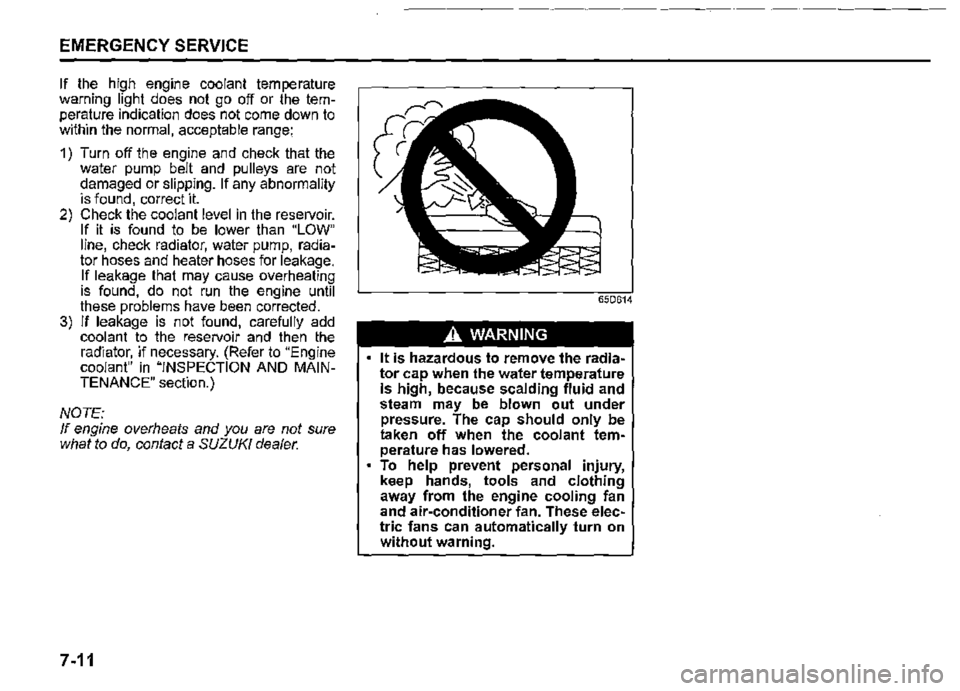
A WARNING
• It is hazardous to remove the radiator cap when the water temperature is high, because scalding fluid and steam may be blown out under pressure. The cap should only be taken off when the coolant temperature has lowered. To help prevent personal injury, keep hands, tools and clothing away from the engine cooling fan and air-conditioner fan. These electric fans can automatically turn on without warning.
Page 390 of 421
APPEARANCE CARE
Corrosion prevention
It is_ important to take good care of your vehicle to protect it from corrosion. Listed below are instructions for how to maintain your vehicle to prevent corrosion. Please read and follow these instructions carefully.
Important information about corro
sion
Common causes of corrosion 1) Accumulation of road salt, dirt moisture or chemicals in hard-to-reach areas of the vehicle underbody or frame. 2) Chipping, scratches and any damage to treated or painted metal surfaces resulting from minor accidents or abrasion by stones and gravel.
Environmental conditions which accelerate corrosion 1) Road salt, dust control chemicals, sea breeze or industrial pollution will all accelerate the corrosion of metal. 2) High humidity will increase the rate of corrosion particularly when the temperature range is just above the freezing point. 3) Moisture in certain areas of a vehicle for an extended period of lime may promote corrosion even though other body sections may be completely dry.
8-1
4) High temperatures will cause an accelerated rate of corrosion to parts of the vehicle which are not well-ventilated to permit quick drying.
This information illustrates the necessity of keeping your vehicle (particularly the ~nderbody) as clean and dry as possible. It Is equally important to repair any damage to the paint or protective coatings as soon as possible.
How to help prevent corrosion
Wash your vehicle frequently The_ best way to preserve the finish on your vehicle and to help avoid corrosion is to keep it clean with frequent washing. Wash your vehicle at least once during the winter and once immediately after the winter. K<:ep your vehicle, particularly the underside, as clean and dry as possible. If you frequently drive on salted roads your vehicle should be washed at least once a month during the winter. If you live near the ocean, your vehicle should be washed at least once a month throughout the year.
For washing instructions, refer to "Vehicle cleaning" section.
Remove foreign material deposits Foreign materials such as salts chemicals road oil or tar, tree sap, bird droppings and industnal fall-out may damage the finish of your vehicle if it is left on painted surfaces. Remove these types of deposits as quickly as possible. If these deposits are difficult to wash off, an additional cleaner may be required. Check that any cleaner you use is not harmful to painted surfaces and is specifically intended for your purposes. Follow the manufacturer's directions when using these special cleaners.
Repair finish damage Carefully examine your vehicle for damage to the painted surfaces. Should you find any chip~ or scratches in the paint, touch them up 1mmed1ately to prevent corrosion from starting. If the chips or scratches have gone through to the bare metal have a qualified body shop make the rep~ir.
Keep passenger and luggage compartments clean Moisture, dirt or mud can accumulate under the floor mats and may cause corrosion. Occasionally, check under these mats to ensure that this area is clean and dry. More fr~quent checks are necessary if the vehicle Is used for off-road driving or in wet weather. Certain cargos such as chemicals, fertilizers, cleaners, salts, etc. are extremely corrosive by nature. These products should be transported in sealed containers. If they
Page 412 of 421
INDEX
Driver's seat belt reminder light/ Front passenger's F seat belt reminder light ....................................................... 2-44 Floor mats ............................................................................... 1-1 Driving on hills ..................................................................... 4-11 Fluid control clutch .............................................................. 6-33 Driving range ............................................................... 2-20, 2-30 Folding rear seats .................................................................. 1-6 Driving time .......................................................................... 2-30 Footrest ................................................................................. 5-13 Dual sensor .......................................................................... 3-43 For Australia ......................................................................... 10-1 Dual sensor brake support indicator light ........................ 2-48 For Chile and Panama ......................................................... 10-6 Dual sensor brake support OFF indicator light ................ 2-49 For GCC countries ............................................................... 10-4 Dual sensor brake support OFF switch ............................. 3-37 For Russia ........................................................................... 10-20
E For Russia and other countries adopting
Electric mirrors .................................................................... 2-14 ERA-GLONASS ................................................................... 10-12
Electric window controls .................................................... 2-11 For Taiwan ............................................................................ 10-7
Electronic stability program (ESP®) ................................... 3-55 For Thailand ........................................................................ 10-11
Emergency locking retractor (ELR) ..................................• 1-1 O Frame hooks ......................................................................... 5-14
Emergency stop signal (ESS) ............................................. 3-52 Front airbags ........................................................................ 1-37
Engine coolant ..................................................................... 6-28 Front fog light ............................................. , ......................... 6-50
Engine coolant temperature light ....................................... 2-48 Front fog light indicator light .............................................. 2-52
Engine hood ........................................................................... 5-2 Front fog light switch ........................................................... 2-60
Engine oil and filter , ............................................................ 6-23 Front passenger airbag deactivation system .................... 1-47
Engine oil consumption ........................................................ 3-2 Front position light .............................................................. 6-48
Engine serial number ............................................................ 9-1 Front seat back pocket ........................................................ 5-11
Engine trouble: Does not start ........................................... 7-10 Front seat heater .................................................................... 1-4
Engine trouble: Overheating .............................................. 7-1 O Front turn signal light .......................................................... 6-48
Engine trouble: Starter does not operate .......................... 7-10 Fuel ...................................................................................... 10-11
ERA-GLONASS microphone ............................................. 10-12 Fuel consumption ............................................... 2-20, 2-30, 9-3
ERA-GLONASS Warning Light ......................................... 10-17
ESP® OFF indicator light. ........................................... 2-43, 3-57
ESP® OFF switch ................................................................. 3-58
Fuel filler cap .......................................................................... 5-1
Fuel gauge ................................................................... 2-16, 2-26
Fuel recommendation .......................................................... 10-6
ESP® warning light ..................................................... 2-42, 3-57 Fuses ..................................................................................... 6-42
Exhaust gas warning ........................................................... 1-49 Fuses in engine compartment ............................................ 6-43
Fuses under dashboard ...................................................... 6-45
11-2
Page 413 of 421
INDEX
G Immobilizer system ................................................................ 2-1
Gear oil ................................................................................. 6-31 Immobilizer system warning light ...................................... 2-46
Gear oil change .................................................................... 6-33 Improving fuel economy ...................................................... 4-10
Gear oil level check ............................................................. 6-32 Information display ..................................................... 2-18, 2-28
Gearshift indicator ...................................................... 2-32, 3-13 Information switch ......................................................... : ..... 2-27
Glove box ............................................................................... 5-9 Inside rearview mirror .......................................................... 2-13
Guide me light ...................................................................... 2-59 Installation of child restraint with top tether ..................... 1-32
H Installation of radio frequency transmitters ...................... 5-30
Halogen headlights .............................................................. 6-47
Hazard warning switch ........................................................ 2-67
Head restraints ................................................................ 1-4, 1-5
Headlight aiming .................................................................. 6-46
Headlight leveling switch .................................................... 2-65
Heated rear window switch / heated outside
Installation with ISOFIX type anchorages .......................... 1-29
Instantaneous fuel consumption ............................... 2-20, 2-30
Instrument cluster ....................................................... 2-15, 2-25
Instrument panel tray ........................................................... 5-10
Interior light ................................................................... 5-5, 6-53
J
rearview mirror switch ........................................................ 2-71 Jacking instructions .............................................................. 7-1
Heating and air conditioning system ................................. 5-16 Jump-starting instructions .................................................... 7-5
High beam assist ................................................................. 3-35 K
High beam assist indicator light (green) ........................... 2-52 Keyless entry system transmitter ......................................... 2-6
High beam assist warning light (orange) .......................... 2-51 Keys ......................................................................................... 2-1
High engine coolant temperature warning light L
(red color) ............................................................................. 2-48 Lane departure warning ...................................................... 3-33 Highway driving ................................................................... 4-1 O Lane departure warning indicator light.. ............................ 2-49
Hill descent control indicator light... .................................. 3-60 Lane departure warning OFF indicator light ..................... 2-50 Hill descent control switch ................................................. 3-59 Lane departure warning OFF switch .................................. 3-38 Hill hold control system ...................................................... 3-61 Lap-shoulder belt ................................................................. 1-1 O Horn ...................................................................................... 2-70 Lap-shoulder belt with detachable connector ................... 1-11 How ABS works ................................................................... 3-55 LED headlight warning light.. .............................................. 2-51
I LED headlights ..................................................................... 6-47
Ignition key reminder ............................................................ 2-2 License plate light ................................................................ 6-52
Ignition switch ........................................................................ 3-2 Light reminder buzzer .......................................................... 2-58
Illumination indicator light.. ................................................ 2-52 Lighting control lever .......................................................... 2-55
11-3