temperature SUZUKI JIMNY 2022 Owner's Manual
[x] Cancel search | Manufacturer: SUZUKI, Model Year: 2022, Model line: JIMNY, Model: SUZUKI JIMNY 2022Pages: 421, PDF Size: 6.35 MB
Page 212 of 421
OPERATING YOUR VEHICLE
NOTE: If the hill descent control indicator blinks when you push the hill descent control switch, check the following conditions. • The transfer lever is in 4-wheel drive high range position ("4H'? or 4-wheel drive low range position("4L '? • The gearshift lever is in a forward gear or reverse gear • The vehicle speed is under 25 km/h (15 mph) • The brake system is under normal oper-ating temperature
NOTE: If any of the following conditions occur, there may be a problem with the hill descent control system or the ESP8 system. Have your vehicle inspected by a SUZUKI dealer. The hill descent control indicator does not come on or blink when you push the hill descent control switch. The hill descent control indicator stays on when driving without pushing the hill descent control switch.
3-61
ESP
HILL HOLD DISABLE
75RM224
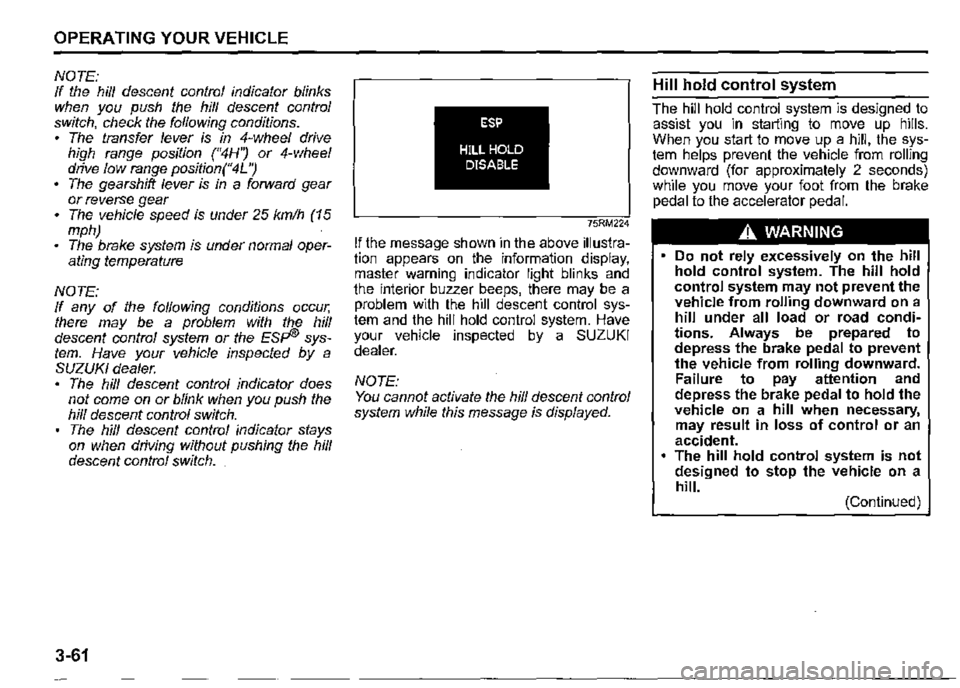
If the message shown in the above illustration appears on the information display, master warning indicator light blinks and the interior buzzer beeps, there may be a problem with the hill descent control system and the hill hold control system. Have your vehicle inspected by a SUZUKI dealer.
NOTE: You cannot activate the hill descent control system while this message is displayed.
Hill hold control system
The hill hold control system is designed to assist you in starting to move up hills. When you start to move up a hill, the system helps prevent the vehicle from rolling downward (for approximately 2 seconds) while you move your foot from the brake pedal to the accelerator pedal.
A WARNING
• Do not rely excessively on the hill hold control system. The hill hold control system may not prevent the vehicle from rolling downward on a hill under all load or road conditions. Always be prepared to depress the brake pedal to prevent the vehicle from rolling downward. Failure to pay attention and depress the brake pedal to hold the vehicle on a hill when necessary, may result in loss of control or an accident. The hill hold control system is not designed to stop the vehicle on a hill. (Continued)
Page 216 of 421
OPERATING YOUR VEHICLE
A WARNING
The load-carrying capacity of your tyres is reduced at lower inflation pressures. If your tyres are even moderately under-inflated, the load on the tyres may exceed the load-carrying capacity of the tyres, which could lead to tyre failure. The low tyre pressure warning light will not alert you to this condition, because it only comes on when one or more of your tyres becomes significantly underinflated.
Check and adjust your tyre pressure at least once a month. Refer to "Tyres" in "INSPECTION AND MAINTENANCE" section.
3-65
A WARNING
Continuing to drive with the low tyre pressure warning light on can lead to an accident, resulting in severe injury or death. If the low tyre pressure warning light comes on and stays on, reduce your speed and avoid abrupt steering and braking. Be aware that driving on a significantly under-inflated tyre can cause the tyre to overheat and can lead to tyre failure, and may affect steering control and brake effectiveness. Stop in a safe place as soon as possible and check your tyres. If you have a flat tyre, replace it with the spare tyre (if equipped). Refer to "Jacking instructions" in "EMERGENCY SERVICE" section for the tyre replacement method. Also refer to "Replacing tyres and/ or wheels" for instructions on how to restore normal operation of the TPMS after you have had a flat tyre. • If one or more of your tyres is under-inflated, adjust the inflation pressure in all of your tyres to the recommended inflation pressure as soon as possible.
The low tyre pressure warning light can come on due to normal causes such as natural air leakage and pressure changes caused by changes in temperature or atmospheric pressure. Adjusting the air pressure in the tyres to the pressure shown on the tyre information placard should cause the low tyre pressure warning light to turn off.
To make the low tyre pressure warning light go off, adjust the tyre pressures when the tyres are cold, and drive the vehicle for about 10 minutes. When the adjusted tyre pressure is recognized, the low tyre pressure warning light will go off and the information display shows the current tyre pressure (if you select the TPMS monitor (if equipped)).
Page 217 of 421
NOTICE
If the low tyre pressure warning light does not go off even when you drive for more than 10 minutes after adjusting the cold tyre pressure, there may be a problem with the TPMS. Have your vehicle inspected by a SUZUKI dealer.
If the light turns on again shortly after adjusting the pressure in your tyres. you may have a flat tyre. If you have a flat tyre, replace it with the spare tyre (if equipped). Refer to "Jacking instructions" in "EMERGENCY SERVICE"" section. Refer to "Replacing tyres and/or wheels" for instructions on how to restore normal operation of the tyre pressure monitoring system after you have had a flat tyre.
61MM0A198
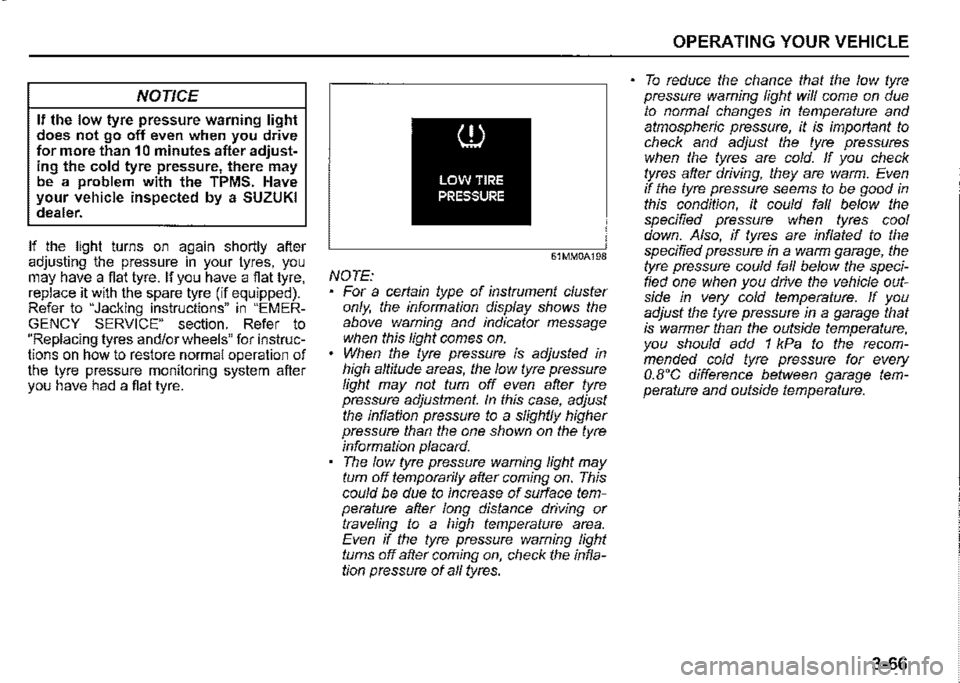
NOTE: For a certain type of instrument cluster only, the information display shows the above warning and indicator message when this light comes on. When the tyre pressure is adjusted in high altitude areas, the low tyre pressure light may not turn off even after tyre pressure adjustment. In this case, adjust the inflation pressure to a slightly higher pressure than the one shown on the tyre informaUon placard. The low tyre pressure warning light may turn off temporarily after coming on. This could be due to increase of surface temperature after long distance driving or traveling to a high temperature area. Even if the tyre pressure warning light turns off after coming on, check the inflation pressure of all tyres.
OPERATING YOUR VEHICLE
To reduce the chance that the low tyre pressure warning light will come on due to normal changes in temperature and atmospheric pressure, it is important to check and adjust the tyre pressures when the tyres are cold. If you check tyres after driving, they are warm. Even if the tyre pressure seems to be good in this condition, it could fall below the specified pressure when tyres cool down. Also, if tyres are inflated to the specified pressure in a warm garage, the tyre pressure could fall below the specified one when you drive the vehicle outside in very cold temperature. If you adjust the tyre pressure in a garage that is warmer than the outside temperature, you should add 1 kPa to the recommended cold tyre pressure for every O.B'C difference between garage temperature and outside temperature.
3-66
Page 233 of 421
Improving fuel economy
The following instructions will help you improve fuel economy.
Avoid excessive idling If you park your vehicle for more than one minute, stop the engine and start it again later. When warming up a cold engine, do not allow the engine to idle or apply full throttle until the engine has reached operating temperature. Allow the engine to warm up by driving.
Avoid fast starts F~st starts away from lights or stop signs will consume fuel unnecessarily and shorten engine life. Start off slowly.
Avoid unnecessary stops Avoid unnecessary deceleration and stopping. Try to maintain a moderate, steady speed whenever possible. Slowing down and then accelerating again uses more fuel.
Keep a steady cruising speed Drive at a constant speed that road and traffic conditions will permit.
Keep the air cleaner clean
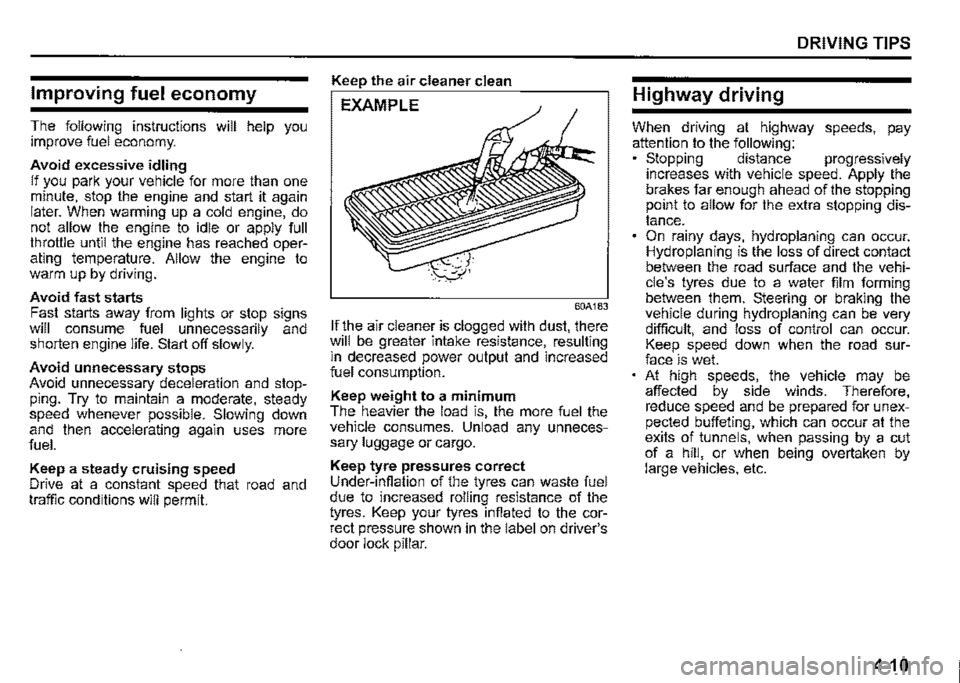
EXAMPLE
60A183
If the air cleaner is clogged with dust, there will be greater intake resistance, resulting m decreased power output and increased fuel consumption.
Keep weight to a minimum The heavier the load is, the more fuel the vehicle consumes. Unload any unnecessary luggage or cargo.
Keep tyre pressures correct Under-infiation of the tyres can waste fuel due to increased rolling resistance of the tyres. Keep your tyres infiated to the correct pressure shown in the label on driver's door lock pillar.
DRIVING TIPS
Highway driving
When driving at highway speeds, pay attention to the following: • Stopping distance progressively increases with vehicle speed. Apply the brakes far enough ahead of the stopping prnnt to allow for the extra stopping distance. On rainy days, hydroplaning can occur. Hydroplaning is the loss of direct contact between the road surface and the vehicle's tyres due to a water film forming between them. Steering or braking the vehicle during hydroplaning can be very difficult, and loss of control can occur. Keep speed down when the road surface is wet. At high speeds, the vehicle may be affected by side winds. Therefore, reduce speed and be prepared for unexpected buffeting, which can occur at the exits of tunnels, when passing by a cut of a hill, or when being overtaken by large vehicles, etc.
4-10
Page 252 of 421

OTHER CONTROLS AND EQUIPMENT
Center outlet
Move the knob (1 . 78Rsoso2, to adjust the direct~~rt1fally or horizontally, o airflow as desired.
5-17
Side outlet
When open ai 1aRsoso26
the air flow ~ele~t~~;i:iti~~t regardless of
A CAUTION
Prolonged exposur the heater or air e to. ~ot air from result in low t cond,tioner could vehicle occu ::;iperatu(e burns. All
dren, the eld~rly tsth part,c~larly chil
needs, individual's wft1e d w,1Jh special an~ sleeping ind' 'd e ,cate skin, ~amtain sufficient ~~• uals1 should air outlets to ,stance from the
exposure to hot ar~fvent prolonged ow.
Manual heating and .
cond"t" · air • ionmg system
Description of controls
Temperature sel t 78RBoso2s Th' . ec or (1) is is used to adjust the t emperature
Blowersp d · Thi . ee selector (2) s is used to turn select blower speed. on the blower and to
Page 253 of 421

Air intake selector (3)
78RB05029
This selector is used to select the following modes.
FRESH AIR (1 . selected by moving the When this mo e 'ts_ of (a) in the above lever to the pos, ,on . illustration, outside air comes m.
RECIRCULATED AIR (b) b moving the
When this mode !~ sel~t(i) i~ the above lever to the pos, ,on air is shut out and illustration, outs1d~ t d This mode is su,t
inside air is recirc~h~iugh dusty or polluted able when dnv,nf el or when attempting air such as m adunnn ~r warm up the inteto quickly cool ow rior.
NOTE: CULATED AIR for an If you select R:c:~me the air in the vehiextended per,o o tan-:inated and the win
c/e can bec~me ir:nisted. Therefore, yo'! dows tend oFgRESH AIR whenever poss,should select ble.
OTHER CONTROLS AND EQUIPMENT
USE
WITH-
(4)
52RS50180
NOTE: WITH" (6) The mark of "USThe windshield and/or the To clear fog on . kly, set the air flow side windows ~::i~Af & DEFROST' or selector (4~. to d . ·ntake selector (3) to
"DEEFRSHOSA~R'?nTh::e' positioning will clear "FR : . Id d/or the side wmthe fogged wmdshteth a~'RECIRCULATED dows faster than e AIR".
Air flow selector (4)
52RM50250
This 1s use . . d to select one of the following
functions.
VENTILATION (c)
· omes Temperature-controlled air c the center and side air outlets.
5-18
Page 254 of 421

OTHER CONTROLS AND EQUIPMENT
BI-LEVEL (d)
78RB05031
Temperature-controlled air comes out of the floor outlets and cooler air comes out of the center and side outlets. When the temperature selector (1) is in the fully cold position or fully hot position, however, the air from the floor outlets and the air from the center and side outlets will be the same temperature.
5-19
HEAT (e)
78RB05032
Temperature-controlled air comes out of the floor outlets and the side outlets, also comes out of the windshield defroster outlets and also comes slightly out of the side defroster outlets.
HEAT & DEFROST (f)
78RB05033
Temperature-controlled air comes out of the floor outlets, the windshield defroster outlets, the side defroster outlets and the side outlets.
Page 255 of 421
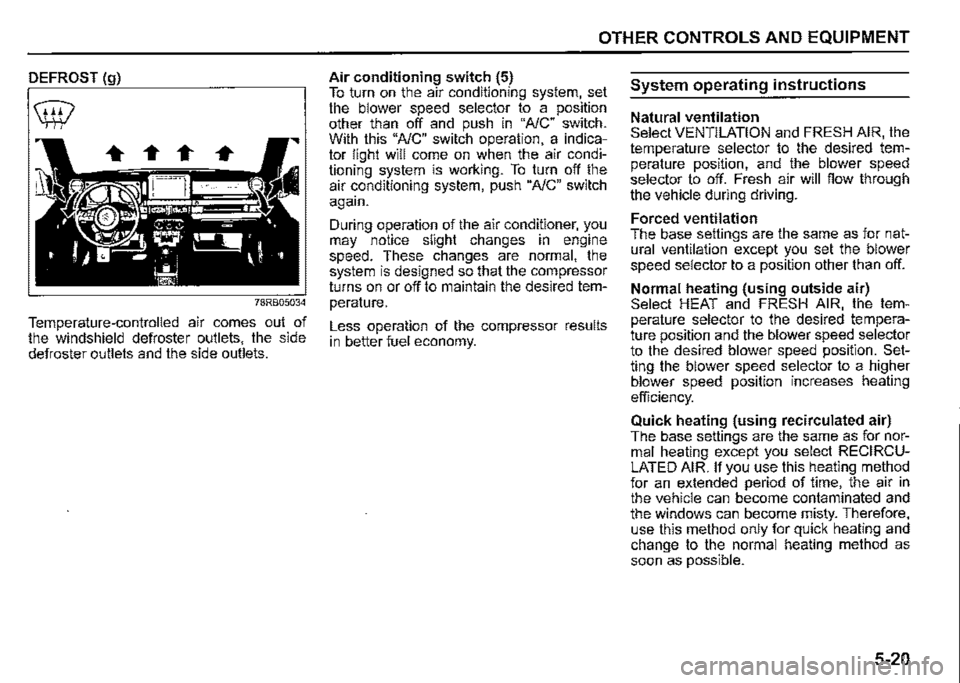
DEFROST (g)
78RB05034
Temperature-controlled air comes out of the windshield defroster outlets, the side defroster outlets and the side outlets.
OTHER CONTROLS AND EQUIPMENT
Air conditioning switch (5) To turn on the air conditioning system, set the blower speed selector to a position other than off and push in "NC" switch. With this "NC" switch operation, a indicator light will come on when the air conditioning system is working. To turn off the air conditioning system, push "NC" switch again.
During operation of the air conditioner, you may notice slight changes in engine speed. These changes are normal, the system is designed so that the compressor turns on or off to maintain the desired temperature.
Less operation of the compressor results in better fuel economy.
System operating instructions
Natural ventilation Select VENTILATION and FRESH AIR, the temperature selector to the desired temperature position, and the blower speed selector to off. Fresh air will flow through the vehicle during driving.
Forced ventilation The base settings are the same as for natural ventilation except you set the blower speed selector to a position other than off.
Normal heating (using outside air) Select HEAT and FRESH AIR, the temperature selector to the desired temperature position and the blower speed selector to the desired blower speed position. Setting the blower speed selector to a higher blower speed position increases heating
efficiency.
Quick heating (using recirculated air) The base settings are the same as for normal heating except you select RECIRCULATED AIR. If you use this heating method for an extended period of time, the air in the vehicle can become contaminated and the windows can become misty. Therefore, use this method only for quick heating and change to the normal heating method as soon as possible.
5-20
Page 256 of 421
OTHER CONTROLS AND EQUIPMENT
Head cooled/Feet warmed heating Select BI-LEVEL and FRESH AIR, the temperature selector to the desired temperature position, and the blower speed selector to the desired blower speed position. Unless the temperature selector is in the fully cold position or fully hot position, the air that comes out of the center and side outlets will be cooler than the air that comes out of the floor outlets.
Normal cooling Set the air flow selector to VENTILATION, the temperature selector to the desired temperature position and the blower speed selector to the desired blower speed position, and turn on "NG" switch. Setting the blower speed selector to a higher blower speed position increases cooling efficiency.
You can switch the air intake selector to either FRESH AIR or RECIRCULATED AIR as you desire. Choosing RECIRCULATED AIR increases cooling efficiency.
Quick cooling (using recirculated air) The base settings are the same as for normal cooling except you select RECIRCULATED AIR and the highest blower speed.
NOTE: If you select RECIRCULATED AIR for an extended period of time, the air in the vehicle can become contaminated and the windows tend to get misted. Therefore, you should select FRESH AIR whenever possible.
5-21
If your vehicle has been left in the sun with the windows closed, it will cool faster if you open the windows briefly while you operate the air conditioner with the air intake selector at FRESH AIR and the blower at high speed.
Dehumidifying Set the air flow selector to a desired air flow selector position, the temperature selector to the desired temperature position and the blower speed selector to the desired blower speed position. Also select FRESH AIR and turn on "NG" switch.
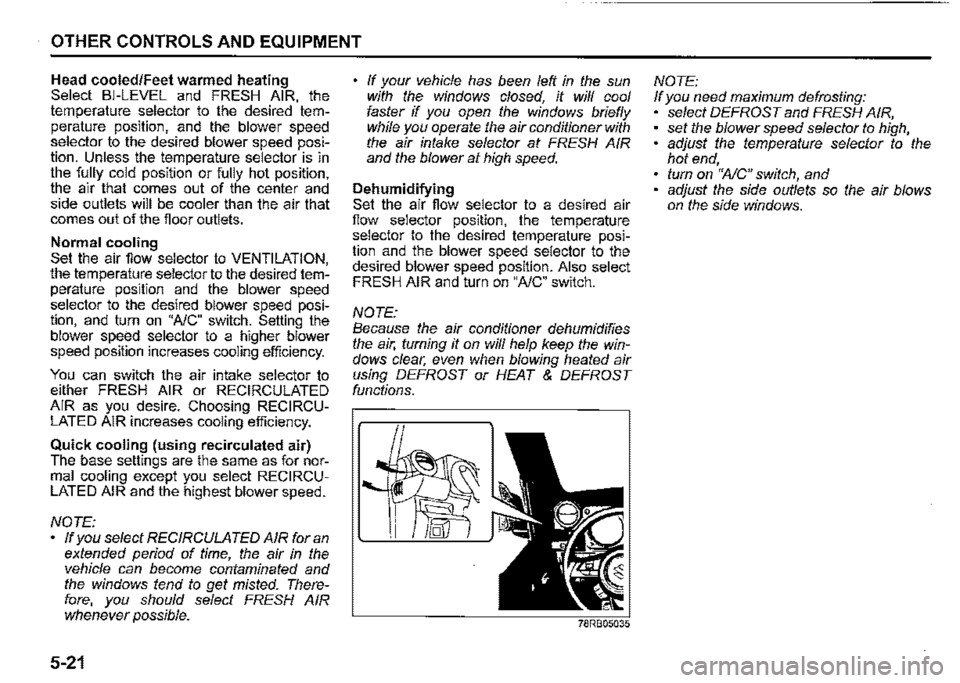
NOTE: Because the air conditioner dehumidifies the air, turning it on will help keep the windows clear, even when blowing heated air using DEFROST or HEAT & DEFROST functions.
NOTE: If you need maximum defrosting: select DEFROST and FRESH AIR, set the blower speed selector to high, adjust the temperature selector to the hot end, turn on 'WC" switch, and adjust the side outlets so the air blows on the side windows.
Page 258 of 421

OTHER CONTROLS AND EQUIPMENT
Automatic heating and air conditioning system
{climate control)
Description of controls
(5) (4) (9) (7) (8)
MODE OFF
'm' 0 fR
(2) (3) (6) (1)
5-23
78RB05036
(1) Temperature selector (2) Blower speed selector (3) Air intake selector (4) Airfiow selector (5) Defrost switch (6) Air conditioning switch (7) "OFF" switch (8) "AUTO" switch (9) Display