seat SUZUKI JIMNY 2022 Repair Manual
[x] Cancel search | Manufacturer: SUZUKI, Model Year: 2022, Model line: JIMNY, Model: SUZUKI JIMNY 2022Pages: 421, PDF Size: 6.35 MB
Page 193 of 421

81M40380
When raindrop, water or dirt on the windshield is not wiped up enough While using the windshield washer When a wiper blade other than SUZUKI genuine parts, including short type wiper
blade is used When the tyres are not inflated to the recommended tyre inflation pressure or when the tyres except the assignment size are equipped,
72M20405
When your vehicle is weighed down by heavy items in the luggage compartment or rear seat
When the headlights are covered in dirt, snow, ice or mud When the optical axis of the headlight is deviated When the brightness changes extremely (for example, passing the entrance or exit of tunnel), When the vehicle is swaying on the rough roads (for example, unevenness roads or stone pavement roads) and the visibility of the monocular camera is unstable, There may be a case to display the traffic sign irrelevant to the vehicle, the traffic sign that is not existed around the vehicle under the following situations. -When the traffic sign is existed on the branched road, the junction or the adjacent lane near the road that the vehicle is moving, -When there are similar things to the color and the object of the traffic sign (for example, the similar traffic sign, the signboard or the structures) -When the vehicle that the decal or sticker like the traffic sign is pasted on is existed in front of your vehicle, or when you overtake such a vehicle, -When the traffic sign is in front of the vehicle on the roundabout,
OPERATING YOUR VEHICLE
NOTE: The traffic sign may be continued to display on the information display under the following situations. Drive safely according to the actual traffic rules. -When you drive in the area where the different speed limit is established even though there is no speed limit sign, -When you drive in the area where the end of traffic regulation is indicated by the lane on the road even though there is no traffic sign to indicate the end of the traffic regulation,
Situations where the dual sensor cannot be detected accurately by the positions or conditions of the traffic signs The detection of traffic sign may be done with delay or there may be a possibility to occur no detection or inaccurate detection of the traffic sign including the supplemental mark under the following situations. When the traffic sign is dirt and hidden by the leaves of the tree or the vehicle in front of your vehicle and then it is hard to recognize the traffic sign, When the circumstance of the traffic sign is complicated and it is hard to recognize the traffic sign, When the traffic sign is far from the vehicle, When the traffic sign is bended or
deformed, When the color of the traffic sign is
faded,
3-42
Page 201 of 421

72M20405
When your vehicle is weighed down by heavy items in the luggage compartment or rear seat When wheel alignment is deviated When the tyres are not infiated to the recommended tyre pressure or the tyres are worn With snow chains or non-specified sized tyres equipped When you have a temporarily repaired fiat tyre With a modified suspension equipped When passing through the entrance or exit of the tunnel and the brightness is changed extremely When driving without lighting the headlights at night or in tunnels When driving on the following roads -On sharp curves or extremely rough surfaces -On a steep slope -On seam of the road When vehicle is swaying When the optical axis of the headlight is deviated
With modified headlights and/or front fog lights equipped When the headlights are covered in dirt, snow, ice or mud
When the following types of a vehicle are in front of you, or when the following situations occur, the dual sensor may not detect a vehicle in front of you or may need more time to detect a vehicle. ·
72M20407
Vehicles in front of you have small, low, or uneven backs as shown below: -A track without side or back gates, and when mounting no luggage on the cargo bed -A vehicle with luggage protruding out from the back -A specially shaped vehicle such as a car carrier trailer or a motorcycle with side car -A low-slung vehicle When ground clearance of vehicle in front of you is extremely high. When a vehicle is oncoming or retreating vehicle
OPERATING YOUR VEHICLE
When a vehicle facing sideways When a vehicle in front of you without turning on the tail lights at night or in tunnels When a vehicle in front of you refiects sunlight strongly When there is a wall in front of the parked vehicle When there is another obstacle beside a vehicle
D
72M20406
When only a part of the vehicle in front of you is within the dual sensor detection field When the difference of speed between the vehicle in front of you and your vehicle is increased When the distance to the vehicle in front of you is short When the vehicle in front of you is difficult to refiect the laser beam When driving on a curve For a while after escaping from a curve When the vehicle in front of you turns, accelerates or decelerates suddenly When a vehicle in front of you jumps out
3-50
Page 224 of 421
DRIVING TIPS
52D078
A WARNING
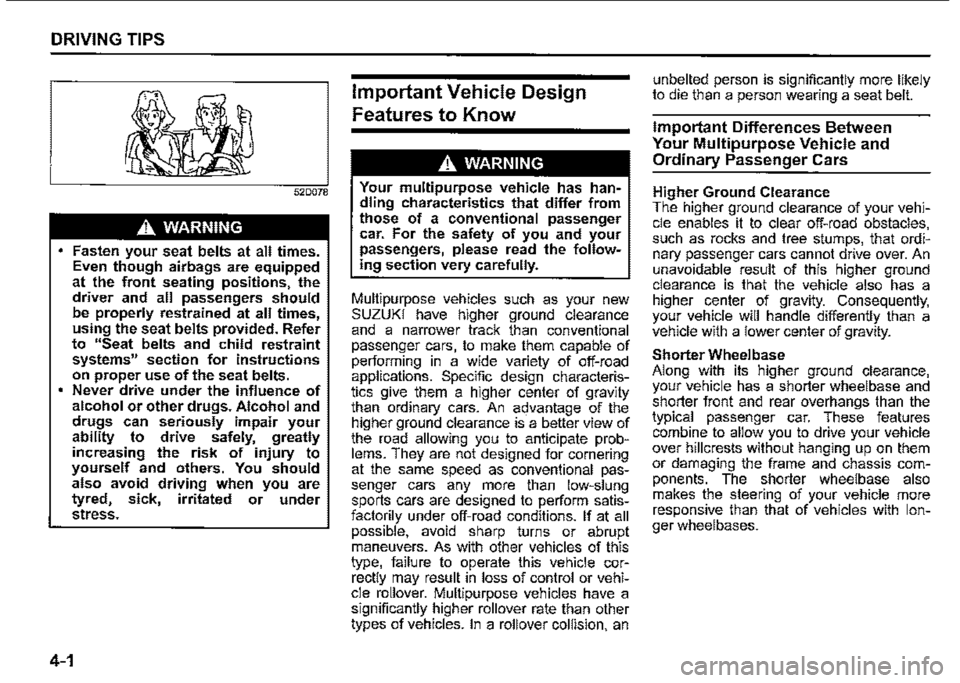
Fasten your seat belts at all times. Even though airbags are equipped at the front seating positions, the driver and all passengers should be properly restrained at all times, using the seat belts provided. Refer to "Seat belts and child restraint systems" section for instructions on proper use of the seat belts. Never drive under the influence of alcohol or other drugs. Alcohol and drugs can seriously impair your ability to drive safely, greatly increasing the risk of injury to yourself and others. You should also avoid driving when you are tyred, sick, irritated or under stress.
4-1
Important Vehicle Design
Features to Know
A WARNING
Your multipurpose vehicle has handling characteristics that differ from those of a conventional passenger car. For the safety of you and your passengers, please read the following section very carefully.
Multipurpose vehicles such as your new SUZUKI have higher ground clearance and a narrower track than conventional passenger cars, to make them capable of performing in a wide variety of off-road applications. Specific design characteristics give them a higher center of gravity than ordinary cars. An advantage of the higher ground clearance is a better view of the road allowing you to anticipate problems. They are not designed for cornering at the same speed as conventional passenger cars any more than low-slung sports cars are designed to perform satisfactorily under off-road conditions. If at all possible, avoid sharp turns or abrupt maneuvers. As with other vehicles of this type, failure to operate this vehicle correctly may result in loss of control or vehicle rollover. Multipurpose vehicles have a significantly higher rollover rate than other types of vehicles. In a rollover collision, an
unbelted person is significantly more likely to die than a person wearing a seat belt.
Important Differences Between
Your Multipurpose Vehicle and
Ordinary Passenger Cars
Higher Ground Clearance The higher ground clearance of your vehicle enables it to clear off-road obstacles, such as rocks and tree stumps, that ordinary passenger cars cannot drive over. An unavoidable result of this higher ground clearance is that the vehicle also has a higher center of gravity. Consequently, your vehicle will handle differently than a vehicle with a lower center of gravity.
Shorter Wheelbase Along with its higher ground clearance, your vehicle has a shorter wheelbase and shorter front and rear overhangs than the typical passenger car. These features combine to allow you to drive your vehicle over hillcrests without hanging up on them or damaging the frame and chassis components. The shorter wheelbase also makes the steering of your vehicle more responsive than that of vehicles with longer wheelbases.
Page 226 of 421

DRIVING TIPS
Know Your Vehicle
Take time to familiarize yourself with the unique handling characteristics of your vehicle by first driving around in an area away from traffic. Practice turning the vehicle at a variety of speeds and in different directions. Get a feel for the greater steering response that your vehicle has over a conventional car.
Wear Your Seat Belts at All Times
The driver and all passengers should be properly restrained at all times, using the seat belts provided. Refer to the "SEAT BELTS" section for instructions on proper use of the seat belts.
Don't Make Sharp Turns
As mentioned before, small multipurpose vehicles have specific design characteristics that allow them to perform in a wide variety of applications. These characteristics also change the cornering behavior relative to conventional passenger cars. Remember, small multipurpose vehicles have more responsive steering and a higher center of gravity than conventional passenger cars. If at all possible, avoid making sharp turns in your vehicle.
4-3
Slow Down on Curves
Learn to approach curves cautiously and at a conservative speed. Do not attempt to take curves at the same speeds that you would in a vehicle with a lower center of gravity. Just as you would not drive a sports car on a trail, you should not attempt to drive your vehicle around curves like a sports car.
Slow Down and Use Caution on
Slippery Roads
60G089A
Under wet road conditions you should drive at a lower speed than on dry roads due to possible slippage of tyres during braking. When driving on icy, snow-covered, or muddy roads, reduce your speed and avoid sudden acceleration, abrupt braking, or sharp steering movements. Use 4-wheel drive high range (4H) for better traction.
Page 227 of 421
NOTICE
Never operate your vehicle in 114H" or 114L11 on dry pavement and, as much as possible, avoid using 114H" or 114L" on wet pavement, as this puts severe stress on the drive train, especially during tight cornering, and can d~mage it. Also, you may have some d1ff1~ culty in steering.
Off-Road Driving
Your vehicle has specific design characteristics for off-road driving. When you leave the paved road, you will encounter driving surfaces of all kinds which may change continually as you drive. In most cases, offroad driving requires the use of 4-wheel drive.
Use Caution on Steep Inclines
Always inspect hills before you attempt to drive up them. Know what is on the other side and how you will get back down. If you have any doubt that it. is safe, do not attempt to drive over a hill. Nev".r d_nve your vehicle up an extremely steep incline. Coming down a steep hill can be trickier than getting up one. Keep the vehicle heading straight down the hill and use low gear. Do not lock the brake~. If the vehicle begins to slide, accelerate slightly to regain steering control.
DRIVING TIPS
Do not Drive Across the Side of
Hills
Driving across the side of a hill can be extremely hazardous. Most of the vehicle'.s weight will be transferred to the downhill tyres, which could result in the vehicle rolling sideways. Whenever possible, avoid this potential hazard. Also, 1f you have to exit your vehicle on a side-hill, always get out on the uphill side.
Wear Your Seat Belts at All Times
You and your passengers should use the seat belts at all times when driving offroad. For proper seat belt use, refer to the "Seat Belts" section in this manual.
Avoid Sudden Reactions in Mud,
Ice, or Snow
Be careful when off-road conditions are slippery. Reduce your speed and avoid sudden movements of the vehicle. Be aware that driving in deep snow or mud can cause a loss of traction and an increase in the resistance to the vehicle's forward motion. Use 4WD low gear (4L) and maintain a steady but moderate speed with a light touch on the steering wheel and brakes.
4-4
Page 231 of 421

A WARNING
In addition to following the driving tips in this section, it is important to observe the following precautions for on-road and off-road driving. Driver and passengers should wear seat belts at all times. Do not let anyone else drive your vehicle unless they are also aware of the vehicle characteristics and handling differences described in this section. Avoid loaning your vehicle to any• one unless you accompany them. Make sure your tyres are in good condition and always maintain the specified tyre pressure. Refer to "Tyres" in the "INSPECTION AND MAINTENANCE" section for details. Do not use tyres other than those specified by SUZUKI. Never use dif• ferent sizes or types of tyres on the front and rear wheels. For informa• lion regarding the specified tyres, refer to the "SPECIFICATIONS" section. Never use oversized tyres or special shock absorbers and springs to raise uack up) your vehicle. This will raise the center of gravity of the vehicle and change its handling characteristics. (Continued)
A WARNING
(Continued) After driving through water, mud, or sandy ground, test the brakes while driving at a slow speed to see if they have maintained their nor• mal effectiveness. If the brakes are less effective than normal, dry them by repeatedly applying the brakes while driving slowly until the brakes have regained their nor• mal effectiveness. After extended operation in mud, sand, or water, have the brakes, bearings and joint parts etc. inspected by a SUZUKI dealer as soon as possible.
DRIVING TIPS
Running-in
NOTICE
The future performance and reliabil• ity of the engine depends on the care and restraint exercised during its early life. It is especially important to observe the following precautions during the first 960 km (600 miles) of vehicle operation. • After starting, do not race the engine. Warm ii up gradually. • Avoid prolonged vehicle operation at a constant speed. Moving parts will break in better if you vary your speed. Start off from a stop slowly. Avoid full throttle starts. Avoid hard braking, especially during the first 320 km (200 miles) of driving. Do not drive slowly with the !rans• mission in a high gear. Drive the vehicle at moderate engine speeds. Do not tow a trailer during the first 960 km (600 miles) of vehicle oper• ation.
4-8
Page 236 of 421
OTHER CONTROLS AND EQUIPMENT
Fuel filler cap
78RB05001
5-1
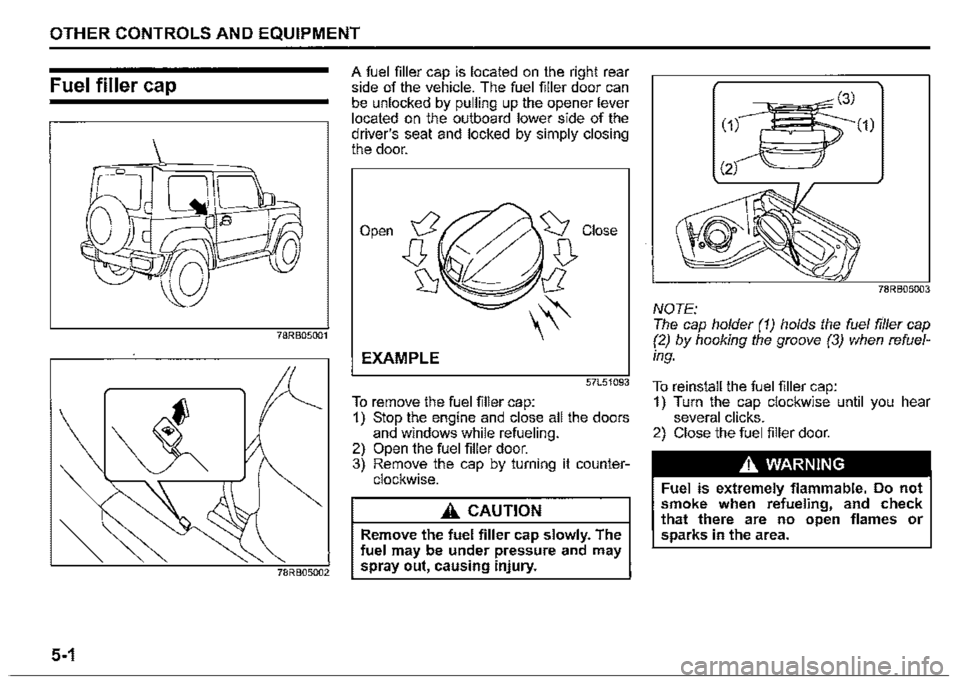
A fuel filler cap is located on the right rear side of the vehicle. The fuel filler door can be unlocked by pulling up the opener lever located on the outboard lower side of the driver's seat and locked by simply closing the door.
Open
EXAMPLE
57L51093
To remove the fuel filler cap: 1) Stop the engine and close all the doors and windows while refueling. 2) Open the fuel filler door. 3) Remove the cap by turning it counterclockwise.
A CAUTION
Remove the fuel filler cap slowly. The fuel may be under pressure and may spray out, causing injury.
78RB05003
NOTE: The cap holder (1) holds the fuel filler cap (2) by hooking the groove (3) when refuel
ing.
To reinstall the fuel filler cap: 1) Turn the cap clockwise until you hear several clicks. 2) Close the fuel filler door.
A WARNING
Fuel is extremely flammable. Do not smoke when refueling, and check that there are no open flames or sparks in the area.
Page 243 of 421

OTHER CONTROLS AND EQUIPMENT
Assist grips Ride-in assist grip
~--~~ 0 0
608110A 78RB05055
Assist grips are provided for convenience. Ride-in assist grip provides solid support for the front passenger when entering or NOTICE exiting the vehicle.
To avoid damaging the assist grip and the molded headlining, do not hang down the assist grip.
A WARNING
Do not put any objects between the passenger side of the dashboard and the ride-in assist grip. When the passenger's airbag is inflated, objects may be flown toward the passenger and may cause serious injury. Front passenger should not grip the ride-in assist grip while seating. In this situation, the passenger would be too close to the the inflating airbag, and may suffer severe injury.
5-8
Page 245 of 421

Cup holder and storage area
(1) Instrument panel tray
(3) Front seat back pocket
(5) Luggage box
(1) (3)
(5)
(2) Cup holder
( 4) Front door pocket
(6) Center console pocket
OTHER CONTROLS AND EQUIPMENT
78RB05016
Instrument panel tray(1)
A WARNING
Do not place any objects which may fall out from the tray when the vehicle is moving. Failure to take the precaution may result in an object interfering with the pedals and causing a loss of vehicle control or an accident.
5-10
Page 246 of 421

OTHER CONTROLS AND EQUIPMENT
Cup holder (2)
Use the rear cup holder to put a cup with a lid or a bottle with a cap. Also, you can put small articles in the rear cup holder.
78RB05017
5-11
A WARNING
Failure to take the precautions listed below could cause personal injury or vehicle damage. Be careful when you are using the cup holders to hold a cup containing hot liquid. Spilling out hot liquid can cause burn injury. Do not use the cup holders to hold sharp-edged, hard or breakable objects. Objects in the cup holders may be thrown about during a sudden stop or impact, and could cause personal injury. • Be careful not to spill liquid or insert any foreign materials into the moving part of the gearshift lever, or any electrical components. Liquid or foreign materials may damage these parts. If you spill, or drop liquid accidentally, have your vehicle inspected by a SUZUKI dealer.
Front seat back pocket (3)
78RB05018
This pocket is provided for holding light and soft things such as gloves, newspapers or magazines.
A CAUTION
Do not put hard or breakable objects in the pocket. If an accident occurs, objects such as bottles, cans, etc. can injure the occupants in the rear seat.