engine SUZUKI KIZASHI 2010 1.G Owners Manual
[x] Cancel search | Manufacturer: SUZUKI, Model Year: 2010, Model line: KIZASHI, Model: SUZUKI KIZASHI 2010 1.GPages: 388, PDF Size: 4.94 MB
Page 321 of 388

7-36
INSPECTION AND MAINTENANCE
57L20-03E
GLOSSARY OF TIRE TERMINOL-
OGY
Accessory Weight – the combined
weight (in excess of those standard
items which may be replaced) of CVT,
power steering, power brakes, power
windows, power seats, radio, and
heater, to the extent that these items
are available as factory-installed
equipment (whether installed or not).
Cold Tire Inflation Pressure – the pres-
sure in a tire that has been driven less
than 1 mile or has been standing for
three hours or more.
Curb Weight – the weight of a motor
vehicle with standard equipment
including the maximum capacity of
fuel, oil, and coolant, and, if so
equipped, air conditioning and addi-
tional weight optional engine.
Intended Outboard Sidewall – (1) the
sidewall that contains a whitewall,
bears white lettering or bears manu-
facturer, brand, and/or model name
molding that is higher or deeper than
the same molding on the other side-
wall of the tire, or (2) the outward fac-
ing sidewall of an asymmetrical tire
that has a particular side that must
always face outward when mounted
on a vehicle.Maximum Inflation Pressure – the max-
imum cold inflation pressure a tire is
designed to support in normal service.
Maximum Loaded Vehicle Weight –
the sum of curb weight, accessory
weight, vehicle capacity weight (total
load capacity), and production options
weight.
Normal Occupant Weight – 68 kilo-
grams times the number of occupants
specified in the second column of
Table 1 (shown below).
Occupant distribution – distribution of
occupants in a vehicle as specified in
the third column of Table 1 (shown
below).
Production Options Weight – the com-
bined weight of those installed regular
production options weighing over 2.3
kilograms in excess of those standard
items which they replace, not previ-
ously considered in curb weight or
accessory weight, including heavy
duty brakes, ride levelers, roof rack,
heavy duty battery, and special trim.
Recommended Inflation Pressure –
the cold tire inflation pressure recom-
mended by a manufacturer.
Rim – metal support for a tire or tire
and tube assembly upon which the tire
beads are seated.Vehicle Capacity Weight – the rated
cargo and luggage load plus 68 kilo-
grams (150 lbs) times the vehicle’s
designated seating capacity.
Vehicle Maximum Load on the Tire –
the load on an individual tire that is
determined by distributing to each axle
its share of the maximum loaded vehi-
cle weight and dividing by two.
Vehicle Normal Load on the Tire – the
load on an individual tire that is deter-
mined by distributing to each axle its
share of the curb weight, accessory
weight, and normal occupant weight
(distributed in accordance with Table 1
shown below) and dividing by 2.
TABLE 1 – Occupant Loading and
Distribution For Vehicle Normal
Load For Various Designated Seat-
ing Capacities
Designated
seating
capacity,
number of
occupantsVehicle nor-
mal load,
number of
occupants
Occupant
distribution
in a nor-
mally loaded
vehicle
2 through 4 2 2 in front5 through 10
32 in front,
1 in second
seat
Page 325 of 388
7-40
INSPECTION AND MAINTENANCE
57L20-03E
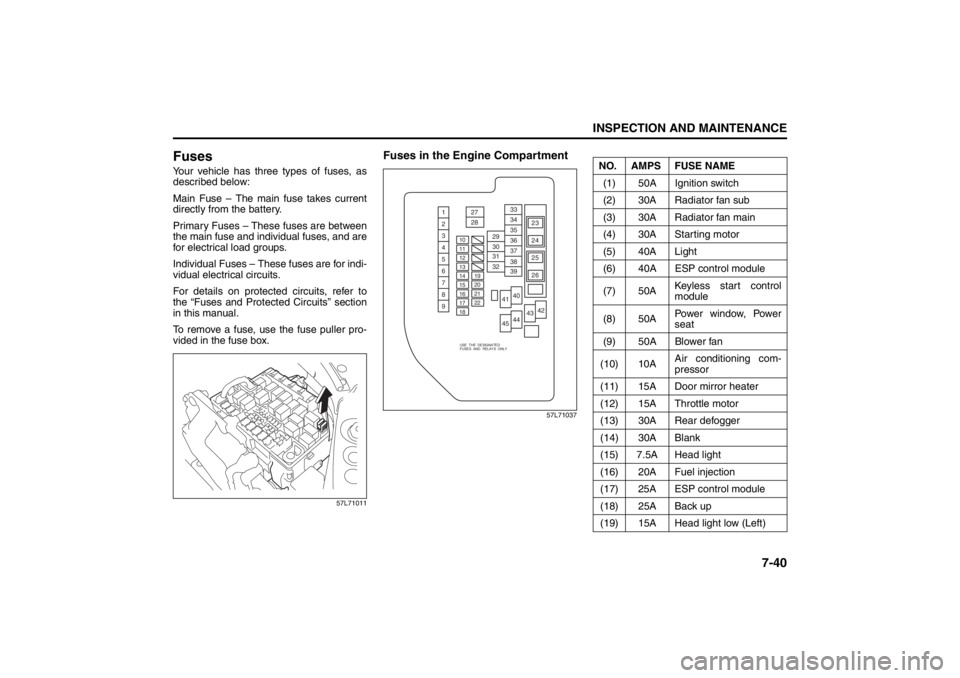
FusesYour vehicle has three types of fuses, as
described below:
Main Fuse – The main fuse takes current
directly from the battery.
Primary Fuses – These fuses are between
the main fuse and individual fuses, and are
for electrical load groups.
Individual Fuses – These fuses are for indi-
vidual electrical circuits.
For details on protected circuits, refer to
the “Fuses and Protected Circuits” section
in this manual.
To remove a fuse, use the fuse puller pro-
vided in the fuse box.
57L71011
Fuses in the Engine Compartment
57L71037
1
10
11
12
13
14
15
16
1719
20
21
22
23
24
25
26 29
30
31
3233
34 27
28
37
38
39
40
41
444342
4535
36
18
2
3
4
5
6
7
8
9
USE THE DESIGNATED
FUSES AND RELAYS ONLY
NO. AMPS FUSE NAME
(1) 50A Ignition switch
(2) 30A Radiator fan sub
(3) 30A Radiator fan main
(4) 30A Starting motor
(5) 40A Light
(6) 40A ESP control module
(7) 50AKeyless start control
module
(8) 50APowe r w i n d ow, Powe r
seat
(9) 50A Blower fan
(10) 10AAir conditioning com-
pressor
(11) 15A Door mirror heater
(12) 15A Throttle motor
(13) 30A Rear defogger
(14) 30A Blank
(15) 7.5A Head light
(16) 20A Fuel injection
(17) 25A ESP control module
(18) 25A Back up
(19) 15A Head light low (Left)
Page 326 of 388
7-41INSPECTION AND MAINTENANCE
57L20-03E
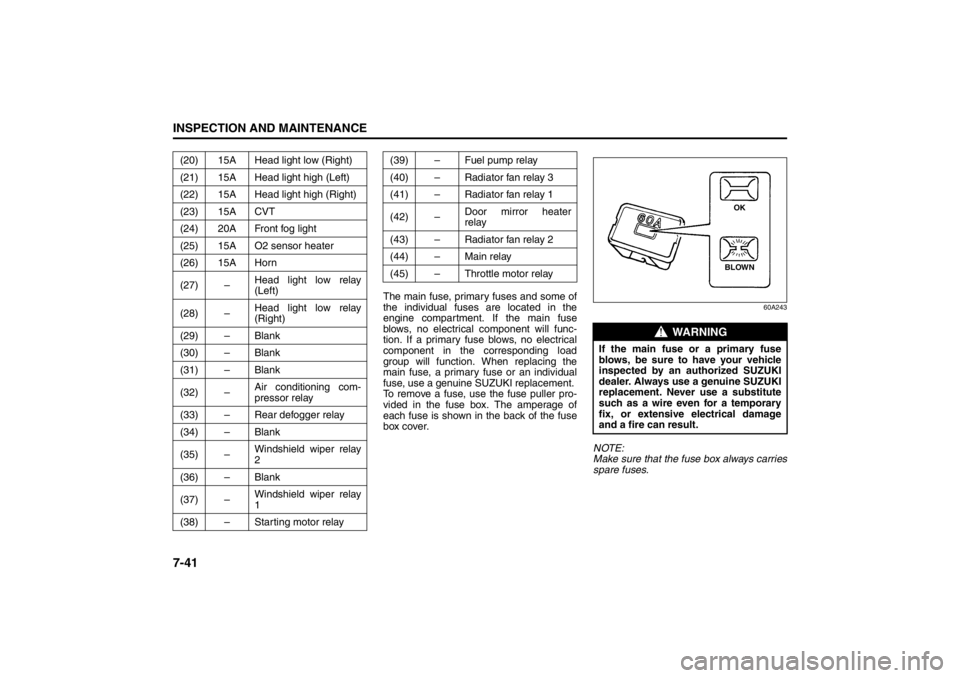
The main fuse, primary fuses and some of
the individual fuses are located in the
engine compartment. If the main fuse
blows, no electrical component will func-
tion. If a primary fuse blows, no electrical
component in the corresponding load
group will function. When replacing the
main fuse, a primary fuse or an individual
fuse, use a genuine SUZUKI replacement.
To remove a fuse, use the fuse puller pro-
vided in the fuse box. The amperage of
each fuse is shown in the back of the fuse
box cover.
60A243
NOTE:
Make sure that the fuse box always carries
spare fuses. (20) 15A Head light low (Right)
(21) 15A Head light high (Left)
(22) 15A Head light high (Right)
(23) 15A CVT
(24) 20A Front fog light
(25) 15A O2 sensor heater
(26) 15A Horn
(27) –Head light low relay
(Left)
(28) –Head light low relay
(Right)
(29) – Blank
(30) – Blank
(31) – Blank
(32) –Air conditioning com-
pressor relay
(33) – Rear defogger relay
(34) – Blank
(35) –Windshield wiper relay
2
(36) – Blank
(37) –Windshield wiper relay
1
(38) – Starting motor relay
(39) – Fuel pump relay
(40) – Radiator fan relay 3
(41) – Radiator fan relay 1
(42) –Door mirror heater
relay
(43) – Radiator fan relay 2
(44) – Main relay
(45) – Throttle motor relay
WARNING
If the main fuse or a primary fuse
blows, be sure to have your vehicle
inspected by an authorized SUZUKI
dealer. Always use a genuine SUZUKI
replacement. Never use a substitute
such as a wire even for a temporary
fix, or extensive electrical damage
and a fire can result.
BLOWNOK
Page 331 of 388
7-46
INSPECTION AND MAINTENANCE
57L20-03E
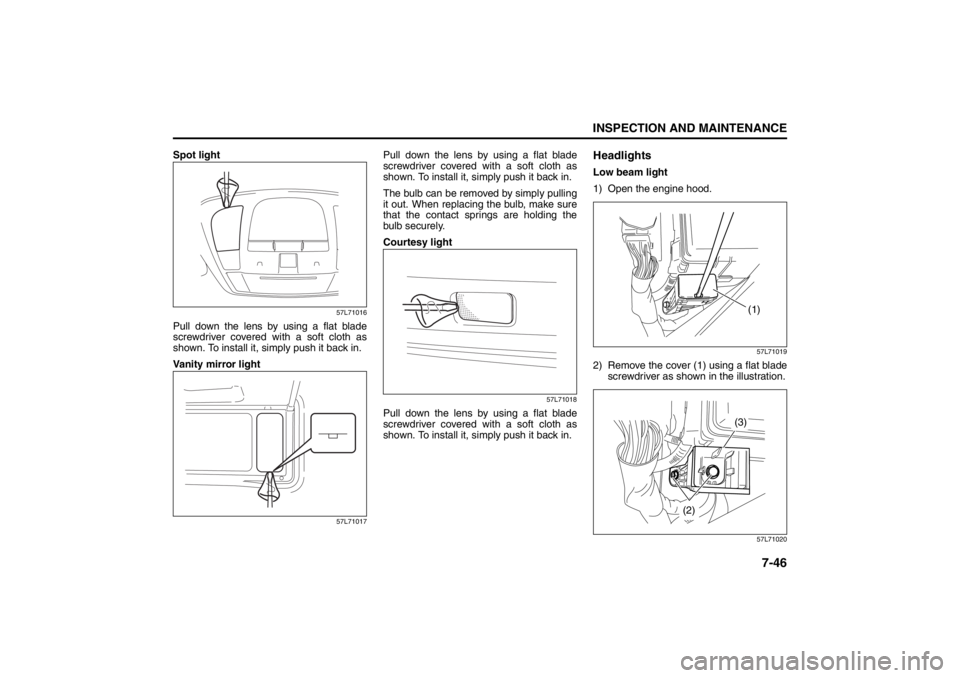
Spot light
57L71016
Pull down the lens by using a flat blade
screwdriver covered with a soft cloth as
shown. To install it, simply push it back in.
Vanity mirror light
57L71017
Pull down the lens by using a flat blade
screwdriver covered with a soft cloth as
shown. To install it, simply push it back in.
The bulb can be removed by simply pulling
it out. When replacing the bulb, make sure
that the contact springs are holding the
bulb securely.
Courtesy light
57L71018
Pull down the lens by using a flat blade
screwdriver covered with a soft cloth as
shown. To install it, simply push it back in.
HeadlightsLow beam light
1) Open the engine hood.
57L71019
2) Remove the cover (1) using a flat blade
screwdriver as shown in the illustration.
57L71020(1)
(3)
(2)
Page 332 of 388
7-47INSPECTION AND MAINTENANCE
57L20-03E
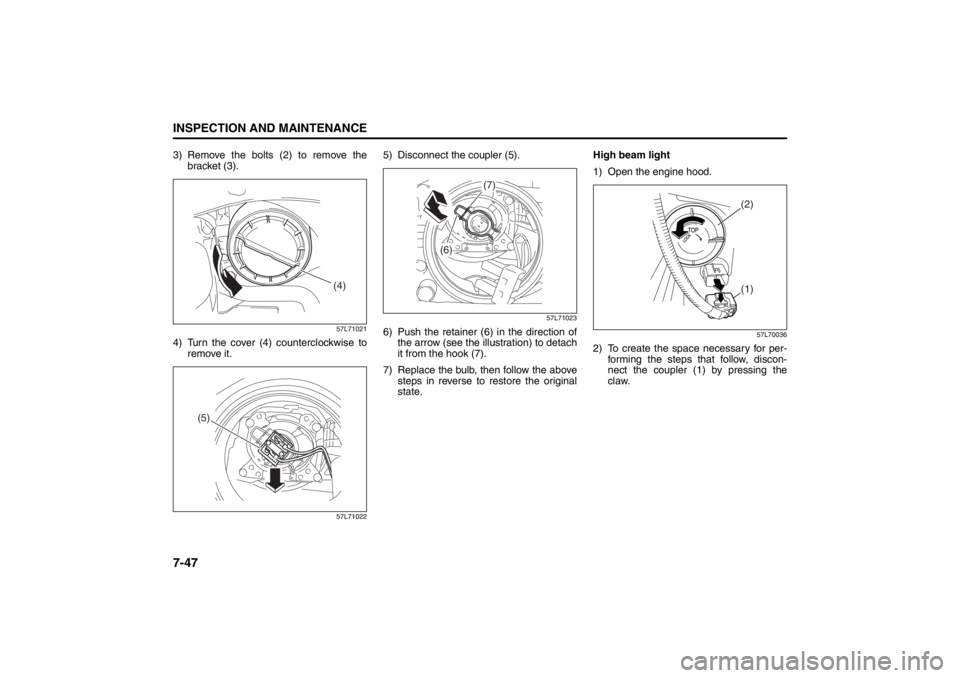
3) Remove the bolts (2) to remove the
bracket (3).
57L71021
4) Turn the cover (4) counterclockwise to
remove it.
57L71022
5) Disconnect the coupler (5).
57L71023
6) Push the retainer (6) in the direction of
the arrow (see the illustration) to detach
it from the hook (7).
7) Replace the bulb, then follow the above
steps in reverse to restore the original
state.High beam light
1) Open the engine hood.
57L70036
2) To create the space necessary for per-
forming the steps that follow, discon-
nect the coupler (1) by pressing the
claw.
(4)
(5)
(7)
(6)
(2)(1)
Page 334 of 388
7-49INSPECTION AND MAINTENANCE
57L20-03E
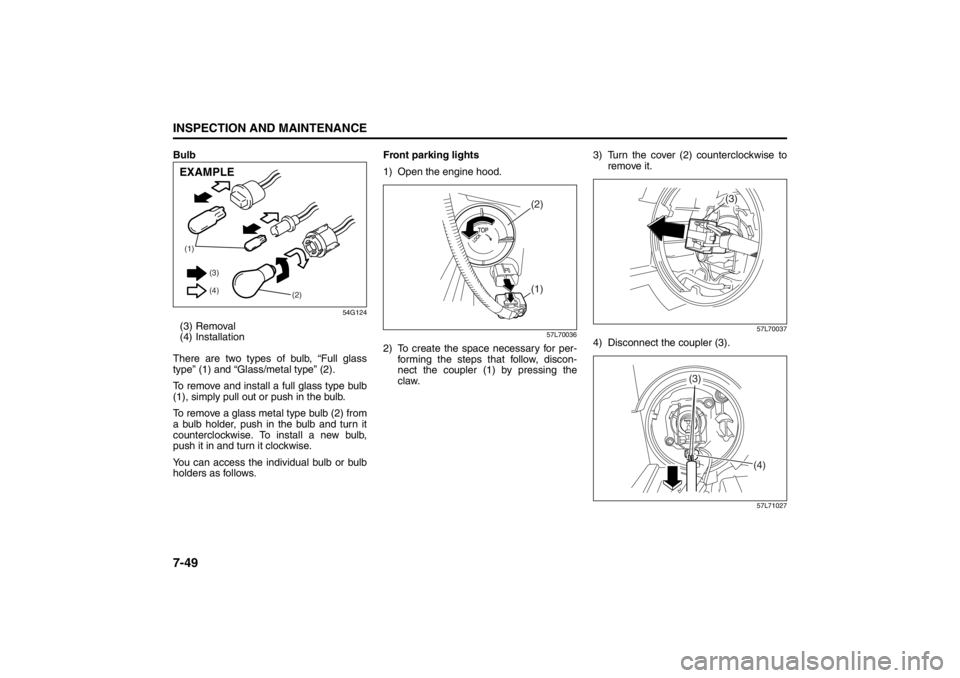
Bulb
54G124
(3) Removal
(4) Installation
There are two types of bulb, “Full glass
type” (1) and “Glass/metal type” (2).
To remove and install a full glass type bulb
(1), simply pull out or push in the bulb.
To remove a glass metal type bulb (2) from
a bulb holder, push in the bulb and turn it
counterclockwise. To install a new bulb,
push it in and turn it clockwise.
You can access the individual bulb or bulb
holders as follows.Front parking lights
1) Open the engine hood.
57L70036
2) To create the space necessary for per-
forming the steps that follow, discon-
nect the coupler (1) by pressing the
claw.3) Turn the cover (2) counterclockwise to
remove it.
57L70037
4) Disconnect the coupler (3).
57L71027
(1)
(2) (3)
(4)EXAMPLE
(2)(1)
(3)
(4)
(3)
Page 335 of 388
7-50
INSPECTION AND MAINTENANCE
57L20-03E
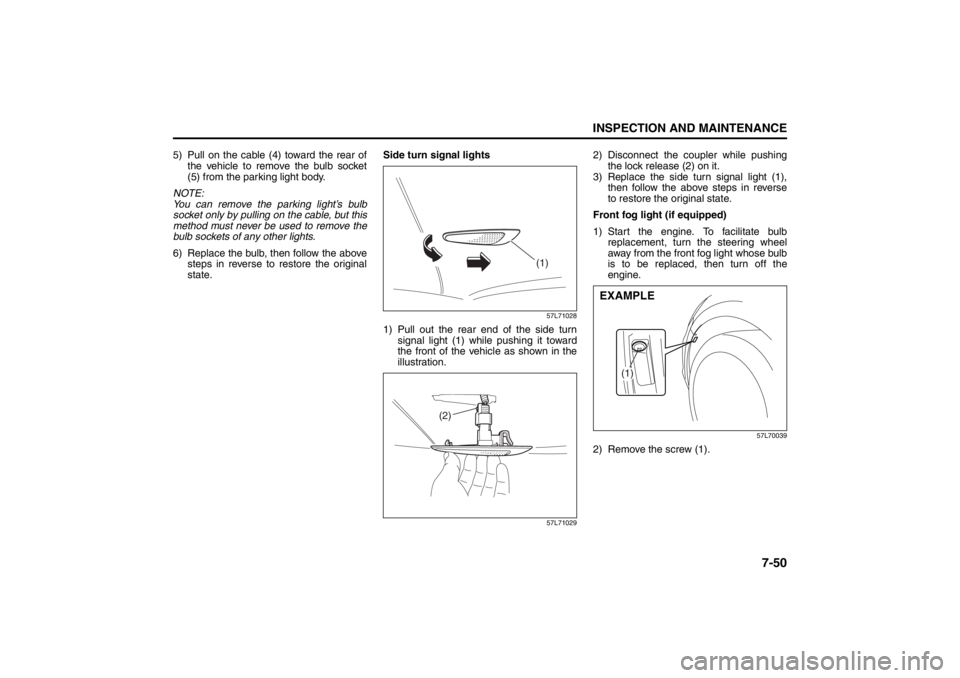
5) Pull on the cable (4) toward the rear of
the vehicle to remove the bulb socket
(5) from the parking light body.
NOTE:
You can remove the parking light’s bulb
socket only by pulling on the cable, but this
method must never be used to remove the
bulb sockets of any other lights.
6) Replace the bulb, then follow the above
steps in reverse to restore the original
state.Side turn signal lights
57L71028
1) Pull out the rear end of the side turn
signal light (1) while pushing it toward
the front of the vehicle as shown in the
illustration.
57L71029
2) Disconnect the coupler while pushing
the lock release (2) on it.
3) Replace the side turn signal light (1),
then follow the above steps in reverse
to restore the original state.
Front fog light (if equipped)
1) Start the engine. To facilitate bulb
replacement, turn the steering wheel
away from the front fog light whose bulb
is to be replaced, then turn off the
engine.
57L70039
2) Remove the screw (1).
(1)
(2)
(1)
EXAMPLE
Page 336 of 388
7-51INSPECTION AND MAINTENANCE
57L20-03E
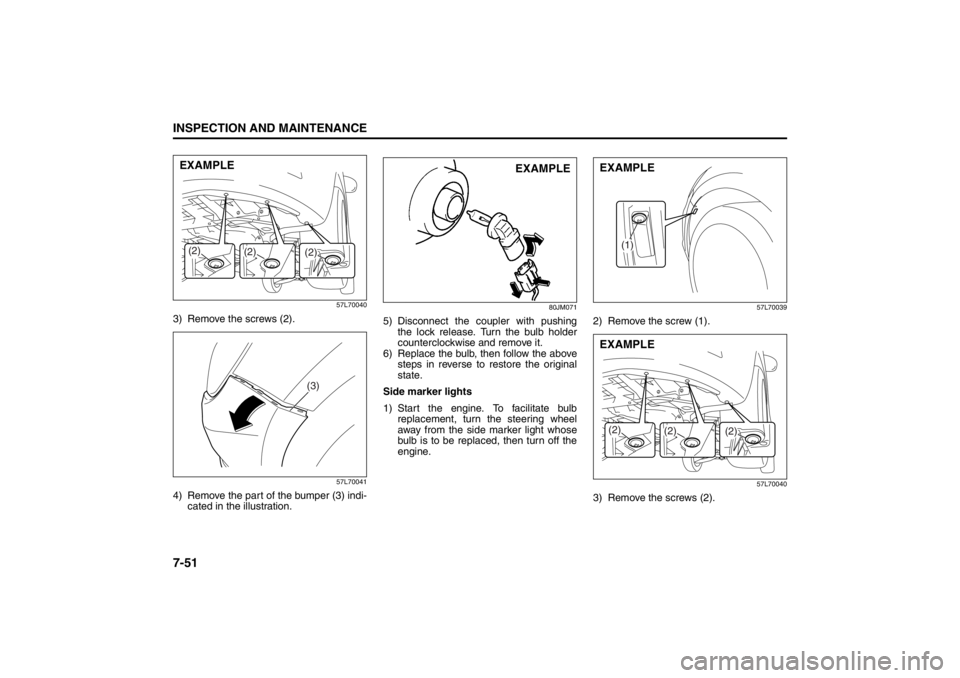
57L70040
3) Remove the screws (2).
57L70041
4) Remove the part of the bumper (3) indi-
cated in the illustration.
80JM071
5) Disconnect the coupler with pushing
the lock release. Turn the bulb holder
counterclockwise and remove it.
6) Replace the bulb, then follow the above
steps in reverse to restore the original
state.
Side marker lights
1) Start the engine. To facilitate bulb
replacement, turn the steering wheel
away from the side marker light whose
bulb is to be replaced, then turn off the
engine.
57L70039
2) Remove the screw (1).
57L70040
3) Remove the screws (2).
(2)
(2)
(2)EXAMPLE
(3)
EXAMPLE
(1)
EXAMPLE
(2)
(2)
(2)EXAMPLE
Page 337 of 388
7-52
INSPECTION AND MAINTENANCE
57L20-03E
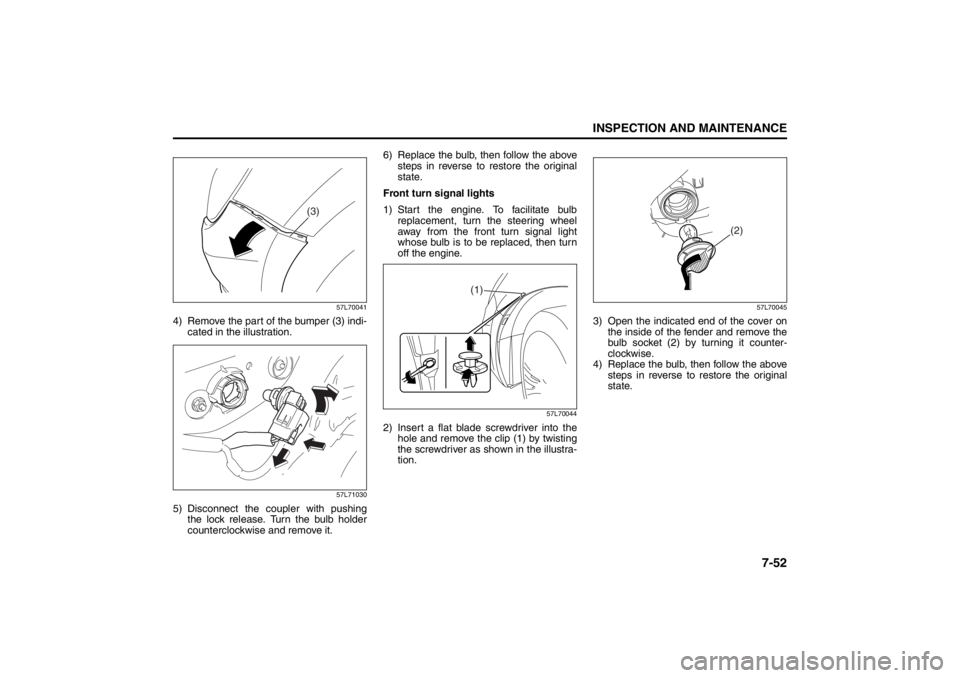
57L70041
4) Remove the part of the bumper (3) indi-
cated in the illustration.
57L71030
5) Disconnect the coupler with pushing
the lock release. Turn the bulb holder
counterclockwise and remove it.6) Replace the bulb, then follow the above
steps in reverse to restore the original
state.
Front turn signal lights
1) Start the engine. To facilitate bulb
replacement, turn the steering wheel
away from the front turn signal light
whose bulb is to be replaced, then turn
off the engine.
57L70044
2) Insert a flat blade screwdriver into the
hole and remove the clip (1) by twisting
the screwdriver as shown in the illustra-
tion.
57L70045
3) Open the indicated end of the cover on
the inside of the fender and remove the
bulb socket (2) by turning it counter-
clockwise.
4) Replace the bulb, then follow the above
steps in reverse to restore the original
state.
(3)
(1)
(2)
Page 342 of 388
7-57INSPECTION AND MAINTENANCE
57L20-03E
Check that there is washer fluid in the tank
by looking at the washer fluid level gauge
which is attached to the cap of the washer
fluid tank. If the fluid level is near “LOW”
mark, refill it.
Use a good quality windshield washer
fluid, diluted with water as necessary.
Air Conditioning SystemIf you do not use the air conditioner for a
long period, such as during winter, it may
not give the best performance when you
start using it again. To help maintain opti-
mum performance and durability of your air
conditioner, it needs to be run periodically.
Operate the air conditioner at least once a
month for one minute with the engine
idling. This circulates the refrigerant and oil
and helps protect the internal components.
WARNING
Do not use “anti-freeze” solution in
the windshield washer reservoir. This
can severely impair visibility when
sprayed on the windshield, and also
damage your vehicle’s paint.
CAUTION
Damage may result if the washer
motor is operated with no fluid in the
washer tank.