ECU SUZUKI MARUTI 2005 1.G User Guide
[x] Cancel search | Manufacturer: SUZUKI, Model Year: 2005, Model line: MARUTI, Model: SUZUKI MARUTI 2005 1.GPages: 136, PDF Size: 2.93 MB
Page 36 of 136
Downloaded from www.Manualslib.com manuals search engine 3683K
BEFORE DRIVING
4-24
Children could be endangered in a
crash if their child restraints are not
properly secured in the vehicle. Be
sure to secure the child in the
restraint system according to the
manufacturer’s instructions.
w ww w
w WARNING
w ww w
w WARNING
far enough forward so that the child’s
feet do not contact the front seatback.
This will help avoid injury to the child
in the event of an accident.
83K-04-05683K-04-057
V VV V
V
Supplemental Restraint Sys-
tem (air bags)
(if equipped)
w ww w
w WARNING
This section of the owner’s manual
describes the protection provided by
your MARUTI SUZUKI SUPPLEMEN-
TAL RESTRAINT SYSTEM (air bags).
Please read and follow ALL these
instructions carefully to minimize your
risk of severe injury or death in the
event of a collision.
Your vehicle is equipped with a Supple-
mental Restraint System consisting of the
following components in addition to a lap-
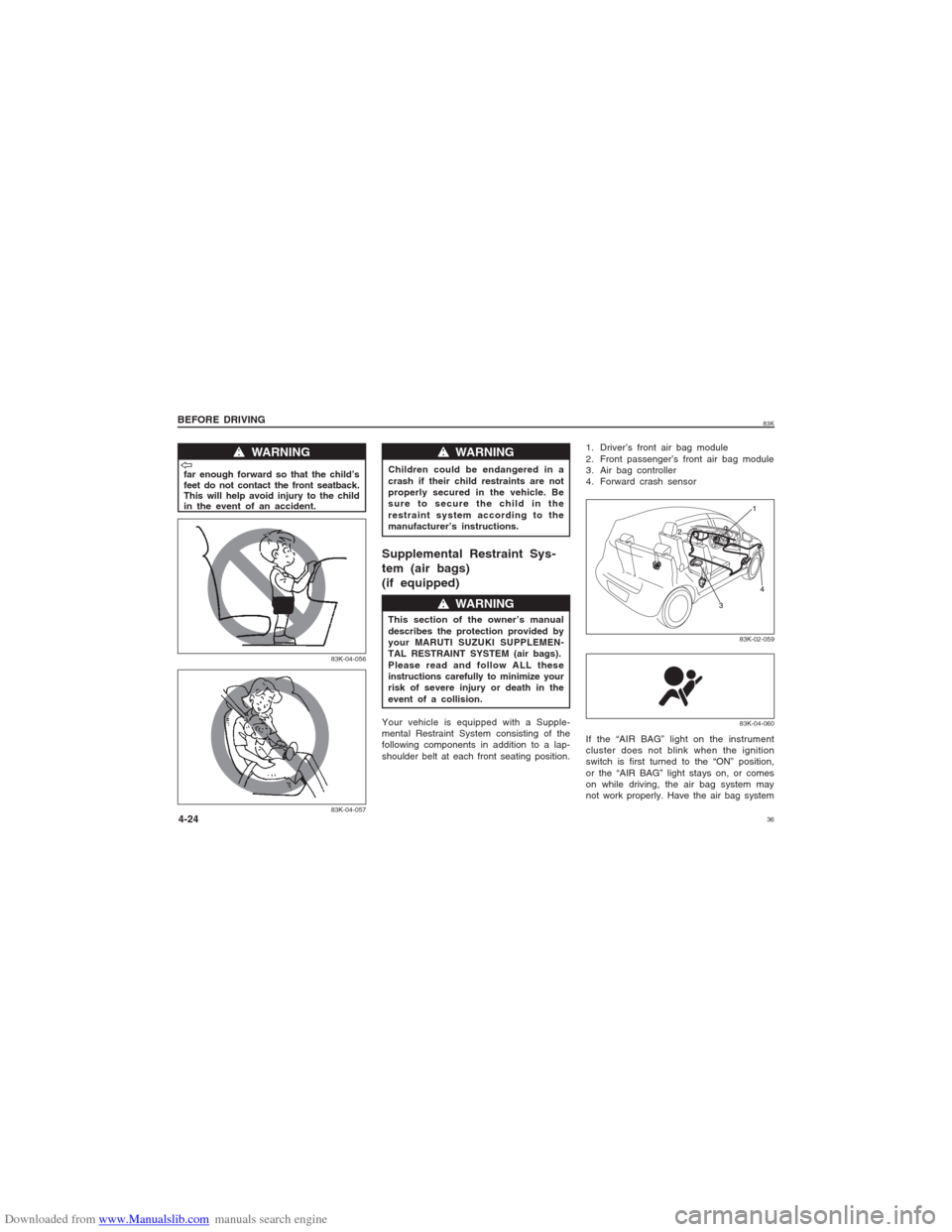
shoulder belt at each front seating position.1. Driver’s front air bag module
2. Front passenger’s front air bag module
3. Air bag controller
4. Forward crash sensor
83K-02-059
If the “AIR BAG” light on the instrument
cluster does not blink when the ignition
switch is first turned to the “ON” position,
or the “AIR BAG” light stays on, or comes
on while driving, the air bag system may
not work properly. Have the air bag system
83K-04-060
Page 38 of 136
Downloaded from www.Manualslib.com manuals search engine 3883K
BEFORE DRIVING
4-26
If you must use a front-facing child restraint
in the front passenger’s seat, be sure to
move the front passenger’s seat as far back
as possible. Please refer to the “Seat Belts
and Child Restraint Systems” section in the
“BEFORE DRIVING” section for details on
securing your child.
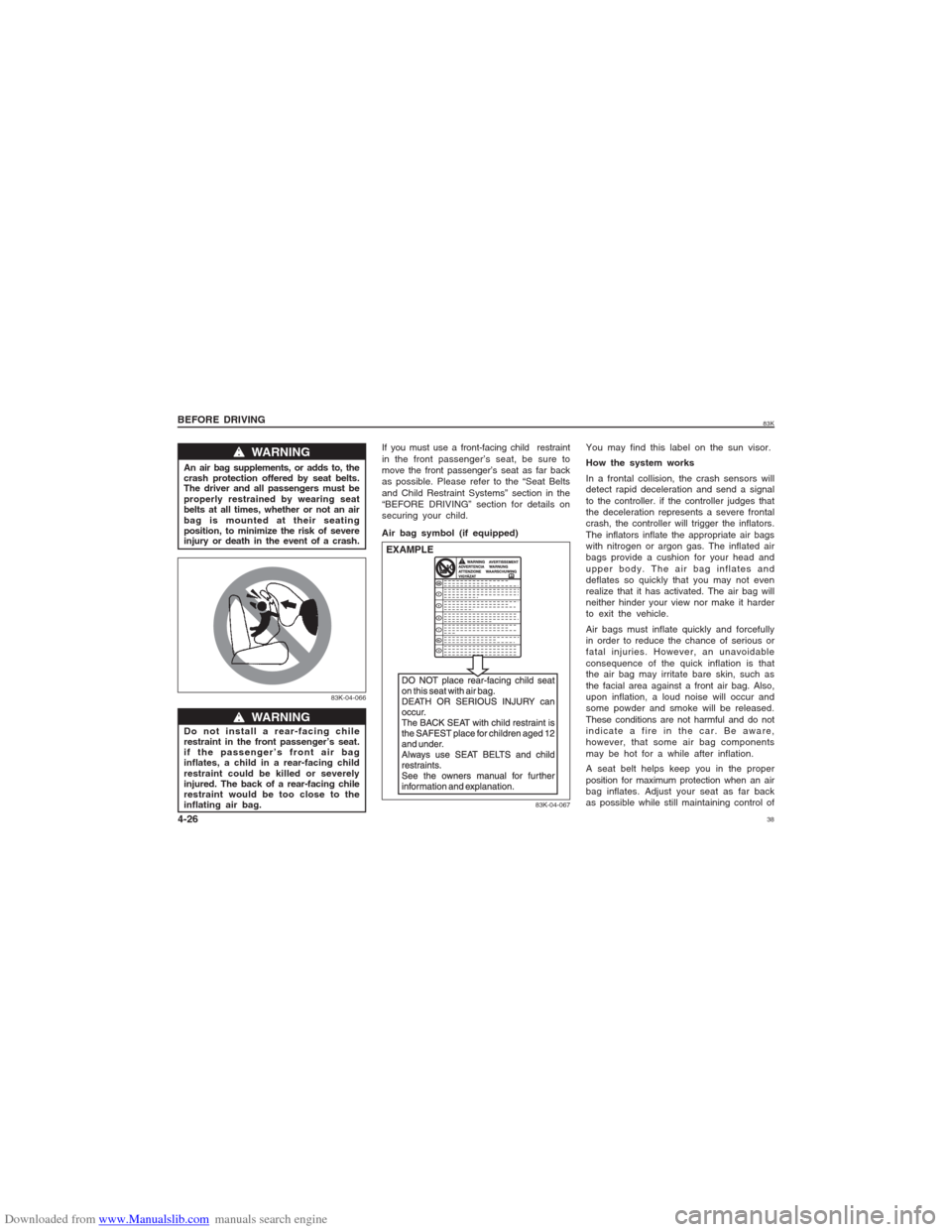
Air bag symbol (if equipped)
83K-04-067
EXAMPLE
You may find this label on the sun visor.
How the system works
In a frontal collision, the crash sensors will
detect rapid deceleration and send a signal
to the controller. if the controller judges that
the deceleration represents a severe frontal
crash, the controller will trigger the inflators.
The inflators inflate the appropriate air bags
with nitrogen or argon gas. The inflated air
bags provide a cushion for your head and
upper body. The air bag inflates and
deflates so quickly that you may not even
realize that it has activated. The air bag will
neither hinder your view nor make it harder
to exit the vehicle.
Air bags must inflate quickly and forcefully
in order to reduce the chance of serious or
fatal injuries. However, an unavoidable
consequence of the quick inflation is that
the air bag may irritate bare skin, such as
the facial area against a front air bag. Also,
upon inflation, a loud noise will occur and
some powder and smoke will be released.
These conditions are not harmful and do not
indicate a fire in the car. Be aware,
however, that some air bag components
may be hot for a while after inflation.
A seat belt helps keep you in the proper
position for maximum protection when an air
bag inflates. Adjust your seat as far back
as possible while still maintaining control of
w ww w
w WARNING
An air bag supplements, or adds to, the
crash protection offered by seat belts.
The driver and all passengers must be
properly restrained by wearing seat
belts at all times, whether or not an air
bag is mounted at their seating
position, to minimize the risk of severe
injury or death in the event of a crash.
83K-04-066
w ww w
w WARNING
Do not install a rear-facing chile
restraint in the front passenger’s seat.
if the passenger’s front air bag
inflates, a child in a rear-facing child
restraint could be killed or severely
injured. The back of a rear-facing chile
restraint would be too close to the
inflating air bag.
Page 54 of 136
Downloaded from www.Manualslib.com manuals search engine 5483K
BEFORE DRIVING
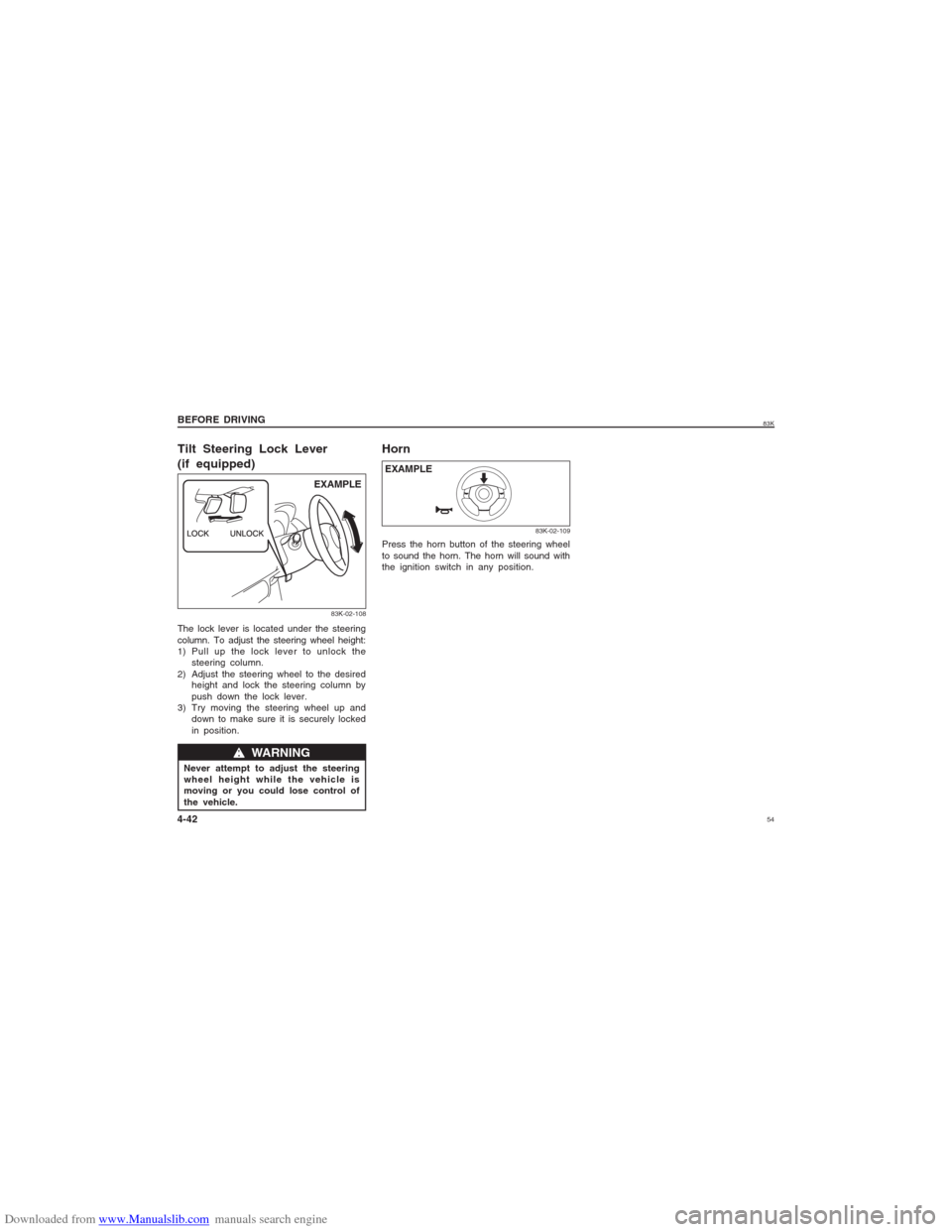
4-42Tilt Steering Lock Lever
(if equipped)
83K-02-108
EXAMPLE
w ww w
w WARNING
Never attempt to adjust the steering
wheel height while the vehicle is
moving or you could lose control of
the vehicle.
83K-02-109
HornPress the horn button of the steering wheel
to sound the horn. The horn will sound with
the ignition switch in any position.EXAMPLE
The lock lever is located under the steering
column. To adjust the steering wheel height:
1) Pull up the lock lever to unlock the
steering column.
2) Adjust the steering wheel to the desired
height and lock the steering column by
push down the lock lever.
3) Try moving the steering wheel up and
down to make sure it is securely locked
in position.
Page 57 of 136
Downloaded from www.Manualslib.com manuals search engine 5783K4) Make sure the bonnet is fully closed and
latched.
5) Check the headlights, turn signal lights,
brake lights and horn for proper opera-
tion.
6) Adjust the seat and adjustable head
restraint (if equipped).
7) Check the brake pedal and the parking
brake lever.
8) Adjust the mirrors.
9) Make sure that you and all passengers
have properly fastened your seat belts.
10)Make sure that all warning lights come
on as the key is turned to the “ON” or
“START” position.
11)Check all gauges.
12)Make sure that the BRAKE SYSTEM
WARNING light turns off when the
parking brake is released.
Once a week, or each time you fill your fuel
tank, perform the following under-hood
checks:
1) Engine oil level
2) Coolant level
3) Brake fluid level
4) Windshield washer fluid level
5) Battery solution level
6) Bonnet latch operation
Pull the Bonnet release handle inside the
vehicle. Make sure that you cannot open
the Bonnet all the way without releasingthe secondary latch. Be sure to close
the Bonnet securely after checking for
proper latch operation. See “All latches,
hinges & locks” of “CHASSIS AND
BODY” in the “Periodic Maintenance
Schedule” in the “INSPECTION AND
MAINTENANCE” section for lubrication
schedule.
w ww w
w WARNING
Make sure the bonnet is fully closed
and latched before driving. If it is not,
it can fly up unexpectedly during
driving, obstructing your view and
resulting in an accident.
Once a month, or each time you fill your
fuel tank, check the tyre pressure using a
tyre pressure gauge. Also check the tyre
pressure of the spare tyre.since its pistons, piston rings and cylinder
walls have not yet become conditioned. New
engines reach the normal level of oil
consumption only after approximately 5000
km (3000 miles) driving.
When judging the amount of oil consump-
tion, note that the oil may become diluted
and make it difficult to accurately judge the
true oil level.
As an example, if a vehicle is used for
repeated short trips, and consumes a nor-
mal amount of oil, the dipstick may not
show any drop in the oil level at all, even
after 1000 km (600 miles) or more of driv-
ing. This is because the oil is gradually
becoming diluted with fuel or moisture,
making it appear that the oil level has not
changed.
You should also be aware that the diluting
ingredients evaporate out when the vehicle
is subsequently driven at high speeds, such
as on an expressway, making it appear that
oil is excessively consumed after high-speed
driving.
OPERATING YOUR VEHICLE
5-2
Engine Oil ConsumptionIt is normal for the engine to consume some
engine oil during normal vehicle operation.
The amount of engine oil consumed
depends on the viscosity of the oil, the
quality of the oil and the conditions the
vehicle is driven under.
More oil is consumed during high-speed
driving and when there is frequent acceler-
ation and deceleration. Under high loads,
your engine also will consume more oil.
A new engine also consumes more oil,
83K-03-003
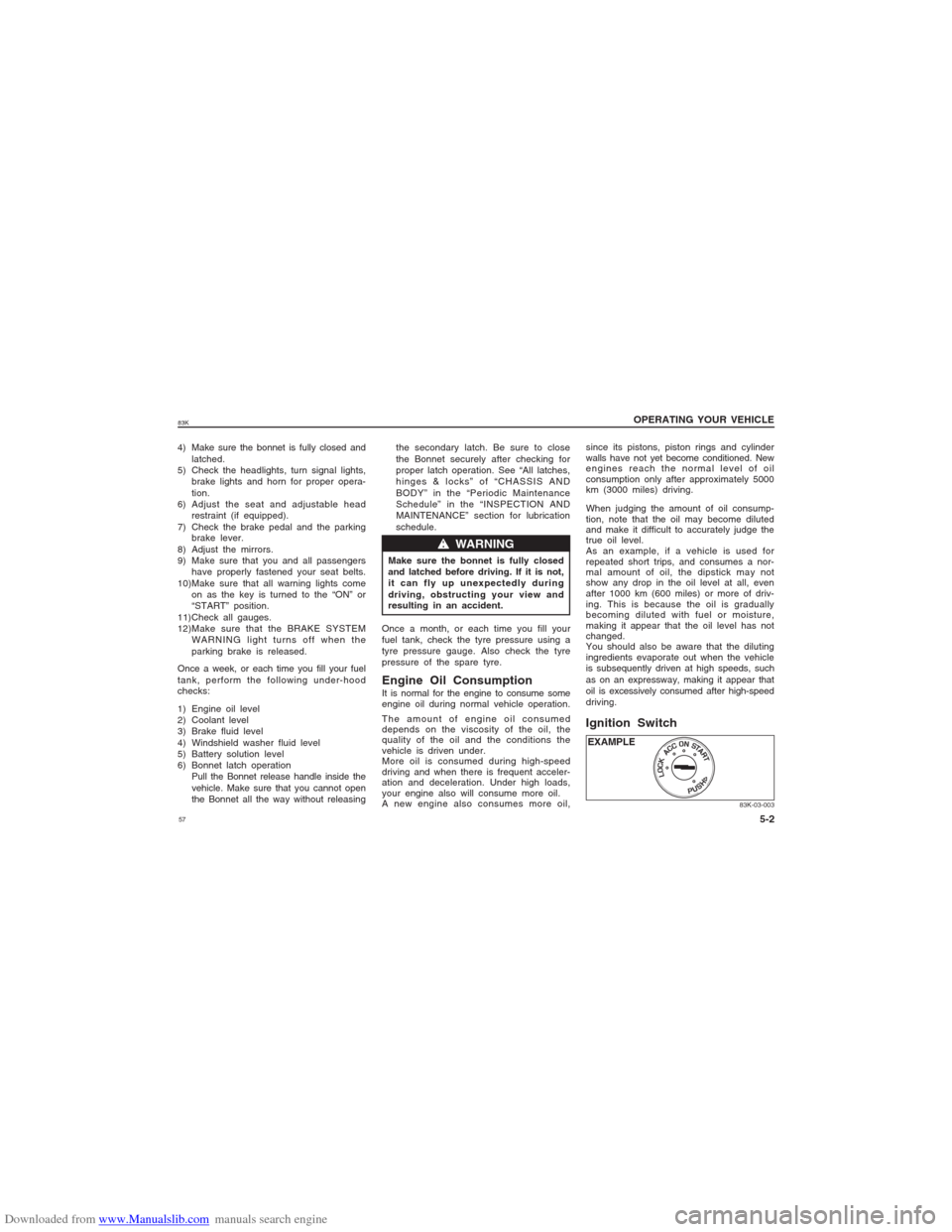
Ignition SwitchEXAMPLE
Page 59 of 136
Downloaded from www.Manualslib.com manuals search engine 5983K
OPERATING YOUR VEHICLE
5-4
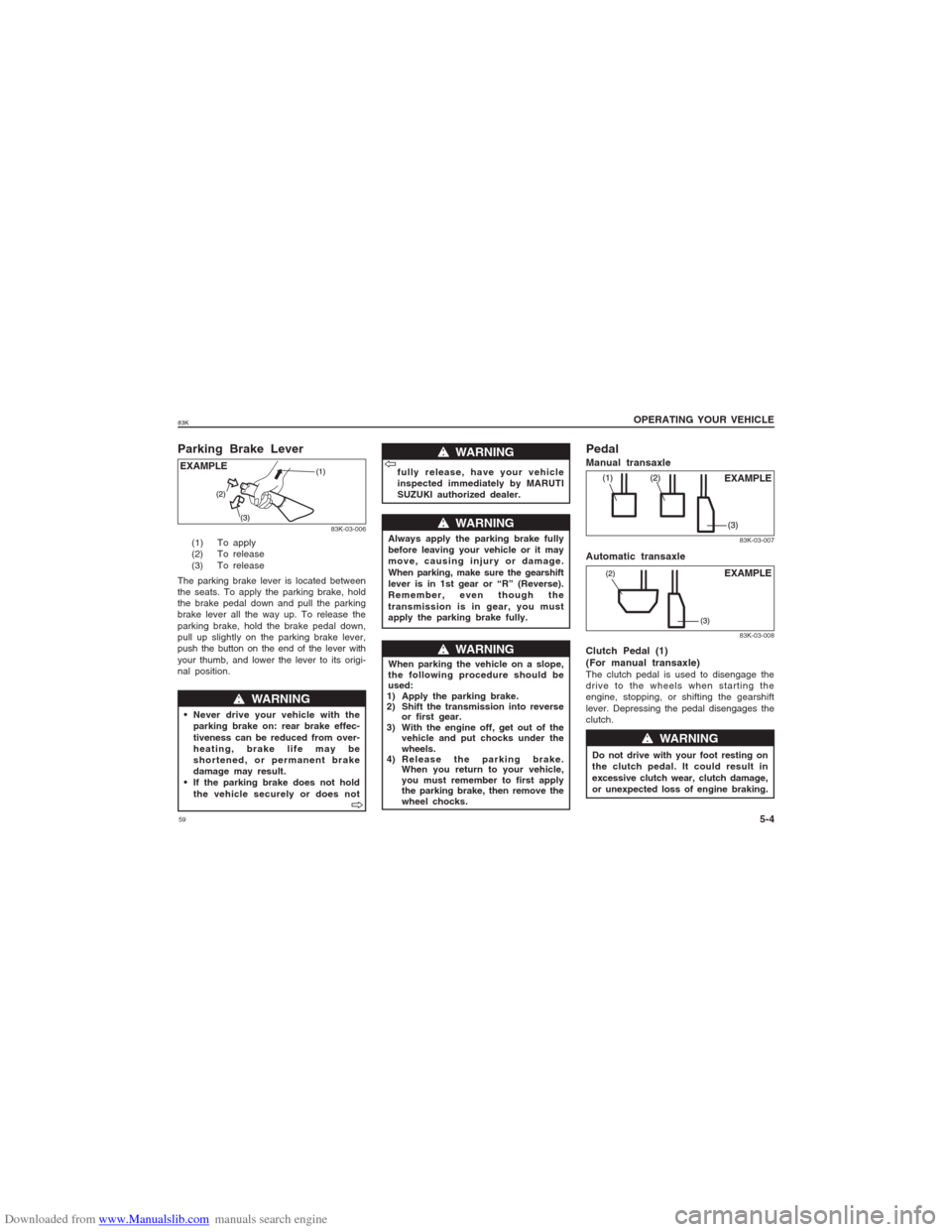
Parking Brake Lever
83K-03-006
w ww w
w WARNING
Never drive your vehicle with the
parking brake on: rear brake effec-
tiveness can be reduced from over-
heating, brake life may be
shortened, or permanent brake
damage may result.
If the parking brake does not hold
the vehicle securely or does not (1) To apply
(2) To release
(3) To release
The parking brake lever is located between
the seats. To apply the parking brake, hold
the brake pedal down and pull the parking
brake lever all the way up. To release the
parking brake, hold the brake pedal down,
pull up slightly on the parking brake lever,
push the button on the end of the lever with
your thumb, and lower the lever to its origi-
nal position.
V VV V
V
w ww w
w WARNING
V VV V
V
w ww w
w WARNING
Always apply the parking brake fully
before leaving your vehicle or it may
move, causing injury or damage.
When parking, make sure the gearshift
lever is in 1st gear or “R” (Reverse).
Remember, even though the
transmission is in gear, you must
apply the parking brake fully.fully release, have your vehicle
inspected immediately by MARUTI
SUZUKI authorized dealer.
w ww w
w WARNING
When parking the vehicle on a slope,
the following procedure should be
used:
1) Apply the parking brake.
2) Shift the transmission into reverse
or first gear.
3) With the engine off, get out of the
vehicle and put chocks under the
wheels.
4) Release the parking brake.
When you return to your vehicle,
you must remember to first apply
the parking brake, then remove the
wheel chocks.
EXAMPLE
PedalManual transaxle
83K-03-007
EXAMPLE
Automatic transaxle
83K-03-008
EXAMPLE
Clutch Pedal (1)
(For manual transaxle)The clutch pedal is used to disengage the
drive to the wheels when starting the
engine, stopping, or shifting the gearshift
lever. Depressing the pedal disengages the
clutch.
w ww w
w WARNING
Do not drive with your foot resting on
the clutch pedal. It could result in
excessive clutch wear, clutch damage,
or unexpected loss of engine braking.
Page 79 of 136
Downloaded from www.Manualslib.com manuals search engine 7983K
OTHER CONTROLS AND EQUIPMENT
7-5
To change the radio station:
To advance to the next preset station,
push the switch (5) briefly.
To select the previous preset station,
push the switch (6) briefly.
To scan the higher frequency radio sta-
tion, push and hold the switch (5).
To scan the lower frequency radio sta-
tion, push and hold the switch (6).
To scan the selection on a CD:
To advance to the next track on a CD,
push the switch (5).
To select the previous track on a CD,
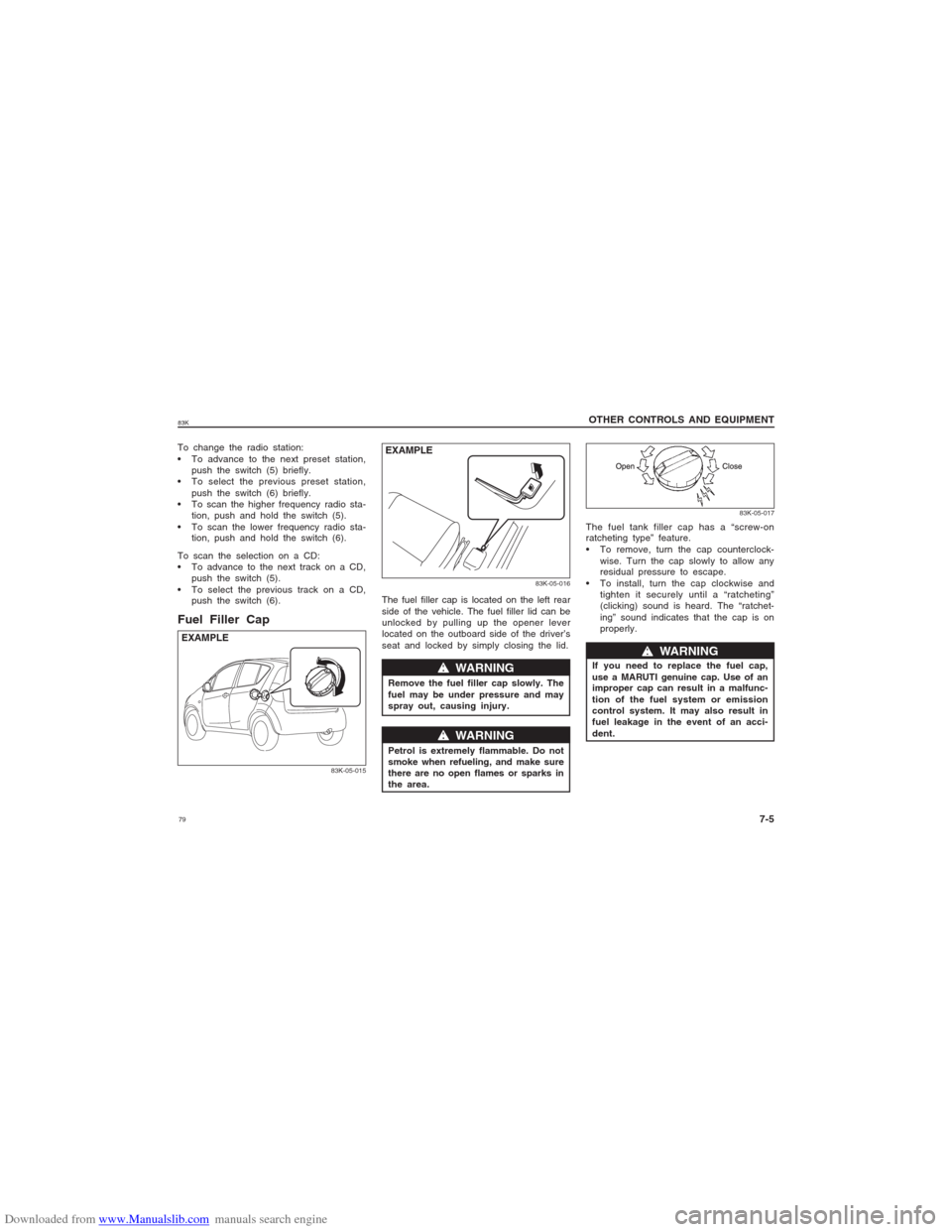
push the switch (6).Fuel Filler Cap
83K-05-015
EXAMPLE
83K-05-016
w ww w
w WARNING
Remove the fuel filler cap slowly. The
fuel may be under pressure and may
spray out, causing injury.
w ww w
w WARNING
Petrol is extremely flammable. Do not
smoke when refueling, and make sure
there are no open flames or sparks in
the area.
EXAMPLE
83K-05-017
The fuel tank filler cap has a “screw-on
ratcheting type” feature.
To remove, turn the cap counterclock-
wise. Turn the cap slowly to allow any
residual pressure to escape.
To install, turn the cap clockwise and
tighten it securely until a “ratcheting”
(clicking) sound is heard. The “ratchet-
ing” sound indicates that the cap is on
properly. The fuel filler cap is located on the left rear
side of the vehicle. The fuel filler lid can be
unlocked by pulling up the opener lever
located on the outboard side of the driver’s
seat and locked by simply closing the lid.
If you need to replace the fuel cap,
use a MARUTI genuine cap. Use of an
improper cap can result in a malfunc-
tion of the fuel system or emission
control system. It may also result in
fuel leakage in the event of an acci-
dent.
w ww w
w WARNING
Page 80 of 136
Downloaded from www.Manualslib.com manuals search engine 8083K
OTHER CONTROLS AND EQUIPMENT
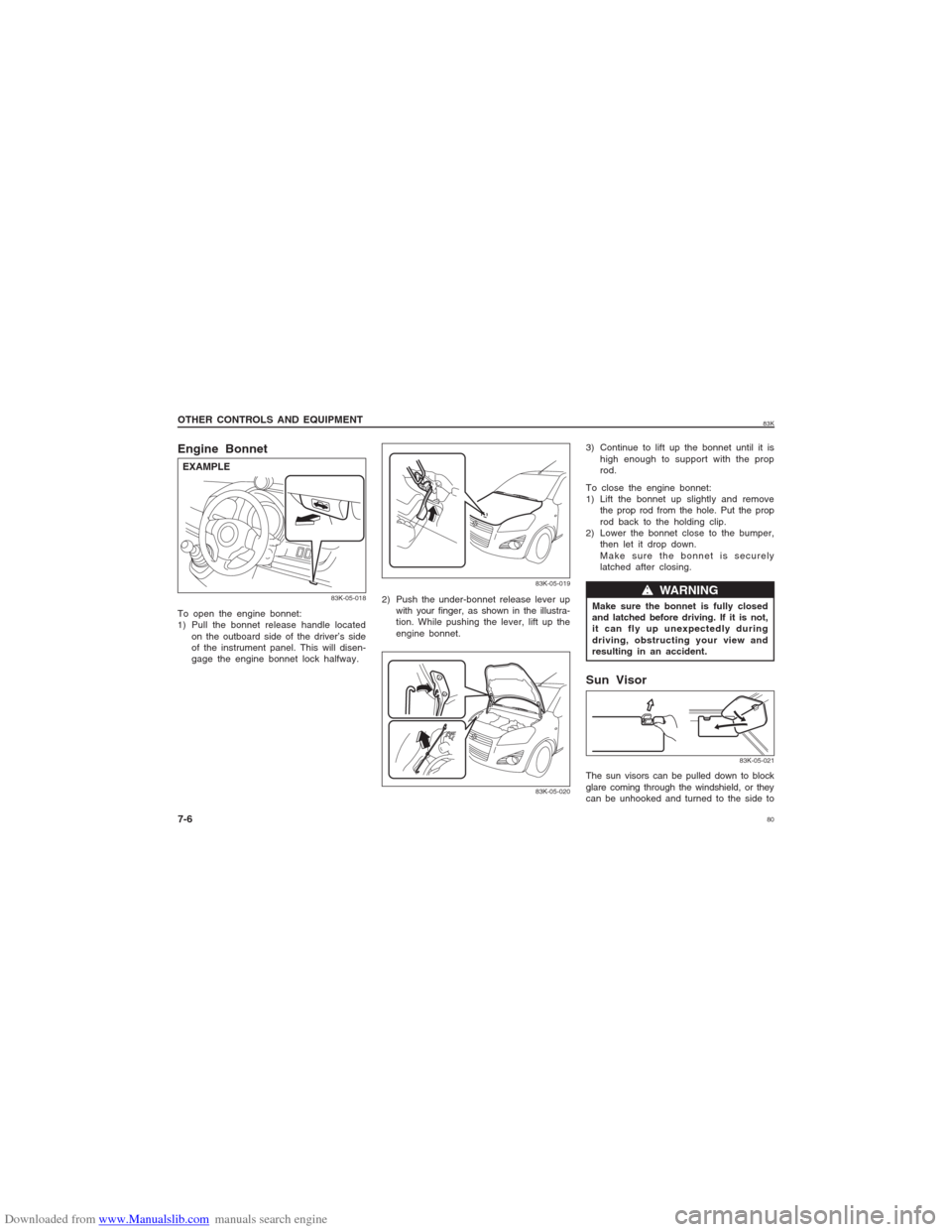
7-6Engine BonnetTo open the engine bonnet:
1) Pull the bonnet release handle located
on the outboard side of the driver’s side
of the instrument panel. This will disen-
gage the engine bonnet lock halfway.
83K-05-018
EXAMPLE
83K-05-01983K-05-020
2) Push the under-bonnet release lever up
with your finger, as shown in the illustra-
tion. While pushing the lever, lift up the
engine bonnet.3) Continue to lift up the bonnet until it is
high enough to support with the prop
rod.
To close the engine bonnet:
1) Lift the bonnet up slightly and remove
the prop rod from the hole. Put the prop
rod back to the holding clip.
2) Lower the bonnet close to the bumper,
then let it drop down.
Make sure the bonnet is securely
latched after closing.
Make sure the bonnet is fully closed
and latched before driving. If it is not,
it can fly up unexpectedly during
driving, obstructing your view and
resulting in an accident.
w ww w
w WARNING
83K-05-021
Sun VisorThe sun visors can be pulled down to block
glare coming through the windshield, or they
can be unhooked and turned to the side to
Page 82 of 136
Downloaded from www.Manualslib.com manuals search engine 8283K
OTHER CONTROLS AND EQUIPMENT
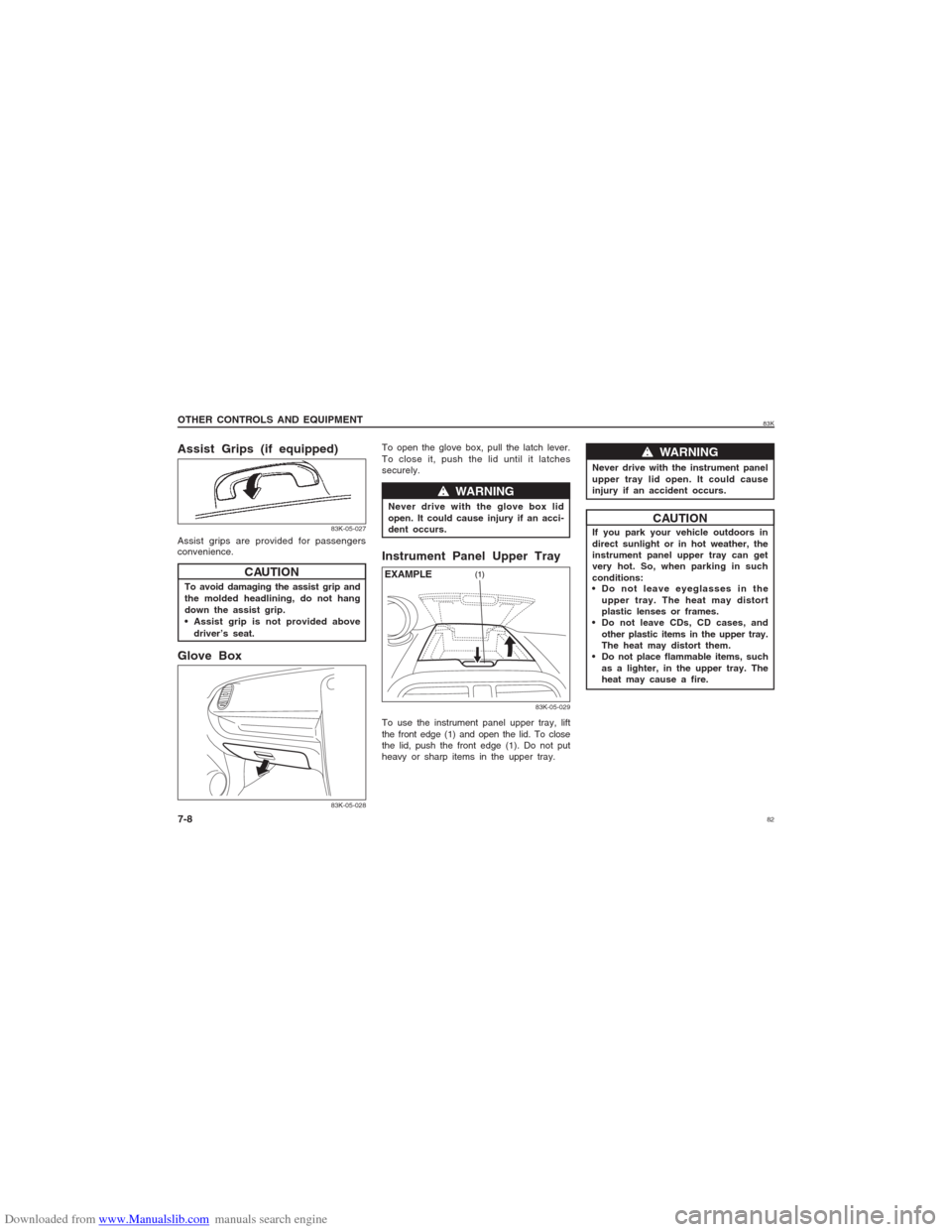
7-8Assist Grips (if equipped)
83K-05-027
Assist grips are provided for passengers
convenience.
CAUTION
To avoid damaging the assist grip and
the molded headlining, do not hang
down the assist grip.
Assist grip is not provided above
driver’s seat.Glove Box
83K-05-028
w ww w
w WARNING
Never drive with the glove box lid
open. It could cause injury if an acci-
dent occurs.To open the glove box, pull the latch lever.
To close it, push the lid until it latches
securely.Instrument Panel Upper Tray
83K-05-029
EXAMPLETo use the instrument panel upper tray, lift
the front edge (1) and open the lid. To close
the lid, push the front edge (1). Do not put
heavy or sharp items in the upper tray.
w ww w
w WARNING
Never drive with the instrument panel
upper tray lid open. It could cause
injury if an accident occurs.
CAUTION
If you park your vehicle outdoors in
direct sunlight or in hot weather, the
instrument panel upper tray can get
very hot. So, when parking in such
conditions:
Do not leave eyeglasses in the
upper tray. The heat may distort
plastic lenses or frames.
Do not leave CDs, CD cases, and
other plastic items in the upper tray.
The heat may distort them.
Do not place flammable items, such
as a lighter, in the upper tray. The
heat may cause a fire.
Page 85 of 136
Downloaded from www.Manualslib.com manuals search engine 8583K
OTHER CONTROLS AND EQUIPMENT
7-11
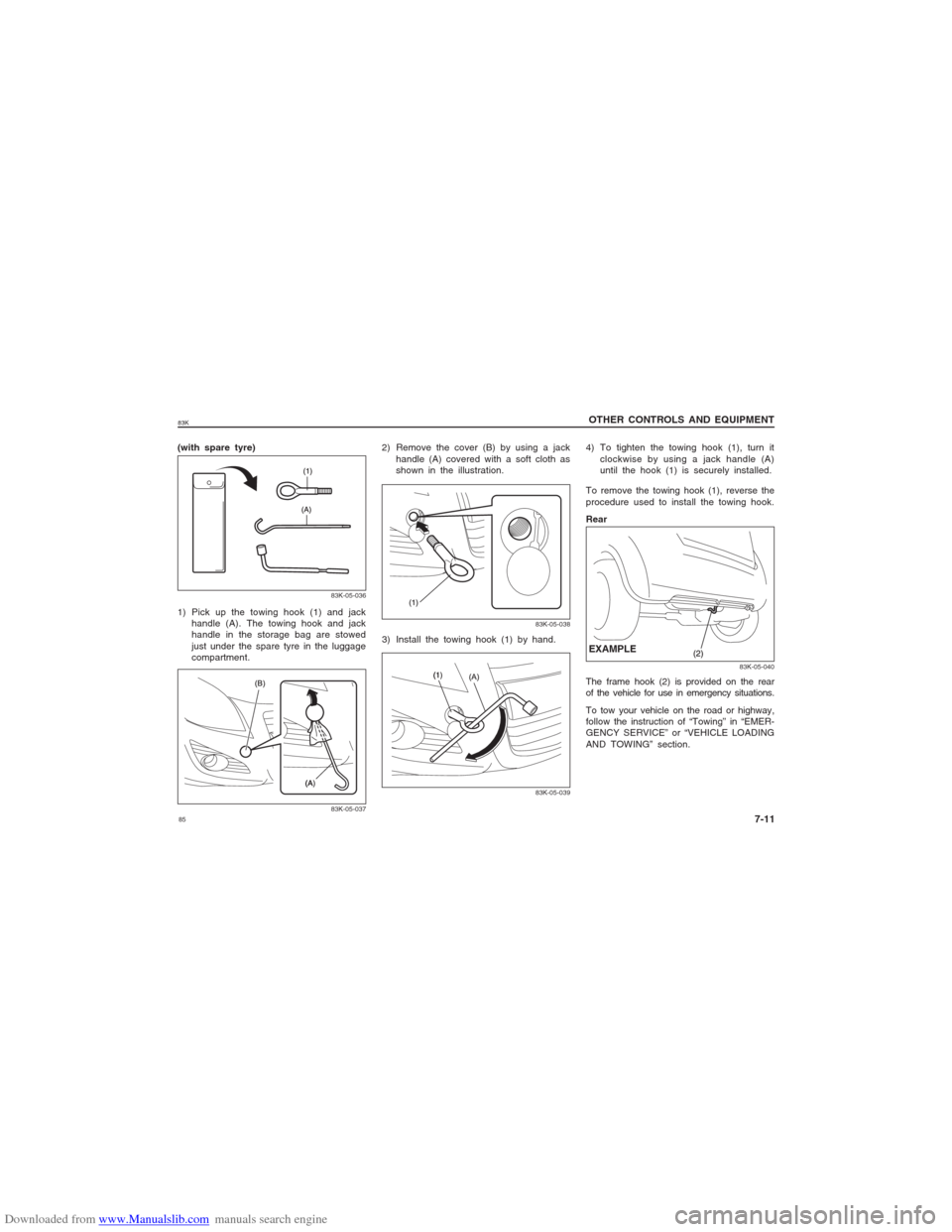
(with spare tyre)
83K-05-03683K-05-037
1) Pick up the towing hook (1) and jack
handle (A). The towing hook and jack
handle in the storage bag are stowed
just under the spare tyre in the luggage
compartment.2) Remove the cover (B) by using a jack
handle (A) covered with a soft cloth as
shown in the illustration.
83K-05-038
3) Install the towing hook (1) by hand.
83K-05-039
To remove the towing hook (1), reverse the
procedure used to install the towing hook.
Rear
83K-05-040
The frame hook (2) is provided on the rear
of the vehicle for use in emergency situations.
To tow your vehicle on the road or highway,
follow the instruction of “Towing” in “EMER-
GENCY SERVICE” or “VEHICLE LOADING
AND TOWING” section.EXAMPLE4) To tighten the towing hook (1), turn it
clockwise by using a jack handle (A)
until the hook (1) is securely installed.
Page 87 of 136
Downloaded from www.Manualslib.com manuals search engine 8783KVEHICLE LOADING AND TOWING
VEHICLE LOADING AND TOWING
Vehicle LoadingYour vehicle was designed for specific weight
capacities. The weight capacities of your
vehicle are indicated by the Gross Vehicle
Weight Rating (GVWR) and the Gross Axle
Weight Rating (GAWR, front and rear). The
GVWR and GAWR (front and rear) are listed
in the “SPECIFICATIONS” section.
GVWR – Maximum permissible overall weight
of the fully loaded vehicle (including all the
occupants, accessories and cargo plus the
trailer nose weight if towing a trailer).
GAWR – (Front and Rear) Maximum per-
missible weight on an individual axle.
Actual weight of the loaded vehicle and actual
loads at the front and rear axles can only be
determined by weighing the vehicle. Compare
these weights to the GVWR and GAWR (front
and rear). If the gross vehicle weight or the
load on either axle exceeds these ratings, you
must remove enough weight to bring the load
down to the rated capacity.
w ww w
w WARNING
Always distribute cargo evenly. To
avoid personal injury or damage to your
vehicle, always secure cargo to prevent
it from shifting if the vehicle moves
suddenly. Place heavier objects on the
floor and as far forward in the cargo
area as possible. Never pile cargo
higher than the top of the seat backs.
w ww w
w WARNING
Never overload your vehicle. The gross
vehicle weight (sum of the weights of
the vehicle, all the occupants,
accessories, cargo plus trailer nose
V VV V
V
w ww w
w WARNING
V VV V
Vweight if towing a trailer) must never
exceed the Gross Vehicle Weight
Rating (GVWR). In addition, never
distribute a load so that the weight on
either the front or rear axle exceeds
the Gross Axle Weight Rating (GAWR).Trailer TowingYour MARUTI SUZUKI was originally
designed to carry people and a normal
amount of cargo, not to tow a trailer. MARUTI
SUZUKI does not recommend you use your
vehicle to tow a trailer if there is not any local
regulation about towing capacity permitted (for
example, registered or statutory towing
capacity). Towing a trailer can adversely affect
handling, durability, and fuel economy.When you tow your vehicle, follow the
instructions below to avoid accidents
and damage to your vehicle. In addition,
be sure to observe government and
local requirements regarding vehicle
lighting and trailer hitches or tow bars.
w ww w
w WARNING
Towing Your VehicleYour vehicle may be towed behind another
Vehicle (such as a motorhome), provided
you use the proper towing method specified
for your vehicle. The towing method you
must use depends on the specifications of
your vehicle: whether it is a manual
transmission vehicle or an automatic
transmission vehicle.
Use the towing instruction table to select the
proper towing method for your vehicle, and
carefully follow the corresponding
instructions. Be sure to use proper towing
equipment designed for recreational towing
and make sure that towing speed does not
exceed 90 km/h.
w ww w
w WARNING
A safety chain should always be used
when you tow your vehicle.
8-1