belt SUZUKI MARUTI 2005 1.G User Guide
[x] Cancel search | Manufacturer: SUZUKI, Model Year: 2005, Model line: MARUTI, Model: SUZUKI MARUTI 2005 1.GPages: 136, PDF Size: 2.93 MB
Page 33 of 136
Downloaded from www.Manualslib.com manuals search engine 3383K
BEFORE DRIVING
4-21
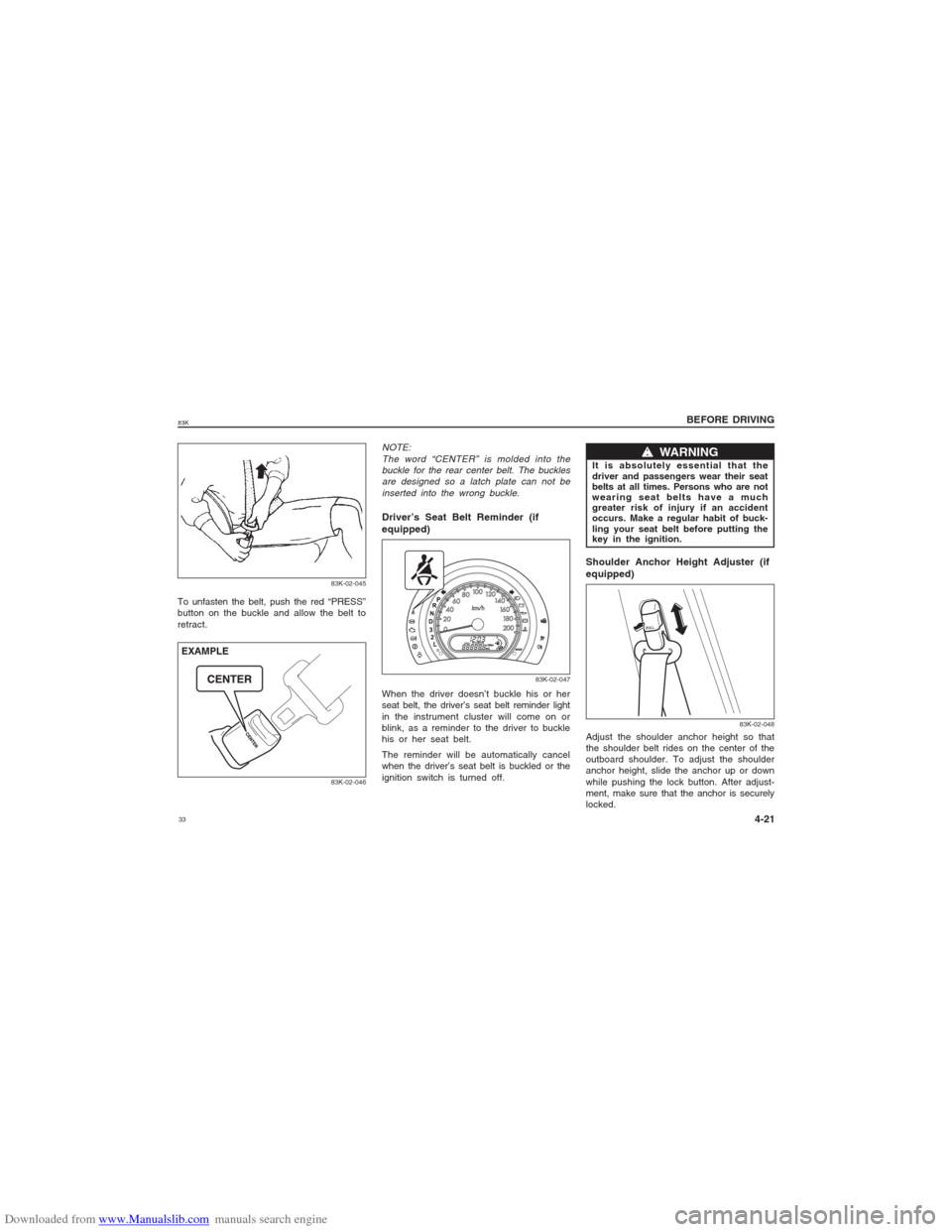
NOTE:
The word “CENTER” is molded into the
buckle for the rear center belt. The buckles
are designed so a latch plate can not be
inserted into the wrong buckle.Driver’s Seat Belt Reminder (if
equipped)
83K-02-047
When the driver doesn’t buckle his or her
seat belt, the driver’s seat belt reminder light
in the instrument cluster will come on or
blink, as a reminder to the driver to buckle
his or her seat belt.
The reminder will be automatically cancel
when the driver’s seat belt is buckled or the
ignition switch is turned off.
Shoulder Anchor Height Adjuster (if
equipped)Adjust the shoulder anchor height so that
the shoulder belt rides on the center of the
outboard shoulder. To adjust the shoulder
anchor height, slide the anchor up or down
while pushing the lock button. After adjust-
ment, make sure that the anchor is securely
locked.
83K-02-048
w ww w
w WARNING
It is absolutely essential that the
driver and passengers wear their seat
belts at all times. Persons who are not
wearing seat belts have a much
greater risk of injury if an accident
occurs. Make a regular habit of buck-
ling your seat belt before putting the
key in the ignition.
83K-02-045
To unfasten the belt, push the red “PRESS”
button on the buckle and allow the belt to
retract.
83K-02-046
EXAMPLE
Page 34 of 136
Downloaded from www.Manualslib.com manuals search engine 3483K
BEFORE DRIVING
4-22
CAUTION
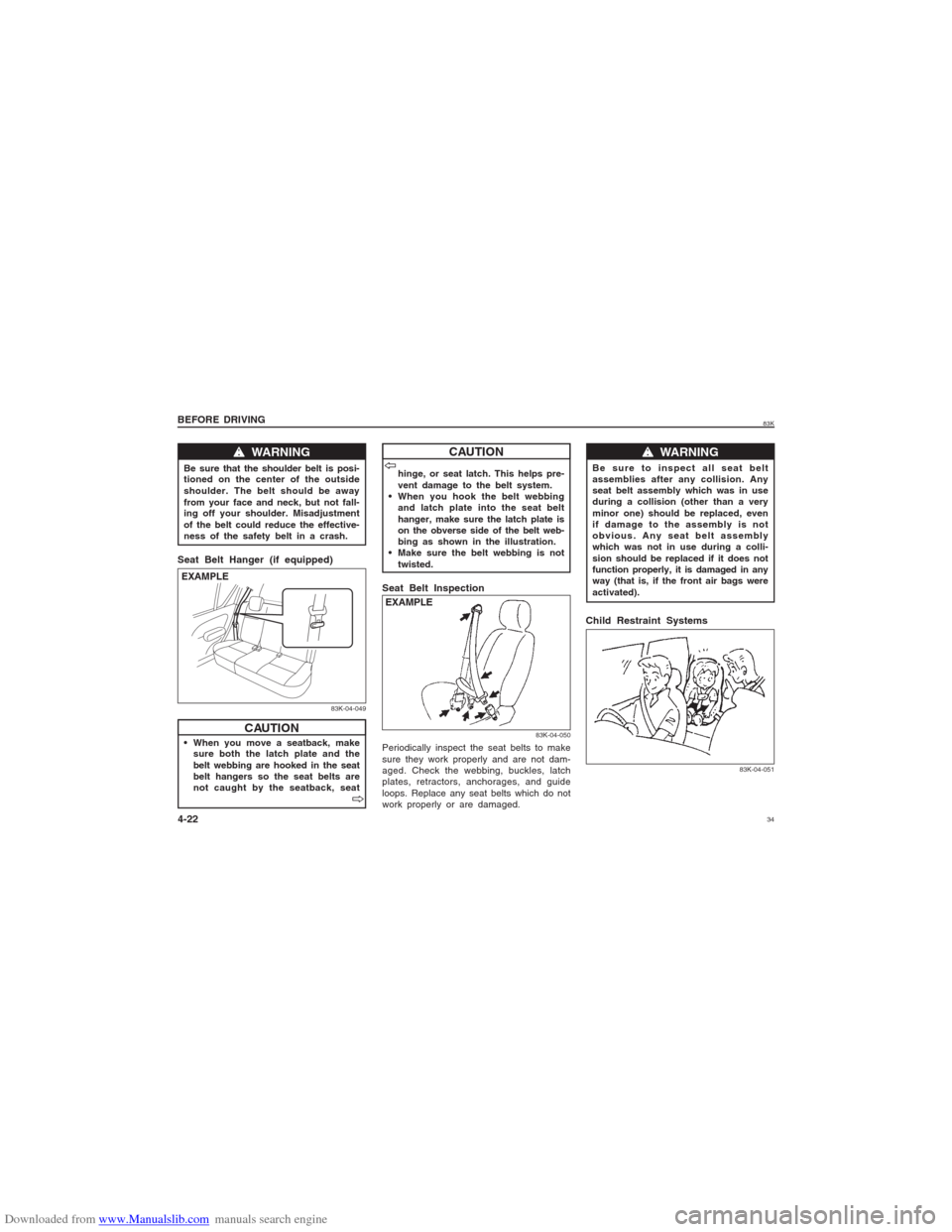
Seat Belt InspectionPeriodically inspect the seat belts to make
sure they work properly and are not dam-
aged. Check the webbing, buckles, latch
plates, retractors, anchorages, and guide
loops. Replace any seat belts which do not
work properly or are damaged.
83K-04-050
w ww w
w WARNING
Be sure to inspect all seat belt
assemblies after any collision. Any
seat belt assembly which was in use
during a collision (other than a very
minor one) should be replaced, even
if damage to the assembly is not
obvious. Any seat belt assembly
which was not in use during a colli-
sion should be replaced if it does not
function properly, it is damaged in any
way (that is, if the front air bags were
activated).
EXAMPLE
hinge, or seat latch. This helps pre-
vent damage to the belt system.
When you hook the belt webbing
and latch plate into the seat belt
hanger, make sure the latch plate is
on the obverse side of the belt web-
bing as shown in the illustration.
Make sure the belt webbing is not
twisted.
83K-04-051
Child Restraint Systems
V VV V
V
w ww w
w WARNING
Be sure that the shoulder belt is posi-
tioned on the center of the outside
shoulder. The belt should be away
from your face and neck, but not fall-
ing off your shoulder. Misadjustment
of the belt could reduce the effective-
ness of the safety belt in a crash.Seat Belt Hanger (if equipped)
83K-04-049
EXAMPLE When you move a seatback, make
sure both the latch plate and the
belt webbing are hooked in the seat
belt hangers so the seat belts are
not caught by the seatback, seat
CAUTION
V VV V
V
Page 35 of 136
Downloaded from www.Manualslib.com manuals search engine 3583K
BEFORE DRIVING
4-23
Booster seat
83K-04-054
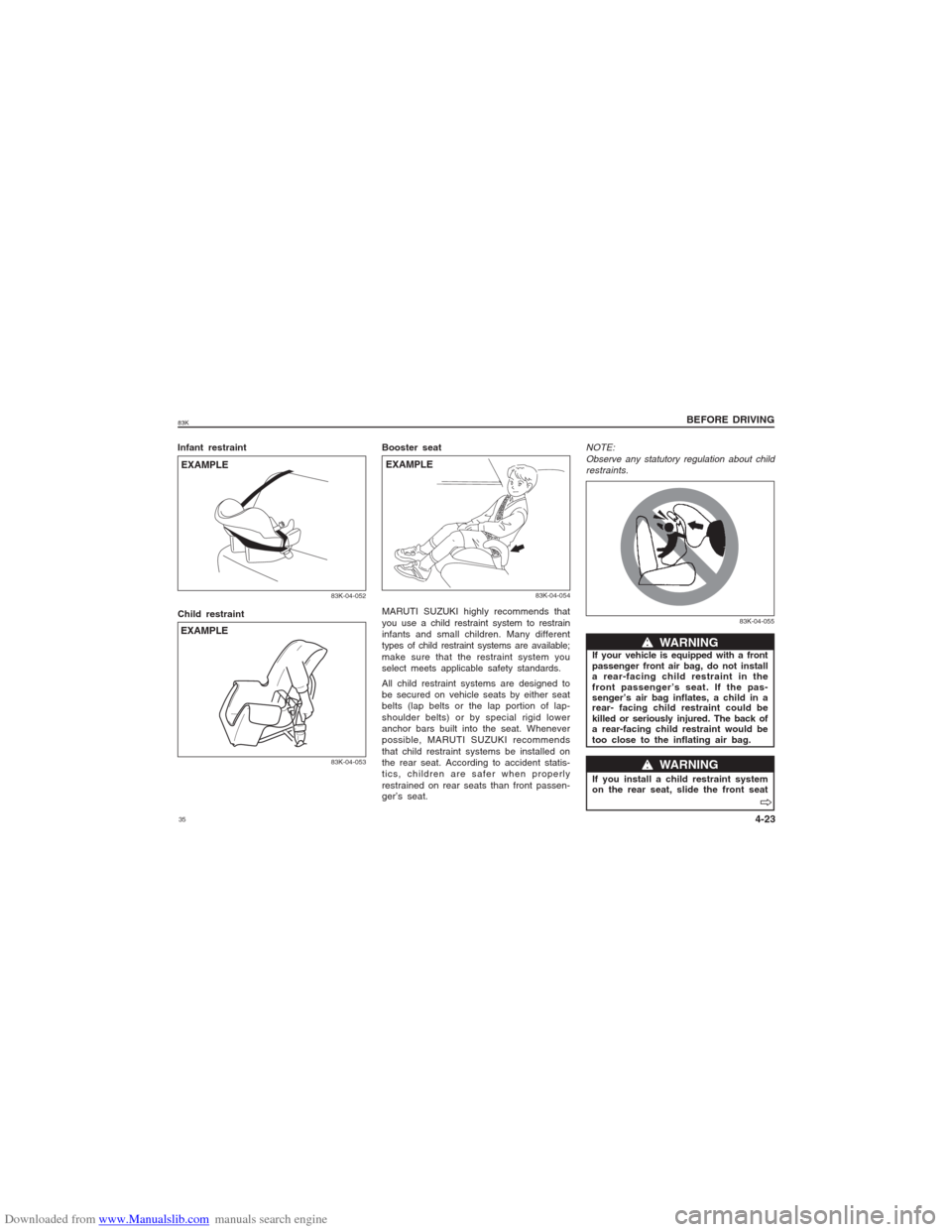
EXAMPLEMARUTI SUZUKI highly recommends that
you use a child restraint system to restrain
infants and small children. Many different
types of child restraint systems are available;
make sure that the restraint system you
select meets applicable safety standards.
All child restraint systems are designed to
be secured on vehicle seats by either seat
belts (lap belts or the lap portion of lap-
shoulder belts) or by special rigid lower
anchor bars built into the seat. Whenever
possible, MARUTI SUZUKI recommends
that child restraint systems be installed on
the rear seat. According to accident statis-
tics, children are safer when properly
restrained on rear seats than front passen-
ger’s seat.
NOTE:
Observe any statutory regulation about child
restraints.
83K-04-055
w ww w
w WARNING
If your vehicle is equipped with a front
passenger front air bag, do not install
a rear-facing child restraint in the
front passenger’s seat. If the pas-
senger’s air bag inflates, a child in a
rear- facing child restraint could be
killed or seriously injured. The back of
a rear-facing child restraint would be
too close to the inflating air bag.
w ww w
w WARNING
If you install a child restraint system
on the rear seat, slide the front seat
V VV V
V
Infant restraint
Child restraint
83K-04-05283K-04-053
EXAMPLEEXAMPLE
Page 36 of 136
Downloaded from www.Manualslib.com manuals search engine 3683K
BEFORE DRIVING
4-24
Children could be endangered in a
crash if their child restraints are not
properly secured in the vehicle. Be
sure to secure the child in the
restraint system according to the
manufacturer’s instructions.
w ww w
w WARNING
w ww w
w WARNING
far enough forward so that the child’s
feet do not contact the front seatback.
This will help avoid injury to the child
in the event of an accident.
83K-04-05683K-04-057
V VV V
V
Supplemental Restraint Sys-
tem (air bags)
(if equipped)
w ww w
w WARNING
This section of the owner’s manual
describes the protection provided by
your MARUTI SUZUKI SUPPLEMEN-
TAL RESTRAINT SYSTEM (air bags).
Please read and follow ALL these
instructions carefully to minimize your
risk of severe injury or death in the
event of a collision.
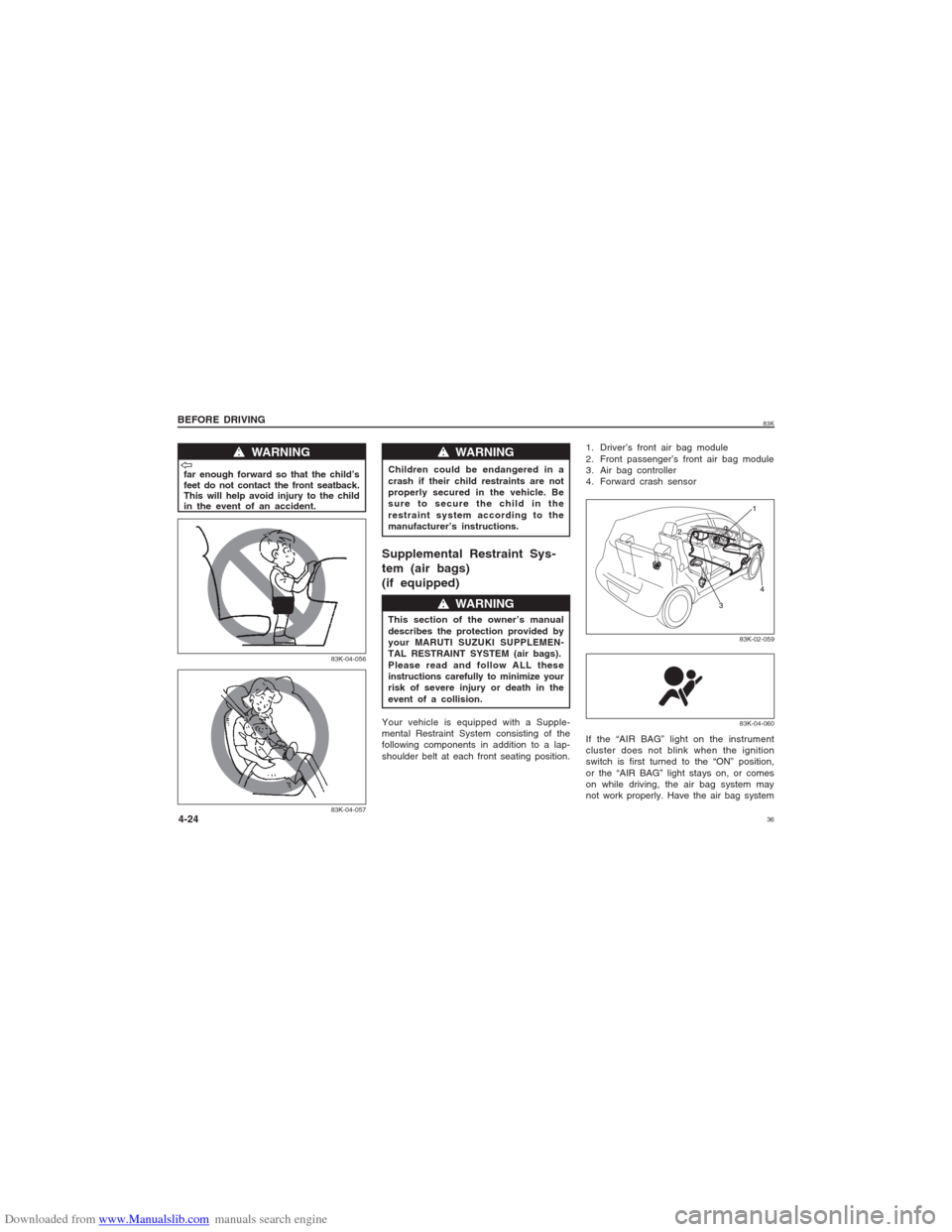
Your vehicle is equipped with a Supple-
mental Restraint System consisting of the
following components in addition to a lap-
shoulder belt at each front seating position.1. Driver’s front air bag module
2. Front passenger’s front air bag module
3. Air bag controller
4. Forward crash sensor
83K-02-059
If the “AIR BAG” light on the instrument
cluster does not blink when the ignition
switch is first turned to the “ON” position,
or the “AIR BAG” light stays on, or comes
on while driving, the air bag system may
not work properly. Have the air bag system
83K-04-060
Page 37 of 136
Downloaded from www.Manualslib.com manuals search engine 3783K
BEFORE DRIVING
4-25
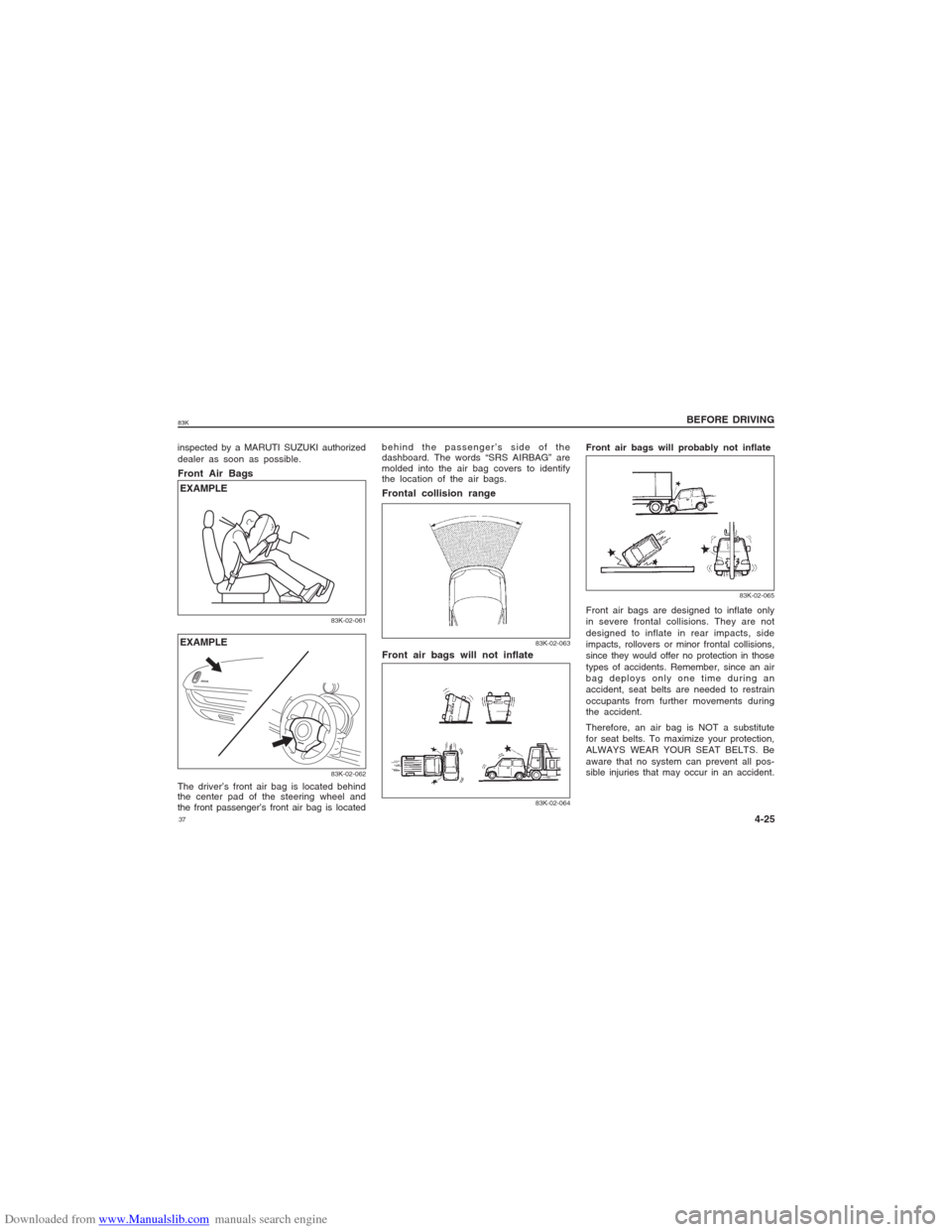
behind the passenger’s side of the
dashboard. The words “SRS AIRBAG” are
molded into the air bag covers to identify
the location of the air bags.Frontal collision range
83K-02-063
Front air bags will not inflate
83K-02-064
Front air bags will probably not inflate
83K-02-065
Front air bags are designed to inflate only
in severe frontal collisions. They are not
designed to inflate in rear impacts, side
impacts, rollovers or minor frontal collisions,
since they would offer no protection in those
types of accidents. Remember, since an air
bag deploys only one time during an
accident, seat belts are needed to restrain
occupants from further movements during
the accident.
Therefore, an air bag is NOT a substitute
for seat belts. To maximize your protection,
ALWAYS WEAR YOUR SEAT BELTS. Be
aware that no system can prevent all pos-
sible injuries that may occur in an accident.
inspected by a MARUTI SUZUKI authorized
dealer as soon as possible.Front Air Bags
83K-02-061
EXAMPLE
83K-02-062
EXAMPLEThe driver’s front air bag is located behind
the center pad of the steering wheel and
the front passenger’s front air bag is located
Page 38 of 136
Downloaded from www.Manualslib.com manuals search engine 3883K
BEFORE DRIVING
4-26
If you must use a front-facing child restraint
in the front passenger’s seat, be sure to
move the front passenger’s seat as far back
as possible. Please refer to the “Seat Belts
and Child Restraint Systems” section in the
“BEFORE DRIVING” section for details on
securing your child.
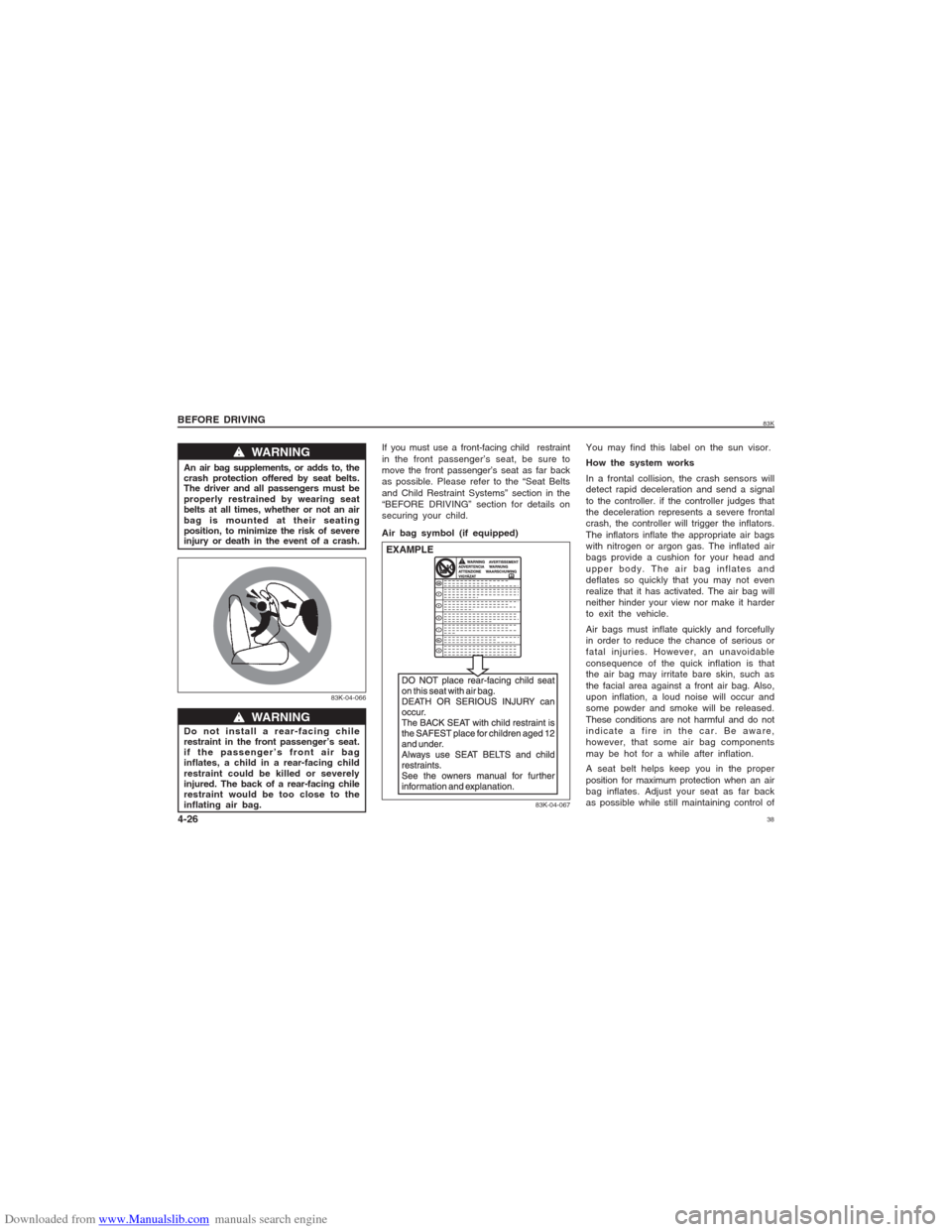
Air bag symbol (if equipped)
83K-04-067
EXAMPLE
You may find this label on the sun visor.
How the system works
In a frontal collision, the crash sensors will
detect rapid deceleration and send a signal
to the controller. if the controller judges that
the deceleration represents a severe frontal
crash, the controller will trigger the inflators.
The inflators inflate the appropriate air bags
with nitrogen or argon gas. The inflated air
bags provide a cushion for your head and
upper body. The air bag inflates and
deflates so quickly that you may not even
realize that it has activated. The air bag will
neither hinder your view nor make it harder
to exit the vehicle.
Air bags must inflate quickly and forcefully
in order to reduce the chance of serious or
fatal injuries. However, an unavoidable
consequence of the quick inflation is that
the air bag may irritate bare skin, such as
the facial area against a front air bag. Also,
upon inflation, a loud noise will occur and
some powder and smoke will be released.
These conditions are not harmful and do not
indicate a fire in the car. Be aware,
however, that some air bag components
may be hot for a while after inflation.
A seat belt helps keep you in the proper
position for maximum protection when an air
bag inflates. Adjust your seat as far back
as possible while still maintaining control of
w ww w
w WARNING
An air bag supplements, or adds to, the
crash protection offered by seat belts.
The driver and all passengers must be
properly restrained by wearing seat
belts at all times, whether or not an air
bag is mounted at their seating
position, to minimize the risk of severe
injury or death in the event of a crash.
83K-04-066
w ww w
w WARNING
Do not install a rear-facing chile
restraint in the front passenger’s seat.
if the passenger’s front air bag
inflates, a child in a rear-facing child
restraint could be killed or severely
injured. The back of a rear-facing chile
restraint would be too close to the
inflating air bag.
Page 39 of 136
Downloaded from www.Manualslib.com manuals search engine 3983K
BEFORE DRIVING
4-27
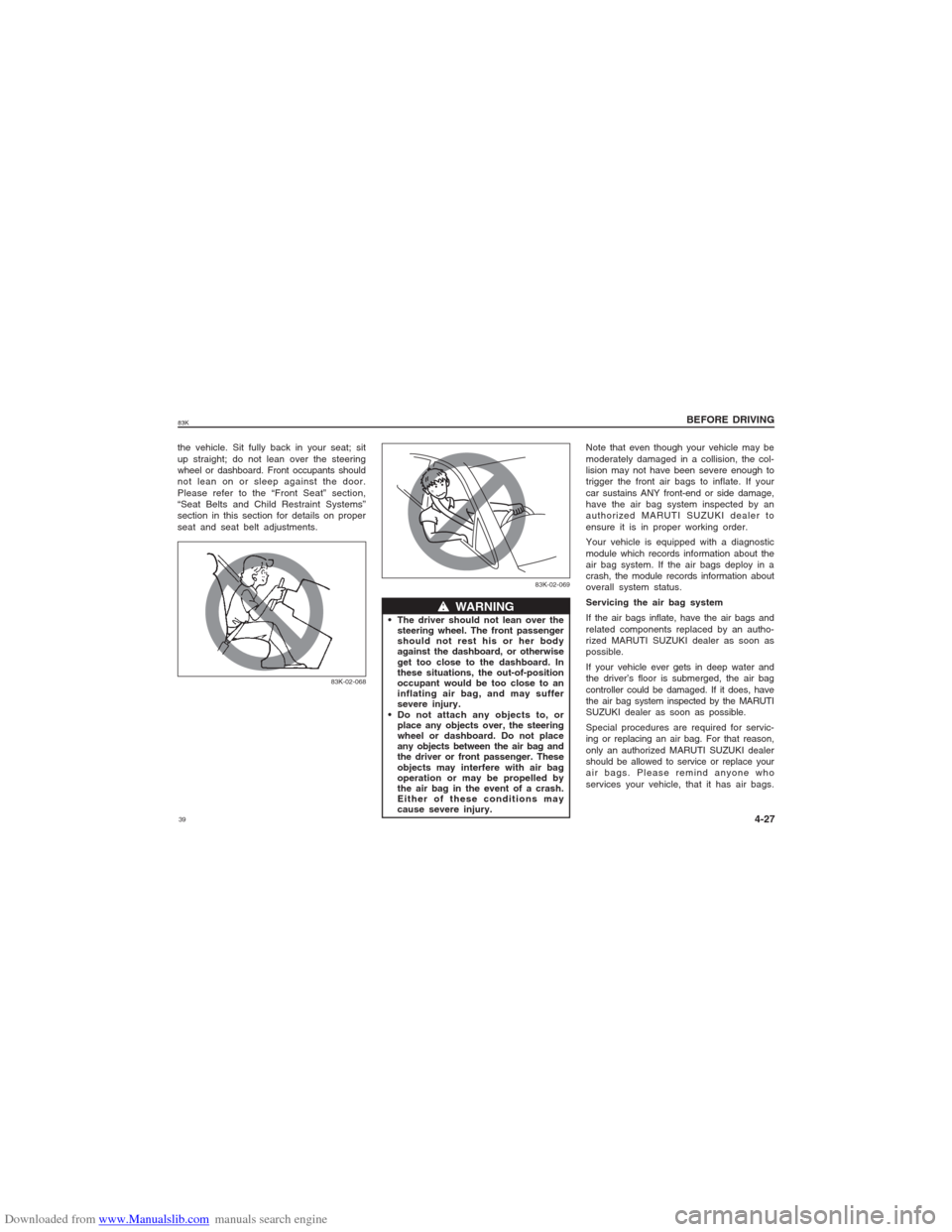
w ww w
w WARNING
The driver should not lean over the
steering wheel. The front passenger
should not rest his or her body
against the dashboard, or otherwise
get too close to the dashboard. In
these situations, the out-of-position
occupant would be too close to an
inflating air bag, and may suffer
severe injury.
Do not attach any objects to, or
place any objects over, the steering
wheel or dashboard. Do not place
any objects between the air bag and
the driver or front passenger. These
objects may interfere with air bag
operation or may be propelled by
the air bag in the event of a crash.
Either of these conditions may
cause severe injury.
83K-02-068
the vehicle. Sit fully back in your seat; sit
up straight; do not lean over the steering
wheel or dashboard. Front occupants should
not lean on or sleep against the door.
Please refer to the “Front Seat” section,
“Seat Belts and Child Restraint Systems”
section in this section for details on proper
seat and seat belt adjustments.Note that even though your vehicle may be
moderately damaged in a collision, the col-
lision may not have been severe enough to
trigger the front air bags to inflate. If your
car sustains ANY front-end or side damage,
have the air bag system inspected by an
authorized MARUTI SUZUKI dealer to
ensure it is in proper working order.
Your vehicle is equipped with a diagnostic
module which records information about the
air bag system. If the air bags deploy in a
crash, the module records information about
overall system status.
Servicing the air bag system
If the air bags inflate, have the air bags and
related components replaced by an autho-
rized MARUTI SUZUKI dealer as soon as
possible.
If your vehicle ever gets in deep water and
the driver’s floor is submerged, the air bag
controller could be damaged. If it does, have
the air bag system inspected by the MARUTI
SUZUKI dealer as soon as possible.
Special procedures are required for servic-
ing or replacing an air bag. For that reason,
only an authorized MARUTI SUZUKI dealer
should be allowed to service or replace your
air bags. Please remind anyone who
services your vehicle, that it has air bags.
83K-02-069
Page 41 of 136
Downloaded from www.Manualslib.com manuals search engine 4183K
BEFORE DRIVING
4-29
The light also comes on together with the
ABS warning light when the rear brake force
control function (Proportioning valve
function) of the ABS system fails.
If the brake system warning light comes on
while you are driving the vehicle, it may
mean that there is something wrong with
the vehicle’s brake system. If this happens,
you should:
1) Pull off the road and stop carefully.
w ww w
w WARNING
Remember that stopping distance may
be longer, you may have to push
harder on the pedal, and the pedal
may go down farther than normal.
w ww w
w WARNING
If the brake system warning light
does not go out after the engine
has been started and the parking
brake has been fully released.
If the brake system warning light
does not come on when the ignition
switch is turned to the “ON” or
“START” position.
If the brake system warning light
comes on at any time during vehi-
cle operation.
2) Test the brakes by carefully starting and
stopping at the side of the road.
– If you determine that it is safe, drive
carefully at low speed to the nearest
MARUTI SUZUKI dealer for repairs, or
– Have the vehicle towed to the nearest
MARUTI SUZUKI dealer for repairs.
V VV V
V
w ww w
w WARNING
If any of the following conditions
occur, you should immediately ask
your MARUTI SUZUKI dealer to
inspect the brake system.
V VV V
V
NOTE:
Because the disc brake system is self-
adjusting, the fluid level will drop as the
brake pads become worn. Replenishing the
brake fluid reservoir is considered normal
periodic maintenance.Seat Belt Warning Light (if
equipped)This light blinks as a reminder until the
driver’s seat belt is buckled.
83K-02-073
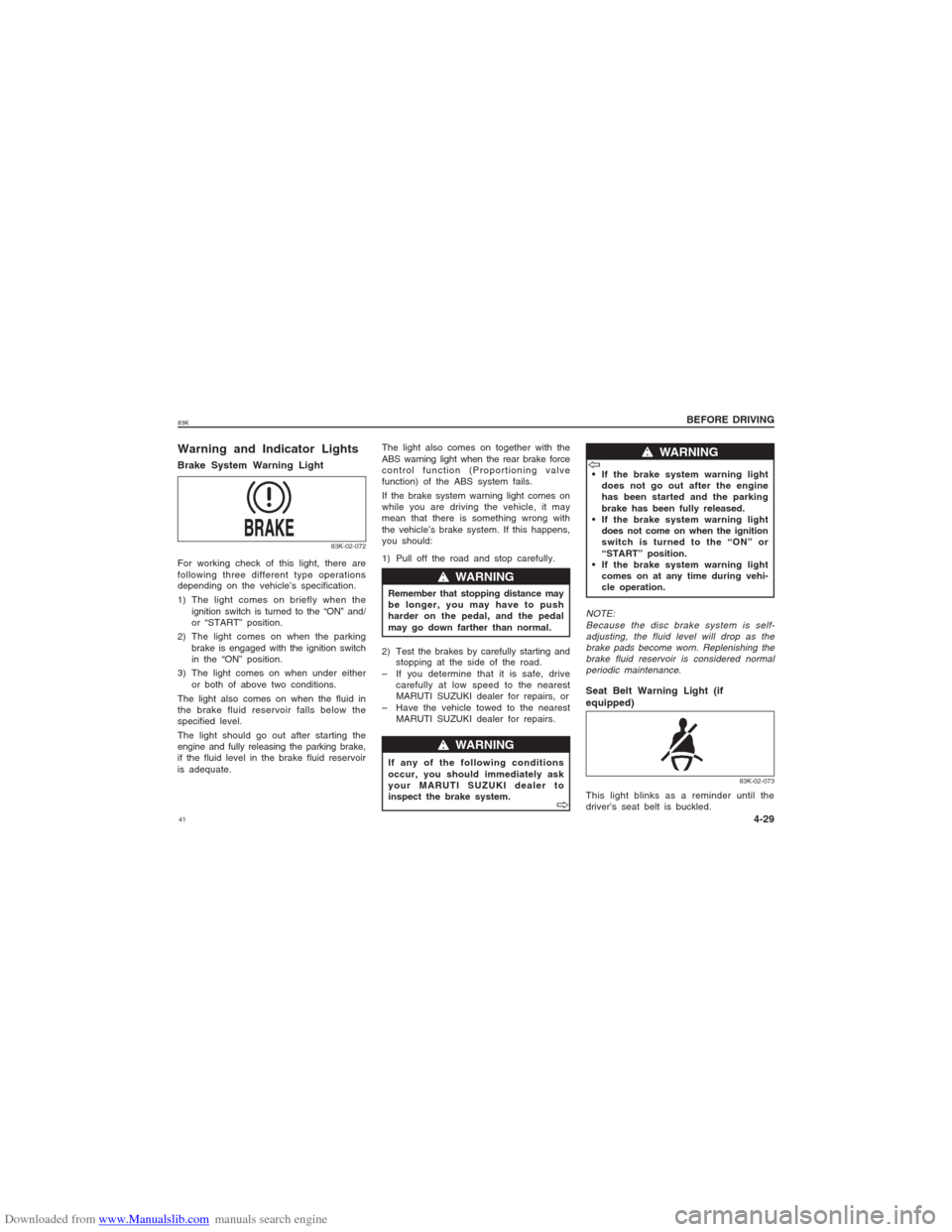
Warning and Indicator LightsBrake System Warning LightFor working check of this light, there are
following three different type operations
depending on the vehicle’s specification.
1) The light comes on briefly when the
ignition switch is turned to the “ON” and/
or “START” position.
2) The light comes on when the parking
brake is engaged with the ignition switch
in the “ON” position.
3) The light comes on when under either
or both of above two conditions.
The light also comes on when the fluid in
the brake fluid reservoir falls below the
specified level.
The light should go out after starting the
engine and fully releasing the parking brake,
if the fluid level in the brake fluid reservoir
is adequate.
83K-02-072
Page 57 of 136
Downloaded from www.Manualslib.com manuals search engine 5783K4) Make sure the bonnet is fully closed and
latched.
5) Check the headlights, turn signal lights,
brake lights and horn for proper opera-
tion.
6) Adjust the seat and adjustable head
restraint (if equipped).
7) Check the brake pedal and the parking
brake lever.
8) Adjust the mirrors.
9) Make sure that you and all passengers
have properly fastened your seat belts.
10)Make sure that all warning lights come
on as the key is turned to the “ON” or
“START” position.
11)Check all gauges.
12)Make sure that the BRAKE SYSTEM
WARNING light turns off when the
parking brake is released.
Once a week, or each time you fill your fuel
tank, perform the following under-hood
checks:
1) Engine oil level
2) Coolant level
3) Brake fluid level
4) Windshield washer fluid level
5) Battery solution level
6) Bonnet latch operation
Pull the Bonnet release handle inside the
vehicle. Make sure that you cannot open
the Bonnet all the way without releasingthe secondary latch. Be sure to close
the Bonnet securely after checking for
proper latch operation. See “All latches,
hinges & locks” of “CHASSIS AND
BODY” in the “Periodic Maintenance
Schedule” in the “INSPECTION AND
MAINTENANCE” section for lubrication
schedule.
w ww w
w WARNING
Make sure the bonnet is fully closed
and latched before driving. If it is not,
it can fly up unexpectedly during
driving, obstructing your view and
resulting in an accident.
Once a month, or each time you fill your
fuel tank, check the tyre pressure using a
tyre pressure gauge. Also check the tyre
pressure of the spare tyre.since its pistons, piston rings and cylinder
walls have not yet become conditioned. New
engines reach the normal level of oil
consumption only after approximately 5000
km (3000 miles) driving.
When judging the amount of oil consump-
tion, note that the oil may become diluted
and make it difficult to accurately judge the
true oil level.
As an example, if a vehicle is used for
repeated short trips, and consumes a nor-
mal amount of oil, the dipstick may not
show any drop in the oil level at all, even
after 1000 km (600 miles) or more of driv-
ing. This is because the oil is gradually
becoming diluted with fuel or moisture,
making it appear that the oil level has not
changed.
You should also be aware that the diluting
ingredients evaporate out when the vehicle
is subsequently driven at high speeds, such
as on an expressway, making it appear that
oil is excessively consumed after high-speed
driving.
OPERATING YOUR VEHICLE
5-2
Engine Oil ConsumptionIt is normal for the engine to consume some
engine oil during normal vehicle operation.
The amount of engine oil consumed
depends on the viscosity of the oil, the
quality of the oil and the conditions the
vehicle is driven under.
More oil is consumed during high-speed
driving and when there is frequent acceler-
ation and deceleration. Under high loads,
your engine also will consume more oil.
A new engine also consumes more oil,
83K-03-003
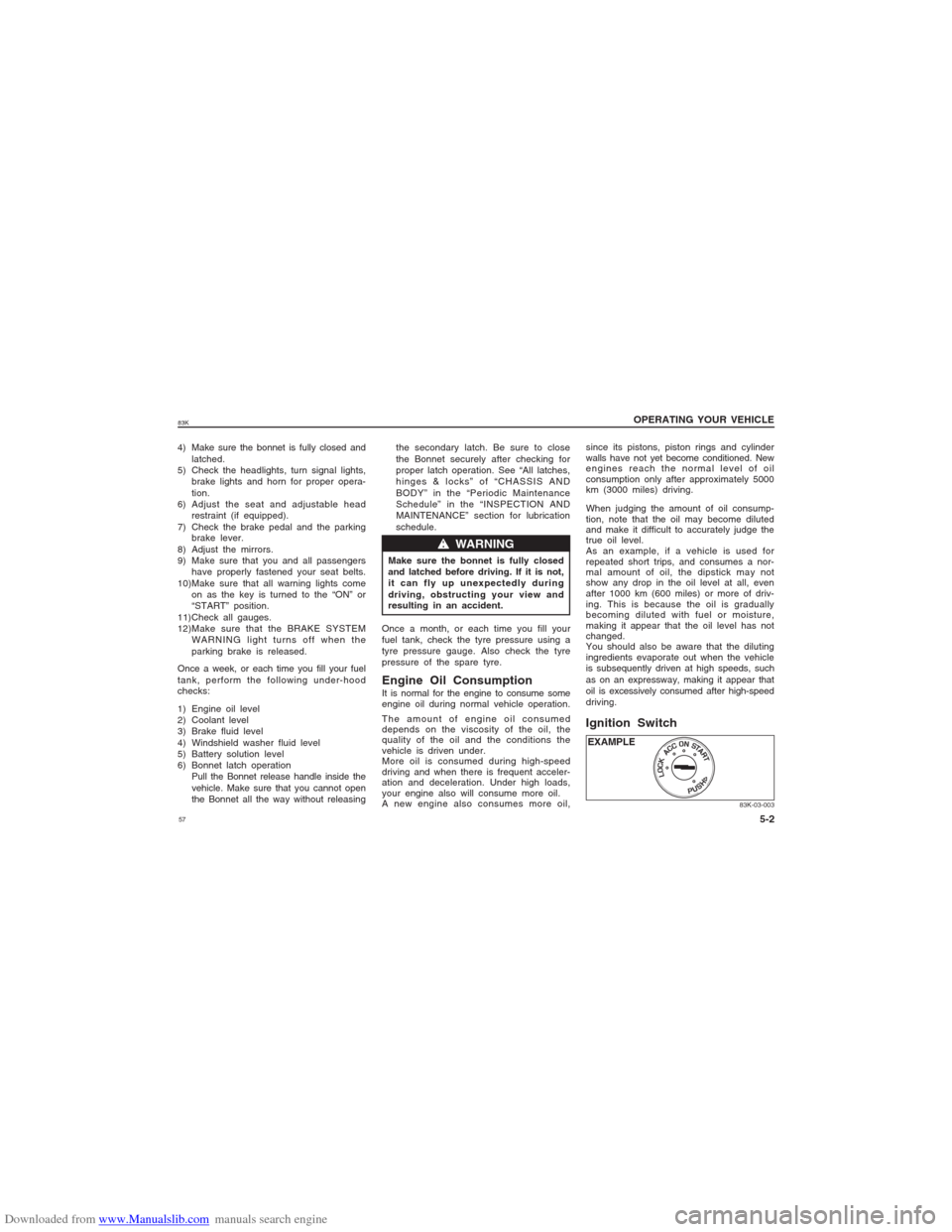
Ignition SwitchEXAMPLE
Page 67 of 136
Downloaded from www.Manualslib.com manuals search engine 6783K Wear Your Seat Belts at All Times,
even if air bags are equipped at the
front seating positions. The driver
and all passengers should be prop-
erly restrained at all times, using
the seat belts provided. Refer to the
“Seat Belts and Child Restraint
Systems” section for instructions on
proper use of the seat belts.
Never drive while under the influ-
ence of alcohol or other drugs.
Alcohol and drugs can seriously
impair your ability to drive safely,
greatly increasing the risk of injury
to yourself and others. You should
also avoid driving when you are
tired, sick, irritated, or under stress.The future performance and reliability
of the engine depends on the care
and restraint exercised during its early
life. It is especially important to
observe the following precautions
during the initial 960 km (600 miles)
of vehicle operation.
After starting, do not race the
engine. Warm it up gradually.
Avoid prolonged vehicle operation at
a constant speed. Moving parts will
break in better if you vary your
speed.
Start off from a stop slowly. Avoid
full throttle starts.
Avoid hard braking, especially dur-
ing the first 320 km (200 miles) of
driving.
Do not drive slowly with the trans-
mission in a high gear.
Drive the vehicle at moderate engine
speeds.
83K-04-001
w ww w
w WARNING
Running-in
CAUTION
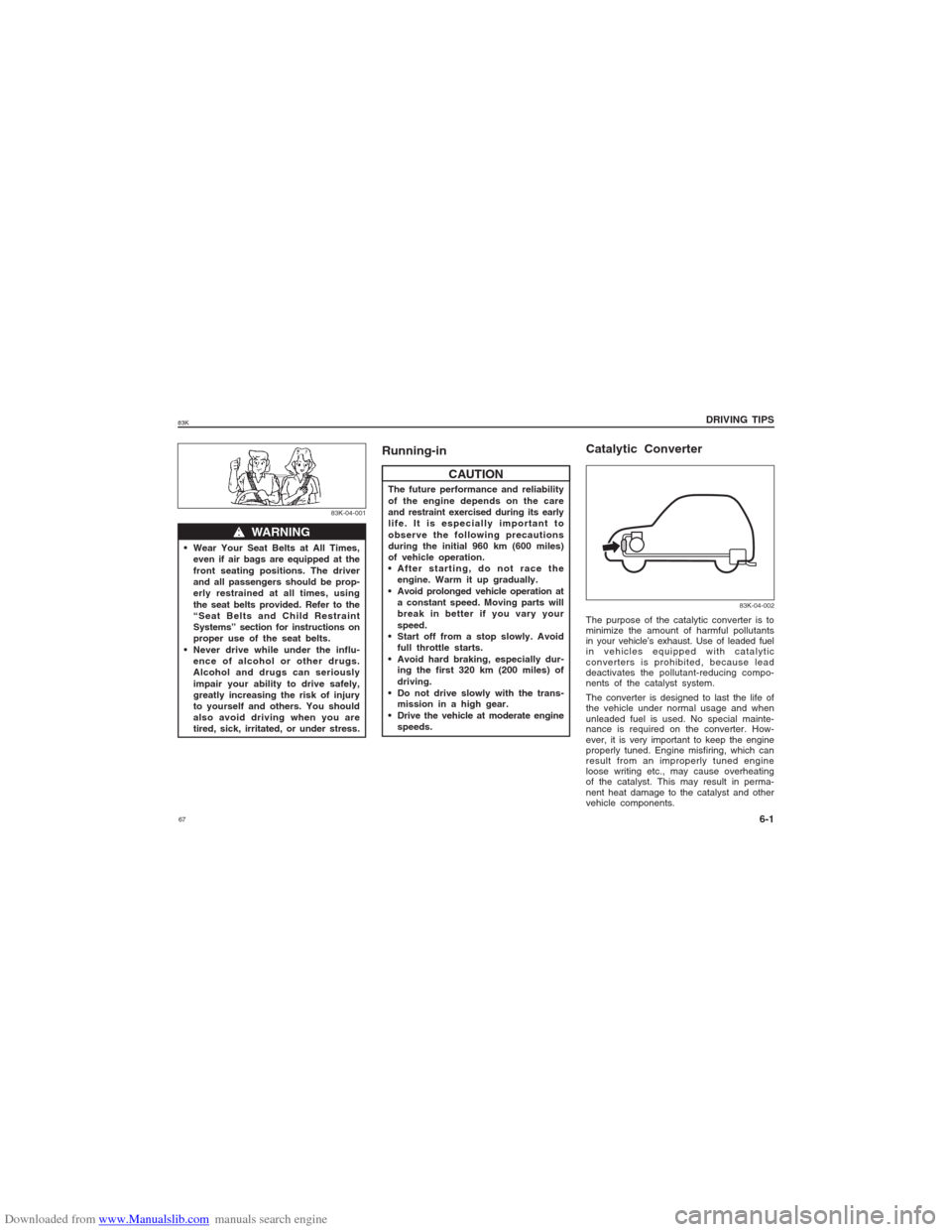
Catalytic ConverterThe purpose of the catalytic converter is to
minimize the amount of harmful pollutants
in your vehicle’s exhaust. Use of leaded fuel
in vehicles equipped with catalytic
converters is prohibited, because lead
deactivates the pollutant-reducing compo-
nents of the catalyst system.
The converter is designed to last the life of
the vehicle under normal usage and when
unleaded fuel is used. No special mainte-
nance is required on the converter. How-
ever, it is very important to keep the engine
properly tuned. Engine misfiring, which can
result from an improperly tuned engine
loose writing etc., may cause overheating
of the catalyst. This may result in perma-
nent heat damage to the catalyst and other
vehicle components.
83K-04-002
DRIVING TIPS
6-1