ignition SUZUKI MARUTI 2005 1.G Owner's Manual
[x] Cancel search | Manufacturer: SUZUKI, Model Year: 2005, Model line: MARUTI, Model: SUZUKI MARUTI 2005 1.GPages: 136, PDF Size: 2.93 MB
Page 49 of 136
Downloaded from www.Manualslib.com manuals search engine 4983K
BEFORE DRIVING
4-37
w ww w
w WARNING
If you attempt to adjust the display
while driving, you could lose control
of the vehicle.
Do not attempt to adjust the display
while driving.NOTE:
Refer to “Speedometer/ Odometer/ Trip
meter” in this section for details of (a), (b),
and (c) indication.Instantaneous fuel consumption (d) (if
equipped)
If you selected instantaneous fuel
consumption the last time you drove the
vehicle, the display indicates “—.-” when the
ignition switch is turned to the “ON” position.
Unless the vehicle is moving, the display will
indicate “—.-”.NOTE:
Depending on the vehicle’s specification,
the fuel consumption units of initial
setting are indicated as L/100km, km/L.
For “L/100km” or “km/L” setting, the
indicated maximum value of
instantaneous fuel consumption is 30. No
more than 30 will be indicated on the
display even if the actual instantaneous
fuel consumption is higher.
Average fuel consumption (e) (if
equipped)If you selected average fuel consumption
the last time you drove the vehicle, the
display shows the last value of average fuel
consumption when the ignition switch is
turned to the “ON” position. Unless you
reset the value of average fuel consumption,
the display indicates the value of average
fuel consumption which includes average
fuel consumption during previous driving.
To reset the value of average fuel
consumption, hold in the “MODE” knob (5)
for a while when the display shows the
average fuel consumption. The display will
indicate “—.-” and then will show a new
average fuel consumption value after driving
for a short time.NOTE:
When you reset the indication or reconnect
the negative (–) terminal to the battery, the
value of average fuel consumption will be
shown after driving for a while.Driving range (f) (if equipped)If you selected driving range the last time
you drove the vehicle, the display shows “—
-” for a few seconds and then shows the
current driving range when the ignition
switch is turned to the “ON” position.
The driving range shown in the display is
NOTE:
If you refuel when the ignition switch is
in the “ON” position, the driving range
may not indicate the correct value.
When you reconnect the negative (–)
terminal to the battery, the value of
driving range will be shown after driving
for a while.
For a new vehicle with low mileage, the
driving range may not be shown
promptly in the display when beginning
to drive. The driving range will be shown
after a while.
NOTE:
The values of fuel consumption and driving
range shown in the display are affected by
conditions such as the following;the approximate distance you can drive until
the fuel gauge indicates “E” based current
driving conditions.
When the low fuel warning light comes on,
the display “—-” will appear.
If the low fuel warning light comes on, fill
the fuel tank immediately regardless of the
value of driving range shown in the display.
As the driving range after refueling is
calculated based on the last driving
condition,the value is different each time you
refuel.
Page 51 of 136
Downloaded from www.Manualslib.com manuals search engine 5183KEXAMPLE
83K-02-098
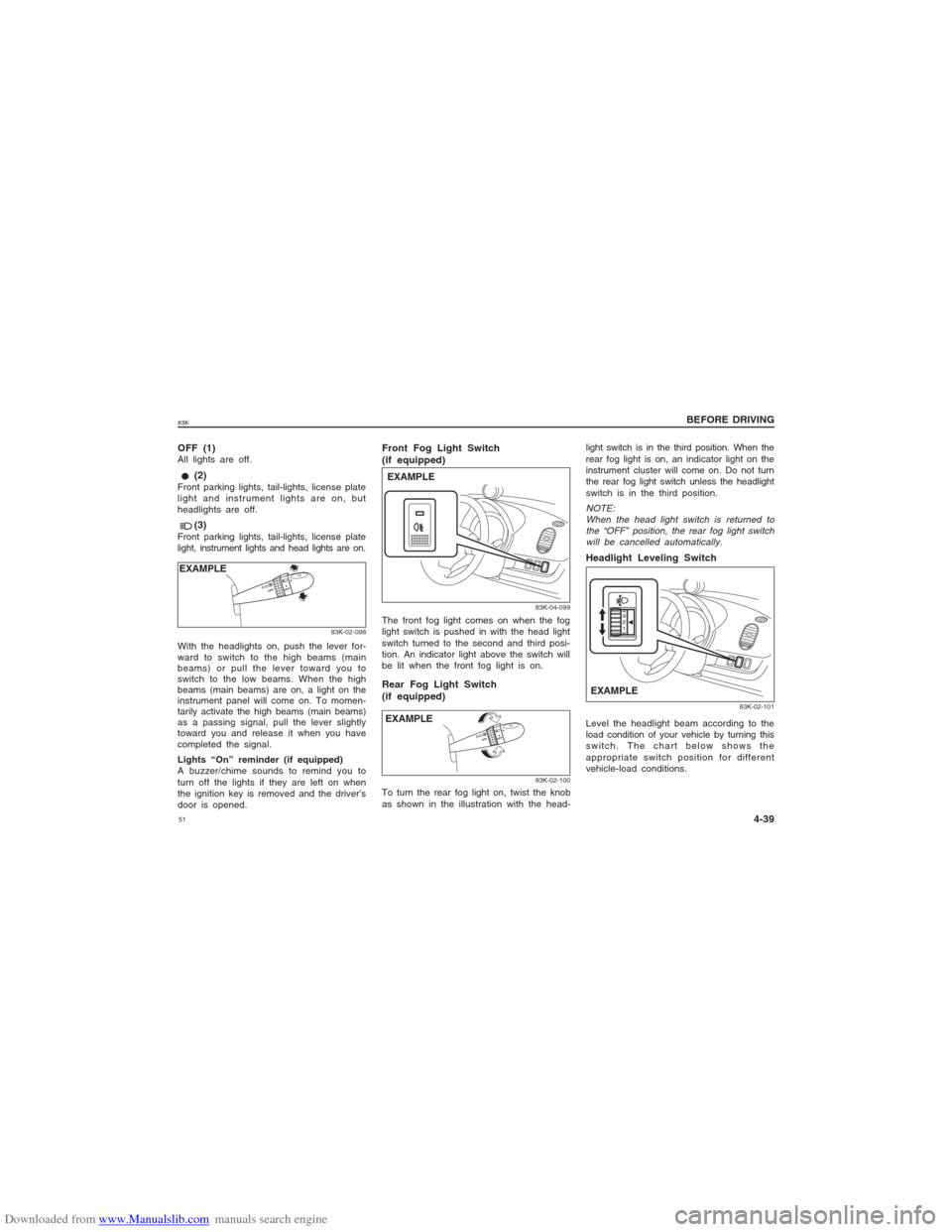
With the headlights on, push the lever for-
ward to switch to the high beams (main
beams) or pull the lever toward you to
switch to the low beams. When the high
beams (main beams) are on, a light on the
instrument panel will come on. To momen-
tarily activate the high beams (main beams)
as a passing signal, pull the lever slightly
toward you and release it when you have
completed the signal.
Lights “On” reminder (if equipped)
A buzzer/chime sounds to remind you to
turn off the lights if they are left on when
the ignition key is removed and the driver’s
door is opened.OFF (1)All lights are off. (2)Front parking lights, tail-lights, license plate
light and instrument lights are on, but
headlights are off. (3)Front parking lights, tail-lights, license plate
light, instrument lights and head lights are on.
Front Fog Light Switch
(if equipped)
83K-04-099
EXAMPLEThe front fog light comes on when the fog
light switch is pushed in with the head light
switch turned to the second and third posi-
tion. An indicator light above the switch will
be lit when the front fog light is on.Rear Fog Light Switch
(if equipped)
83K-02-100
To turn the rear fog light on, twist the knob
as shown in the illustration with the head-
light switch is in the third position. When the
rear fog light is on, an indicator light on the
instrument cluster will come on. Do not turn
the rear fog light switch unless the headlight
switch is in the third position.NOTE:
When the head light switch is returned to
the “OFF” position, the rear fog light switch
will be cancelled automatically.Headlight Leveling Switch
83K-02-101
EXAMPLELevel the headlight beam according to the
load condition of your vehicle by turning this
switch. The chart below shows the
appropriate switch position for different
vehicle-load conditions.
BEFORE DRIVING
4-39 EXAMPLE
Page 52 of 136
Downloaded from www.Manualslib.com manuals search engine 5283K
BEFORE DRIVING
4-40Driver only 0 0
Driver + 1 passenger 0 0
(in front seat)
Driver + 4 passengers,
no cargo 2 2
Driver + 4 passengers,
cargo added 3 3
Driver + full cargo 4 4Vehicle Load
Condition
Switch PositionPetrol Diesel
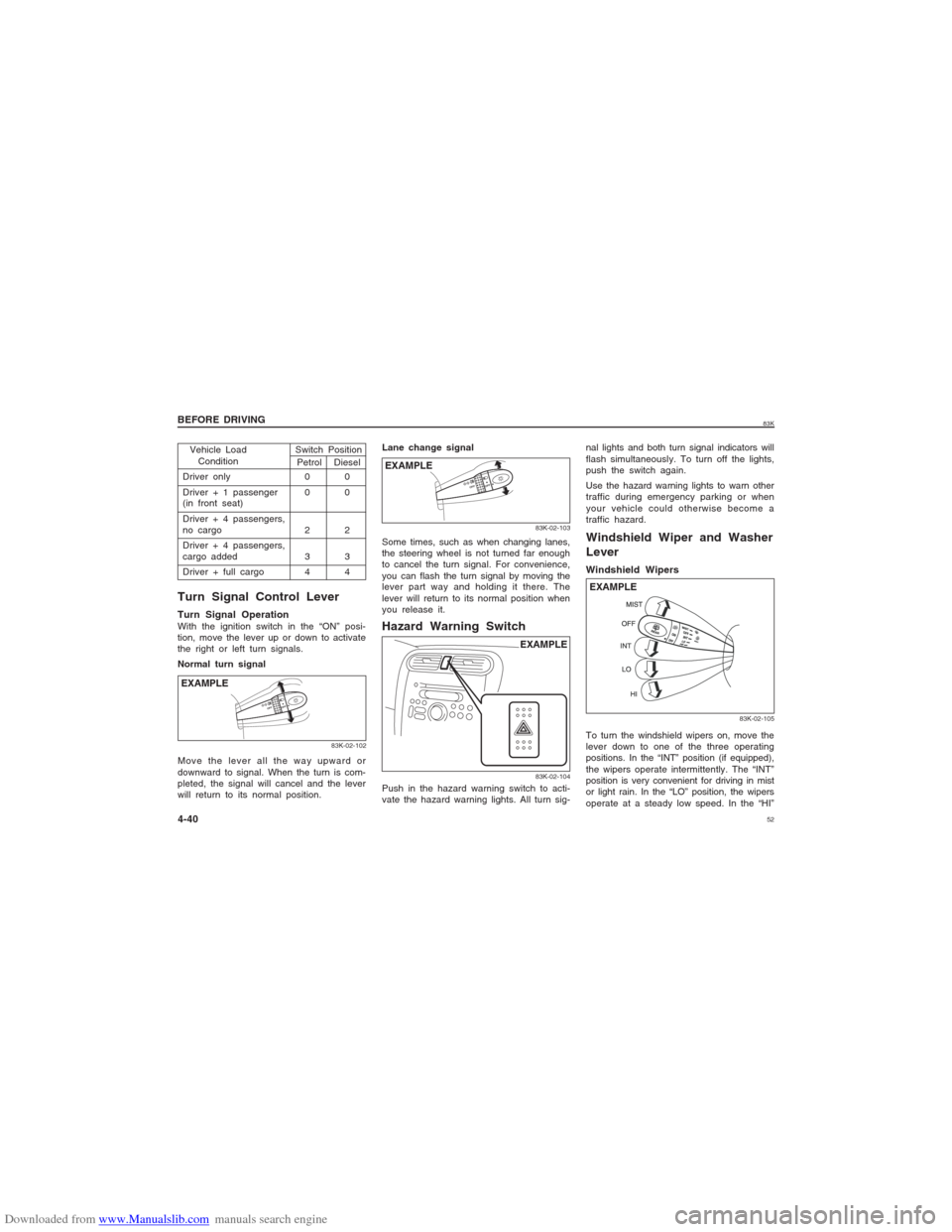
Turn Signal Control LeverTurn Signal OperationWith the ignition switch in the “ON” posi-
tion, move the lever up or down to activate
the right or left turn signals.
Normal turn signalEXAMPLE
83K-02-102
Lane change signalEXAMPLE
83K-02-103
Some times, such as when changing lanes,
the steering wheel is not turned far enough
to cancel the turn signal. For convenience,
you can flash the turn signal by moving the
lever part way and holding it there. The
lever will return to its normal position when
you release it.Hazard Warning Switch
Move the lever all the way upward or
downward to signal. When the turn is com-
pleted, the signal will cancel and the lever
will return to its normal position.
83K-02-104
Windshield Wiper and Washer
LeverWindshield Wipers
83K-02-105
EXAMPLE
Push in the hazard warning switch to acti-
vate the hazard warning lights. All turn sig-nal lights and both turn signal indicators will
flash simultaneously. To turn off the lights,
push the switch again.
Use the hazard warning lights to warn other
traffic during emergency parking or when
your vehicle could otherwise become a
traffic hazard.
To turn the windshield wipers on, move the
lever down to one of the three operating
positions. In the “INT” position (if equipped),
the wipers operate intermittently. The “INT”
position is very convenient for driving in mist
or light rain. In the “LO” position, the wipers
operate at a steady low speed. In the “HI”
EXAMPLE
Page 54 of 136
Downloaded from www.Manualslib.com manuals search engine 5483K
BEFORE DRIVING
4-42Tilt Steering Lock Lever
(if equipped)
83K-02-108
EXAMPLE
w ww w
w WARNING
Never attempt to adjust the steering
wheel height while the vehicle is
moving or you could lose control of
the vehicle.
83K-02-109
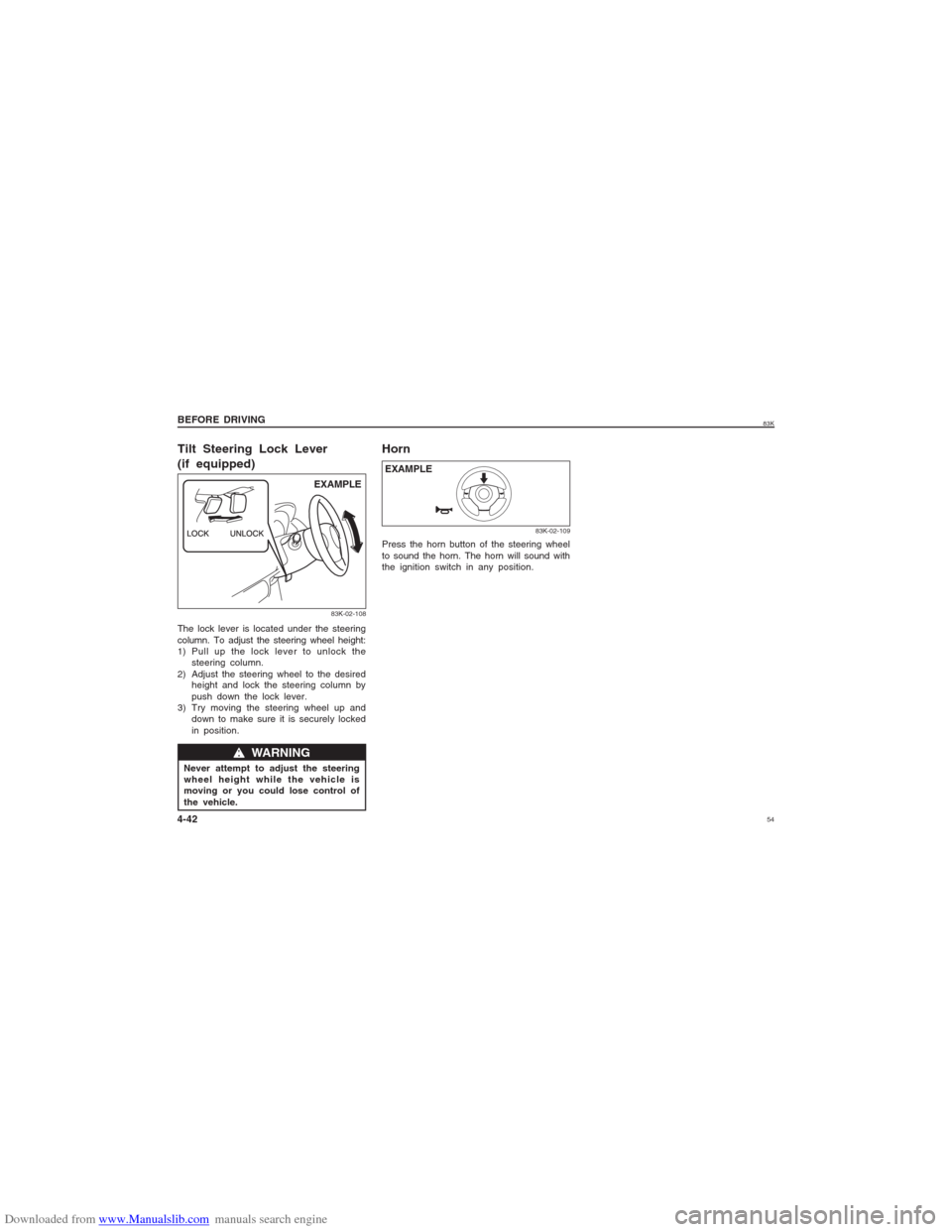
HornPress the horn button of the steering wheel
to sound the horn. The horn will sound with
the ignition switch in any position.EXAMPLE
The lock lever is located under the steering
column. To adjust the steering wheel height:
1) Pull up the lock lever to unlock the
steering column.
2) Adjust the steering wheel to the desired
height and lock the steering column by
push down the lock lever.
3) Try moving the steering wheel up and
down to make sure it is securely locked
in position.
Page 55 of 136
Downloaded from www.Manualslib.com manuals search engine 5583KOPERATING YOUR VEHICLE
Exhaust Gas Warning........................................................................................................ 5-1
Daily Inspection Checklist................................................................................................ 5-1
Engine Oil Consumption................................................................................................... 5-2
Ignition Switch .................................................................................................................... 5-2
Parking Brake Lever.......................................................................................................... 5-4
Pedal..................................................................................................................................... 5-4
Starting the Engine............................................................................................................5-5
Using the Transmission.................................................................................................... 5-6
Braking .................................................................................................................................. 5-9
OPERATING YOUR VEHICLE
Page 57 of 136
Downloaded from www.Manualslib.com manuals search engine 5783K4) Make sure the bonnet is fully closed and
latched.
5) Check the headlights, turn signal lights,
brake lights and horn for proper opera-
tion.
6) Adjust the seat and adjustable head
restraint (if equipped).
7) Check the brake pedal and the parking
brake lever.
8) Adjust the mirrors.
9) Make sure that you and all passengers
have properly fastened your seat belts.
10)Make sure that all warning lights come
on as the key is turned to the “ON” or
“START” position.
11)Check all gauges.
12)Make sure that the BRAKE SYSTEM
WARNING light turns off when the
parking brake is released.
Once a week, or each time you fill your fuel
tank, perform the following under-hood
checks:
1) Engine oil level
2) Coolant level
3) Brake fluid level
4) Windshield washer fluid level
5) Battery solution level
6) Bonnet latch operation
Pull the Bonnet release handle inside the
vehicle. Make sure that you cannot open
the Bonnet all the way without releasingthe secondary latch. Be sure to close
the Bonnet securely after checking for
proper latch operation. See “All latches,
hinges & locks” of “CHASSIS AND
BODY” in the “Periodic Maintenance
Schedule” in the “INSPECTION AND
MAINTENANCE” section for lubrication
schedule.
w ww w
w WARNING
Make sure the bonnet is fully closed
and latched before driving. If it is not,
it can fly up unexpectedly during
driving, obstructing your view and
resulting in an accident.
Once a month, or each time you fill your
fuel tank, check the tyre pressure using a
tyre pressure gauge. Also check the tyre
pressure of the spare tyre.since its pistons, piston rings and cylinder
walls have not yet become conditioned. New
engines reach the normal level of oil
consumption only after approximately 5000
km (3000 miles) driving.
When judging the amount of oil consump-
tion, note that the oil may become diluted
and make it difficult to accurately judge the
true oil level.
As an example, if a vehicle is used for
repeated short trips, and consumes a nor-
mal amount of oil, the dipstick may not
show any drop in the oil level at all, even
after 1000 km (600 miles) or more of driv-
ing. This is because the oil is gradually
becoming diluted with fuel or moisture,
making it appear that the oil level has not
changed.
You should also be aware that the diluting
ingredients evaporate out when the vehicle
is subsequently driven at high speeds, such
as on an expressway, making it appear that
oil is excessively consumed after high-speed
driving.
OPERATING YOUR VEHICLE
5-2
Engine Oil ConsumptionIt is normal for the engine to consume some
engine oil during normal vehicle operation.
The amount of engine oil consumed
depends on the viscosity of the oil, the
quality of the oil and the conditions the
vehicle is driven under.
More oil is consumed during high-speed
driving and when there is frequent acceler-
ation and deceleration. Under high loads,
your engine also will consume more oil.
A new engine also consumes more oil,
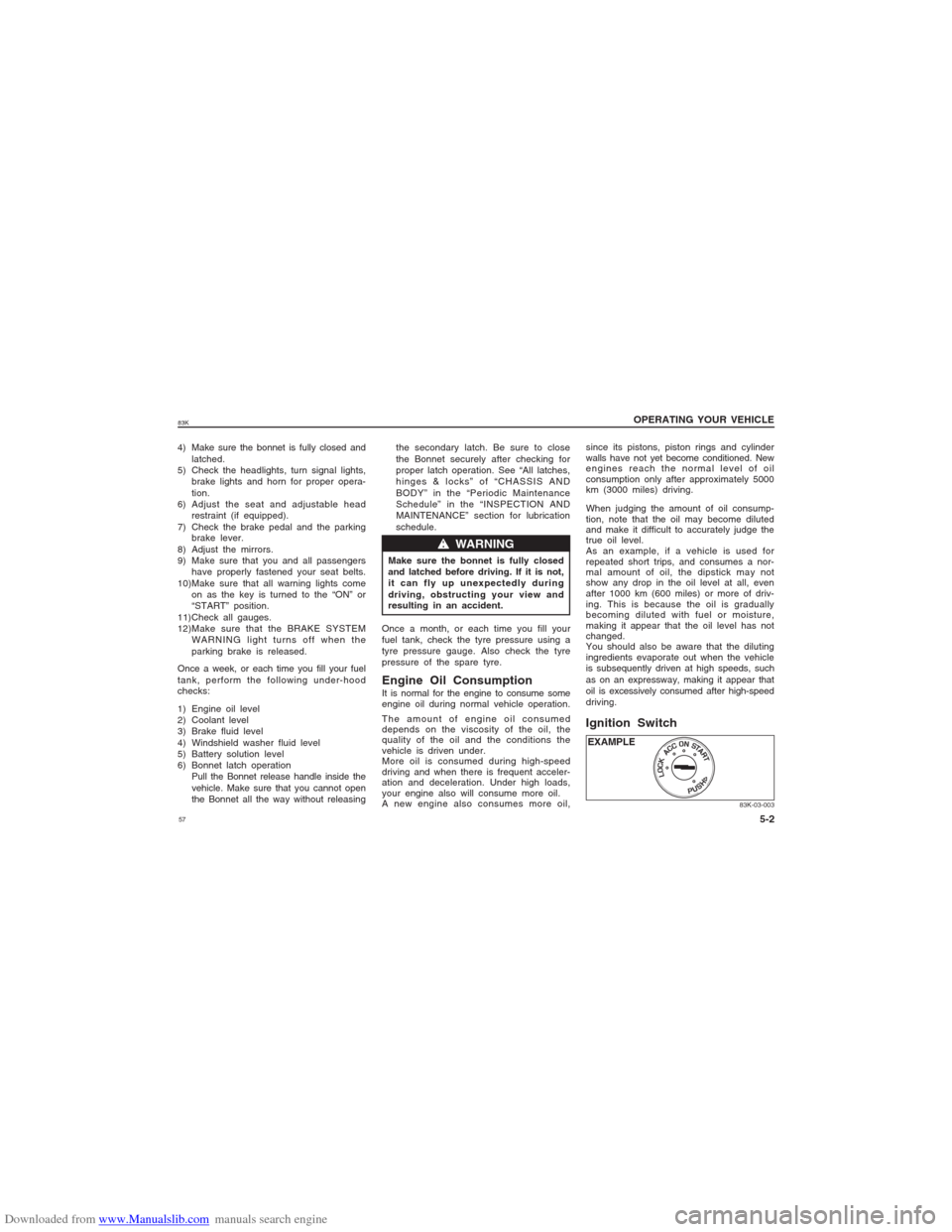
83K-03-003
Ignition SwitchEXAMPLE
Page 58 of 136
Downloaded from www.Manualslib.com manuals search engine 5883K
w ww w
w WARNING
To avoid possible injury, do not oper-
ate controls by reaching through the
steering wheel.
83K-03-004
EXAMPLE OPERATING YOUR VEHICLE
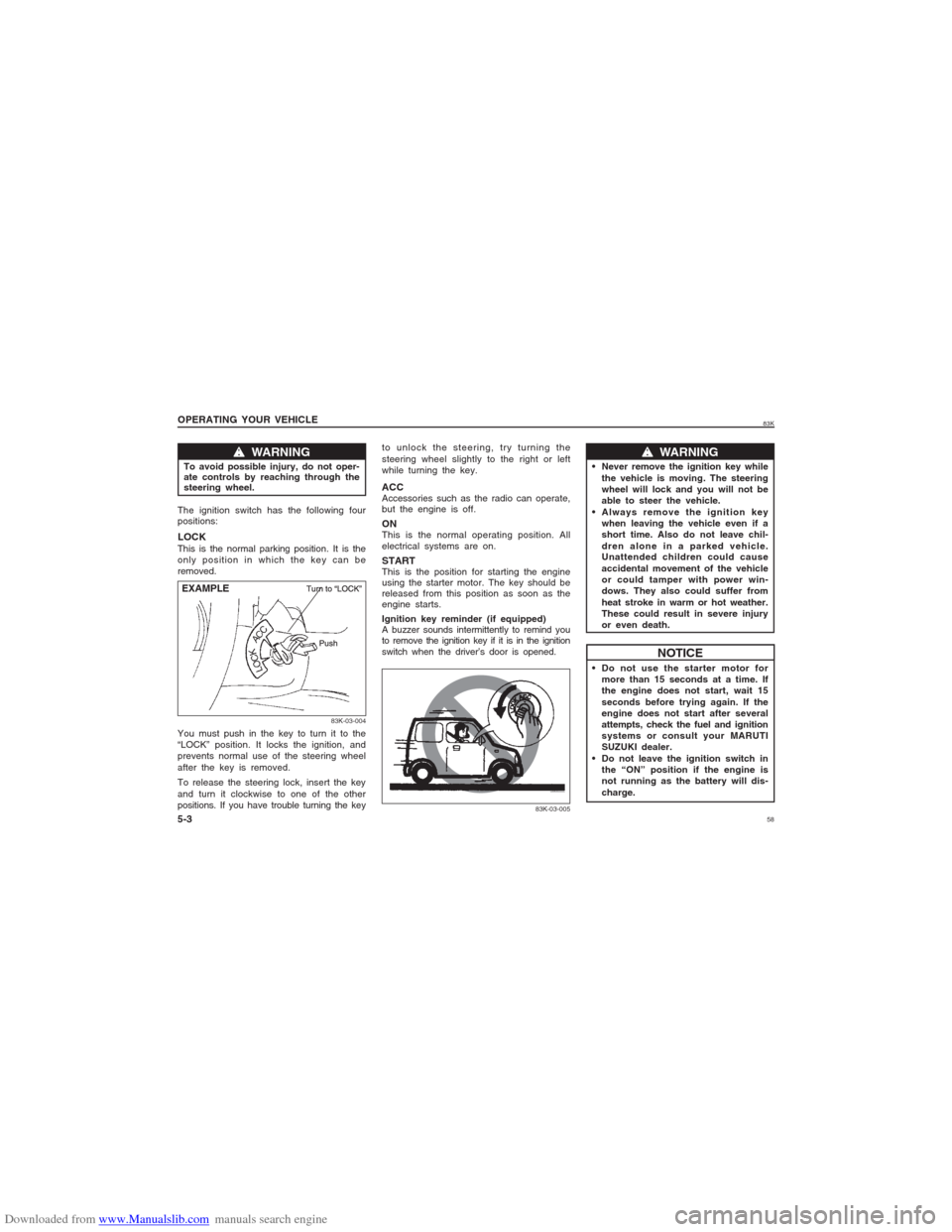
5-3The ignition switch has the following four
positions:LOCKThis is the normal parking position. It is the
only position in which the key can be
removed.
You must push in the key to turn it to the
“LOCK” position. It locks the ignition, and
prevents normal use of the steering wheel
after the key is removed.
To release the steering lock, insert the key
and turn it clockwise to one of the other
positions. If you have trouble turning the keyto unlock the steering, try turning the
steering wheel slightly to the right or left
while turning the key.
ACCAccessories such as the radio can operate,
but the engine is off.ONThis is the normal operating position. All
electrical systems are on.STARTThis is the position for starting the engine
using the starter motor. The key should be
released from this position as soon as the
engine starts.
Ignition key reminder (if equipped)
A buzzer sounds intermittently to remind you
to remove the ignition key if it is in the ignition
switch when the driver’s door is opened.
w ww w
w WARNING
Never remove the ignition key while
the vehicle is moving. The steering
wheel will lock and you will not be
able to steer the vehicle.
Always remove the ignition key
when leaving the vehicle even if a
short time. Also do not leave chil-
dren alone in a parked vehicle.
Unattended children could cause
accidental movement of the vehicle
or could tamper with power win-
dows. They also could suffer from
heat stroke in warm or hot weather.
These could result in severe injury
or even death.
NOTICE
Do not use the starter motor for
more than 15 seconds at a time. If
the engine does not start, wait 15
seconds before trying again. If the
engine does not start after several
attempts, check the fuel and ignition
systems or consult your MARUTI
SUZUKI dealer.
Do not leave the ignition switch in
the “ON” position if the engine is
not running as the battery will dis-
charge.
83K-03-005
Page 60 of 136
Downloaded from www.Manualslib.com manuals search engine 6083K
OPERATING YOUR VEHICLE
5-5 Brake Pedal (2)Your SUZUKI vehicle is equipped with front
disc brakes and rear drum brakes.
Depressing the brake pedal applies both
sets of brakes.
You may hear occasional brake squeal
when you apply the brakes. This is a
normal condition caused by environmental
factors such as cold, wet, snow, etc.
w ww w
w WARNING
If brake squeal is excessive and
occurs each time the brakes are
applied, you should have the brakes
checked by your SUZUKI dealer.
w ww w
w WARNING
Do not “ride” the brakes by applying
them continuously or resting your foot
on the pedal. This will result in
overheating of the brakes which could
cause unpredictable braking action,
longer stopping distances, or
permanent brake damage.Accelerator Pedal (3)This pedal controls the speed of the engine.
Depressing the accelerator pedal increases
power output and speed.
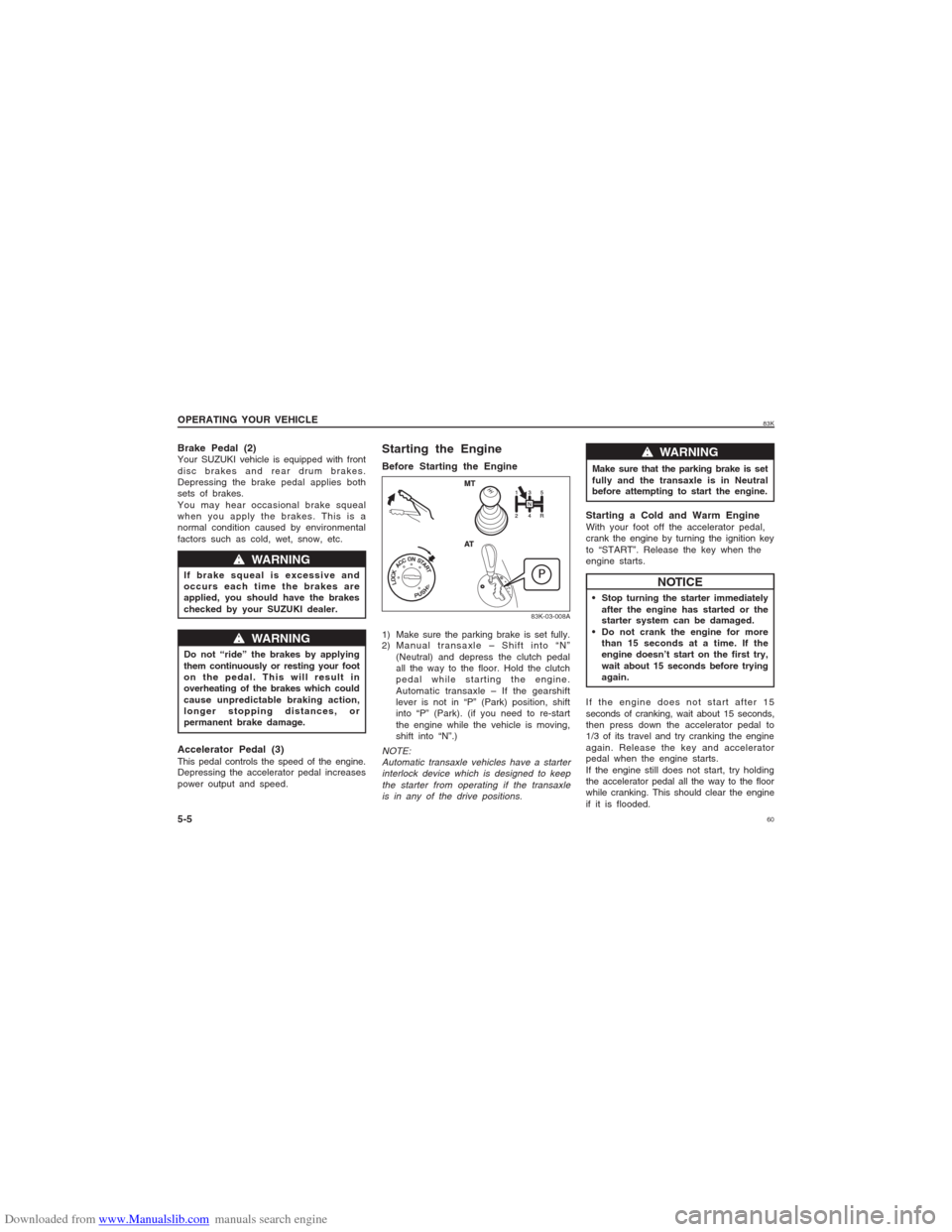
Starting the EngineBefore Starting the Engine
83K-03-008A
1) Make sure the parking brake is set fully.
2) Manual transaxle – Shift into “N”
(Neutral) and depress the clutch pedal
all the way to the floor. Hold the clutch
pedal while starting the engine.
Automatic transaxle – If the gearshift
lever is not in “P” (Park) position, shift
into “P” (Park). (if you need to re-start
the engine while the vehicle is moving,
shift into “N”.)NOTE:
Automatic transaxle vehicles have a starter
interlock device which is designed to keep
the starter from operating if the transaxle
is in any of the drive positions.
Make sure that the parking brake is set
fully and the transaxle is in Neutral
before attempting to start the engine.
w ww w
w WARNING
Starting a Cold and Warm EngineWith your foot off the accelerator pedal,
crank the engine by turning the ignition key
to “START”. Release the key when the
engine starts.
NOTICE
Stop turning the starter immediately
after the engine has started or the
starter system can be damaged.
Do not crank the engine for more
than 15 seconds at a time. If the
engine doesn’t start on the first try,
wait about 15 seconds before trying
again.
If the engine does not start after 15
seconds of cranking, wait about 15 seconds,
then press down the accelerator pedal to
1/3 of its travel and try cranking the engine
again. Release the key and accelerator
pedal when the engine starts.
If the engine still does not start, try holding
the accelerator pedal all the way to the floor
while cranking. This should clear the engine
if it is flooded.
Page 61 of 136
Downloaded from www.Manualslib.com manuals search engine 6183K
OPERATING YOUR VEHICLE
5-6
CAUTION
Stop turning the starter immediately
after the engine has started or the
starter system can be damaged.
Do not crank the engine for more
than 15 seconds at a time. If the
engine doesn’t start on the first try,
wait about 15 seconds before trying
again.
Warm engine
Crank the engine by turning the ignition key
to “START”. Release the key when the
engine starts.
CAUTION
When stopping the engine with tur-
bocharger:Downshifting Km/h
2nd to 1st 20
3rd to 2nd 54
4th to 3rd 80
5th to 4th 112
83K-03-009
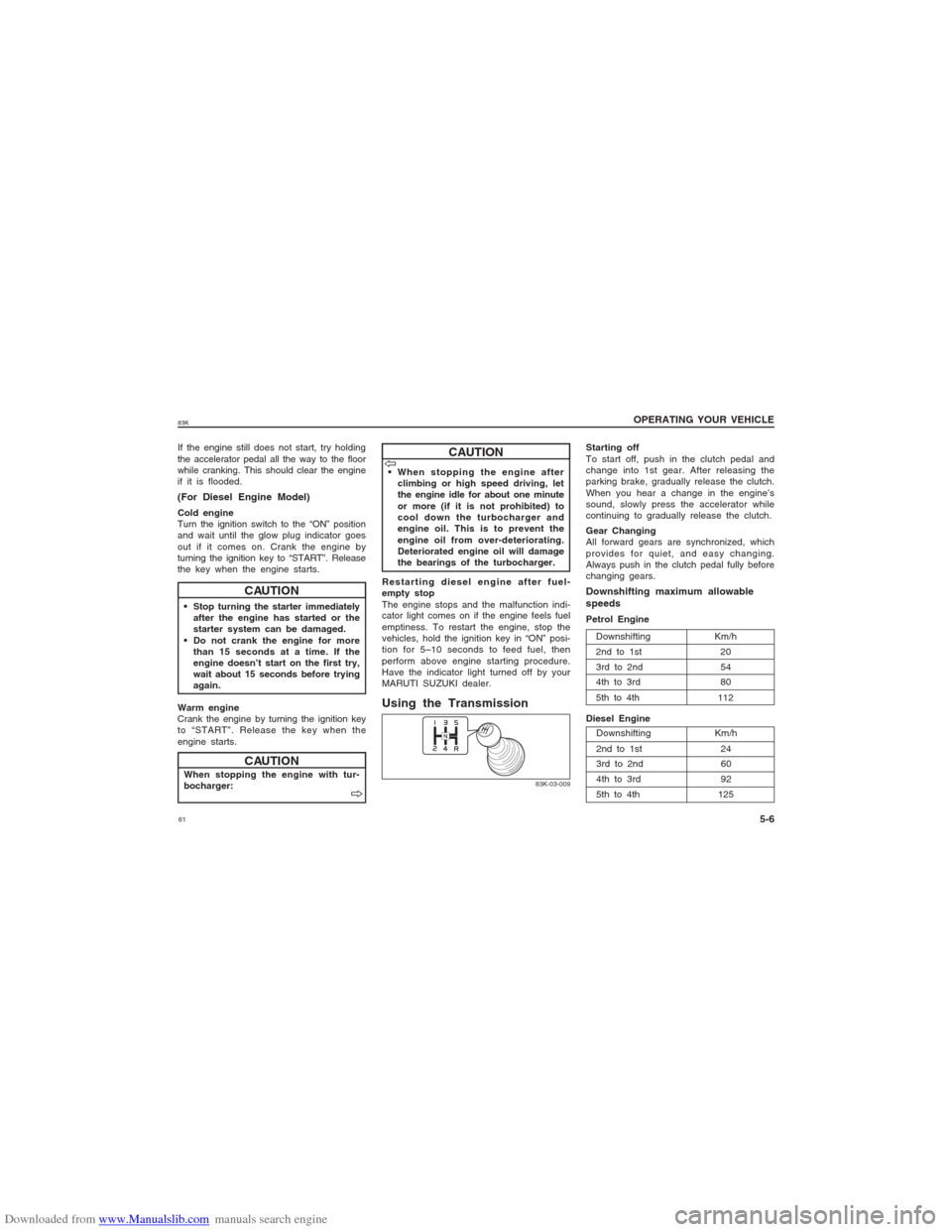
Using the Transmission
Starting off
To start off, push in the clutch pedal and
change into 1st gear. After releasing the
parking brake, gradually release the clutch.
When you hear a change in the engine’s
sound, slowly press the accelerator while
continuing to gradually release the clutch.
Gear Changing
All forward gears are synchronized, which
provides for quiet, and easy changing.
Always push in the clutch pedal fully before
changing gears.Downshifting maximum allowable
speedsPetrol Engine
Downshifting Km/h
2nd to 1st 24
3rd to 2nd 60
4th to 3rd 92
5th to 4th 125
If the engine still does not start, try holding
the accelerator pedal all the way to the floor
while cranking. This should clear the engine
if it is flooded.(For Diesel Engine Model)Cold engine
Turn the ignition switch to the “ON” position
and wait until the glow plug indicator goes
out if it comes on. Crank the engine by
turning the ignition key to “START”. Release
the key when the engine starts. When stopping the engine after
climbing or high speed driving, let
the engine idle for about one minute
or more (if it is not prohibited) to
cool down the turbocharger and
engine oil. This is to prevent the
engine oil from over-deteriorating.
Deteriorated engine oil will damage
the bearings of the turbocharger.
Restarting diesel engine after fuel-
empty stop
The engine stops and the malfunction indi-
cator light comes on if the engine feels fuel
emptiness. To restart the engine, stop the
vehicles, hold the ignition key in “ON” posi-
tion for 5–10 seconds to feed fuel, then
perform above engine starting procedure.
Have the indicator light turned off by your
MARUTI SUZUKI dealer.
Diesel Engine
V VV V
V
CAUTION
V VV V
V
Page 68 of 136
Downloaded from www.Manualslib.com manuals search engine 6883K
To minimize the possibility of catalyst
or other vehicle damage:
Maintain the engine in the proper
operating condition.
In the event of an engine malfunc-
tion, particularly one involving
engine misfire or other apparent
loss of performance, have the vehi-
cle serviced promptly.
Do not turn off the engine or inter-
rupt the ignition when the transmis-
sion is in gear and the vehicle is in
motion.
Do not try to start the engine by
pushing or towing the vehicle, or
coasting down a hill.
Do not idle the engine with any
spark plug wires disconnected or
removed, such as during diagnostic
testing.
Do not idle the vehicle for pro-
longed periods if idling seems rough
or there are other malfunctions.
Do not allow the fuel tank to get
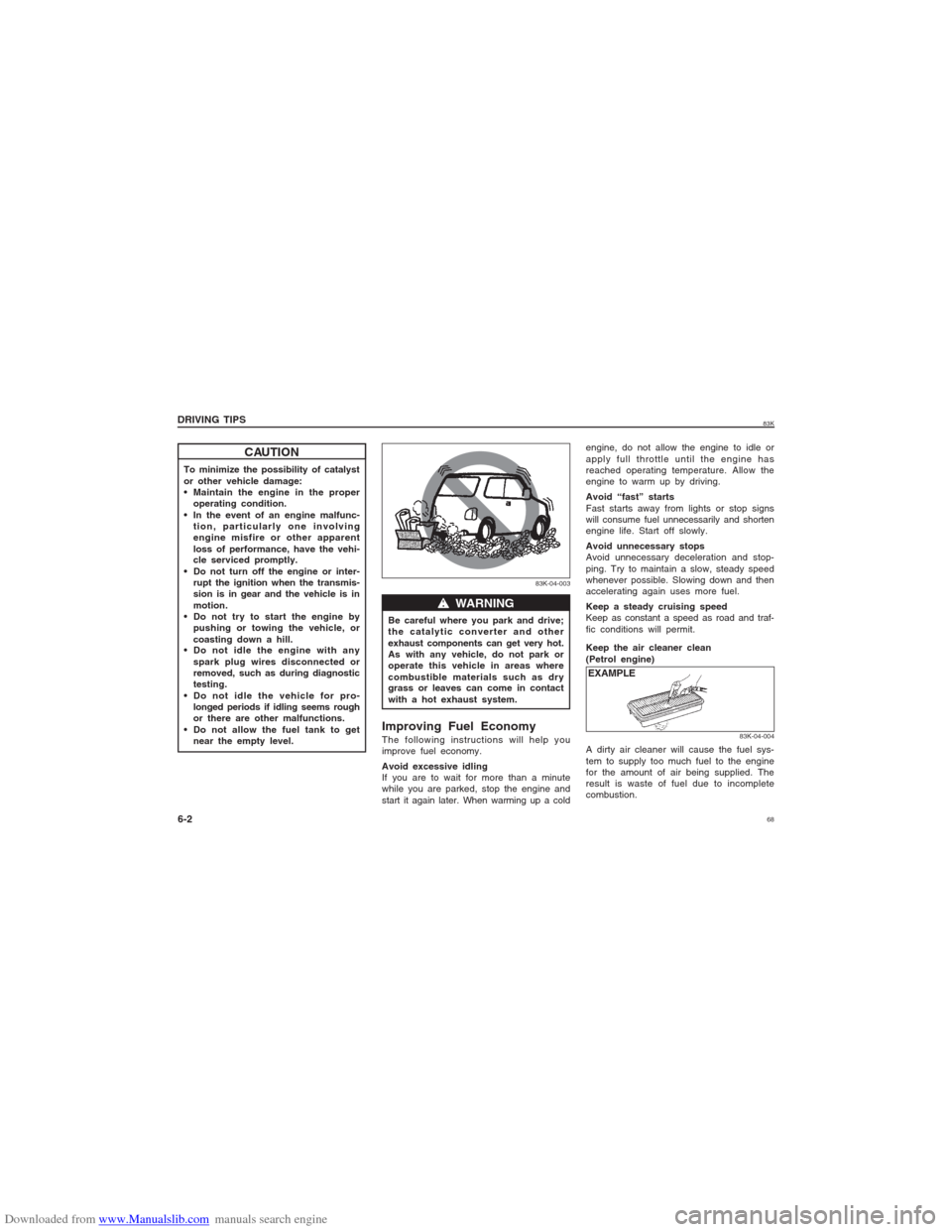
near the empty level.Be careful where you park and drive;
the catalytic converter and other
exhaust components can get very hot.
As with any vehicle, do not park or
operate this vehicle in areas where
combustible materials such as dry
grass or leaves can come in contact
with a hot exhaust system.
w ww w
w WARNING
83K-04-003
engine, do not allow the engine to idle or
apply full throttle until the engine has
reached operating temperature. Allow the
engine to warm up by driving.
Avoid “fast” starts
Fast starts away from lights or stop signs
will consume fuel unnecessarily and shorten
engine life. Start off slowly.
Avoid unnecessary stops
Avoid unnecessary deceleration and stop-
ping. Try to maintain a slow, steady speed
whenever possible. Slowing down and then
accelerating again uses more fuel.
Keep a steady cruising speed
Keep as constant a speed as road and traf-
fic conditions will permit.
DRIVING TIPS
6-2
CAUTION
Improving Fuel EconomyThe following instructions will help you
improve fuel economy.
Avoid excessive idling
If you are to wait for more than a minute
while you are parked, stop the engine and
start it again later. When warming up a coldKeep the air cleaner clean
(Petrol engine)
EXAMPLE
83K-04-004
A dirty air cleaner will cause the fuel sys-
tem to supply too much fuel to the engine
for the amount of air being supplied. The
result is waste of fuel due to incomplete
combustion.