ignition SUZUKI MARUTI 2005 1.G Owner's Guide
[x] Cancel search | Manufacturer: SUZUKI, Model Year: 2005, Model line: MARUTI, Model: SUZUKI MARUTI 2005 1.GPages: 136, PDF Size: 2.93 MB
Page 69 of 136
Downloaded from www.Manualslib.com manuals search engine 6983K
DRIVING TIPS
6-3
(Diesel engine)
No cleaning is required. Replace as per
periodic maintenance schedule.
Keep weight to a minimum
The heavier the load, the more fuel the
vehicle consumes. Take out any luggage or
cargo when it is not necessary.
Keep tyre pressures correct
Underinflation of the tyres can waste fuel
due to increased running resistance of the
tyres. Keep your tyres inflated to the cor-
rect pressure shown on the label on the
driver’s side door pillar.Highway DrivingWhen driving at high speeds, pay attention
to the following:
Stopping distance progressively increa-
ses with vehicle speed. Apply the brakes
far enough ahead of the stopping point
to allow for the extra stopping distance.
On rainy days, “Aquaplaning” can occur.
“Aquaplaning” is the loss of direct con-
tact between the road surface and the
vehicle’s tyres due to a water film form-
ing between them. Steering or braking
the vehicle while “Aquaplaning” can be
very difficult, and loss of control can
occur. Keep speed down when the road
surface is wet.
At high speeds, the vehicle may be
affected by side winds. Therefore, reducespeed and be prepared for unexpected
buffeting, which can occur at the exits
of tunnels, when passing by a cut of a
hill, or when being overtaken by large
vehicles, etc.
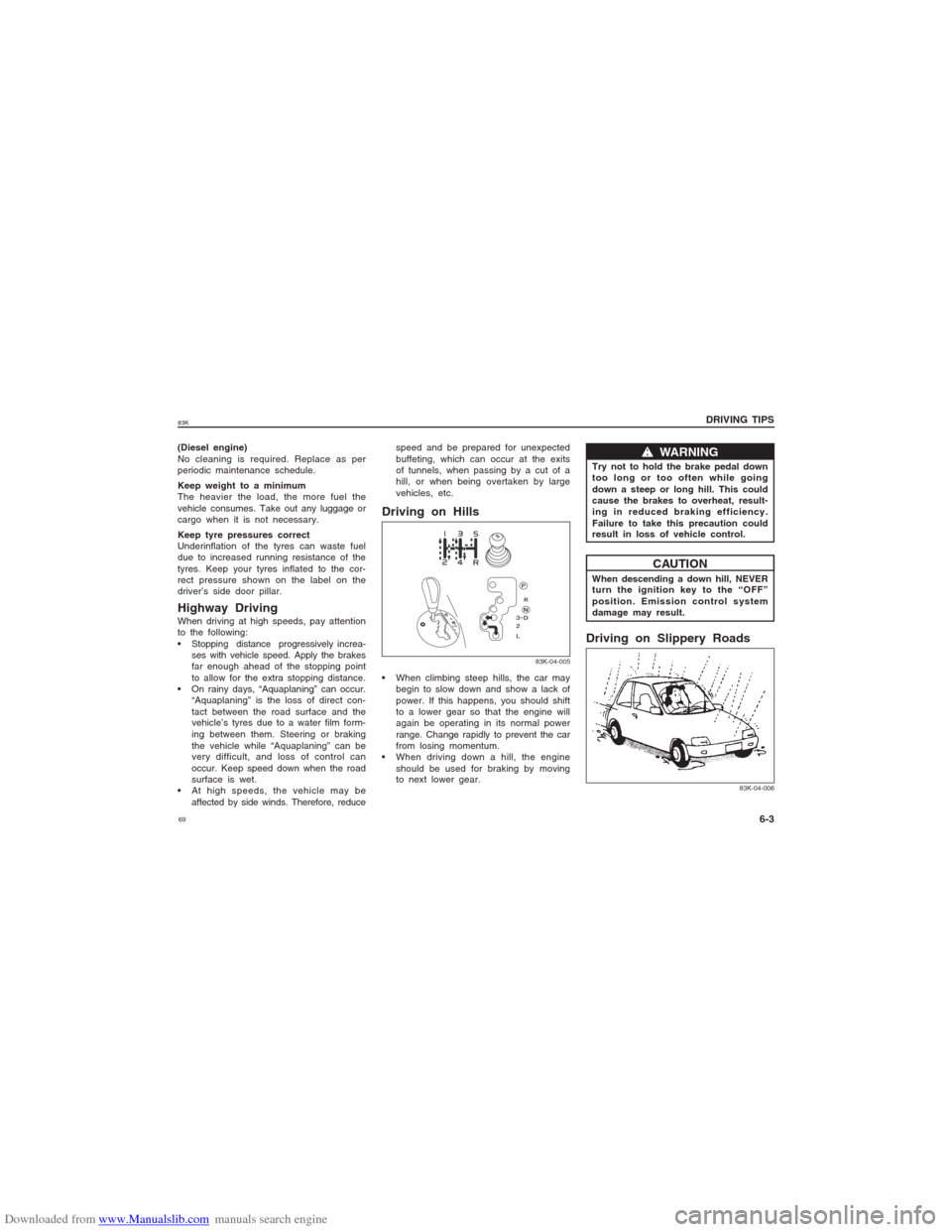
Driving on Hills
w ww w
w WARNING
Try not to hold the brake pedal down
too long or too often while going
down a steep or long hill. This could
cause the brakes to overheat, result-
ing in reduced braking efficiency.
Failure to take this precaution could
result in loss of vehicle control.
CAUTION
When descending a down hill, NEVER
turn the ignition key to the “OFF”
position. Emission control system
damage may result.Driving on Slippery Roads
83K-04-006
83K-04-005
When climbing steep hills, the car may
begin to slow down and show a lack of
power. If this happens, you should shift
to a lower gear so that the engine will
again be operating in its normal power
range. Change rapidly to prevent the car
from losing momentum.
When driving down a hill, the engine
should be used for braking by moving
to next lower gear.
Page 81 of 136
Downloaded from www.Manualslib.com manuals search engine 8183K
OTHER CONTROLS AND EQUIPMENT
7-7
CAUTION
When unhooking and hooking a sun
visor, be sure to handle it by the hard
plastic parts or the sun visor can be
damaged.
83K-05-022
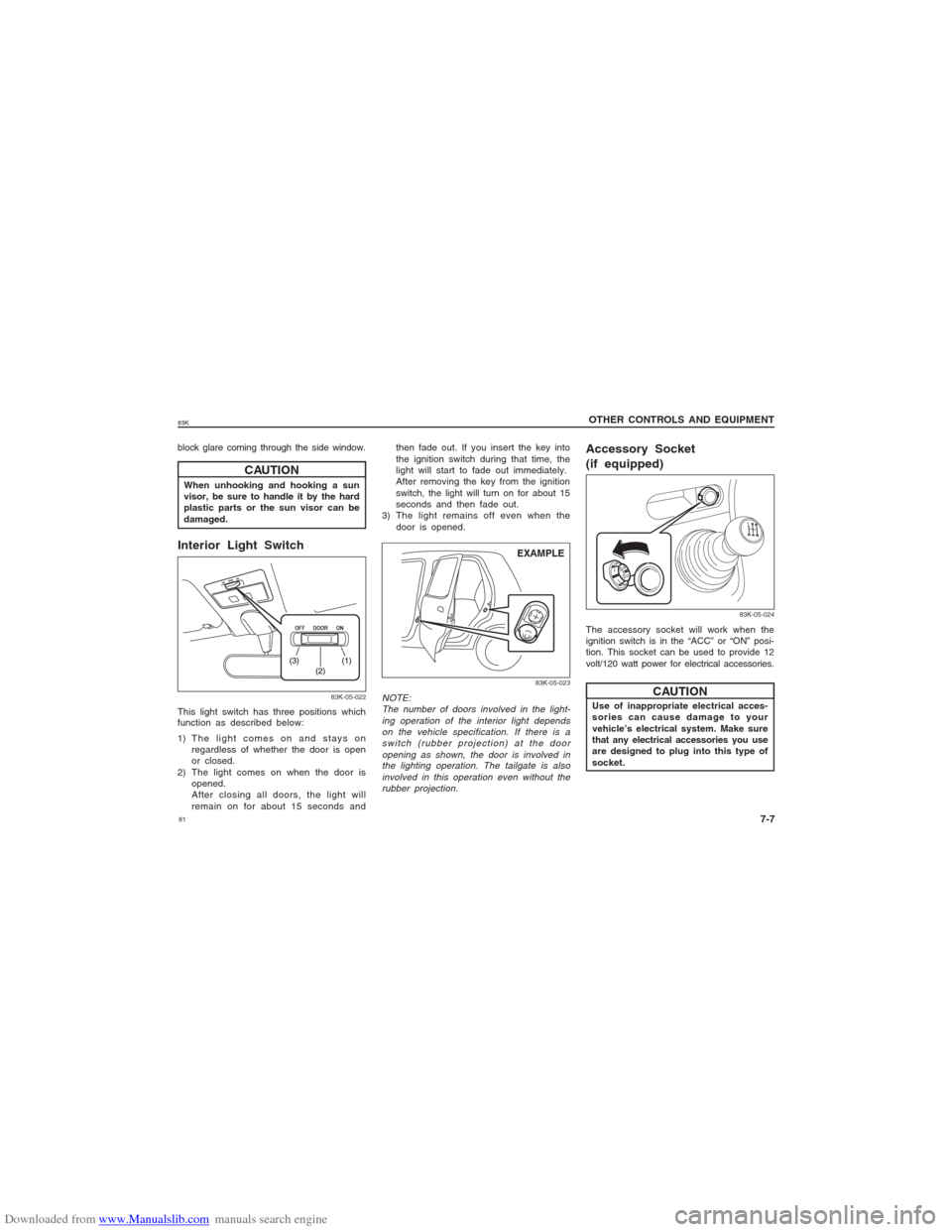
Interior Light Switch
then fade out. If you insert the key into
the ignition switch during that time, the
light will start to fade out immediately.
After removing the key from the ignition
switch, the light will turn on for about 15
seconds and then fade out.
3) The light remains off even when the
door is opened.
83K-05-023
EXAMPLE
NOTE:
The number of doors involved in the light-
ing operation of the interior light depends
on the vehicle specification. If there is a
switch (rubber projection) at the door
opening as shown, the door is involved in
the lighting operation. The tailgate is also
involved in this operation even without the
rubber projection.
block glare coming through the side window.
This light switch has three positions which
function as described below:
1) The light comes on and stays on
regardless of whether the door is open
or closed.
2) The light comes on when the door is
opened.
After closing all doors, the light will
remain on for about 15 seconds and
Accessory Socket
(if equipped)
83K-05-024
CAUTION
Use of inappropriate electrical acces-
sories can cause damage to your
vehicle’s electrical system. Make sure
that any electrical accessories you use
are designed to plug into this type of
socket. The accessory socket will work when the
ignition switch is in the “ACC” or “ON” posi-
tion. This socket can be used to provide 12
volt/120 watt power for electrical accessories.
Page 88 of 136
Downloaded from www.Manualslib.com manuals search engine 8883K
VEHICLE LOADING AND TOWING
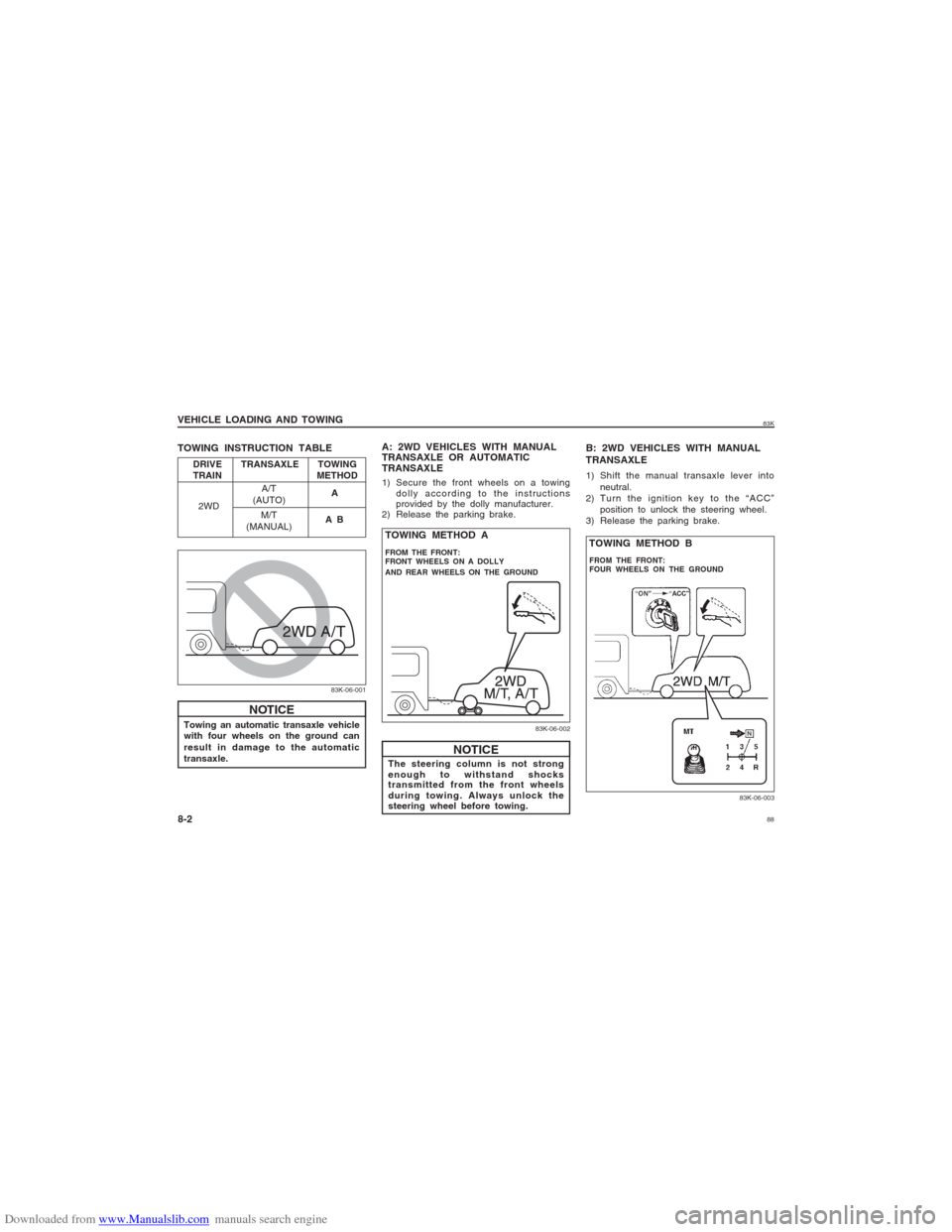
TOWING INSTRUCTION TABLE
DRIVE TRANSAXLE TOWING
TRAIN METHOD2WDA/T
(AUTO)
M/T
(MANUAL)A
A B
Towing an automatic transaxle vehicle
with four wheels on the ground can
result in damage to the automatic
transaxle.
83K-06-001
NOTICE
A: 2WD VEHICLES WITH MANUAL
TRANSAXLE OR AUTOMATIC
TRANSAXLE1) Secure the front wheels on a towing
dolly according to the instructions
provided by the dolly manufacturer.
2) Release the parking brake.
83K-06-002
TOWING METHOD AFROM THE FRONT:
FRONT WHEELS ON A DOLLY
AND REAR WHEELS ON THE GROUND
B: 2WD VEHICLES WITH MANUAL
TRANSAXLE1) Shift the manual transaxle lever into
neutral.
2) Turn the ignition key to the “ACC”
position to unlock the steering wheel.
3) Release the parking brake.
83K-06-003
TOWING METHOD BFROM THE FRONT:
FOUR WHEELS ON THE GROUND
NOTICE
The steering column is not strong
enough to withstand shocks
transmitted from the front wheels
during towing. Always unlock the
steering wheel before towing.
8-2
Page 90 of 136
Downloaded from www.Manualslib.com manuals search engine 9083K
You should take extreme care when
working on your vehicle to prevent
accidental injury. Here are a few pre-
cautions that you should be especially
careful to observe:
To prevent damage or unintended
activation of the air bag system be
sure the battery is disconnected and
the ignition switch has been in the
“LOCK” position for at least 90
seconds before performing any
electrical service work on your
vehicle. Do not touch air bag sys-
tem components and wires. The
wires are wrapped with yellow tape
or yellow tubing, and the couplers
are yellow for easy identification.
w ww w
w WARNING
83K-07-001
w ww w
w WARNING
w ww w
w WARNING
INSPECTION AND MAINTENANCE
9-1
V VV V
V
Do not leave the engine running in
garages or other confined areas.
When the engine is running, keep
hands, clothing, tools, and other
objects away from the fan and drive
belt. Even though the fan may not
be moving, it can automatically turn
on without warning.
When it is necessary to do service
work with the engine running, make
sure that the parking brake is
applied fully and the transmission is
in Neutral.
Do not touch ignition wires or other
ignition system parts when starting
the engine or when the engine is
running, or you could receive an
electric shock.
Be careful not to touch a hot
engine, exhaust manifold and pipes,
muffler, radiator and water hoses.
Do not allow smoking, sparks, or
flames around petrol or the battery.
Flammable fumes are present.
Do not get under your vehicle if it
is supported only with the portable
jack provided in your vehicle.V VV V
V
V VV V
V
Be careful not to cause accidental
short circuits between the positive
and negative battery terminals.
Keep used oil, coolant, and other
fluids away from children and pets.
Dispose of used fluids properly;
never pour them on the ground, into
sewers, etc.V VV V
V
83K-07-002
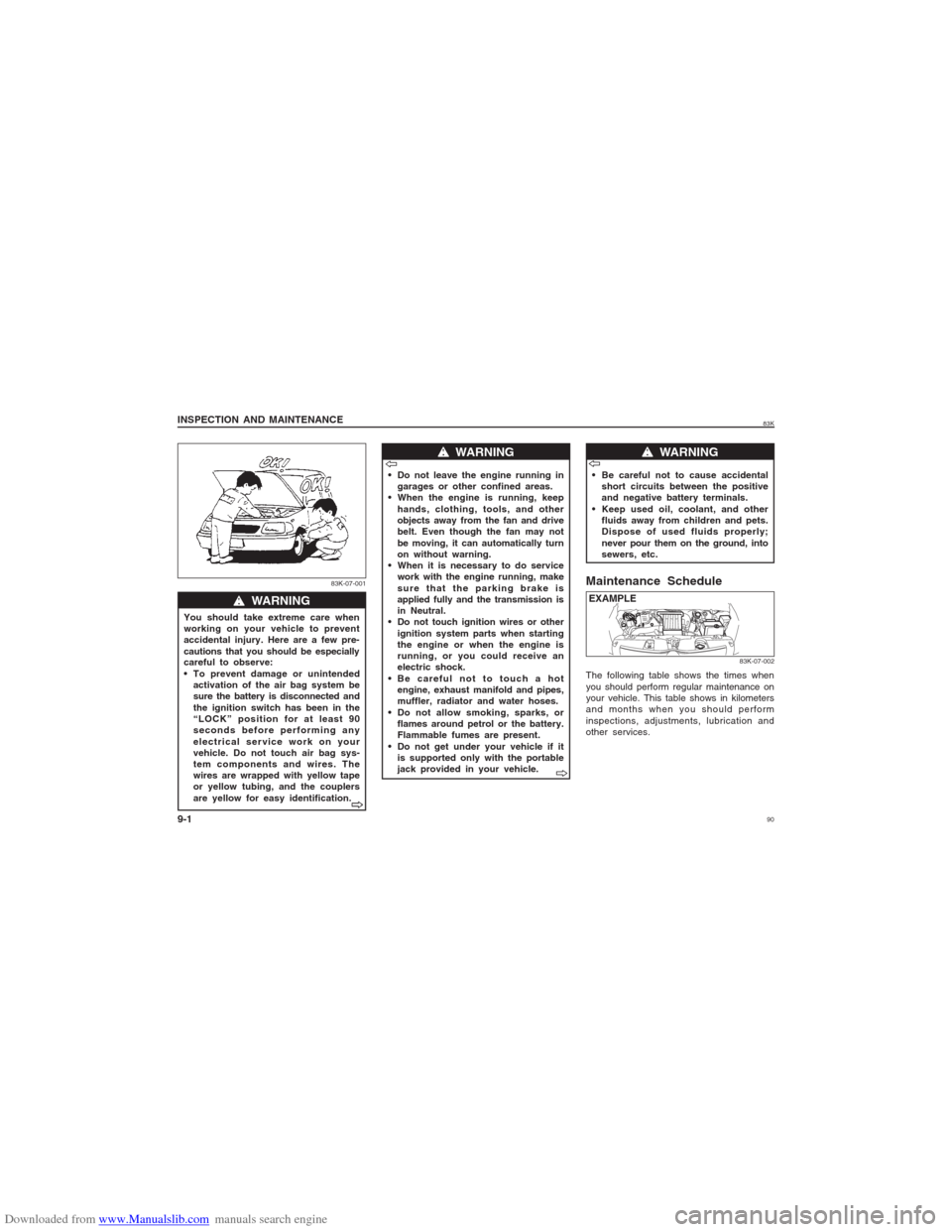
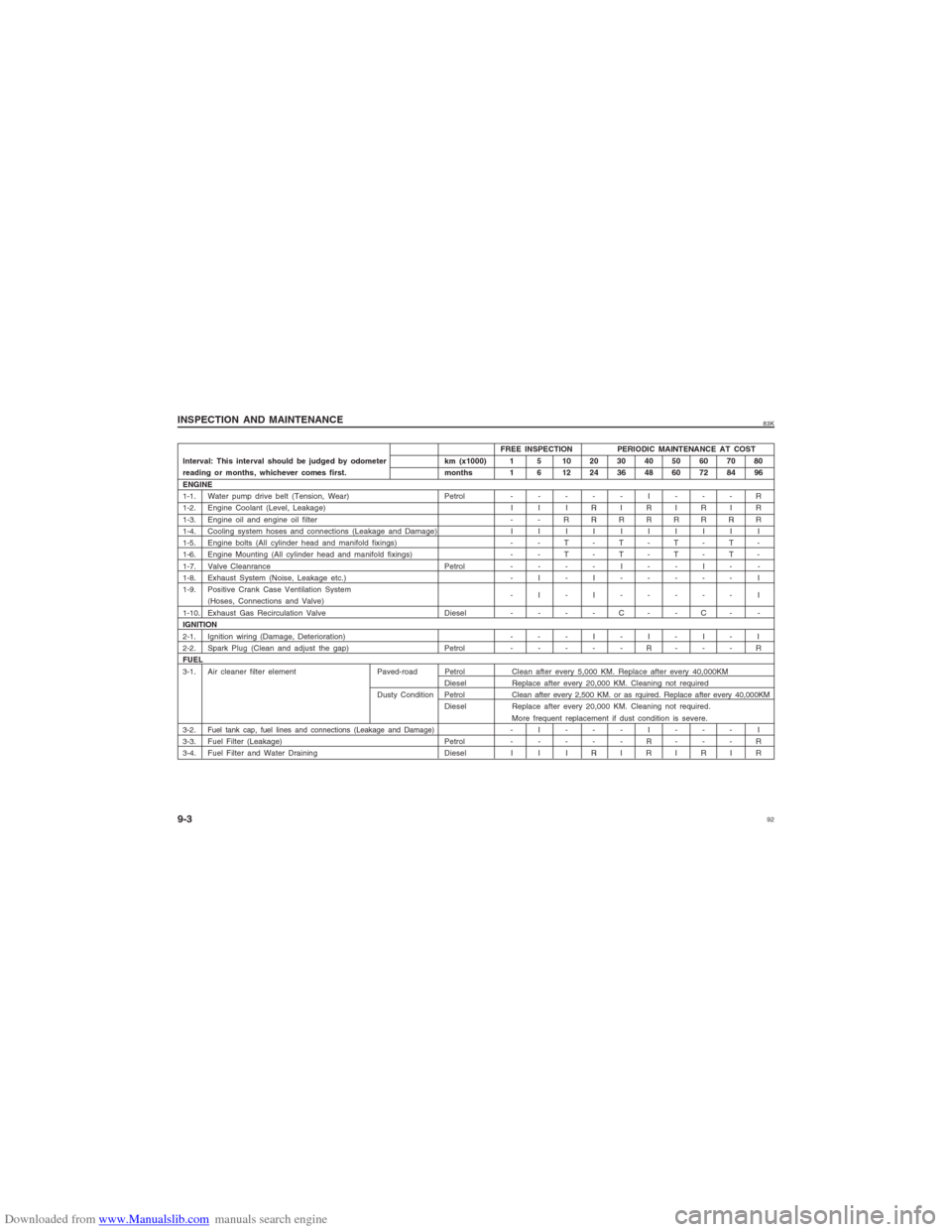
Maintenance ScheduleThe following table shows the times when
you should perform regular maintenance on
your vehicle. This table shows in kilometers
and months when you should perform
inspections, adjustments, lubrication and
other services.EXAMPLE
Page 92 of 136
Downloaded from www.Manualslib.com manuals search engine 9283K
FREE INSPECTION PERIODIC MAINTENANCE AT COST
Interval: This interval should be judged by odometer km (x1000) 1 5 10 20 30 40 50 60 70 80
reading or months, whichever comes first.months 1 6 12 24 36 48 60 72 84 96
ENGINE
1-1. Water pump drive belt (Tension, Wear) Petrol-----I---R
1-2.Engine Coolant (Level, Leakage) I I I R I R I R I R
1-3. Engine oil and engine oil filter - - R RRRRRRR
1-4.Cooling system hoses and connections (Leakage and Damage)IIIIIIIIII
1-5.Engine bolts (All cylinder head and manifold fixings) - - T - T - T - T -
1-6.Engine Mounting (All cylinder head and manifold fixings) - - T - T - T - T -
1-7. Valve Cleanrance Petrol----I--I--
1-8.Exhaust System (Noise, Leakage etc.) - I - I-----I
1-9. Positive Crank Case Ventilation System
(Hoses, Connections and Valve)-I-I-----I
1-10.Exhaust Gas Recirculation Valve Diesel----C--C--
IGNITION
2-1.Ignition wiring (Damage, Deterioration) - - - I - I - I - I
2-2. Spark Plug (Clean and adjust the gap) Petrol-----R---R
FUEL
3-1. Air cleaner filter element Paved-road Petrol Clean after every 5,000 KM. Replace after every 40,000KM
Diesel Replace after every 20,000 KM. Cleaning not required
Dusty Condition Petrol Clean after every 2,500 KM. or as rquired. Replace after every 40,000KM
Diesel Replace after every 20,000 KM. Cleaning not required.
More frequent replacement if dust condition is severe.
3-2.
Fuel tank cap, fuel lines and connections (Leakage and Damage)
-I---I---I
3-3. Fuel Filter (Leakage) Petrol-----R---R
3-4. Fuel Filter and Water Draining Diesel I I I R I R I R I R
INSPECTION AND MAINTENANCE
9-3
Page 101 of 136
Downloaded from www.Manualslib.com manuals search engine 10183K
INSPECTION AND MAINTENANCE
9-12
83K-07-022
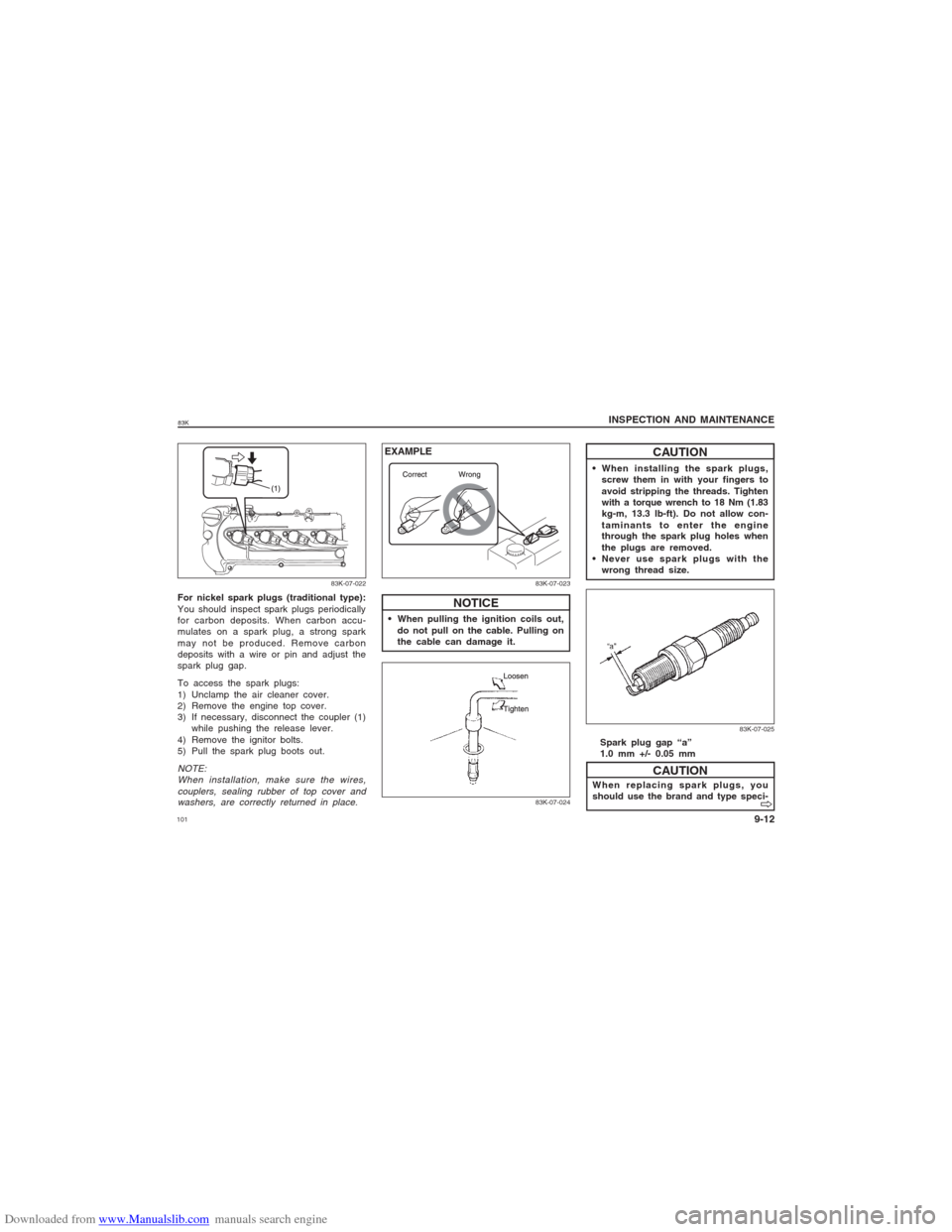
For nickel spark plugs (traditional type):
You should inspect spark plugs periodically
for carbon deposits. When carbon accu-
mulates on a spark plug, a strong spark
may not be produced. Remove carbon
deposits with a wire or pin and adjust the
spark plug gap.
To access the spark plugs:
1) Unclamp the air cleaner cover.
2) Remove the engine top cover.
3) If necessary, disconnect the coupler (1)
while pushing the release lever.
4) Remove the ignitor bolts.
5) Pull the spark plug boots out.NOTE:
When installation, make sure the wires,
couplers, sealing rubber of top cover and
washers, are correctly returned in place.
83K-07-023
EXAMPLE
83K-07-024
NOTICE
CAUTION
When pulling the ignition coils out,
do not pull on the cable. Pulling on
the cable can damage it. When installing the spark plugs,
screw them in with your fingers to
avoid stripping the threads. Tighten
with a torque wrench to 18 Nm (1.83
kg-m, 13.3 lb-ft). Do not allow con-
taminants to enter the engine
through the spark plug holes when
the plugs are removed.
Never use spark plugs with the
wrong thread size.
83K-07-025
Spark plug gap “a”
1.0 mm +/- 0.05 mm
CAUTION
When replacing spark plugs, you
should use the brand and type speci-
V VV V
V
Page 102 of 136
Downloaded from www.Manualslib.com manuals search engine 10283K
INSPECTION AND MAINTENANCE
9-13
CAUTION
fied for your vehicle. For the specified
spark plugs, refer to the “SPECIFI-
CATIONS” section at the end of this
book. It is recommended to trust this
job on your MARUTI SUZUKI dealer.
83K-07-026
NOTE:
If your engine is equipped with the high-
tension cord type ignition wiring and you
experience some firing problem of spark
plugs, such as, hard engine-starting, misfire
etc., the cause may be located not only on
spark plugs but also on deteriorated ignition
wirings (generally, used for more than 80000
km or five years). If spark plug replacement
does not solve the problem, have theEXAMPLEV VV V
V
ignition wiring and other ignition system
inspected by your MARUTI SUZUKI dealer.Gear OilTransmission OilWhen adding gear oil, use gear oil with the
appropriate viscosity and grade.
We highly recommend you use:
API GL-4 SAE 75W-90.
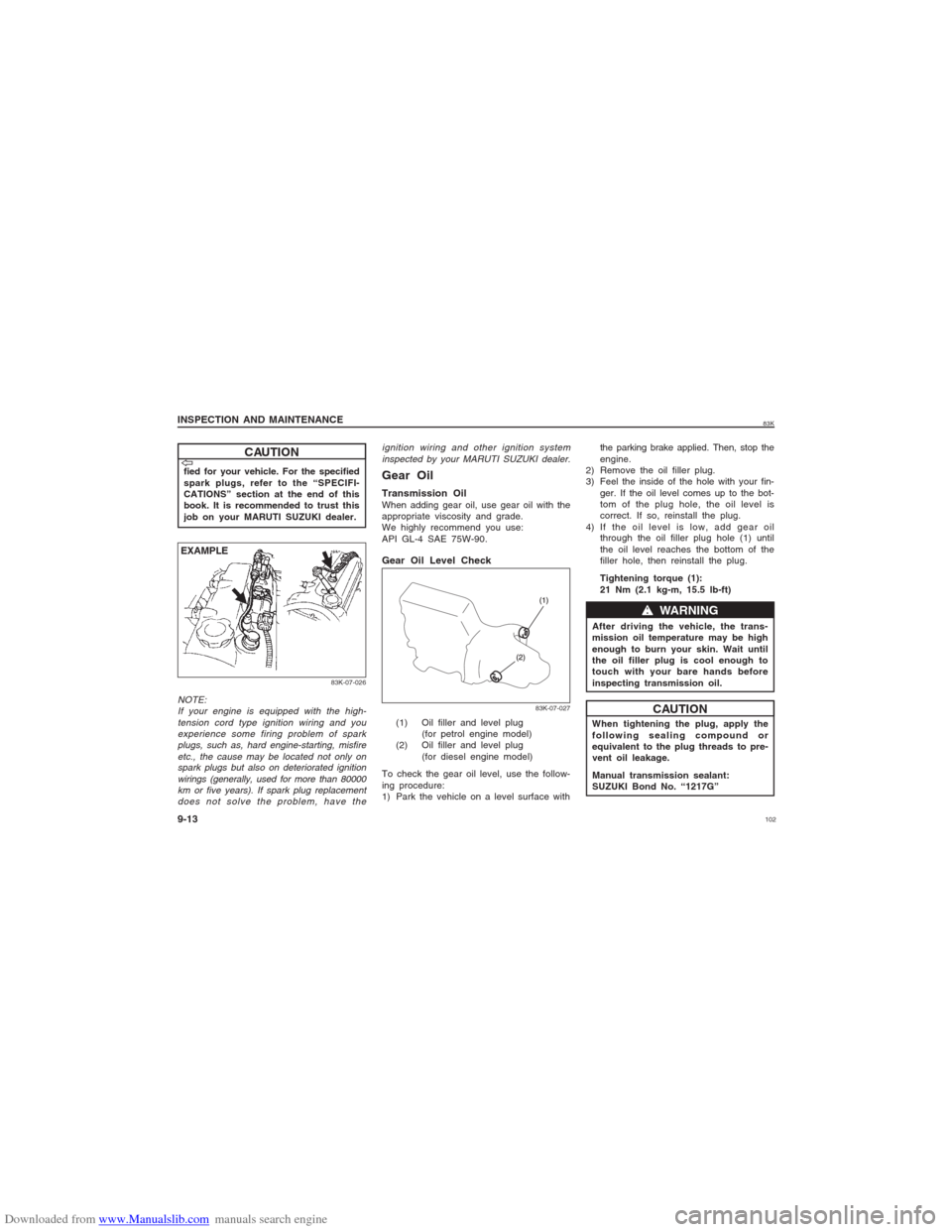
83K-07-027
Gear Oil Level Check
(1) Oil filler and level plug
(for petrol engine model)
(2) Oil filler and level plug
(for diesel engine model)
To check the gear oil level, use the follow-
ing procedure:
1) Park the vehicle on a level surface withthe parking brake applied. Then, stop the
engine.
2) Remove the oil filler plug.
3) Feel the inside of the hole with your fin-
ger. If the oil level comes up to the bot-
tom of the plug hole, the oil level is
correct. If so, reinstall the plug.
4) If the oil level is low, add gear oil
through the oil filler plug hole (1) until
the oil level reaches the bottom of the
filler hole, then reinstall the plug.
Tightening torque (1):
21 Nm (2.1 kg-m, 15.5 lb-ft)
w ww w
w WARNING
After driving the vehicle, the trans-
mission oil temperature may be high
enough to burn your skin. Wait until
the oil filler plug is cool enough to
touch with your bare hands before
inspecting transmission oil.
CAUTION
When tightening the plug, apply the
following sealing compound or
equivalent to the plug threads to pre-
vent oil leakage.
Manual transmission sealant:
SUZUKI Bond No. “1217G”
Page 111 of 136
Downloaded from www.Manualslib.com manuals search engine 11183K
INSPECTION AND MAINTENANCE
9-22
83K-07-043
83K-07-044
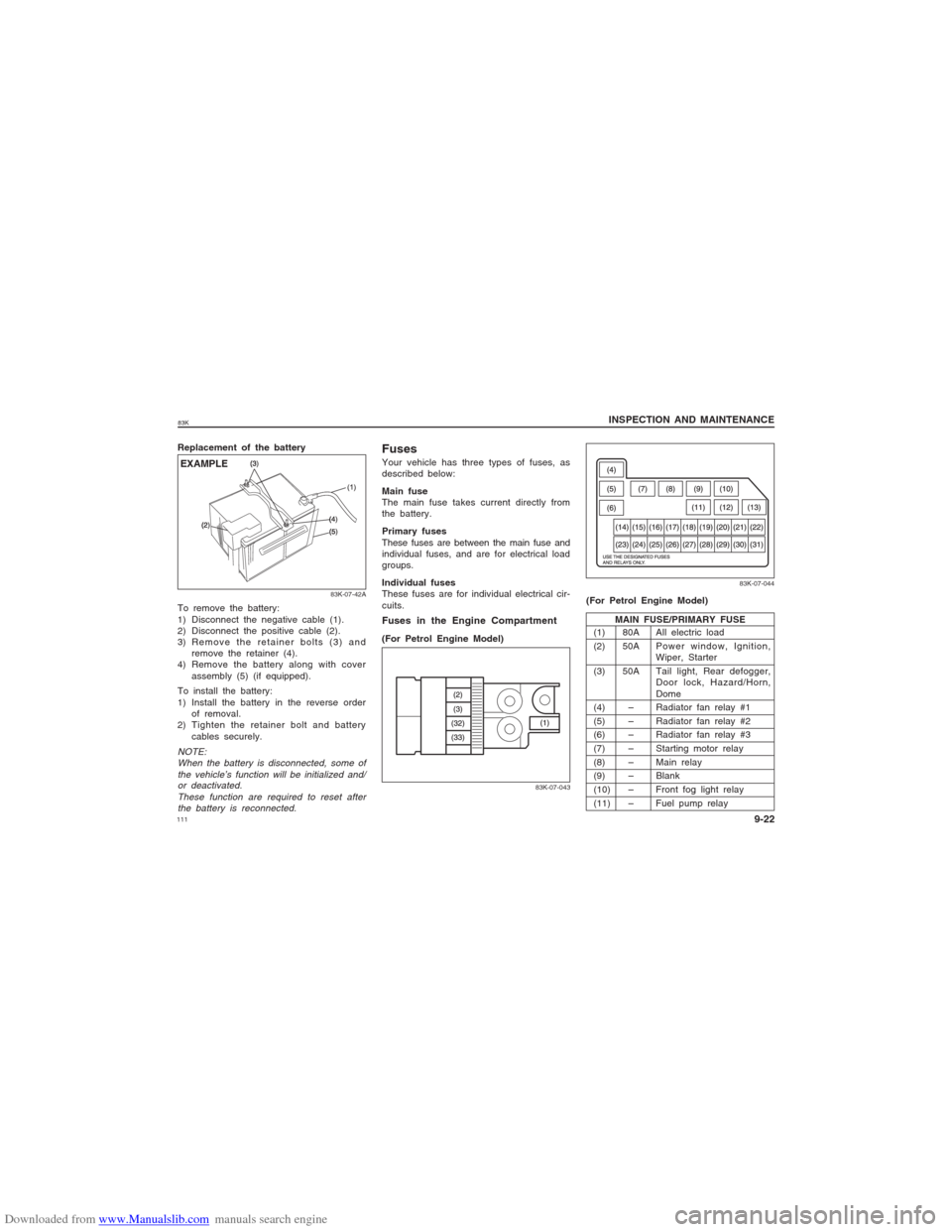
Fuses in the Engine Compartment(For Petrol Engine Model)
Replacement of the battery
83K-07-42A
EXAMPLETo remove the battery:
1) Disconnect the negative cable (1).
2) Disconnect the positive cable (2).
3) Remove the retainer bolts (3) and
remove the retainer (4).
4) Remove the battery along with cover
assembly (5) (if equipped).
To install the battery:
1) Install the battery in the reverse order
of removal.
2) Tighten the retainer bolt and battery
cables securely.NOTE:
When the battery is disconnected, some of
the vehicle’s function will be initialized and/
or deactivated.
These function are required to reset after
the battery is reconnected.
FusesYour vehicle has three types of fuses, as
described below:
Main fuse
The main fuse takes current directly from
the battery.
Primary fuses
These fuses are between the main fuse and
individual fuses, and are for electrical load
groups.
Individual fuses
These fuses are for individual electrical cir-
cuits.
(1) 80A All electric load
(2) 50A Power window, Ignition,
Wiper, Starter
(3) 50A Tail light, Rear defogger,
Door lock, Hazard/Horn,
Dome
(4) – Radiator fan relay #1
(5) – Radiator fan relay #2
(6) – Radiator fan relay #3
(7) – Starting motor relay
(8) – Main relay
(9) – Blank
(10) – Front fog light relay
(11) – Fuel pump relayMAIN FUSE/PRIMARY FUSE(For Petrol Engine Model)
Page 112 of 136
Downloaded from www.Manualslib.com manuals search engine 11283K
INSPECTION AND MAINTENANCE
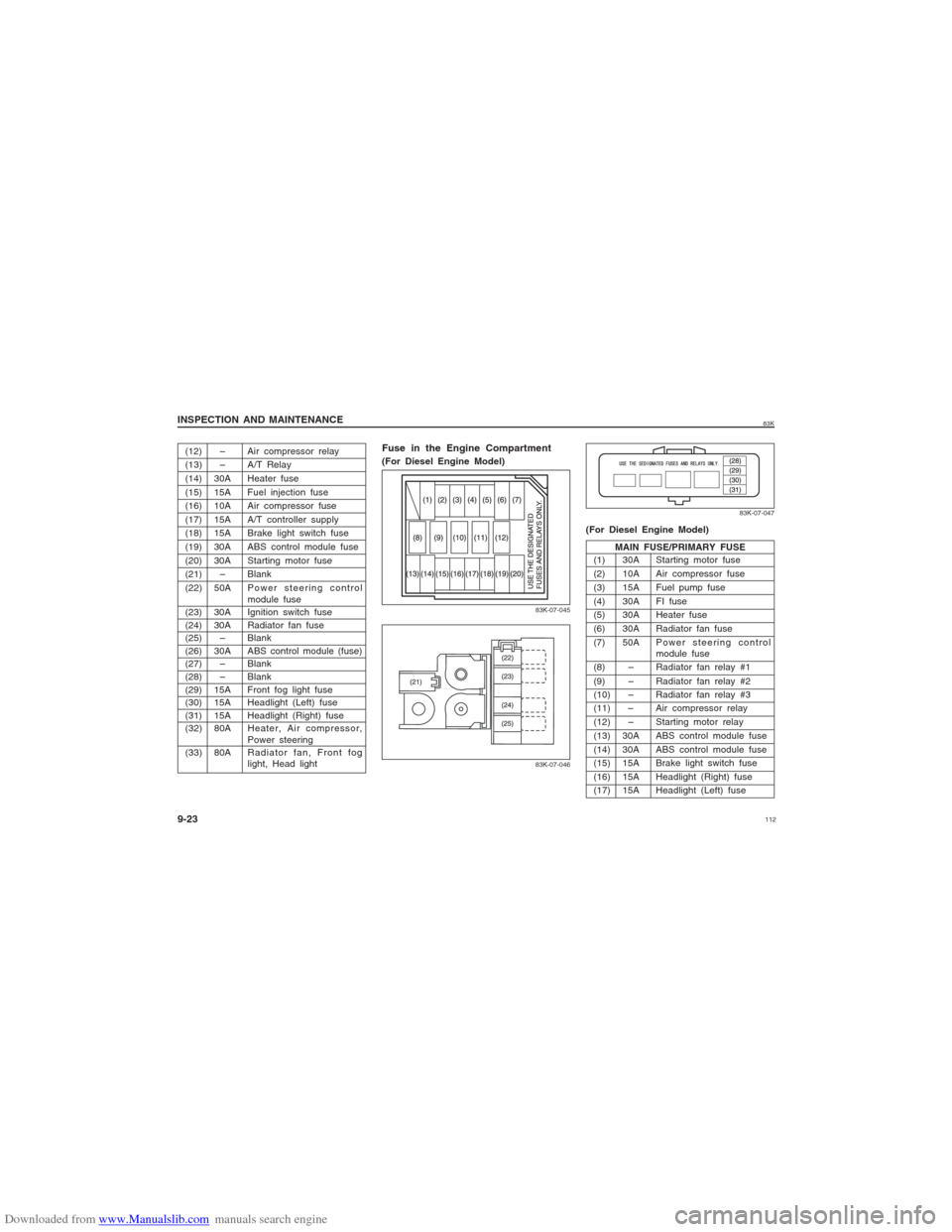
9-23(12) – Air compressor relay
(13) – A/T Relay
(14) 30A Heater fuse
(15) 15A Fuel injection fuse
(16) 10A Air compressor fuse
(17) 15A A/T controller supply
(18) 15A Brake light switch fuse
(19) 30A ABS control module fuse
(20) 30A Starting motor fuse
(21) – Blank
(22) 50A P o w e r steering control
module fuse
(23) 30A Ignition switch fuse
(24) 30A Radiator fan fuse
(25) – Blank
(26) 30AABS control module (fuse)
(27) – Blank
(28) – Blank
(29) 15A Front fog light fuse
(30) 15A Headlight (Left) fuse
(31) 15A Headlight (Right) fuse
(32) 80AHeater, Air compressor,
Power steering
(33) 80ARadiator fan, Front fog
light, Head light
83K-07-046
Fuse in the Engine Compartment(For Diesel Engine Model)
83K-07-045
(For Diesel Engine Model)(1) 30A Starting motor fuse
(2) 10A Air compressor fuse
(3) 15A Fuel pump fuse
(4) 30A FI fuse
(5) 30A Heater fuse
(6) 30A Radiator fan fuse
(7) 50A Power steering control
module fuse
(8) – Radiator fan relay #1
(9) – Radiator fan relay #2
(10) – Radiator fan relay #3
(11) – Air compressor relay
(12) – Starting motor relay
(13) 30A ABS control module fuse
(14) 30A ABS control module fuse
(15) 15A Brake light switch fuse
(16) 15A Headlight (Right) fuse
(17) 15A Headlight (Left) fuseMAIN FUSE/PRIMARY FUSE
83K-07-047
Page 113 of 136
Downloaded from www.Manualslib.com manuals search engine 11383K
INSPECTION AND MAINTENANCE
9-24
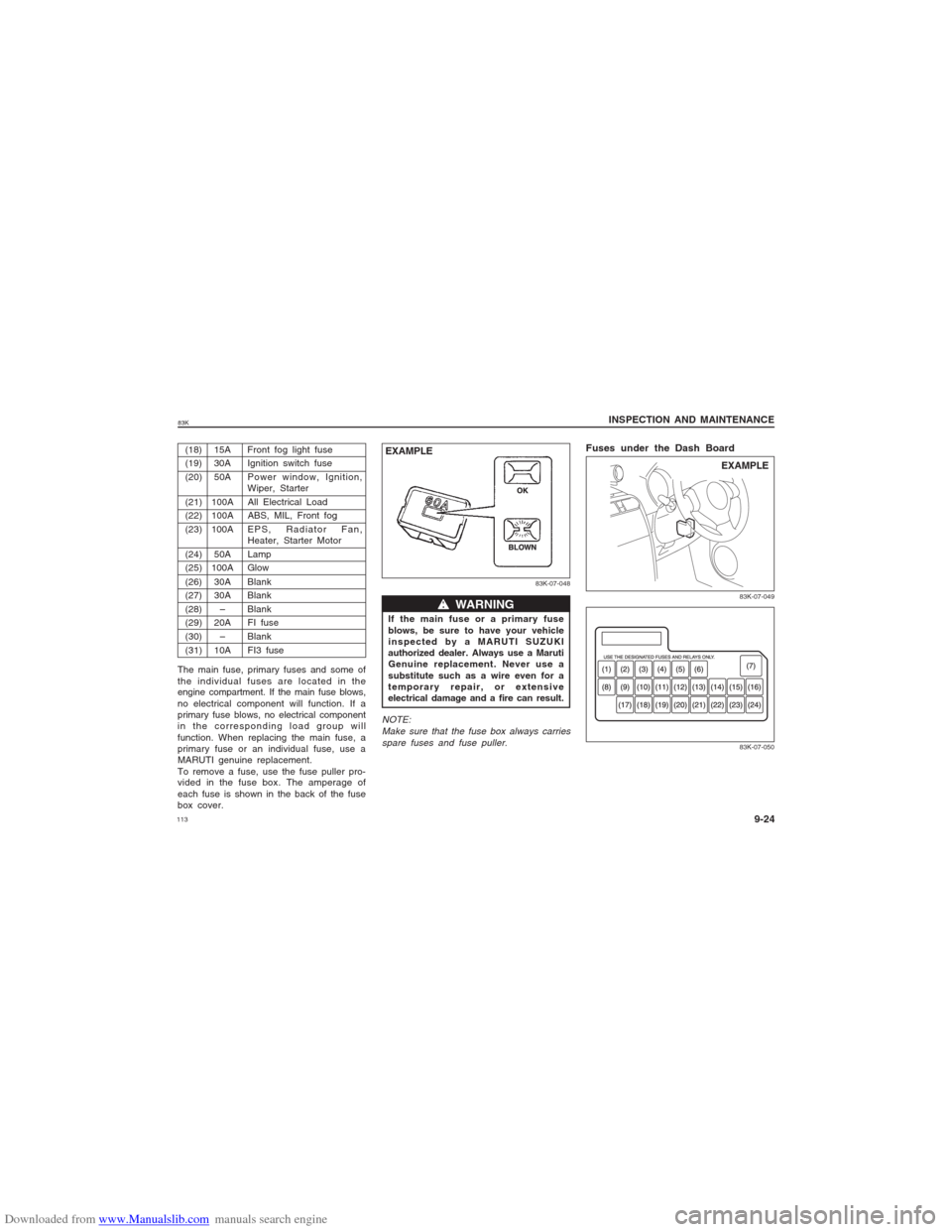
(18) 15A Front fog light fuse
(19) 30A Ignition switch fuse
(20) 50APower window, Ignition,
Wiper, Starter
(21)100A All Electrical Load
(22)100A ABS, MIL, Front fog
(23)100AEPS, Radiator Fan,
Heater, Starter Motor
(24) 50ALamp
(25)100A Glow
(26) 30A Blank
(27) 30A Blank
(28) – Blank
(29) 20A FI fuse
(30) – Blank
(31) 10A FI3 fuseThe main fuse, primary fuses and some of
the individual fuses are located in the
engine compartment. If the main fuse blows,
no electrical component will function. If a
primary fuse blows, no electrical component
in the corresponding load group will
function. When replacing the main fuse, a
primary fuse or an individual fuse, use a
MARUTI genuine replacement.
To remove a fuse, use the fuse puller pro-
vided in the fuse box. The amperage of
each fuse is shown in the back of the fuse
box cover.
w ww w
w WARNING
If the main fuse or a primary fuse
blows, be sure to have your vehicle
inspected by a MARUTI SUZUKI
authorized dealer. Always use a Maruti
Genuine replacement. Never use a
substitute such as a wire even for a
temporary repair, or extensive
electrical damage and a fire can result.NOTE:
Make sure that the fuse box always carries
spare fuses and fuse puller.EXAMPLEFuses under the Dash Board
83K-07-04983K-07-050
EXAMPLE
83K-07-048