lock SUZUKI MARUTI 2005 1.G Owner's Manual
[x] Cancel search | Manufacturer: SUZUKI, Model Year: 2005, Model line: MARUTI, Model: SUZUKI MARUTI 2005 1.GPages: 136, PDF Size: 2.93 MB
Page 40 of 136
Downloaded from www.Manualslib.com manuals search engine 4083K
BEFORE DRIVING
4-28
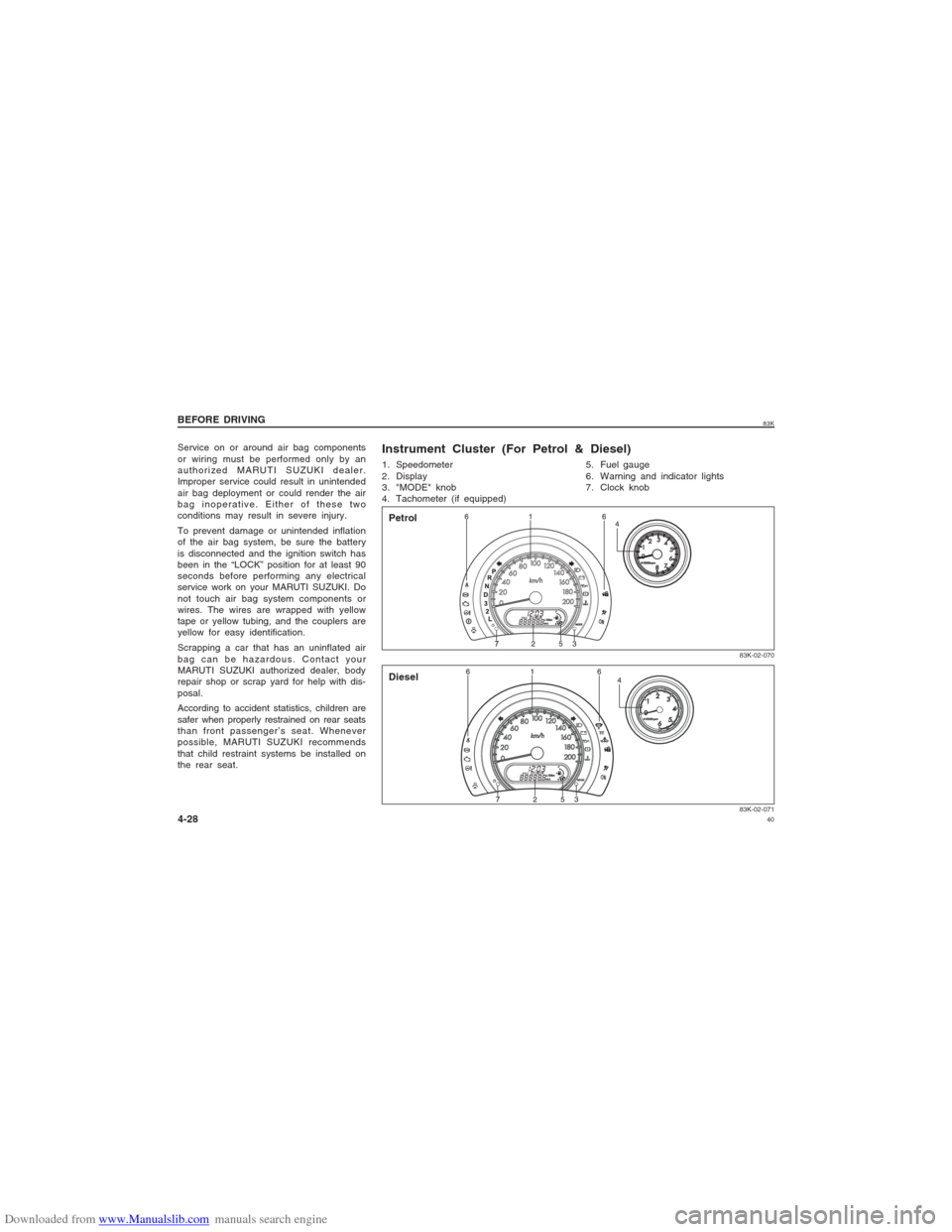
1. Speedometer
2. Display
3. "MODE" knob
4. Tachometer (if equipped)
83K-02-07183K-02-070
5. Fuel gauge
6. Warning and indicator lights
7. Clock knob
Instrument Cluster (For Petrol & Diesel)Petrol
Diesel
Service on or around air bag components
or wiring must be performed only by an
authorized MARUTI SUZUKI dealer.
Improper service could result in unintended
air bag deployment or could render the air
bag inoperative. Either of these two
conditions may result in severe injury.
To prevent damage or unintended inflation
of the air bag system, be sure the battery
is disconnected and the ignition switch has
been in the “LOCK” position for at least 90
seconds before performing any electrical
service work on your MARUTI SUZUKI. Do
not touch air bag system components or
wires. The wires are wrapped with yellow
tape or yellow tubing, and the couplers are
yellow for easy identification.
Scrapping a car that has an uninflated air
bag can be hazardous. Contact your
MARUTI SUZUKI authorized dealer, body
repair shop or scrap yard for help with dis-
posal.
According to accident statistics, children are
safer when properly restrained on rear seats
than front passenger’s seat. Whenever
possible, MARUTI SUZUKI recommends
that child restraint systems be installed on
the rear seat.
Page 42 of 136
Downloaded from www.Manualslib.com manuals search engine 4283K
BEFORE DRIVING
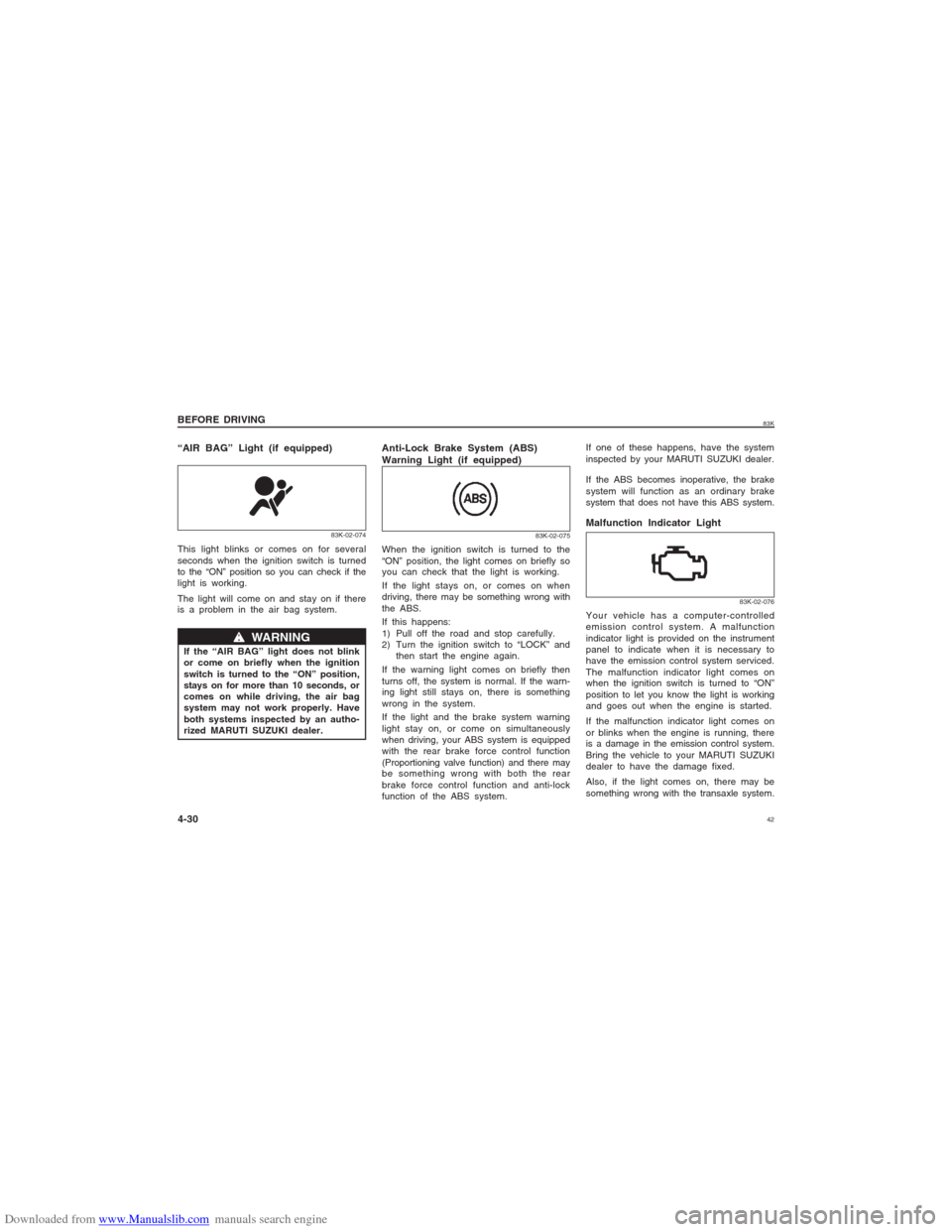
4-30 “AIR BAG” Light (if equipped)This light blinks or comes on for several
seconds when the ignition switch is turned
to the “ON” position so you can check if the
light is working.
The light will come on and stay on if there
is a problem in the air bag system.
83K-02-074
w ww w
w WARNING
If the “AIR BAG” light does not blink
or come on briefly when the ignition
switch is turned to the “ON” position,
stays on for more than 10 seconds, or
comes on while driving, the air bag
system may not work properly. Have
both systems inspected by an autho-
rized MARUTI SUZUKI dealer.
Anti-Lock Brake System (ABS)
Warning Light (if equipped)
83K-02-075
When the ignition switch is turned to the
“ON” position, the light comes on briefly so
you can check that the light is working.
If the light stays on, or comes on when
driving, there may be something wrong with
the ABS.
If this happens:
1) Pull off the road and stop carefully.
2) Turn the ignition switch to “LOCK” and
then start the engine again.
If the warning light comes on briefly then
turns off, the system is normal. If the warn-
ing light still stays on, there is something
wrong in the system.
If the light and the brake system warning
light stay on, or come on simultaneously
when driving, your ABS system is equipped
with the rear brake force control function
(Proportioning valve function) and there may
be something wrong with both the rear
brake force control function and anti-lock
function of the ABS system.
If one of these happens, have the system
inspected by your MARUTI SUZUKI dealer.Malfunction Indicator Light
83K-02-076
If the ABS becomes inoperative, the brake
system will function as an ordinary brake
system that does not have this ABS system.Your vehicle has a computer-controlled
emission control system. A malfunction
indicator light is provided on the instrument
panel to indicate when it is necessary to
have the emission control system serviced.
The malfunction indicator light comes on
when the ignition switch is turned to “ON”
position to let you know the light is working
and goes out when the engine is started.
If the malfunction indicator light comes on
or blinks when the engine is running, there
is a damage in the emission control system.
Bring the vehicle to your MARUTI SUZUKI
dealer to have the damage fixed.
Also, if the light comes on, there may be
something wrong with the transaxle system.
Page 48 of 136
Downloaded from www.Manualslib.com manuals search engine 4883K
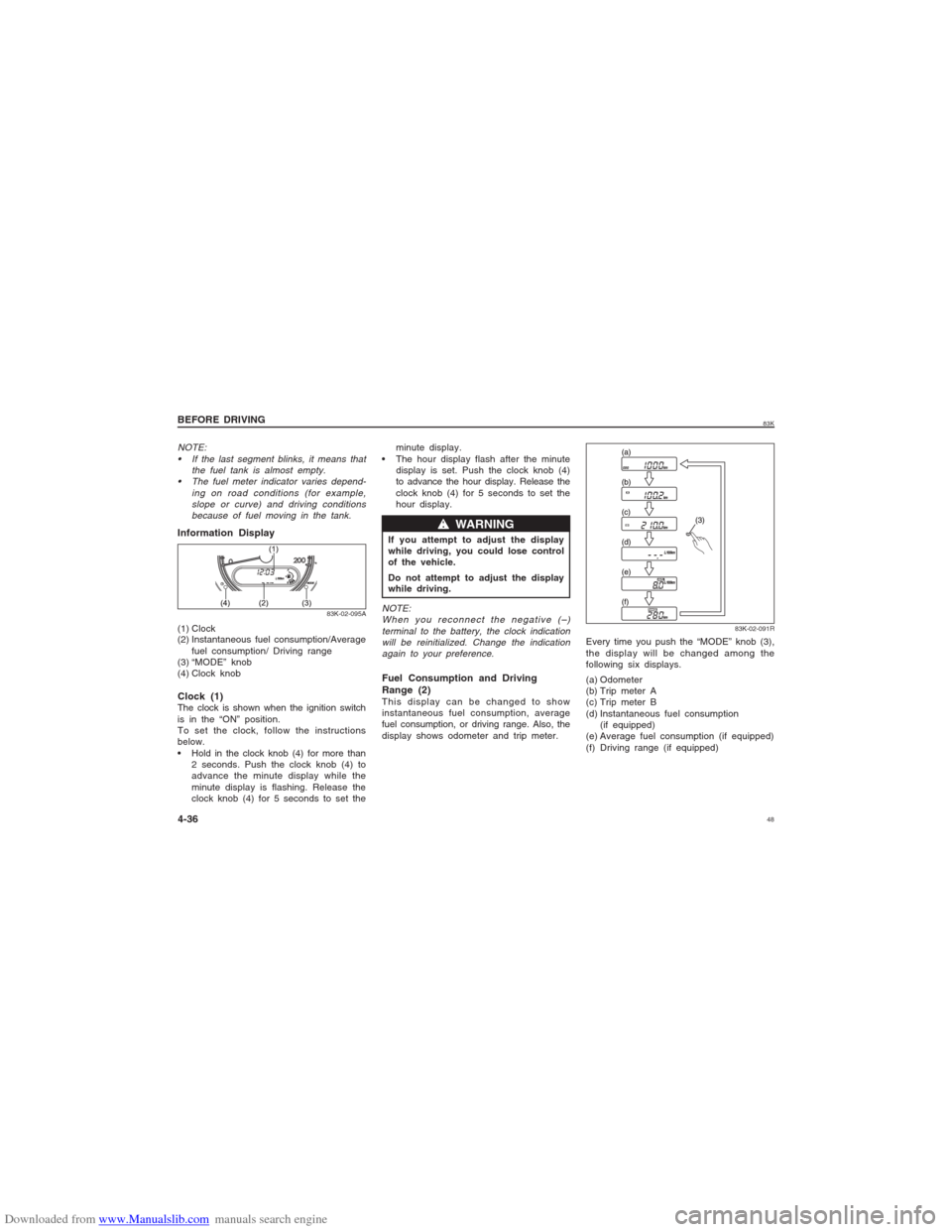
Information Display(1) Clock
(2) Instantaneous fuel consumption/Average
fuel consumption/ Driving range
(3) “MODE” knob
(4) Clock knob
83K-02-095A
NOTE:
If the last segment blinks, it means that
the fuel tank is almost empty.
The fuel meter indicator varies depend-
ing on road conditions (for example,
slope or curve) and driving conditions
because of fuel moving in the tank.Clock (1)The clock is shown when the ignition switch
is in the “ON” position.
To set the clock, follow the instructions
below.
Hold in the clock knob (4) for more than
2 seconds. Push the clock knob (4) to
advance the minute display while the
minute display is flashing. Release the
clock knob (4) for 5 seconds to set theminute display.
The hour display flash after the minute
display is set. Push the clock knob (4)
to advance the hour display. Release the
clock knob (4) for 5 seconds to set the
hour display.
If you attempt to adjust the display
while driving, you could lose control
of the vehicle.
Do not attempt to adjust the display
while driving.
w ww w
w WARNING
NOTE:
When you reconnect the negative (–)
terminal to the battery, the clock indication
will be reinitialized. Change the indication
again to your preference.Fuel Consumption and Driving
Range (2)This display can be changed to show
instantaneous fuel consumption, average
fuel consumption, or driving range. Also, the
display shows odometer and trip meter.
83K-02-091R
Every time you push the “MODE” knob (3),
the display will be changed among the
following six displays.
(a) Odometer
(b) Trip meter A
(c) Trip meter B
(d) Instantaneous fuel consumption
(if equipped)
(e) Average fuel consumption (if equipped)
(f) Driving range (if equipped)
BEFORE DRIVING
4-36
Page 54 of 136
Downloaded from www.Manualslib.com manuals search engine 5483K
BEFORE DRIVING
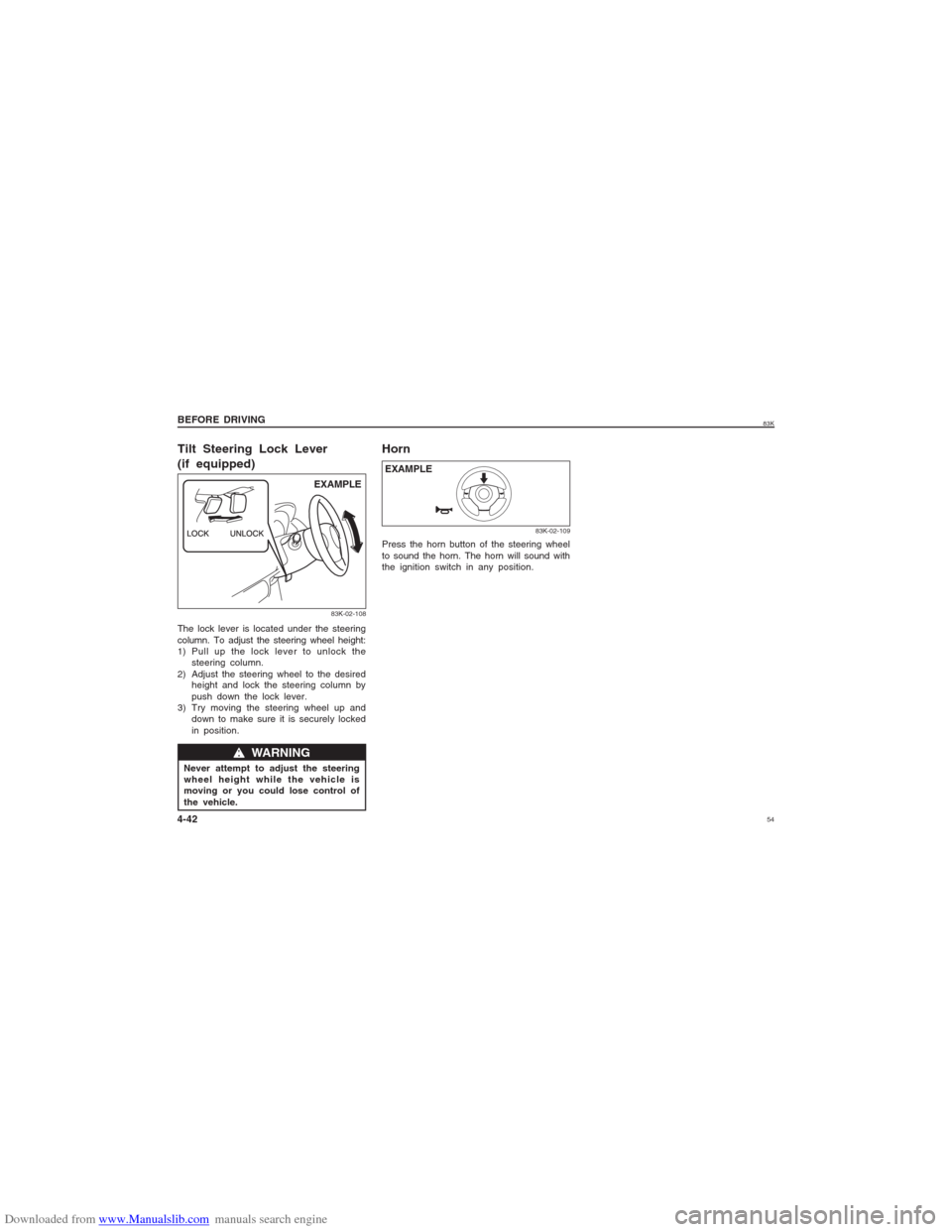
4-42Tilt Steering Lock Lever
(if equipped)
83K-02-108
EXAMPLE
w ww w
w WARNING
Never attempt to adjust the steering
wheel height while the vehicle is
moving or you could lose control of
the vehicle.
83K-02-109
HornPress the horn button of the steering wheel
to sound the horn. The horn will sound with
the ignition switch in any position.EXAMPLE
The lock lever is located under the steering
column. To adjust the steering wheel height:
1) Pull up the lock lever to unlock the
steering column.
2) Adjust the steering wheel to the desired
height and lock the steering column by
push down the lock lever.
3) Try moving the steering wheel up and
down to make sure it is securely locked
in position.
Page 57 of 136
Downloaded from www.Manualslib.com manuals search engine 5783K4) Make sure the bonnet is fully closed and
latched.
5) Check the headlights, turn signal lights,
brake lights and horn for proper opera-
tion.
6) Adjust the seat and adjustable head
restraint (if equipped).
7) Check the brake pedal and the parking
brake lever.
8) Adjust the mirrors.
9) Make sure that you and all passengers
have properly fastened your seat belts.
10)Make sure that all warning lights come
on as the key is turned to the “ON” or
“START” position.
11)Check all gauges.
12)Make sure that the BRAKE SYSTEM
WARNING light turns off when the
parking brake is released.
Once a week, or each time you fill your fuel
tank, perform the following under-hood
checks:
1) Engine oil level
2) Coolant level
3) Brake fluid level
4) Windshield washer fluid level
5) Battery solution level
6) Bonnet latch operation
Pull the Bonnet release handle inside the
vehicle. Make sure that you cannot open
the Bonnet all the way without releasingthe secondary latch. Be sure to close
the Bonnet securely after checking for
proper latch operation. See “All latches,
hinges & locks” of “CHASSIS AND
BODY” in the “Periodic Maintenance
Schedule” in the “INSPECTION AND
MAINTENANCE” section for lubrication
schedule.
w ww w
w WARNING
Make sure the bonnet is fully closed
and latched before driving. If it is not,
it can fly up unexpectedly during
driving, obstructing your view and
resulting in an accident.
Once a month, or each time you fill your
fuel tank, check the tyre pressure using a
tyre pressure gauge. Also check the tyre
pressure of the spare tyre.since its pistons, piston rings and cylinder
walls have not yet become conditioned. New
engines reach the normal level of oil
consumption only after approximately 5000
km (3000 miles) driving.
When judging the amount of oil consump-
tion, note that the oil may become diluted
and make it difficult to accurately judge the
true oil level.
As an example, if a vehicle is used for
repeated short trips, and consumes a nor-
mal amount of oil, the dipstick may not
show any drop in the oil level at all, even
after 1000 km (600 miles) or more of driv-
ing. This is because the oil is gradually
becoming diluted with fuel or moisture,
making it appear that the oil level has not
changed.
You should also be aware that the diluting
ingredients evaporate out when the vehicle
is subsequently driven at high speeds, such
as on an expressway, making it appear that
oil is excessively consumed after high-speed
driving.
OPERATING YOUR VEHICLE
5-2
Engine Oil ConsumptionIt is normal for the engine to consume some
engine oil during normal vehicle operation.
The amount of engine oil consumed
depends on the viscosity of the oil, the
quality of the oil and the conditions the
vehicle is driven under.
More oil is consumed during high-speed
driving and when there is frequent acceler-
ation and deceleration. Under high loads,
your engine also will consume more oil.
A new engine also consumes more oil,
83K-03-003
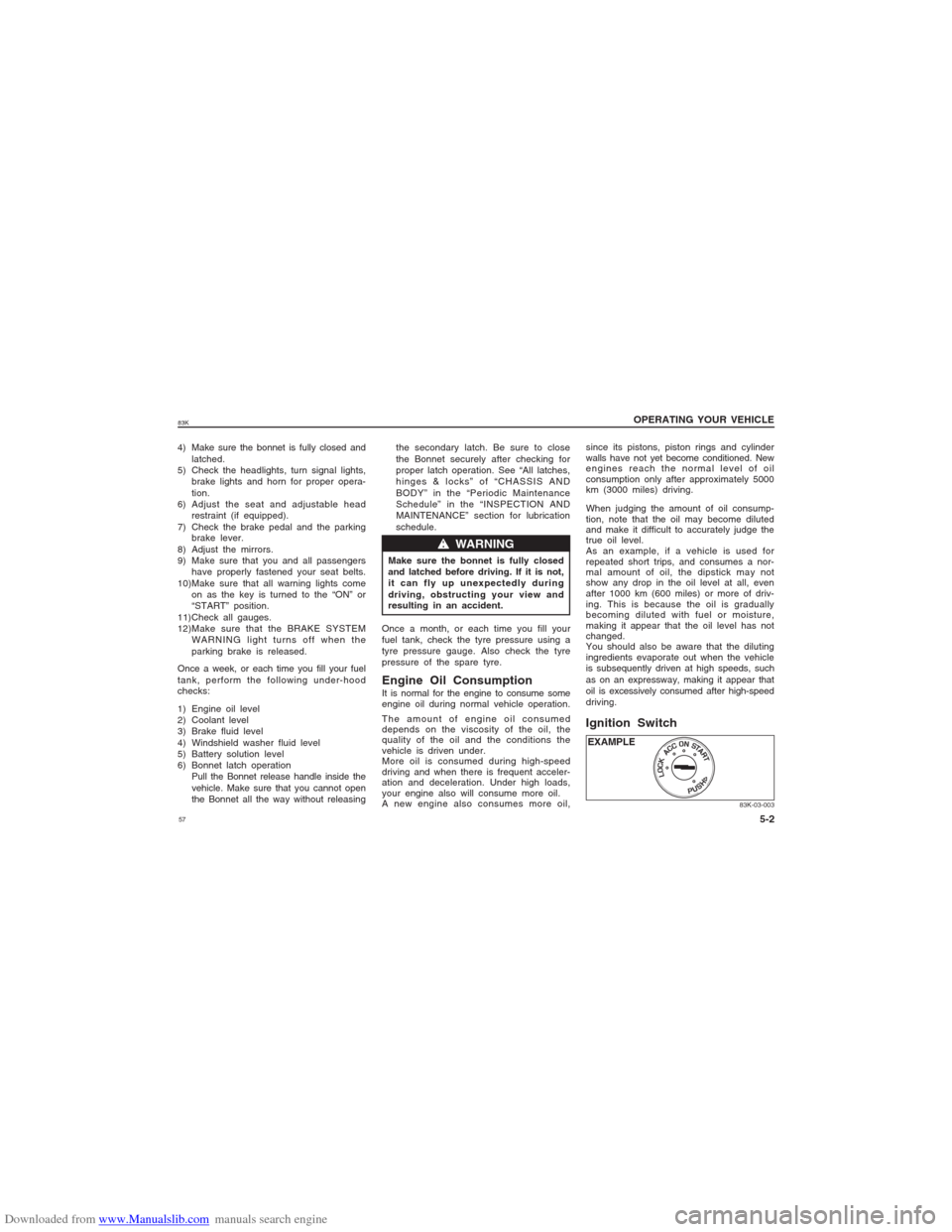
Ignition SwitchEXAMPLE
Page 58 of 136
Downloaded from www.Manualslib.com manuals search engine 5883K
w ww w
w WARNING
To avoid possible injury, do not oper-
ate controls by reaching through the
steering wheel.
83K-03-004
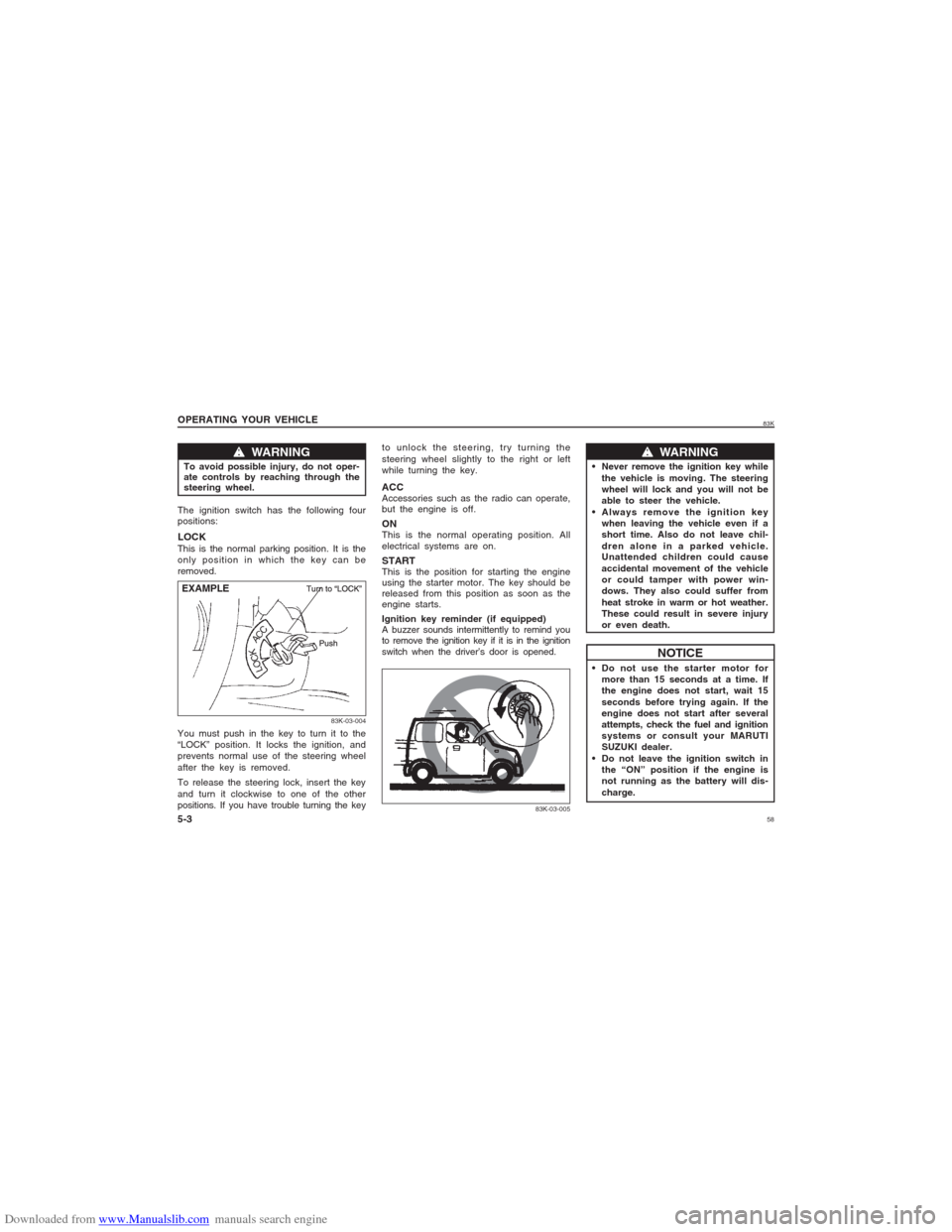
EXAMPLE OPERATING YOUR VEHICLE
5-3The ignition switch has the following four
positions:LOCKThis is the normal parking position. It is the
only position in which the key can be
removed.
You must push in the key to turn it to the
“LOCK” position. It locks the ignition, and
prevents normal use of the steering wheel
after the key is removed.
To release the steering lock, insert the key
and turn it clockwise to one of the other
positions. If you have trouble turning the keyto unlock the steering, try turning the
steering wheel slightly to the right or left
while turning the key.
ACCAccessories such as the radio can operate,
but the engine is off.ONThis is the normal operating position. All
electrical systems are on.STARTThis is the position for starting the engine
using the starter motor. The key should be
released from this position as soon as the
engine starts.
Ignition key reminder (if equipped)
A buzzer sounds intermittently to remind you
to remove the ignition key if it is in the ignition
switch when the driver’s door is opened.
w ww w
w WARNING
Never remove the ignition key while
the vehicle is moving. The steering
wheel will lock and you will not be
able to steer the vehicle.
Always remove the ignition key
when leaving the vehicle even if a
short time. Also do not leave chil-
dren alone in a parked vehicle.
Unattended children could cause
accidental movement of the vehicle
or could tamper with power win-
dows. They also could suffer from
heat stroke in warm or hot weather.
These could result in severe injury
or even death.
NOTICE
Do not use the starter motor for
more than 15 seconds at a time. If
the engine does not start, wait 15
seconds before trying again. If the
engine does not start after several
attempts, check the fuel and ignition
systems or consult your MARUTI
SUZUKI dealer.
Do not leave the ignition switch in
the “ON” position if the engine is
not running as the battery will dis-
charge.
83K-03-005
Page 60 of 136
Downloaded from www.Manualslib.com manuals search engine 6083K
OPERATING YOUR VEHICLE
5-5 Brake Pedal (2)Your SUZUKI vehicle is equipped with front
disc brakes and rear drum brakes.
Depressing the brake pedal applies both
sets of brakes.
You may hear occasional brake squeal
when you apply the brakes. This is a
normal condition caused by environmental
factors such as cold, wet, snow, etc.
w ww w
w WARNING
If brake squeal is excessive and
occurs each time the brakes are
applied, you should have the brakes
checked by your SUZUKI dealer.
w ww w
w WARNING
Do not “ride” the brakes by applying
them continuously or resting your foot
on the pedal. This will result in
overheating of the brakes which could
cause unpredictable braking action,
longer stopping distances, or
permanent brake damage.Accelerator Pedal (3)This pedal controls the speed of the engine.
Depressing the accelerator pedal increases
power output and speed.
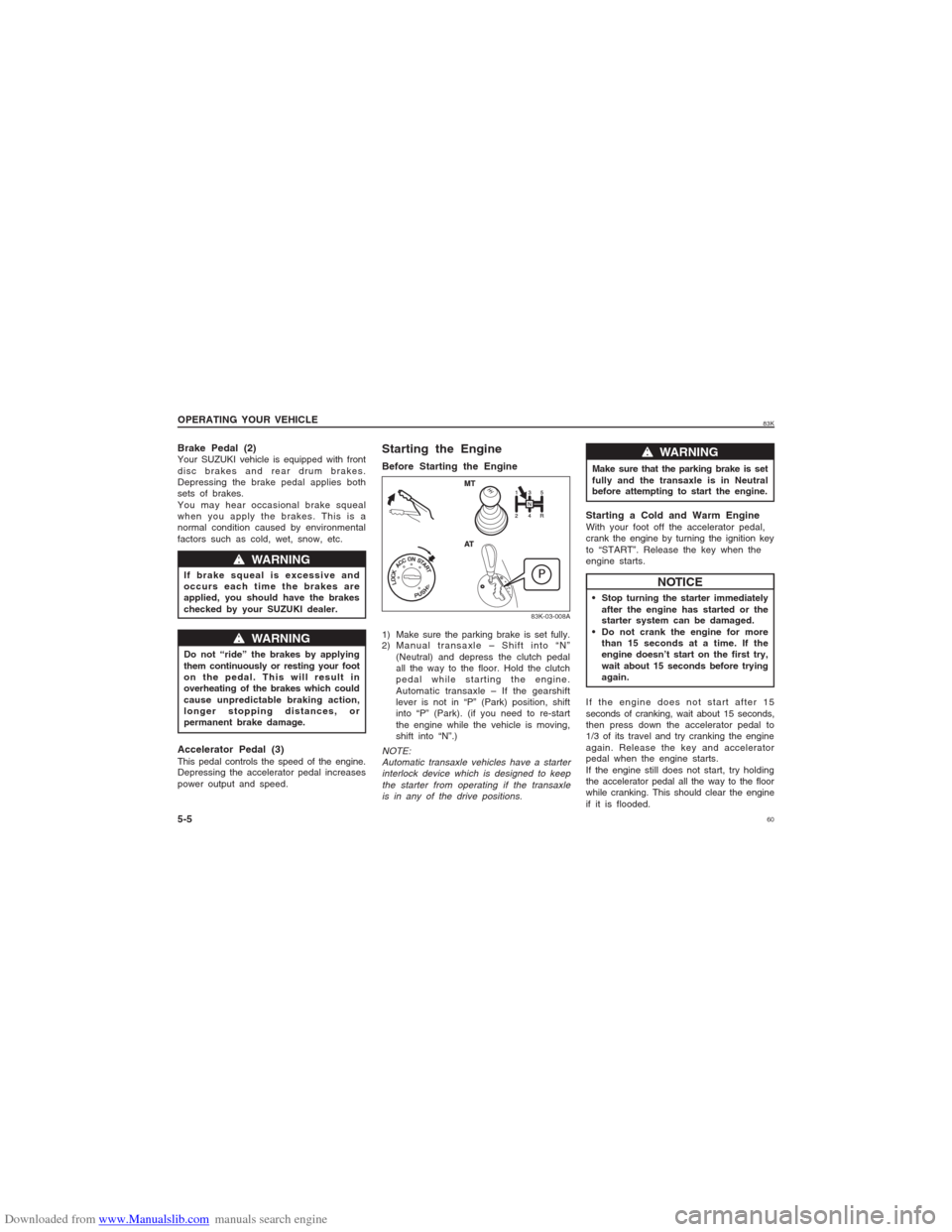
Starting the EngineBefore Starting the Engine
83K-03-008A
1) Make sure the parking brake is set fully.
2) Manual transaxle – Shift into “N”
(Neutral) and depress the clutch pedal
all the way to the floor. Hold the clutch
pedal while starting the engine.
Automatic transaxle – If the gearshift
lever is not in “P” (Park) position, shift
into “P” (Park). (if you need to re-start
the engine while the vehicle is moving,
shift into “N”.)NOTE:
Automatic transaxle vehicles have a starter
interlock device which is designed to keep
the starter from operating if the transaxle
is in any of the drive positions.
Make sure that the parking brake is set
fully and the transaxle is in Neutral
before attempting to start the engine.
w ww w
w WARNING
Starting a Cold and Warm EngineWith your foot off the accelerator pedal,
crank the engine by turning the ignition key
to “START”. Release the key when the
engine starts.
NOTICE
Stop turning the starter immediately
after the engine has started or the
starter system can be damaged.
Do not crank the engine for more
than 15 seconds at a time. If the
engine doesn’t start on the first try,
wait about 15 seconds before trying
again.
If the engine does not start after 15
seconds of cranking, wait about 15 seconds,
then press down the accelerator pedal to
1/3 of its travel and try cranking the engine
again. Release the key and accelerator
pedal when the engine starts.
If the engine still does not start, try holding
the accelerator pedal all the way to the floor
while cranking. This should clear the engine
if it is flooded.
Page 63 of 136

Downloaded from www.Manualslib.com manuals search engine 6383K
OPERATING YOUR VEHICLE
5-8
Use the gearshift lever positions as
described below:
P (Park)
Use this position to lock the transaxle when
the vehicle is parked or when starting the
engine. Shift into Park only when the vehicle
is completely stationary.
R (Reverse)
Use this position to reverse the vehicle from
stop. Make sure that vehicle is completely
stationary before shifting into Reverse.
N (Neutral)
Use this position for starting the engine if the
engine stalls and you need to restart it while
the vehicle is moving. You may also shift into
Neutral and depress the brake pedal to hold
the vehicle stationary during idling.
D (Drive)
Use this position for all normal driving. With
the gearshift lever in “D” range you can get
an automatic downshift by pressing the
accelerator pedal. The higher the vehicle
speed is, the more you need to press the
accelerator pedal to get a downshift.
3 (Low 3)
Use this position for driving on moderate
uphill and downhill gradients. The engine
braking effect on moderate downhills can be
used in this position. The transaxle shifts up
only to 3rd gear.2 (Low 2)
Use this position to provide extra power
when climbing hills, or to provide engine
braking when going down hills.
L (Low 1)
Use this position to provide maximum power
when climbing steep hills or driving through
deep snow or mud, or to provide maximum
engine braking when going down steep hills.
NOTE:
If you move the gearshift lever to a lower
gear while driving faster than the maximum
allowable speed for the lower gear, the
transaxle will not actually downshift until
your speed drops below the maximum
speed for the lower gear.
NOTICE
Be sure to take the following
precautions to help avoid damage to
the automatic transaxle:
Make sure that the vehicle is
completely stationary before shifting
into “P” or “R”.
Do not shift from “P” or “N” to “R”,
“D”, “3”, “2”, or “L” when the
engine is running above idle speed.
Do not rev the engine with the
transaxle in a drive position (“R”,
“D”, “3”, “2”, or “L”) and the front
wheels not moving.
If You Cannot Shift Automatic Tran-
saxle Gearshift Lever Out of “P”
(PARK)
83K-03-011C
Vehicles with an automatic transaxle have
an electrically operated park-lock feature. If
the vehicle’s battery is discharged, or there
is some other electrical failure, the
automatic transaxle cannot be shifted out of
Park in the normal way. Jump starting may
correct the condition. If not, follow the
procedure described below. This procedure
will permit shifting the transaxle out of Park.
NOTICE
Do not use the accelerator to hold
the vehicle on a hill. Use the
vehicle’s brakes.
1) Be sure the parking brake is firmly
applied.
2) If the engine is running, stop the engine.
3) Make sure the key is in the “ON” or
“ACC” position.
Page 64 of 136
Downloaded from www.Manualslib.com manuals search engine 6483K
w ww w
w WARNING
If water gets into the brake drums,
brake performance may become poor
and unpredictable.
After driving through water or wash-
ing the underside of the vehicle, test
the brakes while driving at a slow
speed to see if they have maintained
their normal effectiveness. If the
brakes are less effective than normal,
dry them by repeatedly applying the
brakes while driving slowly until the
brakes have regained their normal
effectiveness.
w ww w
w WARNING
Even without reserve power in the
brake system, you can still stop the
vehicle by pressing the brake pedal
harder than normally required. How-
ever, the stopping distance may be
longer.
OPERATING YOUR VEHICLE
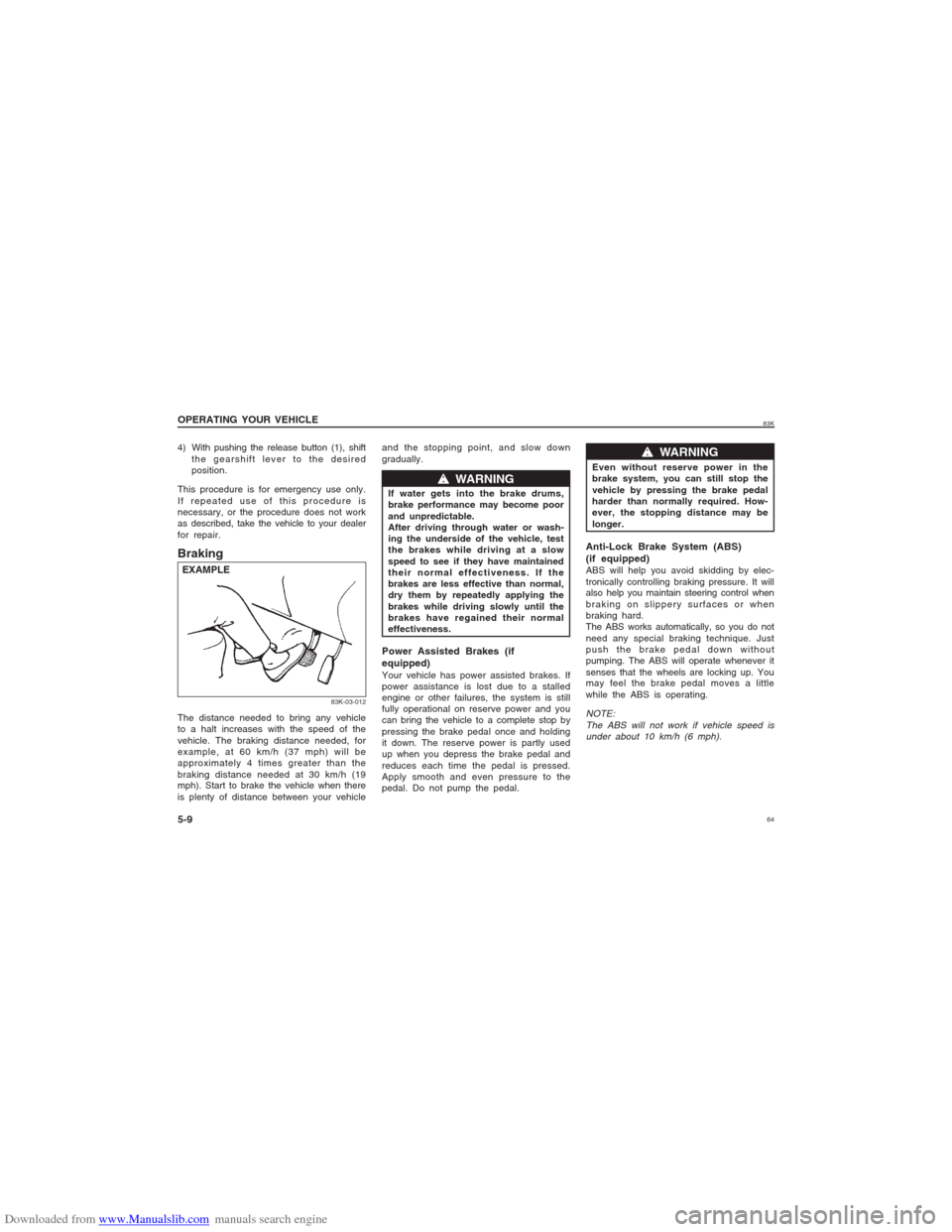
5-9Braking
83K-03-012
EXAMPLE4) With pushing the release button (1), shift
the gearshift lever to the desired
position.
This procedure is for emergency use only.
If repeated use of this procedure is
necessary, or the procedure does not work
as described, take the vehicle to your dealer
for repair.
The distance needed to bring any vehicle
to a halt increases with the speed of the
vehicle. The braking distance needed, for
example, at 60 km/h (37 mph) will be
approximately 4 times greater than the
braking distance needed at 30 km/h (19
mph). Start to brake the vehicle when there
is plenty of distance between your vehicleand the stopping point, and slow down
gradually.
Power Assisted Brakes (if
equipped)Your vehicle has power assisted brakes. If
power assistance is lost due to a stalled
engine or other failures, the system is still
fully operational on reserve power and you
can bring the vehicle to a complete stop by
pressing the brake pedal once and holding
it down. The reserve power is partly used
up when you depress the brake pedal and
reduces each time the pedal is pressed.
Apply smooth and even pressure to the
pedal. Do not pump the pedal.
Anti-Lock Brake System (ABS)
(if equipped)ABS will help you avoid skidding by elec-
tronically controlling braking pressure. It will
also help you maintain steering control when
braking on slippery surfaces or when
braking hard.
The ABS works automatically, so you do not
need any special braking technique. Just
push the brake pedal down without
pumping. The ABS will operate whenever it
senses that the wheels are locking up. You
may feel the brake pedal moves a little
while the ABS is operating.NOTE:
The ABS will not work if vehicle speed is
under about 10 km/h (6 mph).
Page 65 of 136
Downloaded from www.Manualslib.com manuals search engine 6583K
OPERATING YOUR VEHICLE
5-10
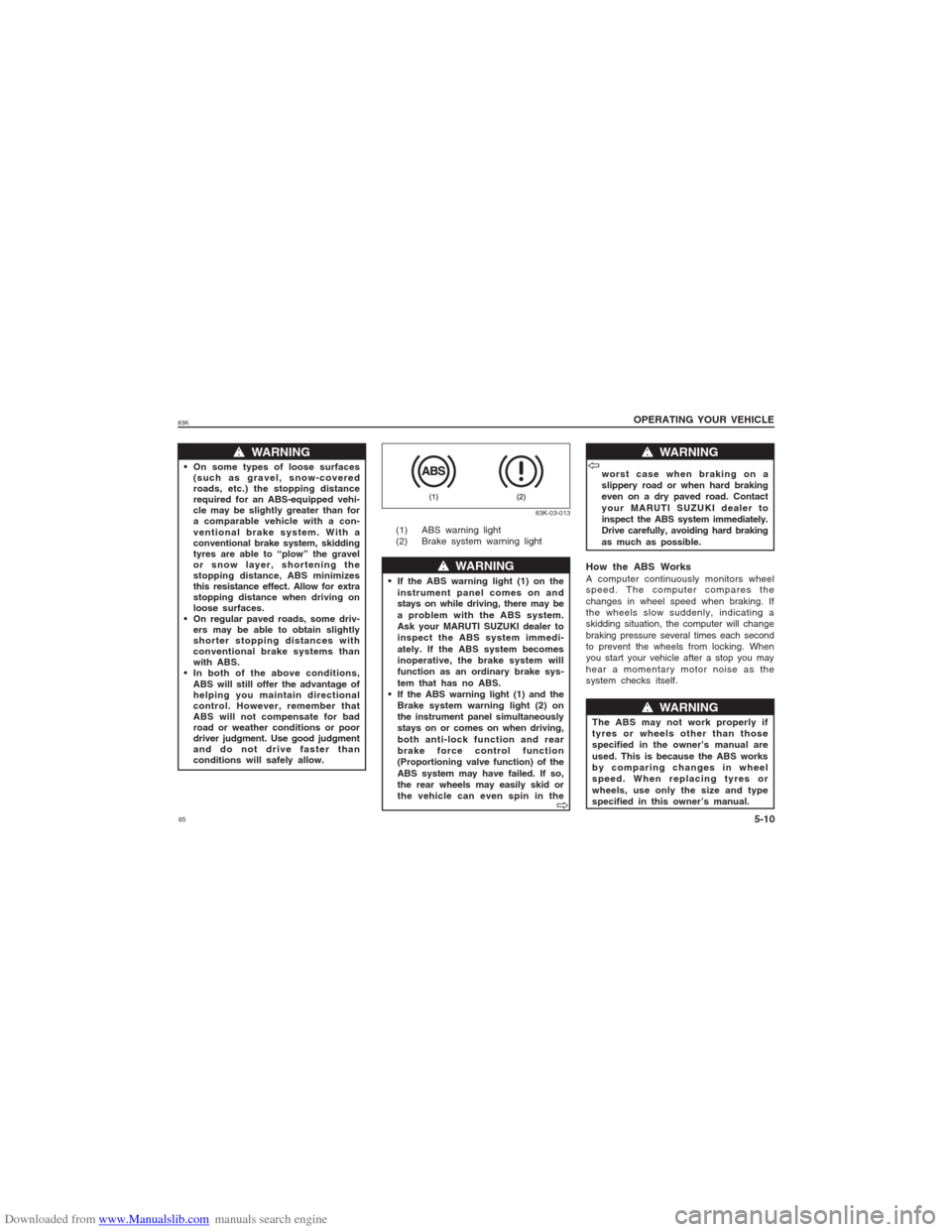
(1) ABS warning light
(2) Brake system warning light
w ww w
w WARNING
If the ABS warning light (1) on the
instrument panel comes on and
stays on while driving, there may be
a problem with the ABS system.
Ask your MARUTI SUZUKI dealer to
inspect the ABS system immedi-
ately. If the ABS system becomes
inoperative, the brake system will
function as an ordinary brake sys-
tem that has no ABS.
If the ABS warning light (1) and the
Brake system warning light (2) on
the instrument panel simultaneously
stays on or comes on when driving,
both anti-lock function and rear
brake force control function
(Proportioning valve function) of the
ABS system may have failed. If so,
the rear wheels may easily skid or
the vehicle can even spin in the
83K-03-013
V VV V
V
w ww w
w WARNING
V VV V
V
w ww w
w WARNING
The ABS may not work properly if
tyres or wheels other than those
specified in the owner’s manual are
used. This is because the ABS works
by comparing changes in wheel
speed. When replacing tyres or
wheels, use only the size and type
specified in this owner’s manual.worst case when braking on a
slippery road or when hard braking
even on a dry paved road. Contact
your MARUTI SUZUKI dealer to
inspect the ABS system immediately.
Drive carefully, avoiding hard braking
as much as possible.How the ABS WorksA computer continuously monitors wheel
speed. The computer compares the
changes in wheel speed when braking. If
the wheels slow suddenly, indicating a
skidding situation, the computer will change
braking pressure several times each second
to prevent the wheels from locking. When
you start your vehicle after a stop you may
hear a momentary motor noise as the
system checks itself.
w ww w
w WARNING
On some types of loose surfaces
(such as gravel, snow-covered
roads, etc.) the stopping distance
required for an ABS-equipped vehi-
cle may be slightly greater than for
a comparable vehicle with a con-
ventional brake system. With a
conventional brake system, skidding
tyres are able to “plow” the gravel
or snow layer, shortening the
stopping distance, ABS minimizes
this resistance effect. Allow for extra
stopping distance when driving on
loose surfaces.
On regular paved roads, some driv-
ers may be able to obtain slightly
shorter stopping distances with
conventional brake systems than
with ABS.
In both of the above conditions,
ABS will still offer the advantage of
helping you maintain directional
control. However, remember that
ABS will not compensate for bad
road or weather conditions or poor
driver judgment. Use good judgment
and do not drive faster than
conditions will safely allow.