Notice SUZUKI SWIFT 2017 5.G Repair Manual
[x] Cancel search | Manufacturer: SUZUKI, Model Year: 2017, Model line: SWIFT, Model: SUZUKI SWIFT 2017 5.GPages: 336, PDF Size: 6.24 MB
Page 202 of 336
7-11INSPECTION AND MAINTENANCE
74LH0-74E
reaches the “FULL” mark. Never fill the res-
ervoir tank above the “FULL” mark.
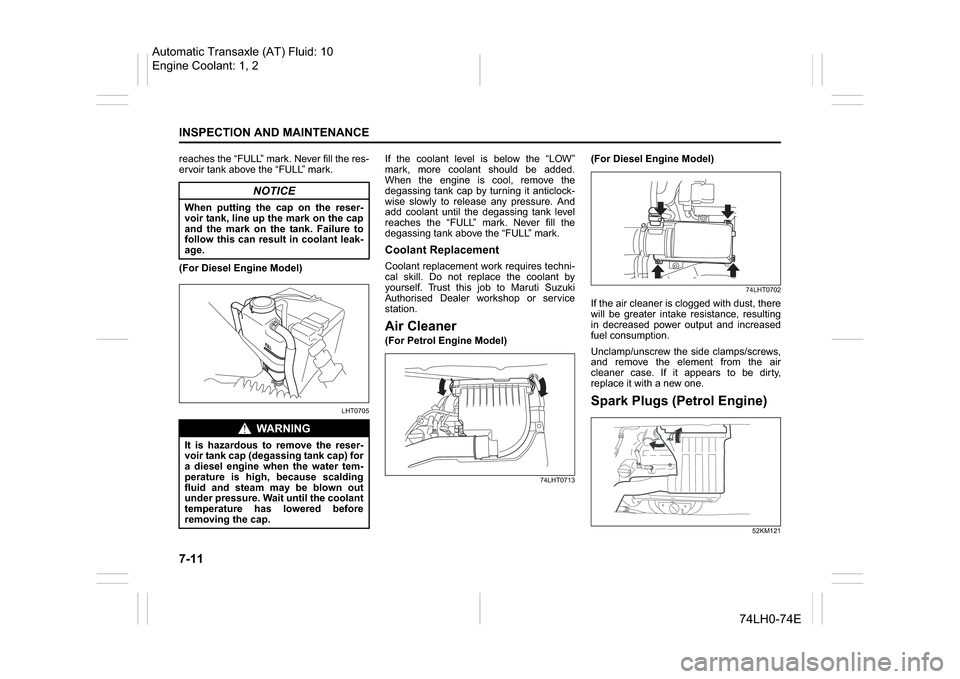
(For Diesel Engine Model)
LHT0705
If the coolant level is below the “LOW”
mark, more coolant should be added.
When the engine is cool, remove the
degassing tank cap by turning it anticlock-
wise slowly to release any pressure. And
add coolant until the degassing tank level
reaches the “FULL” mark. Never fill the
degassing tank above the “FULL” mark.Coolant ReplacementCoolant replacement work requires techni-
cal skill. Do not replace the coolant by
yourself. Trust this job to Maruti Suzuki
Authorised Dealer workshop or service
station.Air Cleaner(For Petrol Engine Model)
74LHT0713
(For Diesel Engine Model)
74LHT0702
If the air cleaner is clogged with dust, there
will be greater intake resistance, resulting
in decreased power output and increased
fuel consumption.
Unclamp/unscrew the side clamps/screws,
and remove the element from the air
cleaner case. If it appears to be dirty,
replace it with a new one.Spark Plugs (Petrol Engine)
52KM121
NOTICE
When putting the cap on the reser-
voir tank, line up the mark on the cap
and the mark on the tank. Failure to
follow this can result in coolant leak-
age.
WA R N I N G
It is hazardous to remove the reser-
voir tank cap (degassing tank cap) for
a diesel engine when the water tem-
perature is high, because scalding
fluid and steam may be blown out
under pressure. Wait until the coolant
temperature has lowered before
removing the cap.
Automatic Transaxle (AT) Fluid: 10
Engine Coolant: 1, 2
Page 203 of 336
7-12
INSPECTION AND MAINTENANCE
74LH0-74E
52KM122
For nickel spark plugs (traditional
type):You should inspect spark plugs periodically
for carbon deposits. When carbon accu-
mulates on a spark plug, a strong spark
may not be produced. Remove carbon
deposits with a wire or pin and adjust the
spark plug gap.
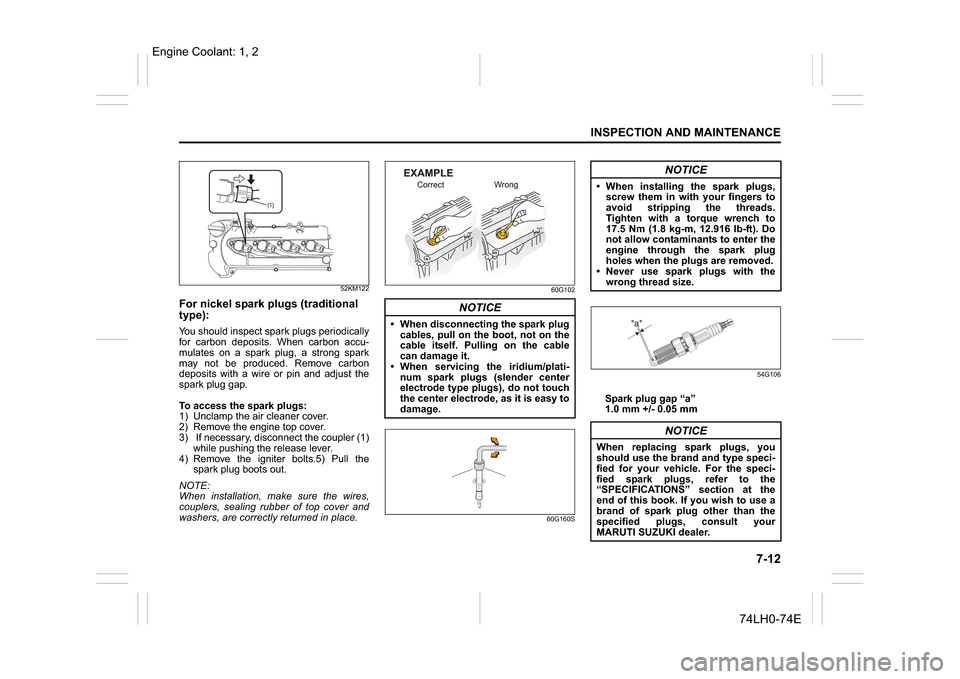
To access the spark plugs:
1) Unclamp the air cleaner cover.
2) Remove the engine top cover.
3) If necessary, disconnect the coupler (1)
while pushing the release lever.
4) Remove the igniter bolts.5) Pull the
spark plug boots out.
NOTE:
When installation, make sure the wires,
couplers, sealing rubber of top cover and
washers, are correctly returned in place.
60G102
60G160S54G106
Spark plug gap “a”
1.0 mm +/- 0.05 mm
NOTICE
When disconnecting the spark plug
cables, pull on the boot, not on the
cable itself. Pulling on the cable
can damage it.
When servicing the iridium/plati-
num spark plugs (slender center
electrode type plugs), do not touch
the center electrode, as it is easy to
damage.
NOTICE
When installing the spark plugs,
screw them in with your fingers to
avoid stripping the threads.
Tighten with a torque wrench to
17.5 Nm (1.8 kg-m, 12.916 lb-ft). Do
not allow contaminants to enter the
engine through the spark plug
holes when the plugs are removed.
Never use spark plugs with the
wrong thread size.
NOTICE
When replacing spark plugs, you
should use the brand and type speci-
fied for your vehicle. For the speci-
fied spark plugs, refer to the
“SPECIFICATIONS” section at the
end of this book. If you wish to use a
brand of spark plug other than the
specified plugs, consult your
MARUTI SUZUKI dealer.
Engine Coolant: 1, 2
Page 204 of 336
7-13INSPECTION AND MAINTENANCE
74LH0-74E
60D204
NOTE:
If your engine is equipped with the high
tension cord type ignition wiring and you
experience some firing problem of spark
plugs, such as, hard engine-starting, mis-
fire etc., the cause may be located not only
on spark plugs but also on deteriorated
ignition wirings (generally, used for more
than 80,000 km or five years). If spark plug
replacement does not solve the problem,
have the ignition wiring and other ignition
system inspected by your MARUTI
SUZUKI dealer.Gear OilManual Transaxle Oil / Auto Gear
Shift OilWhen adding gear oil, use gear oil with the
appropriate viscosity and grade.
We highly recommend you use:
"MARUTI SUZUKI GEAR OIL 75W-80" for
manual transaxle gear oil or Auto Gear
Shift Oil.
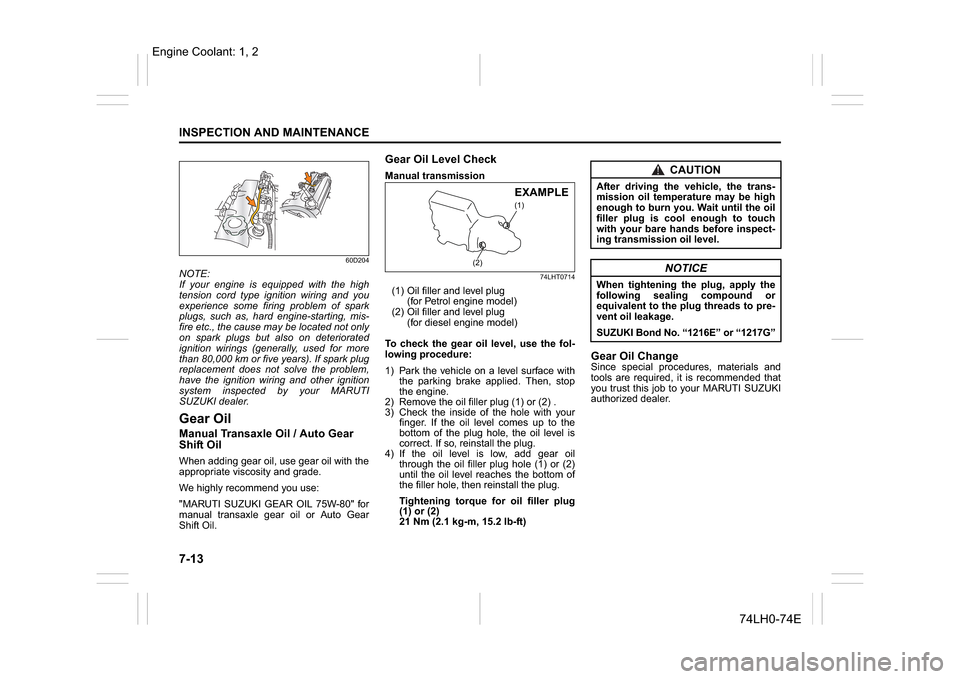
Gear Oil Level CheckManual transmission
74LHT0714
(1) Oil filler and level plug
(for Petrol engine model)
(2) Oil filler and level plug
(for diesel engine model)
To check the gear oil level, use the fol-
lowing procedure:
1) Park the vehicle on a level surface with
the parking brake applied. Then, stop
the engine.
2) Remove the oil filler plug (1) or (2) .
3) Check the inside of the hole with your
finger. If the oil level comes up to the
bottom of the plug hole, the oil level is
correct. If so, reinstall the plug.
4) If the oil level is low, add gear oil
through the oil filler plug hole (1) or (2)
until the oil level reaches the bottom of
the filler hole, then reinstall the plug.
Tightening torque for oil filler plug
(1) or (2)
21 Nm (2.1 kg-m, 15.2 lb-ft)
Gear Oil ChangeSince special procedures, materials and
tools are required, it is recommended that
you trust this job to your MARUTI SUZUKI
authorized dealer.
(1)
(2)
EXAMPLE
CAUTION
After driving the vehicle, the trans-
mission oil temperature may be high
enough to burn you. Wait until the oil
filler plug is cool enough to touch
with your bare hands before inspect-
ing transmission oil level.
NOTICE
When tightening the plug, apply the
following sealing compound or
equivalent to the plug threads to pre-
vent oil leakage.
SUZUKI Bond No. “1216E” or “1217G”
Engine Coolant: 1, 2
Page 205 of 336
7-14
INSPECTION AND MAINTENANCE
74LH0-74E
Clutch Pedal
Cable Control Clutch (For Petrol
Engine Model)
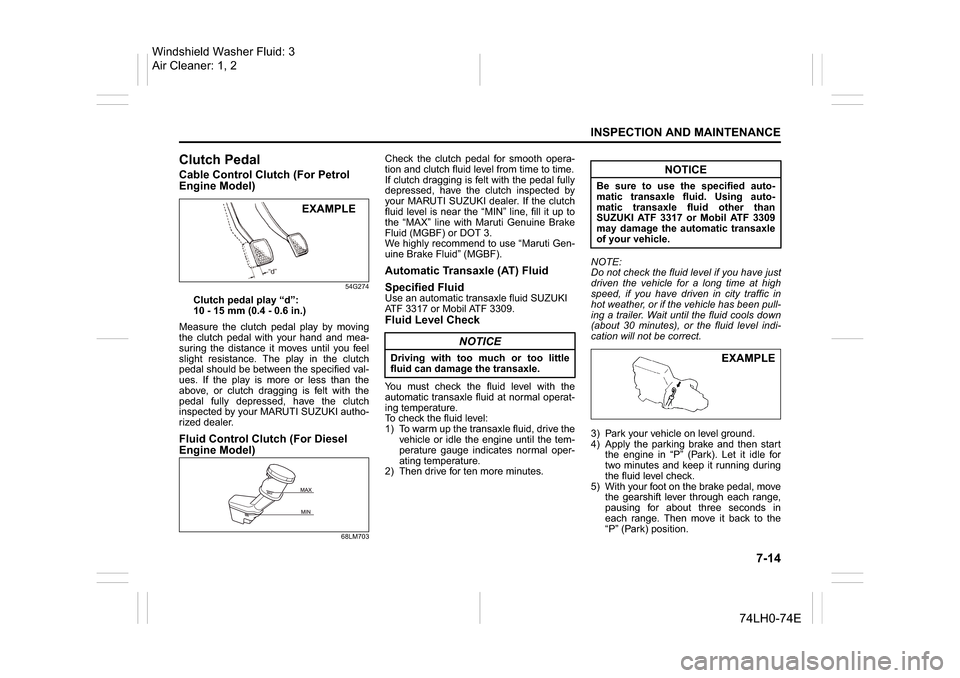
54G274
Clutch pedal play “d”:
10 - 15 mm (0.4 - 0.6 in.)
Measure the clutch pedal play by moving
the clutch pedal with your hand and mea-
suring the distance it moves until you feel
slight resistance. The play in the clutch
pedal should be between the specified val-
ues. If the play is more or less than the
above, or clutch dragging is felt with the
pedal fully depressed, have the clutch
inspected by your MARUTI SUZUKI autho-
rized dealer.
Fluid Control Clutch (For Diesel
Engine Model)
68LM703
Check the clutch pedal for smooth opera-
tion and clutch fluid level from time to time.
If clutch dragging is felt with the pedal fully
depressed, have the clutch inspected by
your MARUTI SUZUKI dealer. If the clutch
fluid level is near the “MIN” line, fill it up to
the “MAX” line with Maruti Genuine Brake
Fluid (MGBF) or DOT 3.
We highly recommend to use “Maruti Gen-
uine Brake Fluid” (MGBF).
Automatic Transaxle (AT) Fluid
Specified Fluid
Use an automatic transaxle fluid SUZUKI
ATF 3317 or Mobil ATF 3309.
Fluid Level Check
You must check the fluid level with the
automatic transaxle fluid at normal operat-
ing temperature.
To check the fluid level:
1) To warm up the transaxle fluid, drive the
vehicle or idle the engine until the tem-
perature gauge indicates normal oper-
ating temperature.
2) Then drive for ten more minutes.NOTE:
Do not check the fluid level if you have just
driven the vehicle for a long time at high
speed, if you have driven in city traffic in
hot weather, or if the vehicle has been pull-
ing a trailer. Wait until the fluid cools down
(about 30 minutes), or the fluid level indi-
cation will not be correct.
3) Park your vehicle on level ground.
4) Apply the parking brake and then start
the engine in “P” (Park). Let it idle for
two minutes and keep it running during
the fluid level check.
5) With your foot on the brake pedal, move
the gearshift lever through each range,
pausing for about three seconds in
each range. Then move it back to the
“P” (Park) position.
EXAMPLE
NOTICE
Driving with too much or too little
fluid can damage the transaxle.
NOTICE
Be sure to use the specified auto-
matic transaxle fluid. Using auto-
matic transaxle fluid other than
SUZUKI ATF 3317 or Mobil ATF 3309
may damage the automatic transaxle
of your vehicle.
EXAMPLE
Windshield Washer Fluid: 3
Air Cleaner: 1, 2
Page 206 of 336
7-15
INSPECTION AND MAINTENANCE
74LH0-74E
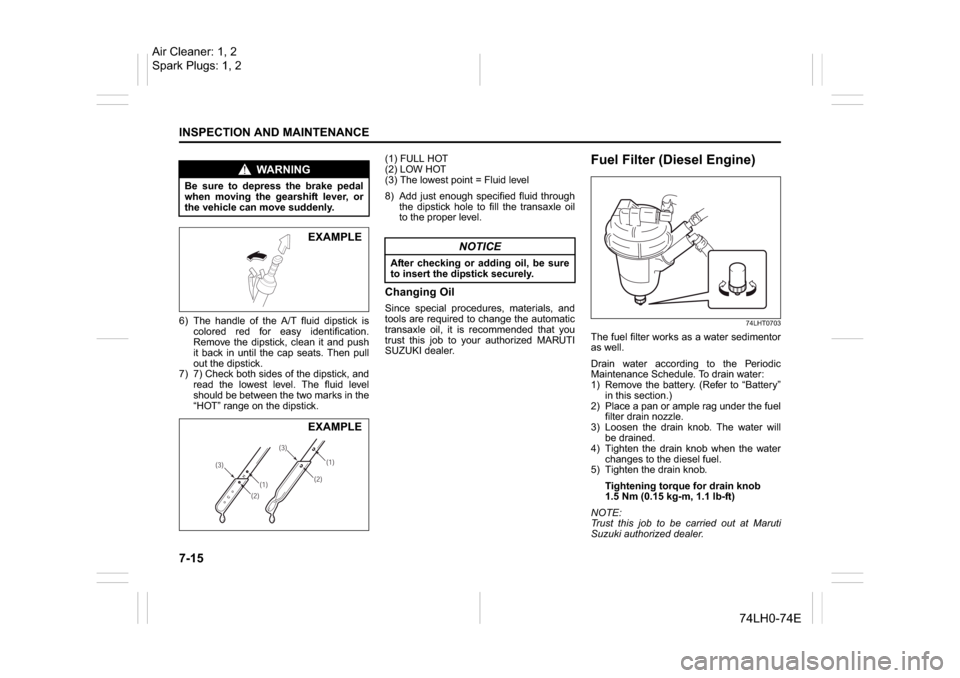
6) The handle of the A/T fluid dipstick is
colored red for easy identification.
Remove the dipstick, clean it and push
it back in until the cap seats. Then pull
out the dipstick.
7) 7) Check both sides of the dipstick, and
read the lowest level. The fluid level
should be between the two marks in the
“HOT” range on the dipstick.(1) FULL HOT
(2) LOW HOT
(3) The lowest point = Fluid level
8) Add just enough specified fluid through
the dipstick hole to fill the transaxle oil
to the proper level.
Changing Oil
Since special procedures, materials, and
tools are required to change the automatic
transaxle oil, it is recommended that you
trust this job to your authorized MARUTI
SUZUKI dealer.
Fuel Filter (Diesel Engine)
74LHT0703
The fuel filter works as a water sedimentor
as well.
Drain water according to the Periodic
Maintenance Schedule. To drain water:
1) Remove the battery. (Refer to “Battery”
in this section.)
2) Place a pan or ample rag under the fuel
filter drain nozzle.
3) Loosen the drain knob. The water will
be drained.
4) Tighten the drain knob when the water
changes to the diesel fuel.
5) Tighten the drain knob.
Tightening torque for drain knob
1.5 Nm (0.15 kg-m, 1.1 lb-ft)
NOTE:
Trust this job to be carried out at Maruti
Suzuki authorized dealer.
WA R N I N G
Be sure to depress the brake pedal
when moving the gearshift lever, or
the vehicle can move suddenly.
EXAMPLE
(1)(2) (3)(1)
(2)(3)
EXAMPLE
NOTICE
After checking or adding oil, be sure
to insert the dipstick securely.
Air Cleaner: 1, 2
Spark Plugs: 1, 2
Page 210 of 336
7-19INSPECTION AND MAINTENANCE
74LH0-74E
Tire Rotation
60G-09-019E
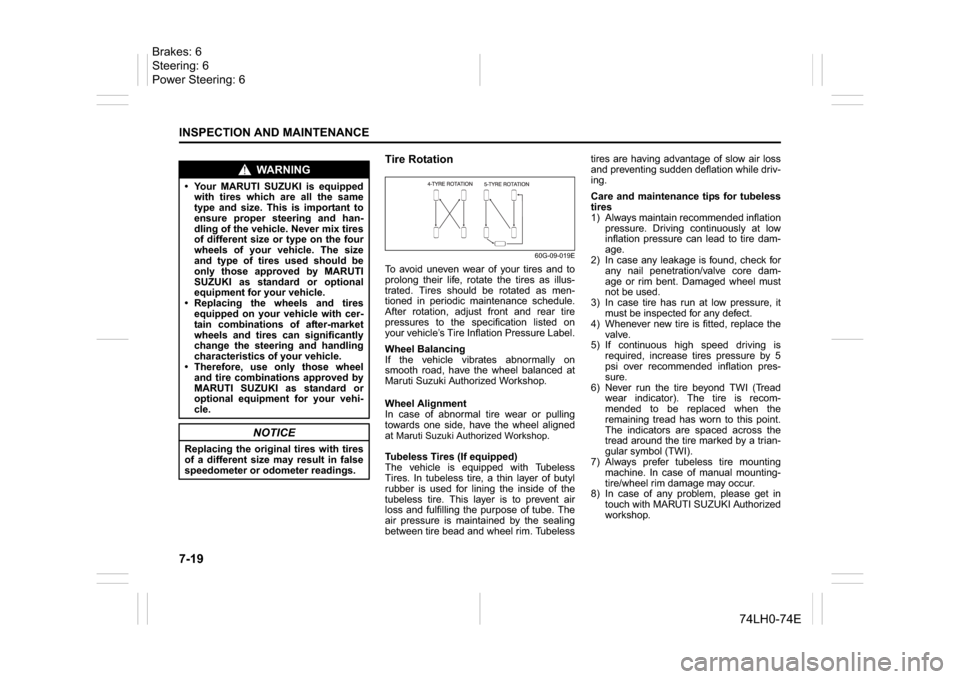
To avoid uneven wear of your tires and to
prolong their life, rotate the tires as illus-
trated. Tires should be rotated as men-
tioned in periodic maintenance schedule.
After rotation, adjust front and rear tire
pressures to the specification listed on
your vehicle’s Tire Inflation Pressure Label.
Wheel Balancing
If the vehicle vibrates abnormally on
smooth road, have the wheel balanced at
Maruti Suzuki Authorized Workshop.
Wheel Alignment
In case of abnormal tire wear or pulling
towards one side, have the wheel aligned
at Maruti Suzuki Authorized Workshop.Tubeless Tires (If equipped)
The vehicle is equipped with Tubeless
Tires. In tubeless tire, a thin layer of butyl
rubber is used for lining the inside of the
tubeless tire. This layer is to prevent air
loss and fulfilling the purpose of tube. The
air pressure is maintained by the sealing
between tire bead and wheel rim. Tubelesstires are having advantage of slow air loss
and preventing sudden deflation while driv-
ing.
Care and maintenance tips for tubeless
tires
1) Always maintain recommended inflation
pressure. Driving continuously at low
inflation pressure can lead to tire dam-
age.
2) In case any leakage is found, check for
any nail penetration/valve core dam-
age or rim bent. Damaged wheel must
not be used.
3) In case tire has run at low pressure, it
must be inspected for any defect.
4) Whenever new tire is fitted, replace the
valve.
5) If continuous high speed driving is
required, increase tires pressure by 5
psi over recommended inflation pres-
sure.
6) Never run the tire beyond TWI (Tread
wear indicator). The tire is recom-
mended to be replaced when the
remaining tread has worn to this point.
The indicators are spaced across the
tread around the tire marked by a trian-
gular symbol (TWI).
7) Always prefer tubeless tire mounting
machine. In case of manual mounting-
tire/wheel rim damage may occur.
8) In case of any problem, please get in
touch with MARUTI SUZUKI Authorized
workshop.
WA R N I N G
Your MARUTI SUZUKI is equipped
with tires which are all the same
type and size. This is important to
ensure proper steering and han-
dling of the vehicle. Never mix tires
of different size or type on the four
wheels of your vehicle. The size
and type of tires used should be
only those approved by MARUTI
SUZUKI as standard or optional
equipment for your vehicle.
Replacing the wheels and tires
equipped on your vehicle with cer-
tain combinations of after-market
wheels and tires can significantly
change the steering and handling
characteristics of your vehicle.
Therefore, use only those wheel
and tire combinations approved by
MARUTI SUZUKI as standard or
optional equipment for your vehi-
cle.
NOTICE
Replacing the original tires with tires
of a different size may result in false
speedometer or odometer readings.
Brakes: 6
Steering: 6
Power Steering: 6
Page 212 of 336
7-21INSPECTION AND MAINTENANCE
74LH0-74E
Diesel
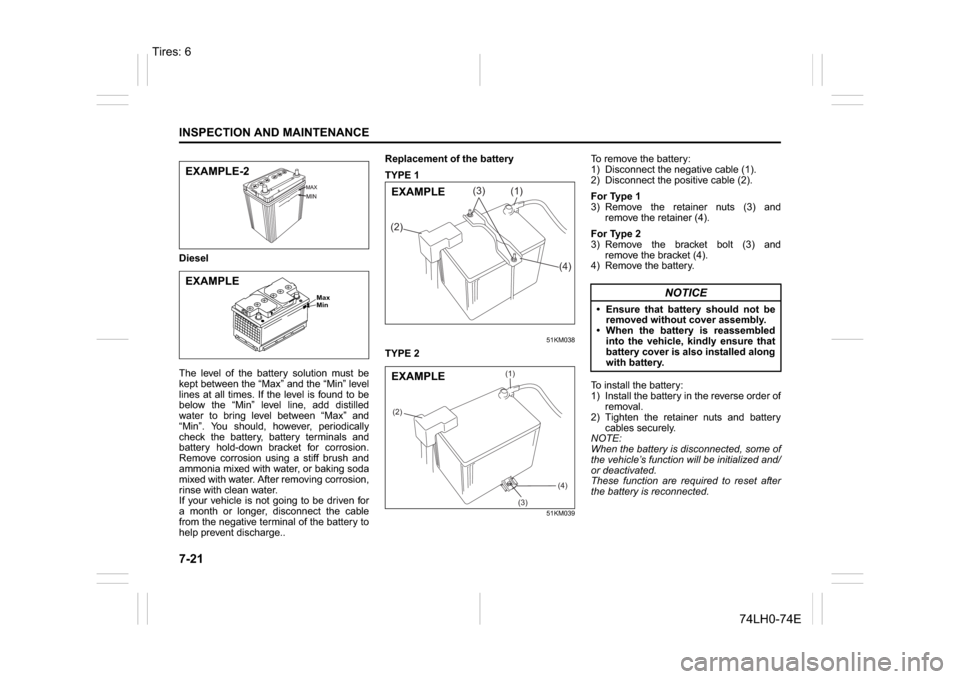
The level of the battery solution must be
kept between the “Max” and the “Min” level
lines at all times. If the level is found to be
below the “Min” level line, add distilled
water to bring level between “Max” and
“Min”. You should, however, periodically
check the battery, battery terminals and
battery hold-down bracket for corrosion.
Remove corrosion using a stiff brush and
ammonia mixed with water, or baking soda
mixed with water. After removing corrosion,
rinse with clean water.
If your vehicle is not going to be driven for
a month or longer, disconnect the cable
from the negative terminal of the battery to
help prevent discharge..Replacement of the battery
TYPE 1
51KM038
TYPE 2
51KM039
To remove the battery:
1) Disconnect the negative cable (1).
2) Disconnect the positive cable (2).
For Type 1
3) Remove the retainer nuts (3) and
remove the retainer (4).
For Type 2
3) Remove the bracket bolt (3) and
remove the bracket (4).
4) Remove the battery.
To install the battery:
1) Install the battery in the reverse order of
removal.
2) Tighten the retainer nuts and battery
cables securely.
NOTE:
When the battery is disconnected, some of
the vehicle’s function will be initialized and/
or deactivated.
These function are required to reset after
the battery is reconnected.
EXAMPLE-2
Max
Min
EXAMPLE
(1)
(2)
(3)
(4)
EXAMPLE
(1)
(2)
(3)
(4)
EXAMPLE
NOTICE
Ensure that battery should not be
removed without cover assembly.
When the battery is reassembled
into the vehicle, kindly ensure that
battery cover is also installed along
with battery.
Tires: 6
Page 215 of 336
7-24
INSPECTION AND MAINTENANCE
74LH0-74E
81A283
Bulb Replacement
(16) – Blank
(17) 15 A Horn
(18) 10 A Stop light
(19) 10 A Air bag
(20) 10 A Back-up light
(21) 15 A Rear wiper / Washer
(22) 25 A Front wiper
(23) 7.5 A Dome light
(24) – Blank
(25) 7.5 A RR fog lamp
(26) – Blank
(27) 7.5 A Ignition-1 signal
(28) 15 A Radio 2
(29) – Blank
(30) 15 A Radio
(31) 10 A Tail lamp
(32) 20 A D/L
(33) – Blank
(34) 10 A Meter
(35) 7.5 A Ignition-2 signal
(36) – Blank
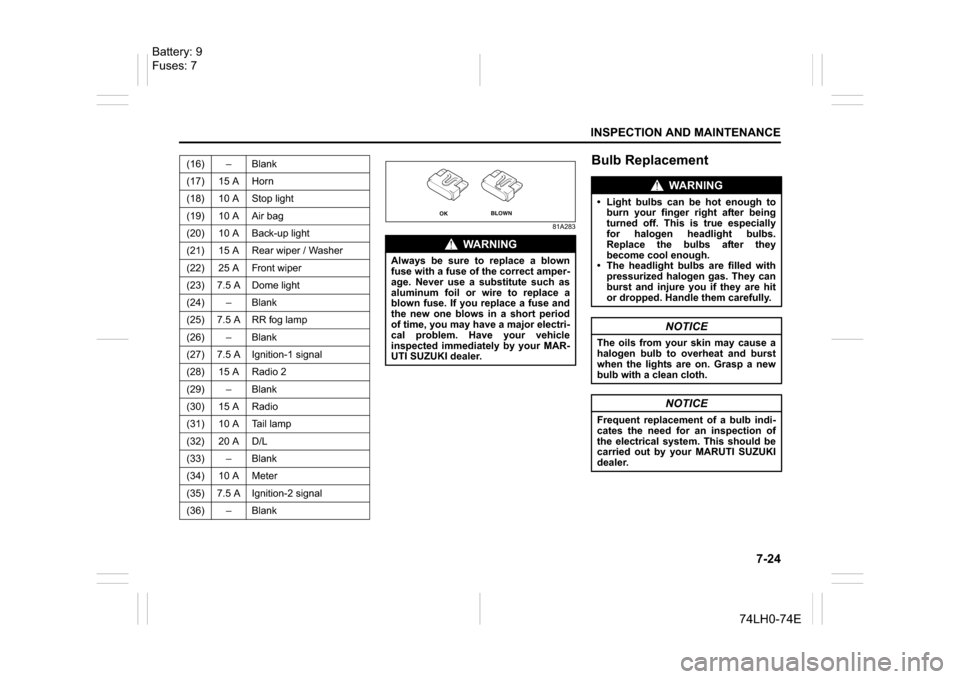
WA R N I N G
Always be sure to replace a blown
fuse with a fuse of the correct amper-
age. Never use a substitute such as
aluminum foil or wire to replace a
blown fuse. If you replace a fuse and
the new one blows in a short period
of time, you may have a major electri-
cal problem. Have your vehicle
inspected immediately by your MAR-
UTI SUZUKI dealer.
OK
BLOWN
WA R N I N G
Light bulbs can be hot enough to
burn your finger right after being
turned off. This is true especially
for halogen headlight bulbs.
Replace the bulbs after they
become cool enough.
The headlight bulbs are filled with
pressurized halogen gas. They can
burst and injure you if they are hit
or dropped. Handle them carefully.
NOTICE
The oils from your skin may cause a
halogen bulb to overheat and burst
when the lights are on. Grasp a new
bulb with a clean cloth.
NOTICE
Frequent replacement of a bulb indi-
cates the need for an inspection of
the electrical system. This should be
carried out by your MARUTI SUZUKI
dealer.
Battery: 9
Fuses: 7
Page 219 of 336
7-28
INSPECTION AND MAINTENANCE
74LH0-74E
63J127
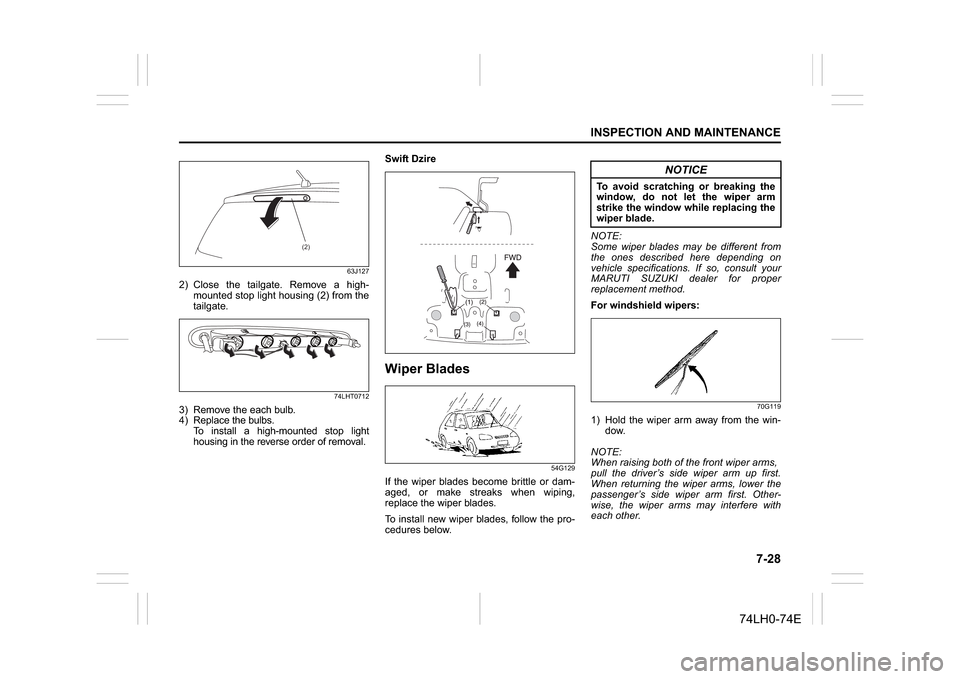
2) Close the tailgate. Remove a high-
mounted stop light housing (2) from the
tailgate.
74LHT0712
3) Remove the each bulb.
4) Replace the bulbs.
To install a high-mounted stop light
housing in the reverse order of removal.Swift Dzire
Wiper Blades
54G129
If the wiper blades become brittle or dam-
aged, or make streaks when wiping,
replace the wiper blades.
To install new wiper blades, follow the pro-
cedures below.NOTE:
Some wiper blades may be different from
the ones described here depending on
vehicle specifications. If so, consult your
MARUTI SUZUKI dealer for proper
replacement method.
For windshield wipers:
70G119
1) Hold the wiper arm away from the win-
dow.
NOTE:
When raising both of the front wiper arms,
pull the driver’s side wiper arm up first.
When returning the wiper arms, lower the
passenger’s side wiper arm first. Other-
wise, the wiper arms may interfere with
each other.
(2)
NOTICE
To avoid scratching or breaking the
window, do not let the wiper arm
strike the window while replacing the
wiper blade.
Page 221 of 336
7-30
INSPECTION AND MAINTENANCE
74LH0-74E
NOTE:
Do not flex the wiper blade frame end more
than necessary. If you do, it can break off.
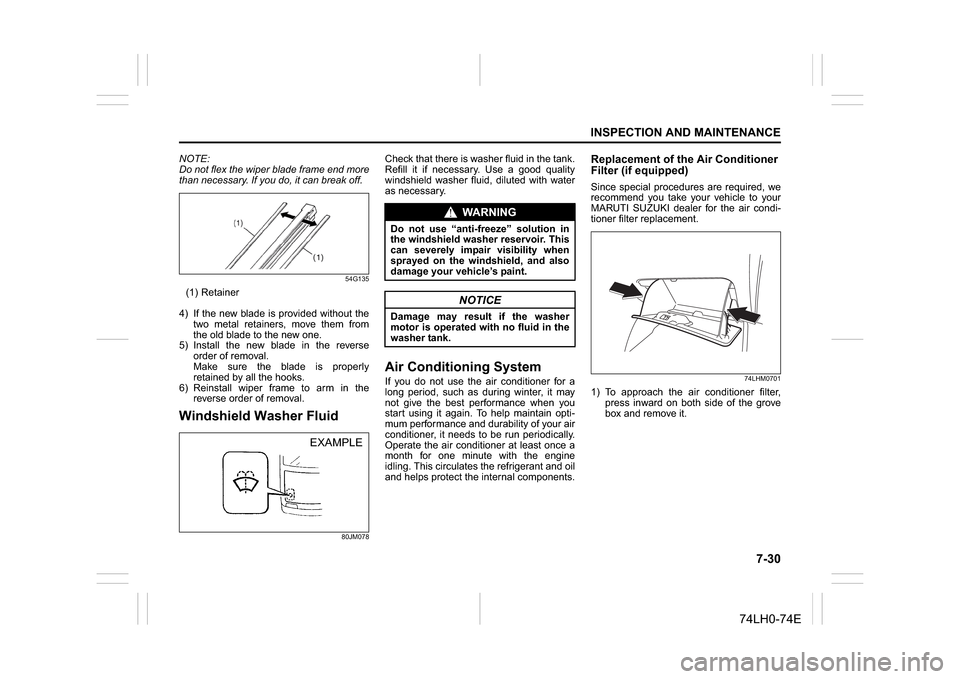
54G135
(1) Retainer
4) If the new blade is provided without the
two metal retainers, move them from
the old blade to the new one.
5) Install the new blade in the reverse
order of removal.
Make sure the blade is properly
retained by all the hooks.
6) Reinstall wiper frame to arm in the
reverse order of removal.Windshield Washer Fluid
80JM078
Check that there is washer fluid in the tank.
Refill it if necessary. Use a good quality
windshield washer fluid, diluted with water
as necessary.Air Conditioning SystemIf you do not use the air conditioner for a
long period, such as during winter, it may
not give the best performance when you
start using it again. To help maintain opti-
mum performance and durability of your air
conditioner, it needs to be run periodically.
Operate the air conditioner at least once a
month for one minute with the engine
idling. This circulates the refrigerant and oil
and helps protect the internal components.
Replacement of the Air Conditioner
Filter (if equipped)Since special procedures are required, we
recommend you take your vehicle to your
MARUTI SUZUKI dealer for the air condi-
tioner filter replacement.
74LHM0701
1) To approach the air conditioner filter,
press inward on both side of the grove
box and remove it.
EXAMPLE
WA R N I N G
Do not use “anti-freeze” solution in
the windshield washer reservoir. This
can severely impair visibility when
sprayed on the windshield, and also
damage your vehicle’s paint.
NOTICE
Damage may result if the washer
motor is operated with no fluid in the
washer tank.