Notice SUZUKI SWIFT 2017 5.G Owner's Manual
[x] Cancel search | Manufacturer: SUZUKI, Model Year: 2017, Model line: SWIFT, Model: SUZUKI SWIFT 2017 5.GPages: 336, PDF Size: 6.24 MB
Page 90 of 336
3-5OPERATING YOUR VEHICLE
74LH0-74E
Manual transaxle – Provided you have the
keyless push start system remote control-
ler with you, the engine automatically
starts when you press the engine switch to
select this ignition mode after shifting to
“N” (Neutral) and depressing the brake and
clutch pedals.
Auto Gear Shift – Provided you have the
keyless push start system remote control-
ler with you, the engine automatically
starts when you press the engine switch to
select this ignition mode after placing the
gearshift lever in the “N” position and
depressing the brake pedal.
NOTE:
You do not need to keep the engine switch
pressed to start the engine.
NOTE:
The steering lock may not be released if
some load is acting on the steering
wheel. If this happens, turn the steering
wheel to the right or left to relieve it from
the load before you press the engineswitch again to change to the desired
ignition mode.
In the presence of strong radio signals or
noise, you may not be able to change
the ignition mode to “ACC” or “ON” or to
start the engine using the engine switch.
Keyless Push Start System
(if equipped)Provided the keyless push start system
remote controller is within the “interior work-
able area” (refer to the related explanation
in this section), you can use the engine
switch for starting the engine and selecting
an ignition mode (“ACC” or “ON”). In addi-
tion, the following functions can be used: Keyless entry function. Refer to “Keyless
Push Start System Remote Controller” in the
“BEFORE DRIVING” section for details. Locking and unlocking doors using a
request switch. Refer to “Keyless Push
Start System Remote Controller” in the
“BEFORE DRIVING” section for details.
Immobilizer (anti-theft) function. Refer to
“Immobilizer System” in the “BEFORE
DRIVING” section for details.
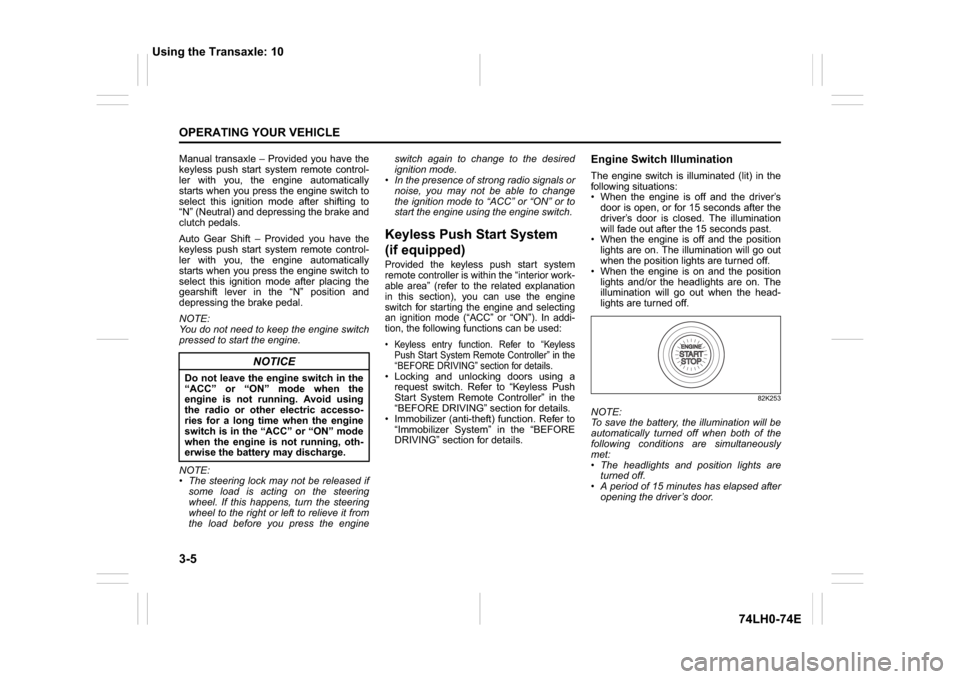
Engine Switch IlluminationThe engine switch is illuminated (lit) in the
following situations:
When the engine is off and the driver’s
door is open, or for 15 seconds after the
driver’s door is closed. The illumination
will fade out after the 15 seconds past.
When the engine is off and the position
lights are on. The illumination will go out
when the position lights are turned off.
When the engine is on and the position
lights and/or the headlights are on. The
illumination will go out when the head-
lights are turned off.
82K253
NOTE:
To save the battery, the illumination will be
automatically turned off when both of the
following conditions are simultaneously
met:
The headlights and position lights are
turned off.
A period of 15 minutes has elapsed after
opening the driver’s door.
NOTICE
Do not leave the engine switch in the
“ACC” or “ON” mode when the
engine is not running. Avoid using
the radio or other electric accesso-
ries for a long time when the engine
switch is in the “ACC” or “ON” mode
when the engine is not running, oth-
erwise the battery may discharge.
Using the Transaxle: 10
Page 94 of 336
3-9OPERATING YOUR VEHICLE
74LH0-74E
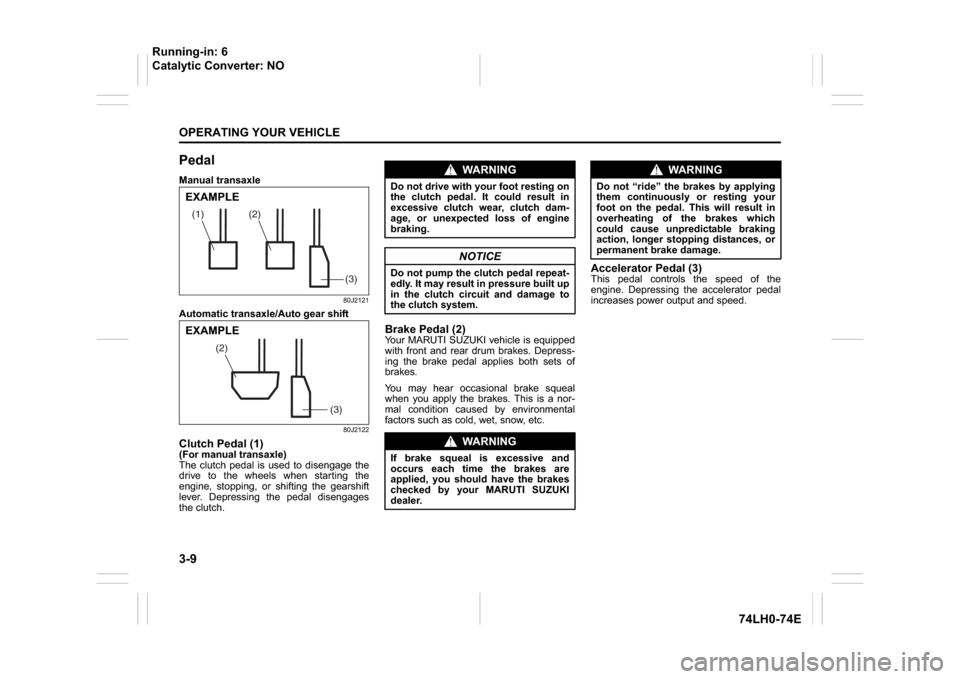
PedalManual transaxle
80J2121
Automatic transaxle/Auto gear shift
80J2122
Clutch Pedal (1)(For manual transaxle)
The clutch pedal is used to disengage the
drive to the wheels when starting the
engine, stopping, or shifting the gearshift
lever. Depressing the pedal disengages
the clutch.
Brake Pedal (2)Your MARUTI SUZUKI vehicle is equipped
with front and rear drum brakes. Depress-
ing the brake pedal applies both sets of
brakes.
You may hear occasional brake squeal
when you apply the brakes. This is a nor-
mal condition caused by environmental
factors such as cold, wet, snow, etc.
Accelerator Pedal (3)This pedal controls the speed of the
engine. Depressing the accelerator pedal
increases power output and speed.
(2)
(1)
(3)EXAMPLE
(3)
(2)
EXAMPLE
WA R N I N G
Do not drive with your foot resting on
the clutch pedal. It could result in
excessive clutch wear, clutch dam-
age, or unexpected loss of engine
braking.
NOTICE
Do not pump the clutch pedal repeat-
edly. It may result in pressure built up
in the clutch circuit and damage to
the clutch system.
WA R N I N G
If brake squeal is excessive and
occurs each time the brakes are
applied, you should have the brakes
checked by your MARUTI SUZUKI
dealer.
WA R N I N G
Do not “ride” the brakes by applying
them continuously or resting your
foot on the pedal. This will result in
overheating of the brakes which
could cause unpredictable braking
action, longer stopping distances, or
permanent brake damage.
Running-in: 6
Catalytic Converter: NO
Page 95 of 336
3-10
OPERATING YOUR VEHICLE
74LH0-74E
Starting the Engine
(Vehicle without Keyless
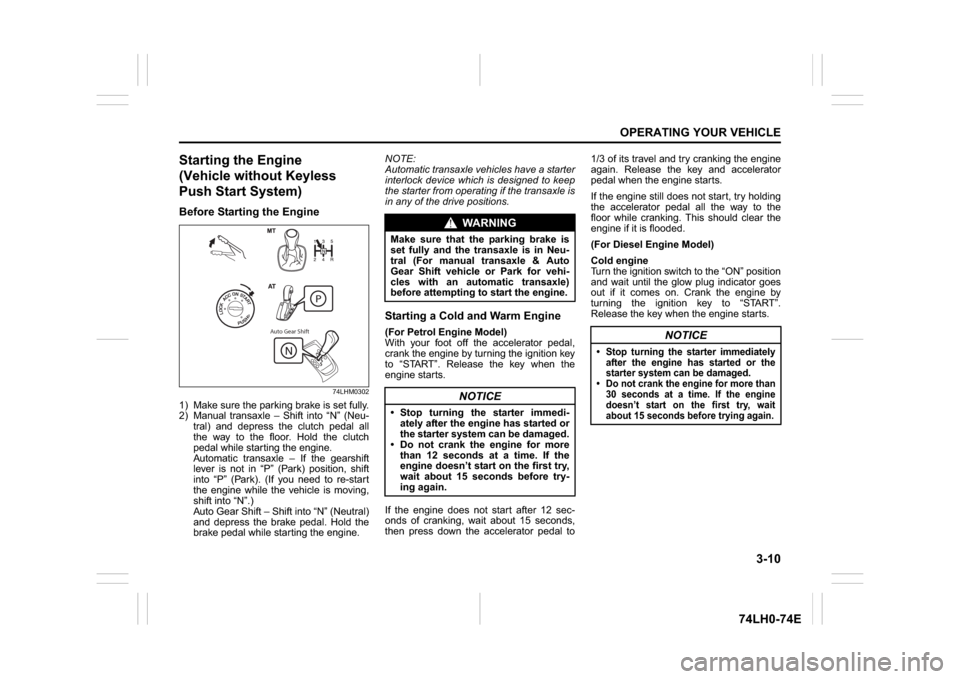
Push Start System)Before Starting the Engine
74LHM0302
1) Make sure the parking brake is set fully.
2) Manual transaxle – Shift into “N” (Neu-
tral) and depress the clutch pedal all
the way to the floor. Hold the clutch
pedal while starting the engine.
Automatic transaxle – If the gearshift
lever is not in “P” (Park) position, shift
into “P” (Park). (If you need to re-start
the engine while the vehicle is moving,
shift into “N”.)
Auto Gear Shift – Shift into “N” (Neutral)
and depress the brake pedal. Hold the
brake pedal while starting the engine.NOTE:
Automatic transaxle vehicles have a starter
interlock device which is designed to keep
the starter from operating if the transaxle is
in any of the drive positions.
Starting a Cold and Warm Engine(For Petrol Engine Model)
With your foot off the accelerator pedal,
crank the engine by turning the ignition key
to “START”. Release the key when the
engine starts.
If the engine does not start after 12 sec-
onds of cranking, wait about 15 seconds,
then press down the accelerator pedal to1/3 of its travel and try cranking the engine
again. Release the key and accelerator
pedal when the engine starts.
If the engine still does not start, try holding
the accelerator pedal all the way to the
floor while cranking. This should clear the
engine if it is flooded.
(For Diesel Engine Model)
Cold engine
Turn the ignition switch to the “ON” position
and wait until the glow plug indicator goes
out if it comes on. Crank the engine by
turning the ignition key to “START”.
Release the key when the engine starts.
Auto Gear Shift
WA R N I N G
Make sure that the parking brake is
set fully and the transaxle is in Neu-
tral (For manual transaxle & Auto
Gear Shift vehicle or Park for vehi-
cles with an automatic transaxle)
before attempting to start the engine.
NOTICE
Stop turning the starter immedi-
ately after the engine has started or
the starter system can be damaged.
Do not crank the engine for more
than 12 seconds at a time. If the
engine doesn’t start on the first try,
wait about 15 seconds before try-
ing again.
NOTICE
Stop turning the starter immediately
after the engine has started or the
starter system can be damaged. Do not crank the engine for more than
30 seconds at a time. If the engine
doesn’t start on the first try, wait
about 15 seconds before trying again.
Page 97 of 336
3-12
OPERATING YOUR VEHICLE
74LH0-74E
NOTE:
You do not need to keep the engine
switch pressed to start the engine.
The engine of a manual transaxle vehi-
cle will not start unless the clutch pedal
is depressed.
You should turn off such loads as the
headlights and air conditioning system to
facilitate starting of the engine.
Even if you fail to start the engine, the
starter motor will stop turning automati-
cally after a short time. After the starter
motor has stopped or if there is some
problem with the system, the starter
motor will rotate only while the engine
switch is being pressed.
Stopping the engine Depress the engine switch to stop the
engine after the vehicle stopped com-
pletely.
In case of emergency, you can stop the
engine by quickly pushing the engine
switch more than 3 times, or pushing
and holding the engine switch more than
2 seconds while the vehicle in motion.
NOTE:
Except in emergency, do not stop the
engine while the vehicle in motion.
The steering and braking operation will
require more efforts when the engine
stopped.
Refer to “Braking” in this section.
If the engine has been stopped and
stayed as it as for while after the engine
was stopped unexpectedly or was raced
before stopped, a clicking sound may be
heard from around the engine when
engine restarted. This is not a malfunc-
tion. In this case, always let the engine
idle before stop it.
Starting a Cold and Warm Engine(For Petrol Engine Model)
With your foot off the accelerator pedal,
crank the engine by pressing the engine
switch to change the ignition mode to
“START”.After pressing the engine switch to change the
ignition mode to “START”, the starter cranks
the engine for about 12 seconds before it can
start the engine. If the engine fails to start at
the first attempt, wait about 15 seconds, then
try again while keeping the engine switch
pressed while pressing down the accelerator
pedal to 1/3 of its travel. Release the accelera-
tor pedal when the engine starts.If the engine still does not start, try holding
the accelerator pedal all the way to the
floor while cranking. This should clear the
engine if it is flooded.
If you are unable to start the engine using
this procedure, consult your MARUTI
SUZUKI dealer.
NOTICE
Do not depress the accelerator
during the engine starting proce-
dure. If the engine does not respond
when you try to start it with the
engine switch or if the engine
switch repeats cycling through the
“LOCK”(OFF) - “ACC” - “ON” mode,
the vehicle battery may be dis-
charged. Check the voltage of the
vehicle battery before trying again.
NOTICE
Avoid stopping the engine while driv-
ing.
NOTICE
Do not crank the engine for more
than 12 seconds at a time.
If the engine doesn’t start on the first
try, wait about 15 seconds before try-
ing again.
Page 98 of 336
3-13OPERATING YOUR VEHICLE
74LH0-74E
(For Diesel Engine Model)
Cold engine
Depress the clutch and brake pedals fully
and press the engine switch to crank the
engine. If the glow plug indicator light
comes on, the engine will start automati-
cally after the glow plug indicator light goes
off or 10 seconds past.
Warm engine
Crank the engine by pressing the engine
switch to change the ignition mode to
“START”.
Caution when stopping the engine with
turbocharger
When stopping the engine after climbing or
high speed driving, let the engine idle for
about one minute or more (if it is not pro-
hibited) to cool down the turbocharger and
engine oil. This is to prevent the engine oil
from over-deteriorating. Deteriorated
engine oil will damage the bearings of the
turbocharger.Restarting diesel engine after fuel-
empty stop
If the engine stops and the low fuel warn-
ing light and the malfunction indicator light
come on, use the following procedure:
1) Fill the fuel tank.
2) Press the engine switch to change the
ignition mode to “ON” for 5-10 seconds
to feed fuel.
3) Perform above engine starting proce-
dure to start the engine.
If the malfunction indicator light still comes
on after the engine started, there may be
some problem with the engine. Ask your
MARUTI SUZUKI dealer to have the
engine inspected.
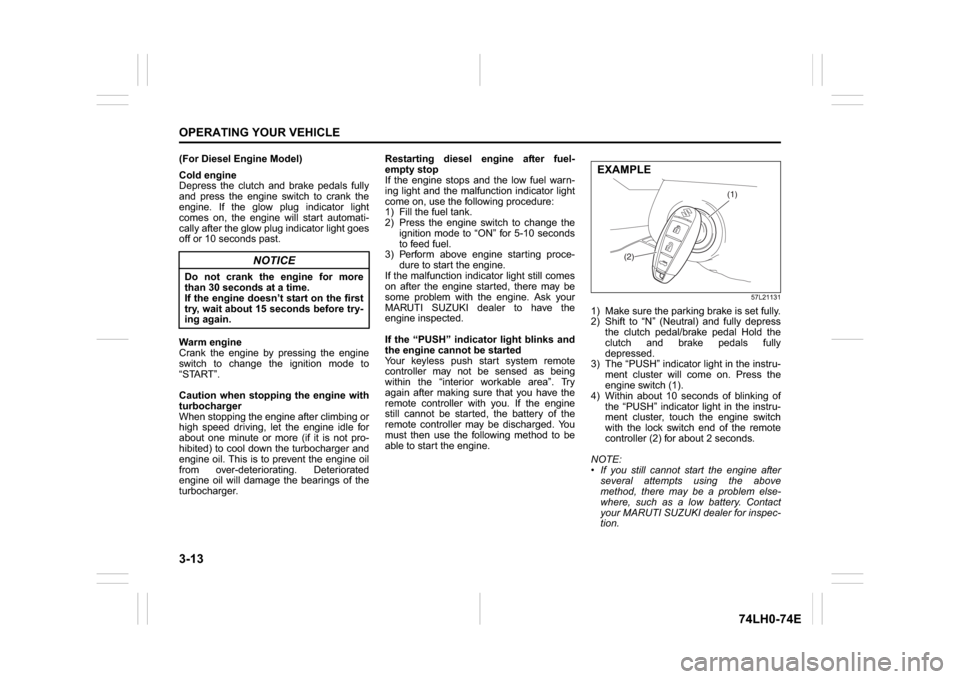
If the “PUSH” indicator light blinks and
the engine cannot be started
Your keyless push start system remote
controller may not be sensed as being
within the “interior workable area”. Try
again after making sure that you have the
remote controller with you. If the engine
still cannot be started, the battery of the
remote controller may be discharged. You
must then use the following method to be
able to start the engine.
57L21131
1) Make sure the parking brake is set fully.
2) Shift to “N” (Neutral) and fully depress
the clutch pedal/brake pedal Hold the
clutch and brake pedals fully
depressed.
3) The “PUSH” indicator light in the instru-
ment cluster will come on. Press the
engine switch (1).
4) Within about 10 seconds of blinking of
the “PUSH” indicator light in the instru-
ment cluster, touch the engine switch
with the lock switch end of the remote
controller (2) for about 2 seconds.
NOTE:
If you still cannot start the engine after
several attempts using the above
method, there may be a problem else-
where, such as a low battery. Contact
your MARUTI SUZUKI dealer for inspec-
tion.
NOTICE
Do not crank the engine for more
than 30 seconds at a time.
If the engine doesn’t start on the first
try, wait about 15 seconds before try-
ing again.
(1)
(2)
EXAMPLE
Page 101 of 336
3-16
OPERATING YOUR VEHICLE
74LH0-74E
R (Reverse) Use this position to reverse the vehicle
from stop. Make sure that vehicle is com-
pletely stationary before shifting into
Reverse. N (Neutral) Use this position for starting the engine if
the engine stalls and you need to restart it
while the vehicle is moving. You may also
shift into Neutral and depress the brake
pedal to hold the vehicle stationary during
idling. D (Drive)Use this position for all normal driving. With
the gearshift lever in “D” range you can get
an automatic downshift by pressing the
accelerator pedal. The higher the vehicle
speed is, the more you need to press the
accelerator pedal to get a downshift. 2 (Low 2) Use this position to provide extra power
when climbing hills, or to provide engine
braking when going down hills. L (Low 1)Use this position to provide maximum-
power when climbing steep hills or driving
through deep snow or mud, or to provide
maximum engine braking when going
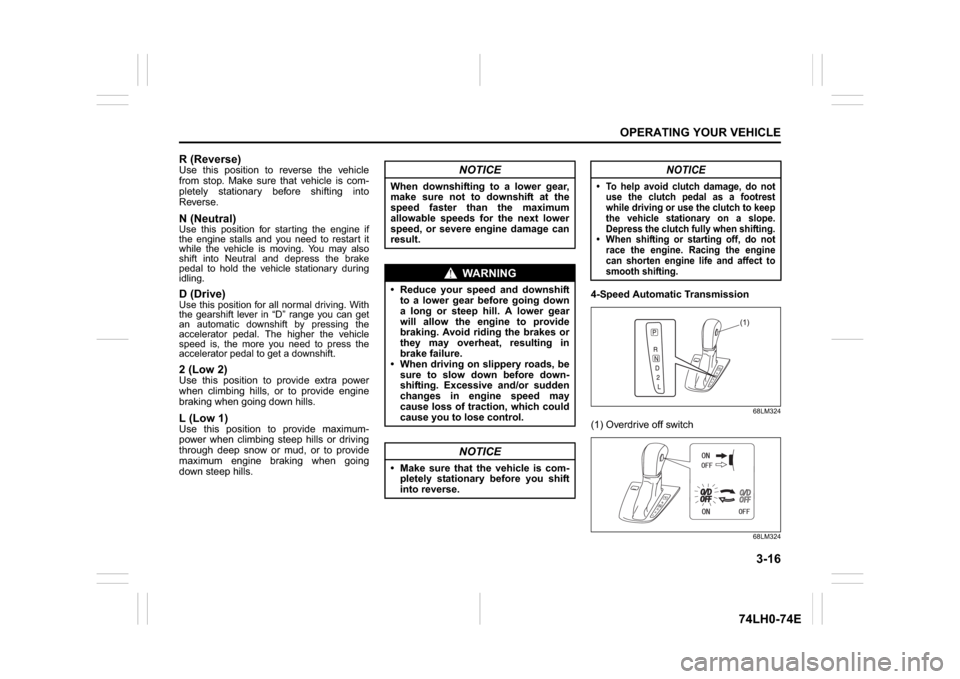
down steep hills.4-Speed Automatic Transmission
68LM324
(1) Overdrive off switch
68LM324
NOTICE
When downshifting to a lower gear,
make sure not to downshift at the
speed faster than the maximum
allowable speeds for the next lower
speed, or severe engine damage can
result.
WA R N I N G
Reduce your speed and downshift
to a lower gear before going down
a long or steep hill. A lower gear
will allow the engine to provide
braking. Avoid riding the brakes or
they may overheat, resulting in
brake failure.
When driving on slippery roads, be
sure to slow down before down-
shifting. Excessive and/or sudden
changes in engine speed may
cause loss of traction, which could
cause you to lose control.
NOTICE
Make sure that the vehicle is com-
pletely stationary before you shift
into reverse.
NOTICE
To help avoid clutch damage, do not
use the clutch pedal as a footrest
while driving or use the clutch to keep
the vehicle stationary on a slope.
Depress the clutch fully when shifting.
When shifting or starting off, do not
race the engine. Racing the engine
can shorten engine life and affect to
smooth shifting.
Page 102 of 336
3-17OPERATING YOUR VEHICLE
74LH0-74E
Overdrive off switchThe transmission is a 4-speed (3-speed
plus overdrive) automatic transmission. By
operating the overdrive off switch, the
transmission can be converted to a 3-
speed automatic transmission that will not
move to the overdrive position. To convert
the transmission to the 3-speed mode,
push in the overdrive off switch and
release it.
To return the transmission to the 4-speed
mode, push in the overdrive off switch
again.
When the ignition switch is turned to the
“ACC” position or the engine switch is
pressed to change the ignition mode to
“ACC”, the transmission in the 3-speed
mode is converted to the 4-speed mode
automatically.]
The 3-speed mode is suitable for the fol-
lowing driving conditions:
Driving on hilly, winding roads
– You can drive more smoothly with less
frequent gear changing
Going down a steep hill
– Some engine braking is provided
NOTE:
If you move the gearshift lever to a lower
gear while driving faster than the maximum
allowable speed for the lower gear, the
transaxle will not actually downshift until
your speed drops below the maximum
speed for the lower gear.
If You Cannot Shift Automatic trans-
mission Gearshift Lever Out of “P”
(PARK)Automatic transmission
Vehicles with an automatic transmission
have an electrically operated parklock fea-
ture. If the vehicle’s battery is discharged,
or there is some other electrical failure, the
automatic transmission cannot be shifted
out of Park in the normal way. Jump start-
ing may correct the condition. If not, follow
the procedure described below. This pro-
cedure will permit shifting the transmission
out of Park.
1) Be sure the parking brake is firmly
applied.
2) If the engine is running, stop the
engine.
3) Make sure the key is in the “ON” or
“ACC” position, or the ignition mode is
“ON” or “ACC”.
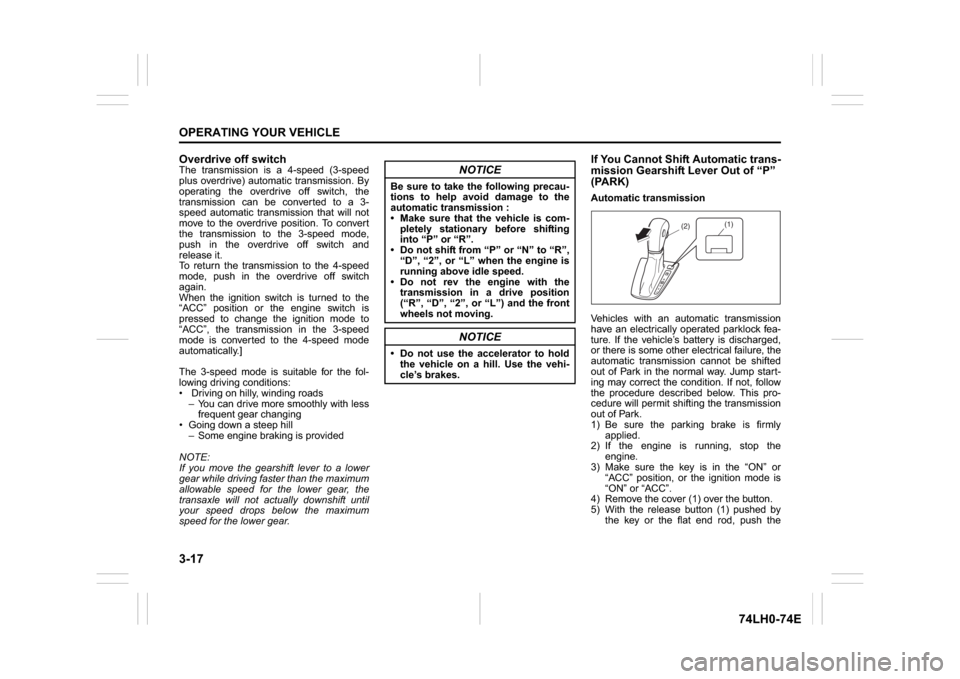
4) Remove the cover (1) over the button.
5) With the release button (1) pushed by
the key or the flat end rod, push the
NOTICE
Be sure to take the following precau-
tions to help avoid damage to the
automatic transmission :
Make sure that the vehicle is com-
pletely stationary before shifting
into “P” or “R”.
Do not shift from “P” or “N” to “R”,
“D”, “2”, or “L” when the engine is
running above idle speed.
Do not rev the engine with the
transmission in a drive position
(“R”, “D”, “2”, or “L”) and the front
wheels not moving.
NOTICE
Do not use the accelerator to hold
the vehicle on a hill. Use the vehi-
cle’s brakes.
(1)
(2)
Page 103 of 336
3-18
OPERATING YOUR VEHICLE
74LH0-74E
knob button (2) and shift the gearshift
lever to the desired position.
This procedure is for emergency use only.
If repeated use of this procedure is neces-
sary, or the procedure does not work as
described, take the vehicle to your dealer
for repair.
Auto Gear ShiftAuto Gear Shift is a 5-speed forward/
reverse transaxle.
Auto Gear Shift has the basic features of
conventional manual transaxle, but clutch
operation and transaxle gear shifting are
controlled electronically.
NOTE:
When you open the driver’s door, the Auto
Gear Shift systems run automatically and
you may hear an operating noise. This
sound does not indicate a malfunction.
The features are as follows:
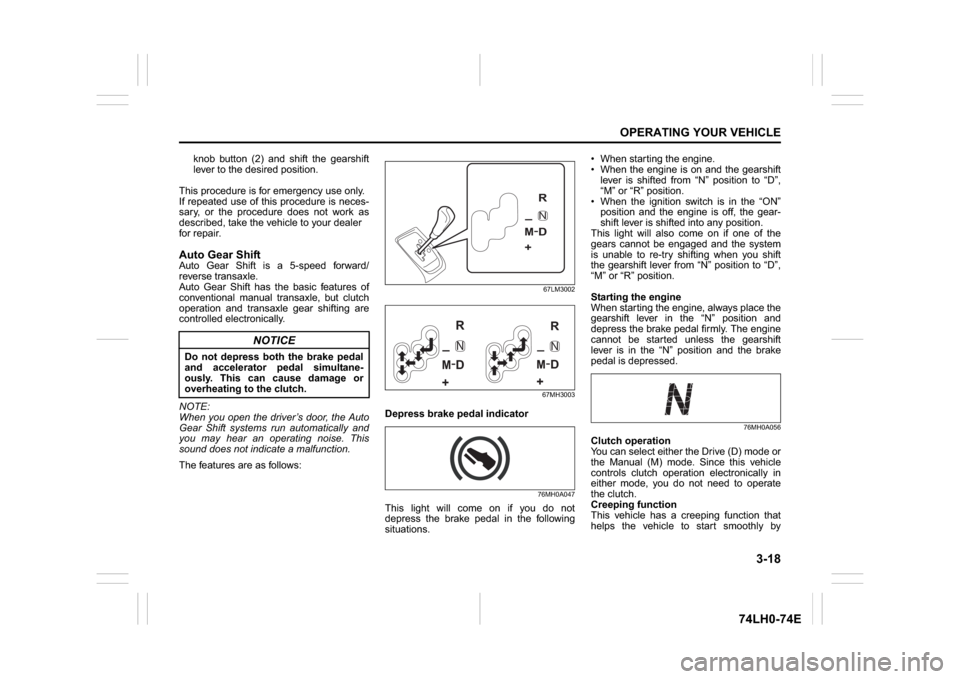
67LM3002
67MH3003
Depress brake pedal indicator
76MH0A047
This light will come on if you do not
depress the brake pedal in the following
situations. When starting the engine.
When the engine is on and the gearshift
lever is shifted from “N” position to “D”,
“M” or “R” position.
When the ignition switch is in the “ON”
position and the engine is off, the gear-
shift lever is shifted into any position.
This light will also come on if one of the
gears cannot be engaged and the system
is unable to re-try shifting when you shift
the gearshift lever from “N” position to “D”,
“M” or “R” position.
Starting the engine
When starting the engine, always place the
gearshift lever in the “N” position and
depress the brake pedal firmly. The engine
cannot be started unless the gearshift
lever is in the “N” position and the brake
pedal is depressed.
76MH0A056
Clutch operation
You can select either the Drive (D) mode or
the Manual (M) mode. Since this vehicle
controls clutch operation electronically in
either mode, you do not need to operate
the clutch.
Creeping function
This vehicle has a creeping function that
helps the vehicle to start smoothly by
NOTICE
Do not depress both the brake pedal
and accelerator pedal simultane-
ously. This can cause damage or
overheating to the clutch.
-M+R
N
D-
-M+R
N
D-
-M+R
N
D-
Page 104 of 336
3-19OPERATING YOUR VEHICLE
74LH0-74E
engaging the clutch. When the gearshift
lever is in any of the positions “D”, “M” or
“R”, and you release your foot from the
brake pedal, the vehicle starts slowly with-
out depressing the accelerator pedal. The
creeping function is disabled if you depress
the brake pedal or pull up the parking
brake lever. Creep is not possible in man-
ual mode with 2nd gear engaged.
NOTE:
If the driver’s door is opened and/or the
parking brake lever is engaged with the
gear in the “M”, “D” or “R” position, the
creeping function will not operate.
Parking and Stopping the vehicle
Auto Gear Shift does not have a parking
position. The vehicle can be parked with
the gearshift lever at “D” or “R” position.
Remember, even though the transaxle is in
gear, you must set the parking brake firmly. Drive (D) mode
When the Drive (D) mode is activated, the
most appropriate gear position is automati-
cally selected upon operation of the accel-
erator pedal and variation of vehicle speed.
Normal driving:
1) Start the engine as instructed in “Start-
ing the engine” in this section.
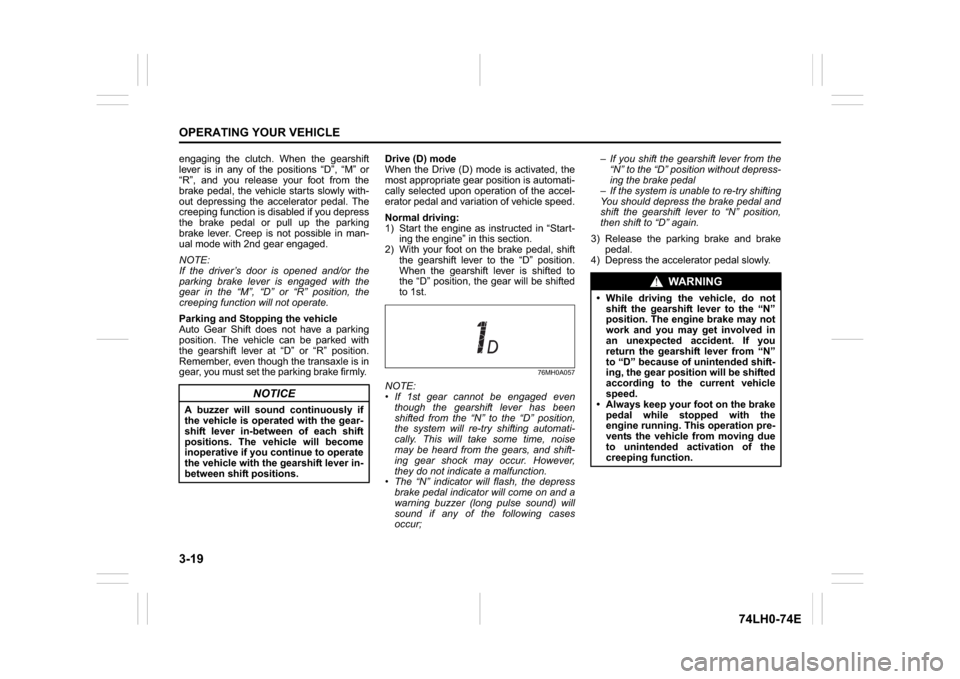
2) With your foot on the brake pedal, shift
the gearshift lever to the “D” position.
When the gearshift lever is shifted to
the “D” position, the gear will be shifted
to 1st.
76MH0A057
NOTE:
If 1st gear cannot be engaged even
though the gearshift lever has been
shifted from the “N” to the “D” position,
the system will re-try shifting automati-
cally. This will take some time, noise
may be heard from the gears, and shift-
ing gear shock may occur. However,
they do not indicate a malfunction.
The “N” indicator will flash, the depress
brake pedal indicator will come on and a
warning buzzer (long pulse sound) will
sound if any of the following cases
occur;– If you shift the gearshift lever from the
“N” to the “D” position without depress-
ing the brake pedal
– If the system is unable to re-try shifting
You should depress the brake pedal and
shift the gearshift lever to “N” position,
then shift to “D” again.
3) Release the parking brake and brake
pedal.
4) Depress the accelerator pedal slowly.
NOTICE
A buzzer will sound continuously if
the vehicle is operated with the gear-
shift lever in-between of each shift
positions. The vehicle will become
inoperative if you continue to operate
the vehicle with the gearshift lever in-
between shift positions.
WA R N I N G
While driving the vehicle, do not
shift the gearshift lever to the “N”
position. The engine brake may not
work and you may get involved in
an unexpected accident. If you
return the gearshift lever from “N”
to “D” because of unintended shift-
ing, the gear position will be shifted
according to the current vehicle
speed.
Always keep your foot on the brake
pedal while stopped with the
engine running. This operation pre-
vents the vehicle from moving due
to unintended activation of the
creeping function.
Page 105 of 336
3-20
OPERATING YOUR VEHICLE
74LH0-74E
Starting off on an uphill/downhill:
Uphill1) Apply the parking brake firmly so that the
vehicle does not roll backwards.
2) Shift the gearshift lever to the “D” posi-
tion while depressing the brake pedal.
Make sure that the gear position indica-
tor in the instrumental cluster displays
1st gear.
3) Release the brake pedal and depress
the accelerator pedal gradually, and
when the vehicle starts to move, release
the parking brake and depress the accel-
erator pedal to start off.Downhill
1) Depress the brake pedal and shift the
gearshift lever to the “D” position. Make
sure that the gear is in 1st by checking
the gear position indicator.
2) Release the brake pedal and depress
the accelerator pedal slowly. Even if the
accelerator pedal is not depressed, the
clutch will be engaged when the vehicle
speed increases.Using engine braking:
When driving on a downhill slope, down-
shifting is recommended. So you can use
engine braking.
By placing the gearshift lever in the “M”
position, the Manual (M) mode is selected,
and you can shift to a lower gear manually.
For details of downshift operation, refer to
“Upshift and downshift” in the “Manual (M)
mode”.
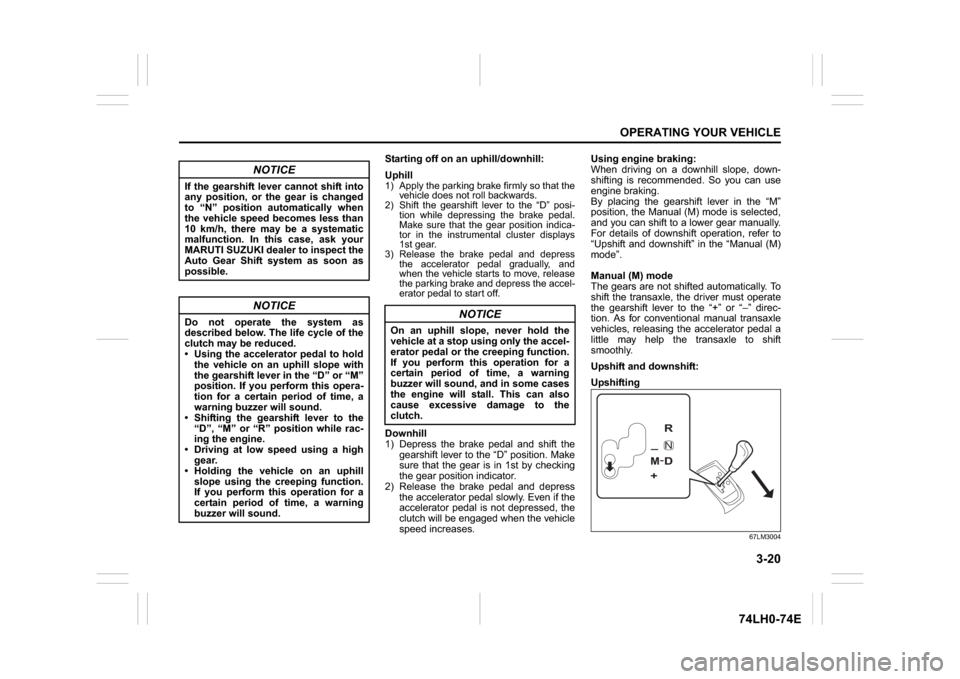
Manual (M) mode
The gears are not shifted automatically. To
shift the transaxle, the driver must operate
the gearshift lever to the “+” or “–” direc-
tion. As for conventional manual transaxle
vehicles, releasing the accelerator pedal a
little may help the transaxle to shift
smoothly.
Upshift and downshift:
Upshifting
67LM3004
NOTICE
If the gearshift lever cannot shift into
any position, or the gear is changed
to “N” position automatically when
the vehicle speed becomes less than
10 km/h, there may be a systematic
malfunction. In this case, ask your
MARUTI SUZUKI dealer to inspect the
Auto Gear Shift system as soon as
possible.
NOTICE
Do not operate the system as
described below. The life cycle of the
clutch may be reduced.
Using the accelerator pedal to hold
the vehicle on an uphill slope with
the gearshift lever in the “D” or “M”
position. If you perform this opera-
tion for a certain period of time, a
warning buzzer will sound.
Shifting the gearshift lever to the
“D”, “M” or “R” position while rac-
ing the engine.
Driving at low speed using a high
gear.
Holding the vehicle on an uphill
slope using the creeping function.
If you perform this operation for a
certain period of time, a warning
buzzer will sound.
NOTICE
On an uphill slope, never hold the
vehicle at a stop using only the accel-
erator pedal or the creeping function.
If you perform this operation for a
certain period of time, a warning
buzzer will sound, and in some cases
the engine will stall. This can also
cause excessive damage to the
clutch.
-M+R
N
D-