Can line SUZUKI SX4 2006 1.G Service Owners Manual
[x] Cancel search | Manufacturer: SUZUKI, Model Year: 2006, Model line: SX4, Model: SUZUKI SX4 2006 1.GPages: 1556, PDF Size: 37.31 MB
Page 1496 of 1556

Downloaded from www.Manualslib.com manuals search engine 10B-23 Body Electrical Control System:
BCM connector “G04”E04-13 — — —
E04-14 — — —
Terminal Circuit Normal voltage Condition
G04-1CAN communication line (low)
for DLC*1.6 – 2.5 V
Refer to “Reference waveform No. 3: ” G04-2CAN communication line (low)
for each control module*1.6 – 2.5 V
G04-3CAN communication line
(high) for DLC*2.5 – 3.6 V
G04-4CAN communication line
(high) for each control module*2.5 – 3.6 V
G04-5Serial communication line of
data link connector 7 – 12 V Ignition switch is at ON position
G04-6 — — —
G04-7 — — —
G04-8 Theft deterrent light10 – 14 V Theft deterrent light is not lit up
0 V Theft deterrent light is lit up
G04-9 — — —
G04-10 — — —
G04-11Serial communication line for
information display and HVAC
control module (if equipped)*0 – 1 V
↑↓
10 – 14 VRefer to “Reference waveform No. 5: ”
G04-12Ground for keyless entry
receiver (if equipped)0 V —
G04-13Power supply for keyless
entry receiver (if equipped)4 – 6 V Ignition switch is at all positions
G04-14Signal for keyless entry
receiver (if equipped)*0 – 1 V
↑↓
4 – 6 VRefer to “Reference waveform No. 6: ”
G04-15 Vehicle speed signal output*0 – 1 V
↑↓
4 – 6VRefer to “Reference waveform No. 7: ”
G04-16 Key reminder switch10 – 14 V Ignition key is inserted to ignition key cylinder
0 VIgnition key is pulled out from ignition key
cylinder
G04-17Rear end door window
defogger switch*3 – 14 V Refer to “Reference waveform No. 8: ”
0 VIgnition switch is at ON position and rear end
door window defogger switch is pushed
G04-18 A/C switch (if equipped)*3 – 14 V Refer to “Reference waveform No. 8: ”
0 VIgnition switch is at ON position, blower speed
selector is at any position other than OFF
position and A/C switch is at ON position
G04-19 — — —
G04-20 — — —
G04-21 Rear wiper INT switch*0 – 1 V
↑↓
10 – 14 VRefer to “Reference waveform No. 9: ”
0 VIgnition switch is at ON position and rear
wiper switch is at INT position
G04-22 Rear wiper low switch*0 – 1 V
↑↓
10 – 14 VRefer to “Reference waveform No. 9: ”
0 VIgnition switch is at ON position and rear
wiper switch is at LOW position Terminal Circuit Normal voltage Condition
Page 1499 of 1556

Downloaded from www.Manualslib.com manuals search engine Body Electrical Control System: 10B-26
Reference waveform No. 1
Parking brake or brake fluid level switch signal (1)
Reference waveform No. 2
Driver seat belt switch signal (1)Reference waveform No. 3
CAN communication signal
Reference waveform No. 4
Oil pressure switch signal (1) Measurement terminal Parking brake switch
CH2: “L01-6” to “G271-3”
Brake fluid level switch
CH2: “E04-5” to “G271-3”
Oscilloscope setting CH1: 5 V / DIV
TIME: 10 ms / DIV
Measurement
conditionParking brake switch:
• Ignition switch is at ON
position, parking brake lever
is released
Brake fluid level switch
• Ignition switch is at ON
position, brake fluid level is in
normal
Measurement terminal CH2: “L01-14” to “G271-3”
Oscilloscope setting CH2: 5 V/DIV
TIME: 4 ms/DIV
Measurement
conditionIgnition switch is at ON position
and driver side seat belt is
fastened
I4RS0AA20018-02
I4RS0AA20016-02
Measurement terminal CAN communication signal for
ABS control module
CH2: “E04-1” to “G271-3”
CH3: “E04-2” to “G271-3”
CAN communication signal for
DLC
CH2: “G04-3” to “G271-3”
CH3: “G04-1” to “G271-3”
CAN communication signal for
each control module
CH2: “G04-4” to “G271-3”
CH3: “G04-2” to “G271-3”
Oscilloscope setting CH2: 1 V/DIV
CH3: 1 V/DIV
TIME: 40 µs/ DIV
Measurement
conditionIgnition switch is at ON position
1. CAN communication line signal (High)
2. CAN communication line signal (Low)
Measurement terminal CH2: “E04-11” to “G271-3”
Oscilloscope setting CH2: 5 V / DIV
TIME: 10 ms / DIV
Measurement
conditionEngine is running and oil
pressure is in normal condition
I4RS0AA20017-02
I4RS0AA20018-02
Page 1503 of 1556
Downloaded from www.Manualslib.com manuals search engine Immobilizer Control System: 10C-1
Control Systems
Immobilizer Control System
Precautions
Precautions in Diagnosing TroublesS6RW0DA300001
• Before confirming the diagnostic trouble code (DTC),
do not disconnect connector from ECM, battery cable
from battery, ground wire harness, or main fuse. Such
disconnection will erase DTC stored in ECM.
• DTC stored in ECM memory can be checked as well
as cleared by using SUZUKI scan tool. Before using
SUZUKI scan tool, read its operator’s manual
carefully to know how to use it and what functions are
available.
• Be sure to read “Precautions for Electrical Circuit
Service in Section 00” before inspection.
• Communication of ECM, BCM, ABS control module,
TCM (if equipped), 4WD control module (if equipped),
keyless start control module (if equipped),
combination meter and DLC is established by CAN
(Controller Area Network). Therefore, handle CAN
communication lines with care referring to “Precaution
for CAN Communication System in Section 00”.
For CAN communication system, refer to description
on “CAN Communication System Description in
Section 1A”.
Precaution in Replacing ECMS6RW0DA300002
• If ECM is replaced with new or used one without
Immobilizer control function, the engine will not be
started. In case of the above, check if the newly
installed ECM has Immobilizer control function.
• After ECM is replaced with new one or used one, the
transponder code in the transponder built in the
ignition key has to be registered with ECM. Or, the
engine cannot be started up. For the registration
procedure, refer to “Procedure after ECM
Replacement”.
Precaution in Replacing Ignition KeyS6RW0DA300003
To register ignition key in case of replacing key(s) and/or
making spare key(s), the transponder code in the ignition
key is registered with ECM. Or the engine can not be
started up. For the registration procedure, refer to
“Registration of the Ignition Key”.
Precautions in Handling Immobilizer Control
System
S6RW0DA300004
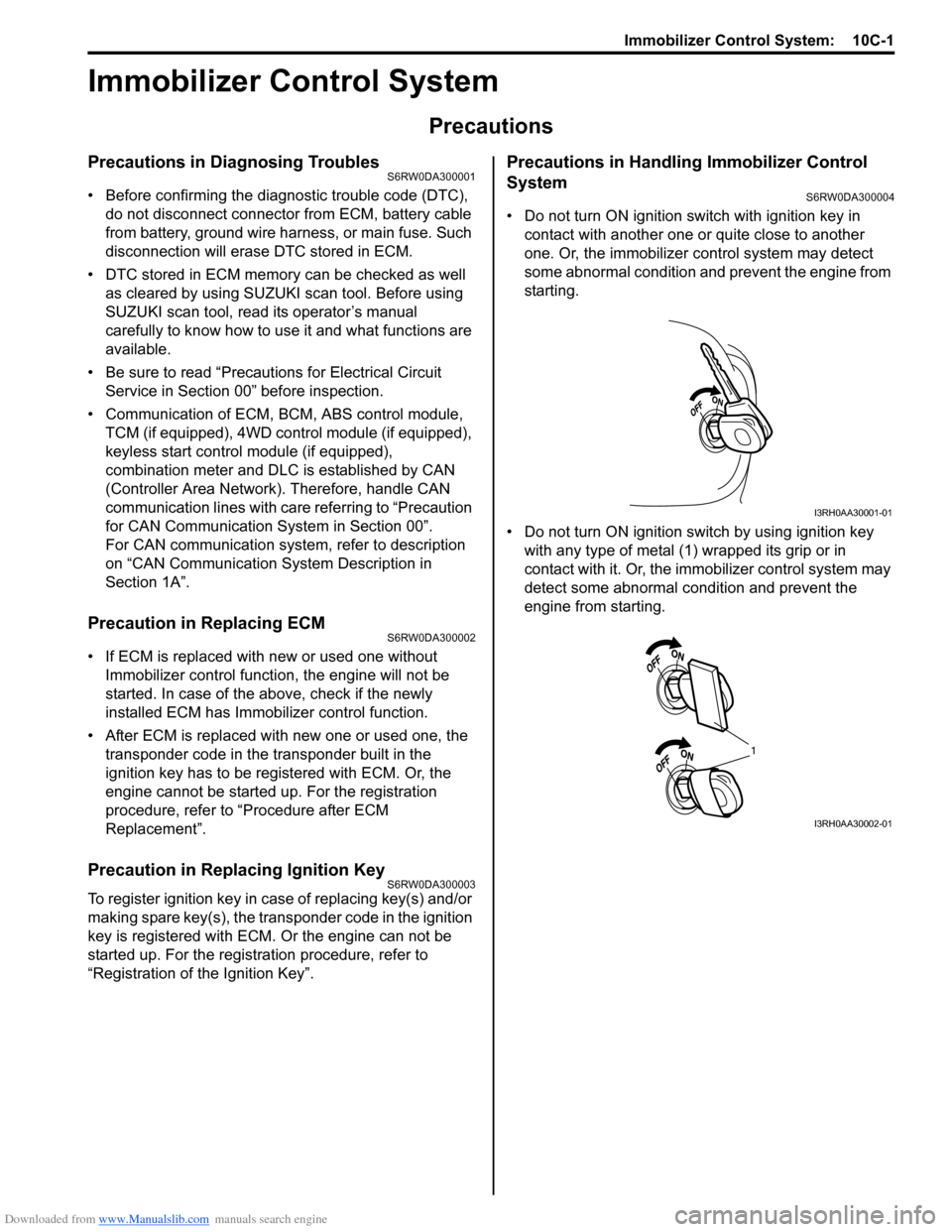
• Do not turn ON ignition switch with ignition key in
contact with another one or quite close to another
one. Or, the immobilizer control system may detect
some abnormal condition and prevent the engine from
starting.
• Do not turn ON ignition switch by using ignition key
with any type of metal (1) wrapped its grip or in
contact with it. Or, the immobilizer control system may
detect some abnormal condition and prevent the
engine from starting.
I3RH0AA30001-01
1
I3RH0AA30002-01
Page 1504 of 1556
Downloaded from www.Manualslib.com manuals search engine 10C-2 Immobilizer Control System:
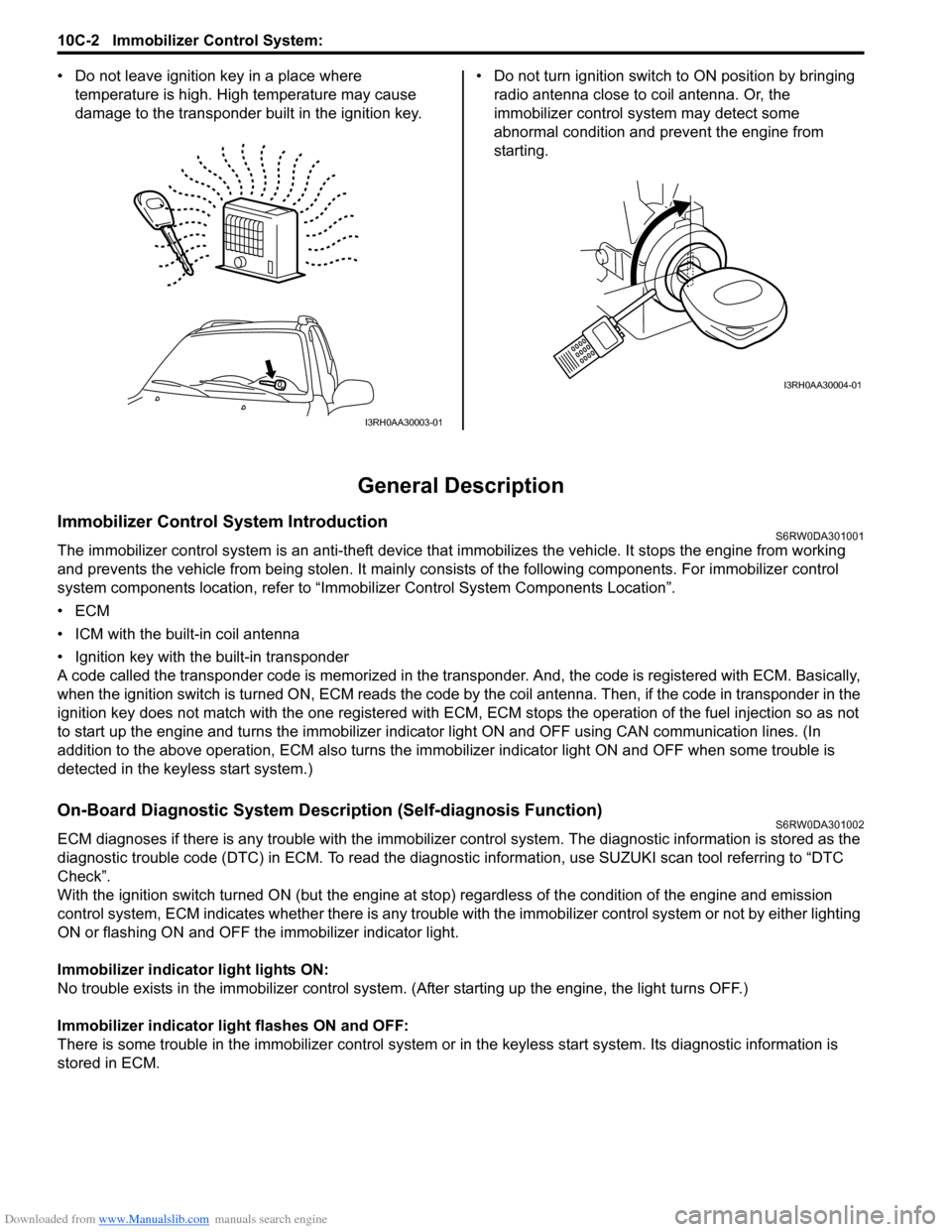
• Do not leave ignition key in a place where
temperature is high. High temperature may cause
damage to the transponder built in the ignition key.• Do not turn ignition switch to ON position by bringing
radio antenna close to coil antenna. Or, the
immobilizer control system may detect some
abnormal condition and prevent the engine from
starting.
General Description
Immobilizer Control System IntroductionS6RW0DA301001
The immobilizer control system is an anti-theft device that immobilizes the vehicle. It stops the engine from working
and prevents the vehicle from being stolen. It mainly consists of the following components. For immobilizer control
system components location, refer to “Immobilizer Control System Components Location”.
•ECM
• ICM with the built-in coil antenna
• Ignition key with the built-in transponder
A code called the transponder code is memorized in the transponder. And, the code is registered with ECM. Basically,
when the ignition switch is turned ON, ECM reads the code by the coil antenna. Then, if the code in transponder in the
ignition key does not match with the one registered with ECM, ECM stops the operation of the fuel injection so as not
to start up the engine and turns the immobilizer indicator light ON and OFF using CAN communication lines. (In
addition to the above operation, ECM also turns the immobilizer indicator light ON and OFF when some trouble is
detected in the keyless start system.)
On-Board Diagnostic System Description (Self-diagnosis Function)S6RW0DA301002
ECM diagnoses if there is any trouble with the immobilizer control system. The diagnostic information is stored as the
diagnostic trouble code (DTC) in ECM. To read the diagnostic information, use SUZUKI scan tool referring to “DTC
Check”.
With the ignition switch turned ON (but the engine at stop) regardless of the condition of the engine and emission
control system, ECM indicates whether there is any trouble with the immobilizer control system or not by either lighting
ON or flashing ON and OFF the immobilizer indicator light.
Immobilizer indicator light lights ON:
No trouble exists in the immobilizer control system. (After starting up the engine, the light turns OFF.)
Immobilizer indicator light flashes ON and OFF:
There is some trouble in the immobilizer control system or in the keyless start system. Its diagnostic information is
stored in ECM.
I3RH0AA30003-01
I3RH0AA30004-01
Page 1509 of 1556
Downloaded from www.Manualslib.com manuals search engine Immobilizer Control System: 10C-7
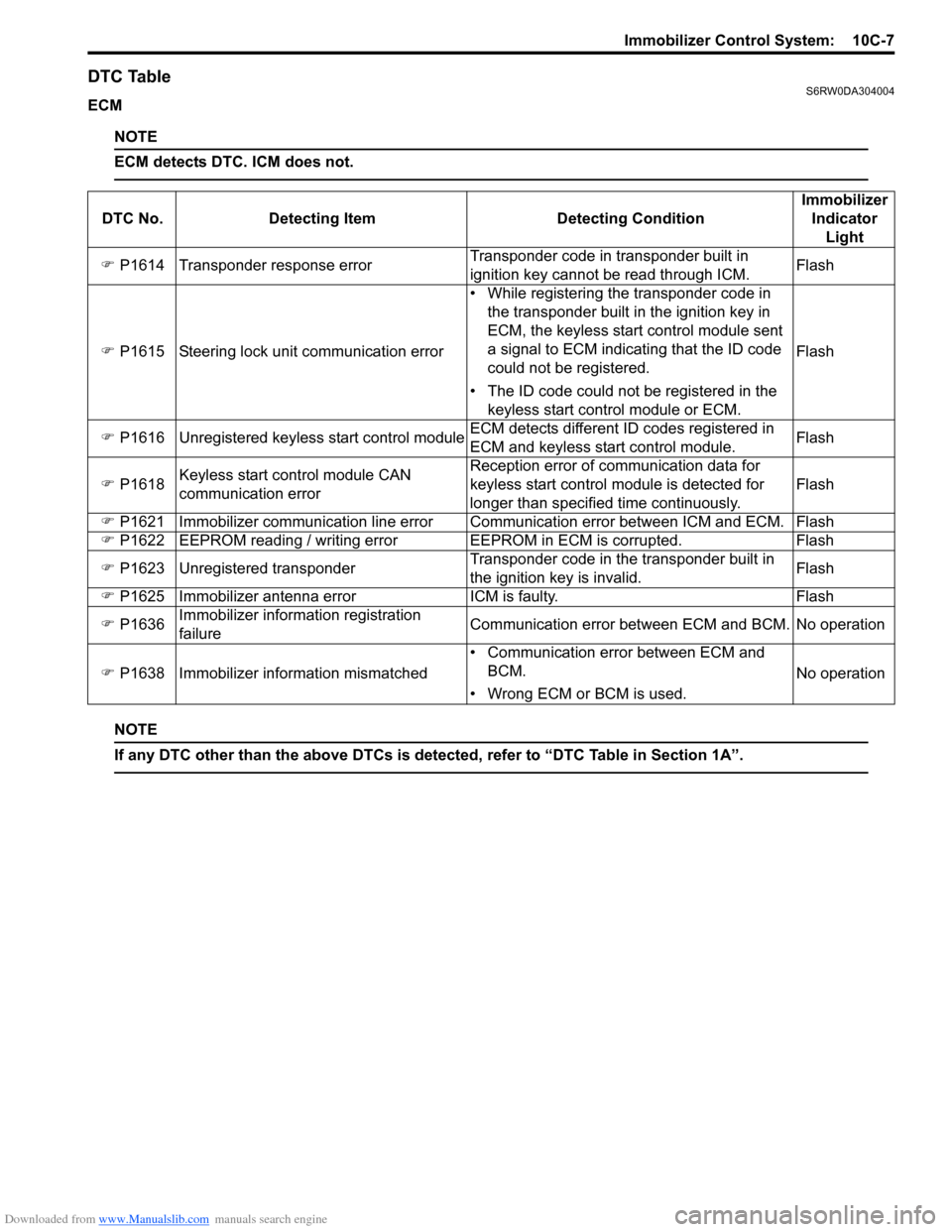
DTC TableS6RW0DA304004
ECM
NOTE
ECM detects DTC. ICM does not.
NOTE
If any DTC other than the above DTCs is detected, refer to “DTC Table in Section 1A”.
DTC No. Detecting Item Detecting ConditionImmobilizer
Indicator
Light
) P1614 Transponder response errorTransponder code in transponder built in
ignition key cannot be read through ICM.Flash
) P1615 Steering lock unit communication error• While registering the transponder code in
the transponder built in the ignition key in
ECM, the keyless start control module sent
a signal to ECM indicating that the ID code
could not be registered.
• The ID code could not be registered in the
keyless start control module or ECM.Flash
) P1616 Unregistered keyless start control moduleECM detects different ID codes registered in
ECM and keyless start control module.Flash
) P1618Keyless start control module CAN
communication errorReception error of communication data for
keyless start control module is detected for
longer than specified time continuously.Flash
) P1621 Immobilizer communication line error Communication error between ICM and ECM. Flash
) P1622 EEPROM reading / writing error EEPROM in ECM is corrupted. Flash
) P1623 Unregistered transponderTransponder code in the transponder built in
the ignition key is invalid.Flash
) P1625 Immobilizer antenna error ICM is faulty. Flash
) P1636Immobilizer information registration
failureCommunication error between ECM and BCM. No operation
) P1638 Immobilizer information mismatched• Communication error between ECM and
BCM.
• Wrong ECM or BCM is used.No operation
Page 1515 of 1556
Downloaded from www.Manualslib.com manuals search engine Immobilizer Control System: 10C-13
DTC P1618: Keyless Start Control Module CAN Communication ErrorS6RW0DA304011
Refer to “Troubleshooting for CAN-DTC in Section 1A”.
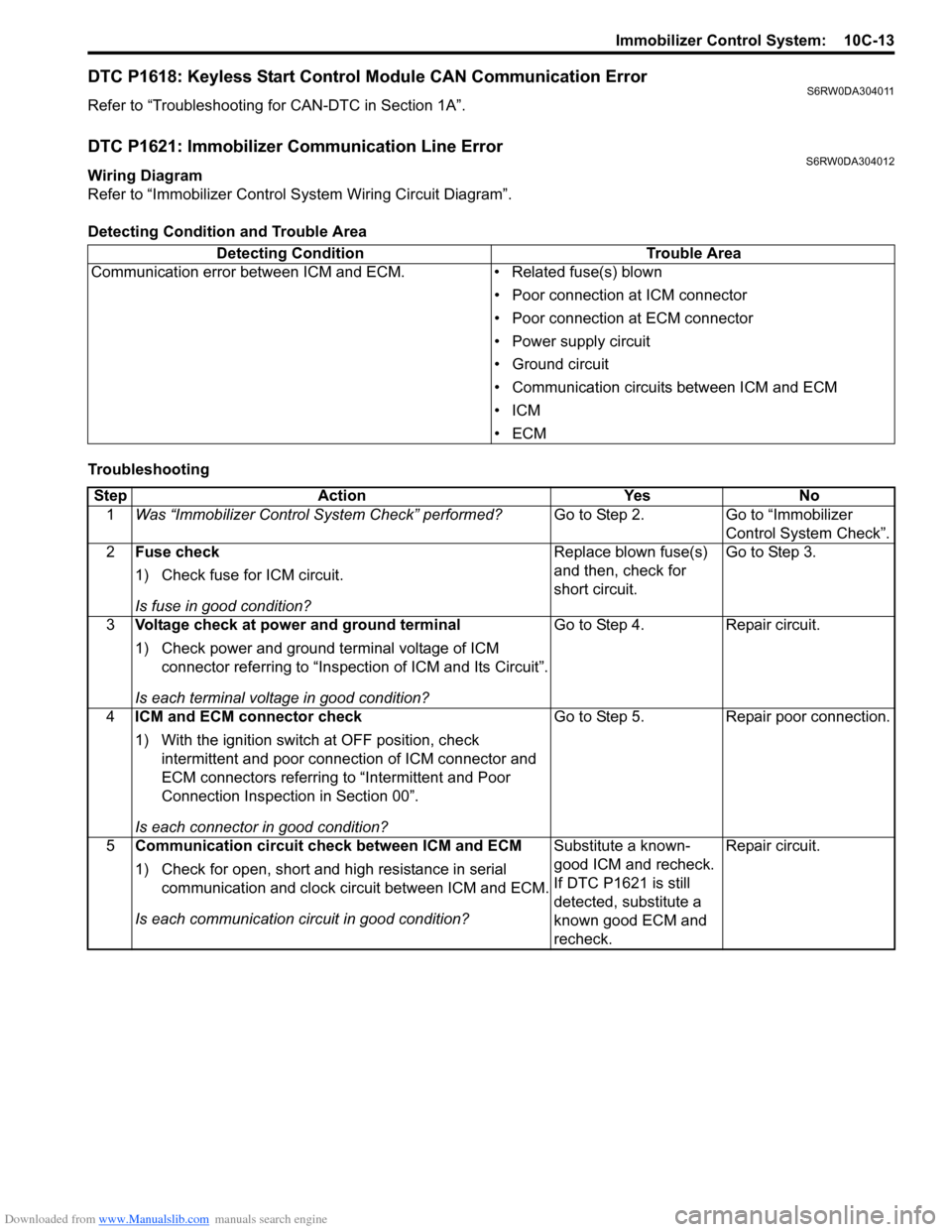
DTC P1621: Immobilizer Communication Line ErrorS6RW0DA304012
Wiring Diagram
Refer to “Immobilizer Control System Wiring Circuit Diagram”.
Detecting Condition and Trouble Area
TroubleshootingDetecting Condition Trouble Area
Communication error between ICM and ECM. • Related fuse(s) blown
• Poor connection at ICM connector
• Poor connection at ECM connector
• Power supply circuit
• Ground circuit
• Communication circuits between ICM and ECM
•ICM
•ECM
Step Action Yes No
1Was “Immobilizer Control System Check” performed?Go to Step 2. Go to “Immobilizer
Control System Check”.
2Fuse check
1) Check fuse for ICM circuit.
Is fuse in good condition?Replace blown fuse(s)
and then, check for
short circuit.Go to Step 3.
3Voltage check at power and ground terminal
1) Check power and ground terminal voltage of ICM
connector referring to “Inspection of ICM and Its Circuit”.
Is each terminal voltage in good condition?Go to Step 4. Repair circuit.
4ICM and ECM connector check
1) With the ignition switch at OFF position, check
intermittent and poor connection of ICM connector and
ECM connectors referring to “Intermittent and Poor
Connection Inspection in Section 00”.
Is each connector in good condition?Go to Step 5. Repair poor connection.
5Communication circuit check between ICM and ECM
1) Check for open, short and high resistance in serial
communication and clock circuit between ICM and ECM.
Is each communication circuit in good condition?Substitute a known-
good ICM and recheck.
If DTC P1621 is still
detected, substitute a
known good ECM and
recheck.Repair circuit.
Page 1520 of 1556
Downloaded from www.Manualslib.com manuals search engine 10C-18 Immobilizer Control System:
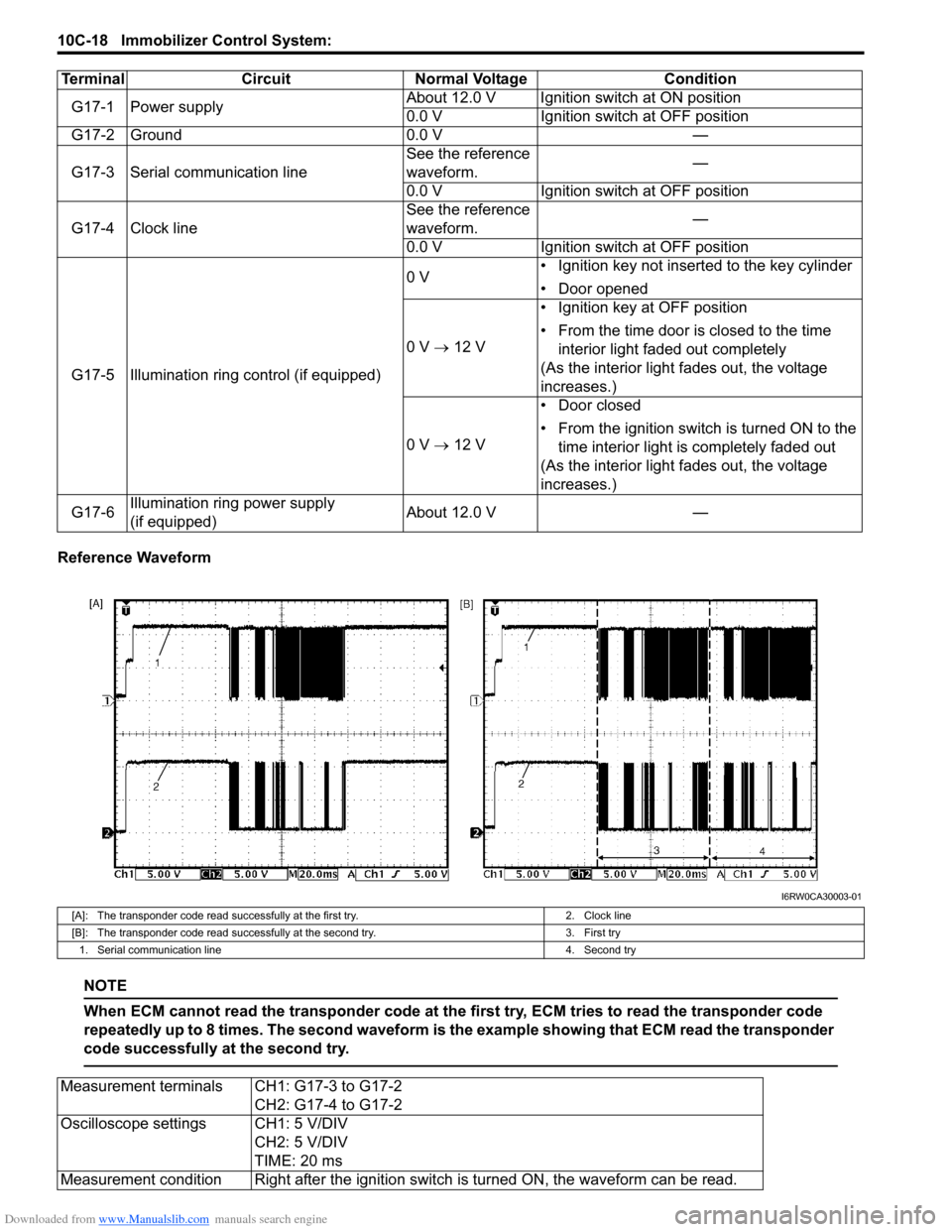
Reference Waveform
NOTE
When ECM cannot read the transponder code at the first try, ECM tries to read the transponder code
repeatedly up to 8 times. The second waveform is the example showing that ECM read the transponder
code successfully at the second try.
Terminal Circuit Normal Voltage Condition
G17-1 Power supplyAbout 12.0 V Ignition switch at ON position
0.0 V Ignition switch at OFF position
G17-2 Ground 0.0 V —
G17-3 Serial communication lineSee the reference
waveform.—
0.0 V Ignition switch at OFF position
G17-4 Clock lineSee the reference
waveform.—
0.0 V Ignition switch at OFF position
G17-5 Illumination ring control (if equipped)0 V• Ignition key not inserted to the key cylinder
• Door opened
0 V → 12 V• Ignition key at OFF position
• From the time door is closed to the time
interior light faded out completely
(As the interior light fades out, the voltage
increases.)
0 V → 12 V• Door closed
• From the ignition switch is turned ON to the
time interior light is completely faded out
(As the interior light fades out, the voltage
increases.)
G17-6Illumination ring power supply
(if equipped)About 12.0 V —
I6RW0CA30003-01
[A]: The transponder code read successfully at the first try. 2. Clock line
[B]: The transponder code read successfully at the second try. 3. First try
1. Serial communication line 4. Second try
Measurement terminals CH1: G17-3 to G17-2
CH2: G17-4 to G17-2
Oscilloscope settings CH1: 5 V/DIV
CH2: 5 V/DIV
TIME: 20 ms
Measurement condition Right after the ignition switch is turned ON, the waveform can be read.
Page 1530 of 1556
Downloaded from www.Manualslib.com manuals search engine 10E-8 Keyless Start System:
Diagnostic Information and Procedures
Precautions in Diagnosing TroublesS6RW0DA504001
• The keyless start system executes data transmission/
reception by means of the radio wave. Therefore,
proper operation may not be obtained if use of the
door lock function and engine start function of the
keyless start system is attempted near the place
where strong radio wave is emitted (TV and radio
broadcasting stations, etc.).
• Diagnostic information stored in keyless start control
module memory can be checked only by key indicator
light.
• Be sure to use the trouble diagnosis procedure as
described in “Keyless Start System Check”. Failure to
follow it may result in incorrect diagnosis. (Some other
DTC may be stored by mistake in the memory of
keyless start control module during inspection.)
• Be sure to read“Precautions for Electrical Circuit
Service in Section 00” before inspection and observe
what is written there.
• Communication of ECM, TCM (A/T model), BCM,
ABS control module, 4WD control module (if
equipped), keyless start control module and
combination meter is established by CAN (Controller
Area Network). (For detail of CAN communication for
keyless start control module, refer to “CAN
Communication System Description”). Therefore,
handle CAN communication line with care referring to
“Precaution for CAN Communication System in
Section 00”.
• Replacement of the keyless start control module
When keyless start control module is replaced with
new one, make sure that register remote controller ID
code to keyless start control module correctly
according to “Registration Procedure for Remote
Controller ID Code”.• Keyless start control module substitution
When the keyless start control module used in
another vehicle was installed in the vehicle being
serviced, register the ID code of the remote controller
to the keyless start control module first and then the
following code.
– With immobilizer control system, register the
ignition key transponder code for the immobilizer
control system in ECM. For registration procedure
of that, refer to “Registration of the Ignition Key in
Section 10C”.
– Without immobilizer control system, register the
steering lock unit ID code in keyless start control
module. For registration procedure of that, refer to
“Keyless Start Registration”.
Self-Diagnosis FunctionS6RW0DA504002
The keyless start control module has self-diagnosis
function to monitor the system components and circuits
while the keyless start system is at work. When the
keyless start control module detects an abnormality in
the system, it saves the area where such abnormality
has occurred as a DTC in its memory. The DTC stored in
memory of the keyless start control module is indicated
by the key indicator light in the combination meter
flashing in a specific pattern. For DTC indication, refer to
“DTC Check” and for the clearing procedure, to “DTC
Clearance”.
Keyless Start System Diagnosis IntroductionS6RW0DA504003
To ensure that the trouble diagnosis is done accurately
and smoothly, observe “Precautions in Diagnosing
Troubles” and follow “Keyless Start System Check”.
4. Ignition knob switch 13. Rear end door request switch 22. Ignition Switch
5. Key reminder switch 14. Driver side door lock switch
6. Driver side door antenna 15. Passenger side door lock switch
Page 1538 of 1556
Downloaded from www.Manualslib.com manuals search engine 10E-16 Keyless Start System:
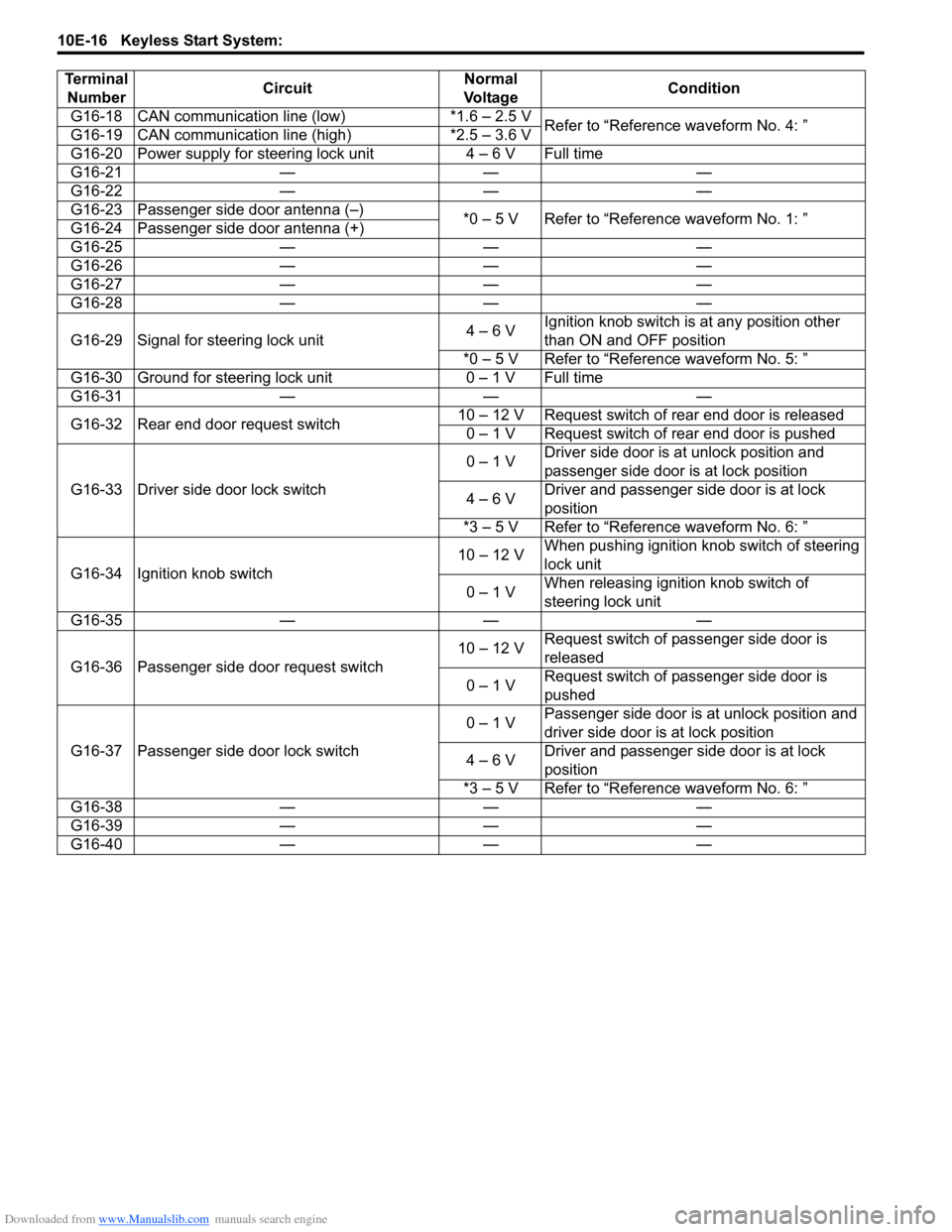
G16-18 CAN communication line (low) *1.6 – 2.5 V
Refer to “Reference waveform No. 4: ”
G16-19 CAN communication line (high) *2.5 – 3.6 V
G16-20 Power supply for steering lock unit 4 – 6 V Full time
G16-21 — — —
G16-22 — — —
G16-23 Passenger side door antenna (–)
*0 – 5 V Refer to “Reference waveform No. 1: ”
G16-24 Passenger side door antenna (+)
G16-25 — — —
G16-26 — — —
G16-27 — — —
G16-28 — — —
G16-29 Signal for steering lock unit4 – 6 VIgnition knob switch is at any position other
than ON and OFF position
*0 – 5 V Refer to “Reference waveform No. 5: ”
G16-30 Ground for steering lock unit 0 – 1 V Full time
G16-31 — — —
G16-32 Rear end door request switch10 – 12 V Request switch of rear end door is released
0 – 1 V Request switch of rear end door is pushed
G16-33 Driver side door lock switch0 – 1 VDriver side door is at unlock position and
passenger side door is at lock position
4 – 6 VDriver and passenger side door is at lock
position
*3 – 5 V Refer to “Reference waveform No. 6: ”
G16-34 Ignition knob switch10 – 12 VWhen pushing ignition knob switch of steering
lock unit
0 – 1 VWhen releasing ignition knob switch of
steering lock unit
G16-35 — — —
G16-36 Passenger side door request switch10 – 12 VRequest switch of passenger side door is
released
0 – 1 VRequest switch of passenger side door is
pushed
G16-37 Passenger side door lock switch0 – 1 VPassenger side door is at unlock position and
driver side door is at lock position
4 – 6 VDriver and passenger side door is at lock
position
*3 – 5 V Refer to “Reference waveform No. 6: ”
G16-38 — — —
G16-39 — — —
G16-40 — — — Terminal
NumberCircuitNormal
Vo l ta g eCondition
Page 1540 of 1556
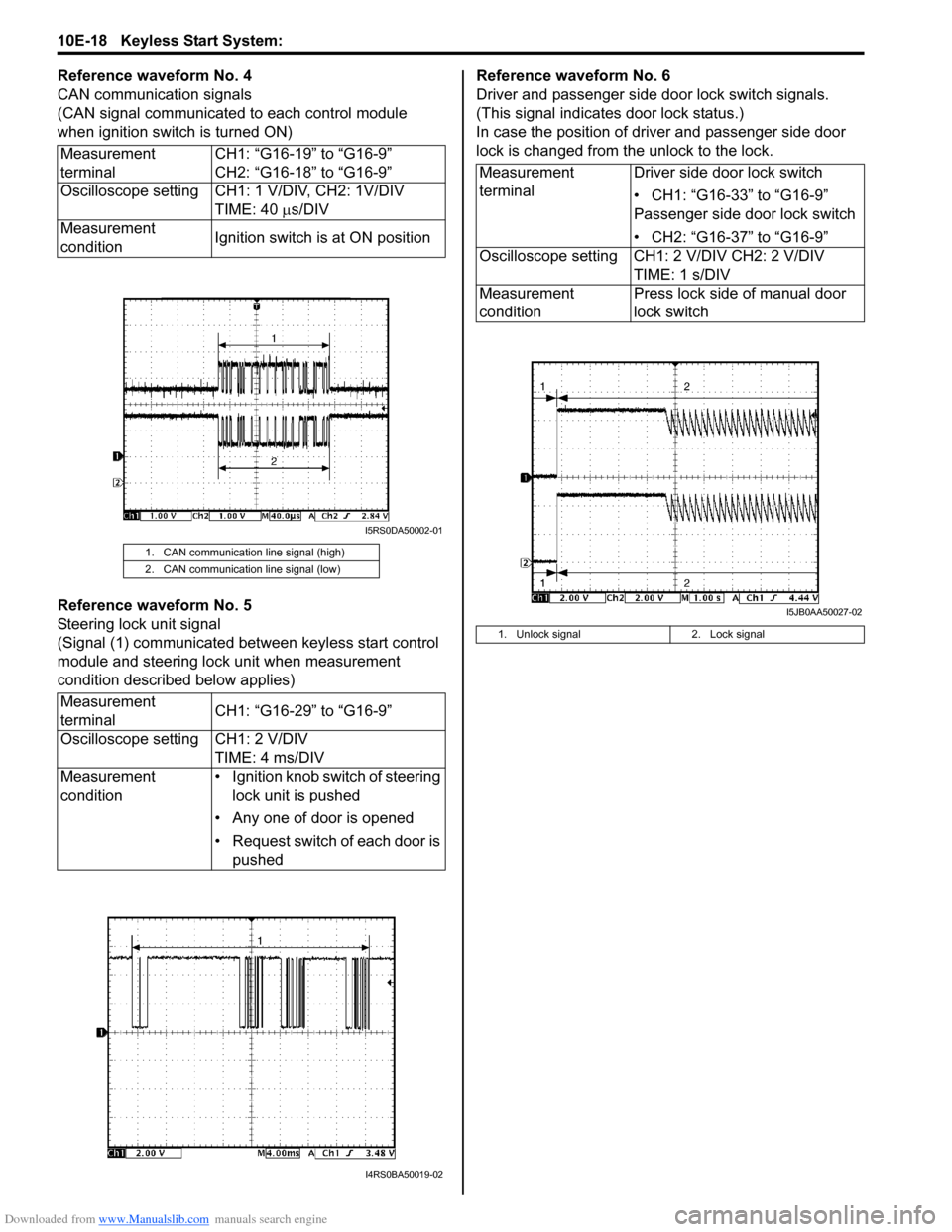
Downloaded from www.Manualslib.com manuals search engine 10E-18 Keyless Start System:
Reference waveform No. 4
CAN communication signals
(CAN signal communicated to each control module
when ignition switch is turned ON)
Reference waveform No. 5
Steering lock unit signal
(Signal (1) communicated between keyless start control
module and steering lock unit when measurement
condition described below applies)Reference waveform No. 6
Driver and passenger side door lock switch signals.
(This signal indicates door lock status.)
In case the position of driver and passenger side door
lock is changed from the unlock to the lock.
Measurement
terminalCH1: “G16-19” to “G16-9”
CH2: “G16-18” to “G16-9”
Oscilloscope setting CH1: 1 V/DIV, CH2: 1V/DIV
TIME: 40 µs/DIV
Measurement
conditionIgnition switch is at ON position
1. CAN communication line signal (high)
2. CAN communication line signal (low)
Measurement
terminalCH1: “G16-29” to “G16-9”
Oscilloscope setting CH1: 2 V/DIV
TIME: 4 ms/DIV
Measurement
condition• Ignition knob switch of steering
lock unit is pushed
• Any one of door is opened
• Request switch of each door is
pushed
I5RS0DA50002-01
I4RS0BA50019-02
Measurement
terminalDriver side door lock switch
• CH1: “G16-33” to “G16-9”
Passenger side door lock switch
• CH2: “G16-37” to “G16-9”
Oscilloscope setting CH1: 2 V/DIV CH2: 2 V/DIV
TIME: 1 s/DIV
Measurement
conditionPress lock side of manual door
lock switch
1. Unlock signal 2. Lock signal
I5JB0AA50027-02