Can line SUZUKI SX4 2006 1.G Service Repair Manual
[x] Cancel search | Manufacturer: SUZUKI, Model Year: 2006, Model line: SX4, Model: SUZUKI SX4 2006 1.GPages: 1556, PDF Size: 37.31 MB
Page 617 of 1556
Downloaded from www.Manualslib.com manuals search engine ABS: 4E-12
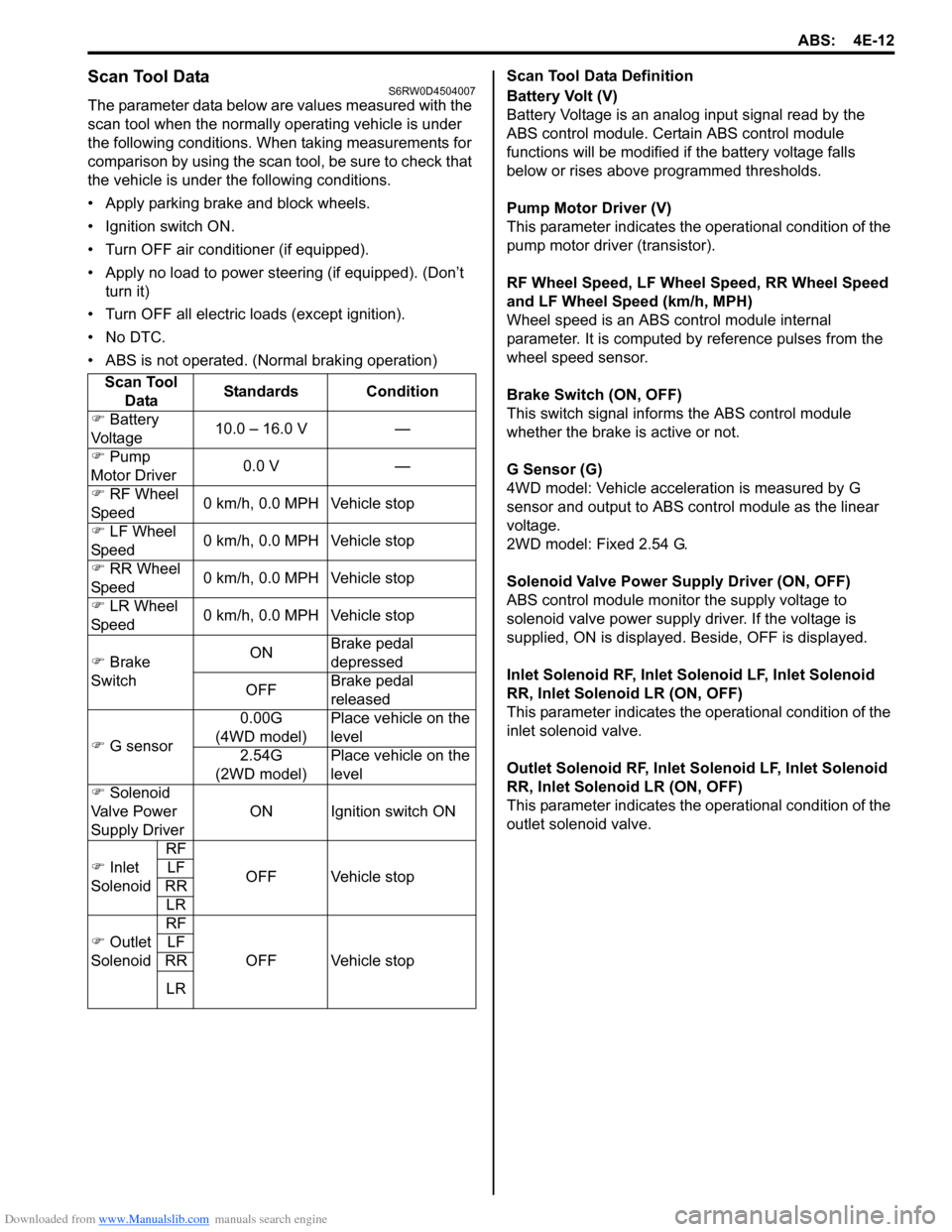
Scan Tool DataS6RW0D4504007
The parameter data below are values measured with the
scan tool when the normally operating vehicle is under
the following conditions. When taking measurements for
comparison by using the scan tool, be sure to check that
the vehicle is under the following conditions.
• Apply parking brake and block wheels.
• Ignition switch ON.
• Turn OFF air conditioner (if equipped).
• Apply no load to power steering (if equipped). (Don’t
turn it)
• Turn OFF all electric loads (except ignition).
• No DTC.
• ABS is not operated. (Normal braking operation)Scan Tool Data Definition
Battery Volt (V)
Battery Voltage is an analog input signal read by the
ABS control module. Certain ABS control module
functions will be modified if the battery voltage falls
below or rises above programmed thresholds.
Pump Motor Driver (V)
This parameter indicates the operational condition of the
pump motor driver (transistor).
RF Wheel Speed, LF Wheel Speed, RR Wheel Speed
and LF Wheel Speed (km/h, MPH)
Wheel speed is an ABS control module internal
parameter. It is computed by reference pulses from the
wheel speed sensor.
Brake Switch (ON, OFF)
This switch signal informs the ABS control module
whether the brake is active or not.
G Sensor (G)
4WD model: Vehicle acceleration is measured by G
sensor and output to ABS control module as the linear
voltage.
2WD model: Fixed 2.54 G.
Solenoid Valve Power Supply Driver (ON, OFF)
ABS control module monitor the supply voltage to
solenoid valve power supply driver. If the voltage is
supplied, ON is displayed. Beside, OFF is displayed.
Inlet Solenoid RF, Inlet Solenoid LF, Inlet Solenoid
RR, Inlet Solenoid LR (ON, OFF)
This parameter indicates the operational condition of the
inlet solenoid valve.
Outlet Solenoid RF, Inlet Solenoid LF, Inlet Solenoid
RR, Inlet Solenoid LR (ON, OFF)
This parameter indicates the operational condition of the
outlet solenoid valve. Scan Tool
DataStandards Condition
) Battery
Voltage10.0 – 16.0 V —
) Pump
Motor Driver0.0 V —
) RF Wheel
Speed0 km/h, 0.0 MPH Vehicle stop
) LF Wheel
Speed0 km/h, 0.0 MPH Vehicle stop
) RR Wheel
Speed0 km/h, 0.0 MPH Vehicle stop
) LR Wheel
Speed0 km/h, 0.0 MPH Vehicle stop
) Brake
SwitchONBrake pedal
depressed
OFFBrake pedal
released
) G sensor0.00G
(4WD model)Place vehicle on the
level
2.54G
(2WD model)Place vehicle on the
level
) Solenoid
Valve Power
Supply DriverON Ignition switch ON
) Inlet
SolenoidRF
OFF Vehicle stop LF
RR
LR
) Outlet
SolenoidRF
OFF Vehicle stop LF
RR
LR
Page 620 of 1556
Downloaded from www.Manualslib.com manuals search engine 4E-15 ABS:
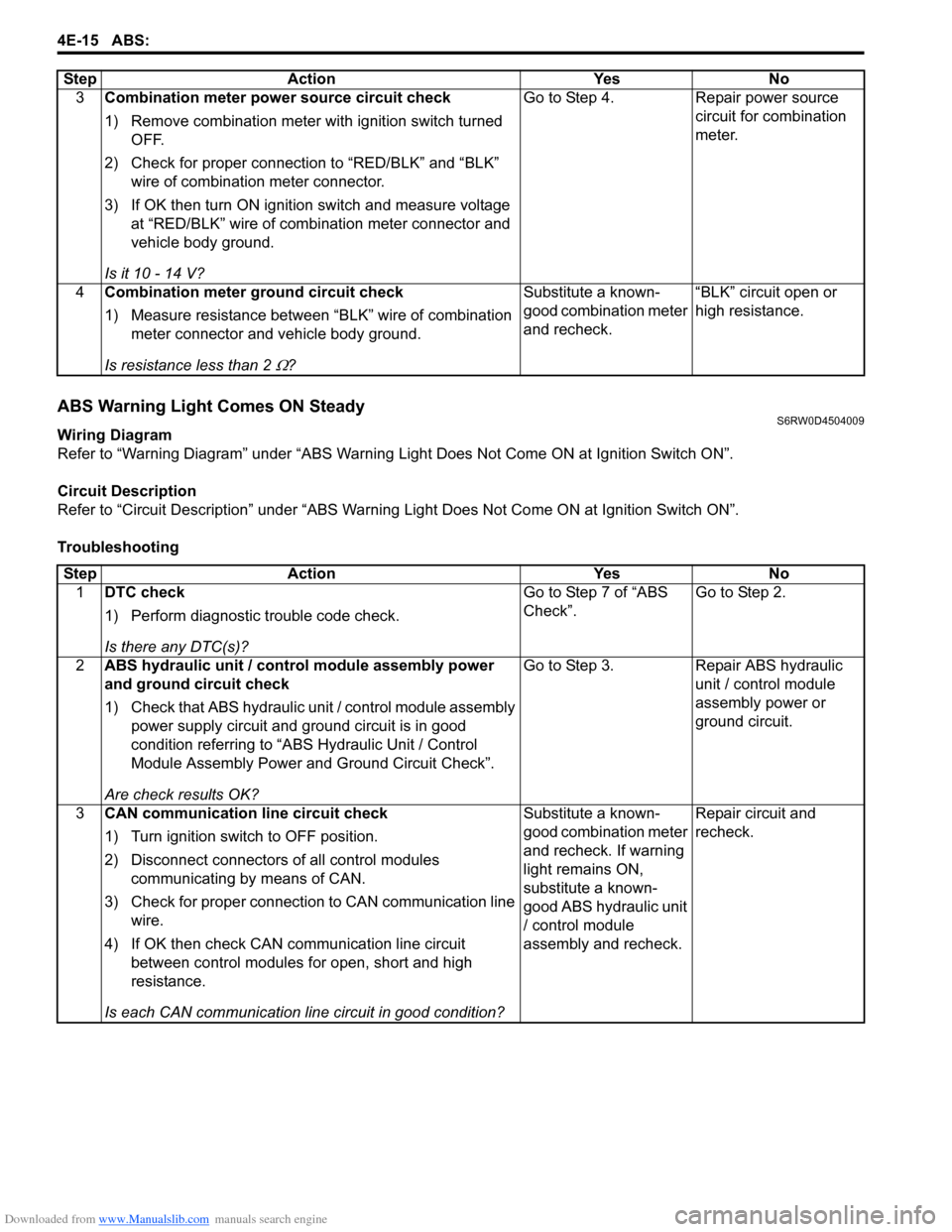
ABS Warning Light Comes ON SteadyS6RW0D4504009
Wiring Diagram
Refer to “Warning Diagram” under “ABS Warning Light Does Not Come ON at Ignition Switch ON”.
Circuit Description
Refer to “Circuit Description” under “ABS Warning Light Does Not Come ON at Ignition Switch ON”.
Troubleshooting 3Combination meter power source circuit check
1) Remove combination meter with ignition switch turned
OFF.
2) Check for proper connection to “RED/BLK” and “BLK”
wire of combination meter connector.
3) If OK then turn ON ignition switch and measure voltage
at “RED/BLK” wire of combination meter connector and
vehicle body ground.
Is it 10 - 14 V?Go to Step 4. Repair power source
circuit for combination
meter.
4Combination meter ground circuit check
1) Measure resistance between “BLK” wire of combination
meter connector and vehicle body ground.
Is resistance less than 2
Ω?Substitute a known-
good combination meter
and recheck.“BLK” circuit open or
high resistance. Step Action Yes No
Step Action Yes No
1DTC check
1) Perform diagnostic trouble code check.
Is there any DTC(s)?Go to Step 7 of “ABS
Check”.Go to Step 2.
2ABS hydraulic unit / control module assembly power
and ground circuit check
1) Check that ABS hydraulic unit / control module assembly
power supply circuit and ground circuit is in good
condition referring to “ABS Hydraulic Unit / Control
Module Assembly Power and Ground Circuit Check”.
Are check results OK?Go to Step 3. Repair ABS hydraulic
unit / control module
assembly power or
ground circuit.
3CAN communication line circuit check
1) Turn ignition switch to OFF position.
2) Disconnect connectors of all control modules
communicating by means of CAN.
3) Check for proper connection to CAN communication line
wire.
4) If OK then check CAN communication line circuit
between control modules for open, short and high
resistance.
Is each CAN communication line circuit in good condition?Substitute a known-
good combination meter
and recheck. If warning
light remains ON,
substitute a known-
good ABS hydraulic unit
/ control module
assembly and recheck.Repair circuit and
recheck.
Page 621 of 1556
Downloaded from www.Manualslib.com manuals search engine ABS: 4E-16
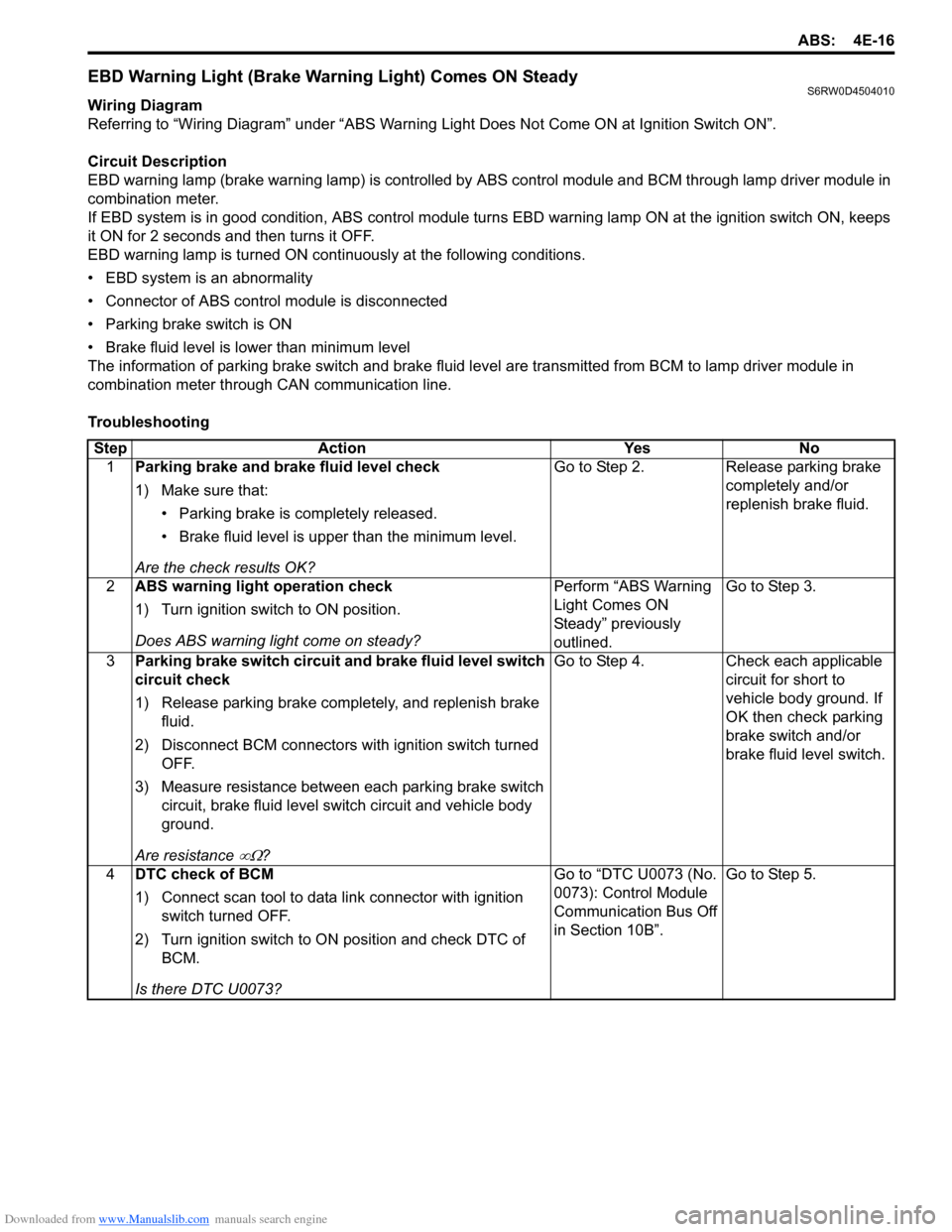
EBD Warning Light (Brake Warning Light) Comes ON SteadyS6RW0D4504010
Wiring Diagram
Referring to “Wiring Diagram” under “ABS Warning Light Does Not Come ON at Ignition Switch ON”.
Circuit Description
EBD warning lamp (brake warning lamp) is controlled by ABS control module and BCM through lamp driver module in
combination meter.
If EBD system is in good condition, ABS control module turns EBD warning lamp ON at the ignition switch ON, keeps
it ON for 2 seconds and then turns it OFF.
EBD warning lamp is turned ON continuously at the following conditions.
• EBD system is an abnormality
• Connector of ABS control module is disconnected
• Parking brake switch is ON
• Brake fluid level is lower than minimum level
The information of parking brake switch and brake fluid level are transmitted from BCM to lamp driver module in
combination meter through CAN communication line.
Troubleshooting
Step Action Yes No
1Parking brake and brake fluid level check
1) Make sure that:
• Parking brake is completely released.
• Brake fluid level is upper than the minimum level.
Are the check results OK?Go to Step 2. Release parking brake
completely and/or
replenish brake fluid.
2ABS warning light operation check
1) Turn ignition switch to ON position.
Does ABS warning light come on steady?Perform “ABS Warning
Light Comes ON
Steady” previously
outlined.Go to Step 3.
3Parking brake switch circuit and brake fluid level switch
circuit check
1) Release parking brake completely, and replenish brake
fluid.
2) Disconnect BCM connectors with ignition switch turned
OFF.
3) Measure resistance between each parking brake switch
circuit, brake fluid level switch circuit and vehicle body
ground.
Are resistance
∞Ω?Go to Step 4. Check each applicable
circuit for short to
vehicle body ground. If
OK then check parking
brake switch and/or
brake fluid level switch.
4DTC check of BCM
1) Connect scan tool to data link connector with ignition
switch turned OFF.
2) Turn ignition switch to ON position and check DTC of
BCM.
Is there DTC U0073?Go to “DTC U0073 (No.
0073): Control Module
Communication Bus Off
in Section 10B”.Go to Step 5.
Page 622 of 1556

Downloaded from www.Manualslib.com manuals search engine 4E-17 ABS:
Serial Data Link Circuit CheckS6RW0D4504011
Wiring Diagram5CAN communication line circuit check
1) Turn ignition switch to OFF position.
2) Disconnect connectors of all control modules
communicating by means of CAN.
3) Check for proper connection to CAN communication line
wire.
4) If OK then check CAN communication line circuit
between control modules for open, short and high
resistance.
Is each CAN communication line circuit in good condition?Substitute a known-
good combination meter
and recheck. If EBD
warning light remains
OFF, substitute a
known-good BCM and/
or ABS hydraulic unit /
control module
assembly and recheck.Repair CAN
communication line
circuit. Step Action Yes No
11+BBBG
G1
12V
14BLU
REDWHTE08 [C]
1
2
3
4
5
6
7 12
13
14
15
16
17
18
19
20
21
228
9
10
11
23
24
25
26WHTGRN
3
E08-2
E08-13REDWHT 5
4 12
9
E08-23BLK
67
BLK
REDWHTG241-7G241-10
G241-16
12V
E08-25E08-24
E08-9
WHT/REDWHT/BLU
GRN/ORN
9
2
1
13
G241-31
RED/BLK
8
REDWHTREDWHT
9
10
E08-16 G04-4
G04-2
G04-1
G04-3 E04-1
E04-2
[D]
1 2 3 4 5 6 7 8 9 10 11
12 13 14 15 16 17
18 19 20 21 22G041 2 3 4 5 6 7
8 9 10 11 12 13 14E04
G241 [E]
132 4 5 6 7 8 9 10111213141516
17 1918 20 2122 23 24 25 26 27 28 29 30 31 32 [A]
I6RW0D450008-01
Page 624 of 1556

Downloaded from www.Manualslib.com manuals search engine 4E-19 ABS:
Trouble shooting
Step Action Yes No
1Scan tool communication check
Can scan tool communicate with BCM?Go to Step 2. Go to Step 3.
2ABS hydraulic unit / control module assembly power
and ground circuit check
1) Check that ABS hydraulic unit / control module assembly
power supply circuit and ground circuit is in good
condition referring to “ABS Hydraulic Unit / Control
Module Assembly Power and Ground Circuit Check”.
Are check results OK?Go to Step 3. Repair ABS hydraulic
unit / control module
assembly power or
ground circuit.
3Data link connector power source circuit check
1) Disconnect scan tool from data link connector.
2) Check for proper connection to scan tool.
3) If OK then turn ignition switch to ON position, and
measure voltage between terminal B of data link
connector and vehicle body ground.
Is voltage 10 – 12 V?Go to Step 4. Terminal B circuit open
or shorted to ground.
4Data link connector ground circuit check
1) Turn ignition switch to OFF position, and measure
resistance between the following terminals:
• Terminal G of data link connector and vehicle body
ground.
• Terminal G1 of data link connector and vehicle body
ground.
Are resistance less than 2
Ω?Go to Step 5. Terminal G and/or G1
wire circuit open or high
resistance.
5Serial communication circuit check
1) Turn ignition switch to OFF position.
2) Disconnect connectors of all control modules
communicating by serial data circuit.
3) Check proper connection at serial data circuit terminals.
4) If OK, then check for high resistance, open or short to
power circuit or ground in serial data circuit.
Is check result in good condition?Go to Step 6. Repair serial data circuit
and recheck.
6CAN communication line circuit check
1) Disconnect connectors of all control modules
communicating by means of CAN.
2) Check for proper connection to CAN communication line
wire.
3) If OK then check CAN communication line circuit
between control modules for open, short and high
resistance.
Is each CAN communication line circuit in good condition?Substitute a known-
good ABS hydraulic unit
/ control module
assembly and recheck.Repair CAN
communication line
circuit and recheck.
Page 645 of 1556
Downloaded from www.Manualslib.com manuals search engine Table of Contents 5- i
5
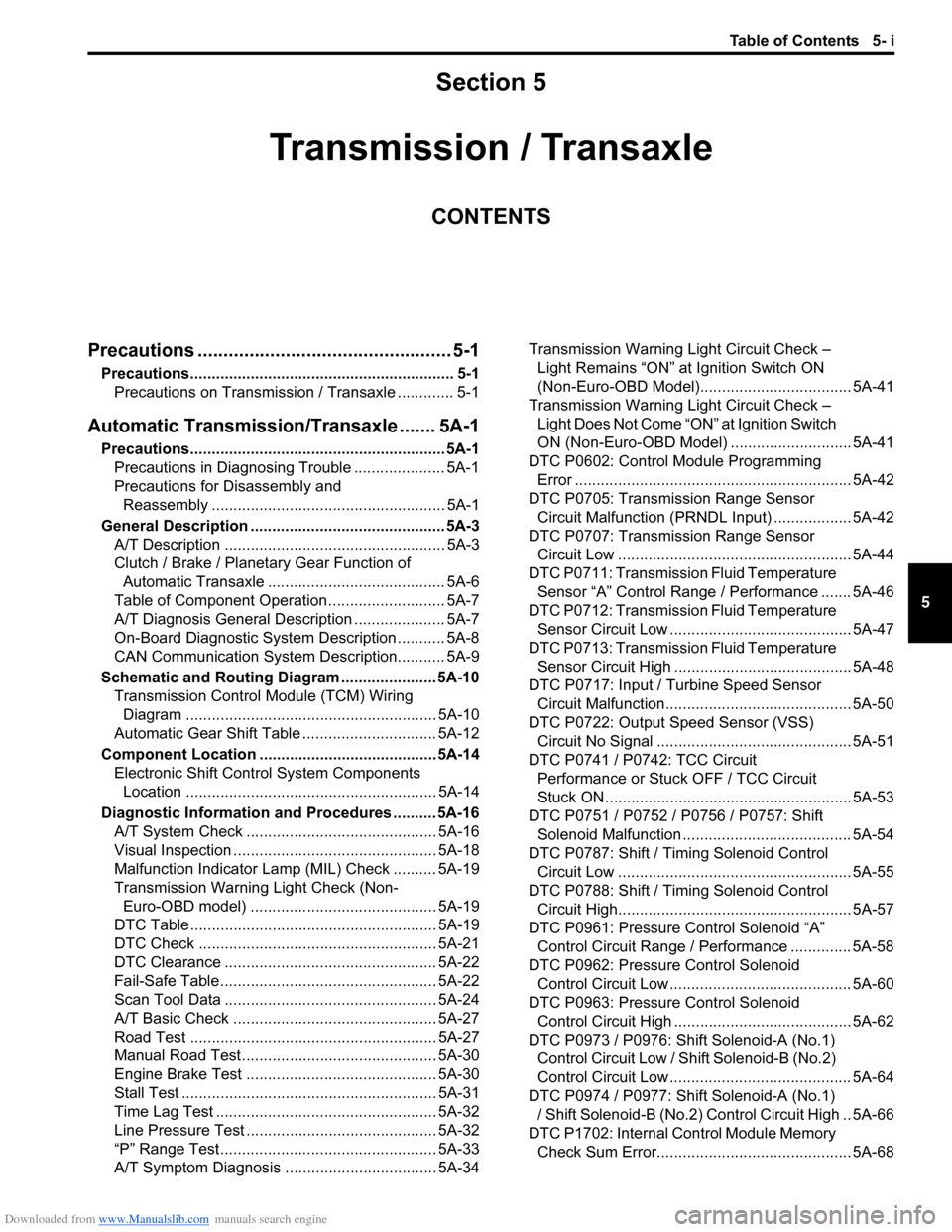
Section 5
CONTENTS
Transmission / Transaxle
Precautions ................................................. 5-1
Precautions............................................................. 5-1
Precautions on Transmission / Transaxle ............. 5-1
Automatic Transmission/Transaxle ....... 5A-1
Precautions........................................................... 5A-1
Precautions in Diagnosing Trouble ..................... 5A-1
Precautions for Disassembly and
Reassembly ...................................................... 5A-1
General Description ............................................. 5A-3
A/T Description ................................................... 5A-3
Clutch / Brake / Planetary Gear Function of
Automatic Transaxle ......................................... 5A-6
Table of Component Operation ........................... 5A-7
A/T Diagnosis General Description ..................... 5A-7
On-Board Diagnostic System Description ........... 5A-8
CAN Communication System Description........... 5A-9
Schematic and Routing Diagram ...................... 5A-10
Transmission Control Module (TCM) Wiring
Diagram .......................................................... 5A-10
Automatic Gear Shift Table ............................... 5A-12
Component Location ......................................... 5A-14
Electronic Shift Control System Components
Location .......................................................... 5A-14
Diagnostic Information and Procedures .......... 5A-16
A/T System Check ............................................ 5A-16
Visual Inspection ............................................... 5A-18
Malfunction Indicator Lamp (MIL) Check .......... 5A-19
Transmission Warning Light Check (Non-
Euro-OBD model) ........................................... 5A-19
DTC Table ......................................................... 5A-19
DTC Check ....................................................... 5A-21
DTC Clearance ................................................. 5A-22
Fail-Safe Table .................................................. 5A-22
Scan Tool Data ................................................. 5A-24
A/T Basic Check ............................................... 5A-27
Road Test ......................................................... 5A-27
Manual Road Test ............................................. 5A-30
Engine Brake Test ............................................ 5A-30
Stall Test ........................................................... 5A-31
Time Lag Test ................................................... 5A-32
Line Pressure Test ............................................ 5A-32
“P” Range Test.................................................. 5A-33
A/T Symptom Diagnosis ................................... 5A-34Transmission Warning Light Circuit Check –
Light Remains “ON” at Ignition Switch ON
(Non-Euro-OBD Model)................................... 5A-41
Transmission Warning Light Circuit Check –
Light Does Not Come “ON” at Ignition Switch
ON (Non-Euro-OBD Model)............................ 5A-41
DTC P0602: Control Module Programming
Error ................................................................ 5A-42
DTC P0705: Transmission Range Sensor
Circuit Malfunction (PRNDL Input) .................. 5A-42
DTC P0707: Transmission Range Sensor
Circuit Low ...................................................... 5A-44
DTC P0711: Transmission Fluid Temperature
Sensor “A” Control Range / Performance ....... 5A-46
DTC P0712: Transmission Fluid Temperature
Sensor Circuit Low .......................................... 5A-47
DTC P0713: Transmission Fluid Temperature
Sensor Circuit High ......................................... 5A-48
DTC P0717: Input / Turbine Speed Sensor
Circuit Malfunction........................................... 5A-50
DTC P0722: Output Speed Sensor (VSS)
Circuit No Signal ............................................. 5A-51
DTC P0741 / P0742: TCC Circuit
Performance or Stuck OFF / TCC Circuit
Stuck ON ......................................................... 5A-53
DTC P0751 / P0752 / P0756 / P0757: Shift
Solenoid Malfunction ....................................... 5A-54
DTC P0787: Shift / Timing Solenoid Control
Circuit Low ...................................................... 5A-55
DTC P0788: Shift / Timing Solenoid Control
Circuit High...................................................... 5A-57
DTC P0961: Pressure Control Solenoid “A”
Control Circuit Range / Performance .............. 5A-58
DTC P0962: Pressure Control Solenoid
Control Circuit Low .......................................... 5A-60
DTC P0963: Pressure Control Solenoid
Control Circuit High ......................................... 5A-62
DTC P0973 / P0976: Shift Solenoid-A (No.1)
Control Circuit Low / Shift Solenoid-B (No.2)
Control Circuit Low .......................................... 5A-64
DTC P0974 / P0977: Shift Solenoid-A (No.1)
/ Shift Solenoid-B (No.2) Control Circuit High .. 5A-66
DTC P1702: Internal Control Module Memory
Check Sum Error............................................. 5A-68
Page 649 of 1556
Downloaded from www.Manualslib.com manuals search engine Automatic Transmission/Transaxle: 5A-1
Transmission / Transaxle
Automatic Transmission/Transaxle
Precautions
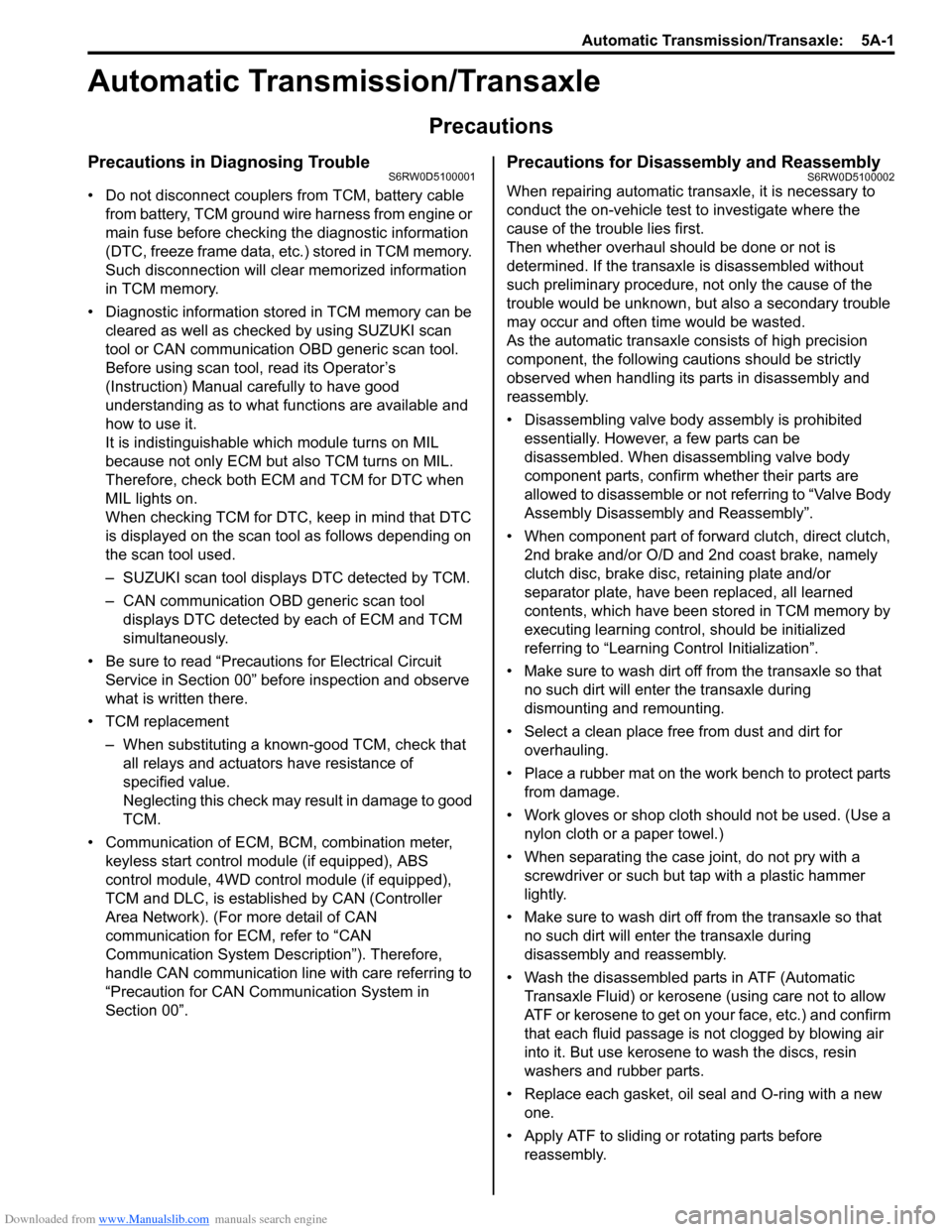
Precautions in Diagnosing TroubleS6RW0D5100001
• Do not disconnect couplers from TCM, battery cable
from battery, TCM ground wire harness from engine or
main fuse before checking the diagnostic information
(DTC, freeze frame data, etc.) stored in TCM memory.
Such disconnection will clear memorized information
in TCM memory.
• Diagnostic information stored in TCM memory can be
cleared as well as checked by using SUZUKI scan
tool or CAN communication OBD generic scan tool.
Before using scan tool, read its Operator’s
(Instruction) Manual carefully to have good
understanding as to what functions are available and
how to use it.
It is indistinguishable which module turns on MIL
because not only ECM but also TCM turns on MIL.
Therefore, check both ECM and TCM for DTC when
MIL lights on.
When checking TCM for DTC, keep in mind that DTC
is displayed on the scan tool as follows depending on
the scan tool used.
– SUZUKI scan tool displays DTC detected by TCM.
– CAN communication OBD generic scan tool
displays DTC detected by each of ECM and TCM
simultaneously.
• Be sure to read “Precautions for Electrical Circuit
Service in Section 00” before inspection and observe
what is written there.
• TCM replacement
– When substituting a known-good TCM, check that
all relays and actuators have resistance of
specified value.
Neglecting this check may result in damage to good
TCM.
• Communication of ECM, BCM, combination meter,
keyless start control module (if equipped), ABS
control module, 4WD control module (if equipped),
TCM and DLC, is established by CAN (Controller
Area Network). (For more detail of CAN
communication for ECM, refer to “CAN
Communication System Description”). Therefore,
handle CAN communication line with care referring to
“Precaution for CAN Communication System in
Section 00”.
Precautions for Disassembly and ReassemblyS6RW0D5100002
When repairing automatic transaxle, it is necessary to
conduct the on-vehicle test to investigate where the
cause of the trouble lies first.
Then whether overhaul should be done or not is
determined. If the transaxle is disassembled without
such preliminary procedure, not only the cause of the
trouble would be unknown, but also a secondary trouble
may occur and often time would be wasted.
As the automatic transaxle consists of high precision
component, the following cautions should be strictly
observed when handling its parts in disassembly and
reassembly.
• Disassembling valve body assembly is prohibited
essentially. However, a few parts can be
disassembled. When disassembling valve body
component parts, confirm whether their parts are
allowed to disassemble or not referring to “Valve Body
Assembly Disassembly and Reassembly”.
• When component part of forward clutch, direct clutch,
2nd brake and/or O/D and 2nd coast brake, namely
clutch disc, brake disc, retaining plate and/or
separator plate, have been replaced, all learned
contents, which have been stored in TCM memory by
executing learning control, should be initialized
referring to “Learning Control Initialization”.
• Make sure to wash dirt off from the transaxle so that
no such dirt will enter the transaxle during
dismounting and remounting.
• Select a clean place free from dust and dirt for
overhauling.
• Place a rubber mat on the work bench to protect parts
from damage.
• Work gloves or shop cloth should not be used. (Use a
nylon cloth or a paper towel.)
• When separating the case joint, do not pry with a
screwdriver or such but tap with a plastic hammer
lightly.
• Make sure to wash dirt off from the transaxle so that
no such dirt will enter the transaxle during
disassembly and reassembly.
• Wash the disassembled parts in ATF (Automatic
Transaxle Fluid) or kerosene (using care not to allow
ATF or kerosene to get on your face, etc.) and confirm
that each fluid passage is not clogged by blowing air
into it. But use kerosene to wash the discs, resin
washers and rubber parts.
• Replace each gasket, oil seal and O-ring with a new
one.
• Apply ATF to sliding or rotating parts before
reassembly.
Page 669 of 1556
Downloaded from www.Manualslib.com manuals search engine Automatic Transmission/Transaxle: 5A-21
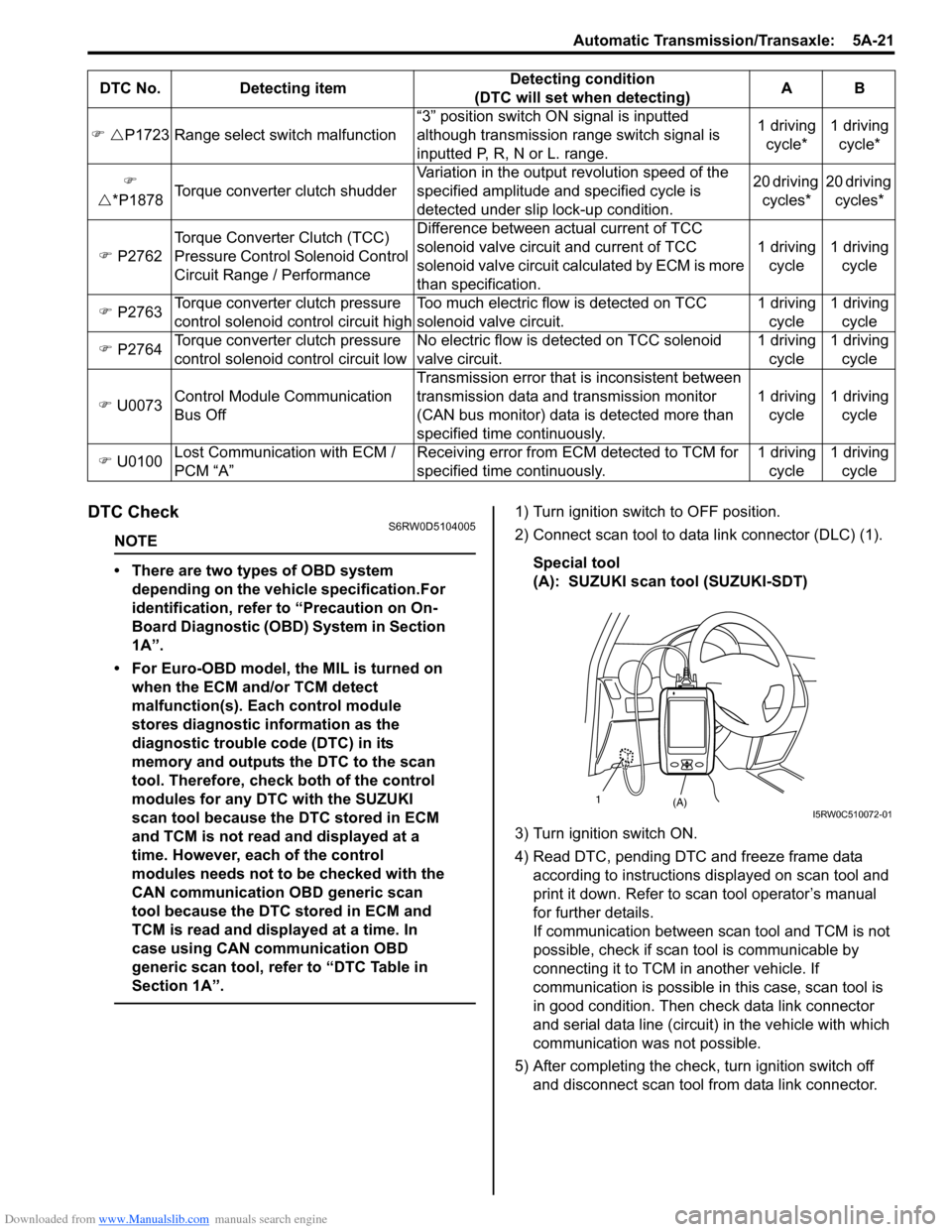
DTC CheckS6RW0D5104005
NOTE
• There are two types of OBD system
depending on the vehicle specification.For
identification, refer to “Precaution on On-
Board Diagnostic (OBD) System in Section
1A”.
• For Euro-OBD model, the MIL is turned on
when the ECM and/or TCM detect
malfunction(s). Each control module
stores diagnostic information as the
diagnostic trouble code (DTC) in its
memory and outputs the DTC to the scan
tool. Therefore, check both of the control
modules for any DTC with the SUZUKI
scan tool because the DTC stored in ECM
and TCM is not read and displayed at a
time. However, each of the control
modules needs not to be checked with the
CAN communication OBD generic scan
tool because the DTC stored in ECM and
TCM is read and displayed at a time. In
case using CAN communication OBD
generic scan tool, refer to “DTC Table in
Section 1A”.
1) Turn ignition switch to OFF position.
2) Connect scan tool to data link connector (DLC) (1).
Special tool
(A): SUZUKI scan tool (SUZUKI-SDT)
3) Turn ignition switch ON.
4) Read DTC, pending DTC and freeze frame data
according to instructions displayed on scan tool and
print it down. Refer to scan tool operator’s manual
for further details.
If communication between scan tool and TCM is not
possible, check if scan tool is communicable by
connecting it to TCM in another vehicle. If
communication is possible in this case, scan tool is
in good condition. Then check data link connector
and serial data line (circuit) in the vehicle with which
communication was not possible.
5) After completing the check, turn ignition switch off
and disconnect scan tool from data link connector. ) UP1723 Range select switch malfunction“3” position switch ON signal is inputted
although transmission range switch signal is
inputted P, R, N or L. range.1 driving
cycle*1 driving
cycle*
)
U*P1878Torque converter clutch shudderVariation in the output revolution speed of the
specified amplitude and specified cycle is
detected under slip lock-up condition.20 driving
cycles*20 driving
cycles*
) P2762Torque Converter Clutch (TCC)
Pressure Control Solenoid Control
Circuit Range / PerformanceDifference between actual current of TCC
solenoid valve circuit and current of TCC
solenoid valve circuit calculated by ECM is more
than specification.1 driving
cycle1 driving
cycle
) P2763Torque converter clutch pressure
control solenoid control circuit highToo much electric flow is detected on TCC
solenoid valve circuit.1 driving
cycle1 driving
cycle
) P2764Torque converter clutch pressure
control solenoid control circuit lowNo electric flow is detected on TCC solenoid
valve circuit.1 driving
cycle1 driving
cycle
) U0073Control Module Communication
Bus OffTransmission error that is inconsistent between
transmission data and transmission monitor
(CAN bus monitor) data is detected more than
specified time continuously.1 driving
cycle1 driving
cycle
) U0100Lost Communication with ECM /
PCM “A”Receiving error from ECM detected to TCM for
specified time continuously.1 driving
cycle1 driving
cycle DTC No. Detecting itemDetecting condition
(DTC will set when detecting)AB
(A) 1I5RW0C510072-01
Page 670 of 1556
Downloaded from www.Manualslib.com manuals search engine 5A-22 Automatic Transmission/Transaxle:
DTC ClearanceS6RW0D5104006
WARNING!
When performing a driving test, select a safe
place where there is neither any traffic nor
any traffic accident possibility and be very
careful during testing to avoid occurrence of
an accident.
After repair or replace malfunction part(s), clear all DTCs
by performing the following procedure.
1) Connect SUZUKI scan tool to data link connector in
the same manner as when making this connection
for “DTC Check”.
2) Turn ignition switch ON.3) Erase DTC and pending DTC according to
instructions displayed on scan tool. Refer to scan
tool operator’s manual for further details.
4) After completing the clearance, turn ignition switch
OFF and disconnect scan tool from data link
connector (DLC).
NOTE
DTC and freeze frame data stored in TCM
memory are also cleared in the following
cases. Be careful not to clear them before
keeping their record.
• When the same malfunction (DTC) is not
detected again during 40 engine warm-up
cycles.
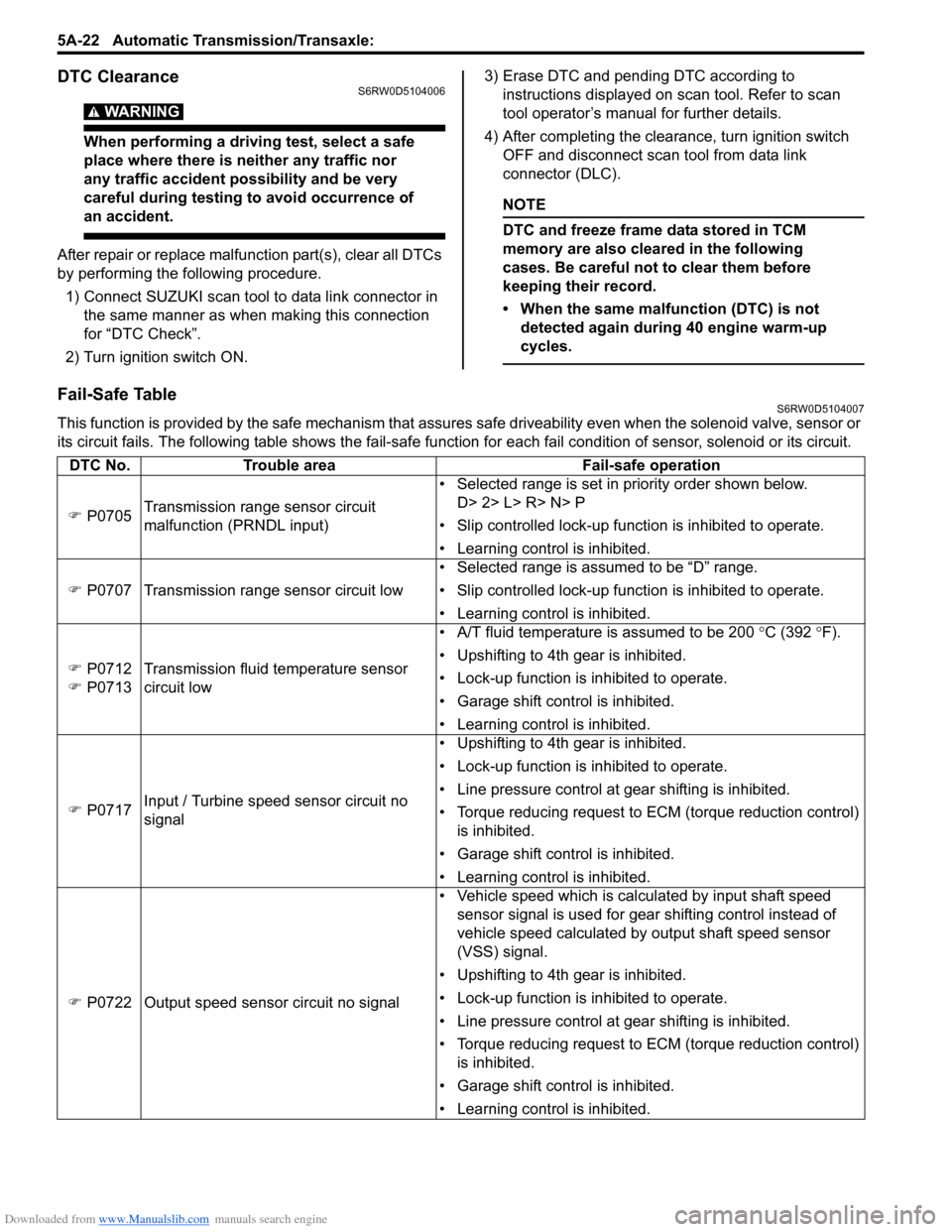
Fail-Safe TableS6RW0D5104007
This function is provided by the safe mechanism that assures safe driveability even when the solenoid valve, sensor or
its circuit fails. The following table shows the fail-safe function for each fail condition of sensor, solenoid or its circuit.
DTC No. Trouble area Fail-safe operation
) P0705Transmission range sensor circuit
malfunction (PRNDL input)• Selected range is set in priority order shown below.
D> 2> L> R> N> P
• Slip controlled lock-up function is inhibited to operate.
• Learning control is inhibited.
) P0707 Transmission range sensor circuit low• Selected range is assumed to be “D” range.
• Slip controlled lock-up function is inhibited to operate.
• Learning control is inhibited.
) P0712
) P0713Transmission fluid temperature sensor
circuit low• A/T fluid temperature is assumed to be 200 °C (392 °F).
• Upshifting to 4th gear is inhibited.
• Lock-up function is inhibited to operate.
• Garage shift control is inhibited.
• Learning control is inhibited.
) P0717Input / Turbine speed sensor circuit no
signal• Upshifting to 4th gear is inhibited.
• Lock-up function is inhibited to operate.
• Line pressure control at gear shifting is inhibited.
• Torque reducing request to ECM (torque reduction control)
is inhibited.
• Garage shift control is inhibited.
• Learning control is inhibited.
) P0722 Output speed sensor circuit no signal• Vehicle speed which is calculated by input shaft speed
sensor signal is used for gear shifting control instead of
vehicle speed calculated by output shaft speed sensor
(VSS) signal.
• Upshifting to 4th gear is inhibited.
• Lock-up function is inhibited to operate.
• Line pressure control at gear shifting is inhibited.
• Torque reducing request to ECM (torque reduction control)
is inhibited.
• Garage shift control is inhibited.
• Learning control is inhibited.
Page 672 of 1556
Downloaded from www.Manualslib.com manuals search engine 5A-24 Automatic Transmission/Transaxle:
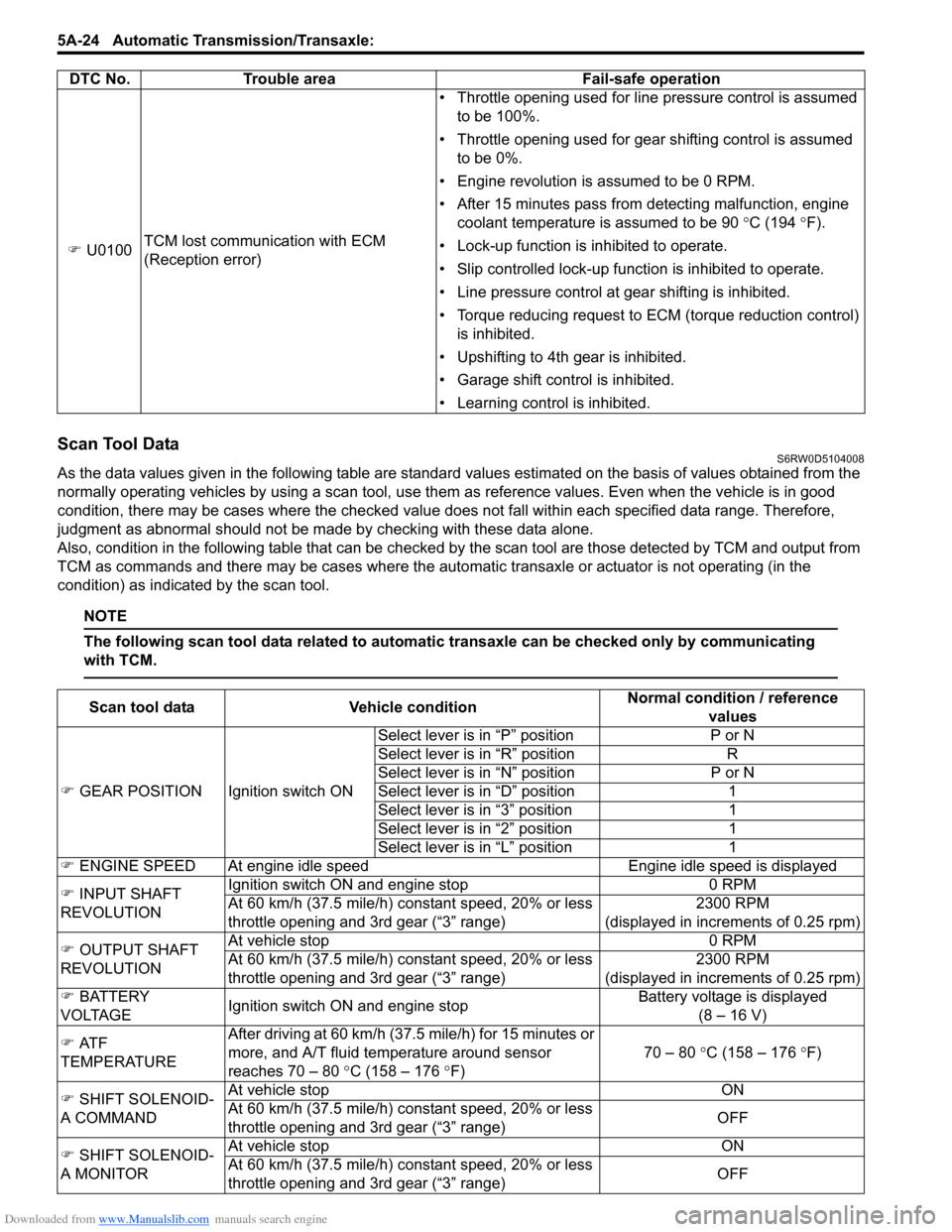
Scan Tool DataS6RW0D5104008
As the data values given in the following table are standard values estimated on the basis of values obtained from the
normally operating vehicles by using a scan tool, use them as reference values. Even when the vehicle is in good
condition, there may be cases where the checked value does not fall within each specified data range. Therefore,
judgment as abnormal should not be made by checking with these data alone.
Also, condition in the following table that can be checked by the scan tool are those detected by TCM and output from
TCM as commands and there may be cases where the automatic transaxle or actuator is not operating (in the
condition) as indicated by the scan tool.
NOTE
The following scan tool data related to automatic transaxle can be checked only by communicating
with TCM.
) U0100TCM lost communication with ECM
(Reception error)• Throttle opening used for line pressure control is assumed
to be 100%.
• Throttle opening used for gear shifting control is assumed
to be 0%.
• Engine revolution is assumed to be 0 RPM.
• After 15 minutes pass from detecting malfunction, engine
coolant temperature is assumed to be 90 °C (194 °F).
• Lock-up function is inhibited to operate.
• Slip controlled lock-up function is inhibited to operate.
• Line pressure control at gear shifting is inhibited.
• Torque reducing request to ECM (torque reduction control)
is inhibited.
• Upshifting to 4th gear is inhibited.
• Garage shift control is inhibited.
• Learning control is inhibited. DTC No. Trouble area Fail-safe operation
Scan tool data Vehicle conditionNormal condition / reference
values
) GEAR POSITION Ignition switch ONSelect lever is in “P” position P or N
Select lever is in “R” position R
Select lever is in “N” position P or N
Select lever is in “D” position 1
Select lever is in “3” position 1
Select lever is in “2” position 1
Select lever is in “L” position 1
) ENGINE SPEED At engine idle speed Engine idle speed is displayed
) INPUT SHAFT
REVOLUTIONIgnition switch ON and engine stop 0 RPM
At 60 km/h (37.5 mile/h) constant speed, 20% or less
throttle opening and 3rd gear (“3” range)2300 RPM
(displayed in increments of 0.25 rpm)
) OUTPUT SHAFT
REVOLUTIONAt vehicle stop 0 RPM
At 60 km/h (37.5 mile/h) constant speed, 20% or less
throttle opening and 3rd gear (“3” range)2300 RPM
(displayed in increments of 0.25 rpm)
) BATTERY
VOLTAGEIgnition switch ON and engine stopBattery voltage is displayed
(8 – 16 V)
) AT F
TEMPERATUREAfter driving at 60 km/h (37.5 mile/h) for 15 minutes or
more, and A/T fluid temperature around sensor
reaches 70 – 80 °C (158 – 176 °F)70 – 80 °C (158 – 176 °F)
) SHIFT SOLENOID-
A COMMANDAt vehicle stop ON
At 60 km/h (37.5 mile/h) constant speed, 20% or less
throttle opening and 3rd gear (“3” range)OFF
) SHIFT SOLENOID-
A MONITORAt vehicle stop ON
At 60 km/h (37.5 mile/h) constant speed, 20% or less
throttle opening and 3rd gear (“3” range)OFF