Precautions SUZUKI SX4 2006 1.G Service Owners Manual
[x] Cancel search | Manufacturer: SUZUKI, Model Year: 2006, Model line: SX4, Model: SUZUKI SX4 2006 1.GPages: 1556, PDF Size: 37.31 MB
Page 256 of 1556
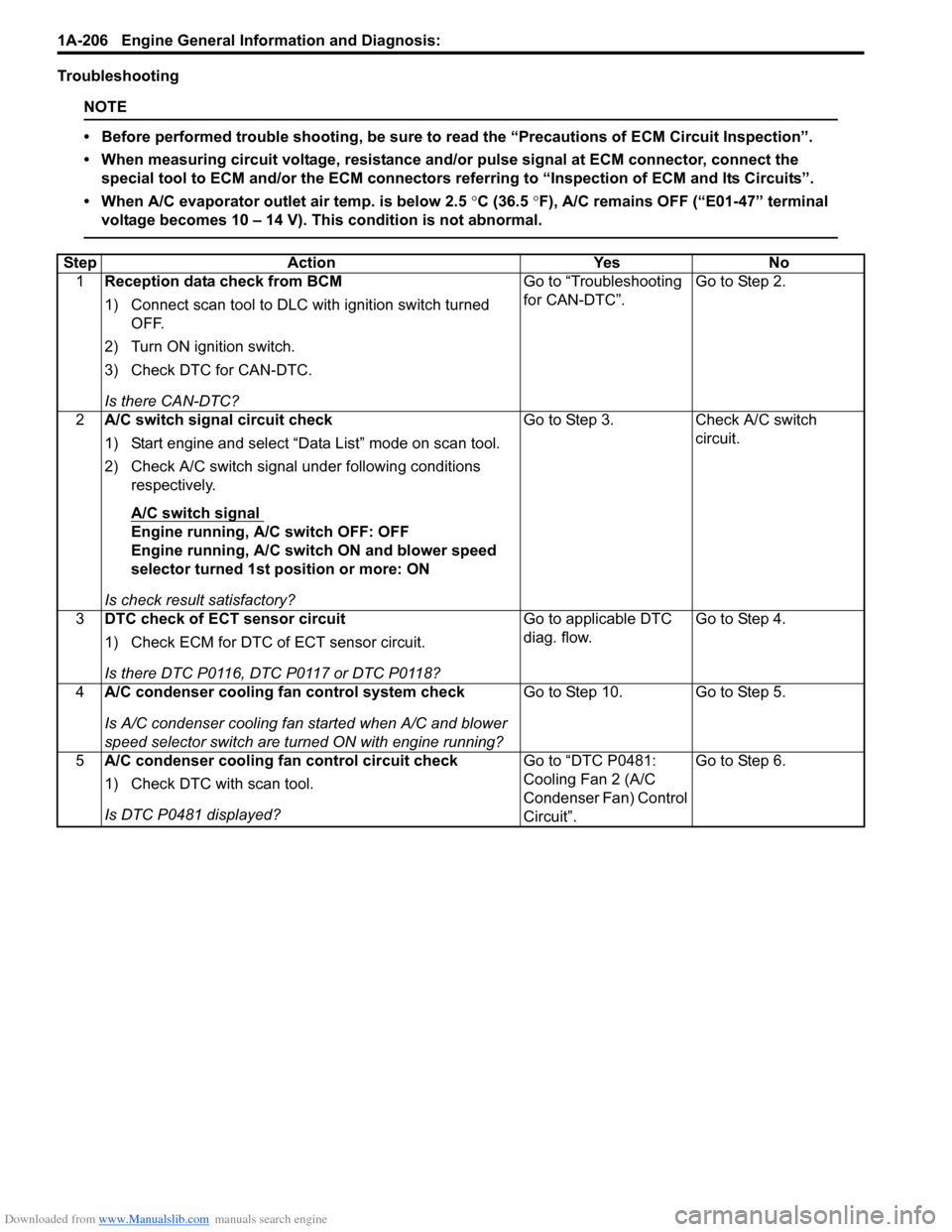
Downloaded from www.Manualslib.com manuals search engine 1A-206 Engine General Information and Diagnosis:
Troubleshooting
NOTE
• Before performed trouble shooting, be sure to read the “Precautions of ECM Circuit Inspection”.
• When measuring circuit voltage, resistance and/or pulse signal at ECM connector, connect the
special tool to ECM and/or the ECM connectors referring to “Inspection of ECM and Its Circuits”.
• When A/C evaporator outlet air temp. is below 2.5 °C (36.5 °F), A/C remains OFF (“E01-47” terminal
voltage becomes 10 – 14 V). This condition is not abnormal.
Step Action Yes No
1Reception data check from BCM
1) Connect scan tool to DLC with ignition switch turned
OFF.
2) Turn ON ignition switch.
3) Check DTC for CAN-DTC.
Is there CAN-DTC?Go to “Troubleshooting
for CAN-DTC”.Go to Step 2.
2A/C switch signal circuit check
1) Start engine and select “Data List” mode on scan tool.
2) Check A/C switch signal under following conditions
respectively.
A/C switch signal
Engine running, A/C switch OFF: OFF
Engine running, A/C switch ON and blower speed
selector turned 1st position or more: ON
Is check result satisfactory?Go to Step 3. Check A/C switch
circuit.
3DTC check of ECT sensor circuit
1) Check ECM for DTC of ECT sensor circuit.
Is there DTC P0116, DTC P0117 or DTC P0118?Go to applicable DTC
diag. flow.Go to Step 4.
4A/C condenser cooling fan control system check
Is A/C condenser cooling fan started when A/C and blower
speed selector switch are turned ON with engine running?Go to Step 10. Go to Step 5.
5A/C condenser cooling fan control circuit check
1) Check DTC with scan tool.
Is DTC P0481 displayed?Go to “DTC P0481:
Cooling Fan 2 (A/C
Condenser Fan) Control
Circuit”.Go to Step 6.
Page 260 of 1556
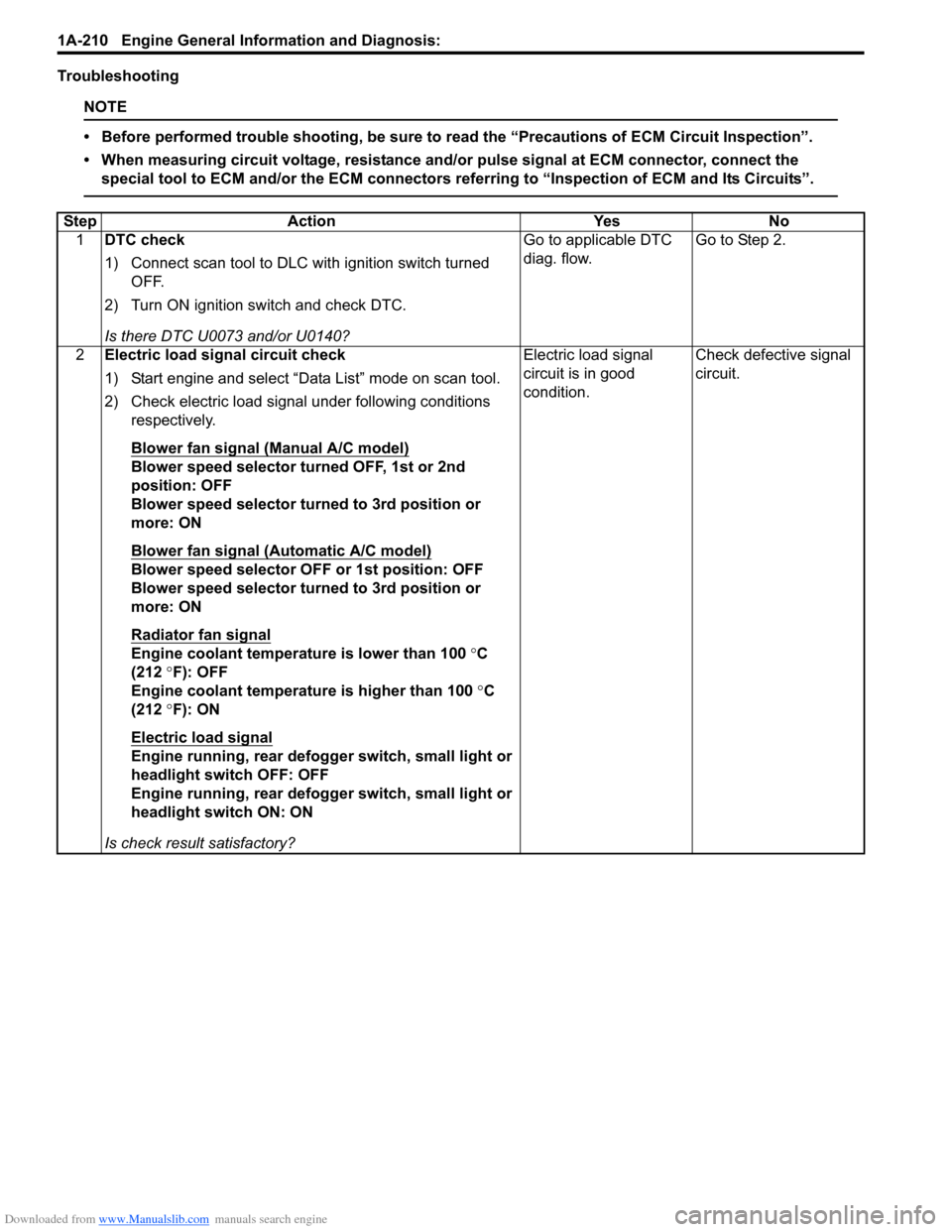
Downloaded from www.Manualslib.com manuals search engine 1A-210 Engine General Information and Diagnosis:
Troubleshooting
NOTE
• Before performed trouble shooting, be sure to read the “Precautions of ECM Circuit Inspection”.
• When measuring circuit voltage, resistance and/or pulse signal at ECM connector, connect the
special tool to ECM and/or the ECM connectors referring to “Inspection of ECM and Its Circuits”.
Step Action Yes No
1DTC check
1) Connect scan tool to DLC with ignition switch turned
OFF.
2) Turn ON ignition switch and check DTC.
Is there DTC U0073 and/or U0140?Go to applicable DTC
diag. flow.Go to Step 2.
2Electric load signal circuit check
1) Start engine and select “Data List” mode on scan tool.
2) Check electric load signal under following conditions
respectively.
Blower fan signal (Manual A/C model)
Blower speed selector turned OFF, 1st or 2nd
position: OFF
Blower speed selector turned to 3rd position or
more: ON
Blower fan signal (Automatic A/C model)
Blower speed selector OFF or 1st position: OFF
Blower speed selector turned to 3rd position or
more: ON
Radiator fan signal
Engine coolant temperature is lower than 100 °C
(212 °F): OFF
Engine coolant temperature is higher than 100 °C
(212 °F): ON
Electric load signal
Engine running, rear defogger switch, small light or
headlight switch OFF: OFF
Engine running, rear defogger switch, small light or
headlight switch ON: ON
Is check result satisfactory?Electric load signal
circuit is in good
condition.Check defective signal
circuit.
Page 261 of 1556
Downloaded from www.Manualslib.com manuals search engine Engine General Information and Diagnosis: 1A-211
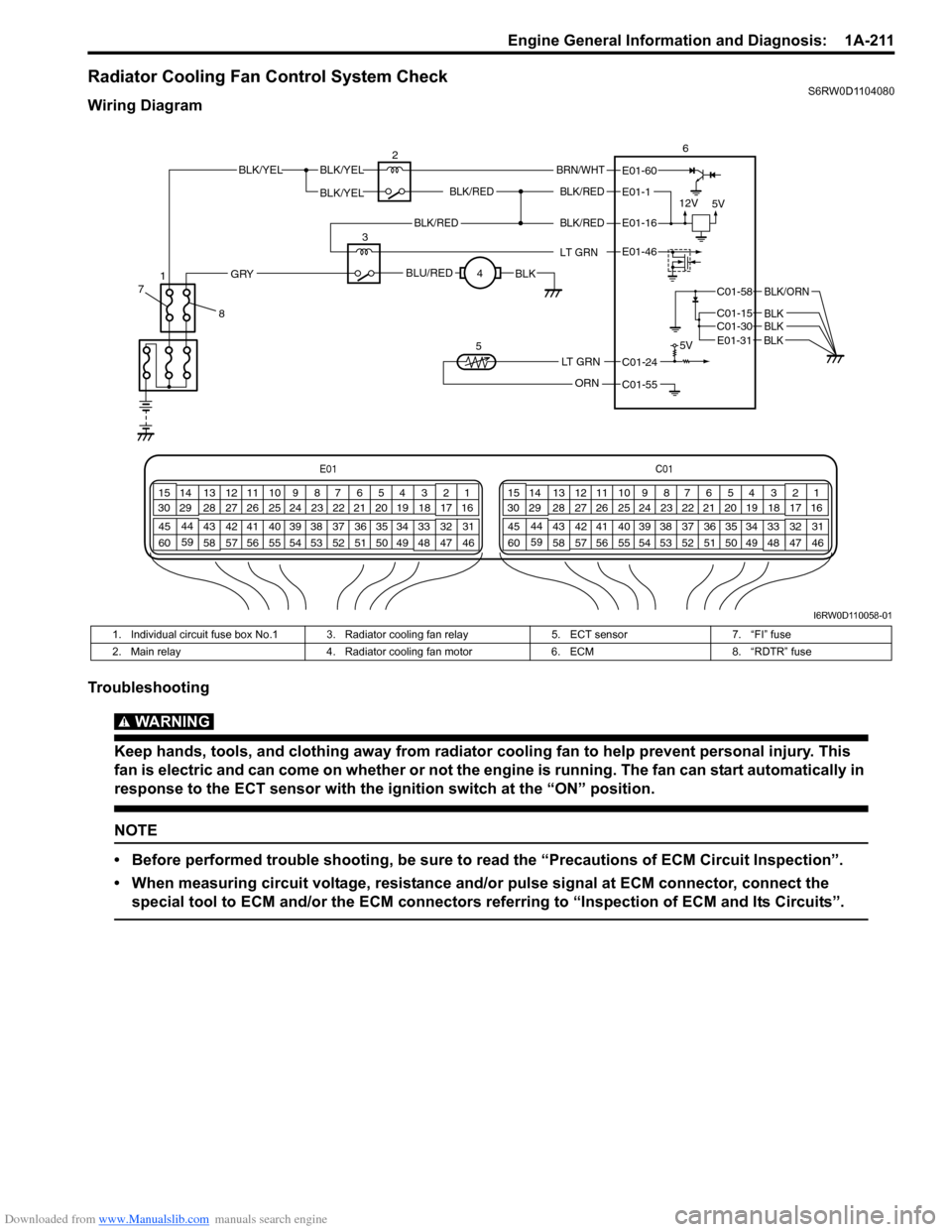
Radiator Cooling Fan Control System CheckS6RW0D1104080
Wiring Diagram
Troubleshooting
WARNING!
Keep hands, tools, and clothing away from radiator cooling fan to help prevent personal injury. This
fan is electric and can come on whether or not the engine is running. The fan can start automatically in
response to the ECT sensor with the ignition switch at the “ON” position.
NOTE
• Before performed trouble shooting, be sure to read the “Precautions of ECM Circuit Inspection”.
• When measuring circuit voltage, resistance and/or pulse signal at ECM connector, connect the
special tool to ECM and/or the ECM connectors referring to “Inspection of ECM and Its Circuits”.
E01C01
3 4
18 19 5 6 7 10 11
17 20
47 46 49 50 51 21 22
5216 259
24 14
29
55 57 54 53 59
60 582
26 27 28 15
30
56 4832 31 34 35 36 37 40 42 39 38 44
45 43 41 331 12 13
238 3 4
18 19 5 6 7 10 11
17 20
47 46 49 50 51 21 22
5216 259
24 14
29
55 57 54 53 59
60 582
26 27 28 15
30
56 4832 31 34 35 36 37 40 42 39 38 44
45 43 41 331 12 13
238
BLK/REDBLK/RED
BLK/YELBLK/YEL
BLK/YEL
BRN/WHT
12V
5V5V
26
E01-1
E01-60
C01-58
C01-15 C01-30
BLK/ORN
BLKBLK
BLK/RED
LT GRN
BLK/REDE01-16
E01-46
BLU/REDBLKGRY
LT GRN
ORN
C01-24
C01-55 3
4
5
E01-31 BLK
8 71
I6RW0D110058-01
1. Individual circuit fuse box No.1 3. Radiator cooling fan relay 5. ECT sensor 7. “FI” fuse
2. Main relay 4. Radiator cooling fan motor 6. ECM 8. “RDTR” fuse
Page 265 of 1556
Downloaded from www.Manualslib.com manuals search engine Aux. Emission Control Devices: 1B-2
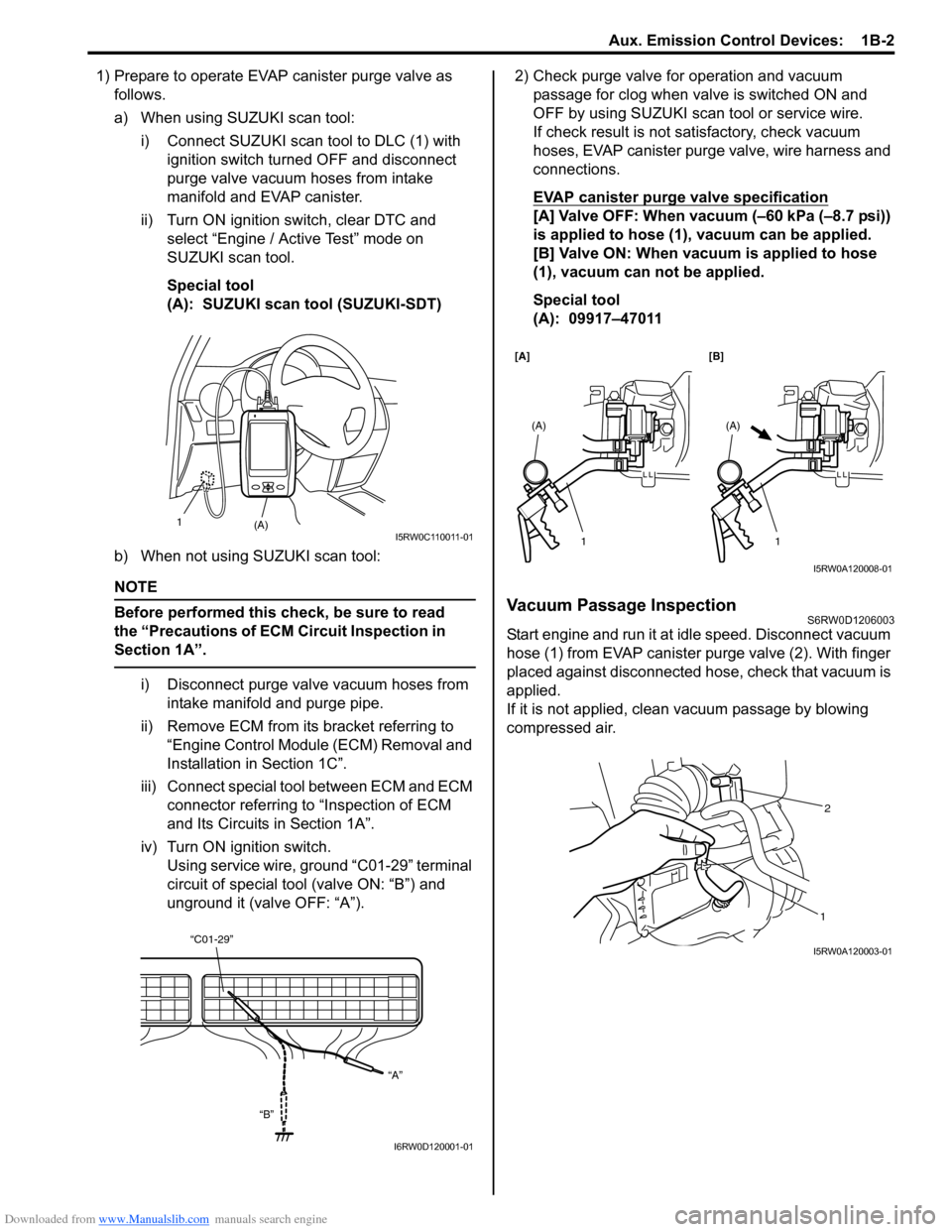
1) Prepare to operate EVAP canister purge valve as
follows.
a) When using SUZUKI scan tool:
i) Connect SUZUKI scan tool to DLC (1) with
ignition switch turned OFF and disconnect
purge valve vacuum hoses from intake
manifold and EVAP canister.
ii) Turn ON ignition switch, clear DTC and
select “Engine / Active Test” mode on
SUZUKI scan tool.
Special tool
(A): SUZUKI scan tool (SUZUKI-SDT)
b) When not using SUZUKI scan tool:
NOTE
Before performed this check, be sure to read
the “Precautions of ECM Circuit Inspection in
Section 1A”.
i) Disconnect purge valve vacuum hoses from
intake manifold and purge pipe.
ii) Remove ECM from its bracket referring to
“Engine Control Module (ECM) Removal and
Installation in Section 1C”.
iii) Connect special tool between ECM and ECM
connector referring to “Inspection of ECM
and Its Circuits in Section 1A”.
iv) Turn ON ignition switch.
Using service wire, ground “C01-29” terminal
circuit of special tool (valve ON: “B”) and
unground it (valve OFF: “A”).2) Check purge valve for operation and vacuum
passage for clog when valve is switched ON and
OFF by using SUZUKI scan tool or service wire.
If check result is not satisfactory, check vacuum
hoses, EVAP canister purge valve, wire harness and
connections.
EVAP canister purge valve specification
[A] Valve OFF: When vacuum (–60 kPa (–8.7 psi))
is applied to hose (1), vacuum can be applied.
[B] Valve ON: When vacuum is applied to hose
(1), vacuum can not be applied.
Special tool
(A): 09917–47011
Vacuum Passage InspectionS6RW0D1206003
Start engine and run it at idle speed. Disconnect vacuum
hose (1) from EVAP canister purge valve (2). With finger
placed against disconnected hose, check that vacuum is
applied.
If it is not applied, clean vacuum passage by blowing
compressed air.
(A) 1I5RW0C110011-01
“C01-29”
“A”
“B”
I6RW0D120001-01
[A]
1 (A)
[B]
1 (A)
I5RW0A120008-01
1
2
I5RW0A120003-01
Page 273 of 1556
Downloaded from www.Manualslib.com manuals search engine Engine Electrical Devices: 1C-5
Electric Throttle Body System CalibrationS6RW0D1306004
NOTE
If the service described under the
“Precautions of Electric Throttle Body
System Calibration in Section 1A” is
performed, calibrate electric throttle body
system as follows.
1) If electric throttle body assembly and/or accelerator
pedal position (APP) sensor assembly are replaced,
perform following steps.
a) Disconnect negative cable at battery for 20
seconds or more for the purpose of clearing
calibration data of closed throttle position from
memory in ECM.
b) Connect negative cable to battery.
2) Keep ignition switch at ON position for 5 seconds or
more without running engine.
Accelerator Pedal Position (APP) Sensor
Assembly On-Vehicle Inspection
S6RW0D1306005
1) Check that APP sensor assembly has been mounted
to vehicle body properly (no pinched floor carpet,
etc.).
If mounting is not properly, reinstall APP sensor
assembly properly referring to “Accelerator Pedal
Position (APP) Sensor Assembly Removal and
Installation”.
2) Connect scan tool to DLC with ignition switch turned
OFF.
3) Turn ON ignition switch and select “Data List” mode
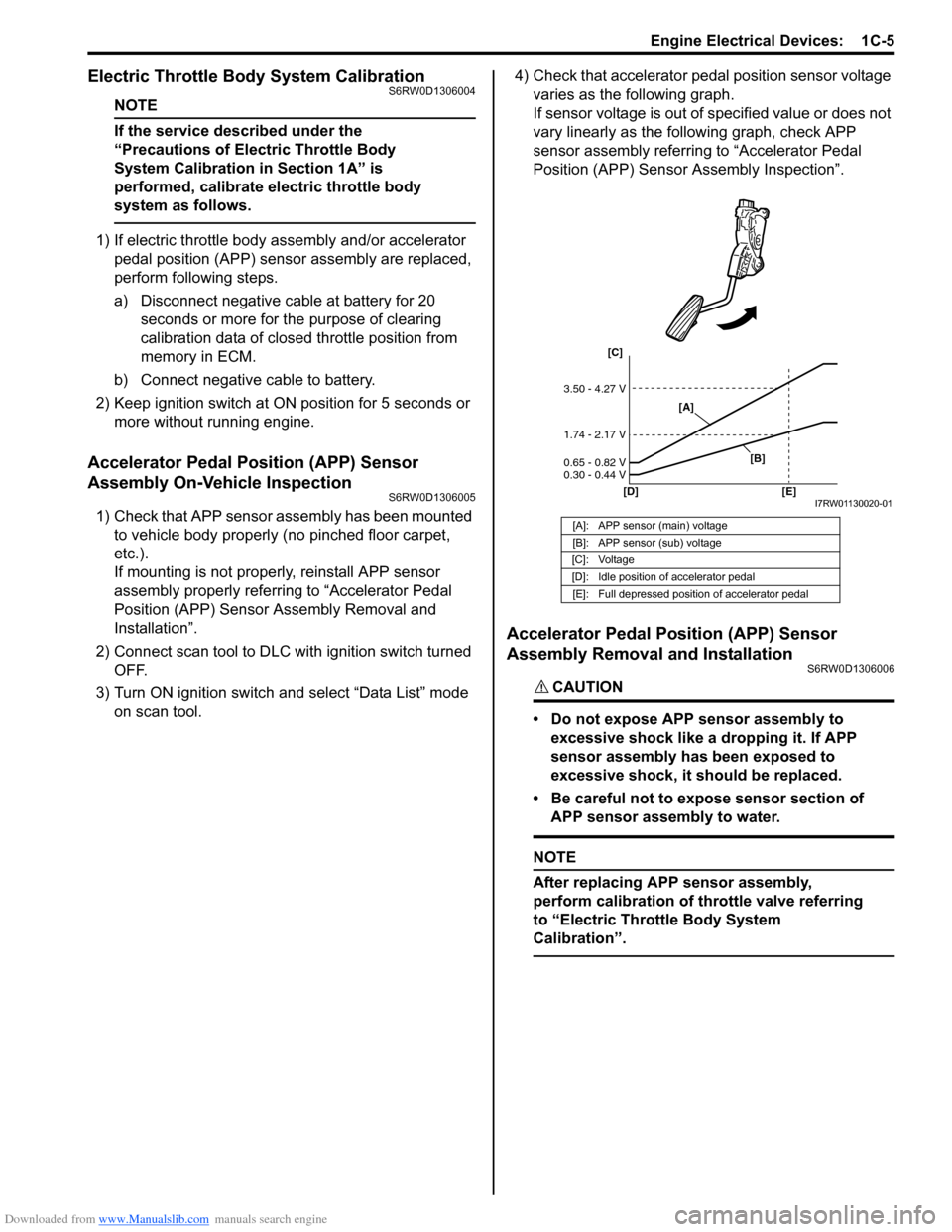
on scan tool.4) Check that accelerator pedal position sensor voltage
varies as the following graph.
If sensor voltage is out of specified value or does not
vary linearly as the following graph, check APP
sensor assembly referring to “Accelerator Pedal
Position (APP) Sensor Assembly Inspection”.
Accelerator Pedal Position (APP) Sensor
Assembly Removal and Installation
S6RW0D1306006
CAUTION!
• Do not expose APP sensor assembly to
excessive shock like a dropping it. If APP
sensor assembly has been exposed to
excessive shock, it should be replaced.
• Be careful not to expose sensor section of
APP sensor assembly to water.
NOTE
After replacing APP sensor assembly,
perform calibration of throttle valve referring
to “Electric Throttle Body System
Calibration”.
[A]: APP sensor (main) voltage
[B]: APP sensor (sub) voltage
[C]: Voltage
[D]: Idle position of accelerator pedal
[E]: Full depressed position of accelerator pedal
[C]
[D] [E]
3.50 - 4.27 V
1.74 - 2.17 V
0.65 - 0.82 V
0.30 - 0.44 V
[A]
[B]
I7RW01130020-01
Page 280 of 1556
Downloaded from www.Manualslib.com manuals search engine 1C-12 Engine Electrical Devices:
Main Relay, Fuel Pump Relay, Starting Motor
Control Relay, Throttle Actuator Control Relay
and Radiator Cooling Fan Relay Inspection
S6RW0D1306017
1) Disconnect negative cable at battery.
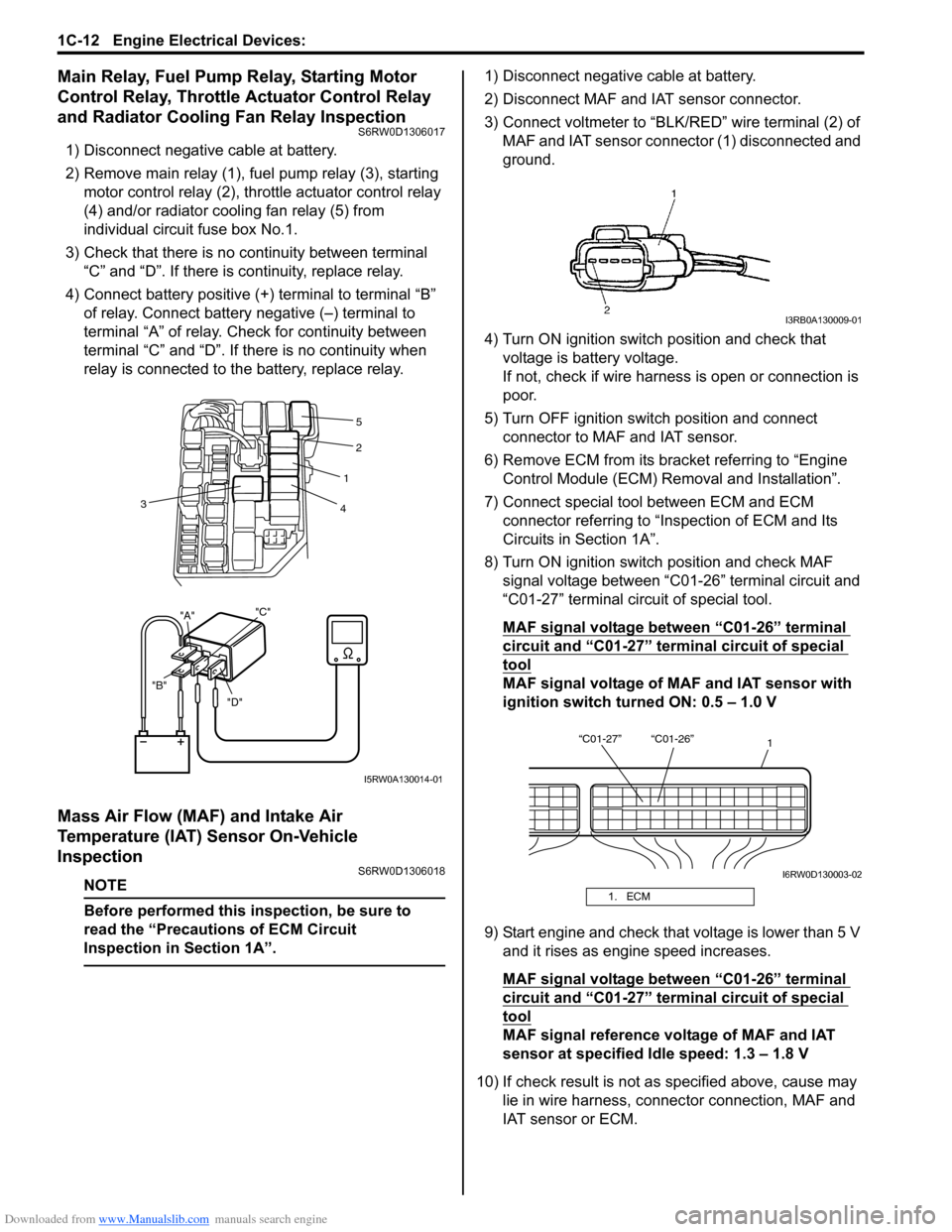
2) Remove main relay (1), fuel pump relay (3), starting
motor control relay (2), throttle actuator control relay
(4) and/or radiator cooling fan relay (5) from
individual circuit fuse box No.1.
3) Check that there is no continuity between terminal
“C” and “D”. If there is continuity, replace relay.
4) Connect battery positive (+) terminal to terminal “B”
of relay. Connect battery negative (–) terminal to
terminal “A” of relay. Check for continuity between
terminal “C” and “D”. If there is no continuity when
relay is connected to the battery, replace relay.
Mass Air Flow (MAF) and Intake Air
Temperature (IAT) Sensor On-Vehicle
Inspection
S6RW0D1306018
NOTE
Before performed this inspection, be sure to
read the “Precautions of ECM Circuit
Inspection in Section 1A”.
1) Disconnect negative cable at battery.
2) Disconnect MAF and IAT sensor connector.
3) Connect voltmeter to “BLK/RED” wire terminal (2) of
MAF and IAT sensor connector (1) disconnected and
ground.
4) Turn ON ignition switch position and check that
voltage is battery voltage.
If not, check if wire harness is open or connection is
poor.
5) Turn OFF ignition switch position and connect
connector to MAF and IAT sensor.
6) Remove ECM from its bracket referring to “Engine
Control Module (ECM) Removal and Installation”.
7) Connect special tool between ECM and ECM
connector referring to “Inspection of ECM and Its
Circuits in Section 1A”.
8) Turn ON ignition switch position and check MAF
signal voltage between “C01-26” terminal circuit and
“C01-27” terminal circuit of special tool.
MAF signal voltage between “C01-26” terminal
circuit and “C01-27” terminal circuit of special
tool
MAF signal voltage of MAF and IAT sensor with
ignition switch turned ON: 0.5 – 1.0 V
9) Start engine and check that voltage is lower than 5 V
and it rises as engine speed increases.
MAF signal voltage between “C01-26” terminal
circuit and “C01-27” terminal circuit of special
tool
MAF signal reference voltage of MAF and IAT
sensor at specified Idle speed: 1.3 – 1.8 V
10) If check result is not as specified above, cause may
lie in wire harness, connector connection, MAF and
IAT sensor or ECM.
"D" "B""A""C"
2
1
4 3
5
I5RW0A130014-01
1. ECM
I3RB0A130009-01
“C01-27” “C01-26”
1
I6RW0D130003-02
Page 378 of 1556
Downloaded from www.Manualslib.com manuals search engine 1G-1 Fuel System:
Engine
Fuel System
Precautions
Precautions on Fuel System ServiceS6RW0D1700001
WARNING!
Before attempting service of any type on fuel system, the following should be always observed in
order to reduce the risk of fire and personal injury.
• Disconnect negative cable at battery.
• Do not smoke, and place no smoking signs near work area.
• Be sure to have CO
2 fire extinguisher handy.
• Be sure to perform work in a well-ventilated area and away from any open flames (such as gas hot
heater).
• Wear safety glasses.
• To relieve fuel vapor pressure in fuel tank, remove fuel filler cap from fuel filler neck and then
reinstall it.
• As fuel feed line is still under high fuel pressure even after stopping engine, loosening or
disconnecting fuel feed line directly may cause dangerous spout of fuel. Before loosening or
disconnecting fuel feed line, make sure to relieve fuel pressure referring to “Fuel Pressure Relief
Procedure”.
• A small amount of fuel may be released when the fuel line is disconnected. In order to reduce the
risk of personal injury, cover a shop cloth to the fitting to be disconnected. Be sure to put that cloth
in an approved container after disconnecting.
• Never run engine with fuel pump relay disconnected when engine and exhaust system are hot.
• Note that fuel hose connection varies with each type of pipe. Be sure to connect and clamp each
hose correctly referring to “Fuel Hose Disconnecting and Reconnecting”.
After connecting, make sure that it has no twist or kink.
• When installing injector or fuel feed pipe, lubricate its O-ring with gasoline.
• When servicing the fuel tank, it should be treated with respect, with no contact with sharp edges or
hot surfaces. In addition, the fuel tank should not be dropped since fuel tank, fuel pump and other
components can be damaged by the impact. If dropped, all components should be replaced because
there is a risk of damage.
• The fuel tank is made of resin.
Be sure not to allow solvent (chemical article such as grease and sealant) to attach to the fuel tank
as some chemical reaction may occur, causing the fuel tank to be swollen, hardened or distorted
leakage and resulting in fuel leakage from the fuel tank.
Page 380 of 1556
Downloaded from www.Manualslib.com manuals search engine 1G-3 Fuel System:
Schematic and Routing Diagram
Fuel Delivery System DiagramS6RW0D1702001
Diagnostic Information and Procedures
Fuel Pressure InspectionS6RW0D1704001
WARNING!
Before starting the following procedure, be
sure to observe “Precautions on Fuel System
Service” in order to reduce the risk of fire and
personal injury.
1) Relieve fuel pressure in fuel feed line referring to
“Fuel Pressure Relief Procedure”.
2) Disconnect fuel feed hose from fuel delivery pipe.
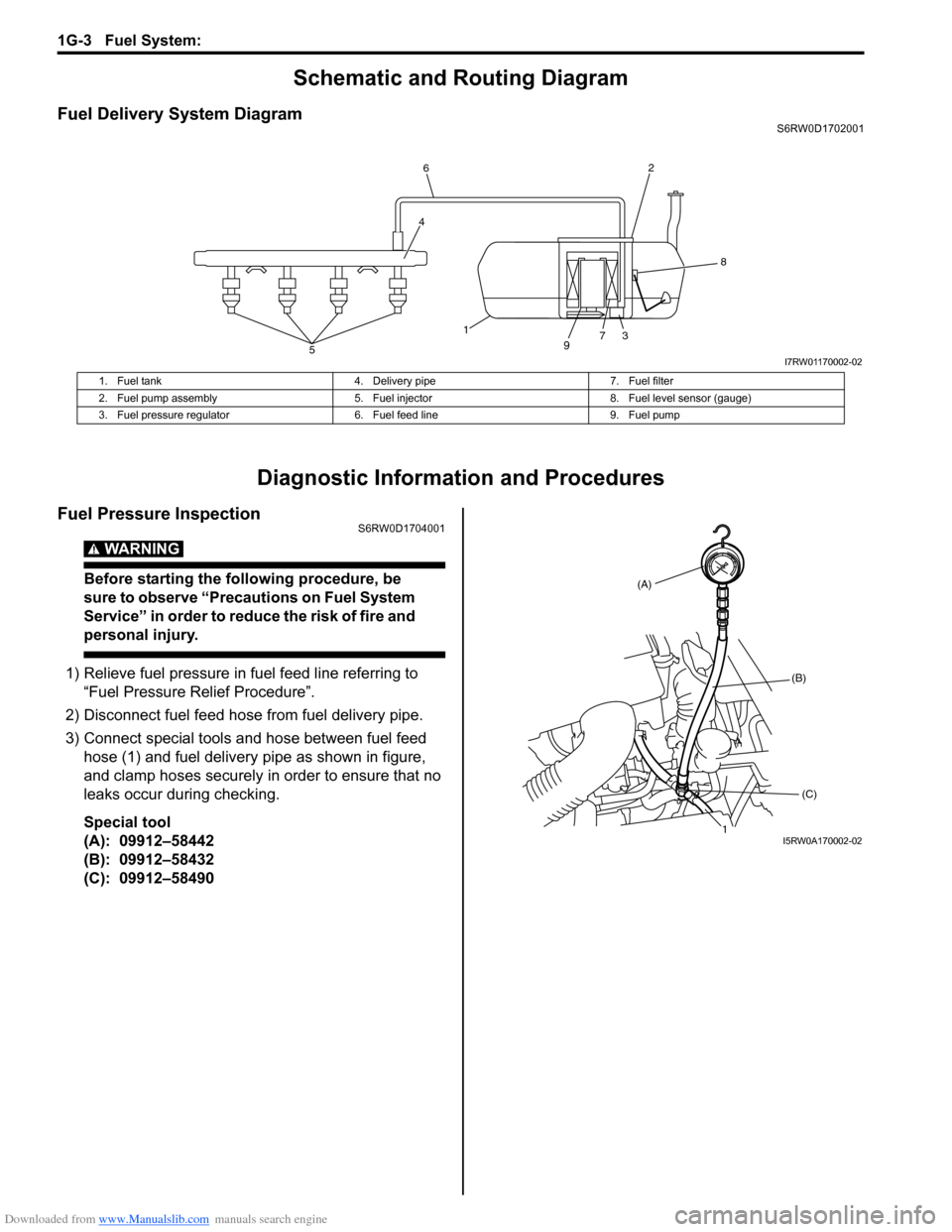
3) Connect special tools and hose between fuel feed
hose (1) and fuel delivery pipe as shown in figure,
and clamp hoses securely in order to ensure that no
leaks occur during checking.
Special tool
(A): 09912–58442
(B): 09912–58432
(C): 09912–58490
73 6
1 4
5
8
9
2
I7RW01170002-02
1. Fuel tank 4. Delivery pipe 7. Fuel filter
2. Fuel pump assembly 5. Fuel injector 8. Fuel level sensor (gauge)
3. Fuel pressure regulator 6. Fuel feed line 9. Fuel pump
(C) (B)
(A)
1I5RW0A170002-02
Page 383 of 1556

Downloaded from www.Manualslib.com manuals search engine Fuel System: 1G-6
Fuel Hose Disconnecting and ReconnectingS6RW0D1706002
WARNING!
Before starting the following procedure, be sure to observe “Precautions on Fuel System Service” in
order to reduce the risk of fire and personal injury.
For Connection Other Than Quick Joint
• Clamp around fuel tank
NOTE
Be sure to install hose to spool of pipe surely.
9. Fuel tank bolt 19. Grommet
10. Fuel tank belt 20. O-ring
I7RW01170005-01
[A]: Connection A “b”: 30 mm (1.18 in.) 1. Pipe
[B]: Connection B “c”: 38 mm (1.50 in.) 2. Hose
[C]: Connection C “d”: 5 – 12 mm (0.20 – 0.48 in.) 3. Clamp
[D]: Connection D “e”: 7 – 14 mm (0.28 – 0.55 in.) : 1.5 N⋅m (0.15 kgf-m, 1.0 lb-ft)
“a”: 3 – 7 mm (0.12 – 0.28 in.) “f”: 2 mm (0.08 in.)
Page 385 of 1556
Downloaded from www.Manualslib.com manuals search engine Fuel System: 1G-8
6) Start engine and run it until engine stops for lack of
fuel. Repeat cranking engine 2 – 3 times for about 3
seconds each time in order to dissipate fuel pressure
in lines. Fuel connections are now safe for servicing.
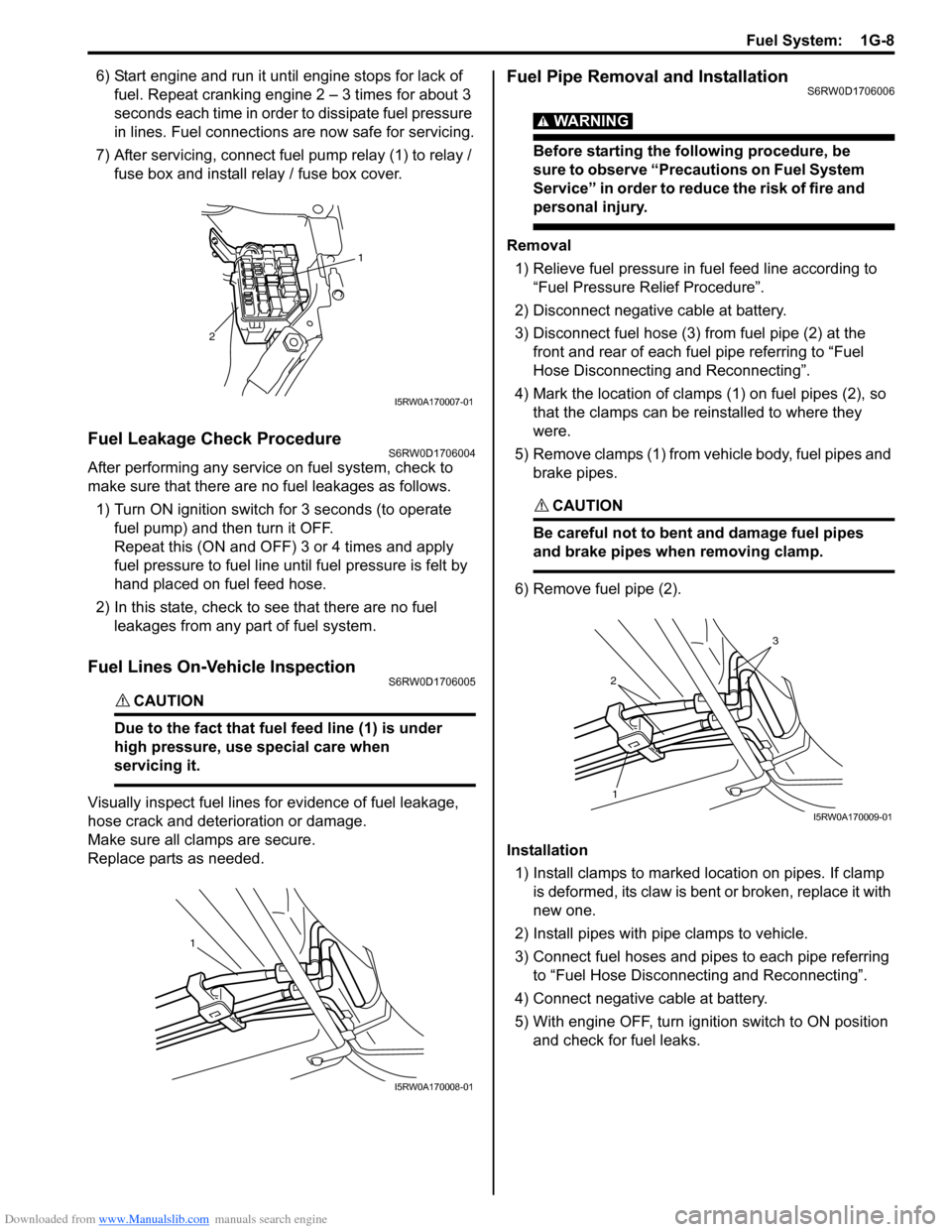
7) After servicing, connect fuel pump relay (1) to relay /
fuse box and install relay / fuse box cover.
Fuel Leakage Check ProcedureS6RW0D1706004
After performing any service on fuel system, check to
make sure that there are no fuel leakages as follows.
1) Turn ON ignition switch for 3 seconds (to operate
fuel pump) and then turn it OFF.
Repeat this (ON and OFF) 3 or 4 times and apply
fuel pressure to fuel line until fuel pressure is felt by
hand placed on fuel feed hose.
2) In this state, check to see that there are no fuel
leakages from any part of fuel system.
Fuel Lines On-Vehicle InspectionS6RW0D1706005
CAUTION!
Due to the fact that fuel feed line (1) is under
high pressure, use special care when
servicing it.
Visually inspect fuel lines for evidence of fuel leakage,
hose crack and deterioration or damage.
Make sure all clamps are secure.
Replace parts as needed.
Fuel Pipe Removal and InstallationS6RW0D1706006
WARNING!
Before starting the following procedure, be
sure to observe “Precautions on Fuel System
Service” in order to reduce the risk of fire and
personal injury.
Removal
1) Relieve fuel pressure in fuel feed line according to
“Fuel Pressure Relief Procedure”.
2) Disconnect negative cable at battery.
3) Disconnect fuel hose (3) from fuel pipe (2) at the
front and rear of each fuel pipe referring to “Fuel
Hose Disconnecting and Reconnecting”.
4) Mark the location of clamps (1) on fuel pipes (2), so
that the clamps can be reinstalled to where they
were.
5) Remove clamps (1) from vehicle body, fuel pipes and
brake pipes.
CAUTION!
Be careful not to bent and damage fuel pipes
and brake pipes when removing clamp.
6) Remove fuel pipe (2).
Installation
1) Install clamps to marked location on pipes. If clamp
is deformed, its claw is bent or broken, replace it with
new one.
2) Install pipes with pipe clamps to vehicle.
3) Connect fuel hoses and pipes to each pipe referring
to “Fuel Hose Disconnecting and Reconnecting”.
4) Connect negative cable at battery.
5) With engine OFF, turn ignition switch to ON position
and check for fuel leaks.
1
2
I5RW0A170007-01
1
I5RW0A170008-01
2
3
1
I5RW0A170009-01