Precautions SUZUKI SX4 2006 1.G Service Manual Online
[x] Cancel search | Manufacturer: SUZUKI, Model Year: 2006, Model line: SX4, Model: SUZUKI SX4 2006 1.GPages: 1556, PDF Size: 37.31 MB
Page 204 of 1556

Downloaded from www.Manualslib.com manuals search engine 1A-154 Engine General Information and Diagnosis:
DTC Troubleshooting
NOTE
Before this troubleshooting is performed, read the precautions for DTC troubleshooting referring to
“Precautions for DTC Troubleshooting”.
Step Action Yes No
1Was “Engine and Emission Control System Check”
performed? Go to Step 2. Go to “Engine and
Emission Control
System Check”.
2APP sensor assembly mounting check
1) Check that APP sensor assembly has been mounted to
vehicle body properly (no pinched floor carpet, etc.).
Is it OK?Go to Step 3. Reinstall APP sensor
assembly properly
referring to “Accelerator
Pedal Position (APP)
Sensor Assembly
Removal and
Installation in Section
1C”.
3APP sensor (main) and its circuit check
1) Connect scan tool to DLC with ignition switch turned
OFF.
2) Turn ON ignition switch, check “APP Sensor 1 Volt”
displayed on scan tool.
Is displayed voltage 4.76 V or more?Go to Step 4. Intermittent trouble.
Check for intermittent
referring to “Intermittent
and Poor Connection
Inspection in Section
00”.
4ECM voltage check
1) Disconnect connector from APP sensor assembly with
ignition switch turned OFF.
2) Check for proper connection to APP sensor assembly at
“BRN”, “GRN” and “BLU” wire terminals.
3) If OK, measure voltage between “BRN” wire terminal of
APP sensor assembly connector and vehicle body
ground with ignition switch turned ON.
Is voltage 4 – 6 V?Go to Step 6. Go to Step 5.
5Wire harness check
1) Disconnect connectors from ECM with ignition switch
turned OFF.
2) Check for proper connection of ECM connector at “E01-
35” terminal.
3) If OK, measure voltage between “E01-35” terminal of
ECM connector and engine ground with ignition switch
turned ON.
Is voltage 0 V?Substitute a known-
good ECM and recheck.“BRN” wire is shorted to
power circuit.
"GRN" "BLU" "BRN"
"YEL"
"WHT"
"RED"
I4RS0B110048-01
Page 206 of 1556

Downloaded from www.Manualslib.com manuals search engine 1A-156 Engine General Information and Diagnosis:
DTC Confirmation Procedure
1) With ignition switch turned OFF, connect scan tool.
2) Turn ON ignition switch and clear DTC using scan tool.
3) Keep the accelerator pedal at idle position for 2 seconds.
4) Keep the accelerator pedal at fully depressed position for 2 seconds.
5) Repeat Step 3) and 4) for 3 times.
6) Check DTC.
DTC Troubleshooting
NOTE
Before this troubleshooting is performed, read the precautions for DTC troubleshooting referring to
“Precautions for DTC Troubleshooting”.
Step Action Yes No
1Was “Engine and Emission Control System Check”
performed?Go to Step 2. Go to “Engine and
Emission Control
System Check”.
2APP sensor assembly mounting check
1) Check that APP sensor assembly has been mounted to
vehicle body properly (no pinched floor carpet, etc.).
Is it OK?Go to Step 3. Reinstall APP sensor
assembly properly
referring to “Accelerator
Pedal Position (APP)
Sensor Assembly
Removal and
Installation in Section
1C”.
3APP sensor (sub) and its circuit check
1) Connect scan tool to DLC with ignition switch turned
OFF.
2) Turn ON ignition switch, check “APP Sensor 2 Volt”
displayed on scan tool.
Is displayed voltage below 0.179 V?Go to Step 4. Intermittent trouble.
Check for intermittent
referring to “Intermittent
and Poor Connection
Inspection in Section
00”.
4ECM voltage check
1) Disconnect connector from APP sensor assembly with
ignition switch turned OFF.
2) Check for proper connection to APP sensor assembly at
“RED”, “YEL” and “WHT” wire terminals.
3) If OK, measure voltage between “RED” wire terminal of
APP sensor assembly connector and vehicle body
ground with ignition switch turned ON.
Is voltage 4 – 6 V?Go to Step 7. Go to Step 5.
"GRN" "BLU" "BRN"
"YEL"
"WHT"
"RED"
I4RS0B110048-01
Page 208 of 1556

Downloaded from www.Manualslib.com manuals search engine 1A-158 Engine General Information and Diagnosis:
DTC P2128: Pedal Position Sensor (Sub) Circuit High InputS6RW0D1104065
Wiring Diagram
Refer to “DTC P2122: Pedal Position Sensor (Main) Circuit Low Input”.
DTC Detecting Condition and Trouble Area
DTC Confirmation Procedure
1) With ignition switch turned OFF, connect scan tool.
2) Turn ON ignition switch and clear DTC using scan tool.
3) Keep the accelerator pedal at idle position for 2 seconds.
4) Keep the accelerator pedal at fully depressed position for 2 seconds.
5) Repeat Step 3) and 4) for 3 times.
6) Check DTC.
DTC Troubleshooting
NOTE
Before this troubleshooting is performed, read the precautions for DTC troubleshooting referring to
“Precautions for DTC Troubleshooting”.
DTC detecting condition Trouble area
Output voltage of APP sensor (sub) is higher than specified value.
(1 driving detection logic)• APP sensor (sub) circuit
• APP sensor assembly
•ECM
• Incorrect mounting of APP sensor assembly
Step Action Yes No
1Was “Engine and Emission Control System Check”
performed?Go to Step 2. Go to “Engine and
Emission Control
System Check”.
2APP sensor assembly mounting check
1) Check that APP sensor assembly has been mounted to
vehicle body properly (no pinched floor carpet, etc.).
Is it OK?Go to Step 3. Reinstall APP sensor
assembly properly
referring to “Accelerator
Pedal Position (APP)
Sensor Assembly
Removal and
Installation in Section
1C”.
3APP sensor (sub) and its circuit check
1) Connect scan tool to DLC with ignition switch turned
OFF.
2) Turn ON ignition switch, check “APP Sensor 2 Volt”
displayed on scan tool.
Is displayed voltage 4.76 V or more?Go to Step 4. Intermittent trouble.
Check for intermittent
referring to “Intermittent
and Poor Connection
Inspection in Section
00”.
Page 211 of 1556
Downloaded from www.Manualslib.com manuals search engine Engine General Information and Diagnosis: 1A-161
DTC Detecting Condition and Trouble Area
DTC Confirmation Procedure
1) With ignition switch turned OFF, connect scan tool.
2) Turn ON ignition switch and clear DTC using scan tool.
3) Keep the accelerator pedal at idle position for 2 seconds.
4) Keep the accelerator pedal at fully depressed position for 2 seconds.
5) Repeat Step 3) and 4) for 3 times.
6) Check DTC.
DTC Troubleshooting
NOTE
Before this troubleshooting is performed, read the precautions for DTC troubleshooting referring to
“Precautions for DTC Troubleshooting”.
DTC detecting condition Trouble area
Difference between the opening angle based on throttle position
sensor (main) and the opening angle based on throttle position
sensor (sub) is more than specification for specified time.
(1 driving detection logic)• Throttle position sensor (main) and (sub) circuit
• Electric throttle body assembly
•ECM
Step Action Yes No
1Was “Engine and Emission Control System Check”
performed?Go to Step 2. Go to “Engine and
Emission Control
System Check”.
2Throttle position sensor and its circuit check
1) Connect scan tool to DLC with ignition switch turned
OFF.
2) Turn ON ignition switch, check each voltage of “TP
Sensor 1 Volt” and “TP Sensor 2 Volt” displayed on scan
tool when accelerator pedal is idle position and fully
depressed.
Is each TP sensor voltage within specified value in the table
“Scan Tool Data”?Intermittent trouble.
Check for intermittent
referring to “Intermittent
and Poor Connection
Inspection in Section
00”.Go to Step 3.
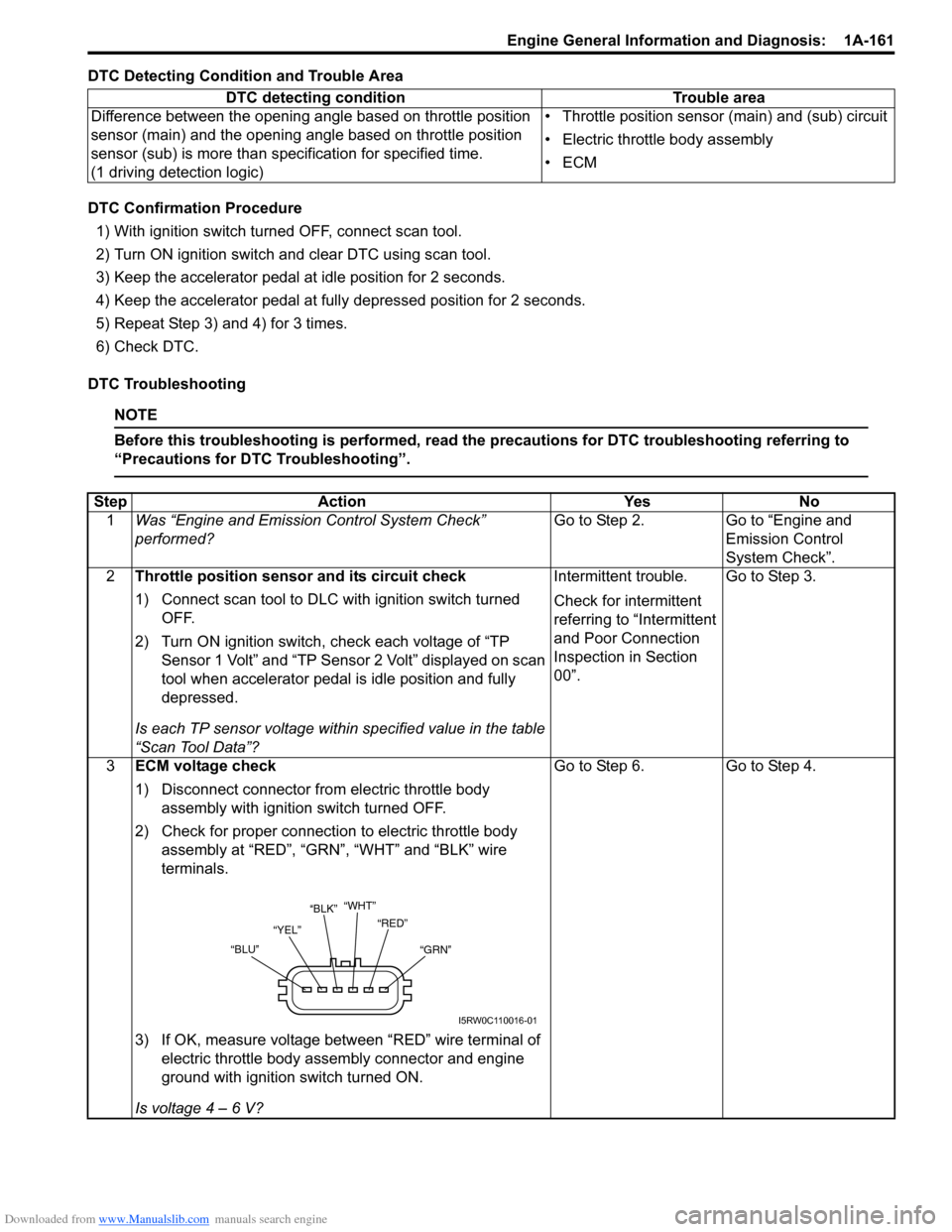
3ECM voltage check
1) Disconnect connector from electric throttle body
assembly with ignition switch turned OFF.
2) Check for proper connection to electric throttle body
assembly at “RED”, “GRN”, “WHT” and “BLK” wire
terminals.
3) If OK, measure voltage between “RED” wire terminal of
electric throttle body assembly connector and engine
ground with ignition switch turned ON.
Is voltage 4 – 6 V?Go to Step 6. Go to Step 4.
“WHT”
“YEL”“RED”
“GRN” “BLU”“BLK”
I5RW0C110016-01
Page 214 of 1556
Downloaded from www.Manualslib.com manuals search engine 1A-164 Engine General Information and Diagnosis:
DTC Troubleshooting
NOTE
Before this troubleshooting is performed, read the precautions for DTC troubleshooting referring to
“Precautions for DTC Troubleshooting”.
Step Action Yes No
1Was “Engine and Emission Control System Check”
performed?Go to Step 2. Go to “Engine and
Emission Control
System Check”.
2APP sensor and its circuit check
1) Connect scan tool to DLC with ignition switch turned
OFF.
2) Turn ON ignition switch.
3) Check each voltage of “APP Sensor 1 Volt” and “APP
Sensor 2 Volt” displayed on scan tool when accelerator
pedal is idle position and fully depressed.
Is each APP sensor voltage within specified value in the
table “Scan Tool Data”?Intermittent trouble.
Check for intermittent
referring to “Intermittent
and Poor Connection
Inspection in Section
00”.Go to Step 3.
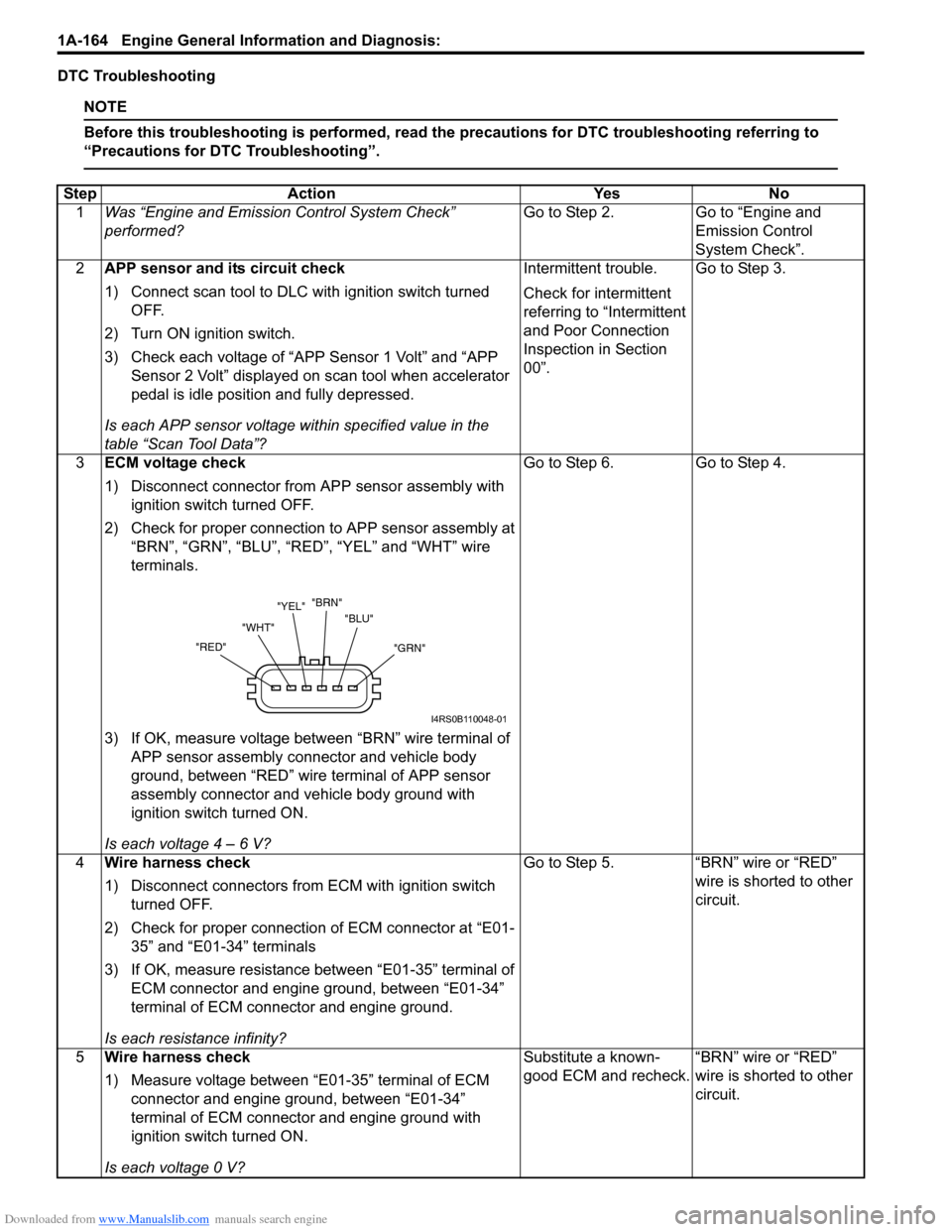
3ECM voltage check
1) Disconnect connector from APP sensor assembly with
ignition switch turned OFF.
2) Check for proper connection to APP sensor assembly at
“BRN”, “GRN”, “BLU”, “RED”, “YEL” and “WHT” wire
terminals.
3) If OK, measure voltage between “BRN” wire terminal of
APP sensor assembly connector and vehicle body
ground, between “RED” wire terminal of APP sensor
assembly connector and vehicle body ground with
ignition switch turned ON.
Is each voltage 4 – 6 V?Go to Step 6. Go to Step 4.
4Wire harness check
1) Disconnect connectors from ECM with ignition switch
turned OFF.
2) Check for proper connection of ECM connector at “E01-
35” and “E01-34” terminals
3) If OK, measure resistance between “E01-35” terminal of
ECM connector and engine ground, between “E01-34”
terminal of ECM connector and engine ground.
Is each resistance infinity?Go to Step 5. “BRN” wire or “RED”
wire is shorted to other
circuit.
5Wire harness check
1) Measure voltage between “E01-35” terminal of ECM
connector and engine ground, between “E01-34”
terminal of ECM connector and engine ground with
ignition switch turned ON.
Is each voltage 0 V?Substitute a known-
good ECM and recheck.“BRN” wire or “RED”
wire is shorted to other
circuit.
"GRN" "BLU" "BRN"
"YEL"
"WHT"
"RED"
I4RS0B110048-01
Page 216 of 1556

Downloaded from www.Manualslib.com manuals search engine 1A-166 Engine General Information and Diagnosis:
DTC Confirmation Procedure
DTC P2227:
WARNING!
• When performing a road test, select a place where there is no traffic or possibility of a traffic
accident and be very careful during testing to avoid occurrence of an accident.
• Road test should be carried out by 2 persons, a driver and a tester, on a level road.
1) Connect scan tool to DLC with ignition switch turned OFF.
2) Turn ON ignition switch and clear DTC, pending DTC and freeze frame data by using scan tool and warm up
engine to normal operating temperature.
3) Check DTC and pending DTC by using scan tool.
DTC P2228 / P2229:
1) Connect scan tool to DLC with ignition switch turned OFF.
2) Turn ON ignition switch, clear DTC by using scan tool and run engine for 1 min.
3) Check DTC and pending DTC by using scan tool.
DTC Troubleshooting
NOTE
Before this troubleshooting is performed, read the precautions for DTC troubleshooting referring to
“Precautions for DTC Troubleshooting”.
DTC U0073: Control Module Communication Bus OffS6RW0D1104069
Refer to “Troubleshooting for CAN-DTC”.
DTC U0101: Lost Communication with TCMS6RW0D1104082
Refer to “Troubleshooting for CAN-DTC”.
DTC U0121: Lost Communication with ABS Control ModuleS6RW0D1104070
Refer to“Troubleshooting for CAN-DTC”.
DTC U0140: Lost Communication with Body Control ModuleS6RW0D1104071
Refer to“Troubleshooting for CAN-DTC”.Step Action Yes No
1Was “Engine and Emission Control System Check”
performed?Go to Step 2. Go to “Engine and
Emission Control
System Check”.
2Is DTC P2227 set?Go to Step 3. Substitute a known-
good ECM and recheck.
3MAP sensor check
1) Check MAP sensor and its circuit referring to “DTC
P0107: Manifold Absolute Pressure Circuit Low
Input”and/or “DTC P0108: Manifold Absolute Pressure
Circuit High Input”.
Is check result satisfactory?Substitute a known-
good ECM and recheck.MAP sensor or its circuit
malfunction.
Page 222 of 1556

Downloaded from www.Manualslib.com manuals search engine 1A-172 Engine General Information and Diagnosis:
Inspection of ECM and Its CircuitsS6RW0D1104072
ECM and its circuits can be checked by measuring voltage, pulse signal and resistance with special tool connected.
CAUTION!
ECM cannot be checked by itself. It is strictly prohibited to connect voltmeter or ohmmeter to ECM
with ECM connectors disconnected from it.
Voltage Check
1) Remove ECM (1) from its bracket referring to “Engine Control Module (ECM) Removal and Installation in Section
1C”.
2) Connect special tool between ECM and ECM connectors securely.
Special tool
(A): 09933–06320
3) Check voltage and/or pulse signal using voltmeter (2) and oscilloscope (3).
NOTE
• As each terminal voltage is affected by battery voltage, confirm that it is 11 V or more when ignition
switch is turned ON.
• Voltage with asterisk (*) cannot be measured with voltmeter because it is pulse signal. Use
oscilloscope for its check if necessary.
• Before this inspection, be sure to read the “Precautions of ECM Circuit Inspection”.
Viewed from harness side
1
2
3(A)
I5JB0A110073-01
E01C01
3 4
18 19 5 6 7 10 11
17 20
47 46 49 50 51 21 22
5216 259
24 14
29
55 57 54 53 59
60 582
26 27 28 15
30
56 4832 31 34 35 36 37 40 42 39 38 44
45 43 41 331 12 13
238 3 4
18 19 5 6 7 10 11
17 20
47 46 49 50 51 21 22
5216 259
24 14
29
55 57 54 53 59
60 582
26 27 28 15
30
56 4832 31 34 35 36 37 40 42 39 38 44
45 43 41 331 12 13
238
I6RW0D110051-01
Page 244 of 1556
Downloaded from www.Manualslib.com manuals search engine 1A-194 Engine General Information and Diagnosis:
Troubleshooting
NOTE
• Before performed trouble shooting, be sure to read the “Precautions of ECM Circuit Inspection”.
• When measuring circuit voltage, resistance and/or pulse signal at ECM connector, connect the
special tool to ECM and/or the ECM connectors referring to “Inspection of ECM and Its Circuits”.
Step Action Yes No
1Circuit fuse check
1) Disconnect connectors from ECM with ignition switch
turned OFF.
2) Check for proper connection to ECM connector at “E01-
2”, “E01-29”, “E01-60”, “E01-1”, “E01-16”, “E01-31”,
“C01-58”, “C01-15” and “C01-30” terminals.
3) If OK, check “DOME” fuse and “IG COIL” fuse for
blowing.
Are “DOME” fuse and “IG COIL” fuse in good condition?Go to Step 2. Replace fuse (s) and
check for short in
circuits connected to
fuse(s).
2Power supply circuit check
1) Measure voltage between “E01-2” terminal of ECM
connector and body ground.
Is voltage 10 – 14 V?Go to Step 3. “WHT/RED” or “WHT”
wire is open circuit.
3Ignition signal check
1) Turn ignition switch to ON position.
2) Measure voltage between “E01-29” terminal of ECM
connector and body ground.
Is voltage 10 – 14 V?Go to Step 4. “BLK/WHT” or “GRN”
wire is open circuit.
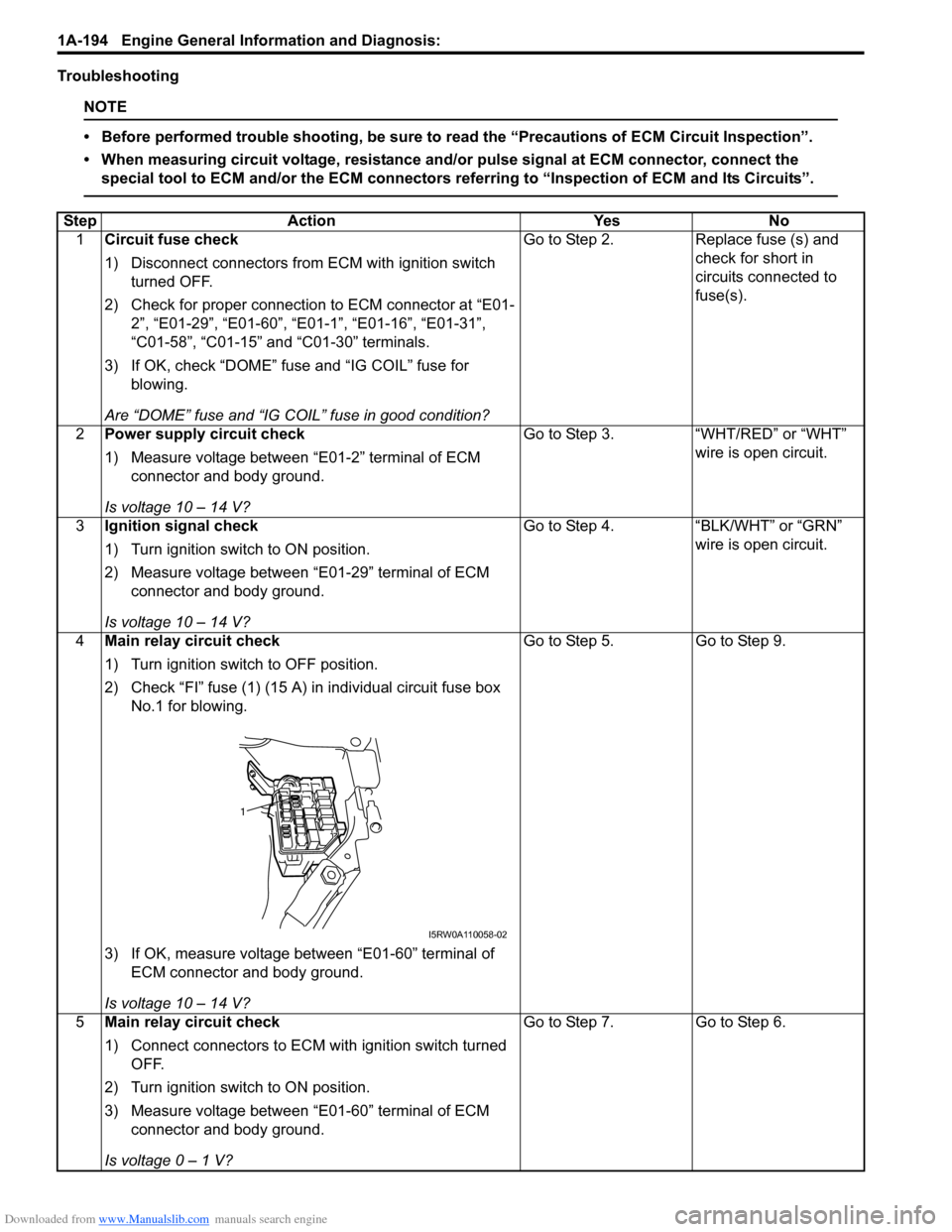
4Main relay circuit check
1) Turn ignition switch to OFF position.
2) Check “FI” fuse (1) (15 A) in individual circuit fuse box
No.1 for blowing.
3) If OK, measure voltage between “E01-60” terminal of
ECM connector and body ground.
Is voltage 10 – 14 V?Go to Step 5. Go to Step 9.
5Main relay circuit check
1) Connect connectors to ECM with ignition switch turned
OFF.
2) Turn ignition switch to ON position.
3) Measure voltage between “E01-60” terminal of ECM
connector and body ground.
Is voltage 0 – 1 V?Go to Step 7. Go to Step 6.
1
I5RW0A110058-02
Page 247 of 1556

Downloaded from www.Manualslib.com manuals search engine Engine General Information and Diagnosis: 1A-197
Troubleshooting
NOTE
• Before performed trouble shooting, be sure to read the “Precautions of ECM Circuit Inspection”.
• When measuring circuit voltage, resistance and/or pulse signal at ECM connector, connect the
special tool to ECM and/or the ECM connectors referring to “Inspection of ECM and Its Circuits”.
Step Action Yes No
1Fuel injector check for operating sound
1) Using sound scope, check each injector for operating
sound at engine cranking.
Do all 4 injector make operating sound?Fuel injectors circuit is
in good condition.Go to Step 2.
2Fuel injector resistance check
1) Disconnect connectors from fuel injectors with ignition
switch turned OFF.
2) Check for proper connection to fuel injector at each
terminals.
3) If OK, check all 4 fuel injectors for resistance referring to
“Fuel Injector On-Vehicle Inspection in Section 1G”.
Are all injectors in good condition?Go to Step 3. Faulty fuel injector.
3Fuel injector insulation resistance check
1) Check that there is insulation between each fuel injector
terminal and engine ground.
Is there insulation?Go to Step 4. Faulty fuel injector.
4Fuel injector power supply check
1) Measure voltage between each “BLK/RED” wire terminal
of fuel injector connector and engine ground with ignition
switch turned ON.
Is voltage 10 – 14 V?Go to Step 5. “BLK/RED” wire is open
or shorted to ground
circuit.
If it is in good condition,
go to “ECM Power and
Ground Circuit Check”.
5Wire circuit check
1) Turn OFF ignition switch.
2) Disconnect connectors from ECM.
3) Measure resistance between each “BLU/YEL”, “BLU/
WHT”, “BLU/RED”, “BLU/ORN” wire terminal of fuel
injector connector and vehicle body ground.
Is resistance infinity?Go to Step 6. “BLU/YEL”, “BLU/WHT”,
“BLU/RED” and/or
“BLU/ORN” wire(s) are
shorted to ground.
6Wire circuit check
1) Measure voltage between each “BLU/YEL”, “BLU/WHT”,
“BLU/RED”, “BLU/ORN” wire terminal of fuel injector
connector and vehicle body ground with ignition switch
turned ON.
Is voltage 0 V?Go to Step 7. “BLU/YEL”, “BLU/WHT”,
“BLU/RED” and/or
“BLU/ORN” wire(s) are
shorted to power supply
circuit.
7Fuel injector drive signal check
1) Connect connectors to each fuel injector and ECM with
ignition switch turned OFF.
2) Turn ON ignition switch.
3) Measure voltage between each “C01-1”, “C01-2”, “C01-
16”, “C01-17” terminal of ECM connector and vehicle
body ground.
Is voltage 10 – 14 V?Check fuel injector
referring to “Fuel
Injector Inspection in
Section 1G”.
If check result is
satisfactory, substitute a
known-good ECM and
recheck.“BLU/YEL”, “BLU/WHT”,
“BLU/RED” and/or
“BLU/ORN” wire(s) are
open circuit.
Page 249 of 1556
Downloaded from www.Manualslib.com manuals search engine Engine General Information and Diagnosis: 1A-199
Troubleshooting
NOTE
• Before performed trouble shooting, be sure to read the “Precautions of ECM Circuit Inspection”.
• When measuring circuit voltage, resistance and/or pulse signal at ECM connector, connect the
special tool to ECM and/or the ECM connectors referring to “Inspection of ECM and Its Circuits”.
Step Action Yes No
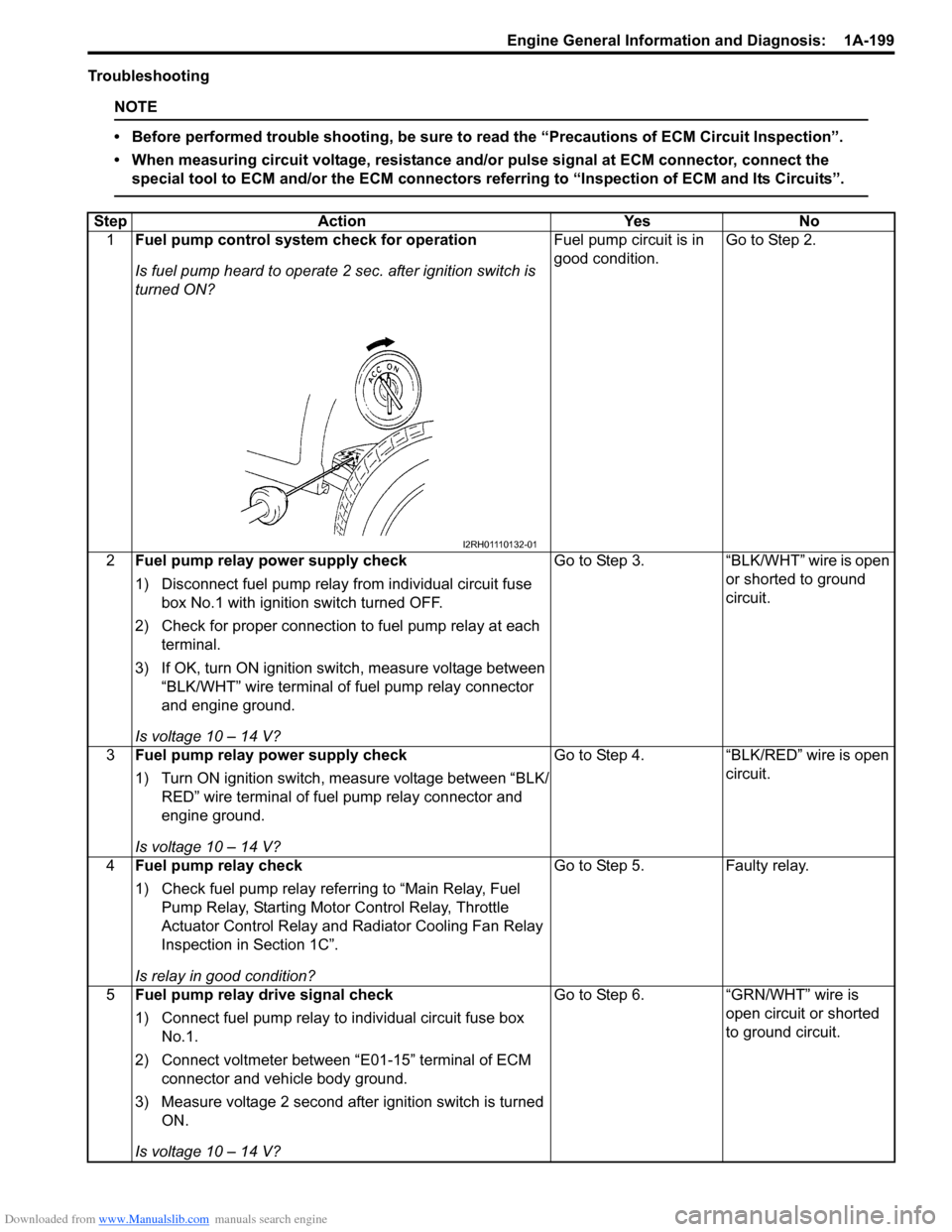
1Fuel pump control system check for operation
Is fuel pump heard to operate 2 sec. after ignition switch is
turned ON?Fuel pump circuit is in
good condition.Go to Step 2.
2Fuel pump relay power supply check
1) Disconnect fuel pump relay from individual circuit fuse
box No.1 with ignition switch turned OFF.
2) Check for proper connection to fuel pump relay at each
terminal.
3) If OK, turn ON ignition switch, measure voltage between
“BLK/WHT” wire terminal of fuel pump relay connector
and engine ground.
Is voltage 10 – 14 V?Go to Step 3. “BLK/WHT” wire is open
or shorted to ground
circuit.
3Fuel pump relay power supply check
1) Turn ON ignition switch, measure voltage between “BLK/
RED” wire terminal of fuel pump relay connector and
engine ground.
Is voltage 10 – 14 V?Go to Step 4. “BLK/RED” wire is open
circuit.
4Fuel pump relay check
1) Check fuel pump relay referring to “Main Relay, Fuel
Pump Relay, Starting Motor Control Relay, Throttle
Actuator Control Relay and Radiator Cooling Fan Relay
Inspection in Section 1C”.
Is relay in good condition?Go to Step 5. Faulty relay.
5Fuel pump relay drive signal check
1) Connect fuel pump relay to individual circuit fuse box
No.1.
2) Connect voltmeter between “E01-15” terminal of ECM
connector and vehicle body ground.
3) Measure voltage 2 second after ignition switch is turned
ON.
Is voltage 10 – 14 V?Go to Step 6. “GRN/WHT” wire is
open circuit or shorted
to ground circuit.
I2RH01110132-01