speed SUZUKI SX4 2006 1.G Service Owners Manual
[x] Cancel search | Manufacturer: SUZUKI, Model Year: 2006, Model line: SX4, Model: SUZUKI SX4 2006 1.GPages: 1556, PDF Size: 37.31 MB
Page 416 of 1556
Downloaded from www.Manualslib.com manuals search engine 1J-2 Charging System:
Care of battery
WARNING!
• Never expose battery to open flame or electric spark because of battery generate gas which is
flammable and explosive.
• Do not allow battery fluid to contact eyes, skin, fabrics, or painted surfaces as fluid is a corrosive
acid. Flush any contacted area with water immediately and thoroughly.
• Batteries should always be kept out of reach of children.
1) The battery is a very reliable component, but needs periodical attentions.
• Keep the battery carrier clean.
• Prevent rust formation on the terminal posts.
• Keep the electrolyte up to the upper level uniformly in all cells.
• When keeping battery on vehicle over a long period of time, follow instructions given below.
– Weekly, start the engine and run it until it reaches normal operating temperature with engine speed of 2000 to
3000 rpm. Make sure all electric switches are off before storing the vehicle.
– Recharge the battery twice a month to prevent it from discharging excessively. This is especially important
when ambient temperature is low.
The battery discharges even when it is not used, while vehicles are being stored. Battery electrolyte can
freeze and battery case can crack at cold ambient condition if battery is not properly charged.
2) Keep the battery cable connections clean.
The cable connections, particularly at the positive (+) terminal post, tend to become corroded. The product of
corrosion, or rust, on the mating faces of conductors resists the flow of current.
Clean the terminals and fittings periodically to ensure good metal-to-metal contact, and grease the connections
after each cleaning to protect them against rusting.
3) Be always in the know as to the state of charge of the battery. The simplest way to tell the state of charge is to
carry out a hydrometer test. The hydrometer is an instrument for measuring the specific gravity (S.G.) of the
battery electrolyte. The S.G. of the electrolyte is indicative of the state of charge. Refer to “Battery Inspection”.
Page 418 of 1556
Downloaded from www.Manualslib.com manuals search engine 1J-4 Charging System:
Diagnostic Information and Procedures
Battery InspectionS6RW0D1A04001
Common Causes of Failure
A battery is not designed to last indefinitely; however,
with proper care, it will provide many years of service. If
the battery performs satisfactorily during test buy fails to
operate properly for no apparent reason, the following
are some factors that may point to the cause of trouble:
• Accessories left on overnight or for an extended
period without the generator operating.
• Slow average driving speed for short periods.
• Electrical load exceeding generator output particularly
with addition of aftermarket equipment.
• Defects in charging system such as high resistance,
slipping drive belt, loose generator output terminal,
faulty generator or voltage regulator. Refer to
“Generator Symptom Diagnosis”.
• Battery abuse, including failure to keep battery cable
terminals clean and tight or loose battery hold down.
• Mechanical problems in electrical system such as
shorted or pinched wires.
Visual Inspection
Check for obvious damage, such as cracked or broken
case or cover, that could permit loss of electrolyte. If
obvious damage is noted, replace battery. Determine
cause of damage and correct as needed.
Generator Symptom DiagnosisS6RW0D1A04002
CAUTION!
• Do not mistake polarities of “IG” terminal
and “L” terminal.
• Do not create short circuit between “IG”
and “L” terminals. Always connect these
terminals through a lamp.
• Do not connect any load between “L” and
“E” terminals.
• When connecting charger or booster
battery to vehicle battery, refer to “Jump
Starting in Case of Emergency”.
Trouble in charging system will show up as one or more
of the following conditions:
1) Faulty indicator lamp operation.
2) An undercharged battery as evidenced by slow
cranking or indicator dark.
3) An overcharged battery as evidenced by excessive
spewing of electrolyte from vents.
Noise from generator may be caused by loose drive
pulley, loose mounting bolts, worn or dirty bearings,
defective diode, or defective stator.
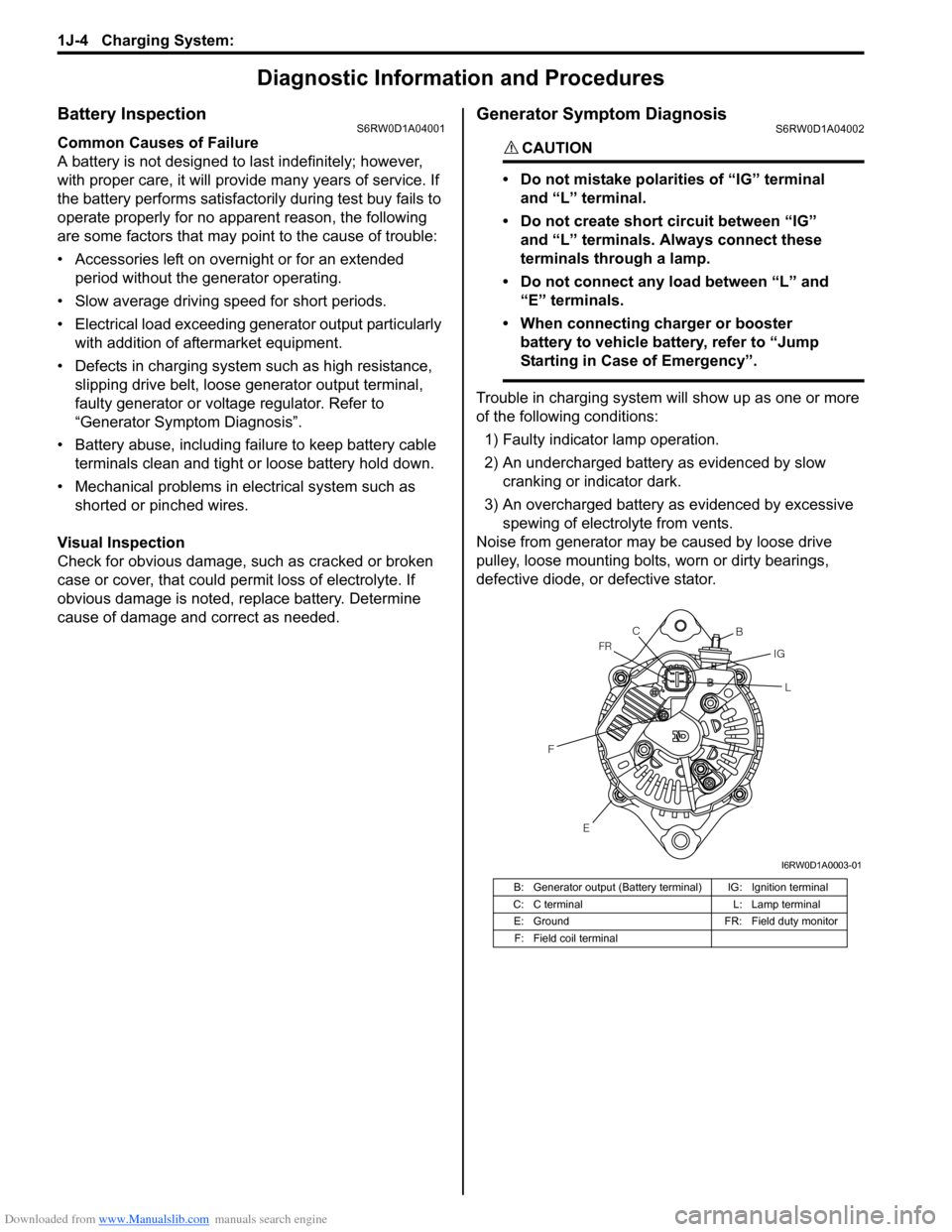
B: Generator output (Battery terminal) IG: Ignition terminal
C: C terminal L: Lamp terminal
E: Ground FR: Field duty monitor
F: Field coil terminal
E FFRC
B
IG
L
I6RW0D1A0003-01
Page 427 of 1556
Downloaded from www.Manualslib.com manuals search engine Charging System: 1J-13
Specifications
Charging System SpecificationsS6RW0D1A07003
Battery
NOTE
The battery used in each vehicle is one of the following two types, depending on specification.
Battery
: 46B24R (40.6AH/5HR), 55B24R (42.5AH/5HR) 12V
Generator
Tightening Torque SpecificationsS6RW0D1A07004
NOTE
The specified tightening torque is also described in the following.
“Generator Dismounting and Remounting”
“Generator Components”
Reference:
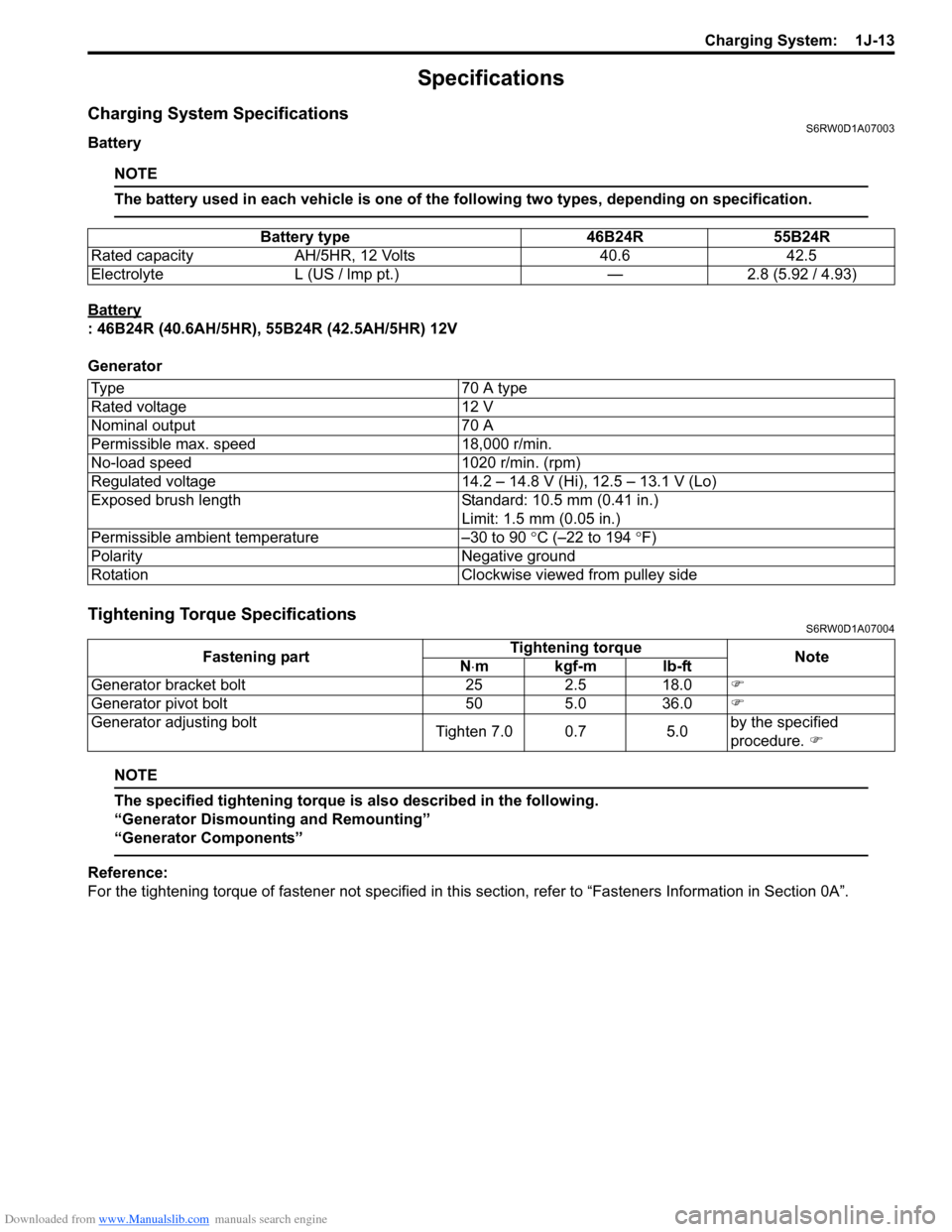
For the tightening torque of fastener not specified in this section, refer to “Fasteners Information in Section 0A”. Battery type 46B24R 55B24R
Rated capacity AH/5HR, 12 Volts 40.6 42.5
Electrolyte L (US / lmp pt.) — 2.8 (5.92 / 4.93)
Type 70 A type
Rated voltage 12 V
Nominal output 70 A
Permissible max. speed 18,000 r/min.
No-load speed 1020 r/min. (rpm)
Regulated voltage 14.2 – 14.8 V (Hi), 12.5 – 13.1 V (Lo)
Exposed brush length Standard: 10.5 mm (0.41 in.)
Limit: 1.5 mm (0.05 in.)
Permissible ambient temperature –30 to 90 °C (–22 to 194 °F)
Polarity Negative ground
Rotation Clockwise viewed from pulley side
Fastening partTightening torque
Note
N⋅mkgf-mlb-ft
Generator bracket bolt 25 2.5 18.0)
Generator pivot bolt 50 5.0 36.0)
Generator adjusting bolt
Tighten 7.0 0.7 5.0by the specified
procedure. )
Page 442 of 1556
Downloaded from www.Manualslib.com manuals search engine 2B-5 Front Suspension:
Front Strut Assembly Removal and InstallationS6RW0D2206003
CAUTION!
When rebound stopper and strut assembly
were removed, check strut support lower nut
for specified torque before installing strut
assembly.
Removal
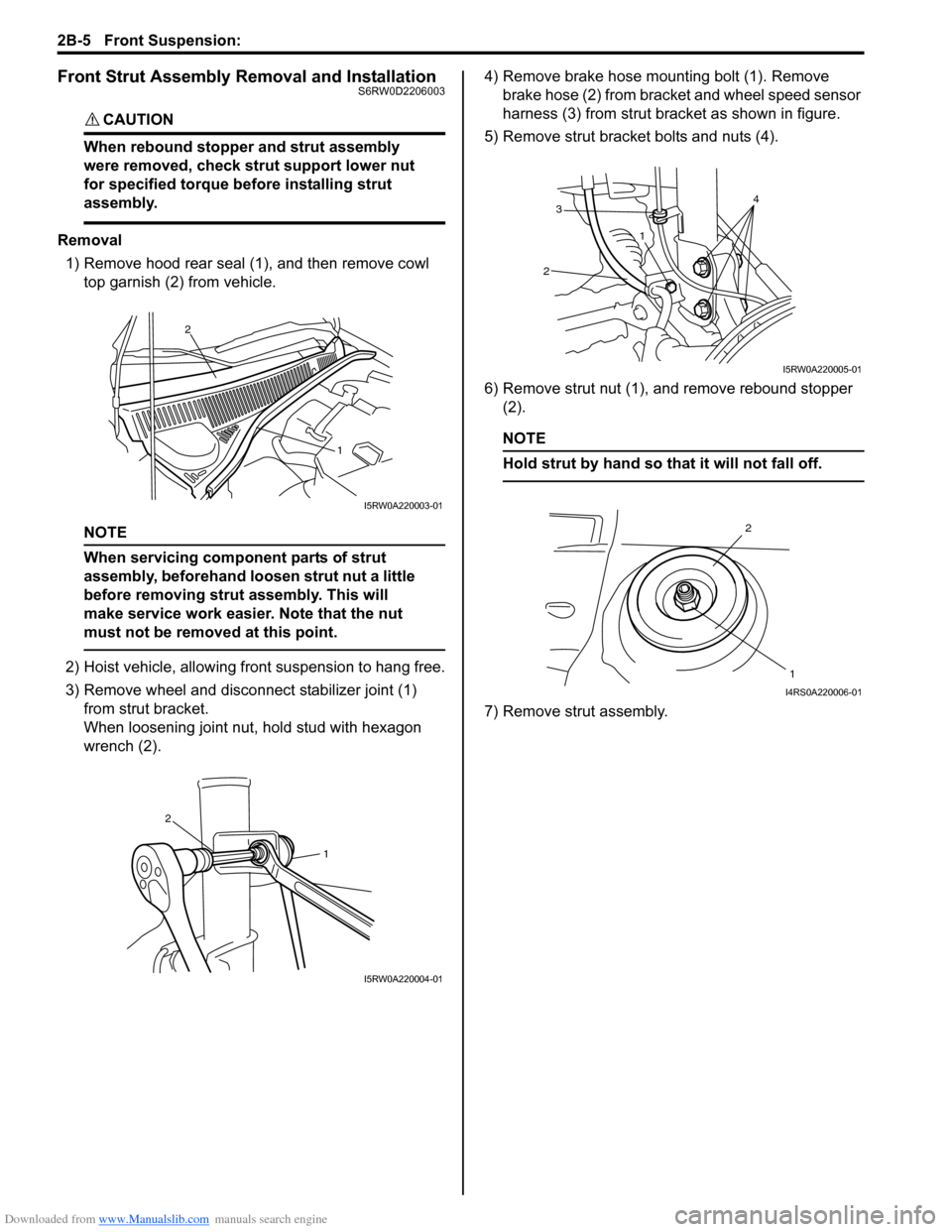
1) Remove hood rear seal (1), and then remove cowl
top garnish (2) from vehicle.
NOTE
When servicing component parts of strut
assembly, beforehand loosen strut nut a little
before removing strut assembly. This will
make service work easier. Note that the nut
must not be removed at this point.
2) Hoist vehicle, allowing front suspension to hang free.
3) Remove wheel and disconnect stabilizer joint (1)
from strut bracket.
When loosening joint nut, hold stud with hexagon
wrench (2).4) Remove brake hose mounting bolt (1). Remove
brake hose (2) from bracket and wheel speed sensor
harness (3) from strut bracket as shown in figure.
5) Remove strut bracket bolts and nuts (4).
6) Remove strut nut (1), and remove rebound stopper
(2).
NOTE
Hold strut by hand so that it will not fall off.
7) Remove strut assembly.
2
1
I5RW0A220003-01
1
2
I5RW0A220004-01
3
214
I5RW0A220005-01
2
1
I4RS0A220006-01
Page 443 of 1556
Downloaded from www.Manualslib.com manuals search engine Front Suspension: 2B-6
Installation
Install strut assembly by reversing removal procedure,
noting the following instructions.
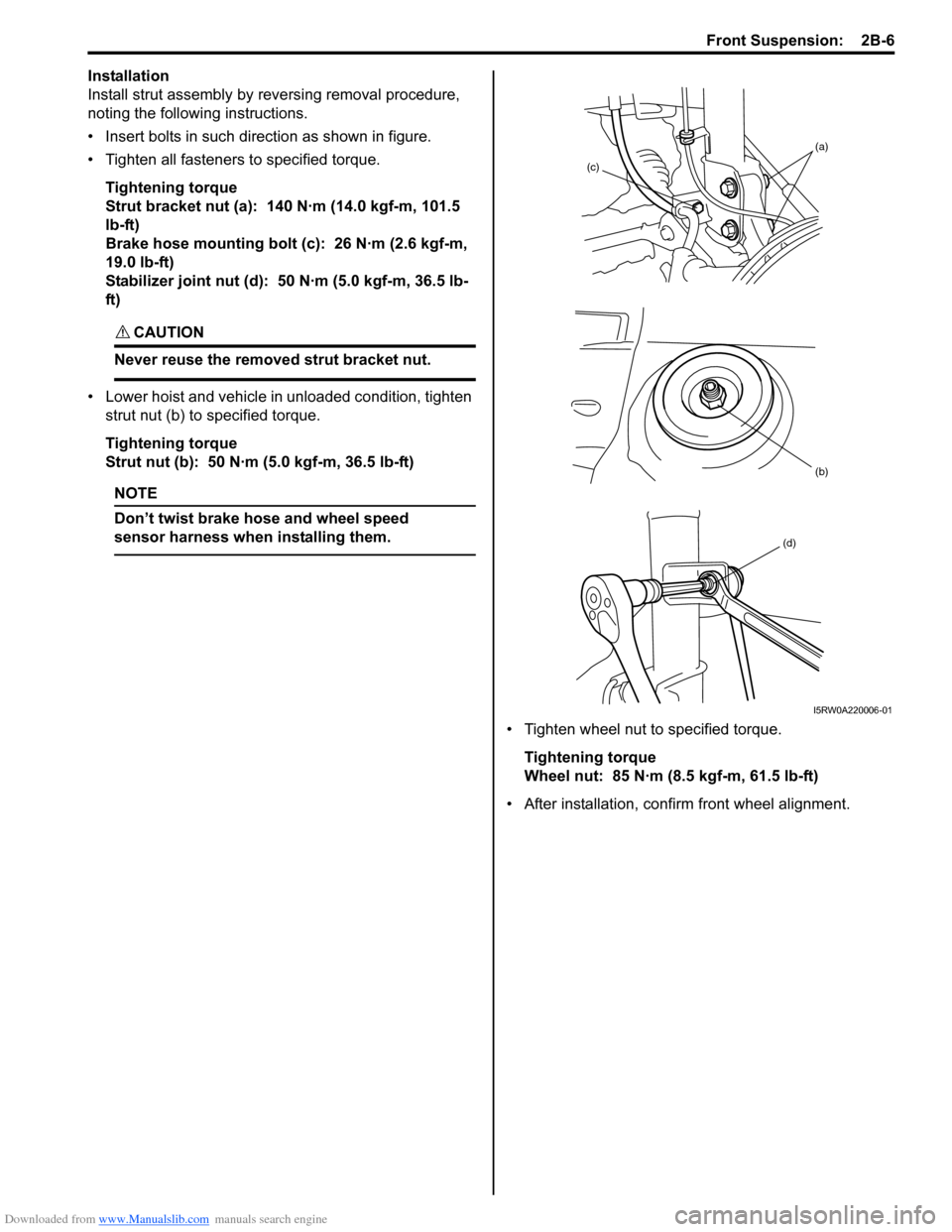
• Insert bolts in such direction as shown in figure.
• Tighten all fasteners to specified torque.
Tightening torque
Strut bracket nut (a): 140 N·m (14.0 kgf-m, 101.5
lb-ft)
Brake hose mounting bolt (c): 26 N·m (2.6 kgf-m,
19.0 lb-ft)
Stabilizer joint nut (d): 50 N·m (5.0 kgf-m, 36.5 lb-
ft)
CAUTION!
Never reuse the removed strut bracket nut.
• Lower hoist and vehicle in unloaded condition, tighten
strut nut (b) to specified torque.
Tightening torque
Strut nut (b): 50 N·m (5.0 kgf-m, 36.5 lb-ft)
NOTE
Don’t twist brake hose and wheel speed
sensor harness when installing them.
• Tighten wheel nut to specified torque.
Tightening torque
Wheel nut: 85 N·m (8.5 kgf-m, 61.5 lb-ft)
• After installation, confirm front wheel alignment.
(b)
(a)
(c)
(d)
I5RW0A220006-01
Page 447 of 1556
Downloaded from www.Manualslib.com manuals search engine Front Suspension: 2B-10
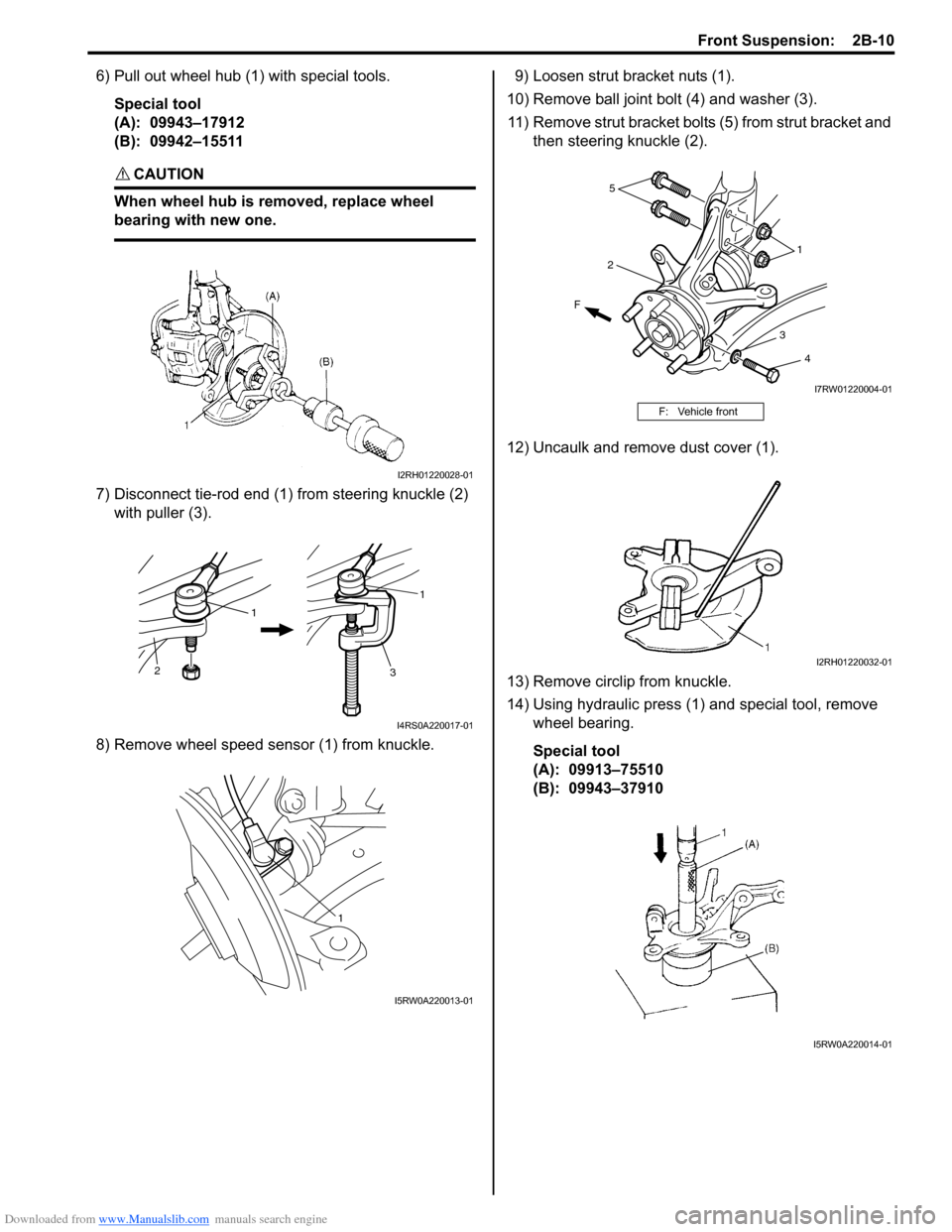
6) Pull out wheel hub (1) with special tools.
Special tool
(A): 09943–17912
(B): 09942–15511
CAUTION!
When wheel hub is removed, replace wheel
bearing with new one.
7) Disconnect tie-rod end (1) from steering knuckle (2)
with puller (3).
8) Remove wheel speed sensor (1) from knuckle.9) Loosen strut bracket nuts (1).
10) Remove ball joint bolt (4) and washer (3).
11) Remove strut bracket bolts (5) from strut bracket and
then steering knuckle (2).
12) Uncaulk and remove dust cover (1).
13) Remove circlip from knuckle.
14) Using hydraulic press (1) and special tool, remove
wheel bearing.
Special tool
(A): 09913–75510
(B): 09943–37910
I2RH01220028-01
1
2
3
1
I4RS0A220017-01
1
I5RW0A220013-01
F: Vehicle front
F
5
21
3
4
I7RW01220004-01
I2RH01220032-01
I5RW0A220014-01
Page 449 of 1556
Downloaded from www.Manualslib.com manuals search engine Front Suspension: 2B-12
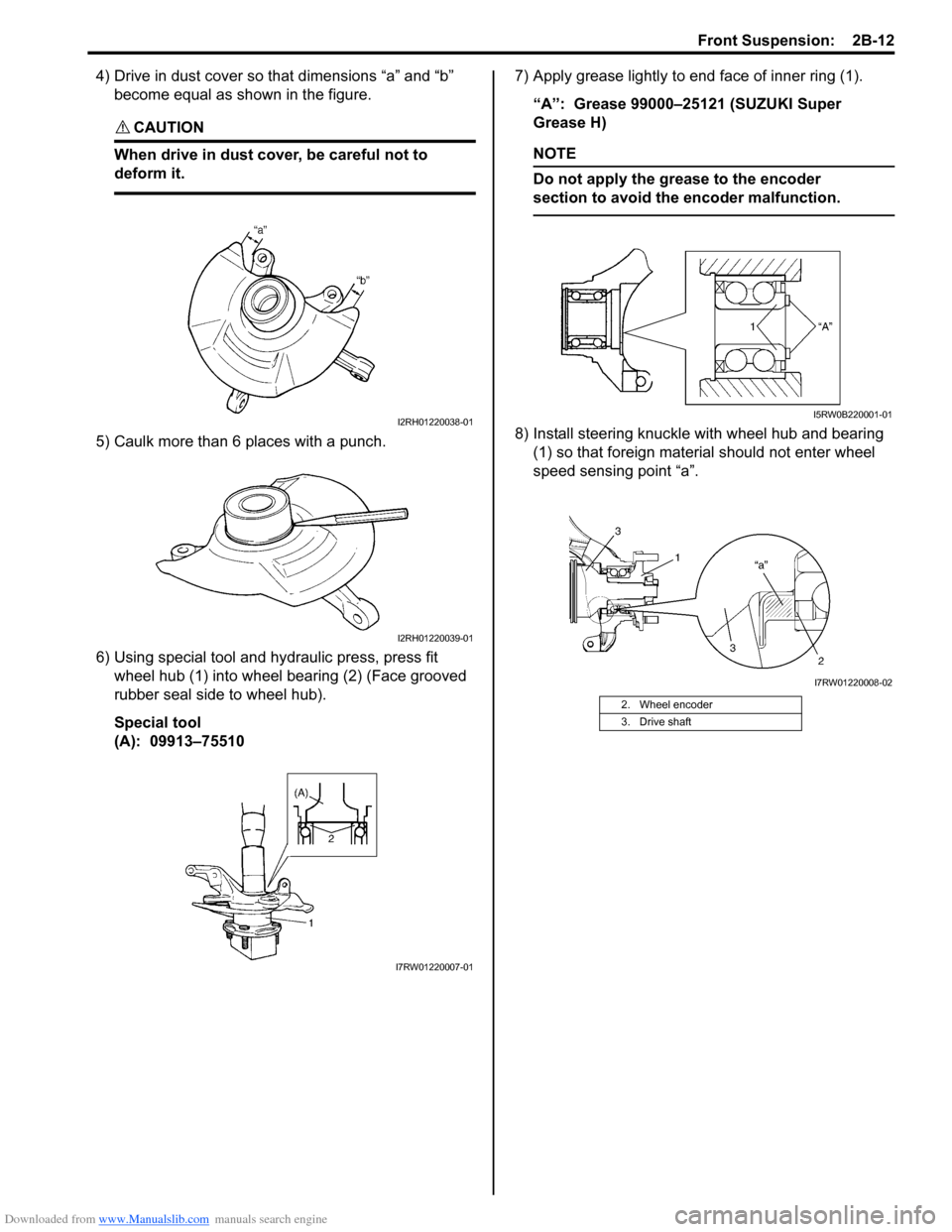
4) Drive in dust cover so that dimensions “a” and “b”
become equal as shown in the figure.
CAUTION!
When drive in dust cover, be careful not to
deform it.
5) Caulk more than 6 places with a punch.
6) Using special tool and hydraulic press, press fit
wheel hub (1) into wheel bearing (2) (Face grooved
rubber seal side to wheel hub).
Special tool
(A): 09913–75510 7) Apply grease lightly to end face of inner ring (1).
“A”: Grease 99000–25121 (SUZUKI Super
Grease H)
NOTE
Do not apply the grease to the encoder
section to avoid the encoder malfunction.
8) Install steering knuckle with wheel hub and bearing
(1) so that foreign material should not enter wheel
speed sensing point “a”.I2RH01220038-01
I2RH01220039-01
I7RW01220007-01
2. Wheel encoder
3. Drive shaft
I5RW0B220001-01
I7RW01220008-02
Page 450 of 1556
Downloaded from www.Manualslib.com manuals search engine 2B-13 Front Suspension:
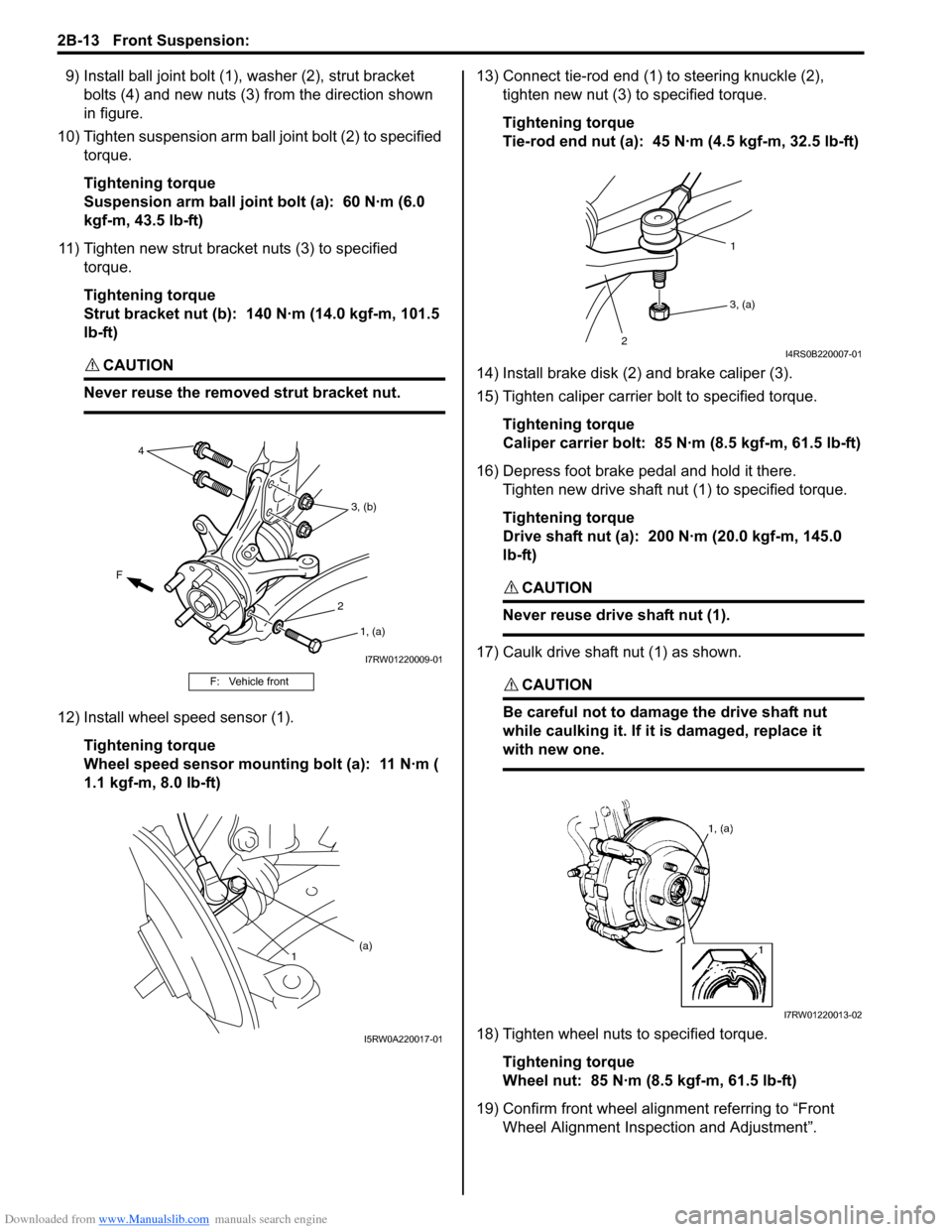
9) Install ball joint bolt (1), washer (2), strut bracket
bolts (4) and new nuts (3) from the direction shown
in figure.
10) Tighten suspension arm ball joint bolt (2) to specified
torque.
Tightening torque
Suspension arm ball joint bolt (a): 60 N·m (6.0
kgf-m, 43.5 lb-ft)
11) Tighten new strut bracket nuts (3) to specified
torque.
Tightening torque
Strut bracket nut (b): 140 N·m (14.0 kgf-m, 101.5
lb-ft)
CAUTION!
Never reuse the removed strut bracket nut.
12) Install wheel speed sensor (1).
Tightening torque
Wheel speed sensor mounting bolt (a): 11 N·m (
1.1 kgf-m, 8.0 lb-ft)13) Connect tie-rod end (1) to steering knuckle (2),
tighten new nut (3) to specified torque.
Tightening torque
Tie-rod end nut (a): 45 N·m (4.5 kgf-m, 32.5 lb-ft)
14) Install brake disk (2) and brake caliper (3).
15) Tighten caliper carrier bolt to specified torque.
Tightening torque
Caliper carrier bolt: 85 N·m (8.5 kgf-m, 61.5 lb-ft)
16) Depress foot brake pedal and hold it there.
Tighten new drive shaft nut (1) to specified torque.
Tightening torque
Drive shaft nut (a): 200 N·m (20.0 kgf-m, 145.0
lb-ft)
CAUTION!
Never reuse drive shaft nut (1).
17) Caulk drive shaft nut (1) as shown.
CAUTION!
Be careful not to damage the drive shaft nut
while caulking it. If it is damaged, replace it
with new one.
18) Tighten wheel nuts to specified torque.
Tightening torque
Wheel nut: 85 N·m (8.5 kgf-m, 61.5 lb-ft)
19) Confirm front wheel alignment referring to “Front
Wheel Alignment Inspection and Adjustment”.
F: Vehicle front
F
4
3, (b)
2
1, (a)
I7RW01220009-01
1(a)
I5RW0A220017-01
1
3, (a)
2I4RS0B220007-01
I7RW01220013-02
Page 458 of 1556
Downloaded from www.Manualslib.com manuals search engine 2B-21 Front Suspension:
Specifications
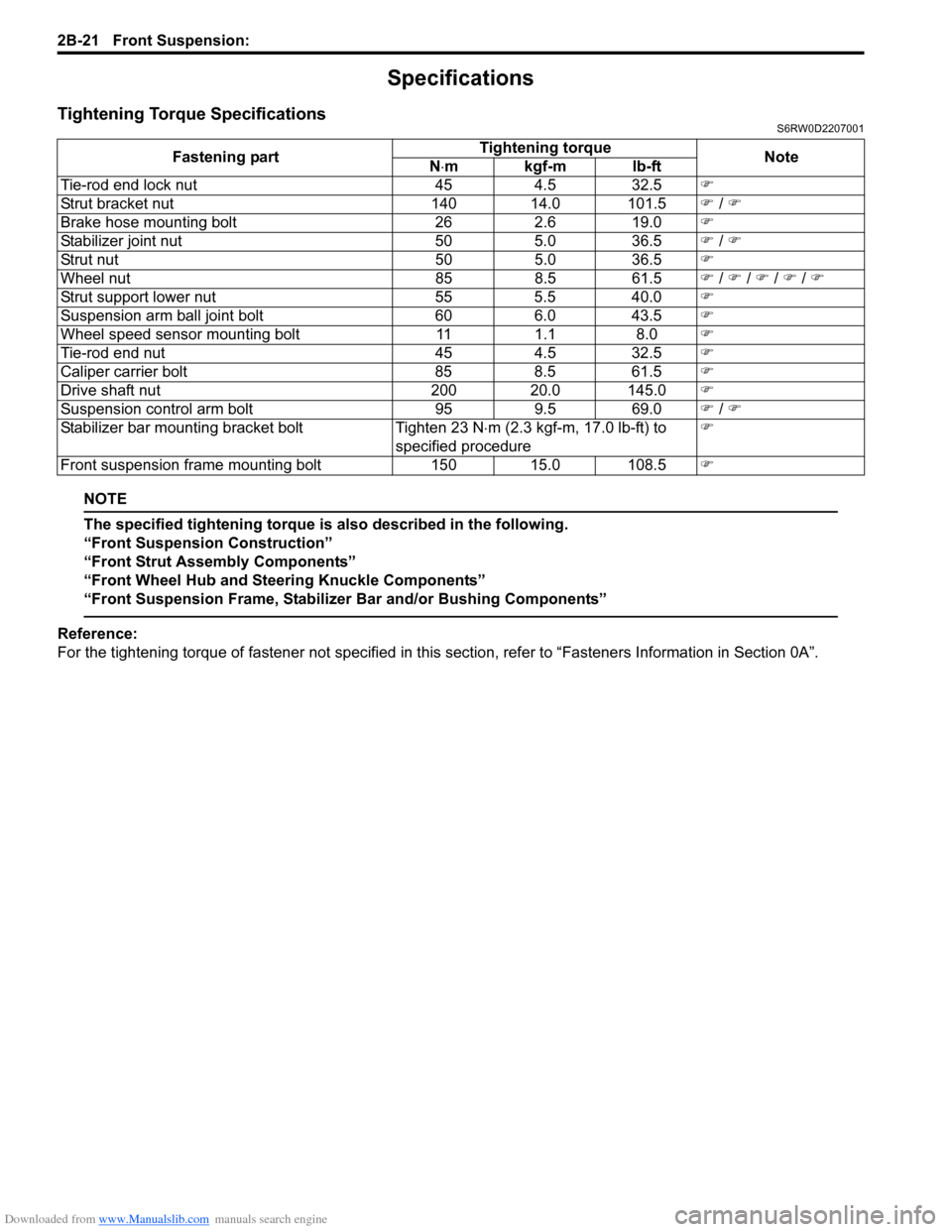
Tightening Torque SpecificationsS6RW0D2207001
NOTE
The specified tightening torque is also described in the following.
“Front Suspension Construction”
“Front Strut Assembly Components”
“Front Wheel Hub and Steering Knuckle Components”
“Front Suspension Frame, Stabilizer Bar and/or Bushing Components”
Reference:
For the tightening torque of fastener not specified in this section, refer to “Fasteners Information in Section 0A”. Fastening partTightening torque
Note
N⋅mkgf-mlb-ft
Tie-rod end lock nut 45 4.5 32.5)
Strut bracket nut 140 14.0 101.5) / )
Brake hose mounting bolt 26 2.6 19.0)
Stabilizer joint nut 50 5.0 36.5) / )
Strut nut 50 5.0 36.5)
Wheel nut 85 8.5 61.5) / ) / ) / ) / )
Strut support lower nut 55 5.5 40.0)
Suspension arm ball joint bolt 60 6.0 43.5)
Wheel speed sensor mounting bolt 11 1.1 8.0)
Tie-rod end nut 45 4.5 32.5)
Caliper carrier bolt 85 8.5 61.5)
Drive shaft nut 200 20.0 145.0)
Suspension control arm bolt 95 9.5 69.0) / )
Stabilizer bar mounting bracket bolt Tighten 23 N⋅m (2.3 kgf-m, 17.0 lb-ft) to
specified procedure)
Front suspension frame mounting bolt 150 15.0 108.5)
Page 463 of 1556
Downloaded from www.Manualslib.com manuals search engine Rear Suspension: 2C-4
Rear Coil Spring Removal and InstallationS6RW0D2306005
CAUTION!
Removal and Installation both coil springs
(right and left) at the same time to avoid rear
axle twisting and other damage.
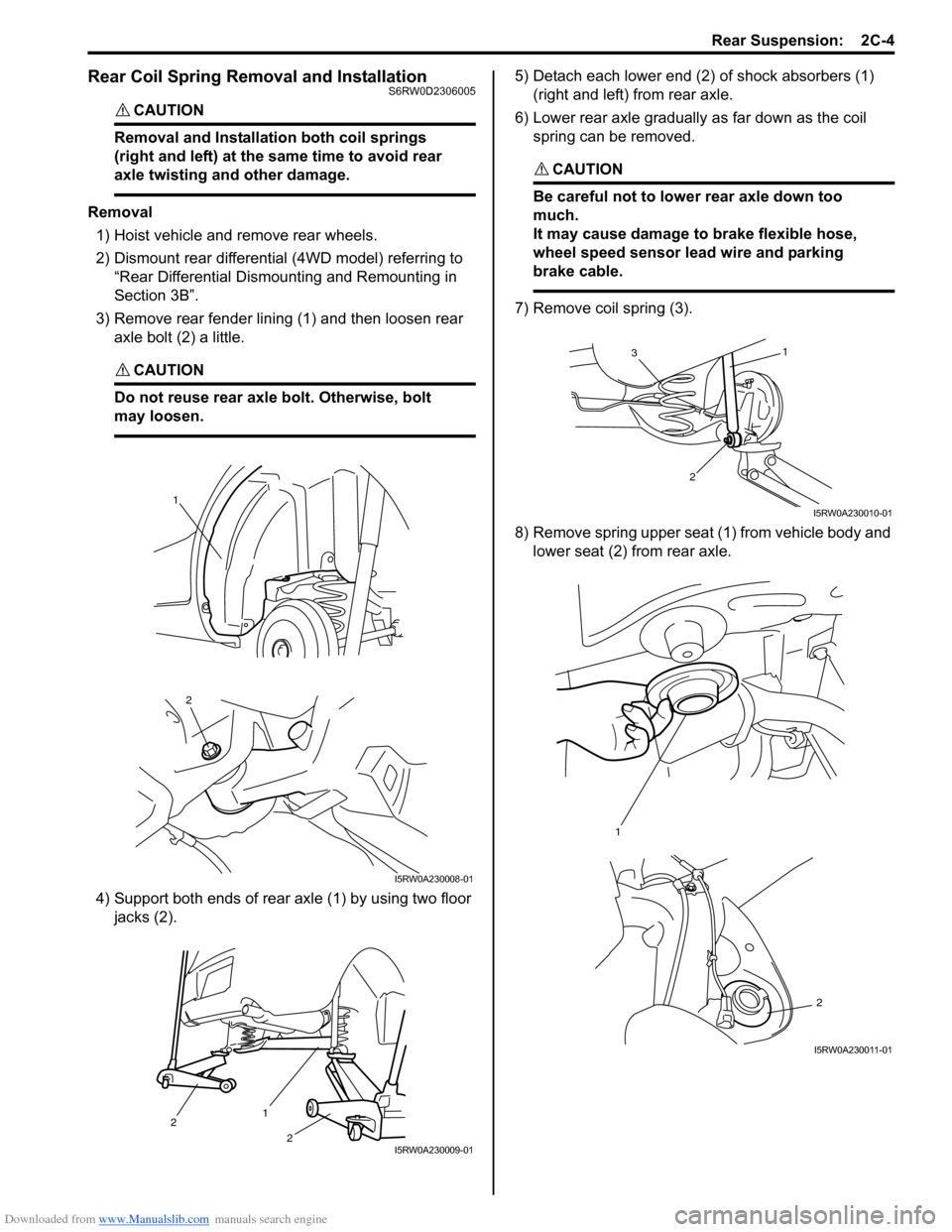
Removal
1) Hoist vehicle and remove rear wheels.
2) Dismount rear differential (4WD model) referring to
“Rear Differential Dismounting and Remounting in
Section 3B”.
3) Remove rear fender lining (1) and then loosen rear
axle bolt (2) a little.
CAUTION!
Do not reuse rear axle bolt. Otherwise, bolt
may loosen.
4) Support both ends of rear axle (1) by using two floor
jacks (2).5) Detach each lower end (2) of shock absorbers (1)
(right and left) from rear axle.
6) Lower rear axle gradually as far down as the coil
spring can be removed.
CAUTION!
Be careful not to lower rear axle down too
much.
It may cause damage to brake flexible hose,
wheel speed sensor lead wire and parking
brake cable.
7) Remove coil spring (3).
8) Remove spring upper seat (1) from vehicle body and
lower seat (2) from rear axle.
2
1
I5RW0A230008-01
1
2
2
I5RW0A230009-01
1
2
3
I5RW0A230010-01
1
2
I5RW0A230011-01