Lights SUZUKI SX4 2006 1.G Service User Guide
[x] Cancel search | Manufacturer: SUZUKI, Model Year: 2006, Model line: SX4, Model: SUZUKI SX4 2006 1.GPages: 1556, PDF Size: 37.31 MB
Page 509 of 1556
Downloaded from www.Manualslib.com manuals search engine Differential: 3B-12
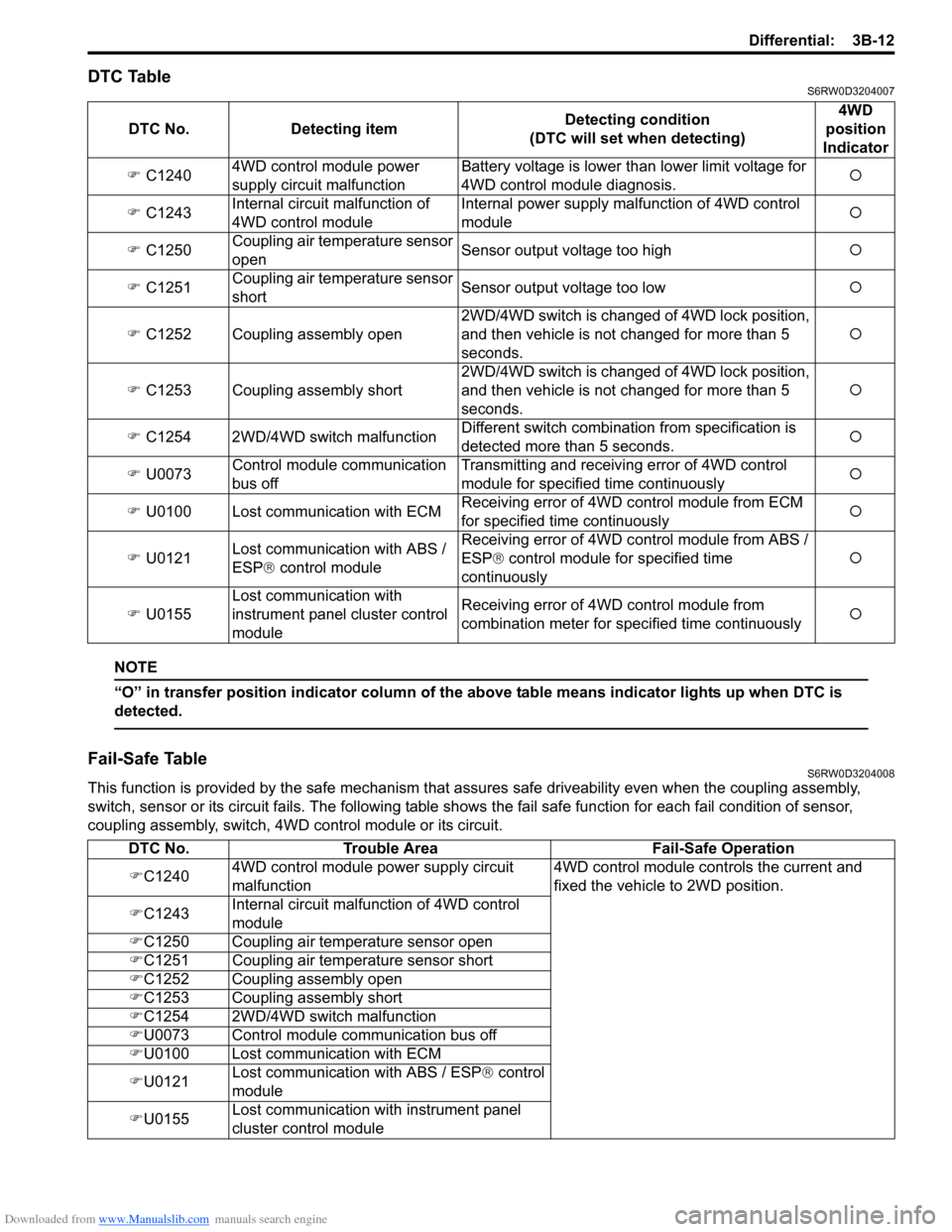
DTC TableS6RW0D3204007
NOTE
“O” in transfer position indicator column of the above table means indicator lights up when DTC is
detected.
Fail-Safe TableS6RW0D3204008
This function is provided by the safe mechanism that assures safe driveability even when the coupling assembly,
switch, sensor or its circuit fails. The following table shows the fail safe function for each fail condition of sensor,
coupling assembly, switch, 4WD control module or its circuit. DTC No. Detecting itemDetecting condition
(DTC will set when detecting)4WD
position
Indicator
) C12404WD control module power
supply circuit malfunctionBattery voltage is lower than lower limit voltage for
4WD control module diagnosis.{
) C1243Internal circuit malfunction of
4WD control moduleInternal power supply malfunction of 4WD control
module{
) C1250Coupling air temperature sensor
openSensor output voltage too high{
) C1251Coupling air temperature sensor
shortSensor output voltage too low{
) C1252 Coupling assembly open2WD/4WD switch is changed of 4WD lock position,
and then vehicle is not changed for more than 5
seconds.{
) C1253 Coupling assembly short2WD/4WD switch is changed of 4WD lock position,
and then vehicle is not changed for more than 5
seconds.{
) C1254 2WD/4WD switch malfunctionDifferent switch combination from specification is
detected more than 5 seconds.{
) U0073Control module communication
bus offTransmitting and receiving error of 4WD control
module for specified time continuously{
) U0100 Lost communication with ECMReceiving error of 4WD control module from ECM
for specified time continuously{
) U0121Lost communication with ABS /
ESP® control moduleReceiving error of 4WD control module from ABS /
ESP® control module for specified time
continuously{
) U0155Lost communication with
instrument panel cluster control
moduleReceiving error of 4WD control module from
combination meter for specified time continuously{
DTC No. Trouble Area Fail-Safe Operation
)C12404WD control module power supply circuit
malfunction4WD control module controls the current and
fixed the vehicle to 2WD position.
)C1243Internal circuit malfunction of 4WD control
module
)C1250 Coupling air temperature sensor open
)C1251 Coupling air temperature sensor short
)C1252 Coupling assembly open
)C1253 Coupling assembly short
)C1254 2WD/4WD switch malfunction
)U0073 Control module communication bus off
)U0100 Lost communication with ECM
)U0121Lost communication with ABS / ESP® control
module
)U0155Lost communication with instrument panel
cluster control module
Page 577 of 1556
Downloaded from www.Manualslib.com manuals search engine Brake Control System and Diagnosis: 4A-6
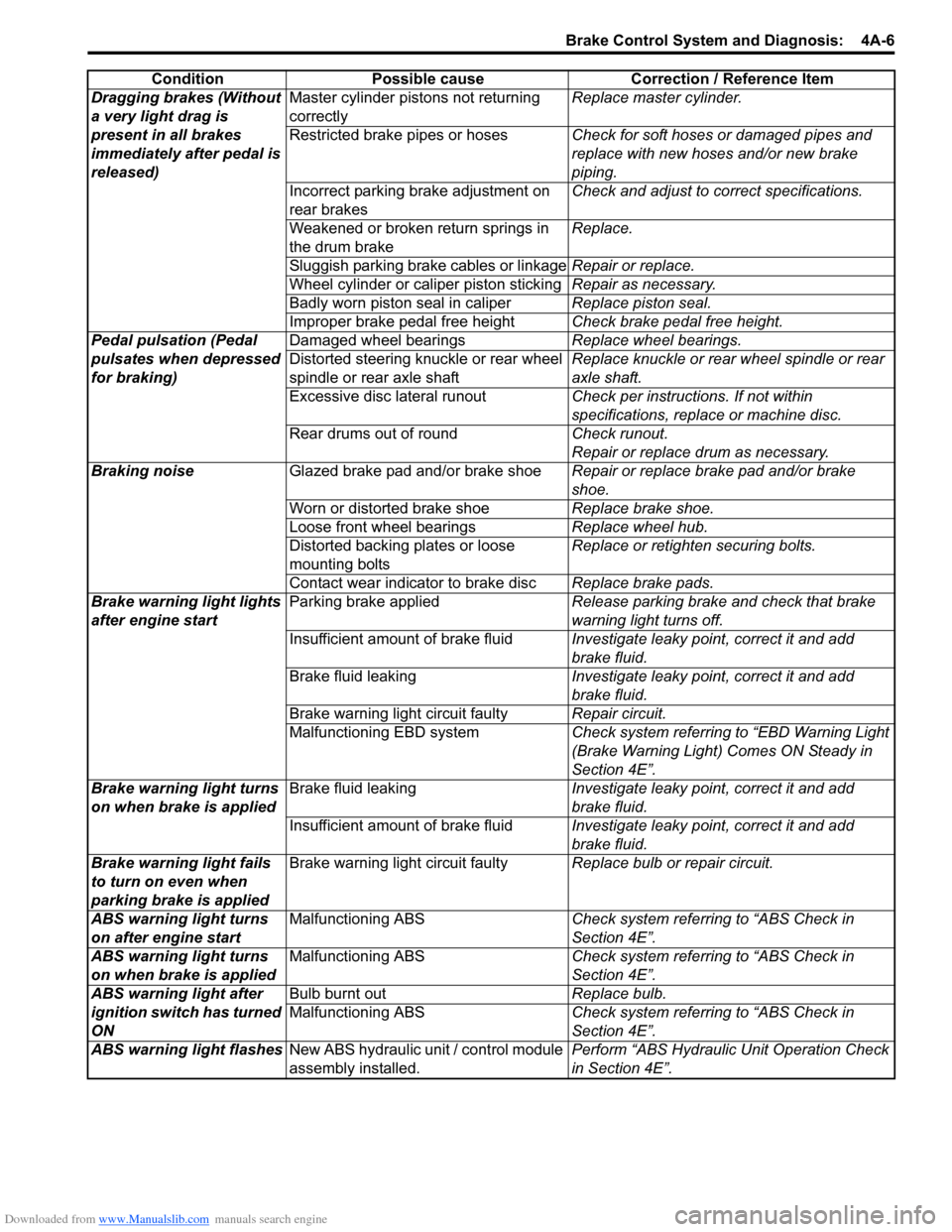
Dragging brakes (Without
a very light drag is
present in all brakes
immediately after pedal is
released)Master cylinder pistons not returning
correctlyReplace master cylinder.
Restricted brake pipes or hosesCheck for soft hoses or damaged pipes and
replace with new hoses and/or new brake
piping.
Incorrect parking brake adjustment on
rear brakesCheck and adjust to correct specifications.
Weakened or broken return springs in
the drum brakeReplace.
Sluggish parking brake cables or linkageRepair or replace.
Wheel cylinder or caliper piston stickingRepair as necessary.
Badly worn piston seal in caliperReplace piston seal.
Improper brake pedal free heightCheck brake pedal free height.
Pedal pulsation (Pedal
pulsates when depressed
for braking)Damaged wheel bearingsReplace wheel bearings.
Distorted steering knuckle or rear wheel
spindle or rear axle shaftReplace knuckle or rear wheel spindle or rear
axle shaft.
Excessive disc lateral runoutCheck per instructions. If not within
specifications, replace or machine disc.
Rear drums out of roundCheck runout.
Repair or replace drum as necessary.
Braking noiseGlazed brake pad and/or brake shoeRepair or replace brake pad and/or brake
shoe.
Worn or distorted brake shoeReplace brake shoe.
Loose front wheel bearingsReplace wheel hub.
Distorted backing plates or loose
mounting boltsReplace or retighten securing bolts.
Contact wear indicator to brake discReplace brake pads.
Brake warning light lights
after engine startParking brake appliedRelease parking brake and check that brake
warning light turns off.
Insufficient amount of brake fluidInvestigate leaky point, correct it and add
brake fluid.
Brake fluid leakingInvestigate leaky point, correct it and add
brake fluid.
Brake warning light circuit faultyRepair circuit.
Malfunctioning EBD systemCheck system referring to “EBD Warning Light
(Brake Warning Light) Comes ON Steady in
Section 4E”.
Brake warning light turns
on when brake is appliedBrake fluid leakingInvestigate leaky point, correct it and add
brake fluid.
Insufficient amount of brake fluidInvestigate leaky point, correct it and add
brake fluid.
Brake warning light fails
to turn on even when
parking brake is appliedBrake warning light circuit faultyReplace bulb or repair circuit.
ABS warning light turns
on after engine startMalfunctioning ABSCheck system referring to “ABS Check in
Section 4E”.
ABS warning light turns
on when brake is appliedMalfunctioning ABSCheck system referring to “ABS Check in
Section 4E”.
ABS warning light after
ignition switch has turned
ON Bulb burnt outReplace bulb.
Malfunctioning ABSCheck system referring to “ABS Check in
Section 4E”.
ABS warning light flashesNew ABS hydraulic unit / control module
assembly installed.Perform “ABS Hydraulic Unit Operation Check
in Section 4E”. Condition Possible cause Correction / Reference Item
Page 579 of 1556
Downloaded from www.Manualslib.com manuals search engine Brake Control System and Diagnosis: 4A-8
Brake Fluid Level InspectionS6RW0D4106004
CAUTION!
Do not use shock absorber fluid or any other
fluid which contains mineral oil. Do not use a
container which has been used for mineral oil
or a container which is wet from water.
Mineral oil will cause swelling and distortion
of rubber parts in hydraulic brake system and
water mixed into brake fluid will lower fluid
boiling point. Keep all fluid containers
capped to prevent contamination.
NOTE
Be sure to use particular brake fluid either as
indicated on reservoir cap of that vehicle or
recommended in owner’s manual which
comes along with that vehicle. Use of any
other fluid is strictly prohibited.
Fluid level should be between MIN and MAX
lines marked on reservoir.
When brake warning light lights sometimes
during driving, replenish fluid to MAX level.
When fluid decreases quickly, inspect brake
system for leakage. Correct leaky points and
then refill to specified level.
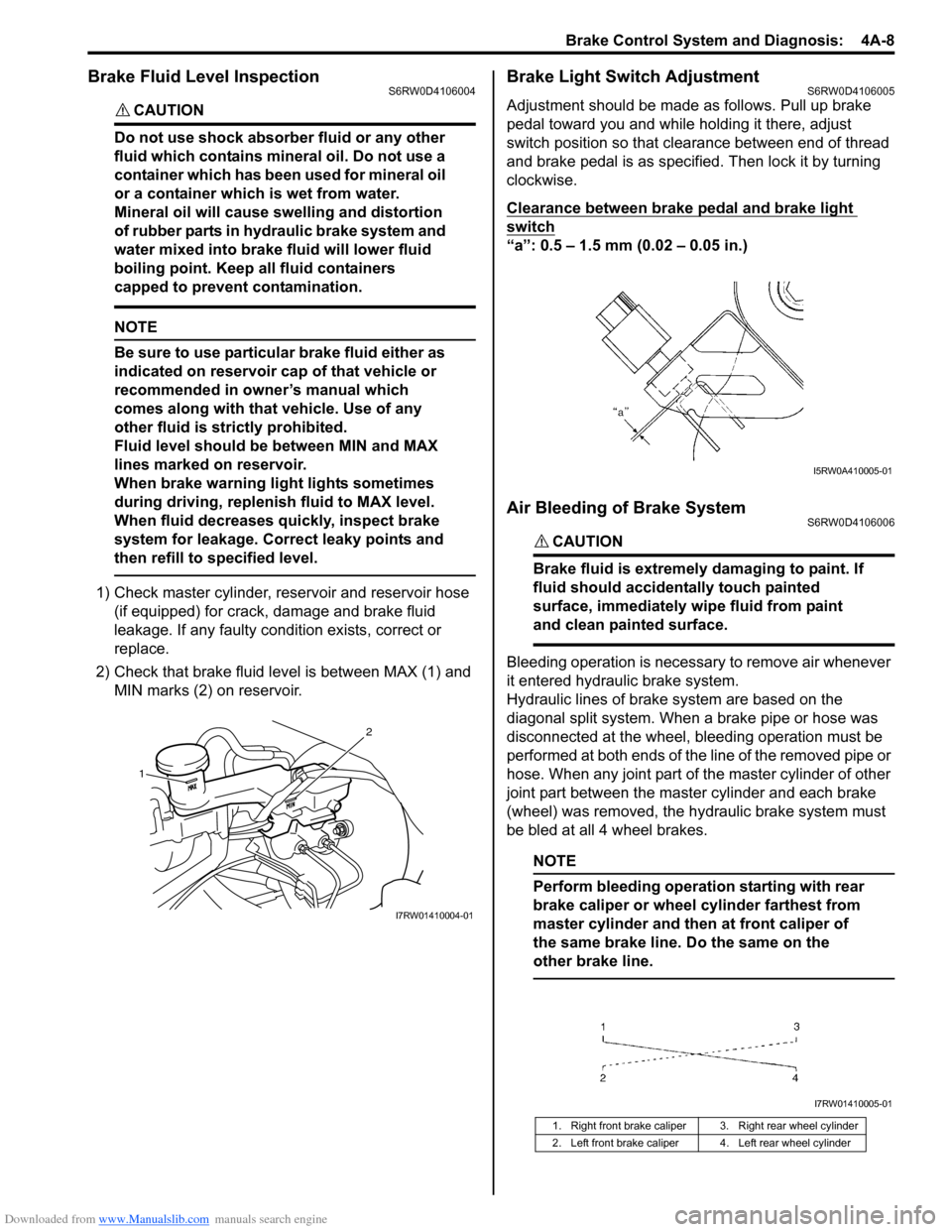
1) Check master cylinder, reservoir and reservoir hose
(if equipped) for crack, damage and brake fluid
leakage. If any faulty condition exists, correct or
replace.
2) Check that brake fluid level is between MAX (1) and
MIN marks (2) on reservoir.
Brake Light Switch AdjustmentS6RW0D4106005
Adjustment should be made as follows. Pull up brake
pedal toward you and while holding it there, adjust
switch position so that clearance between end of thread
and brake pedal is as specified. Then lock it by turning
clockwise.
Clearance between brake pedal and brake light
switch
“a”: 0.5 – 1.5 mm (0.02 – 0.05 in.)
Air Bleeding of Brake SystemS6RW0D4106006
CAUTION!
Brake fluid is extremely damaging to paint. If
fluid should accidentally touch painted
surface, immediately wipe fluid from paint
and clean painted surface.
Bleeding operation is necessary to remove air whenever
it entered hydraulic brake system.
Hydraulic lines of brake system are based on the
diagonal split system. When a brake pipe or hose was
disconnected at the wheel, bleeding operation must be
performed at both ends of the line of the removed pipe or
hose. When any joint part of the master cylinder of other
joint part between the master cylinder and each brake
(wheel) was removed, the hydraulic brake system must
be bled at all 4 wheel brakes.
NOTE
Perform bleeding operation starting with rear
brake caliper or wheel cylinder farthest from
master cylinder and then at front caliper of
the same brake line. Do the same on the
other brake line.
1
2
I7RW01410004-01
1. Right front brake caliper 3. Right rear wheel cylinder
2. Left front brake caliper 4. Left rear wheel cylinder
I5RW0A410005-01
I7RW01410005-01
Page 607 of 1556
Downloaded from www.Manualslib.com manuals search engine ABS: 4E-2
General Description
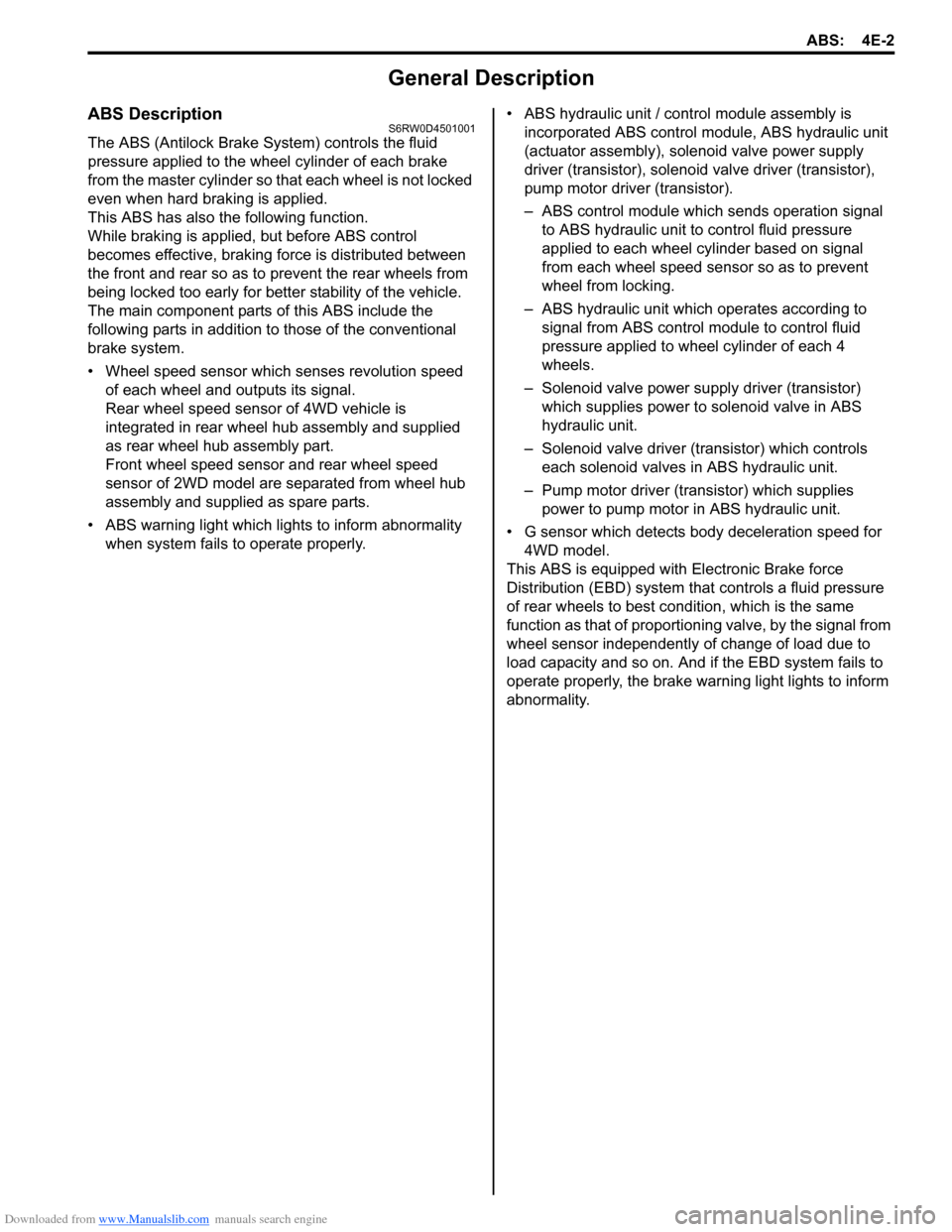
ABS DescriptionS6RW0D4501001
The ABS (Antilock Brake System) controls the fluid
pressure applied to the wheel cylinder of each brake
from the master cylinder so that each wheel is not locked
even when hard braking is applied.
This ABS has also the following function.
While braking is applied, but before ABS control
becomes effective, braking force is distributed between
the front and rear so as to prevent the rear wheels from
being locked too early for better stability of the vehicle.
The main component parts of this ABS include the
following parts in addition to those of the conventional
brake system.
• Wheel speed sensor which senses revolution speed
of each wheel and outputs its signal.
Rear wheel speed sensor of 4WD vehicle is
integrated in rear wheel hub assembly and supplied
as rear wheel hub assembly part.
Front wheel speed sensor and rear wheel speed
sensor of 2WD model are separated from wheel hub
assembly and supplied as spare parts.
• ABS warning light which lights to inform abnormality
when system fails to operate properly.• ABS hydraulic unit / control module assembly is
incorporated ABS control module, ABS hydraulic unit
(actuator assembly), solenoid valve power supply
driver (transistor), solenoid valve driver (transistor),
pump motor driver (transistor).
– ABS control module which sends operation signal
to ABS hydraulic unit to control fluid pressure
applied to each wheel cylinder based on signal
from each wheel speed sensor so as to prevent
wheel from locking.
– ABS hydraulic unit which operates according to
signal from ABS control module to control fluid
pressure applied to wheel cylinder of each 4
wheels.
– Solenoid valve power supply driver (transistor)
which supplies power to solenoid valve in ABS
hydraulic unit.
– Solenoid valve driver (transistor) which controls
each solenoid valves in ABS hydraulic unit.
– Pump motor driver (transistor) which supplies
power to pump motor in ABS hydraulic unit.
• G sensor which detects body deceleration speed for
4WD model.
This ABS is equipped with Electronic Brake force
Distribution (EBD) system that controls a fluid pressure
of rear wheels to best condition, which is the same
function as that of proportioning valve, by the signal from
wheel sensor independently of change of load due to
load capacity and so on. And if the EBD system fails to
operate properly, the brake warning light lights to inform
abnormality.
Page 608 of 1556
Downloaded from www.Manualslib.com manuals search engine 4E-3 ABS:
ABS Hydraulic Unit / Control Module Assembly
Description
S6RW0D4501002
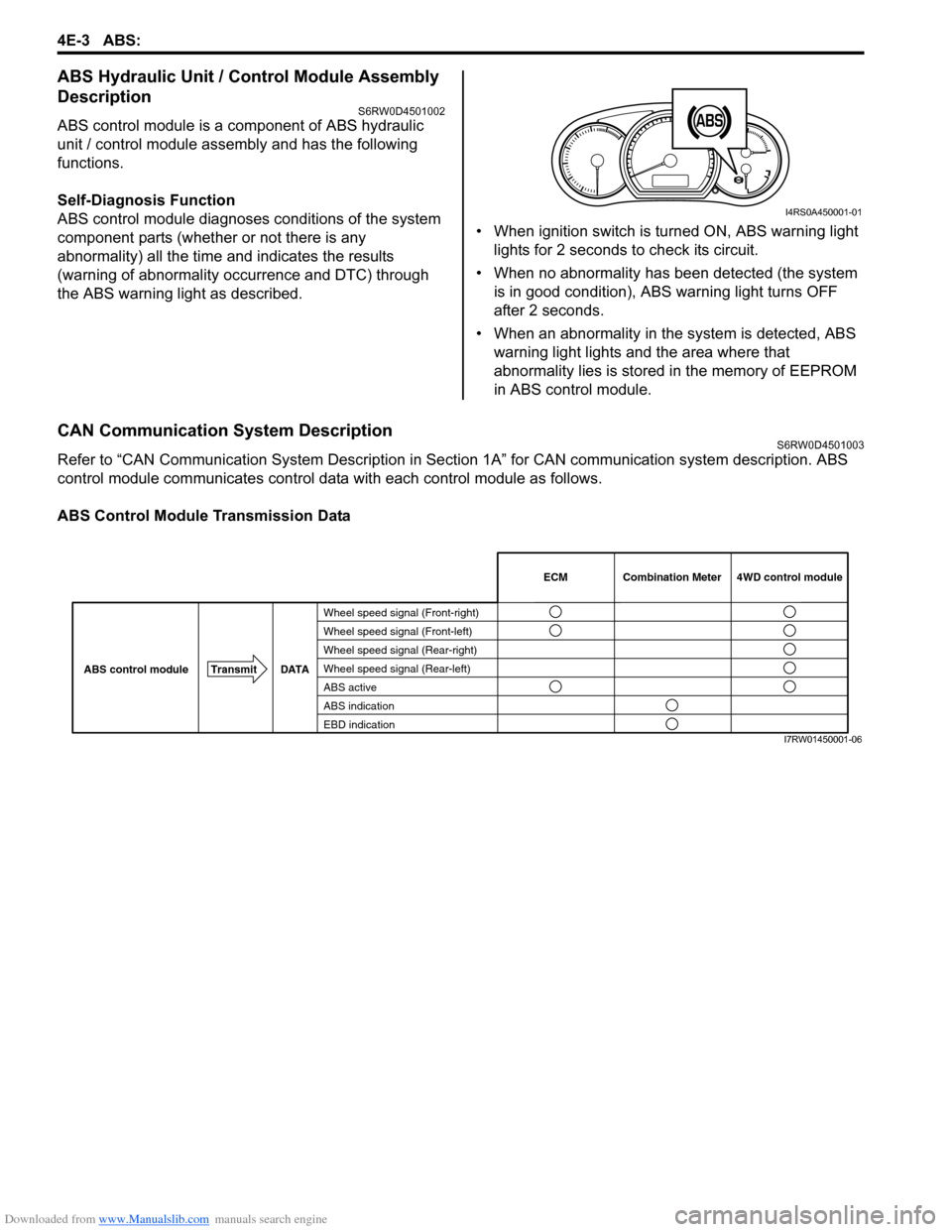
ABS control module is a component of ABS hydraulic
unit / control module assembly and has the following
functions.
Self-Diagnosis Function
ABS control module diagnoses conditions of the system
component parts (whether or not there is any
abnormality) all the time and indicates the results
(warning of abnormality occurrence and DTC) through
the ABS warning light as described.• When ignition switch is turned ON, ABS warning light
lights for 2 seconds to check its circuit.
• When no abnormality has been detected (the system
is in good condition), ABS warning light turns OFF
after 2 seconds.
• When an abnormality in the system is detected, ABS
warning light lights and the area where that
abnormality lies is stored in the memory of EEPROM
in ABS control module.
CAN Communication System DescriptionS6RW0D4501003
Refer to “CAN Communication System Description in Section 1A” for CAN communication system description. ABS
control module communicates control data with each control module as follows.
ABS Control Module Transmission Data
1
I4RS0A450001-01
Wheel speed signal (Front-right)
Wheel speed signal (Front-left)
Wheel speed signal (Rear-right)
Wheel speed signal (Rear-left)
ABS active
ABS indication
EBD indicationCombination Meter
TransmitDATA
ABS control module ECM 4WD control module
I7RW01450001-06
Page 615 of 1556
Downloaded from www.Manualslib.com manuals search engine ABS: 4E-10
Problem symptom confirmation
Check if what the customer claimed in “Customer
Questionnaire” is actually found in the vehicle and if that
symptom is found, whether it is identified as a failure.
(This step should be shared with the customer if
possible.) Check warning lights related to brake system
referring to “EBD Warning Light (Brake Warning Light)
Check” and “ABS Warning Light Check”.
DTC check, record and clearance
Perform “DTC Check” procedure, record it and then
clear it referring to “DTC Clearance”.
Recheck DTC referring to “DTC Check”.
When DTC which is recorded at DTC check procedure is
detected again after performing DTC clearance, go to
“Step 4: ABS Check: ” to proceed the diagnosis.
When DTC which is recorded at DTC check procedure is
not indicated anymore after performing DTC clearance,
ABS control module does not perform the system
diagnosis, or temporary abnormality may occur,
therefore go to “Step 2: Driving Test: ” to proceed the
diagnosis.
Step 2: Driving Test
Test drive the vehicle at 40 km/h (25 MPH) for more than
a minute and check if any trouble symptom (such as
abnormal lighting of ABS warning light) exists.
If the malfunction DTC is confirmed again at ignition
switch ON, driving test as described is not necessary.
Proceed to Step 3.
Step 3: DTC Check
Recheck DTC referring to “DTC Check”.
Step 4: ABS Check
According to ABS Check for the DTC confirmation in
Step 3, locate the cause of the trouble, namely in a
sensor, switch, wire harness, connector, actuator
assembly or other part and repair or replace faulty parts.
Step 5: Brakes Diagnosis
Check the parts or system suspected as a possible
cause referring to “Brakes Symptom Diagnosis in
Section 4A” and based on symptoms appearing on the
vehicle (symptom obtained through Steps 1 and 2 and
repair or replace faulty parts, if any).
Step 6: Check for Intermittent Problem
Check parts where an intermittent trouble is easy to
occur (e.g., wire harness, connector, etc.), referring to
“Intermittent and Poor Connection Inspection in Section
00” and related circuit of trouble code recorded in Step 1
to 3.
Step 7: Final Confirmation Test
Confirm that the problem symptom has gone and the
ABS is free from any abnormal conditions. If what has
been repaired is related to the malfunction DTC, clear
the DTC once referring to “DTC Clearance” and perform
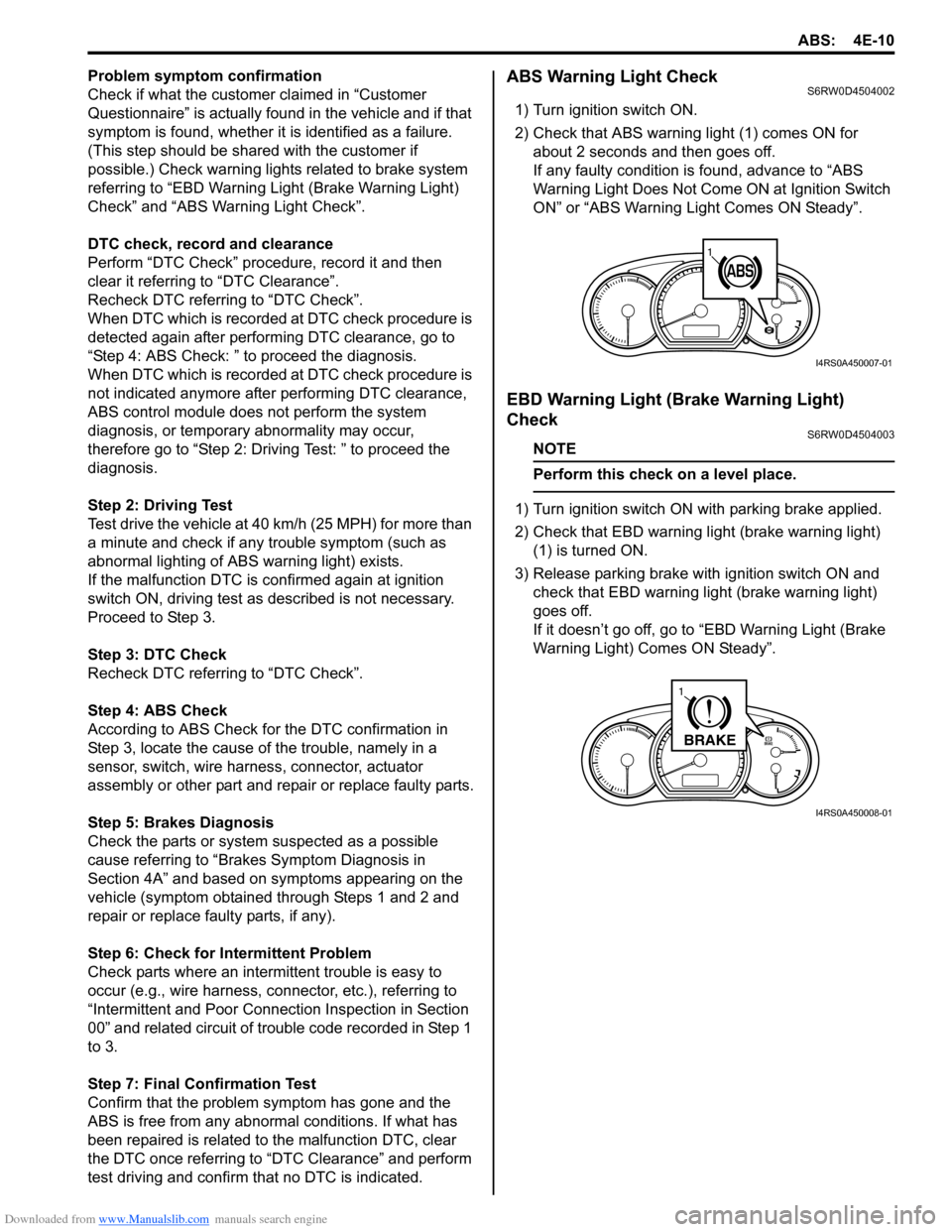
test driving and confirm that no DTC is indicated.ABS Warning Light CheckS6RW0D4504002
1) Turn ignition switch ON.
2) Check that ABS warning light (1) comes ON for
about 2 seconds and then goes off.
If any faulty condition is found, advance to “ABS
Warning Light Does Not Come ON at Ignition Switch
ON” or “ABS Warning Light Comes ON Steady”.
EBD Warning Light (Brake Warning Light)
Check
S6RW0D4504003
NOTE
Perform this check on a level place.
1) Turn ignition switch ON with parking brake applied.
2) Check that EBD warning light (brake warning light)
(1) is turned ON.
3) Release parking brake with ignition switch ON and
check that EBD warning light (brake warning light)
goes off.
If it doesn’t go off, go to “EBD Warning Light (Brake
Warning Light) Comes ON Steady”.
11
I4RS0A450007-01
BRAKE
1
I4RS0A450008-01
Page 619 of 1556
Downloaded from www.Manualslib.com manuals search engine ABS: 4E-14
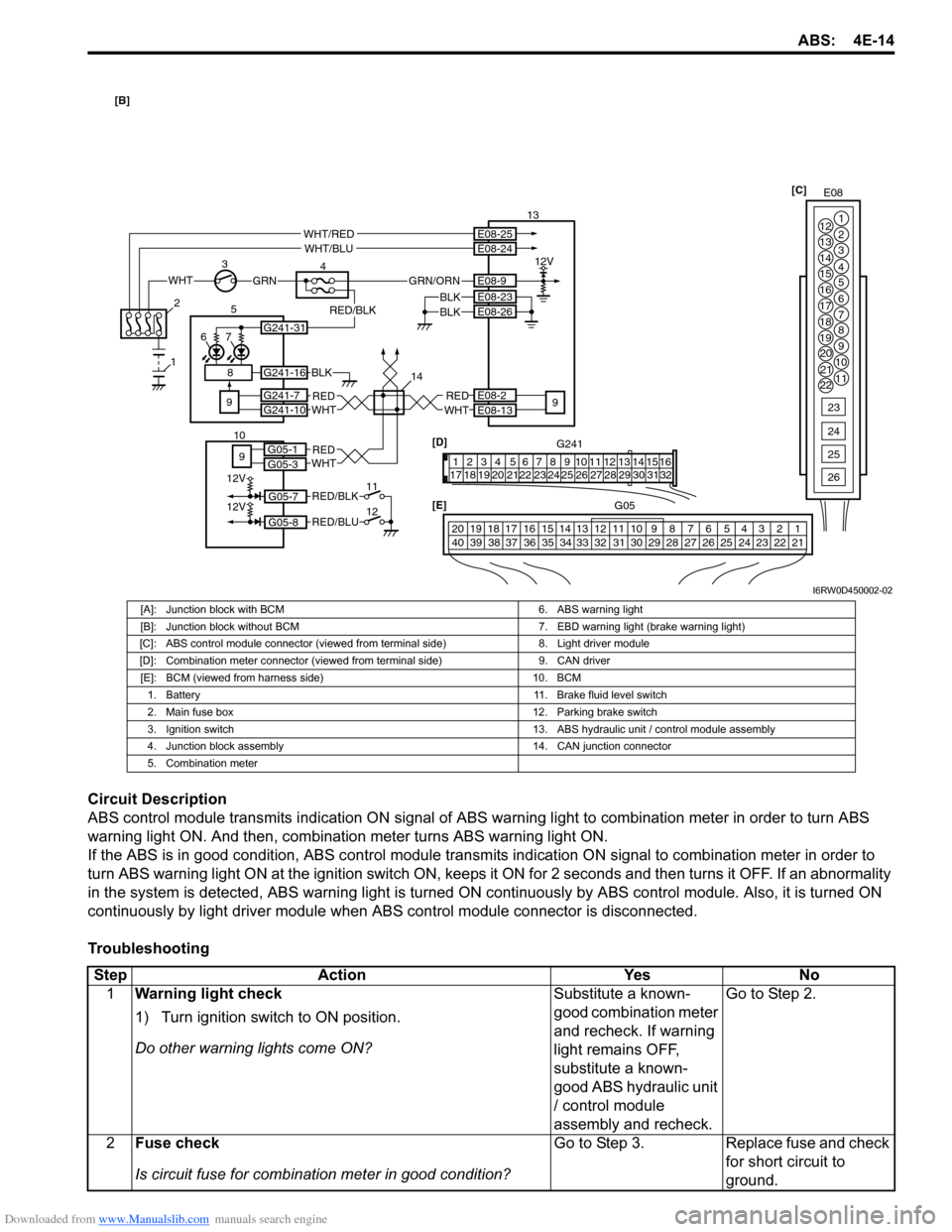
Circuit Description
ABS control module transmits indication ON signal of ABS warning light to combination meter in order to turn ABS
warning light ON. And then, combination meter turns ABS warning light ON.
If the ABS is in good condition, ABS control module transmits indication ON signal to combination meter in order to
turn ABS warning light ON at the ignition switch ON, keeps it ON for 2 seconds and then turns it OFF. If an abnormality
in the system is detected, ABS warning light is turned ON continuously by ABS control module. Also, it is turned ON
continuously by light driver module when ABS control module connector is disconnected.
Troubleshooting
G241 [D]
132 4 5 6 7 8 9 10111213141516
17 1918 20 2122 23 24 25 26 27 28 29 30 31 32E08 [C]
1
2
3
4
5
6
7 12
13
14
15
16
17
18
19
20
21
228
9
10
11
23
24
25
26
G05 [E]
1 2 3 4 765 8 9 10 11 14 15 16
36 34 33 32 3135 24 23 2122 28 27 2526 37 39 38 4018 17 13 12 19 20
30 29
WHTGRN
3
E08-2
E08-13REDWHT 5
4 13
9
E08-23
E08-26BLKBLK
67
BLK
REDWHTG241-7G241-10
G241-16
12V
E08-25E08-24
E08-9
WHT/REDWHT/BLU
GRN/ORN
9
2
1
14
G241-31
RED/BLK
8
REDWHT9
12V
12V
11
12G05-7
G05-1G05-3
G05-8
RED/BLK
RED/BLU
10
[B]
I6RW0D450002-02
[A]: Junction block with BCM 6. ABS warning light
[B]: Junction block without BCM 7. EBD warning light (brake warning light)
[C]: ABS control module connector (viewed from terminal side) 8. Light driver module
[D]: Combination meter connector (viewed from terminal side) 9. CAN driver
[E]: BCM (viewed from harness side) 10. BCM
1. Battery 11. Brake fluid level switch
2. Main fuse box 12. Parking brake switch
3. Ignition switch 13. ABS hydraulic unit / control module assembly
4. Junction block assembly 14. CAN junction connector
5. Combination meter
Step Action Yes No
1Warning light check
1) Turn ignition switch to ON position.
Do other warning lights come ON?Substitute a known-
good combination meter
and recheck. If warning
light remains OFF,
substitute a known-
good ABS hydraulic unit
/ control module
assembly and recheck.Go to Step 2.
2Fuse check
Is circuit fuse for combination meter in good condition?Go to Step 3. Replace fuse and check
for short circuit to
ground.
Page 649 of 1556
Downloaded from www.Manualslib.com manuals search engine Automatic Transmission/Transaxle: 5A-1
Transmission / Transaxle
Automatic Transmission/Transaxle
Precautions
Precautions in Diagnosing TroubleS6RW0D5100001
• Do not disconnect couplers from TCM, battery cable
from battery, TCM ground wire harness from engine or
main fuse before checking the diagnostic information
(DTC, freeze frame data, etc.) stored in TCM memory.
Such disconnection will clear memorized information
in TCM memory.
• Diagnostic information stored in TCM memory can be
cleared as well as checked by using SUZUKI scan
tool or CAN communication OBD generic scan tool.
Before using scan tool, read its Operator’s
(Instruction) Manual carefully to have good
understanding as to what functions are available and
how to use it.
It is indistinguishable which module turns on MIL
because not only ECM but also TCM turns on MIL.
Therefore, check both ECM and TCM for DTC when
MIL lights on.
When checking TCM for DTC, keep in mind that DTC
is displayed on the scan tool as follows depending on
the scan tool used.
– SUZUKI scan tool displays DTC detected by TCM.
– CAN communication OBD generic scan tool
displays DTC detected by each of ECM and TCM
simultaneously.
• Be sure to read “Precautions for Electrical Circuit
Service in Section 00” before inspection and observe
what is written there.
• TCM replacement
– When substituting a known-good TCM, check that
all relays and actuators have resistance of
specified value.
Neglecting this check may result in damage to good
TCM.
• Communication of ECM, BCM, combination meter,
keyless start control module (if equipped), ABS
control module, 4WD control module (if equipped),
TCM and DLC, is established by CAN (Controller
Area Network). (For more detail of CAN
communication for ECM, refer to “CAN
Communication System Description”). Therefore,
handle CAN communication line with care referring to
“Precaution for CAN Communication System in
Section 00”.
Precautions for Disassembly and ReassemblyS6RW0D5100002
When repairing automatic transaxle, it is necessary to
conduct the on-vehicle test to investigate where the
cause of the trouble lies first.
Then whether overhaul should be done or not is
determined. If the transaxle is disassembled without
such preliminary procedure, not only the cause of the
trouble would be unknown, but also a secondary trouble
may occur and often time would be wasted.
As the automatic transaxle consists of high precision
component, the following cautions should be strictly
observed when handling its parts in disassembly and
reassembly.
• Disassembling valve body assembly is prohibited
essentially. However, a few parts can be
disassembled. When disassembling valve body
component parts, confirm whether their parts are
allowed to disassemble or not referring to “Valve Body
Assembly Disassembly and Reassembly”.
• When component part of forward clutch, direct clutch,
2nd brake and/or O/D and 2nd coast brake, namely
clutch disc, brake disc, retaining plate and/or
separator plate, have been replaced, all learned
contents, which have been stored in TCM memory by
executing learning control, should be initialized
referring to “Learning Control Initialization”.
• Make sure to wash dirt off from the transaxle so that
no such dirt will enter the transaxle during
dismounting and remounting.
• Select a clean place free from dust and dirt for
overhauling.
• Place a rubber mat on the work bench to protect parts
from damage.
• Work gloves or shop cloth should not be used. (Use a
nylon cloth or a paper towel.)
• When separating the case joint, do not pry with a
screwdriver or such but tap with a plastic hammer
lightly.
• Make sure to wash dirt off from the transaxle so that
no such dirt will enter the transaxle during
disassembly and reassembly.
• Wash the disassembled parts in ATF (Automatic
Transaxle Fluid) or kerosene (using care not to allow
ATF or kerosene to get on your face, etc.) and confirm
that each fluid passage is not clogged by blowing air
into it. But use kerosene to wash the discs, resin
washers and rubber parts.
• Replace each gasket, oil seal and O-ring with a new
one.
• Apply ATF to sliding or rotating parts before
reassembly.
Page 656 of 1556
Downloaded from www.Manualslib.com manuals search engine 5A-8 Automatic Transmission/Transaxle:
On-Board Diagnostic System DescriptionS6RW0D5101005
NOTE
There are two types of OBD system
depending on the vehicle specification.For
identification, refer to “Precaution on On-
Board Diagnostic (OBD) System in Section
1A”.
For automatic transaxle control system, TCM has the
following functions.
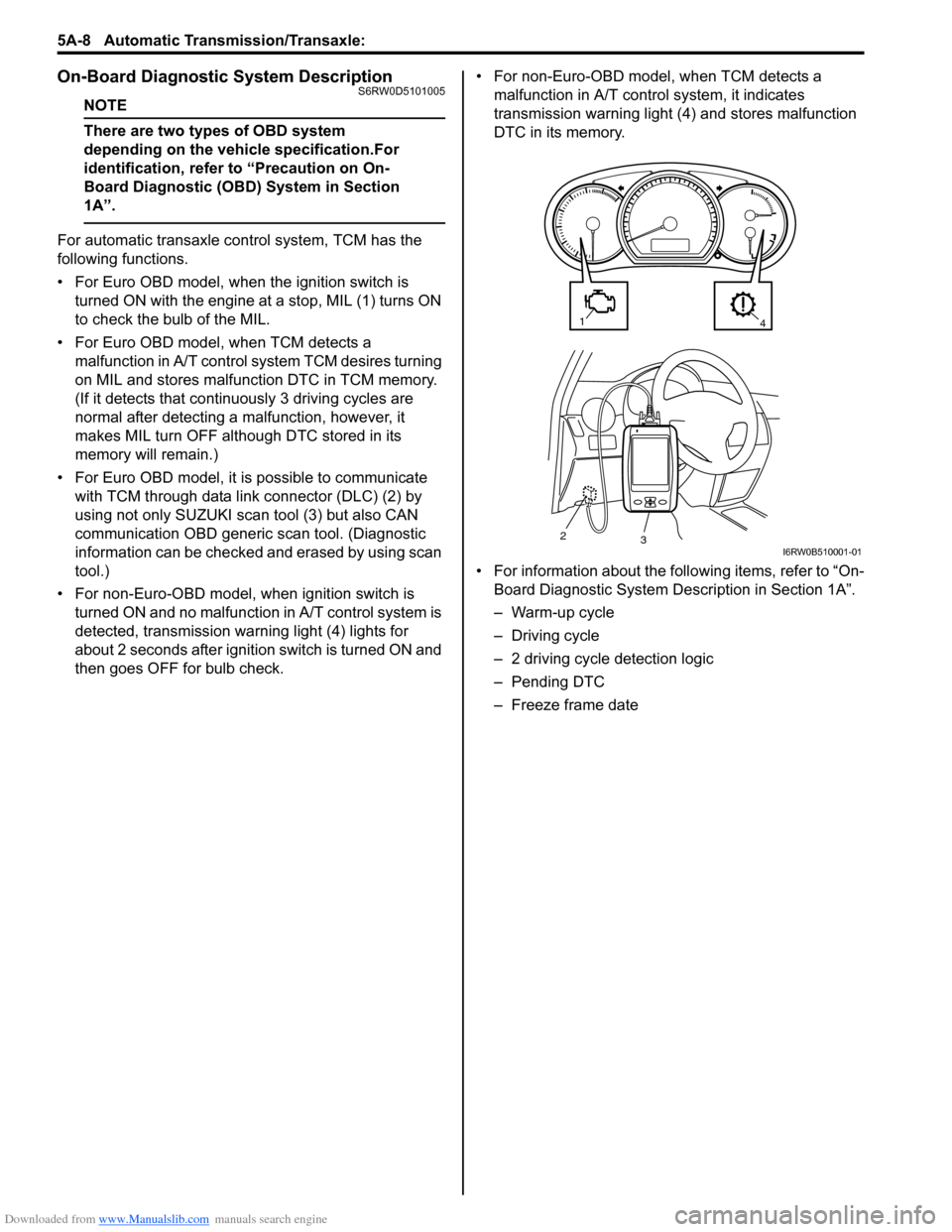
• For Euro OBD model, when the ignition switch is
turned ON with the engine at a stop, MIL (1) turns ON
to check the bulb of the MIL.
• For Euro OBD model, when TCM detects a
malfunction in A/T control system TCM desires turning
on MIL and stores malfunction DTC in TCM memory.
(If it detects that continuously 3 driving cycles are
normal after detecting a malfunction, however, it
makes MIL turn OFF although DTC stored in its
memory will remain.)
• For Euro OBD model, it is possible to communicate
with TCM through data link connector (DLC) (2) by
using not only SUZUKI scan tool (3) but also CAN
communication OBD generic scan tool. (Diagnostic
information can be checked and erased by using scan
tool.)
• For non-Euro-OBD model, when ignition switch is
turned ON and no malfunction in A/T control system is
detected, transmission warning light (4) lights for
about 2 seconds after ignition switch is turned ON and
then goes OFF for bulb check.• For non-Euro-OBD model, when TCM detects a
malfunction in A/T control system, it indicates
transmission warning light (4) and stores malfunction
DTC in its memory.
• For information about the following items, refer to “On-
Board Diagnostic System Description in Section 1A”.
– Warm-up cycle
– Driving cycle
– 2 driving cycle detection logic
– Pending DTC
– Freeze frame date
1
3 2
4
I6RW0B510001-01
Page 667 of 1556
Downloaded from www.Manualslib.com manuals search engine Automatic Transmission/Transaxle: 5A-19
Malfunction Indicator Lamp (MIL) CheckS6RW0D5104003
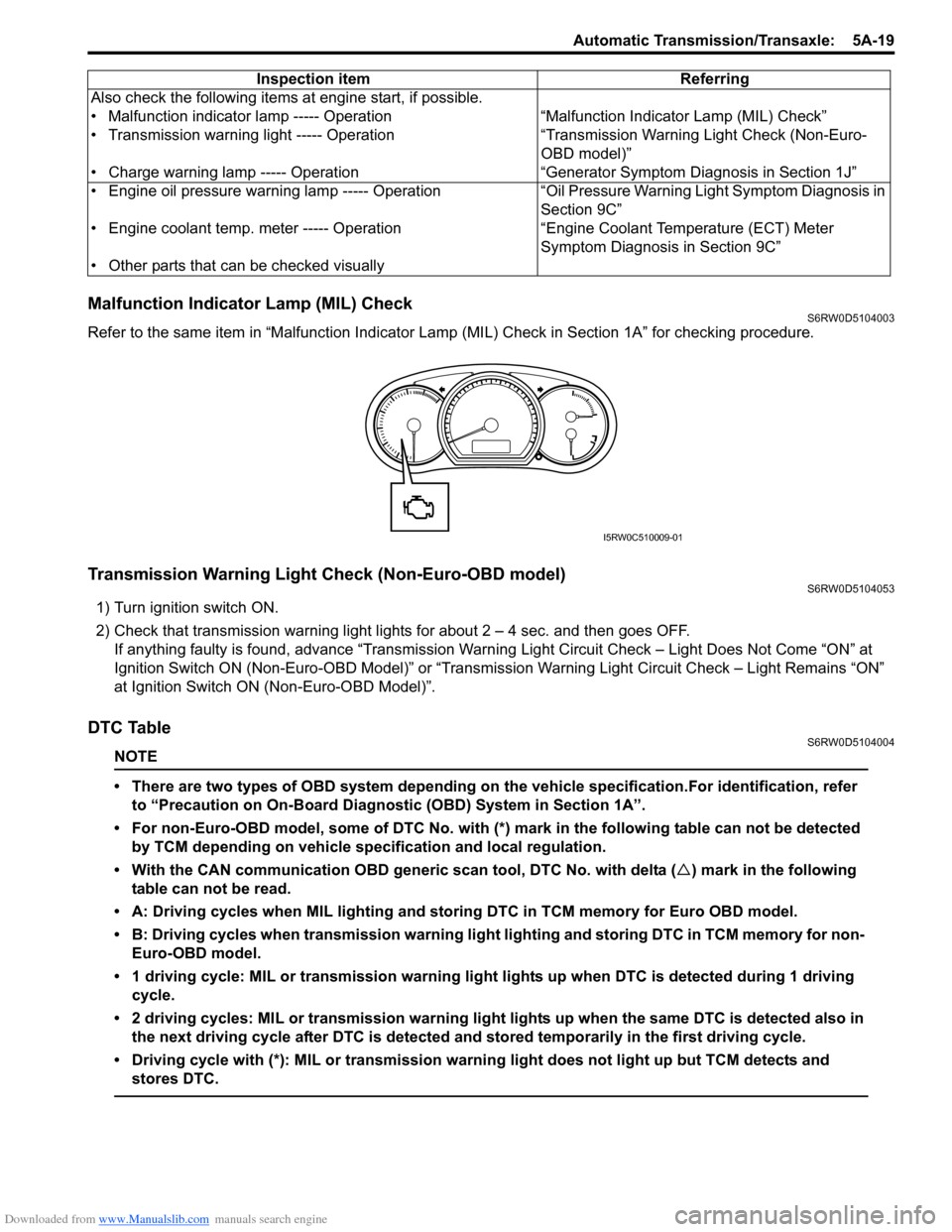
Refer to the same item in “Malfunction Indicator Lamp (MIL) Check in Section 1A” for checking procedure.
Transmission Warning Light Check (Non-Euro-OBD model)S6RW0D5104053
1) Turn ignition switch ON.
2) Check that transmission warning light lights for about 2 – 4 sec. and then goes OFF.
If anything faulty is found, advance “Transmission Warning Light Circuit Check – Light Does Not Come “ON” at
Ignition Switch ON (Non-Euro-OBD Model)” or “Transmission Warning Light Circuit Check – Light Remains “ON”
at Ignition Switch ON (Non-Euro-OBD Model)”.
DTC TableS6RW0D5104004
NOTE
• There are two types of OBD system depending on the vehicle specification.For identification, refer
to “Precaution on On-Board Diagnostic (OBD) System in Section 1A”.
• For non-Euro-OBD model, some of DTC No. with (*) mark in the following table can not be detected
by TCM depending on vehicle specification and local regulation.
• With the CAN communication OBD generic scan tool, DTC No. with delta (U) mark in the following
table can not be read.
• A: Driving cycles when MIL lighting and storing DTC in TCM memory for Euro OBD model.
• B: Driving cycles when transmission warning light lighting and storing DTC in TCM memory for non-
Euro-OBD model.
• 1 driving cycle: MIL or transmission warning light lights up when DTC is detected during 1 driving
cycle.
• 2 driving cycles: MIL or transmission warning light lights up when the same DTC is detected also in
the next driving cycle after DTC is detected and stored temporarily in the first driving cycle.
• Driving cycle with (*): MIL or transmission warning light does not light up but TCM detects and
stores DTC.
Also check the following items at engine start, if possible.
• Malfunction indicator lamp ----- Operation “Malfunction Indicator Lamp (MIL) Check”
• Transmission warning light ----- Operation “Transmission Warning Light Check (Non-Euro-
OBD model)”
• Charge warning lamp ----- Operation “Generator Symptom Diagnosis in Section 1J”
• Engine oil pressure warning lamp ----- Operation “Oil Pressure Warning Light Symptom Diagnosis in
Section 9C”
• Engine coolant temp. meter ----- Operation “Engine Coolant Temperature (ECT) Meter
Symptom Diagnosis in Section 9C”
• Other parts that can be checked visuallyInspection item Referring
I5RW0C510009-01