Washer SUZUKI SX4 2006 1.G Service User Guide
[x] Cancel search | Manufacturer: SUZUKI, Model Year: 2006, Model line: SX4, Model: SUZUKI SX4 2006 1.GPages: 1556, PDF Size: 37.31 MB
Page 461 of 1556
Downloaded from www.Manualslib.com manuals search engine Rear Suspension: 2C-2
Rear Shock Absorber Removal and InstallationS6RW0D2306002
Removal
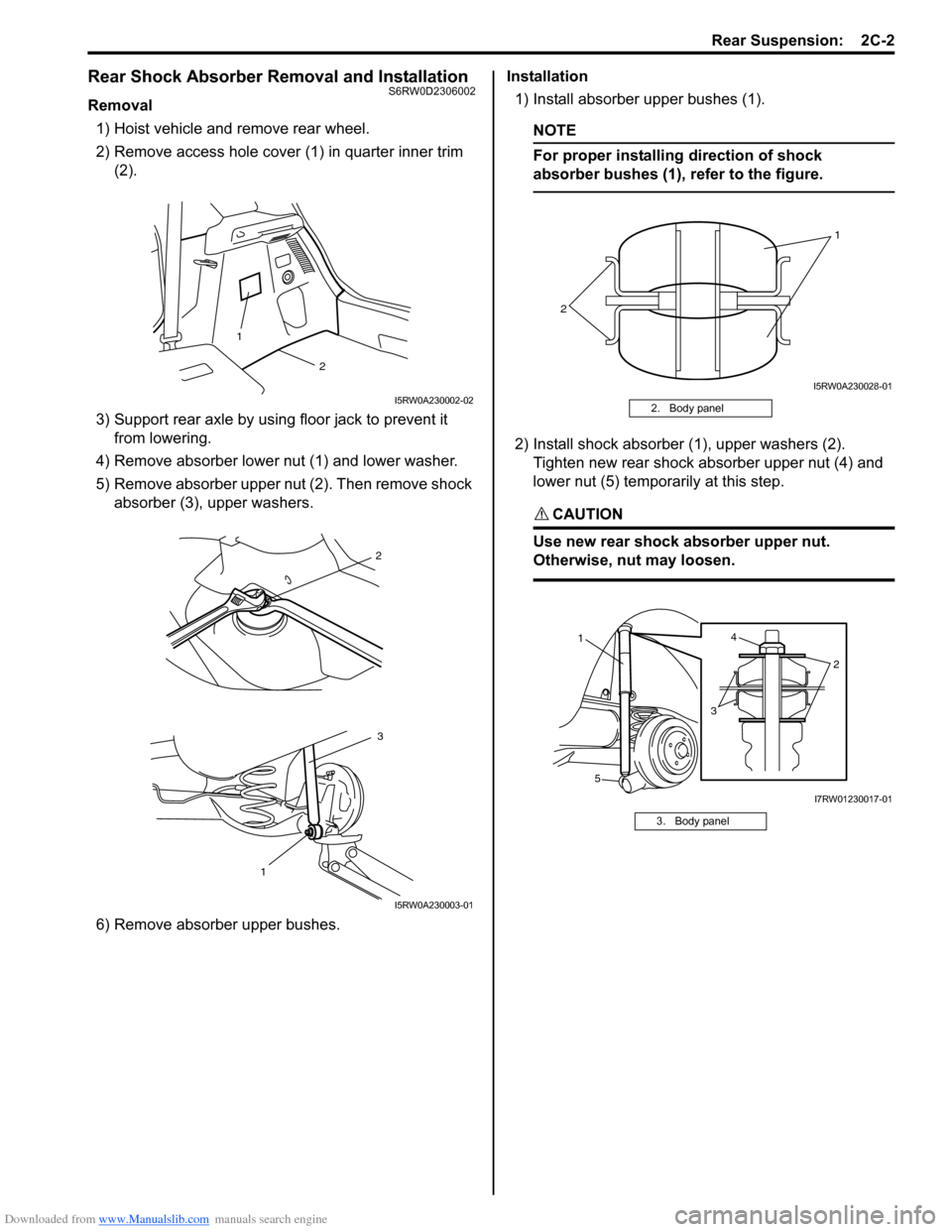
1) Hoist vehicle and remove rear wheel.
2) Remove access hole cover (1) in quarter inner trim
(2).
3) Support rear axle by using floor jack to prevent it
from lowering.
4) Remove absorber lower nut (1) and lower washer.
5) Remove absorber upper nut (2). Then remove shock
absorber (3), upper washers.
6) Remove absorber upper bushes.Installation
1) Install absorber upper bushes (1).
NOTE
For proper installing direction of shock
absorber bushes (1), refer to the figure.
2) Install shock absorber (1), upper washers (2).
Tighten new rear shock absorber upper nut (4) and
lower nut (5) temporarily at this step.
CAUTION!
Use new rear shock absorber upper nut.
Otherwise, nut may loosen.
2
1
I5RW0A230002-02
2
1
3
I5RW0A230003-01
2. Body panel
3. Body panel
1
2
I5RW0A230028-01
14
32
5
I7RW01230017-01
Page 464 of 1556
Downloaded from www.Manualslib.com manuals search engine 2C-5 Rear Suspension:
Installation
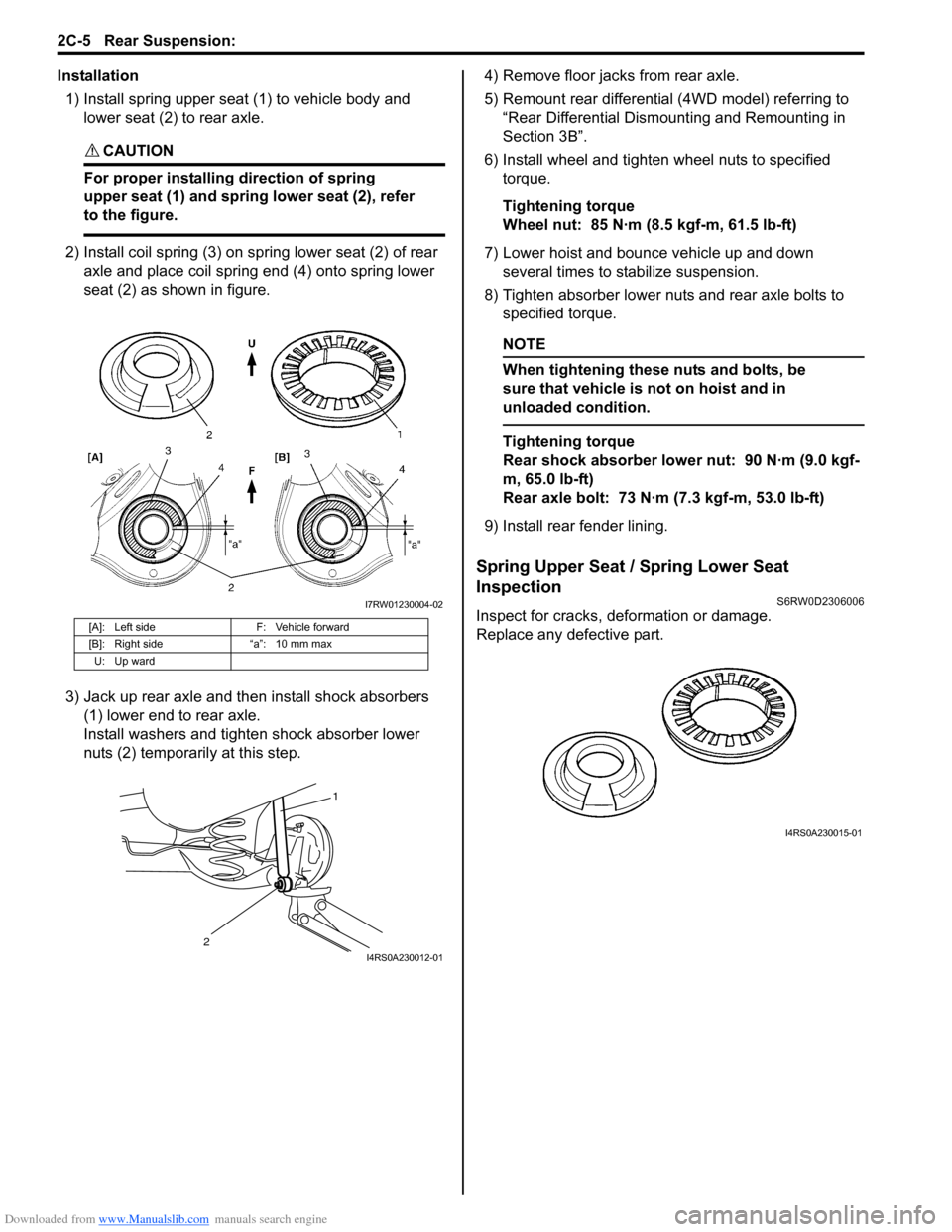
1) Install spring upper seat (1) to vehicle body and
lower seat (2) to rear axle.
CAUTION!
For proper installing direction of spring
upper seat (1) and spring lower seat (2), refer
to the figure.
2) Install coil spring (3) on spring lower seat (2) of rear
axle and place coil spring end (4) onto spring lower
seat (2) as shown in figure.
3) Jack up rear axle and then install shock absorbers
(1) lower end to rear axle.
Install washers and tighten shock absorber lower
nuts (2) temporarily at this step.4) Remove floor jacks from rear axle.
5) Remount rear differential (4WD model) referring to
“Rear Differential Dismounting and Remounting in
Section 3B”.
6) Install wheel and tighten wheel nuts to specified
torque.
Tightening torque
Wheel nut: 85 N·m (8.5 kgf-m, 61.5 lb-ft)
7) Lower hoist and bounce vehicle up and down
several times to stabilize suspension.
8) Tighten absorber lower nuts and rear axle bolts to
specified torque.
NOTE
When tightening these nuts and bolts, be
sure that vehicle is not on hoist and in
unloaded condition.
Tightening torque
Rear shock absorber lower nut: 90 N·m (9.0 kgf-
m, 65.0 lb-ft)
Rear axle bolt: 73 N·m (7.3 kgf-m, 53.0 lb-ft)
9) Install rear fender lining.
Spring Upper Seat / Spring Lower Seat
Inspection
S6RW0D2306006
Inspect for cracks, deformation or damage.
Replace any defective part.[A]: Left side F: Vehicle forward
[B]: Right side “a”: 10 mm max
U: Up ward
I7RW01230004-02
1
2I4RS0A230012-01
I4RS0A230015-01
Page 480 of 1556
Downloaded from www.Manualslib.com manuals search engine 3A-1 Drive Shaft / Axle: Front
Driveline / Axle
Drive Shaft / Axle
Front
General Description
Front Drive Shaft ConstructionS6RW0D3111001
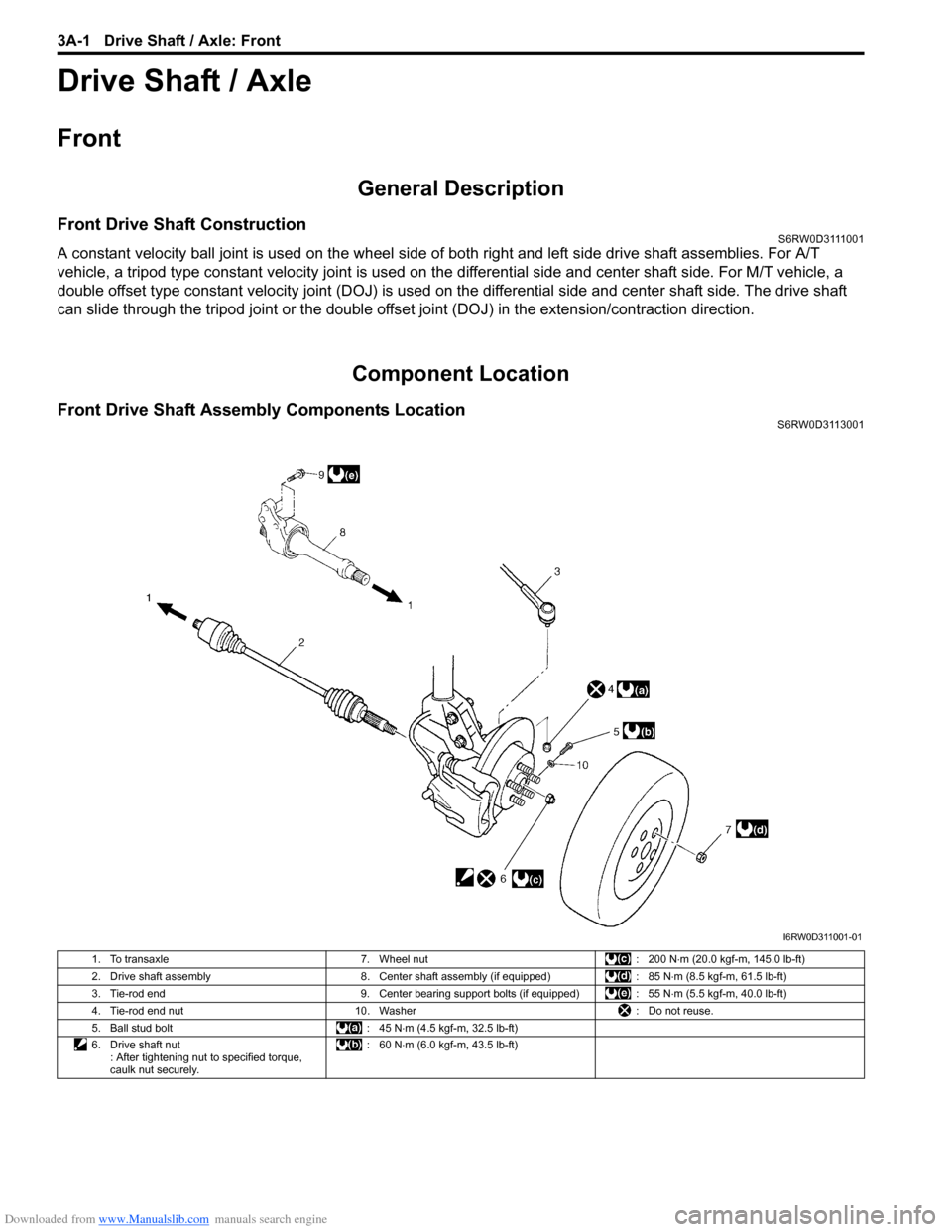
A constant velocity ball joint is used on the wheel side of both right and left side drive shaft assemblies. For A/T
vehicle, a tripod type constant velocity joint is used on the differential side and center shaft side. For M/T vehicle, a
double offset type constant velocity joint (DOJ) is used on the differential side and center shaft side. The drive shaft
can slide through the tripod joint or the double offset joint (DOJ) in the extension/contraction direction.
Component Location
Front Drive Shaft Assembly Components LocationS6RW0D3113001
I6RW0D311001-01
1. To transaxle 7. Wheel nut : 200 N⋅m (20.0 kgf-m, 145.0 lb-ft)
2. Drive shaft assembly 8. Center shaft assembly (if equipped) : 85 N⋅m (8.5 kgf-m, 61.5 lb-ft)
3. Tie-rod end 9. Center bearing support bolts (if equipped) : 55 N⋅m (5.5 kgf-m, 40.0 lb-ft)
4. Tie-rod end nut 10. Washer : Do not reuse.
5. Ball stud bolt : 45 N⋅m (4.5 kgf-m, 32.5 lb-ft)
6. Drive shaft nut
: After tightening nut to specified torque,
caulk nut securely.:60 N⋅m (6.0 kgf-m, 43.5 lb-ft)
Page 532 of 1556
Downloaded from www.Manualslib.com manuals search engine 3B-35 Differential:
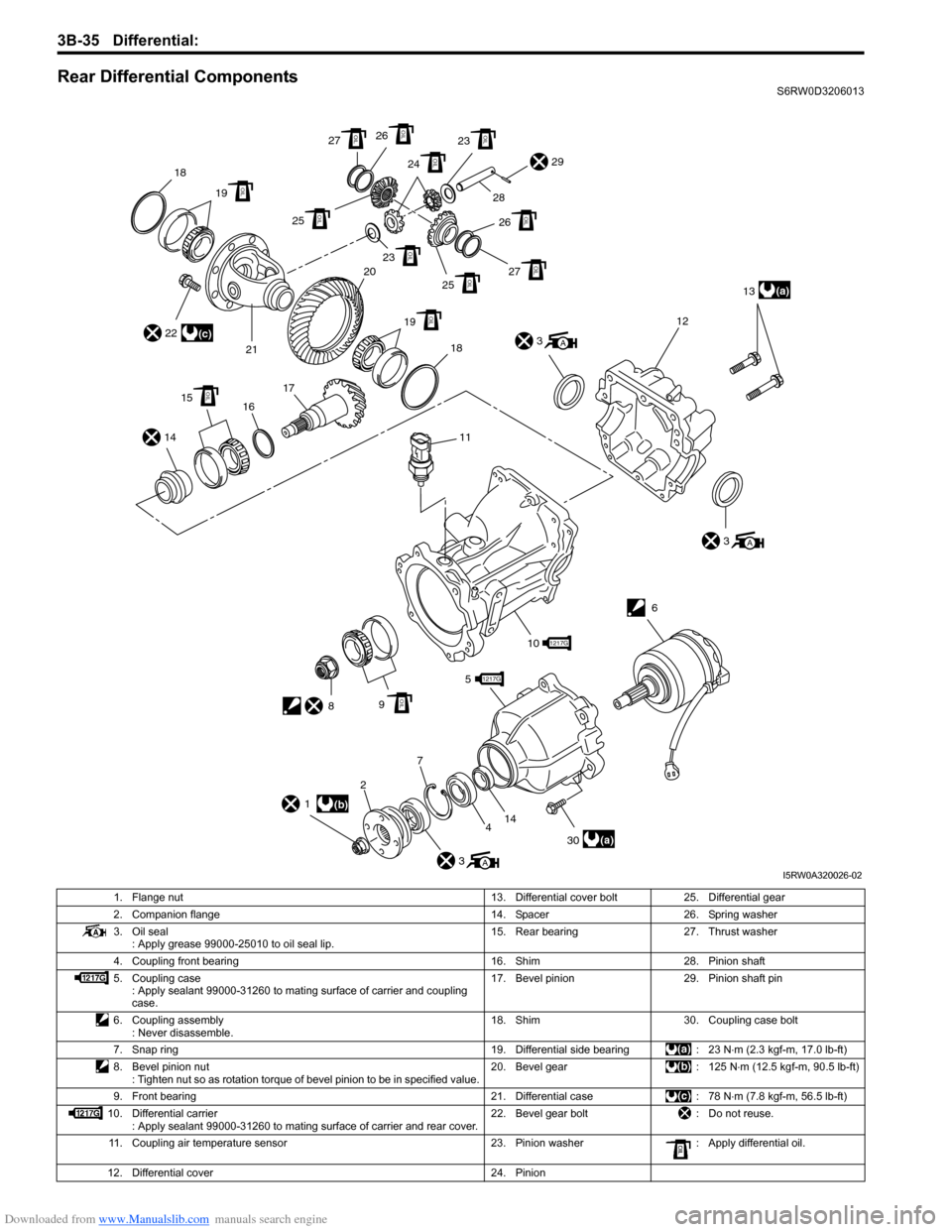
Rear Differential ComponentsS6RW0D3206013
4 5
9
2
30
6
(a)13
12
(a)
3
A
3A
141617 2118
29
3A
1(b)
22
1217G
101217G
11
8OIL
15OIL
19 20OIL
23OIL
25OIL27OIL
27OIL
25OIL
19OIL18
26 28
OIL
26OIL23OIL
24OIL
(c)
14
7
I5RW0A320026-02
1. Flange nut 13. Differential cover bolt 25. Differential gear
2. Companion flange 14. Spacer 26. Spring washer
3. Oil seal
: Apply grease 99000-25010 to oil seal lip.15. Rear bearing 27. Thrust washer
4. Coupling front bearing 16. Shim 28. Pinion shaft
5. Coupling case
: Apply sealant 99000-31260 to mating surface of carrier and coupling
case.17. Bevel pinion 29. Pinion shaft pin
6. Coupling assembly
: Never disassemble.18. Shim 30. Coupling case bolt
7. Snap ring 19. Differential side bearing : 23 N⋅m (2.3 kgf-m, 17.0 lb-ft)
8. Bevel pinion nut
: Tighten nut so as rotation torque of bevel pinion to be in specified value.20. Bevel gear : 125 N⋅m (12.5 kgf-m, 90.5 lb-ft)
9. Front bearing 21. Differential case : 78 N⋅m (7.8 kgf-m, 56.5 lb-ft)
10. Differential carrier
: Apply sealant 99000-31260 to mating surface of carrier and rear cover.22. Bevel gear bolt : Do not reuse.
11. Coupling air temperature sensor 23. Pinion washer : Apply differential oil.
12. Differential cover 24. Pinion
Page 534 of 1556
Downloaded from www.Manualslib.com manuals search engine 3B-37 Differential:
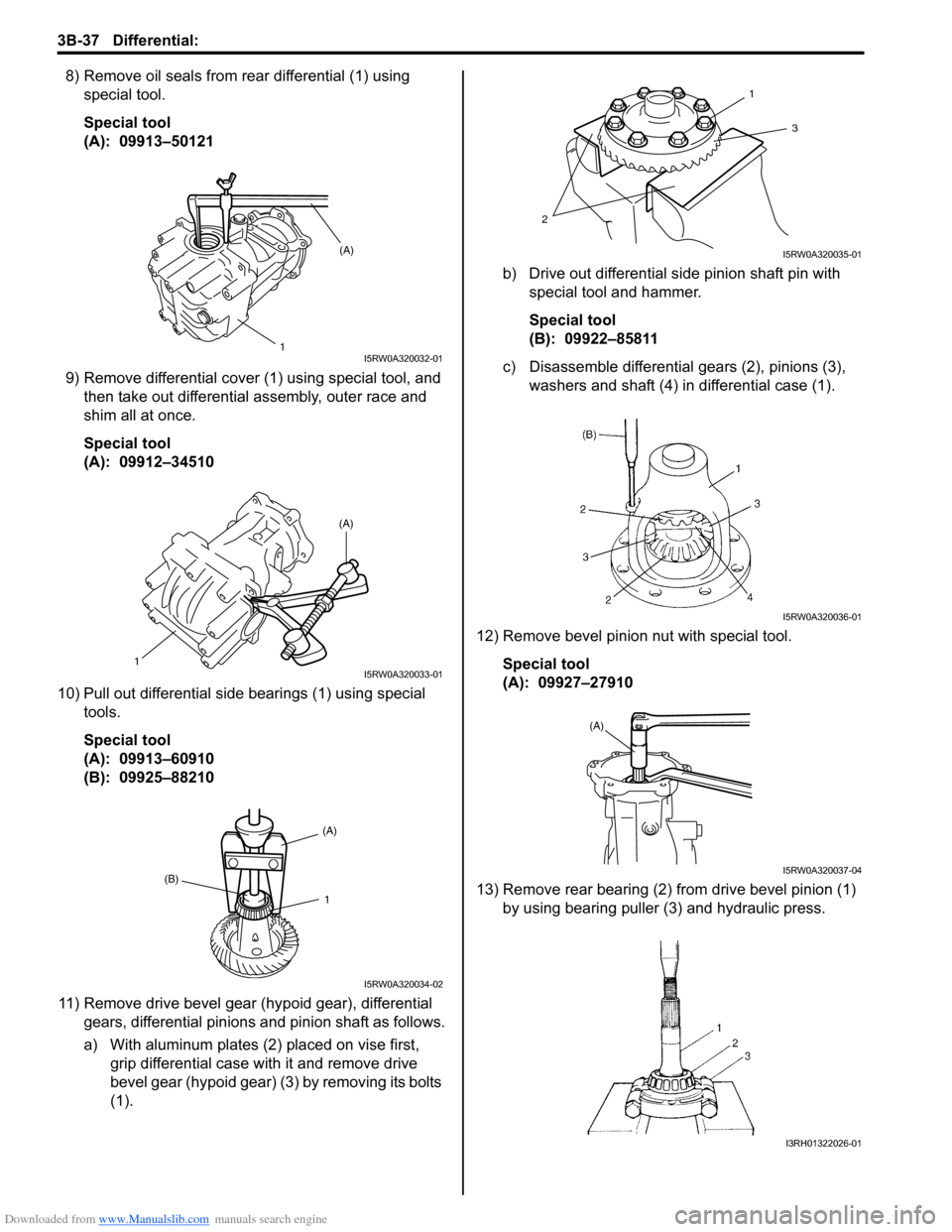
8) Remove oil seals from rear differential (1) using
special tool.
Special tool
(A): 09913–50121
9) Remove differential cover (1) using special tool, and
then take out differential assembly, outer race and
shim all at once.
Special tool
(A): 09912–34510
10) Pull out differential side bearings (1) using special
tools.
Special tool
(A): 09913–60910
(B): 09925–88210
11) Remove drive bevel gear (hypoid gear), differential
gears, differential pinions and pinion shaft as follows.
a) With aluminum plates (2) placed on vise first,
grip differential case with it and remove drive
bevel gear (hypoid gear) (3) by removing its bolts
(1).b) Drive out differential side pinion shaft pin with
special tool and hammer.
Special tool
(B): 09922–85811
c) Disassemble differential gears (2), pinions (3),
washers and shaft (4) in differential case (1).
12) Remove bevel pinion nut with special tool.
Special tool
(A): 09927–27910
13) Remove rear bearing (2) from drive bevel pinion (1)
by using bearing puller (3) and hydraulic press.
1(A)I5RW0A320032-01
(A)
1
I5RW0A320033-01
(A)
(B)
1
I5RW0A320034-02
1
3
2
I5RW0A320035-01
I5RW0A320036-01
(A)
I5RW0A320037-04
I3RH01322026-01
Page 535 of 1556

Downloaded from www.Manualslib.com manuals search engine Differential: 3B-38
14) Using a hammer and brass bar (1), drive out front
bearing outer race (2).
15) Using a hammer and brass bar (1), drive out rear
bearing outer race (2).
Reassembly
Judging from faulty conditions noted before disassembly
and what is found through visual check of bearing and
gear tooth etc. after disassembly, prepare replacing
parts and proceed to reassembly according to
procedures as described in the following.
CAUTION!
• Bevel gear and pinion must be replaced as
a set when either replacement becomes
necessary.
• When replacing taper roller bearing,
replace as inner race & outer race
assembly.
1) Press-fit bevel pinion bearing outer races to
differential carrier (1) by using special tools and
hydraulic press as shown in the figure.
Special tool
(A): 09913–85210
(B): 09913–75510
2) After applying differential oil to differential gears (4),
pinions (5), pinion shaft (3), side washers (1), spring
washers (7) and pinion washers (2), install them in
differential case (6).
For correct installing direction of side washers and
spring washers, refer to figure.
NOTE
Used left and right differential side washers
are not interchangeable.
3) Check pinion gear (1) for smooth rotation.
1
2
I5RW0A320038-01
1
2
I5RW0A320039-01
(B)(A)
1
I5RW0A320040-02
7 6
4
5
3
21
I5RW0A320041-01
I3RH01322031-01
Page 588 of 1556
Downloaded from www.Manualslib.com manuals search engine 4B-1 Front Brakes:
Brakes
Front Brakes
Repair Instructions
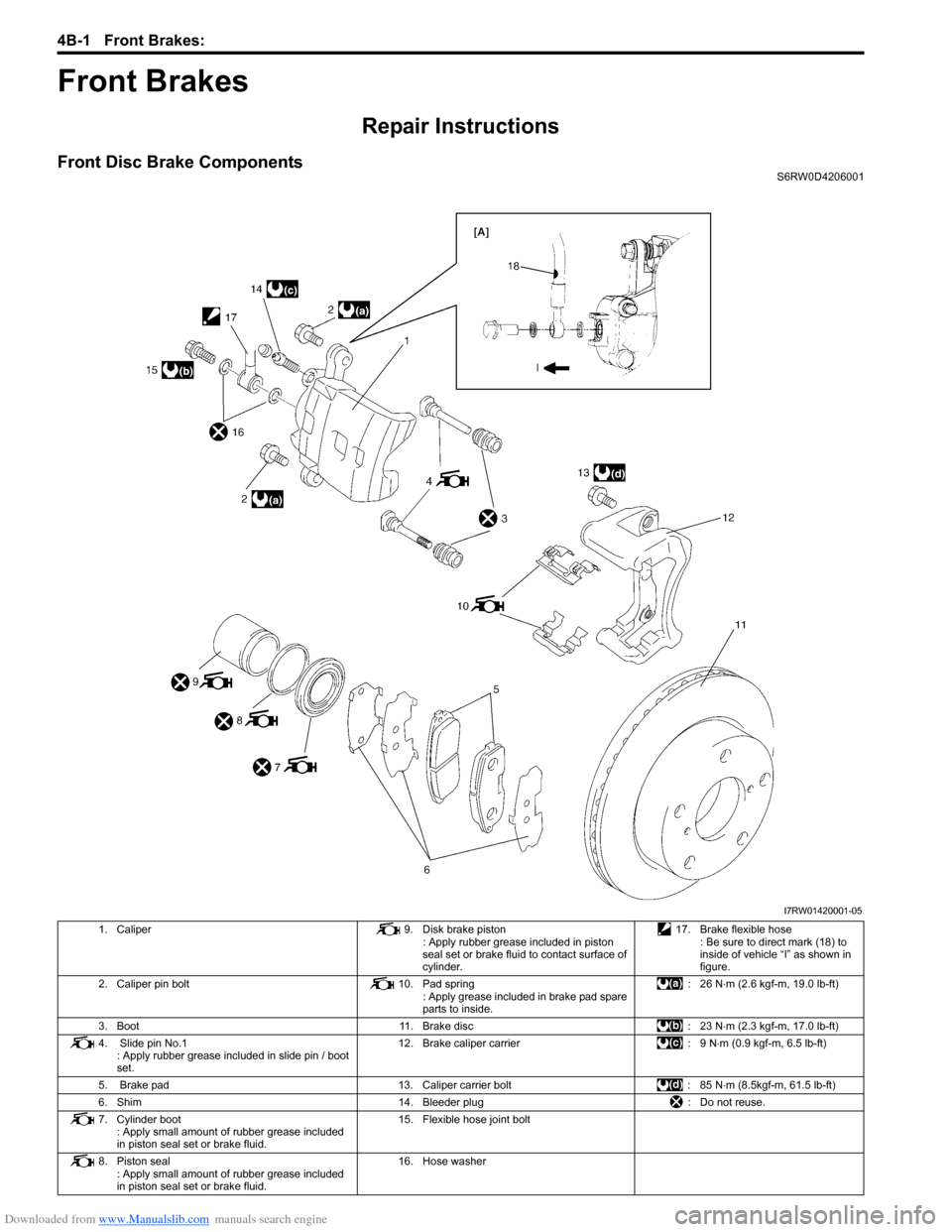
Front Disc Brake ComponentsS6RW0D4206001
I7RW01420001-05
1. Caliper 9. Disk brake piston
: Apply rubber grease included in piston
seal set or brake fluid to contact surface of
cylinder.17. Brake flexible hose
: Be sure to direct mark (18) to
inside of vehicle “I” as shown in
figure.
2. Caliper pin bolt 10. Pad spring
: Apply grease included in brake pad spare
parts to inside.: 26 N⋅m (2.6 kgf-m, 19.0 lb-ft)
3. Boot 11. Brake disc : 23 N⋅m (2.3 kgf-m, 17.0 lb-ft)
4. Slide pin No.1
: Apply rubber grease included in slide pin / boot
set.12. Brake caliper carrier : 9 N⋅m (0.9 kgf-m, 6.5 lb-ft)
5. Brake pad 13. Caliper carrier bolt : 85 N⋅m (8.5kgf-m, 61.5 lb-ft)
6. Shim 14. Bleeder plug : Do not reuse.
7. Cylinder boot
: Apply small amount of rubber grease included
in piston seal set or brake fluid.15. Flexible hose joint bolt
8. Piston seal
: Apply small amount of rubber grease included
in piston seal set or brake fluid.16. Hose washer
Page 649 of 1556
Downloaded from www.Manualslib.com manuals search engine Automatic Transmission/Transaxle: 5A-1
Transmission / Transaxle
Automatic Transmission/Transaxle
Precautions
Precautions in Diagnosing TroubleS6RW0D5100001
• Do not disconnect couplers from TCM, battery cable
from battery, TCM ground wire harness from engine or
main fuse before checking the diagnostic information
(DTC, freeze frame data, etc.) stored in TCM memory.
Such disconnection will clear memorized information
in TCM memory.
• Diagnostic information stored in TCM memory can be
cleared as well as checked by using SUZUKI scan
tool or CAN communication OBD generic scan tool.
Before using scan tool, read its Operator’s
(Instruction) Manual carefully to have good
understanding as to what functions are available and
how to use it.
It is indistinguishable which module turns on MIL
because not only ECM but also TCM turns on MIL.
Therefore, check both ECM and TCM for DTC when
MIL lights on.
When checking TCM for DTC, keep in mind that DTC
is displayed on the scan tool as follows depending on
the scan tool used.
– SUZUKI scan tool displays DTC detected by TCM.
– CAN communication OBD generic scan tool
displays DTC detected by each of ECM and TCM
simultaneously.
• Be sure to read “Precautions for Electrical Circuit
Service in Section 00” before inspection and observe
what is written there.
• TCM replacement
– When substituting a known-good TCM, check that
all relays and actuators have resistance of
specified value.
Neglecting this check may result in damage to good
TCM.
• Communication of ECM, BCM, combination meter,
keyless start control module (if equipped), ABS
control module, 4WD control module (if equipped),
TCM and DLC, is established by CAN (Controller
Area Network). (For more detail of CAN
communication for ECM, refer to “CAN
Communication System Description”). Therefore,
handle CAN communication line with care referring to
“Precaution for CAN Communication System in
Section 00”.
Precautions for Disassembly and ReassemblyS6RW0D5100002
When repairing automatic transaxle, it is necessary to
conduct the on-vehicle test to investigate where the
cause of the trouble lies first.
Then whether overhaul should be done or not is
determined. If the transaxle is disassembled without
such preliminary procedure, not only the cause of the
trouble would be unknown, but also a secondary trouble
may occur and often time would be wasted.
As the automatic transaxle consists of high precision
component, the following cautions should be strictly
observed when handling its parts in disassembly and
reassembly.
• Disassembling valve body assembly is prohibited
essentially. However, a few parts can be
disassembled. When disassembling valve body
component parts, confirm whether their parts are
allowed to disassemble or not referring to “Valve Body
Assembly Disassembly and Reassembly”.
• When component part of forward clutch, direct clutch,
2nd brake and/or O/D and 2nd coast brake, namely
clutch disc, brake disc, retaining plate and/or
separator plate, have been replaced, all learned
contents, which have been stored in TCM memory by
executing learning control, should be initialized
referring to “Learning Control Initialization”.
• Make sure to wash dirt off from the transaxle so that
no such dirt will enter the transaxle during
dismounting and remounting.
• Select a clean place free from dust and dirt for
overhauling.
• Place a rubber mat on the work bench to protect parts
from damage.
• Work gloves or shop cloth should not be used. (Use a
nylon cloth or a paper towel.)
• When separating the case joint, do not pry with a
screwdriver or such but tap with a plastic hammer
lightly.
• Make sure to wash dirt off from the transaxle so that
no such dirt will enter the transaxle during
disassembly and reassembly.
• Wash the disassembled parts in ATF (Automatic
Transaxle Fluid) or kerosene (using care not to allow
ATF or kerosene to get on your face, etc.) and confirm
that each fluid passage is not clogged by blowing air
into it. But use kerosene to wash the discs, resin
washers and rubber parts.
• Replace each gasket, oil seal and O-ring with a new
one.
• Apply ATF to sliding or rotating parts before
reassembly.
Page 650 of 1556
Downloaded from www.Manualslib.com manuals search engine 5A-2 Automatic Transmission/Transaxle:
CAUTION!
• Keep component parts in group for each
subassembly and avoid mixing them up.
• Clean all parts with cleaning solvent
thoroughly and air dry them.
• Use kerosene or automatic transaxle fluid
as cleaning solvent.
• Do not use wiping cloths or rags to clean
or dry parts.
• All oil passages should be blown out and
checked to make sure that they are not
obstructed.
• Keep face and eyes away from solvent
spray while air blowing parts.
• Check mating surface for irregularities and
remove them, if any, and clean it again.
• Soak new clutch discs and brake discs in
transaxle fluid for at least 2 hours before
assembly.
• Replace all gaskets and O-ring with new
ones.
• Apply automatic transaxle fluid to all O-
rings.
• When installing seal ring, be careful so that
it is not expanded excessively, extruded or
caught.
• Replace oil seals that are removed and
apply grease to their lips.
• Before installing, be sure to apply
automatic transaxle fluid to sliding, rolling
and thrusting surface of all component
part. Also after installation, make sure to
check each part for proper operation.
• Always use torque wrench when
tightening bolts.
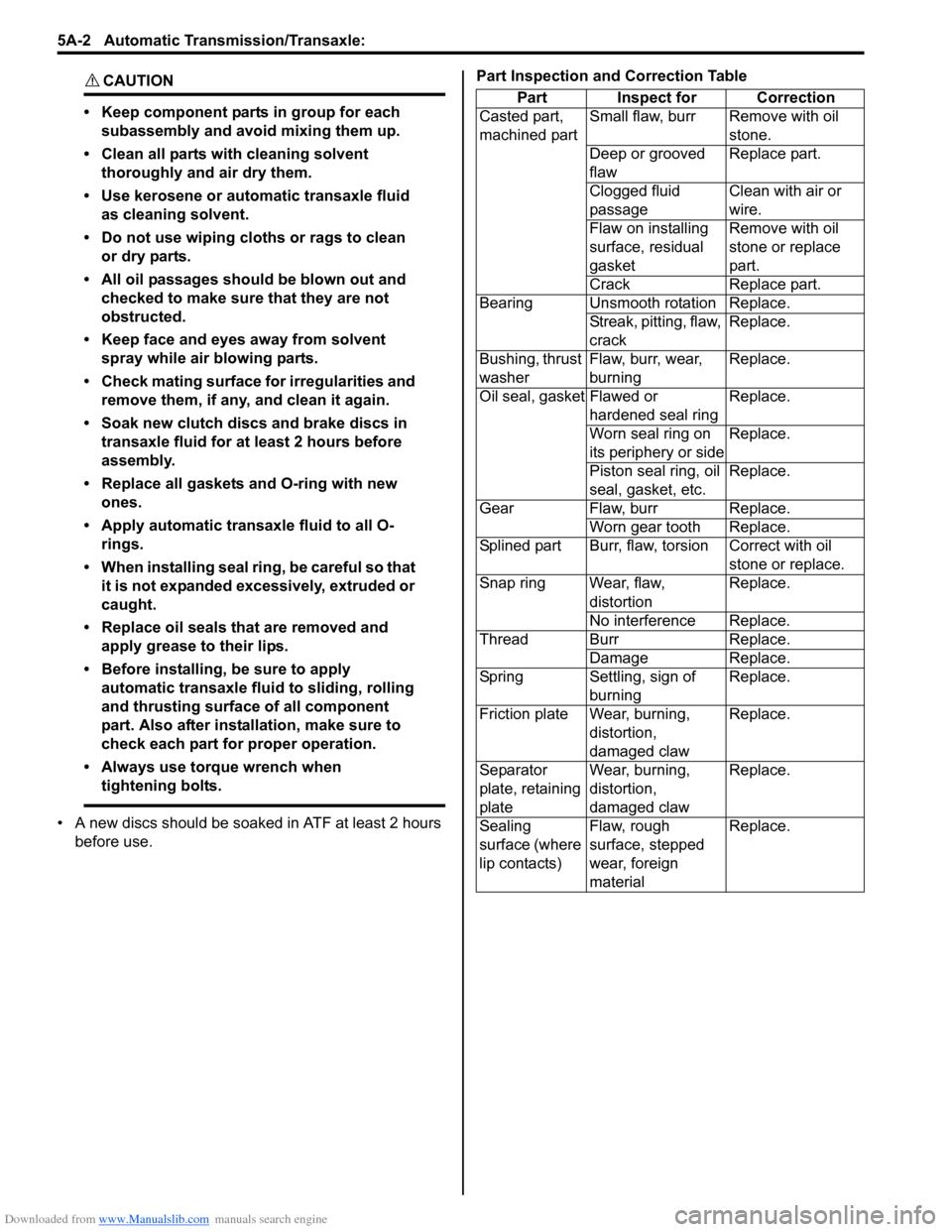
• A new discs should be soaked in ATF at least 2 hours
before use.Part Inspection and Correction Table
Part Inspect for Correction
Casted part,
machined partSmall flaw, burr Remove with oil
stone.
Deep or grooved
flawReplace part.
Clogged fluid
passageClean with air or
wire.
Flaw on installing
surface, residual
gasketRemove with oil
stone or replace
part.
Crack Replace part.
Bearing Unsmooth rotation Replace.
Streak, pitting, flaw,
crackReplace.
Bushing, thrust
washerFlaw, burr, wear,
burningReplace.
Oil seal, gasket Flawed or
hardened seal ringReplace.
Worn seal ring on
its periphery or sideReplace.
Piston seal ring, oil
seal, gasket, etc.Replace.
Gear Flaw, burr Replace.
Worn gear tooth Replace.
Splined part Burr, flaw, torsion Correct with oil
stone or replace.
Snap ring Wear, flaw,
distortionReplace.
No interference Replace.
Thread Burr Replace.
Damage Replace.
Spring Settling, sign of
burningReplace.
Friction plate Wear, burning,
distortion,
damaged clawReplace.
Separator
plate, retaining
plateWear, burning,
distortion,
damaged clawReplace.
Sealing
surface (where
lip contacts)Flaw, rough
surface, stepped
wear, foreign
materialReplace.
Page 691 of 1556

Downloaded from www.Manualslib.com manuals search engine Automatic Transmission/Transaxle: 5A-43
DTC Detecting Condition and Trouble Area
DTC Confirmation Procedure
1) Connect scan tool to DLC with ignition switch OFF.
2) Clear DTCs in TCM memory by using scan tool.
3) Start engine and shift select lever to “D” range.
4) Keep engine running at idle speed for 25 seconds or more.
5) Stop vehicle and check DTC.
DTC TroubleshootingDTC detecting condition Trouble area
Multiple or more signals are inputted simultaneously for 10
seconds.• Select cable maladjusted
• Transmission range sensor maladjusted
• Transmission range sensor or its circuit malfunction
•TCM
Step Action Yes No
1Was “A/T System Check” performed?Go to Step 2. Go to “A/T System
Check”.
2Do you have SUZUKI scan tool?Go to Step 3. Go to Step 4.
3Check transmission range sensor circuit for operation
Check by using SUZUKI scan tool:
1) Connect SUZUKI scan tool to DLC with ignition switch
OFF.
2) Turn ignition switch ON and check transmission range
signal (“P”, “R”, “N”, “D”, “2” or “L”) on display when
shifting select lever to each range.
Is applicable range indicated?Intermittent trouble.
Check for intermittent
referring to “Intermittent
and Poor Connection
Inspection in Section
00”.Go to Step 5.
4Check transmission range sensor circuit for operation
Check by not using SUZUKI scan tool:
1) Turn ignition switch ON.
2) Check voltage at terminals “C07-1”, “C07-7”, “C07-8”,
“C07-18”, “C07-19” and “C07-20” respectively with
select lever shifted to each range.
Taking terminal “C07-19” as an example, is battery
voltage indicated only when select lever is shifted to “2”
range and 0 V for other ranges as shown in the following
table.
Check voltage at other terminals likewise, referring to the
following table.
Are check results satisfactory?Intermittent trouble.
Check for intermittent
referring to “Intermittent
and Poor Connection
Inspection in Section
00”.Go to Step 5.
5 1) Check select cable for adjustment referring to “Select
Cable Adjustment”.
Is it adjusted correctly?Go to Step 6. Adjust.
6Check transmission range sensor for installation
position
1) Shift select lever to “N” range.
2) Check that “N” reference line on sensor and needle
direction shaped on lock washer are aligned.
Are they aligned?Go to Step 7. Adjust.