oil replacement SUZUKI SX4 2006 1.G Service User Guide
[x] Cancel search | Manufacturer: SUZUKI, Model Year: 2006, Model line: SX4, Model: SUZUKI SX4 2006 1.GPages: 1556, PDF Size: 37.31 MB
Page 647 of 1556

Downloaded from www.Manualslib.com manuals search engine Table of Contents 5-iii
Diagnostic Information and Procedures ............ 5B-5
Manual Transaxle Symptom Diagnosis............... 5B-5
Repair Instructions .............................................. 5B-5
Manual Transaxle Oil Level Check ..................... 5B-5
Manual Transaxle Oil Change ............................ 5B-6
Differential Side Oil Seal Replacement ............... 5B-7
Gear Shift Control Lever and Cable
Components...................................................... 5B-8
Gear Shift Control Lever and Cable Removal
and Installation .................................................. 5B-9
Gear Select Control Cable Adjustment ............... 5B-9
Back Up Light Switch Removal and
Installation ....................................................... 5B-10
Back Up Light Switch Inspection ....................... 5B-10
Manual Transaxle Unit Components ................. 5B-11
Manual Transaxle Unit Dismounting and
Remounting..................................................... 5B-12
Gear Shift and Select Shaft Assembly
Components.................................................... 5B-13
Gear Shift and Select Shaft Assembly
Removal and Installation................................. 5B-14
Gear Shift and Select Shaft Assembly
Disassembly and Reassembly ........................ 5B-15
Manual Transaxle Assembly Components........ 5B-16
Fifth Gear Disassembly and Reassembly ......... 5B-17
Manual Transaxle Assembly Disassembly
and Reassembly ............................................. 5B-19
Right Case Disassembly and Reassembly ....... 5B-24
Left Case Disassembly and Reassembly.......... 5B-25
Input Shaft and Countershaft Components....... 5B-27
Input Shaft Disassembly and Reassembly........ 5B-28
Countershaft Disassembly and Reassembly .... 5B-31
Gear Shift Shaft Components ........................... 5B-35
5th and Reverse Gear Shift Shafts
Disassembly and Reassembly ........................ 5B-35
Gear Shift Shaft and Fork Inspection ................ 5B-35
Differential Components ................................... 5B-36Differential Disassembly and Reassembly ........ 5B-36
Specifications .....................................................5B-38
Tightening Torque Specifications ...................... 5B-38
Special Tools and Equipment ...........................5B-39
Recommended Service Material ....................... 5B-39
Special Tool ...................................................... 5B-39
Clutch ....................................................... 5C-1
General Description .............................................5C-1
Clutch (Hydraulic Type) Construction .................5C-1
Diagnostic Information and Procedures ............5C-2
Clutch System Symptom Diagnosis ....................5C-2
Repair Instructions ..............................................5C-3
Clutch Pedal Inspection ......................................5C-3
Clutch Fluid Level Inspection ..............................5C-3
Air Bleeding of Clutch System.............................5C-3
Clutch Fluid Pipe and Hose Location ..................5C-4
Clutch Fluid Pipe Removal and Installation.........5C-4
Clutch Fluid Pipe Inspection................................5C-4
Clutch Master Cylinder Removal and
Installation .........................................................5C-5
Clutch Operating Cylinder Assembly
Removal and Installation ...................................5C-5
Clutch Operating Cylinder Assembly
Inspection ..........................................................5C-6
Clutch Cover, Clutch Disc and Flywheel
Components ......................................................5C-6
Clutch Cover, Clutch Disc and Flywheel
Removal and Installation ...................................5C-7
Clutch Cover, Clutch Disc and Flywheel
Inspection ..........................................................5C-8
Specifications .......................................................5C-9
Tightening Torque Specifications ........................5C-9
Special Tools and Equipment ...........................5C-10
Recommended Service Material .......................5C-10
Special Tool ......................................................5C-10
Page 649 of 1556
Downloaded from www.Manualslib.com manuals search engine Automatic Transmission/Transaxle: 5A-1
Transmission / Transaxle
Automatic Transmission/Transaxle
Precautions
Precautions in Diagnosing TroubleS6RW0D5100001
• Do not disconnect couplers from TCM, battery cable
from battery, TCM ground wire harness from engine or
main fuse before checking the diagnostic information
(DTC, freeze frame data, etc.) stored in TCM memory.
Such disconnection will clear memorized information
in TCM memory.
• Diagnostic information stored in TCM memory can be
cleared as well as checked by using SUZUKI scan
tool or CAN communication OBD generic scan tool.
Before using scan tool, read its Operator’s
(Instruction) Manual carefully to have good
understanding as to what functions are available and
how to use it.
It is indistinguishable which module turns on MIL
because not only ECM but also TCM turns on MIL.
Therefore, check both ECM and TCM for DTC when
MIL lights on.
When checking TCM for DTC, keep in mind that DTC
is displayed on the scan tool as follows depending on
the scan tool used.
– SUZUKI scan tool displays DTC detected by TCM.
– CAN communication OBD generic scan tool
displays DTC detected by each of ECM and TCM
simultaneously.
• Be sure to read “Precautions for Electrical Circuit
Service in Section 00” before inspection and observe
what is written there.
• TCM replacement
– When substituting a known-good TCM, check that
all relays and actuators have resistance of
specified value.
Neglecting this check may result in damage to good
TCM.
• Communication of ECM, BCM, combination meter,
keyless start control module (if equipped), ABS
control module, 4WD control module (if equipped),
TCM and DLC, is established by CAN (Controller
Area Network). (For more detail of CAN
communication for ECM, refer to “CAN
Communication System Description”). Therefore,
handle CAN communication line with care referring to
“Precaution for CAN Communication System in
Section 00”.
Precautions for Disassembly and ReassemblyS6RW0D5100002
When repairing automatic transaxle, it is necessary to
conduct the on-vehicle test to investigate where the
cause of the trouble lies first.
Then whether overhaul should be done or not is
determined. If the transaxle is disassembled without
such preliminary procedure, not only the cause of the
trouble would be unknown, but also a secondary trouble
may occur and often time would be wasted.
As the automatic transaxle consists of high precision
component, the following cautions should be strictly
observed when handling its parts in disassembly and
reassembly.
• Disassembling valve body assembly is prohibited
essentially. However, a few parts can be
disassembled. When disassembling valve body
component parts, confirm whether their parts are
allowed to disassemble or not referring to “Valve Body
Assembly Disassembly and Reassembly”.
• When component part of forward clutch, direct clutch,
2nd brake and/or O/D and 2nd coast brake, namely
clutch disc, brake disc, retaining plate and/or
separator plate, have been replaced, all learned
contents, which have been stored in TCM memory by
executing learning control, should be initialized
referring to “Learning Control Initialization”.
• Make sure to wash dirt off from the transaxle so that
no such dirt will enter the transaxle during
dismounting and remounting.
• Select a clean place free from dust and dirt for
overhauling.
• Place a rubber mat on the work bench to protect parts
from damage.
• Work gloves or shop cloth should not be used. (Use a
nylon cloth or a paper towel.)
• When separating the case joint, do not pry with a
screwdriver or such but tap with a plastic hammer
lightly.
• Make sure to wash dirt off from the transaxle so that
no such dirt will enter the transaxle during
disassembly and reassembly.
• Wash the disassembled parts in ATF (Automatic
Transaxle Fluid) or kerosene (using care not to allow
ATF or kerosene to get on your face, etc.) and confirm
that each fluid passage is not clogged by blowing air
into it. But use kerosene to wash the discs, resin
washers and rubber parts.
• Replace each gasket, oil seal and O-ring with a new
one.
• Apply ATF to sliding or rotating parts before
reassembly.
Page 666 of 1556
Downloaded from www.Manualslib.com manuals search engine 5A-18 Automatic Transmission/Transaxle:
Step 2. DTC / Freeze Frame Data Check, Record and
Clearance
First, referring to “DTC Check”, check DTC and pending
DTC. If DTC exists, print or write down DTC and freeze
frame data and then clear malfunction DTC(s) by
referring to “DTC Clearance”. Malfunction DTC indicates
malfunction in the system but it is not possible to know
from it whether the malfunction is occurring now or it
occurred in the past and normal condition has been
restored. In order to know that, check symptom in
question according to Step 5 and then recheck DTC
according to Step 6.
Diagnosing a trouble based on the DTC in this step only
or failure to clear the DTC in this step may result in an
faulty diagnosis, trouble diagnosis of a normal circuit or
difficulty in troubleshooting which is otherwise
unnecessary.
Step 3 and 4. Visual Inspection
As a preliminary step, be sure to perform visual check of
the items that support proper function of the engine and
automatic transaxle referring to “Visual Inspection”.
Step 5. Trouble Symptom Confirmation
Check trouble symptoms based on information obtained
in “Step 1. Customer Complaint Analysis: ” and “Step 2.
DTC / Freeze Frame Data Check, Record and
Clearance: ”.
Also, reconfirm DTC according to “DTC Confirmation
Procedure” described in each DTC flow.
Step 6 and 7. Rechecking and Record of DTC and
Freeze Frame Data
Refer to “DTC Check” for checking procedure.Step 8. A/T Basic Check and A/T Symptom
Diagnosis
Perform basic check of A/T according to “A/T Basic
Check” first. When the end of the flow has been reached,
check the parts of the system suspected as a possible
cause referring to “A/T Symptom Diagnosis” and based
on symptoms appearing on the vehicle (symptoms
obtained through steps of customer complaint analysis,
trouble symptom confirmation and/or A/T basic check)
and repair or replace faulty parts, if any.
Step 9. Troubleshooting for DTC
Based on the DTC indicated in Step 6 / 7 and referring to
“applicable DTC flow”, locate the cause of the trouble,
namely in a sensor, switch, wire harness, connector,
actuator, TCM or other part and repair or replace faulty
parts.
Step 10. Check for Intermittent Problem
Check parts where an intermittent trouble is easy to
occur (e.g. wire harness, connector, etc.), referring to
“Intermittent and Poor Connection Inspection in Section
00” and related circuit of DTC recorded in Step 2.
Step 11. Final Confirmation Test
Confirm that the problem symptom has gone and the
vehicle is free from any abnormal conditions. If what has
been repaired is related to the malfunction DTC, clear
the DTC once and check to ensure that no malfunction
DTC is indicated.
Visual InspectionS6RW0D5104002
Visually check the following parts and systems.
Inspection item Referring
• A/T fluid ----- level, leakage, color “Automatic Transaxle Fluid Level Inspection in
Section 0B”
• A/T fluid hoses ----- disconnection, looseness, deterioration “A/T Fluid Cooler Hoses Replacement”
• Throttle cable (if equipped) ----- play (under warm engine),
installation
• A/T select cable ----- installation “Select Cable Removal and Installation”
• Engine oil ----- level, leakage “Engine Oil and Filter Change in Section 0B”
• Engine coolant ----- level, leakage “Engine Coolant Change in Section 0B”
• Engine mountings ----- play, looseness, damage “Engine Assembly Removal and Installation in
Section 1D”
• Suspension ----- play, looseness “Suspension, Wheels and Tires Symptom
Diagnosis in Section 2A”
• Drive shafts ----- damage “Front Drive Shaft Assembly On-Vehicle Inspection
in Section 3A”
• Battery ----- indicator condition, corrosion of terminal “Battery Inspection in Section 1J”
• Connectors of electric wire harness ----- disconnection, friction “Electronic Shift Control System Components
Location”
• Fuses ----- burning
• Parts ----- installation, damage
• Bolts ----- looseness
• Other parts that can be checked visually
Page 746 of 1556
Downloaded from www.Manualslib.com manuals search engine 5A-98 Automatic Transmission/Transaxle:
Differential Side Oil Seal ReplacementS6RW0D5106023
1) Lift up vehicle and drain automatic transaxle fluid.
2) Remove drive shaft assembly and center shaft
referring to “Front Drive Shaft Assembly Removal
and Installation in Section 3A”.
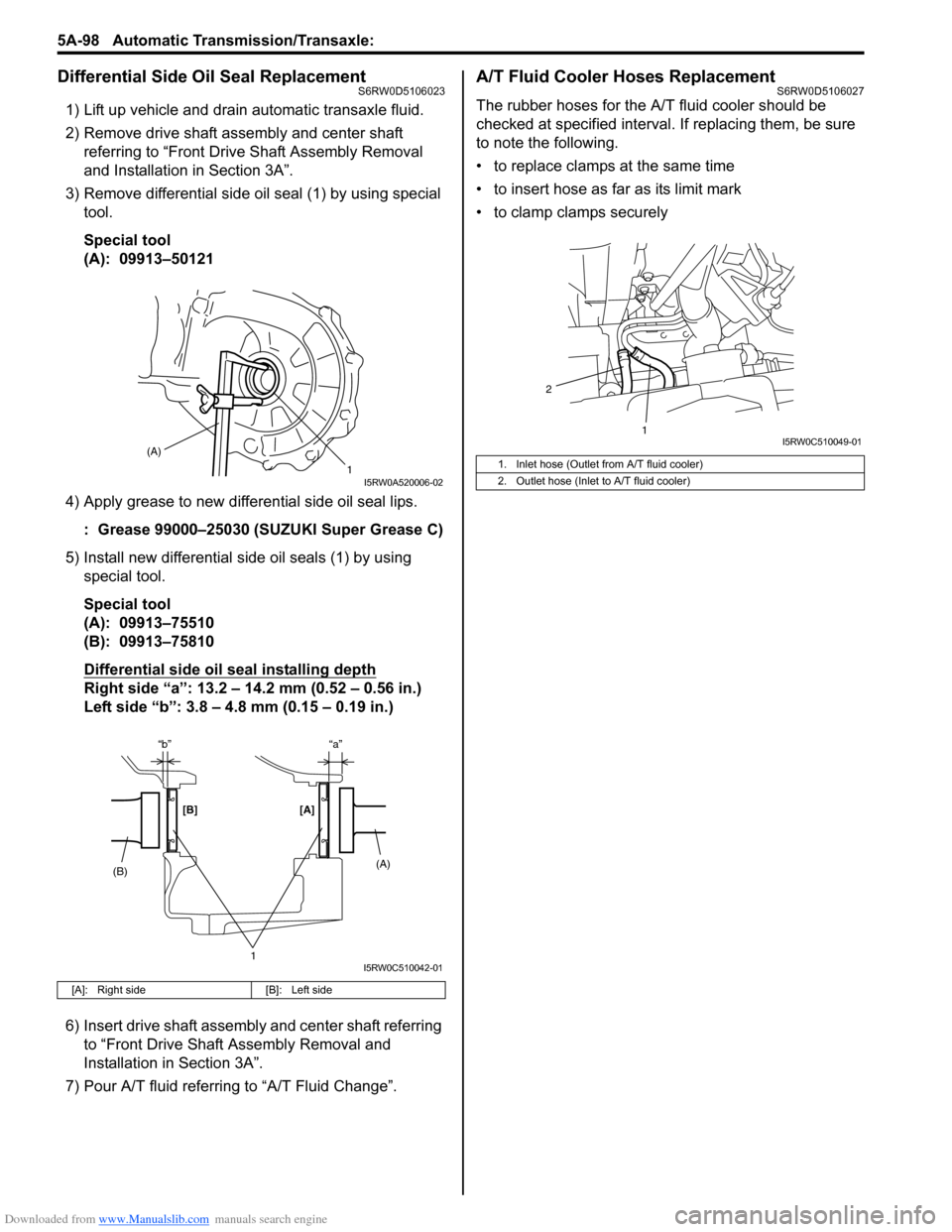
3) Remove differential side oil seal (1) by using special
tool.
Special tool
(A): 09913–50121
4) Apply grease to new differential side oil seal lips.
: Grease 99000–25030 (SUZUKI Super Grease C)
5) Install new differential side oil seals (1) by using
special tool.
Special tool
(A): 09913–75510
(B): 09913–75810
Differential side oil seal installing depth
Right side “a”: 13.2 – 14.2 mm (0.52 – 0.56 in.)
Left side “b”: 3.8 – 4.8 mm (0.15 – 0.19 in.)
6) Insert drive shaft assembly and center shaft referring
to “Front Drive Shaft Assembly Removal and
Installation in Section 3A”.
7) Pour A/T fluid referring to “A/T Fluid Change”.
A/T Fluid Cooler Hoses ReplacementS6RW0D5106027
The rubber hoses for the A/T fluid cooler should be
checked at specified interval. If replacing them, be sure
to note the following.
• to replace clamps at the same time
• to insert hose as far as its limit mark
• to clamp clamps securely
[A]: Right side [B]: Left side
(A)
1I5RW0A520006-02
“a” “b”
(B)[B] [A]
1
(A)
I5RW0C510042-01
1. Inlet hose (Outlet from A/T fluid cooler)
2. Outlet hose (Inlet to A/T fluid cooler)
2
1I5RW0C510049-01
Page 789 of 1556
Downloaded from www.Manualslib.com manuals search engine Automatic Transmission/Transaxle: 5A-141
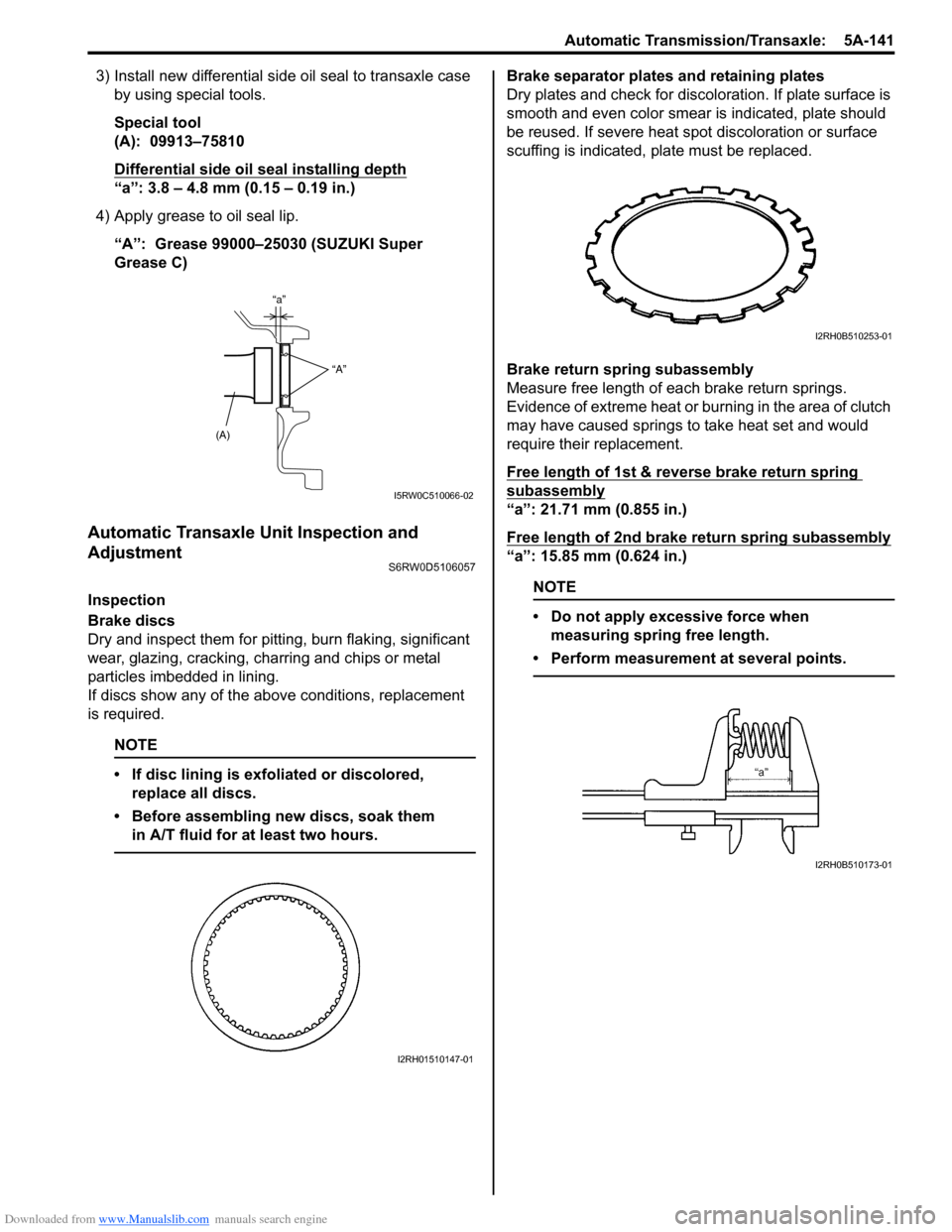
3) Install new differential side oil seal to transaxle case
by using special tools.
Special tool
(A): 09913–75810
Differential side oil seal installing depth
“a”: 3.8 – 4.8 mm (0.15 – 0.19 in.)
4) Apply grease to oil seal lip.
“A”: Grease 99000–25030 (SUZUKI Super
Grease C)
Automatic Transaxle Unit Inspection and
Adjustment
S6RW0D5106057
Inspection
Brake discs
Dry and inspect them for pitting, burn flaking, significant
wear, glazing, cracking, charring and chips or metal
particles imbedded in lining.
If discs show any of the above conditions, replacement
is required.
NOTE
• If disc lining is exfoliated or discolored,
replace all discs.
• Before assembling new discs, soak them
in A/T fluid for at least two hours.
Brake separator plates and retaining plates
Dry plates and check for discoloration. If plate surface is
smooth and even color smear is indicated, plate should
be reused. If severe heat spot discoloration or surface
scuffing is indicated, plate must be replaced.
Brake return spring subassembly
Measure free length of each brake return springs.
Evidence of extreme heat or burning in the area of clutch
may have caused springs to take heat set and would
require their replacement.
Free length of 1st & reverse brake return spring
subassembly
“a”: 21.71 mm (0.855 in.)
Free length of 2nd brake return spring subassembly
“a”: 15.85 mm (0.624 in.)
NOTE
• Do not apply excessive force when
measuring spring free length.
• Perform measurement at several points.
(A)“a”
“A”
I5RW0C510066-02
I2RH01510147-01
I2RH0B510253-01
I2RH0B510173-01
Page 819 of 1556

Downloaded from www.Manualslib.com manuals search engine Manual Transmission/Transaxle: 5B-7
Differential Side Oil Seal ReplacementS6RW0D5206003
1) Lift up vehicle and drain transaxle oil.
2) Remove drive shaft assembly and center shaft
referring to “Front Drive Shaft Assembly Removal
and Installation in Section 3A”.
3) Remove oil seal (1) by using special tool.
Special tool
(A): 09913–50121
4) Install a new oil seal (1) by using special tool.
NOTE
• When installing oil seal, face its spring
side inward.
• Install oil seal horizontally to surface of
case.
Special tool
(A): 09913–75810
(B): 09913–75510
Distance between case and right oil seal for 2WD
“a”: 9.5 – 10.5 mm (0.37 – 0.41 in.)
Distance between case and left oil seal
“b”: 0 – 1.0 mm (0 – 0.04 in.)5) Apply grease to oil seal lip and at the same time
check drive shaft where oil seal contacts and make
sure of its smoothness.
“A”: Grease 99000–25011 (SUZUKI Super
Grease A)
6) Insert drive shaft assembly and center shaft referring
to “Front Drive Shaft Assembly Removal and
Installation in Section 3A”.
7) Pour transaxle oil referring to “Manual Transaxle Oil
Change”.
(A)
1I5RW0A520006-02
“b”
“a”
1, “A”
(A)(B)
I5RW0A520051-01
Page 836 of 1556
Downloaded from www.Manualslib.com manuals search engine 5B-24 Manual Transmission/Transaxle:
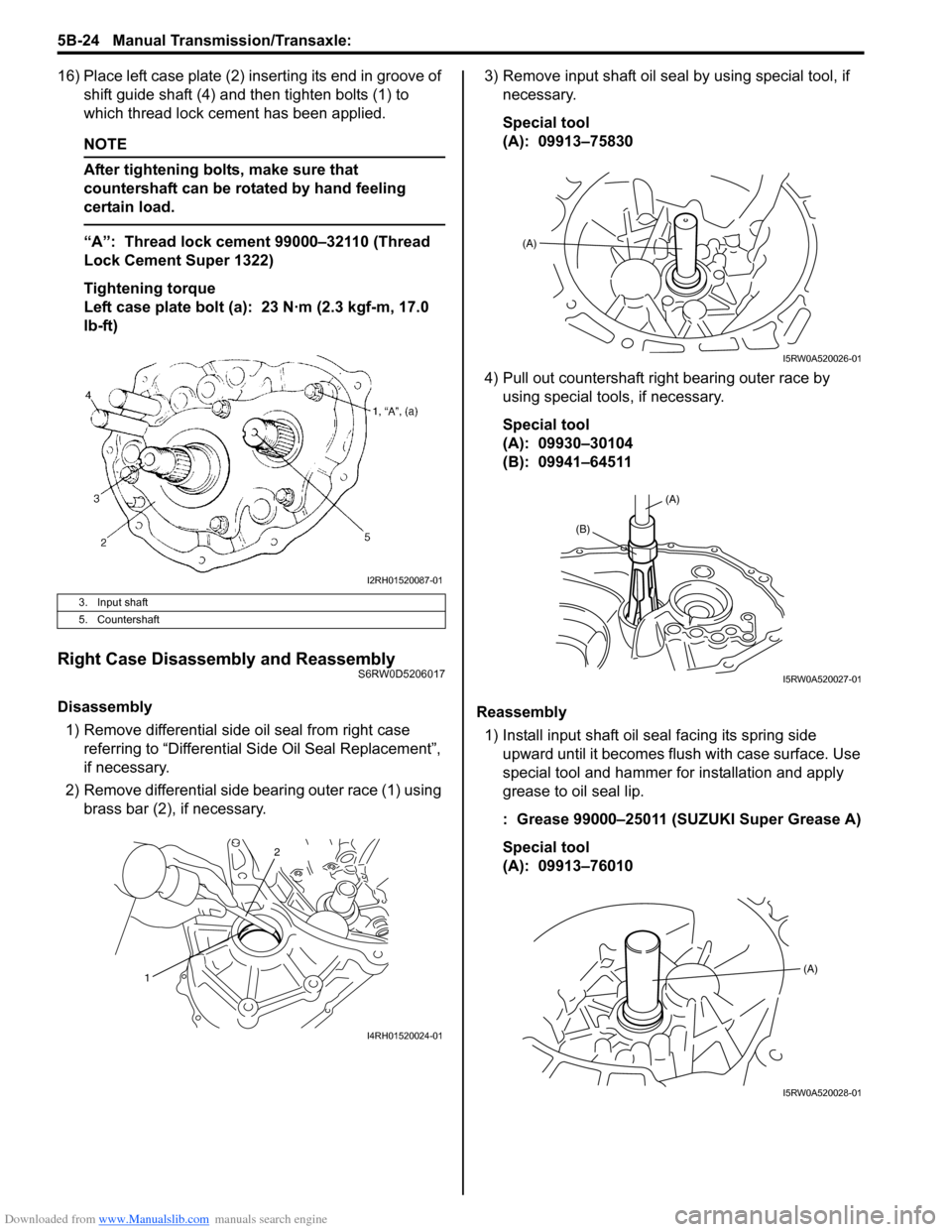
16) Place left case plate (2) inserting its end in groove of
shift guide shaft (4) and then tighten bolts (1) to
which thread lock cement has been applied.
NOTE
After tightening bolts, make sure that
countershaft can be rotated by hand feeling
certain load.
“A”: Thread lock cement 99000–32110 (Thread
Lock Cement Super 1322)
Tightening torque
Left case plate bolt (a): 23 N·m (2.3 kgf-m, 17.0
lb-ft)
Right Case Disassembly and ReassemblyS6RW0D5206017
Disassembly
1) Remove differential side oil seal from right case
referring to “Differential Side Oil Seal Replacement”,
if necessary.
2) Remove differential side bearing outer race (1) using
brass bar (2), if necessary.3) Remove input shaft oil seal by using special tool, if
necessary.
Special tool
(A): 09913–75830
4) Pull out countershaft right bearing outer race by
using special tools, if necessary.
Special tool
(A): 09930–30104
(B): 09941–64511
Reassembly
1) Install input shaft oil seal facing its spring side
upward until it becomes flush with case surface. Use
special tool and hammer for installation and apply
grease to oil seal lip.
: Grease 99000–25011 (SUZUKI Super Grease A)
Special tool
(A): 09913–76010
3. Input shaft
5. Countershaft
I2RH01520087-01
2
1
I4RH01520024-01
(A)
I5RW0A520026-01
(A)
(B)
I5RW0A520027-01
(A)
I5RW0A520028-01
Page 847 of 1556

Downloaded from www.Manualslib.com manuals search engine Manual Transmission/Transaxle: 5B-35
Gear Shift Shaft ComponentsS6RW0D5206022
5th and Reverse Gear Shift Shafts Disassembly
and Reassembly
S6RW0D5206023
Disassembly
Disassemble component parts by using special tool and
hammer.
Special tool
: 09922–85811
Reassembly
Replace or correct parts as required and assemble
shafts making sure that component parts are in proper
order as shown in figure.
NOTE
Install 2 steel balls (3) in reverse gear shift
arm (1) without fail.
Gear Shift Shaft and Fork InspectionS6RW0D5206024
1) Using feeler gauge, check clearance between fork
(1) and sleeve (2) and replace those parts if it
exceeds limit of 1.0 mm (0.039 in.).
NOTE
For correct judgement of parts replacement,
carefully inspect contact portion of fork and
sleeve.
Clearance “a” between fork and sleeve
Service limit: 1.0 mm (0.039 in.)
2) Insert each gear shift shaft into case and check that
it moves smoothly. If it doesn’t, correct by using
oilstone, reamer or the like.
I5RW0A520041-01
1. Low speed gear shift shaft 4. 5th & reverse gear shift guide shaft 7. 5th & reverse gear shift yoke
2. High speed gear shift shaft 5. Reverse gear shift arm : 13 N⋅m (1.3 kgf-m, 9.5 lb-ft)
3. 5th & reverse gear shift shaft 6. Gear shift locating bolt
: Apply sealant 99000-31260 to bolt thread.
2. Spring 6. 5th & reverse gear shift yoke
4. Spring pin 7. 5th & reverse gear shift guide shaft
5. 5th & reverse gear shift shaft
I5RW0A520042-01
I2RH01520068-01
Page 1051 of 1556
Downloaded from www.Manualslib.com manuals search engine Air Bag System: 8B-12
Diagnostic Information and Procedures
Air Bag Diagnostic System CheckS6RW0D8204001
WARNING!
To avoid deployment when troubleshooting
the air bag system, do not use electrical test
equipment such as a battery powered or AC
powered voltmeter, ohmmeter, etc., or any
type of electrical equipment other than that
specified in this manual. Do not use a non-
powered probe type tester.
Instructions in this manual must be followed
carefully, otherwise personal injury may
result.
CAUTION!
• The order in which DTCs are diagnosed is
very important. Failure to diagnose the
DTCs in the order specified may result in
extended diagnostic time, incorrect
diagnosis and incorrect parts replacement.
• When measurement of resistance or
voltage is required in the flow, use a tester
along with a correct terminal adapter from
special tool (Connector test adapter kit).
• When a check for proper connection is
required, refer to “Inspection of
Intermittent and Poor Connections”.
• If an open circuit in the air bag wire
harness damaged, connector or terminal is
found, replace the wire harness,
connectors and terminals as an assembly.
The diagnostic procedures used are designed to find
and repair air bag system malfunctions.
To get the best results, it is important to use the
diagnostic flow and follow the sequence in the following.
1) Perform the “Air Bag Diagnostic System Check
Flow”.
(The “Air Bag Diagnostic System Check Flow” must
be the starting point of any air bag system diagnosis.
The “Air Bag Diagnostic System Check Flow” checks
for proper “AIR BAG” warning light operation through
“AIR BAG” warning light and whether air bag DTCs
exist.)
2) Refer to the proper diagnostic flow as directed by the
“Air Bag Diagnostic System Check Flow”.
(The “Air Bag Diagnostic System Check Flow” will
lead you to the correct flow to diagnose any air bag
system malfunctions. Bypassing these procedures
may result in extended diagnostic time, incorrect
diagnosis and incorrect parts replacement.)
3) Repeat the “Air Bag Diagnostic System Check Flow”
after any repair or diagnostic procedures have been
performed.
(Performing the “Air Bag Diagnostic System Check
Flow” after all repair or diagnostic procedures will
ensure that the repair has been made correctly and
that no other malfunctions exist.)
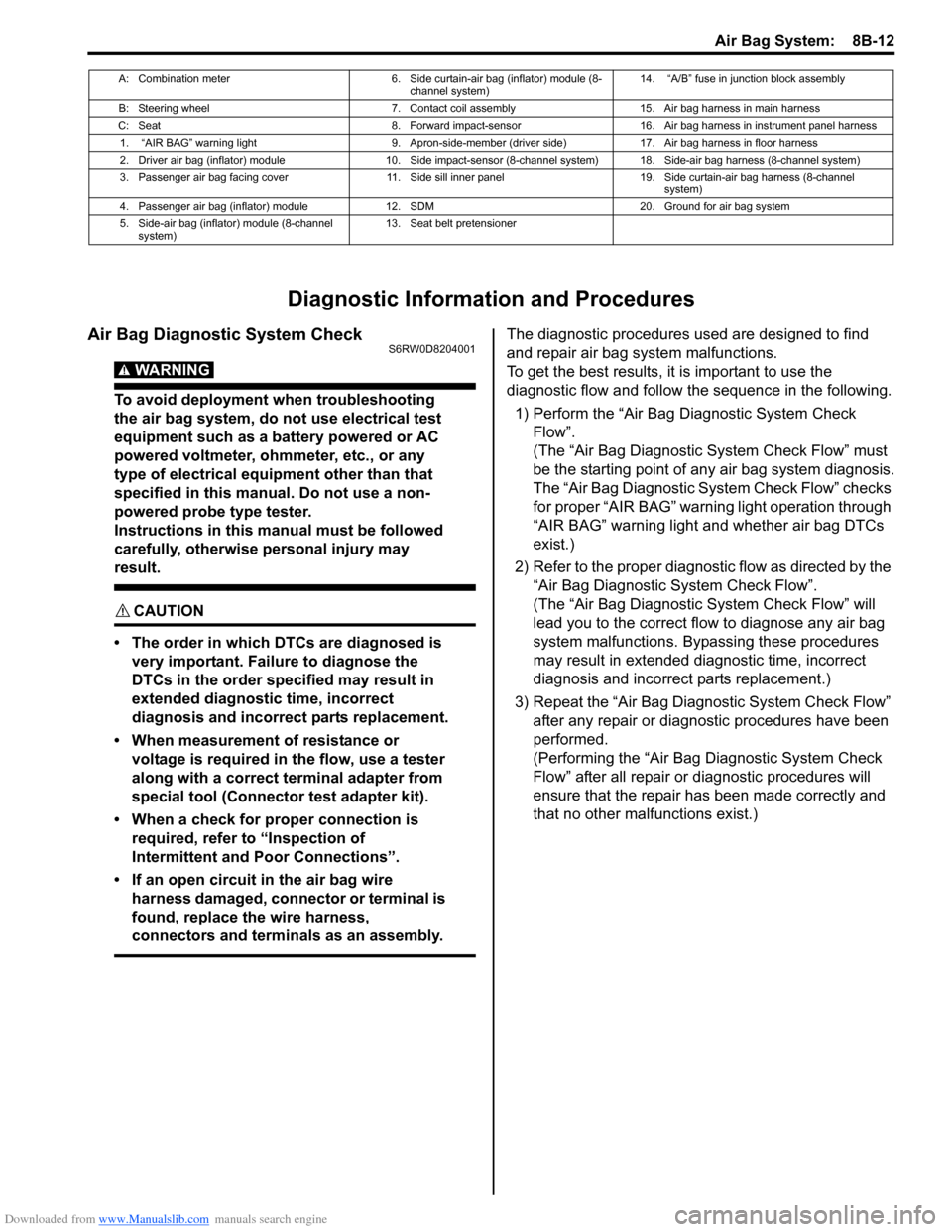
A: Combination meter 6. Side curtain-air bag (inflator) module (8-
channel system)14. “A/B” fuse in junction block assembly
B: Steering wheel 7. Contact coil assembly 15. Air bag harness in main harness
C: Seat 8. Forward impact-sensor 16. Air bag harness in instrument panel harness
1. “AIR BAG” warning light 9. Apron-side-member (driver side) 17. Air bag harness in floor harness
2. Driver air bag (inflator) module 10. Side impact-sensor (8-channel system) 18. Side-air bag harness (8-channel system)
3. Passenger air bag facing cover 11. Side sill inner panel 19. Side curtain-air bag harness (8-channel
system)
4. Passenger air bag (inflator) module 12. SDM 20. Ground for air bag system
5. Side-air bag (inflator) module (8-channel
system)13. Seat belt pretensioner
Page 1129 of 1556

Downloaded from www.Manualslib.com manuals search engine Air Bag System: 8B-90
• Improperly formed or damaged terminals.
Check each connector terminal in problem circuits
carefully to ensure good contact tension by using the
corresponding mating terminal included in the
connector test adapter kit (special tool).
If contact tension is not enough, reform the terminal to
increase contact tension or replace it.
Special tool
(A): 09932–76010 Connector test adapter kit
• Poor terminal-to-wire connection.
Check each wire harness in problem circuits for poor
connection by shaking it by hand lightly. If any
abnormal condition is found, change the wire harness
assembly or component parts with new ones.
• Wire insulation which is rubbed through, causing an
intermittent short as the bare area touches other
wiring or parts of the vehicle.
• Wire broken inside the insulation. This condition could
cause a continuity check to show a good circuit, but if
only 1 or 2 strands of a multi-strand-type wire are
intact, resistance could be far too high.
Repair and Inspection Required after AccidentS6RW0D8204048
CAUTION!
• All air bag system components, including
the electrical harness (component
mounting points), must be inspected after
an accident. If any components are
damaged or bent, they must be replaced
even if air bag system activation did not
occur.
• Never use air bag system parts from
another vehicle.
• Do not attempt to service the parts below.
Service of these parts is by replacement
only.
– Driver / Passenger air bag (inflator)
modules
– Driver / Passenger side-air bag (inflator)
modules
– Driver / Passenger side curtain-air bag
(inflator) modules
– Driver / Passenger seat belt
pretensioners
– Forward impact-sensor
– Driver / Passenger side impact-sensors
–SDM
– Contact coil and combination switch
assembly
– Air bag wire harness in main harness,
instrument panel harness, floor harness,
passenger air bag harness, side-air bag
harness and side curtain-air bag
harness.
• Proper operation of the sensors and air
bag system requires that any repairs to the
vehicle structure return it to its original
production configuration.
(A)
I4RS0A820045-01
IYSQ01010028-01
IYSQ01820025-01