Can SUZUKI SX4 2006 1.G Service Workshop Manual
[x] Cancel search | Manufacturer: SUZUKI, Model Year: 2006, Model line: SX4, Model: SUZUKI SX4 2006 1.GPages: 1556, PDF Size: 37.31 MB
Page 718 of 1556

Downloaded from www.Manualslib.com manuals search engine 5A-70 Automatic Transmission/Transaxle:
DTC P2762: Torque Converter Clutch (TCC) Pressure Control Solenoid Control Circuit Range /
Performance
S6RW0D5104050
Wiring Diagram
DTC Detecting Condition and Trouble Area
DTC Confirmation Procedure
1) Connect scan tool to DLC with ignition switch OFF, if available.
2) Clear DTC in TCM memory.
3) Start engine.
4) Keep engine running at idle speed for 30 seconds or more.
5) Stop vehicle and check DTC.
12V
C06-5
C06-3
WHT/BLU
WHT/BLK
3
1
2
53
C06C07
[A]
I6RW0D510007-01
1. TCM 3. A/T
2. TCC solenoid valve [A]: Terminal arrangement of TCM connector (viewed from harness side)
DTC detecting condition Trouble area
Difference between actual current of TCC solenoid valve
circuit and current of TCC solenoid valve circuit calculated by
ECM is more than specification.• TCC solenoid valve or its circuit malfunction
•TCM
Page 720 of 1556

Downloaded from www.Manualslib.com manuals search engine 5A-72 Automatic Transmission/Transaxle:
DTC P2763: Torque Converter Clutch (TCC) Pressure Control Solenoid Control Circuit HighS6RW0D5104042
Wiring Diagram
DTC Detecting Condition and Trouble Area
DTC Confirmation Procedure
WARNING!
• When performing a road test, select a place where there is no traffic or possibility of a traffic
accident and be very careful during testing to avoid occurrence of an accident.
• Road test should be carried out with 2 persons, a driver and a tester, on a level road.
1) Connect scan tool to DLC with ignition switch OFF, if available.
2) Clear DTC in TCM memory.
3) Start engine.
4) Keep engine running at idle speed in “P” range for 10 seconds or more.
5) Check DTC.
12V
C06-5
C06-3
WHT/BLU
WHT/BLK
3
1
2
53
C06C07
[A]
I6RW0D510007-01
1. TCM 3. A/T
2. TCC solenoid valve [A]: Terminal arrangement of TCM connector (viewed from harness side)
DTC detecting condition Trouble area
Voltage of TCC solenoid valve TCM terminal is high although
TCM is commanding TCC solenoid valve to turn OFF.• TCC solenoid valve circuit shorted to ground
• Malfunction of TCC solenoid valve
•TCM
Page 722 of 1556

Downloaded from www.Manualslib.com manuals search engine 5A-74 Automatic Transmission/Transaxle:
DTC P2764: Torque Converter Clutch (TCC) Circuit Pressure Control Solenoid Control Circuit LowS6RW0D5104043
Wiring Diagram
DTC Detecting Condition and Trouble Area
DTC Confirmation Procedure
WARNING!
• When performing a road test, select a place where there is no traffic or possibility of a traffic
accident and be very careful during testing to avoid occurrence of an accident.
• Road test should be carried out with 2 persons, a driver and a tester, on a level road.
1) Connect scan tool to DLC with ignition switch OFF, if available.
2) Clear DTC in TCM memory.
3) Start engine.
4) Keep engine running at idle speed in “P” range for 20 seconds or more.
5) Check DTC.
12V
C06-5
C06-3
WHT/BLU
WHT/BLK
3
1
2
53
C06C07
[A]
I6RW0D510007-01
1. TCM 3. A/T
2. TCC solenoid valve [A]: Terminal arrangement of TCM connector (viewed from harness side)
DTC detecting condition Trouble area
Voltage of TCC solenoid valve TCM terminal is low although
TCM is commanding TCC solenoid valve to turn ON.• TCC solenoid valve circuit shorted to ground
• Malfunction of TCC solenoid valve
•TCM
Page 724 of 1556

Downloaded from www.Manualslib.com manuals search engine 5A-76 Automatic Transmission/Transaxle:
DTC U0073: Control Module Communication Bus OffS6RW0D5104051
Refer to “Troubleshooting for CAN-DTC in Section 1A”.
DTC U0100: Lost Communication with ECM / PCM “A”S6RW0D5104052
Refer to “Troubleshooting for CAN-DTC in Section 1A”.
Inspection of TCM and Its CircuitsS6RW0D5104044
TCM and its circuits can be checked at TCM wiring connectors by measuring voltage, pulse signal and resistance.
CAUTION!
TCM cannot be checked by itself, it is strictly prohibited to connect voltmeter or ohmmeter to TCM with
connector disconnected from it.
1) Remove TCM (1) from vehicle referring to “Transmission Control Module (TCM) Removal and Installation”.
2) Connect TCM connectors (2) to TCM.
3) Check voltage and/or pulse signal at each terminal of connectors connected using voltmeter (3) and oscilloscope
(4).
NOTE
• As each terminal voltage is affected by battery voltage, confirm that it is 11 V or more when ignition
switch is ON.
• Voltage with asterisk(*) cannot be measured by voltmeter because it is pulse signal. Check it with
oscilloscope if necessary.
Terminal arrangement of TCM coupler (Viewed from harness side)
3
4
12
I4RS0A510021-02
65
16 15 14 13 12 1143
24 23 212210 9 8 721
19 20 18 17 C06
17 16
26 2515 14 65 342
13 12
23 22 2411 10 9
21 20 1987
18 1 C07
I6RW0B510018-01
Page 725 of 1556

Downloaded from www.Manualslib.com manuals search engine Automatic Transmission/Transaxle: 5A-77
Connector “C06”
Terminal Wire color CircuitStandard
voltageCondition
1 BLK Ground 0 – 1 V Ignition switch ON
2LT GRN/
BLKPressure control
solenoid valve (–)0.6 – 1.0 V Ignition switch ON
3 WHT/BLK TCC solenoid valve (–) 0.6 – 1.0 V Ignition switch ON
4GRYPressure control
solenoid valve (+)*0 – 0.6 V
↑↓
10 – 14 V
(“Reference
waveform
No. 1: ”)Engine running at idling.
(Output signal is duty pulse. Duty ratio varies
depending on throttle valve opening.)
5 WHT/BLU TCC solenoid valve (+)*0 – 0.6 V
↑↓
10 – 14 V
(“Reference
waveform
No. 2: ”)Engine running at idling.
(Output signal is duty pulse. Duty ratio varies
depending on torque converter clutch operating
condition.)
6 YEL/BLK Power source 10 – 14 V Ignition switch ON
7WHTCAN communication
line (Low)*2.5 – 3.6 V
↑↓
1.6 – 2.5 V
(“Reference
waveform
No. 3: ”)Engine running at idling with after warming up.
(CAN communication signal is pulse. Pulse signal
frequency varies depending on engine condition.))
8— — — —
9— — — —
10 — — — —
11 LT G R NTransmission fluid
temperature sensor (+)2.9 – 3.1 V Ignition switch ON, fluid temperature is 20 °C (68 °F)
0.3 – 0.5 V Ignition switch ON, fluid temperature is 100 °C (212 °F)
12 ORNTransmission fluid
temperature sensor (–)0 – 1 V Ignition switch ON
13 — — — —
14 BLU/BLK Timing solenoid valve 0 – 1 V Ignition switch ON
15 BLK/YELShift solenoid valve-B
(No.2)9 – 14 V Ignition switch ON, select lever in “P” range
16 BRNShift solenoid valve-A
(No.1)9 – 14 V Ignition switch ON, select lever in “P” range
17 REDCAN communication
line (High)*2.5 – 3.6 V
↑↓
1.6 – 2.5 V
(“Reference
waveform
No. 3: ”)Engine running at idling with after warming up.
(CAN communication signal is pulse. Pulse signal
frequency varies depending on engine condition.)
18 — — — —
19 — — — —
20 — — — —
21 — — — —
22 — — — —
23 BLK Ground 0 – 1 V Ignition switch ON
24 WHT/REDPower source for back-
up10 – 14 V Constantly
Page 727 of 1556

Downloaded from www.Manualslib.com manuals search engine Automatic Transmission/Transaxle: 5A-79
Reference waveform No. 1
Pressure control solenoid valve signal at engine idling.
Reference waveform No. 2
TCC pressure control solenoid valve signal at engine
idling.Reference waveform No. 3
CAN communication line (High & Low) signal at engine
idling.
Reference waveform No. 4
Input shaft speed sensor signal at engine idling. Measurement
terminalCH1: “C06-4” to “C06-1”
Oscilloscope
settingCH1: 5 V/DIV
TIME: 2 ms/DIV
Measurement
condition• After warmed up to normal
operating temperature
• Engine at specified idle speed
with “P” range.
Measurement
terminalCH1: “C06-5” to “C06-1”
Oscilloscope
settingCH1: 5 V/DIV
Time: 2 ms/DIV
Measurement
condition• After warmed up to normal
operating temperature
• Engine at specified idle speed
with “P” range
I3RM0B510029-01
I4RS0A510024-01
Measurement
terminalCH1: “C06-7” to “C06-1”
CH2: “C06-17” to “C06-1”
Oscilloscope
settingCH1: 1 V/DIV
TIME: 100 µs/DIV
Measurement
condition• After warmed up to normal
operating temperature
• Engine at specified idle speed
with “P” range.
Measurement
terminalCH1: “C07-6” to “C06-1”
Oscilloscope
settingCH1: 2 V/DIV
TIME: 10 ms/DIV
Measurement
condition• After warmed up to normal
operating temperature
• Engine at specified idle speed
with “P” range.
I3RM0B510030-01
I3RM0B510027-01
Page 729 of 1556

Downloaded from www.Manualslib.com manuals search engine Automatic Transmission/Transaxle: 5A-81
Troubleshooting
Brake Interlock System InspectionS6RW0D5104046
1) Check that select lever cannot be moved to any
other range from “P” range position when ignition
switch key is at ACC position, at LOCK position or it
is removed from keyhole of ignition switch, or brake
pedal is not depressed.2) Shift select lever to “P” range position, check for the
following.
• Ignition key can be turned between LOCK and
ACC positions back and forth and also it can be
removed from ignition switch. Step Action Yes No
1Check TCM back-up power circuit
1) Disconnect TCM connector with ignition switch OFF.
2) Check for proper connection to TCM at “C06-24”
terminal.
3) If OK, check voltage at terminal “C06-24” of
disconnected TCM connector.
Is it 10 – 14 V?Go to Step 2. “WHT/RED” circuit open
or shorted to ground.
2Check TCM power circuit
1) Disconnect TCM connector with ignition switch OFF.
2) Check for proper connection to TCM at “C06-6” terminal.
3) If OK, turn ignition switch ON and check voltage at
terminal “C06-6” of disconnected TCM connector.
Is it 10 – 14 V?Go to Step 4. Go to Step 3.
3Check A/T relay operation
1) Check A/T relay operation referring to “A/T Relay
Inspection”.
Is check result satisfactory?“YEL/BLK”, “YEL/BLU”,
“LT GRN/BLK” or “BLK”
circuit for power supply
open.Replace A/T relay.
4Check TCM ground circuit
1) Turn ignition switch OFF.
2) With TCM connectors disconnected, check for proper
connection to TCM at “C06-1” / “C06-23” terminal.
3) If OK, check resistance between “C06-1” / “C06-23”
terminal of disconnected TCM connector and body
ground.
Is continuity indicated?TCM power and ground
circuits are in good
condition.“BLK” circuit for TCM
ground open.
I4RS0A510047-01
I4RS0A510048-01
Page 730 of 1556
Downloaded from www.Manualslib.com manuals search engine 5A-82 Automatic Transmission/Transaxle:
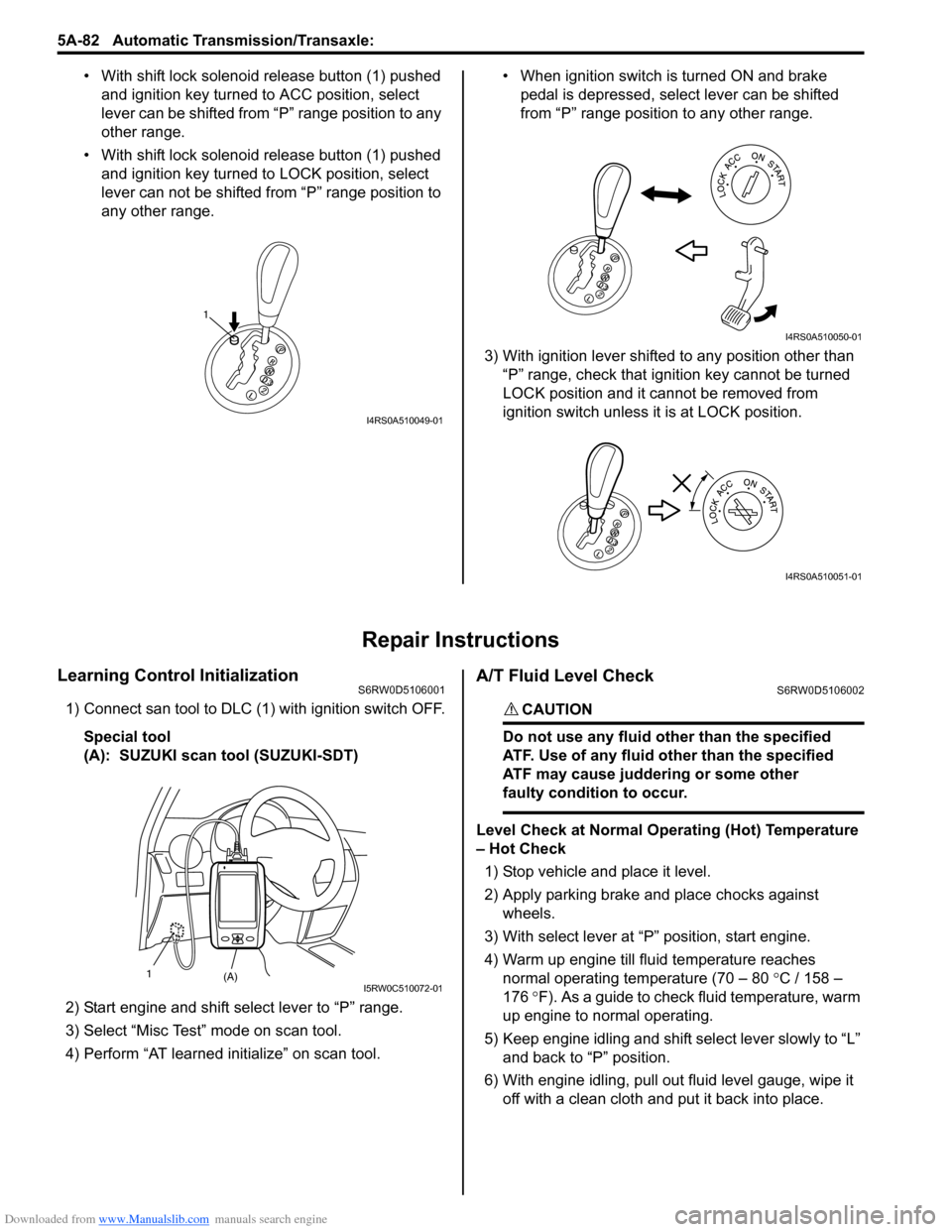
• With shift lock solenoid release button (1) pushed
and ignition key turned to ACC position, select
lever can be shifted from “P” range position to any
other range.
• With shift lock solenoid release button (1) pushed
and ignition key turned to LOCK position, select
lever can not be shifted from “P” range position to
any other range.• When ignition switch is turned ON and brake
pedal is depressed, select lever can be shifted
from “P” range position to any other range.
3) With ignition lever shifted to any position other than
“P” range, check that ignition key cannot be turned
LOCK position and it cannot be removed from
ignition switch unless it is at LOCK position.
Repair Instructions
Learning Control InitializationS6RW0D5106001
1) Connect san tool to DLC (1) with ignition switch OFF.
Special tool
(A): SUZUKI scan tool (SUZUKI-SDT)
2) Start engine and shift select lever to “P” range.
3) Select “Misc Test” mode on scan tool.
4) Perform “AT learned initialize” on scan tool.
A/T Fluid Level CheckS6RW0D5106002
CAUTION!
Do not use any fluid other than the specified
ATF. Use of any fluid other than the specified
ATF may cause juddering or some other
faulty condition to occur.
Level Check at Normal Operating (Hot) Temperature
– Hot Check
1) Stop vehicle and place it level.
2) Apply parking brake and place chocks against
wheels.
3) With select lever at “P” position, start engine.
4) Warm up engine till fluid temperature reaches
normal operating temperature (70 – 80 °C / 158 –
176 °F). As a guide to check fluid temperature, warm
up engine to normal operating.
5) Keep engine idling and shift select lever slowly to “L”
and back to “P” position.
6) With engine idling, pull out fluid level gauge, wipe it
off with a clean cloth and put it back into place.
1
I4RS0A510049-01
I4RS0A510050-01
I4RS0A510051-01
(A) 1I5RW0C510072-01
Page 731 of 1556
Downloaded from www.Manualslib.com manuals search engine Automatic Transmission/Transaxle: 5A-83
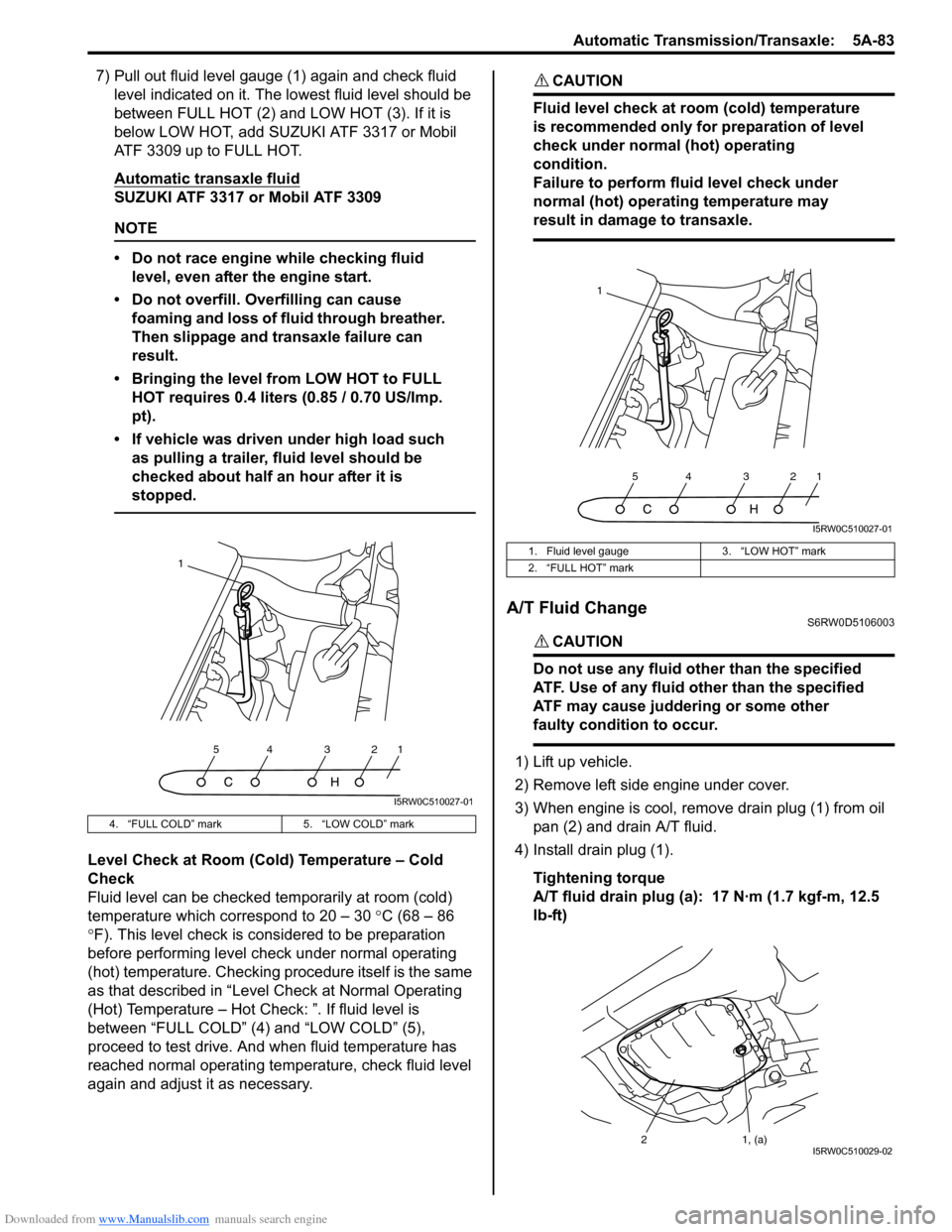
7) Pull out fluid level gauge (1) again and check fluid
level indicated on it. The lowest fluid level should be
between FULL HOT (2) and LOW HOT (3). If it is
below LOW HOT, add SUZUKI ATF 3317 or Mobil
ATF 3309 up to FULL HOT.
Automatic transaxle fluid
SUZUKI ATF 3317 or Mobil ATF 3309
NOTE
• Do not race engine while checking fluid
level, even after the engine start.
• Do not overfill. Overfilling can cause
foaming and loss of fluid through breather.
Then slippage and transaxle failure can
result.
• Bringing the level from LOW HOT to FULL
HOT requires 0.4 liters (0.85 / 0.70 US/Imp.
pt).
• If vehicle was driven under high load such
as pulling a trailer, fluid level should be
checked about half an hour after it is
stopped.
Level Check at Room (Cold) Temperature – Cold
Check
Fluid level can be checked temporarily at room (cold)
temperature which correspond to 20 – 30 °C (68 – 86
°F). This level check is considered to be preparation
before performing level check under normal operating
(hot) temperature. Checking procedure itself is the same
as that described in “Level Check at Normal Operating
(Hot) Temperature – Hot Check: ”. If fluid level is
between “FULL COLD” (4) and “LOW COLD” (5),
proceed to test drive. And when fluid temperature has
reached normal operating temperature, check fluid level
again and adjust it as necessary.
CAUTION!
Fluid level check at room (cold) temperature
is recommended only for preparation of level
check under normal (hot) operating
condition.
Failure to perform fluid level check under
normal (hot) operating temperature may
result in damage to transaxle.
A/T Fluid ChangeS6RW0D5106003
CAUTION!
Do not use any fluid other than the specified
ATF. Use of any fluid other than the specified
ATF may cause juddering or some other
faulty condition to occur.
1) Lift up vehicle.
2) Remove left side engine under cover.
3) When engine is cool, remove drain plug (1) from oil
pan (2) and drain A/T fluid.
4) Install drain plug (1).
Tightening torque
A/T fluid drain plug (a): 17 N·m (1.7 kgf-m, 12.5
lb-ft)
4. “FULL COLD” mark 5. “LOW COLD” mark
1
54 321
I5RW0C510027-01
1. Fluid level gauge 3. “LOW HOT” mark
2. “FULL HOT” mark
1
54 321
I5RW0C510027-01
21, (a)I5RW0C510029-02
Page 735 of 1556

Downloaded from www.Manualslib.com manuals search engine Automatic Transmission/Transaxle: 5A-87
2) Remove adjuster (cable end) from select lever pin of
select lever assembly.
3) Remove adjuster (cable end) from select lever pin of
select lever assembly.
4) Release lock plate (1) which restrict moving of cable
end holder (2).
5) Push cable end holder (1) out from eye-end (2) using
an appropriate tool (3) to disengage cable.
6) Shift select lever to “N” position.
7) Apply grease to select lever pin and install adjuster
(cable end) to it.
: Grease 99000–25011 (SUZUKI Super Grease
A)
8) With both select lever and transmission range
sensor kept each “N” position, drive cable end holder
(1) in until it locks cable.
9) Slide lock plate (2) to secure cable end holder in
position.
10) After select cable was installed, check for the
following.
• Push vehicle with select lever shifted to “P” range.
Vehicle should not move.
• Vehicle can not be driven in “N” range.• Vehicle can be driven in “D”, “3”, “2” and “L”
ranges.
• Vehicle can be backed in “R” range.
Key Interlock Cable Removal and InstallationS6RW0D5106026
NOTE
Don’t bend interlock cable excessively when
removing and installing it, or system will not
operate correctly.
Removal
1) If the vehicle is equipped with air bag system,
disconnect negative cable at battery and disable air
bag system, referring to “Disabling Air Bag System in
Section 8B”.
2) Remove steering column cover.
3) Turn ignition switch to ACC position.
4) Pull out key interlock cable (1) from key cylinder
cover (2) while pressing checkhook with slotted
screwdriver (3) or the like.
5) Turn ignition switch to LOCK position.
6) Remove console box referring to “Console Box
Components in Section 9H”.
7) Detach cable end (1) from interlock cam (2) while
pressing claws (3) of interlock cam boss.
At this time, be careful not to cause damage to its
claws.
Detach cable casing cap (4) from bracket (5) while
pressing checkhook.
8) Remove interlock cable.
I2RH01510046-01
I2RH01510047-01
I3RM0B510037-01
2
13I5RW0C510045-01
4
5 3 12
4
I5RW0C510046-01