PPL SUZUKI SX4 2006 1.G Service Workshop Manual
[x] Cancel search | Manufacturer: SUZUKI, Model Year: 2006, Model line: SX4, Model: SUZUKI SX4 2006 1.GPages: 1556, PDF Size: 37.31 MB
Page 965 of 1556
Downloaded from www.Manualslib.com manuals search engine Air Conditioning System: Manual Type 7B-25
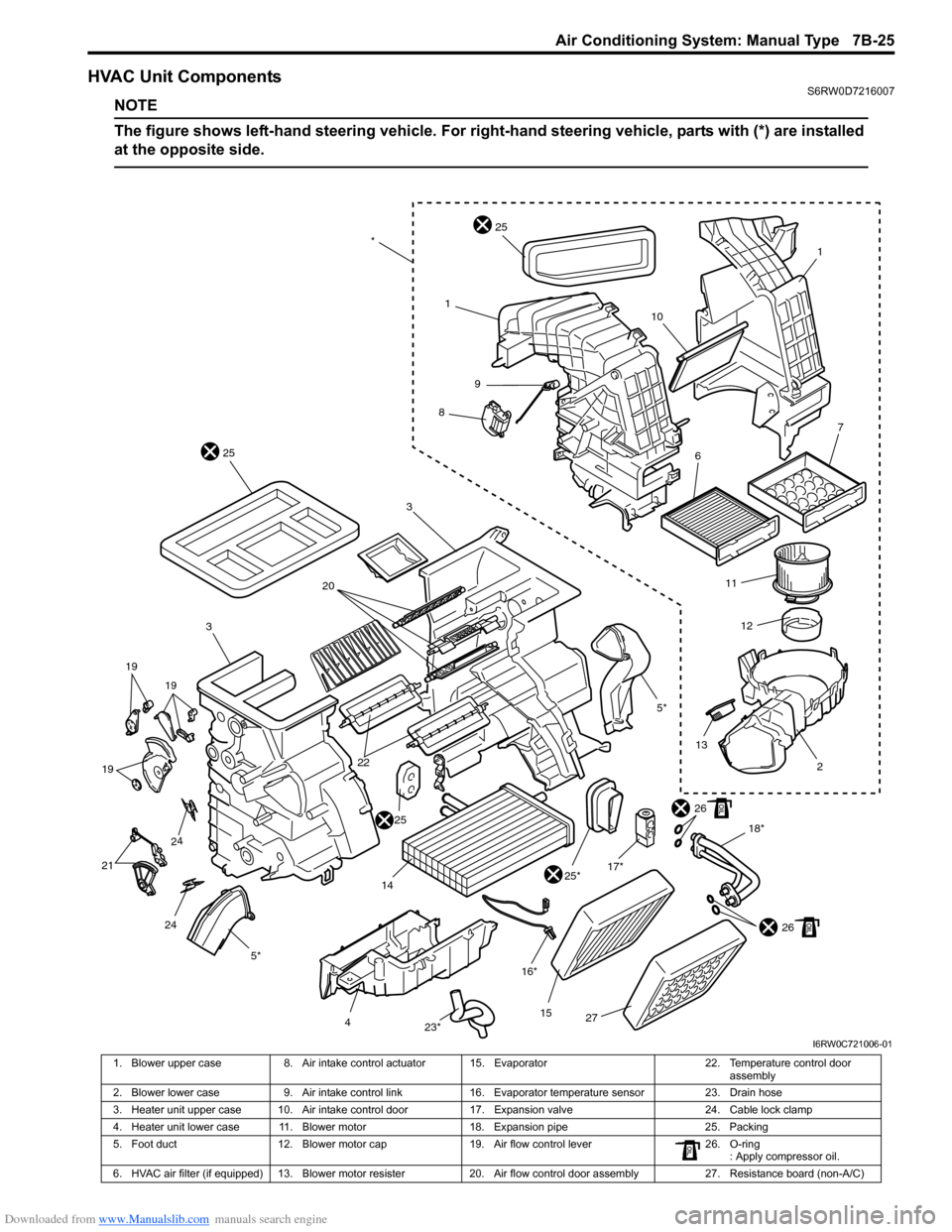
HVAC Unit ComponentsS6RW0D7216007
NOTE
The figure shows left-hand steering vehicle. For right-hand steering vehicle, parts with (*) are installed
at the opposite side.
1
10
1
9
8
25
25
3
20
3
19 19
19
24
24 21
4
23*27 15 16* 14
25*18*2
2526
17*1312 11
5*22
67
*
26
5*
I6RW0C721006-01
1. Blower upper case 8. Air intake control actuator 15. Evaporator 22. Temperature control door
assembly
2. Blower lower case 9. Air intake control link 16. Evaporator temperature sensor 23. Drain hose
3. Heater unit upper case 10. Air intake control door 17. Expansion valve 24. Cable lock clamp
4. Heater unit lower case 11. Blower motor 18. Expansion pipe 25. Packing
5. Foot duct 12. Blower motor cap 19. Air flow control lever 26. O-ring
: Apply compressor oil.
6. HVAC air filter (if equipped) 13. Blower motor resister 20. Air flow control door assembly 27. Resistance board (non-A/C)
Page 968 of 1556

Downloaded from www.Manualslib.com manuals search engine 7B-28 Air Conditioning System: Manual Type
Evaporator Temperature Sensor InspectionS6RW0D7216011
Check resistance between terminals of evaporator
temperature sensor (1).
If check results are as not specified, replace evaporator
temperature sensor.
Evaporator temperature sensor resistance
0 °C (32 °F): 6.6 – 6.8 kΩ
25 °C (77 °F): 2.0 – 2.1 kΩ
Expansion Valve Removal and InstallationS6RW0D7216012
Removal
1) Recover refrigerant from the A/C system with
recovery and recycling equipment referring to
“Recovery” in “Operation Procedure for Refrigerant
Charge”.
2) Loosen a bolt (1) and remove pipes from expansion
valve (2).
3) Loosen bolts (3) and remove expansion valve.
Installation
Reverse removal procedure noting the following
instructions.
• Apply compressor oil to O-ring of expansion valve and
pipes.
• Tighten expansion valve bolts to specified torque.
Tightening torque
Expansion valve bolt: 4.5 N·m (0.45 kgf-m, 3.5 lb-
ft)
• Evacuate and charge the A/C system referring to
“Evacuation” and “Charge” in “Operation Procedure
for Refrigerant Charge”.
Expansion Valve InspectionS6RW0D7216013
Refer to “A/C System Performance Inspection”.
[A]: Resistance
[B]: Temperature
(kΩ)
6.75
2.00
0
3225
77 [A]
[B]
(˚C)
(˚F)
1
I7RW01721020-01
1
22 3
I4RS0A720028-01
Page 969 of 1556

Downloaded from www.Manualslib.com manuals search engine Air Conditioning System: Manual Type 7B-29
A/C Refrigerant Pressure Sensor and Its Circuit
Inspection
S6RW0D7216014
1) Disconnect A/C refrigerant pressure sensor
connector.
2) Turn ignition switch to ON position.
3) Check if voltage between “RED” wire terminal and
“ORN” wire terminal of A/C refrigerant pressure
sensor connector is 4.75 V to 5.25 V.
If not, check A/C refrigerant pressure sensor circuit.
4) Connect A/C refrigerant pressure sensor connector
with ignition switch turned OFF.
5) Connect manifold gauge set to the charging valves.
6) Check A/C refrigerant pressure sensor voltage of
ECM connector referring to “A/C System Inspection
at ECM”.
If voltage is not as specified below, replace A/C
refrigerant pressure sensor.
A/C refrigerant pressure sensor voltage
specifications (A/C refrigerant pressure measured
by manifold gauge)
0.8 MPa (8.0 kgf/cm2, 116 psi): 1.40 – 1.78 V
1.4 MPa (14 kgf/cm2, 203 psi): 2.18 – 2.64 V
1.6 MPa (16 kgf/cm2, 232 psi): 2.44 – 2.92 V
1.8 MPa (18 kgf/cm2, 261 psi): 2.70 – 3.21 V
A/C Refrigerant Pressure Sensor Removal and
Installation
S6RW0D7216015
Removal
1) Recover refrigerant from the A/C system with the
recovery and recycling equipment referring to
“Recovery” in “Operation Procedure for Refrigerant
Charge”.
2) Disconnect negative (–) cable from battery.
3) Disconnect A/C refrigerant pressure sensor
connector.
4) Remove A/C refrigerant pressure sensor (1) from
liquid pipe (2).Installation
Reverse removal procedure noting the following
instructions.
• Apply compressor oil to O-ring of A/C refrigerant
pressure sensor.
• Tighten A/C refrigerant pressure sensor to specified
torque.
Tightening torque
A/C refrigerant pressure sensor (a): 11 N·m (1.1
kgf-m, 8.0 lb-ft)
• Evacuate and charge the A/C system referring to
“Evacuation” and “Charge” in “Operation Procedure
for Refrigerant Charge”.
A/C Switch InspectionS6RW0D7216016
• Check that there is continuity between terminal (1)
and terminal (2) when A/C switch is at ON position.
• Check that there is no continuity between terminal (1)
and terminal (2) when A/C switch is at OFF position.
If check result does not meet the above conditions,
replace HVAC control unit.
2
1
I5RW0A721029-01
(a)
I5RW0A721030-01
1
2
I5RW0A721031-01
Page 972 of 1556
Downloaded from www.Manualslib.com manuals search engine 7B-32 Air Conditioning System: Manual Type
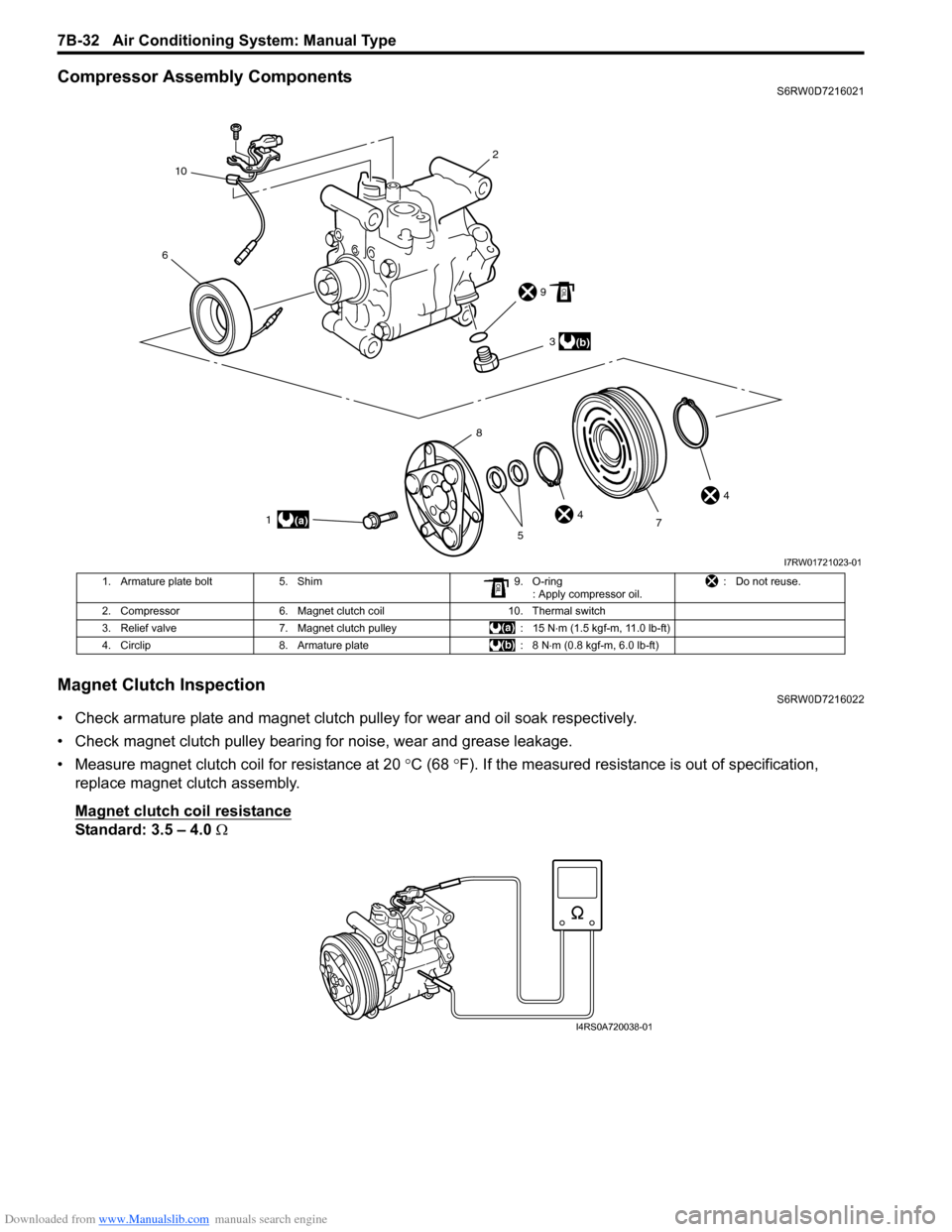
Compressor Assembly ComponentsS6RW0D7216021
Magnet Clutch InspectionS6RW0D7216022
• Check armature plate and magnet clutch pulley for wear and oil soak respectively.
• Check magnet clutch pulley bearing for noise, wear and grease leakage.
• Measure magnet clutch coil for resistance at 20 °C (68 °F). If the measured resistance is out of specification,
replace magnet clutch assembly.
Magnet clutch coil resistance
Standard: 3.5 – 4.0 Ω
6
2
9
4
4 3
1
7
5 8(a)
(b)
10
I7RW01721023-01
1. Armature plate bolt 5. Shim 9. O-ring
: Apply compressor oil.: Do not reuse.
2. Compressor 6. Magnet clutch coil 10. Thermal switch
3. Relief valve 7. Magnet clutch pulley : 15 N⋅m (1.5 kgf-m, 11.0 lb-ft)
4. Circlip 8. Armature plate : 8 N⋅m (0.8 kgf-m, 6.0 lb-ft)
I4RS0A720038-01
Page 975 of 1556
Downloaded from www.Manualslib.com manuals search engine Air Conditioning System: Manual Type 7B-35
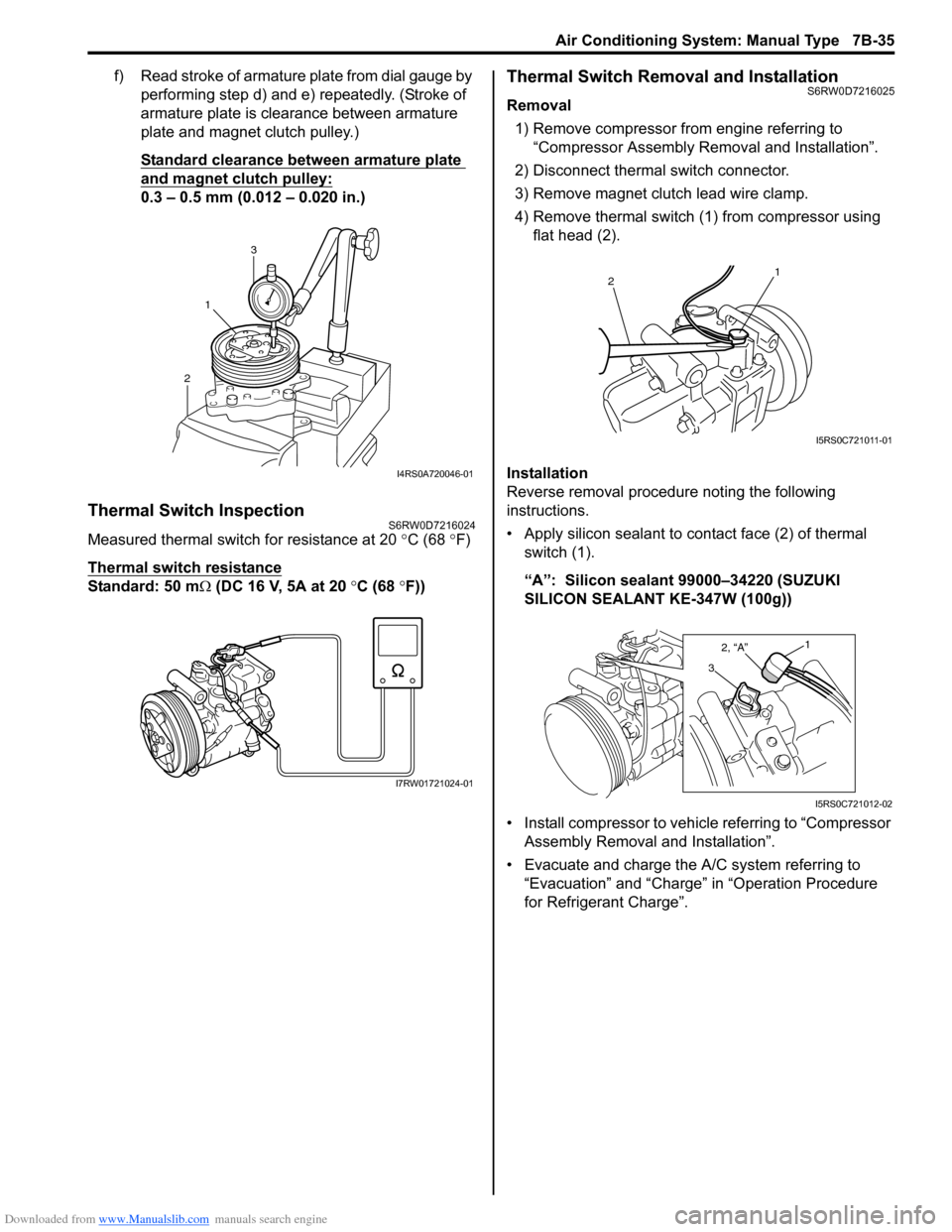
f) Read stroke of armature plate from dial gauge by
performing step d) and e) repeatedly. (Stroke of
armature plate is clearance between armature
plate and magnet clutch pulley.)
Standard clearance between armature plate
and magnet clutch pulley:
0.3 – 0.5 mm (0.012 – 0.020 in.)
Thermal Switch InspectionS6RW0D7216024
Measured thermal switch for resistance at 20 °C (68 °F)
Thermal switch resistance
Standard: 50 mΩ (DC 16 V, 5A at 20 °C (68 °F))
Thermal Switch Removal and InstallationS6RW0D7216025
Removal
1) Remove compressor from engine referring to
“Compressor Assembly Removal and Installation”.
2) Disconnect thermal switch connector.
3) Remove magnet clutch lead wire clamp.
4) Remove thermal switch (1) from compressor using
flat head (2).
Installation
Reverse removal procedure noting the following
instructions.
• Apply silicon sealant to contact face (2) of thermal
switch (1).
“A”: Silicon sealant 99000–34220 (SUZUKI
SILICON SEALANT KE-347W (100g))
• Install compressor to vehicle referring to “Compressor
Assembly Removal and Installation”.
• Evacuate and charge the A/C system referring to
“Evacuation” and “Charge” in “Operation Procedure
for Refrigerant Charge”.
213
I4RS0A720046-01
I7RW01721024-01
21
I5RS0C721011-01
3
2, “A”1
I5RS0C721012-02
Page 976 of 1556
Downloaded from www.Manualslib.com manuals search engine 7B-36 Air Conditioning System: Manual Type
Relief Valve InspectionS6RW0D7216026
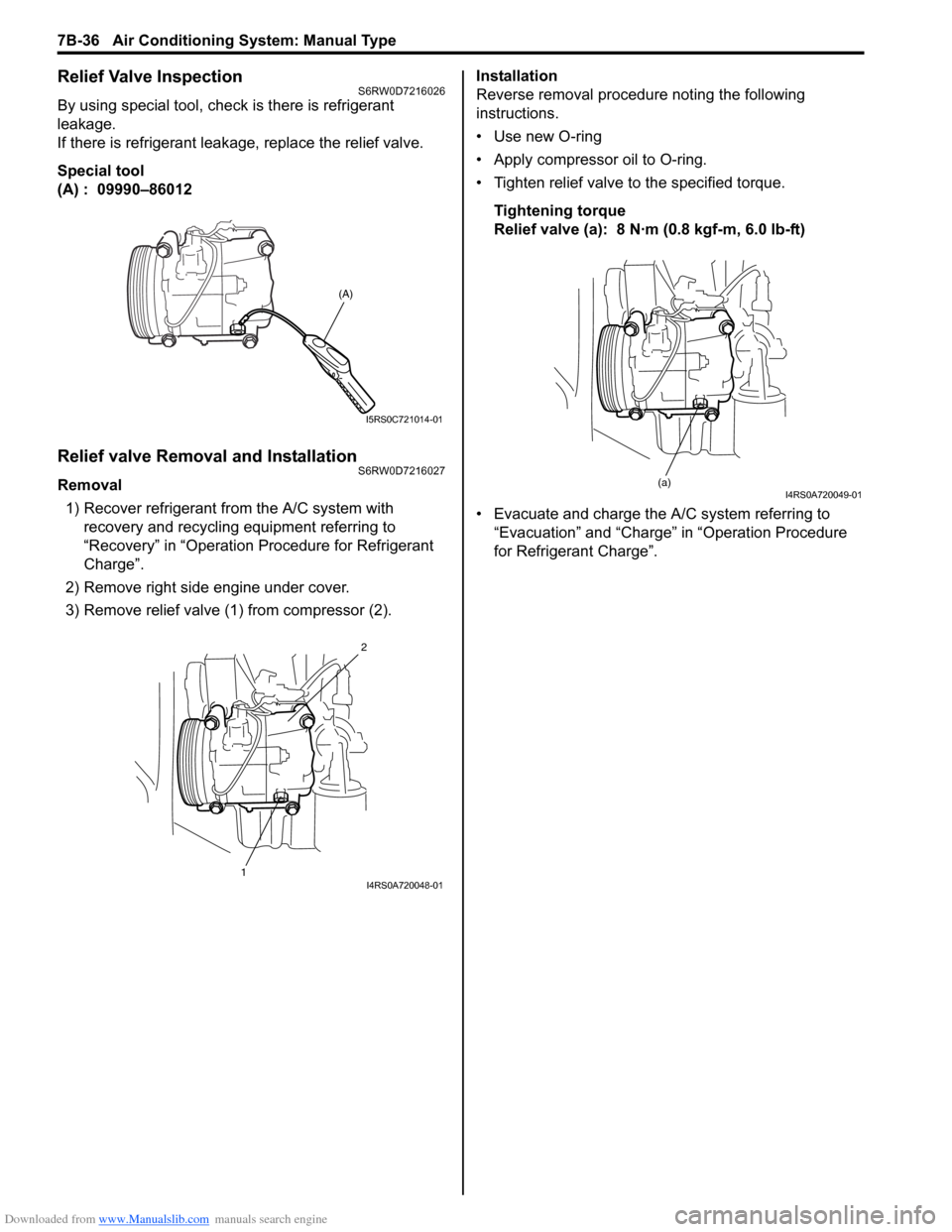
By using special tool, check is there is refrigerant
leakage.
If there is refrigerant leakage, replace the relief valve.
Special tool
(A) : 09990–86012
Relief valve Removal and InstallationS6RW0D7216027
Removal
1) Recover refrigerant from the A/C system with
recovery and recycling equipment referring to
“Recovery” in “Operation Procedure for Refrigerant
Charge”.
2) Remove right side engine under cover.
3) Remove relief valve (1) from compressor (2).Installation
Reverse removal procedure noting the following
instructions.
• Use new O-ring
• Apply compressor oil to O-ring.
• Tighten relief valve to the specified torque.
Tightening torque
Relief valve (a): 8 N·m (0.8 kgf-m, 6.0 lb-ft)
• Evacuate and charge the A/C system referring to
“Evacuation” and “Charge” in “Operation Procedure
for Refrigerant Charge”.
(A)
I5RS0C721014-01
12I4RS0A720048-01
(a)I4RS0A720049-01
Page 981 of 1556
Downloaded from www.Manualslib.com manuals search engine Air Conditioning System: Automatic Type 7B-41
On-Board Diagnostic System DescriptionS6RW0D7221004
NOTE
The diagnostic information as diagnostic
trouble code (DTC) can be known by using
SUZUKI scan tool. For further details, refer to
“DTC Check”.
HVAC control module detects malfunctions, which may
occur in the following area.
• Inside air temperature sensor
• Evaporator temperature sensor
• Sunload sensor
• Temperature control actuator
• Air flow control actuator
• Temperature selector of HVAC control module
• Air flow selector of HVAC control module
• Blower speed selector of HVAC control module
• Back-up power supply circuit of HAVC control module
• Serial communication line between BCM and HVAC
control module• Received data from BCM as follows
– Outside air temperature sensor signal
– ECT sensor signal
– A/C refrigerant pressure sensor signal
– VSS signal
– Engine type signal
– Combination meter spec signal
– CAN communication circuit failure signal
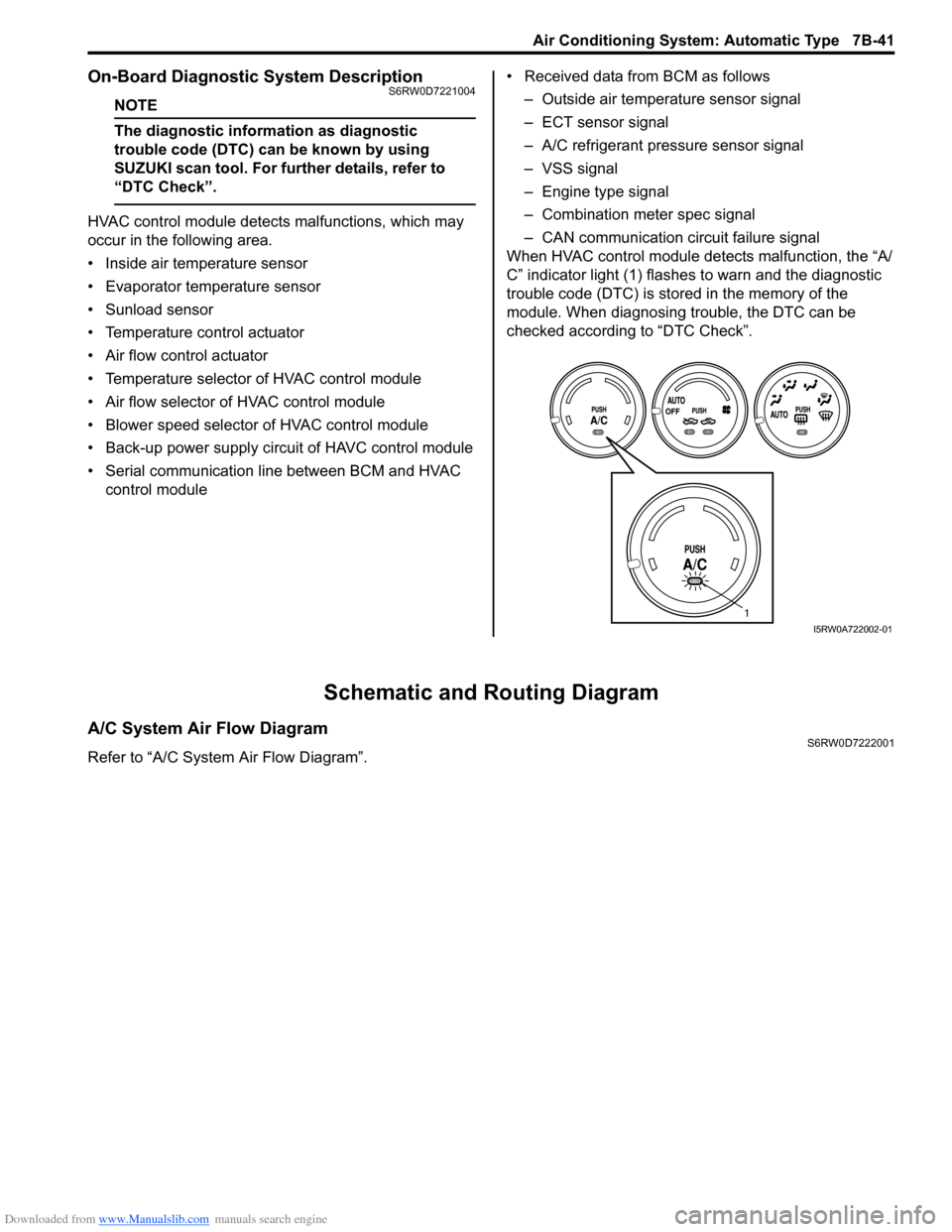
When HVAC control module detects malfunction, the “A/
C” indicator light (1) flashes to warn and the diagnostic
trouble code (DTC) is stored in the memory of the
module. When diagnosing trouble, the DTC can be
checked according to “DTC Check”.
Schematic and Routing Diagram
A/C System Air Flow DiagramS6RW0D7222001
Refer to “A/C System Air Flow Diagram”.
1
I5RW0A722002-01
Page 986 of 1556

Downloaded from www.Manualslib.com manuals search engine 7B-46 Air Conditioning System: Automatic Type
Description for Each Step
Step 1. Customer complaint analysis
Talk to customer, and then record details of the problem.
Customer questionnaire (Example)
NOTE
The form is a standard sample. It should be modified according to conditions characteristic of each
market.
Step 2. Visual inspection
As a preliminary step, be sure to perform visual check of
the items that support proper function of the air
conditioning system referring to “Visual Inspection”.
Step 3. DTC check
Check DTC referring to “DTC Check”.
Step 4. DTC troubleshooting
Based on the DTC, perform an applicable DTC
diagnostic flow and locate the cause of the trouble,
namely in a sensor, wire harness, connector, actuator,
HVAC control module or other part and repair faulty
parts.
Step 5. A/C system performance inspection
Inspect A/C system suspected to be a possible cause
referring to “A/C System Performance Inspection”.Step 6. A/C system symptom diagnosis
Check any part or system suspected to be a possible
cause referring to “A/C System Symptom Diagnosis”.
Step 7. Check for intermittent problem
Check any part where an intermittent trouble is easy to
occur (e.g., wire harness, connector, etc.), referring to
“Intermittent and Poor Connection Inspection in Section
00” and related circuit of trouble cord recorded.
Step 8. Final confirmation test
Confirm if the problem symptom is troubleshoot and the
A/C system is free from any abnormal conditions. If there
existed DTC, clear the DTC. Then, check if the DTC is
still detected and if there is any other DTC.
I4RH01722014-01
Page 993 of 1556
Downloaded from www.Manualslib.com manuals search engine Air Conditioning System: Automatic Type 7B-53
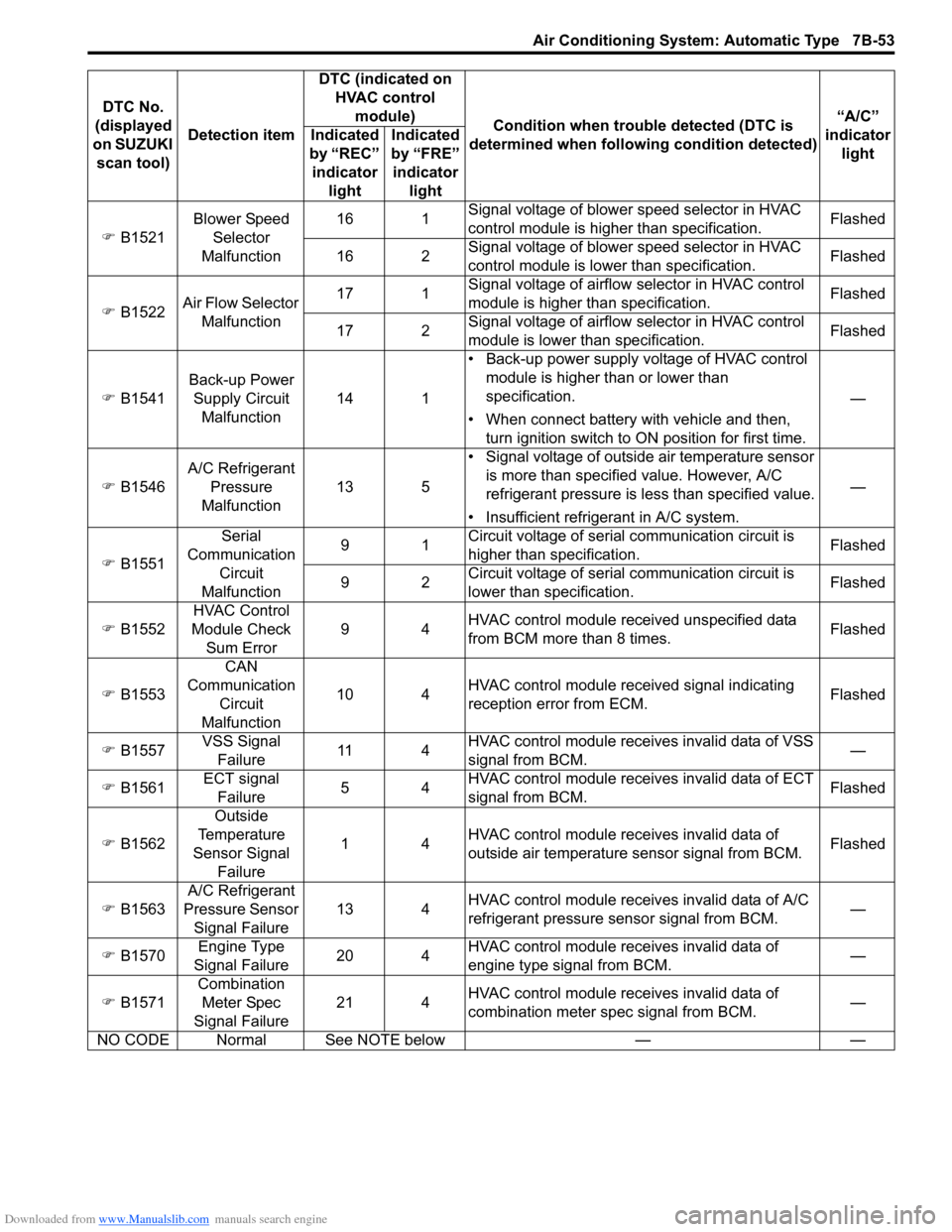
) B1521Blower Speed
Selector
Malfunction16 1Signal voltage of blower speed selector in HVAC
control module is higher than specification.Flashed
16 2Signal voltage of blower speed selector in HVAC
control module is lower than specification.Flashed
) B1522Air Flow Selector
Malfunction17 1Signal voltage of airflow selector in HVAC control
module is higher than specification.Flashed
17 2Signal voltage of airflow selector in HVAC control
module is lower than specification.Flashed
) B1541Back-up Power
Supply Circuit
Malfunction14 1• Back-up power supply voltage of HVAC control
module is higher than or lower than
specification.
• When connect battery with vehicle and then,
turn ignition switch to ON position for first time.—
) B1546A/C Refrigerant
Pressure
Malfunction13 5• Signal voltage of outside air temperature sensor
is more than specified value. However, A/C
refrigerant pressure is less than specified value.
• Insufficient refrigerant in A/C system.—
) B1551Serial
Communication
Circuit
Malfunction91Circuit voltage of serial communication circuit is
higher than specification.Flashed
92Circuit voltage of serial communication circuit is
lower than specification.Flashed
) B1552HVAC Control
Module Check
Sum Error94HVAC control module received unspecified data
from BCM more than 8 times.Flashed
) B1553CAN
Communication
Circuit
Malfunction10 4HVAC control module received signal indicating
reception error from ECM.Flashed
) B1557VSS Signal
Failure11 4HVAC control module receives invalid data of VSS
signal from BCM.—
) B1561ECT signal
Failure54HVAC control module receives invalid data of ECT
signal from BCM.Flashed
) B1562Outside
Temperature
Sensor Signal
Failure14HVAC control module receives invalid data of
outside air temperature sensor signal from BCM.Flashed
) B1563A/C Refrigerant
Pressure Sensor
Signal Failure13 4HVAC control module receives invalid data of A/C
refrigerant pressure sensor signal from BCM.—
) B1570Engine Type
Signal Failure20 4HVAC control module receives invalid data of
engine type signal from BCM.—
) B1571Combination
Meter Spec
Signal Failure21 4HVAC control module receives invalid data of
combination meter spec signal from BCM.—
NO CODE Normal See NOTE below — —DTC No.
(displayed
on SUZUKI
scan tool)Detection itemDTC (indicated on
HVAC control
module)
Condition when trouble detected (DTC is
determined when following condition detected)“A/C”
indicator
light Indicated
by “REC”
indicator
lightIndicated
by “FRE”
indicator
light
Page 1001 of 1556
Downloaded from www.Manualslib.com manuals search engine Air Conditioning System: Automatic Type 7B-61
DTC Troubleshooting
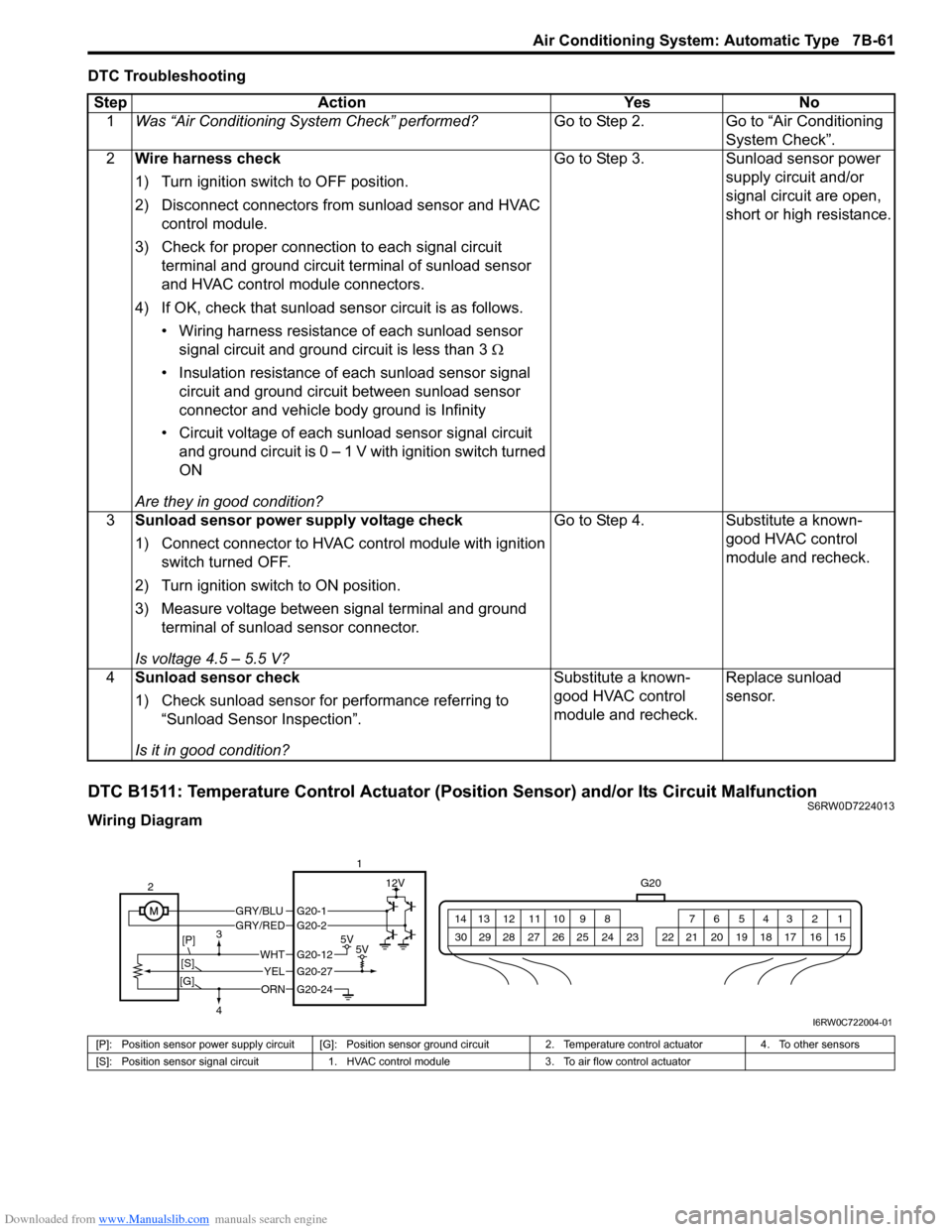
DTC B1511: Temperature Control Actuator (Position Sensor) and/or Its Circuit MalfunctionS6RW0D7224013
Wiring DiagramStep Action Yes No
1Was “Air Conditioning System Check” performed?Go to Step 2. Go to “Air Conditioning
System Check”.
2Wire harness check
1) Turn ignition switch to OFF position.
2) Disconnect connectors from sunload sensor and HVAC
control module.
3) Check for proper connection to each signal circuit
terminal and ground circuit terminal of sunload sensor
and HVAC control module connectors.
4) If OK, check that sunload sensor circuit is as follows.
• Wiring harness resistance of each sunload sensor
signal circuit and ground circuit is less than 3 Ω
• Insulation resistance of each sunload sensor signal
circuit and ground circuit between sunload sensor
connector and vehicle body ground is Infinity
• Circuit voltage of each sunload sensor signal circuit
and ground circuit is 0 – 1 V with ignition switch turned
ON
Are they in good condition?Go to Step 3. Sunload sensor power
supply circuit and/or
signal circuit are open,
short or high resistance.
3Sunload sensor power supply voltage check
1) Connect connector to HVAC control module with ignition
switch turned OFF.
2) Turn ignition switch to ON position.
3) Measure voltage between signal terminal and ground
terminal of sunload sensor connector.
Is voltage 4.5 – 5.5 V?Go to Step 4. Substitute a known-
good HVAC control
module and recheck.
4Sunload sensor check
1) Check sunload sensor for performance referring to
“Sunload Sensor Inspection”.
Is it in good condition?Substitute a known-
good HVAC control
module and recheck.Replace sunload
sensor.
G20
1 2 3 4 5 6 7 8 9 10 11 12 13 14
15 16 17 18 19 20 21 24 23 22 25 26 27 28 29 30
GRY/BLUGRY/RED
5V5V
12V
ORN
WHT
YEL
G20-12
G20-27
G20-24
G20-1G20-2
2
[P]
[S]3
4
[G]
1
I6RW0C722004-01
[P]: Position sensor power supply circuit [G]: Position sensor ground circuit 2. Temperature control actuator 4. To other sensors
[S]: Position sensor signal circuit 1. HVAC control module 3. To air flow control actuator