Sas SUZUKI SX4 2006 1.G Service Repair Manual
[x] Cancel search | Manufacturer: SUZUKI, Model Year: 2006, Model line: SX4, Model: SUZUKI SX4 2006 1.GPages: 1556, PDF Size: 37.31 MB
Page 578 of 1556
Downloaded from www.Manualslib.com manuals search engine 4A-7 Brake Control System and Diagnosis:
Repair Instructions
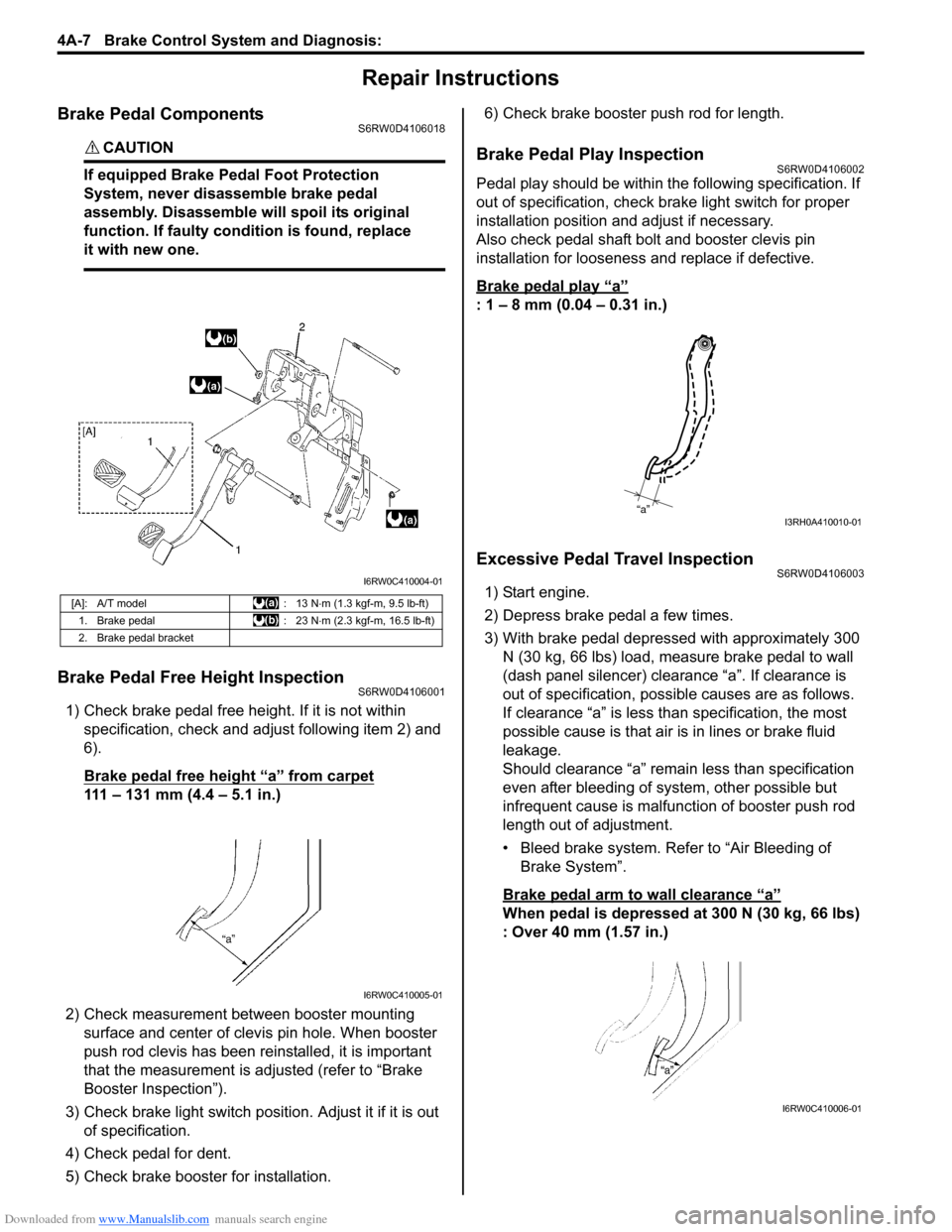
Brake Pedal ComponentsS6RW0D4106018
CAUTION!
If equipped Brake Pedal Foot Protection
System, never disassemble brake pedal
assembly. Disassemble will spoil its original
function. If faulty condition is found, replace
it with new one.
Brake Pedal Free Height InspectionS6RW0D4106001
1) Check brake pedal free height. If it is not within
specification, check and adjust following item 2) and
6).
Brake pedal free height “a” from carpet
111 – 131 mm (4.4 – 5.1 in.)
2) Check measurement between booster mounting
surface and center of clevis pin hole. When booster
push rod clevis has been reinstalled, it is important
that the measurement is adjusted (refer to “Brake
Booster Inspection”).
3) Check brake light switch position. Adjust it if it is out
of specification.
4) Check pedal for dent.
5) Check brake booster for installation.6) Check brake booster push rod for length.
Brake Pedal Play InspectionS6RW0D4106002
Pedal play should be within the following specification. If
out of specification, check brake light switch for proper
installation position and adjust if necessary.
Also check pedal shaft bolt and booster clevis pin
installation for looseness and replace if defective.
Brake pedal play
“a”
: 1 – 8 mm (0.04 – 0.31 in.)
Excessive Pedal Travel InspectionS6RW0D4106003
1) Start engine.
2) Depress brake pedal a few times.
3) With brake pedal depressed with approximately 300
N (30 kg, 66 lbs) load, measure brake pedal to wall
(dash panel silencer) clearance “a”. If clearance is
out of specification, possible causes are as follows.
If clearance “a” is less than specification, the most
possible cause is that air is in lines or brake fluid
leakage.
Should clearance “a” remain less than specification
even after bleeding of system, other possible but
infrequent cause is malfunction of booster push rod
length out of adjustment.
• Bleed brake system. Refer to “Air Bleeding of
Brake System”.
Brake pedal arm to wall clearance
“a”
When pedal is depressed at 300 N (30 kg, 66 lbs)
: Over 40 mm (1.57 in.)
[A]: A/T model : 13 N⋅m (1.3 kgf-m, 9.5 lb-ft)
1. Brake pedal : 23 N⋅m (2.3 kgf-m, 16.5 lb-ft)
2. Brake pedal bracket
I6RW0C410004-01
I6RW0C410005-01
“a”I3RH0A410010-01
I6RW0C410006-01
Page 582 of 1556
Downloaded from www.Manualslib.com manuals search engine 4A-11 Brake Control System and Diagnosis:
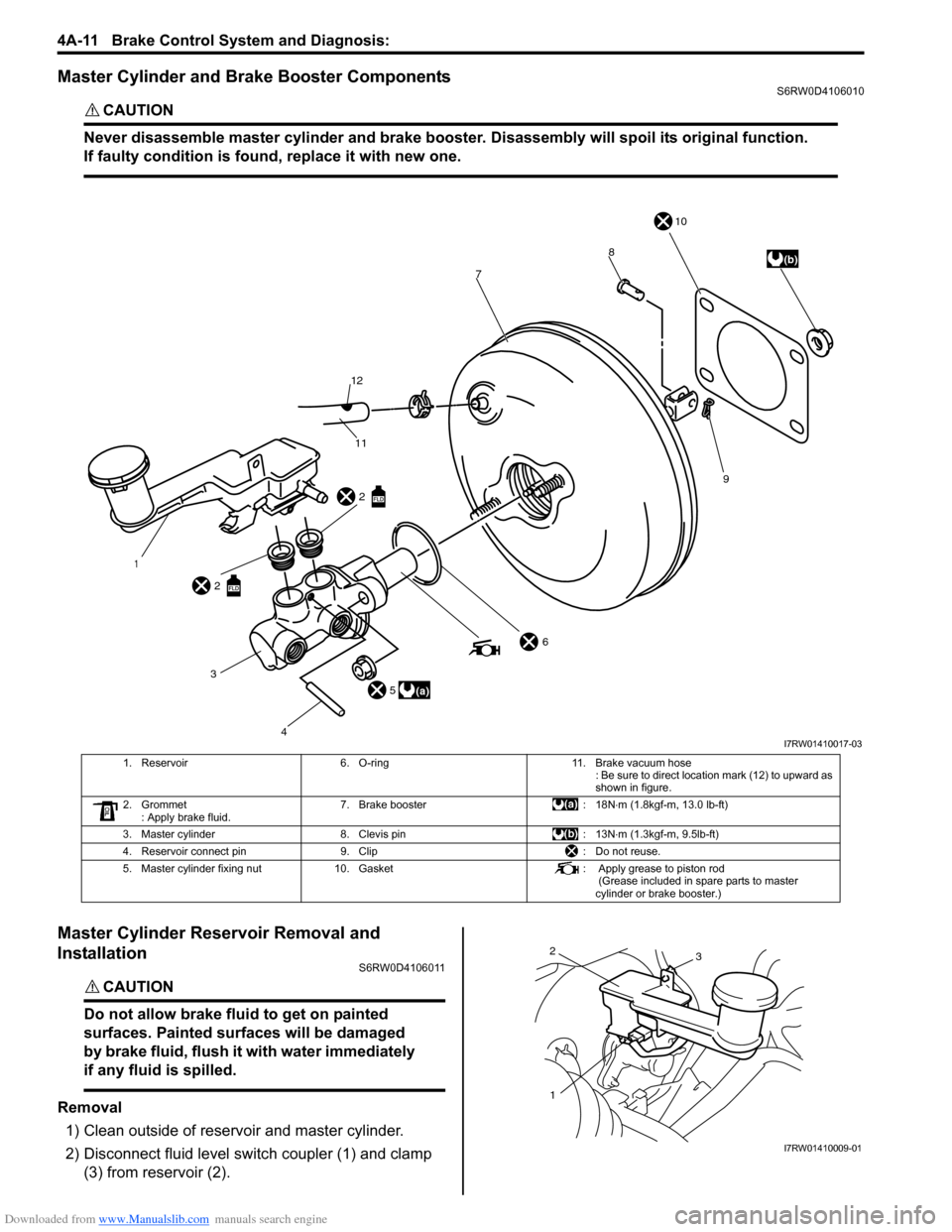
Master Cylinder and Brake Booster ComponentsS6RW0D4106010
CAUTION!
Never disassemble master cylinder and brake booster. Disassembly will spoil its original function.
If faulty condition is found, replace it with new one.
Master Cylinder Reservoir Removal and
Installation
S6RW0D4106011
CAUTION!
Do not allow brake fluid to get on painted
surfaces. Painted surfaces will be damaged
by brake fluid, flush it with water immediately
if any fluid is spilled.
Removal
1) Clean outside of reservoir and master cylinder.
2) Disconnect fluid level switch coupler (1) and clamp
(3) from reservoir (2).
4 2
2
1
(b) 10
9 8
7
11 12
6
3
5(a)
I7RW01410017-03
1. Reservoir 6. O-ring 11. Brake vacuum hose
: Be sure to direct location mark (12) to upward as
shown in figure.
2. Grommet
: Apply brake fluid. 7. Brake booster : 18N⋅m (1.8kgf-m, 13.0 lb-ft)
3. Master cylinder 8. Clevis pin : 13N⋅m (1.3kgf-m, 9.5lb-ft)
4. Reservoir connect pin 9. Clip : Do not reuse.
5. Master cylinder fixing nut 10. Gasket : Apply grease to piston rod
(Grease included in spare parts to master
cylinder or brake booster.)
2
13
I7RW01410009-01
Page 583 of 1556
Downloaded from www.Manualslib.com manuals search engine Brake Control System and Diagnosis: 4A-12
3) Drain brake fluid in reservoir.
4) Disconnect clutch reservoir hose from reservoir (M/T
model).
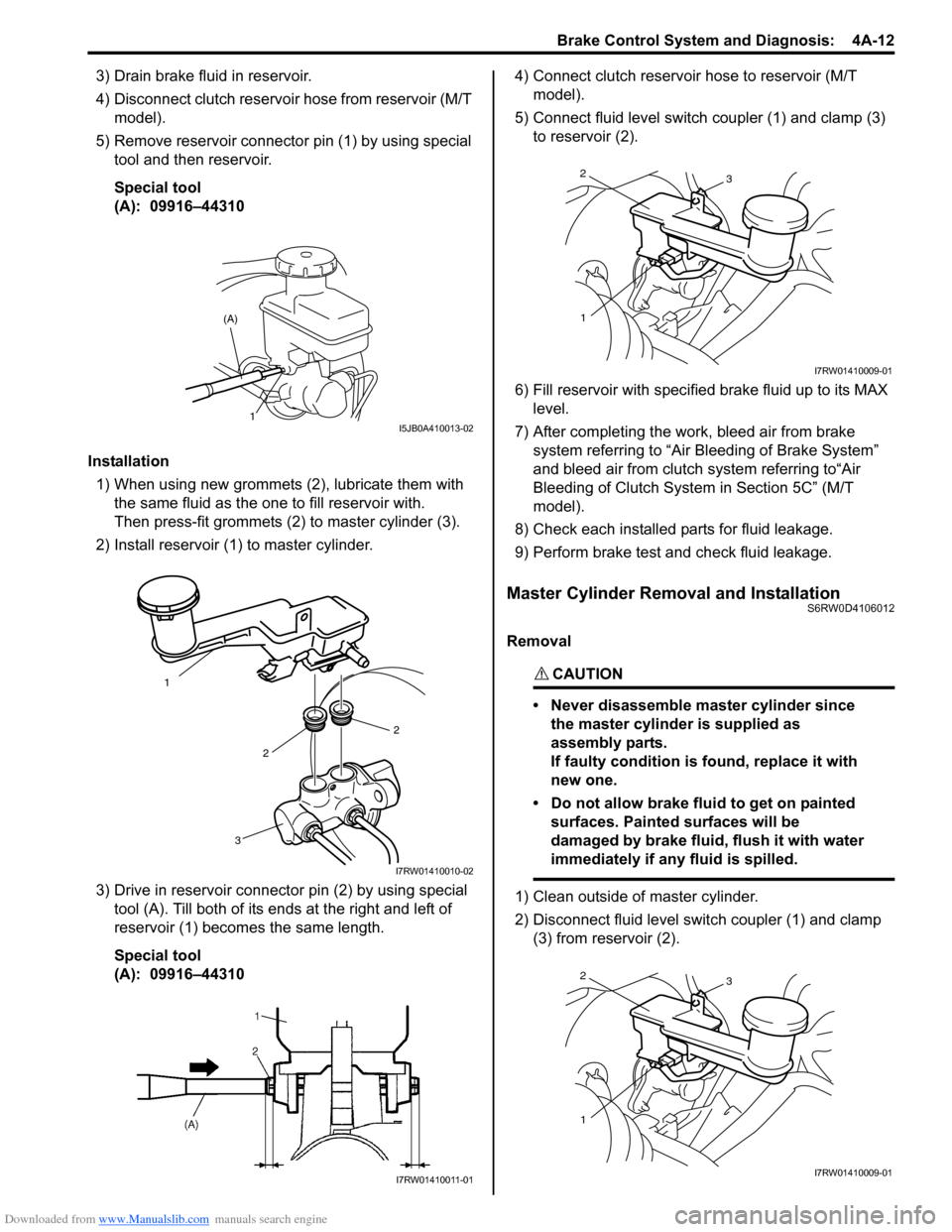
5) Remove reservoir connector pin (1) by using special
tool and then reservoir.
Special tool
(A): 09916–44310
Installation
1) When using new grommets (2), lubricate them with
the same fluid as the one to fill reservoir with.
Then press-fit grommets (2) to master cylinder (3).
2) Install reservoir (1) to master cylinder.
3) Drive in reservoir connector pin (2) by using special
tool (A). Till both of its ends at the right and left of
reservoir (1) becomes the same length.
Special tool
(A): 09916–44310 4) Connect clutch reservoir hose to reservoir (M/T
model).
5) Connect fluid level switch coupler (1) and clamp (3)
to reservoir (2).
6) Fill reservoir with specified brake fluid up to its MAX
level.
7) After completing the work, bleed air from brake
system referring to “Air Bleeding of Brake System”
and bleed air from clutch system referring to“Air
Bleeding of Clutch System in Section 5C” (M/T
model).
8) Check each installed parts for fluid leakage.
9) Perform brake test and check fluid leakage.
Master Cylinder Removal and InstallationS6RW0D4106012
Removal
CAUTION!
• Never disassemble master cylinder since
the master cylinder is supplied as
assembly parts.
If faulty condition is found, replace it with
new one.
• Do not allow brake fluid to get on painted
surfaces. Painted surfaces will be
damaged by brake fluid, flush it with water
immediately if any fluid is spilled.
1) Clean outside of master cylinder.
2) Disconnect fluid level switch coupler (1) and clamp
(3) from reservoir (2).
1 (A)I5JB0A410013-02
1
2
2
3
I7RW01410010-02
I7RW01410011-01
2
13
I7RW01410009-01
2
13
I7RW01410009-01
Page 591 of 1556
Downloaded from www.Manualslib.com manuals search engine Front Brakes: 4B-4
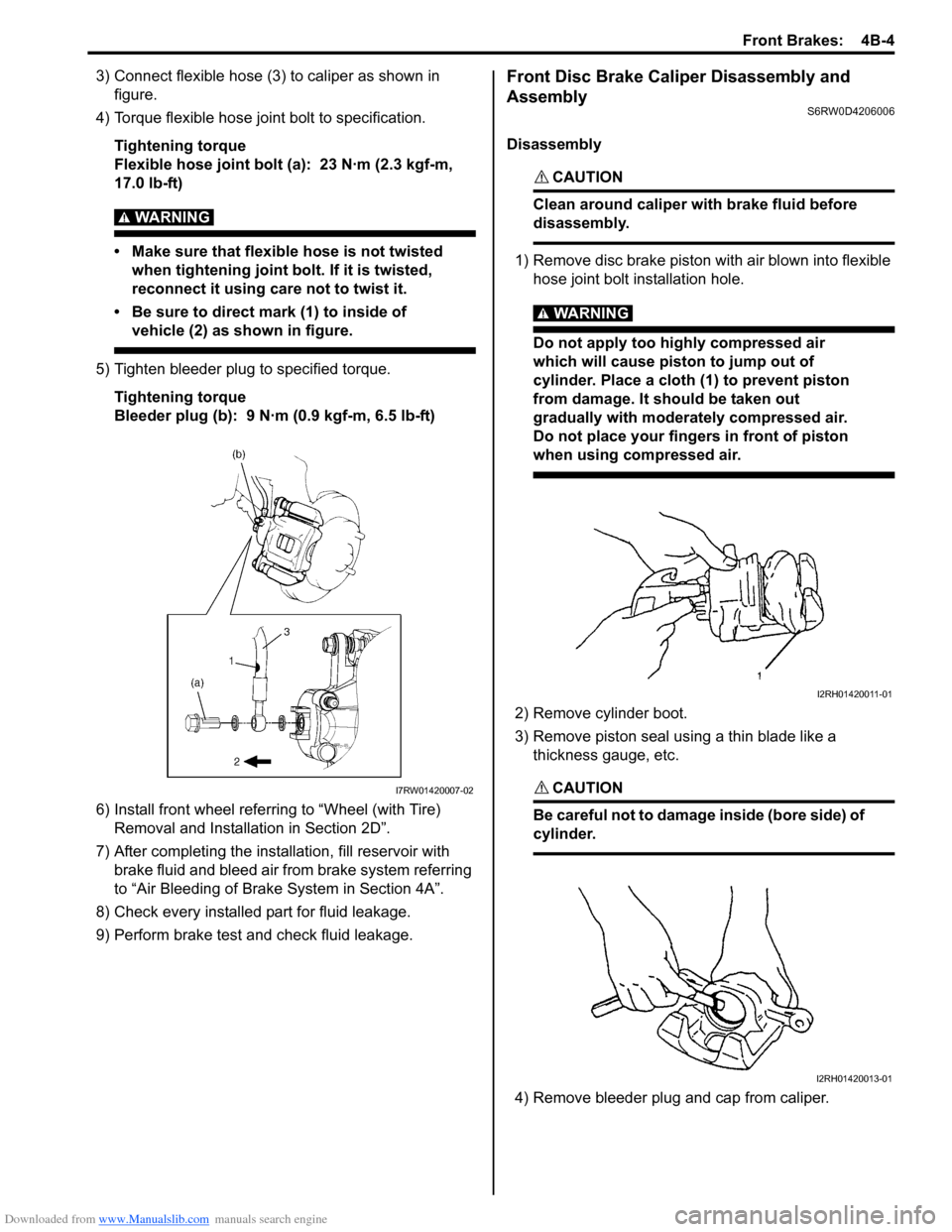
3) Connect flexible hose (3) to caliper as shown in
figure.
4) Torque flexible hose joint bolt to specification.
Tightening torque
Flexible hose joint bolt (a): 23 N·m (2.3 kgf-m,
17.0 lb-ft)
WARNING!
• Make sure that flexible hose is not twisted
when tightening joint bolt. If it is twisted,
reconnect it using care not to twist it.
• Be sure to direct mark (1) to inside of
vehicle (2) as shown in figure.
5) Tighten bleeder plug to specified torque.
Tightening torque
Bleeder plug (b): 9 N·m (0.9 kgf-m, 6.5 lb-ft)
6) Install front wheel referring to “Wheel (with Tire)
Removal and Installation in Section 2D”.
7) After completing the installation, fill reservoir with
brake fluid and bleed air from brake system referring
to “Air Bleeding of Brake System in Section 4A”.
8) Check every installed part for fluid leakage.
9) Perform brake test and check fluid leakage.
Front Disc Brake Caliper Disassembly and
Assembly
S6RW0D4206006
Disassembly
CAUTION!
Clean around caliper with brake fluid before
disassembly.
1) Remove disc brake piston with air blown into flexible
hose joint bolt installation hole.
WARNING!
Do not apply too highly compressed air
which will cause piston to jump out of
cylinder. Place a cloth (1) to prevent piston
from damage. It should be taken out
gradually with moderately compressed air.
Do not place your fingers in front of piston
when using compressed air.
2) Remove cylinder boot.
3) Remove piston seal using a thin blade like a
thickness gauge, etc.
CAUTION!
Be careful not to damage inside (bore side) of
cylinder.
4) Remove bleeder plug and cap from caliper.
I7RW01420007-02
I2RH01420011-01
I2RH01420013-01
Page 592 of 1556
Downloaded from www.Manualslib.com manuals search engine 4B-5 Front Brakes:
Assembly
Assemble parts in reverse order of disassembly,
observing the following instructions.
CAUTION!
• Wash each part cleanly before installation
in the same fluid as the one used in master
cylinder reservoir.
• Never use other fluid or thinner.
• Before installing piston seal and cylinder
boot to cylinder, apply rubber grease
included in piston seal set or brake fluid to
them.
• Install a new piston seal into groove in
cylinder securely making sure that it is not
twisted.
• After reassembling brake lines, bleed air
from them.
Before installing caliper to carrier, install slide pins with
rubber grease included in slide pin / boot set applied into
caliper carrier hole and check for its smooth movement
in thrust direction.
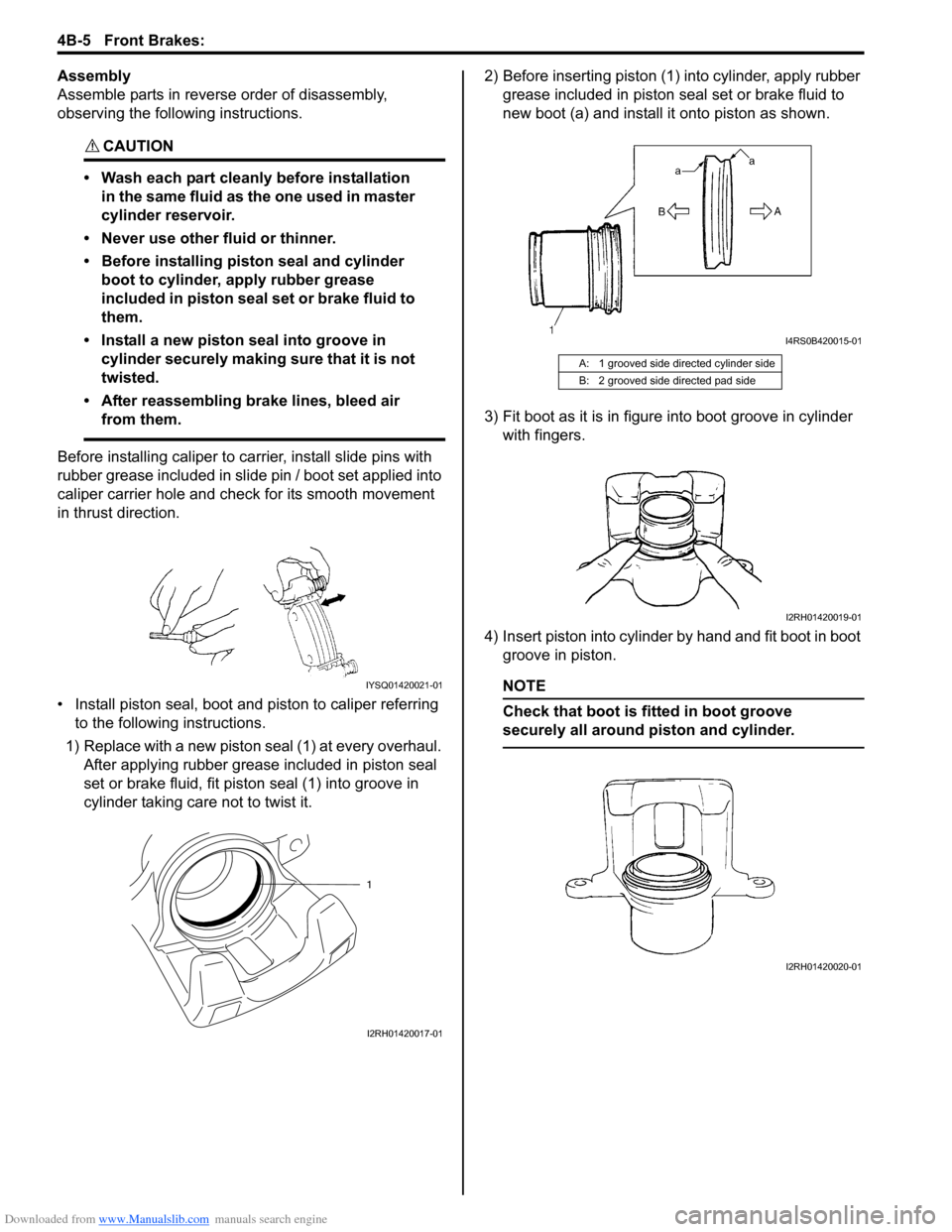
• Install piston seal, boot and piston to caliper referring
to the following instructions.
1) Replace with a new piston seal (1) at every overhaul.
After applying rubber grease included in piston seal
set or brake fluid, fit piston seal (1) into groove in
cylinder taking care not to twist it.2) Before inserting piston (1) into cylinder, apply rubber
grease included in piston seal set or brake fluid to
new boot (a) and install it onto piston as shown.
3) Fit boot as it is in figure into boot groove in cylinder
with fingers.
4) Insert piston into cylinder by hand and fit boot in boot
groove in piston.
NOTE
Check that boot is fitted in boot groove
securely all around piston and cylinder.
IYSQ01420021-01
1
I2RH01420017-01
A: 1 grooved side directed cylinder side
B: 2 grooved side directed pad side
I4RS0B420015-01
I2RH01420019-01
I2RH01420020-01
Page 600 of 1556
Downloaded from www.Manualslib.com manuals search engine 4C-5 Rear Brakes:
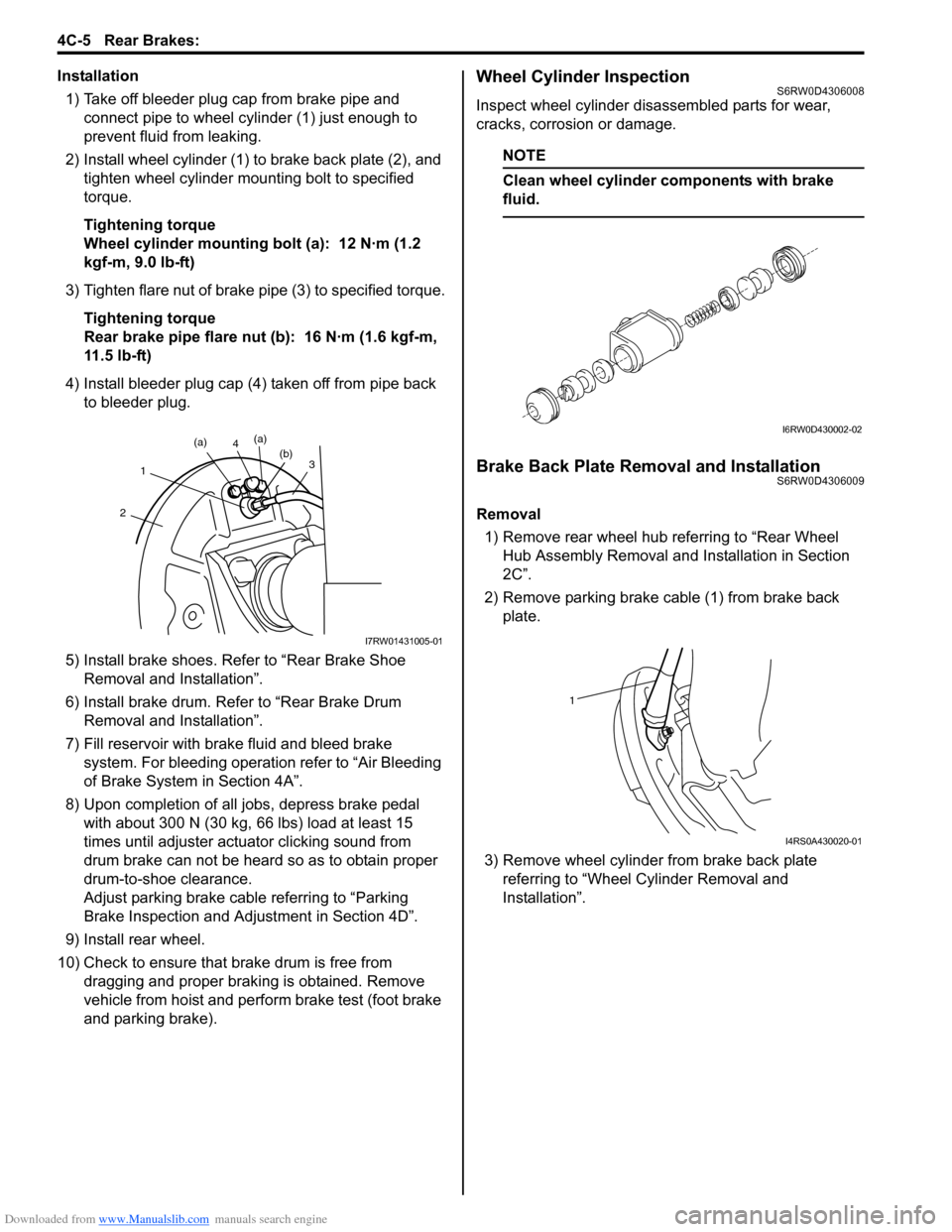
Installation
1) Take off bleeder plug cap from brake pipe and
connect pipe to wheel cylinder (1) just enough to
prevent fluid from leaking.
2) Install wheel cylinder (1) to brake back plate (2), and
tighten wheel cylinder mounting bolt to specified
torque.
Tightening torque
Wheel cylinder mounting bolt (a): 12 N·m (1.2
kgf-m, 9.0 lb-ft)
3) Tighten flare nut of brake pipe (3) to specified torque.
Tightening torque
Rear brake pipe flare nut (b): 16 N·m (1.6 kgf-m,
11.5 lb-ft)
4) Install bleeder plug cap (4) taken off from pipe back
to bleeder plug.
5) Install brake shoes. Refer to “Rear Brake Shoe
Removal and Installation”.
6) Install brake drum. Refer to “Rear Brake Drum
Removal and Installation”.
7) Fill reservoir with brake fluid and bleed brake
system. For bleeding operation refer to “Air Bleeding
of Brake System in Section 4A”.
8) Upon completion of all jobs, depress brake pedal
with about 300 N (30 kg, 66 lbs) load at least 15
times until adjuster actuator clicking sound from
drum brake can not be heard so as to obtain proper
drum-to-shoe clearance.
Adjust parking brake cable referring to “Parking
Brake Inspection and Adjustment in Section 4D”.
9) Install rear wheel.
10) Check to ensure that brake drum is free from
dragging and proper braking is obtained. Remove
vehicle from hoist and perform brake test (foot brake
and parking brake).Wheel Cylinder InspectionS6RW0D4306008
Inspect wheel cylinder disassembled parts for wear,
cracks, corrosion or damage.
NOTE
Clean wheel cylinder components with brake
fluid.
Brake Back Plate Removal and InstallationS6RW0D4306009
Removal
1) Remove rear wheel hub referring to “Rear Wheel
Hub Assembly Removal and Installation in Section
2C”.
2) Remove parking brake cable (1) from brake back
plate.
3) Remove wheel cylinder from brake back plate
referring to “Wheel Cylinder Removal and
Installation”.
(b)3
4(a)
(a)
1
2
I7RW01431005-01
I6RW0D430002-02
1
I4RS0A430020-01
Page 604 of 1556
Downloaded from www.Manualslib.com manuals search engine 4D-3 Parking Brake:
Parking Brake Lever Removal and InstallationS6RW0D4406003
Removal
1) Remove console box.
2) Block vehicle wheels and release parking brake
lever.
3) Disconnect lead wire of parking brake switch at
coupler.
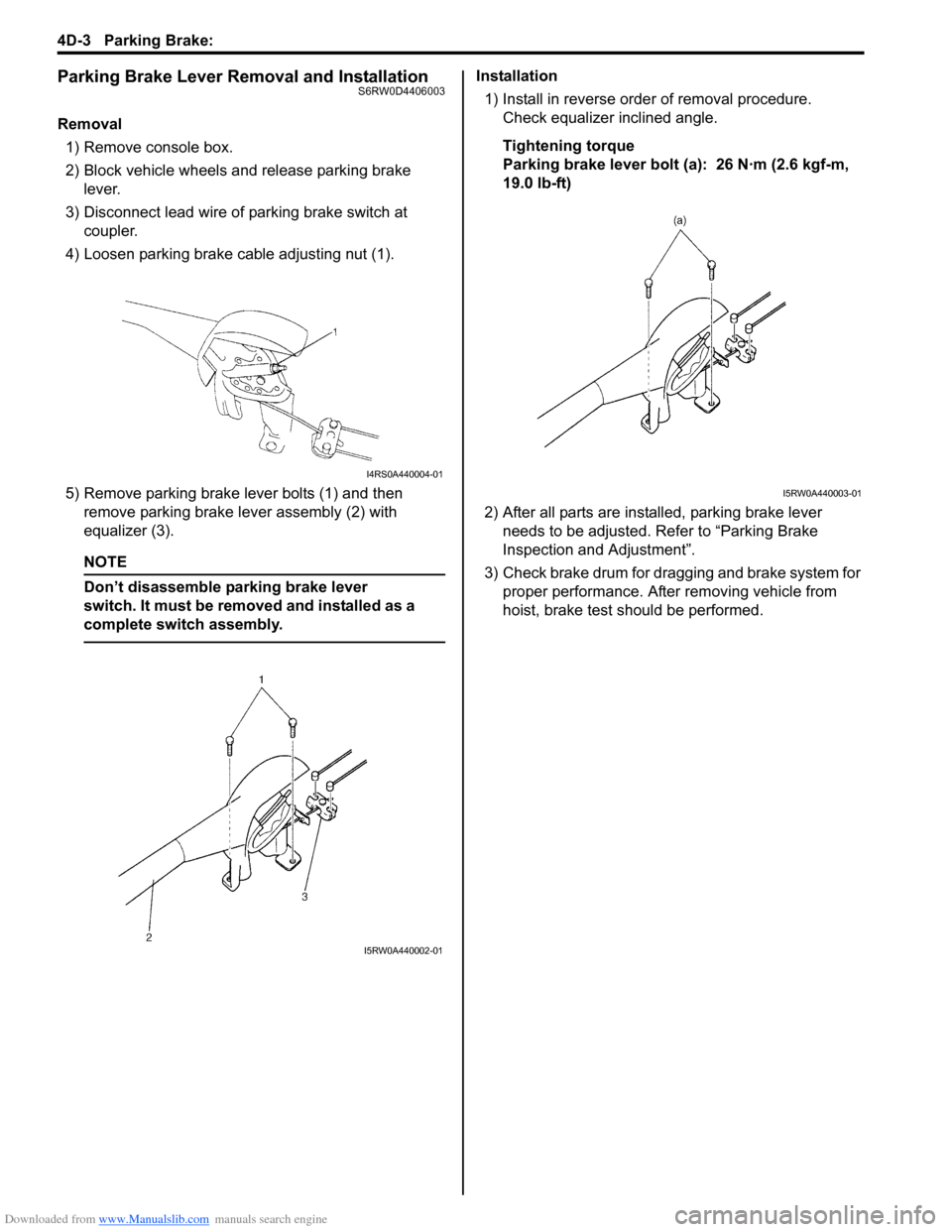
4) Loosen parking brake cable adjusting nut (1).
5) Remove parking brake lever bolts (1) and then
remove parking brake lever assembly (2) with
equalizer (3).
NOTE
Don’t disassemble parking brake lever
switch. It must be removed and installed as a
complete switch assembly.
Installation
1) Install in reverse order of removal procedure.
Check equalizer inclined angle.
Tightening torque
Parking brake lever bolt (a): 26 N·m (2.6 kgf-m,
19.0 lb-ft)
2) After all parts are installed, parking brake lever
needs to be adjusted. Refer to “Parking Brake
Inspection and Adjustment”.
3) Check brake drum for dragging and brake system for
proper performance. After removing vehicle from
hoist, brake test should be performed.
I4RS0A440004-01
I5RW0A440002-01
I5RW0A440003-01
Page 637 of 1556

Downloaded from www.Manualslib.com manuals search engine ABS: 4E-32
7) Turn ignition switch to ON position and select menu
to “HYDRAULIC CONTROL TEST” under
“miscellaneous test” (“MISC. TEST”) mode of
SUZUKI scan tool.
8) Perform the following checks with help of another
person.
Brake pedal (1) should be depressed and then select
testing wheel by SUZUKI scan tool and the wheel (2)
should be turned by another person’s hand. At this
time, check that:
• Operation sound of solenoid is heard and the
wheel turns only about 0.5 sec. (Brake force is
depressurized).
• Operation sound of pump motor is heard and
pulsation is felt at brake pedal.9) Check for all 4-wheels condition respectively. If a
faulty condition is found, replace ABS hydraulic unit /
control module assembly.
10) After completing the check, turn ignition switch to
OFF position and disconnect SUZUKI scan tool from
DLC.
ABS Hydraulic Unit / Control Module Assembly ComponentsS6RW0D4506002
CAUTION!
Never disassemble ABS hydraulic unit / control module assembly, loosen blind plug or remove motor.
Performing any of these prohibited services will affect original performance of ABS hydraulic unit /
control module assembly.
I4RH01450021-01
I6RW0C450006-01
1. ABS hydraulic unit / control module assembly : 16 N⋅m (1.6 kgf-m, 11.5 lb-ft) : 26 N⋅m (2.6 kgf-m, 19.0 lb-ft)
2. Bracket : 9 N⋅m (0.9 kgf-m, 6.5 lb-ft)
Page 638 of 1556

Downloaded from www.Manualslib.com manuals search engine 4E-33 ABS:
ABS Hydraulic Unit / Control Module Assembly
On-Vehicle Inspection
S6RW0D4506003
CAUTION!
Never disassemble ABS hydraulic unit /
control module assembly, loosen blind plug
or remove motor. Performing any of these
prohibited services will affect original
performance of ABS hydraulic unit / control
module assembly.
Check hydraulic unit for fluid leakage.
If any, repair or replace.
ABS Hydraulic Unit / Control Module Assembly
Removal and Installation
S6RW0D4506004
CAUTION!
Never disassemble ABS hydraulic unit /
control module assembly, loosen blind plug
or remove motor. Performing any of these
prohibited services will affect original
performance of ABS hydraulic unit / control
module assembly.
Removal
1) Disconnect negative cable from battery.
2) Disconnect ABS hydraulic unit / control module
assembly connector (1) by pull up the lock (2).3) Using special tool, loosen flare nuts (1) and
disconnect brake pipes (2) from ABS hydraulic unit /
control module assembly (3).
Special tool
(A): 09950-78220
NOTE
Put bleeder plug cap or the like onto pipe to
prevent fluid from spilling. Do not allow brake
fluid to get on painted surfaces.
4) Remove ABS hydraulic unit / control module with
bracket from vehicle by removing two bracket bolts.
5) Remove bolt and pull out ABS hydraulic unit / control
module assembly (1) from bracket (3) using flat end
rod or the like (2).
CAUTION!
• Do not give an impact to hydraulic unit.
• Use care not to allow dust to enter
hydraulic unit.
• Do not place hydraulic unit on its side or
upside down. Handling it in inappropriate
way will affect its original performance.
[A]: Disconnect C: Pull up to disconnect
[B]: Connect D: Pull down to connect
2 1
CD
[A]
[B]
I5RW0A450001-01
(A)
1
3 2
I5RW0A450020-01
I5RW0A450021-01
Page 645 of 1556
Downloaded from www.Manualslib.com manuals search engine Table of Contents 5- i
5
Section 5
CONTENTS
Transmission / Transaxle
Precautions ................................................. 5-1
Precautions............................................................. 5-1
Precautions on Transmission / Transaxle ............. 5-1
Automatic Transmission/Transaxle ....... 5A-1
Precautions........................................................... 5A-1
Precautions in Diagnosing Trouble ..................... 5A-1
Precautions for Disassembly and
Reassembly ...................................................... 5A-1
General Description ............................................. 5A-3
A/T Description ................................................... 5A-3
Clutch / Brake / Planetary Gear Function of
Automatic Transaxle ......................................... 5A-6
Table of Component Operation ........................... 5A-7
A/T Diagnosis General Description ..................... 5A-7
On-Board Diagnostic System Description ........... 5A-8
CAN Communication System Description........... 5A-9
Schematic and Routing Diagram ...................... 5A-10
Transmission Control Module (TCM) Wiring
Diagram .......................................................... 5A-10
Automatic Gear Shift Table ............................... 5A-12
Component Location ......................................... 5A-14
Electronic Shift Control System Components
Location .......................................................... 5A-14
Diagnostic Information and Procedures .......... 5A-16
A/T System Check ............................................ 5A-16
Visual Inspection ............................................... 5A-18
Malfunction Indicator Lamp (MIL) Check .......... 5A-19
Transmission Warning Light Check (Non-
Euro-OBD model) ........................................... 5A-19
DTC Table ......................................................... 5A-19
DTC Check ....................................................... 5A-21
DTC Clearance ................................................. 5A-22
Fail-Safe Table .................................................. 5A-22
Scan Tool Data ................................................. 5A-24
A/T Basic Check ............................................... 5A-27
Road Test ......................................................... 5A-27
Manual Road Test ............................................. 5A-30
Engine Brake Test ............................................ 5A-30
Stall Test ........................................................... 5A-31
Time Lag Test ................................................... 5A-32
Line Pressure Test ............................................ 5A-32
“P” Range Test.................................................. 5A-33
A/T Symptom Diagnosis ................................... 5A-34Transmission Warning Light Circuit Check –
Light Remains “ON” at Ignition Switch ON
(Non-Euro-OBD Model)................................... 5A-41
Transmission Warning Light Circuit Check –
Light Does Not Come “ON” at Ignition Switch
ON (Non-Euro-OBD Model)............................ 5A-41
DTC P0602: Control Module Programming
Error ................................................................ 5A-42
DTC P0705: Transmission Range Sensor
Circuit Malfunction (PRNDL Input) .................. 5A-42
DTC P0707: Transmission Range Sensor
Circuit Low ...................................................... 5A-44
DTC P0711: Transmission Fluid Temperature
Sensor “A” Control Range / Performance ....... 5A-46
DTC P0712: Transmission Fluid Temperature
Sensor Circuit Low .......................................... 5A-47
DTC P0713: Transmission Fluid Temperature
Sensor Circuit High ......................................... 5A-48
DTC P0717: Input / Turbine Speed Sensor
Circuit Malfunction........................................... 5A-50
DTC P0722: Output Speed Sensor (VSS)
Circuit No Signal ............................................. 5A-51
DTC P0741 / P0742: TCC Circuit
Performance or Stuck OFF / TCC Circuit
Stuck ON ......................................................... 5A-53
DTC P0751 / P0752 / P0756 / P0757: Shift
Solenoid Malfunction ....................................... 5A-54
DTC P0787: Shift / Timing Solenoid Control
Circuit Low ...................................................... 5A-55
DTC P0788: Shift / Timing Solenoid Control
Circuit High...................................................... 5A-57
DTC P0961: Pressure Control Solenoid “A”
Control Circuit Range / Performance .............. 5A-58
DTC P0962: Pressure Control Solenoid
Control Circuit Low .......................................... 5A-60
DTC P0963: Pressure Control Solenoid
Control Circuit High ......................................... 5A-62
DTC P0973 / P0976: Shift Solenoid-A (No.1)
Control Circuit Low / Shift Solenoid-B (No.2)
Control Circuit Low .......................................... 5A-64
DTC P0974 / P0977: Shift Solenoid-A (No.1)
/ Shift Solenoid-B (No.2) Control Circuit High .. 5A-66
DTC P1702: Internal Control Module Memory
Check Sum Error............................................. 5A-68