brake SUZUKI XL7 2007 2.G Owner's Manual
[x] Cancel search | Manufacturer: SUZUKI, Model Year: 2007, Model line: XL7, Model: SUZUKI XL7 2007 2.GPages: 274, PDF Size: 6.12 MB
Page 167 of 274

4-9 DRIVING YOUR VEHICLE
78J00-03E
acceleration skid, too much throttle causes
the driving wheels to spin.
A cornering skid is best handled by easing
your foot off the accelerator pedal.
Remember: Any traction control system
helps avoid only the acceleration skid. If
your traction system is off, then an acceler-
ation skid is also best handled by easing
your foot off the accelerator pedal. Refer to
“Traction Control System (TCS)” and
“Electronic Stability Control” in this section.
If your vehicle starts to slide, ease your
foot off the accelerator pedal and quickly
steer the way you want the vehicle to go. If
you start steering quickly enough, your
vehicle may straighten out. Always be
ready for a second skid if it occurs.
Of course, traction is reduced when water,
snow, ice, gravel, or other material is on
the road. For safety, you will want to slow
down and adjust your driving to these con-
ditions. It is important to slow down on slip-
pery surfaces because stopping distance
will be longer and vehicle control more lim-
ited.
While driving on a surface with reduced
traction, try your best to avoid sudden
steering, acceleration, or braking, including
reducing vehicle speed by shifting to a
lower gear. Any sudden changes could
cause the tires to slide. You may not realize
the surface is slippery until your vehicle is
skidding. Learn to recognize warning clues– such as enough water, ice, or packed
snow on the road to make a mirrored sur-
face – and slow down when you have any
doubt.
If you have the Anti-Lock Brake System
(ABS), remember: It helps avoid only the
braking skid. If you do not have ABS, then
in a braking skid, where the wheels are no
longer rolling, release enough pressure on
the brakes to get the wheels rolling again.
This restores steering control. Push the
brake pedal down steadily when you have
to stop suddenly. As long as the wheels
are rolling, you will have steering control.
Remember: Any Anti-Lock Brake System
(ABS) helps avoid only the braking skid.
Driving at NightNight driving is more dangerous than day
driving. One reason is that some drivers
are likely to be impaired – by alcohol or
drugs, with night vision problems, or by
fatigue.
Here are some tips on night driving.
Drive defensively.
Do not drink and drive.
Adjust the inside rearview mirror to
reduce glare from headlamps behind
you.
Since you cannot see as well, you may
need to slow down and keep more space
between you and other vehicles. Slow down, especially on higher speed
roads. Your vehicle’s headlamps can
light up only much road ahead.
In remote areas, watch for animals.
If you are tired, pull off the road in a safe
place and rest.
No one can see as well at night as in the
daytime. But as we get older these differ-
ences increase. A 50-year-old driver may
require at least twice much light to see the
same thing at night as a 20-year-old.
What you do in the daytime can also affect
your night vision. For example, if you
spend the day in bright sunshine you are
wise to wear sunglasses. Your eyes will
have less trouble adjusting to night. But if
you are driving, do not wear sunglasses at
night. They may cut down on glare from
headlamps, but they also make a lot of
things invisible.
You can be temporarily blinded by
approaching headlamps. It can take a sec-
ond or two, or even several seconds, for
your eyes to re-adjust to the dark. When
you are faced with severe glare, as from a
driver who does not lower the high beams,
or a vehicle with misaimed headlamps,
slow down a little. Avoid staring directly
into the approaching headlamps.
Keep the windshield and all the glass on
your vehicle clean – inside and out. Glare
at night is made much worse by dirt on the
glass. Even the inside of the glass can
Page 168 of 274
4-10 DRIVING YOUR VEHICLE
78J00-03E
build up a film caused by dust. Dirty glass
makes lights dazzle and flash more than
clean glass would, making the pupils of
your eyes contract repeatedly.
Remember that the headlamps light up far
less of a roadway when you are in a turn or
curve. Keep your eyes moving; that way, it
is easier to pick out dimly lighted objects.
Just as the headlamps should be checked
regularly for proper aim, so should your
eyes be examined regularly. Some drivers
suffer from night blindness – the inability to
see in dim light – and are not even aware
of it.Driving in Rain and on Wet Roads
1527470
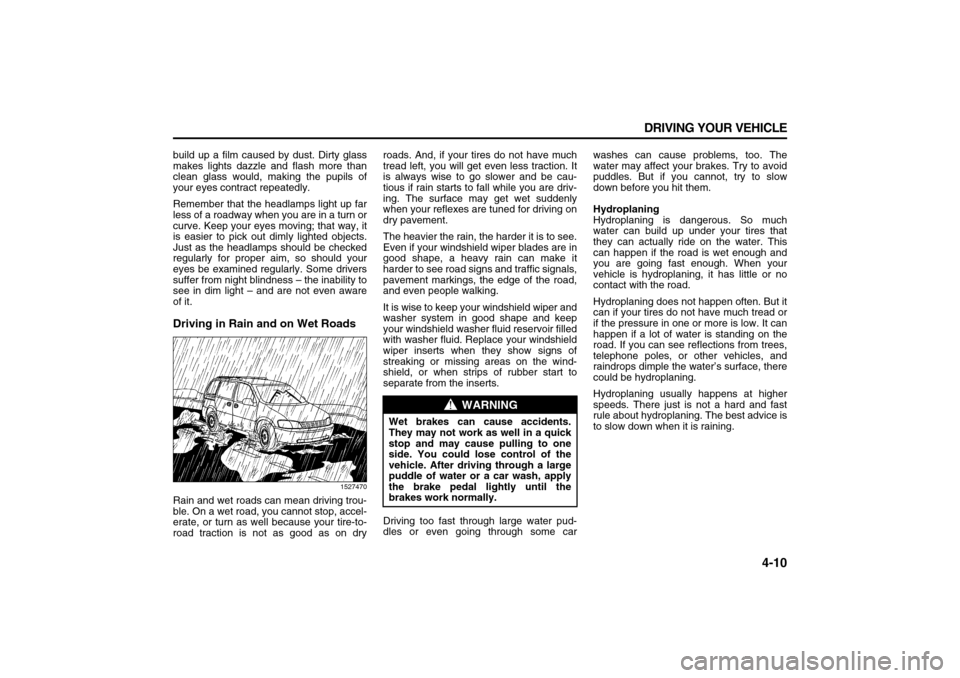
Rain and wet roads can mean driving trou-
ble. On a wet road, you cannot stop, accel-
erate, or turn as well because your tire-to-
road traction is not as good as on dryroads. And, if your tires do not have much
tread left, you will get even less traction. It
is always wise to go slower and be cau-
tious if rain starts to fall while you are driv-
ing. The surface may get wet suddenly
when your reflexes are tuned for driving on
dry pavement.
The heavier the rain, the harder it is to see.
Even if your windshield wiper blades are in
good shape, a heavy rain can make it
harder to see road signs and traffic signals,
pavement markings, the edge of the road,
and even people walking.
It is wise to keep your windshield wiper and
washer system in good shape and keep
your windshield washer fluid reservoir filled
with washer fluid. Replace your windshield
wiper inserts when they show signs of
streaking or missing areas on the wind-
shield, or when strips of rubber start to
separate from the inserts.
Driving too fast through large water pud-
dles or even going through some carwashes can cause problems, too. The
water may affect your brakes. Try to avoid
puddles. But if you cannot, try to slow
down before you hit them.
Hydroplaning
Hydroplaning is dangerous. So much
water can build up under your tires that
they can actually ride on the water. This
can happen if the road is wet enough and
you are going fast enough. When your
vehicle is hydroplaning, it has little or no
contact with the road.
Hydroplaning does not happen often. But it
can if your tires do not have much tread or
if the pressure in one or more is low. It can
happen if a lot of water is standing on the
road. If you can see reflections from trees,
telephone poles, or other vehicles, and
raindrops dimple the water’s surface, there
could be hydroplaning.
Hydroplaning usually happens at higher
speeds. There just is not a hard and fast
rule about hydroplaning. The best advice is
to slow down when it is raining.
WARNING
Wet brakes can cause accidents.
They may not work as well in a quick
stop and may cause pulling to one
side. You could lose control of the
vehicle. After driving through a large
puddle of water or a car wash, apply
the brake pedal lightly until the
brakes work normally.
Page 171 of 274
4-13 DRIVING YOUR VEHICLE
78J00-03E
does, your vehicle can leave the road in
less than a second, and you could crash
and be injured.
What can you do about highway hypnosis?
First, be aware that it can happen.
Then here are some tips:
Make sure your vehicle is well ventilated,
with a comfortably cool interior.
Keep your eyes moving. Scan the road
ahead and to the sides. Check your
vehicle’s mirrors and instruments fre-
quently.
If you get sleepy, pull off the road into a
rest, service, or parking area and take a
nap, get some exercise, or both. For
safety, treat drowsiness on the highway
as an emergency.
Hill and Mountain Roads
806088
Driving on steep hills or mountains is differ-
ent from driving in flat or rolling terrain.
If you drive regularly in steep country, or if
you are planning to visit there, here are
some tips that can make your trips safer
and more enjoyable.
Keep your vehicle in good shape. Check
all fluid levels and also the brakes, tires,
cooling system, and transaxle. These
parts can work hard on mountain roads. Know how to go down hills. The most
important thing to know is this: let your
engine do some of the slowing down.
Shift to a lower gear when you go down
a steep or long hill.
Know how to go uphill. You may want to
shift down to a lower gear. The lower
gears help cool your engine and tran-
saxle, and you can climb the hill better.
Stay in your own lane when driving on
two-lane roads in hills or mountains. Do
not swing wide or cut across the center
WARNING
If you do not shift down, the brakes
could get so hot that they would not
work well. You would then have poor
braking or even none going down a
hill. You could crash. Shift down to
let the engine assist the brakes on a
steep downhill slope.
WARNING
Coasting downhill in NEUTRAL (N) or
with the ignition off is dangerous.
The brakes will have to do all the
work of slowing down. They could
get so hot that they would not work
well. You would then have poor brak-
ing or even none going down a hill.
You could crash. Always have the
engine running and your vehicle in
gear when you go downhill.
Page 173 of 274
4-15 DRIVING YOUR VEHICLE
78J00-03E
vehicle has a traction system, you will want
to slow down and adjust your driving to the
road conditions. Under certain conditions,
you may want to turn the traction system
off, such as when driving through deep
snow and loose gravel, to help maintain
vehicle motion at lower speeds. Refer to
“Traction Control System (TCS)” and
“Electronic Stability Control” in this section.
The Anti-Lock Brake System (ABS)
improves your vehicle’s stability when you
make a hard stop on a slippery road. Even
though you have ABS, you will want to
begin stopping sooner than you would on
dry pavement. Refer to “Anti-Lock Brake
System (ABS)” in this section.
Allow greater following distance on any
slippery road.
Watch for slippery spots. The road might
be fine until you hit a spot that is covered
with ice. On an otherwise clear road, ice
patches may appear in shaded areas
where the sun cannot reach, such as
around clumps of trees, behind build-
ings, or under bridges. Sometimes the
surface of a curve or an overpass may
remain icy when the surrounding roads
are clear. If you see a patch of ice ahead
of you, brake before you are on it. Try not
to brake while you are actually on the
ice, and avoid sudden steering maneu-
vers.If You Are Caught in a Blizzard
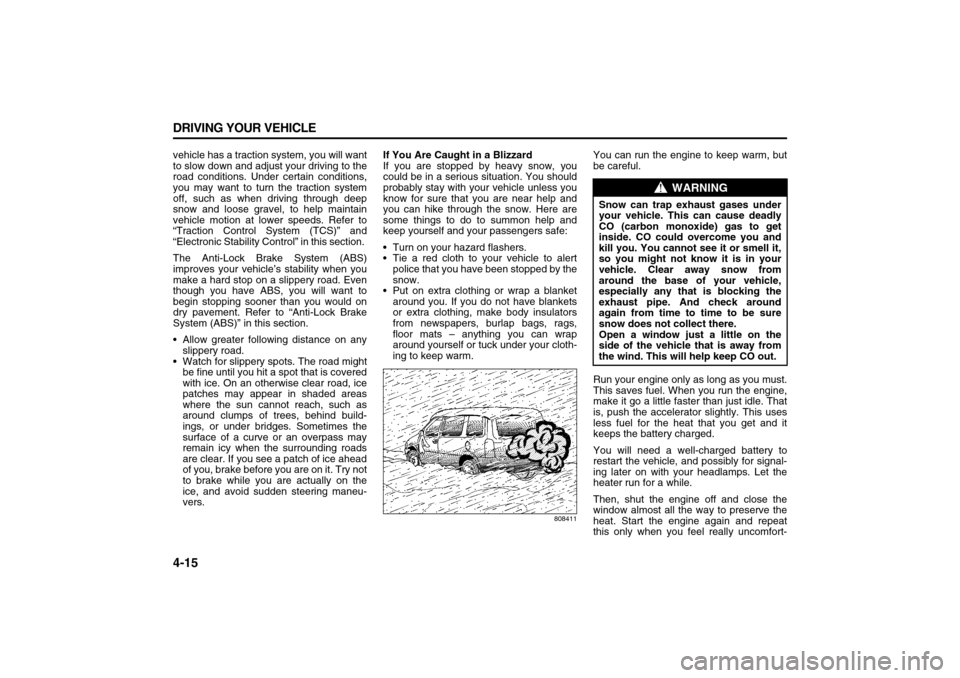
If you are stopped by heavy snow, you
could be in a serious situation. You should
probably stay with your vehicle unless you
know for sure that you are near help and
you can hike through the snow. Here are
some things to do to summon help and
keep yourself and your passengers safe:
Turn on your hazard flashers.
Tie a red cloth to your vehicle to alert
police that you have been stopped by the
snow.
Put on extra clothing or wrap a blanket
around you. If you do not have blankets
or extra clothing, make body insulators
from newspapers, burlap bags, rags,
floor mats – anything you can wrap
around yourself or tuck under your cloth-
ing to keep warm.
808411
You can run the engine to keep warm, but
be careful.
Run your engine only as long as you must.
This saves fuel. When you run the engine,
make it go a little faster than just idle. That
is, push the accelerator slightly. This uses
less fuel for the heat that you get and it
keeps the battery charged.
You will need a well-charged battery to
restart the vehicle, and possibly for signal-
ing later on with your headlamps. Let the
heater run for a while.
Then, shut the engine off and close the
window almost all the way to preserve the
heat. Start the engine again and repeat
this only when you feel really uncomfort-
WARNING
Snow can trap exhaust gases under
your vehicle. This can cause deadly
CO (carbon monoxide) gas to get
inside. CO could overcome you and
kill you. You cannot see it or smell it,
so you might not know it is in your
vehicle. Clear away snow from
around the base of your vehicle,
especially any that is blocking the
exhaust pipe. And check around
again from time to time to be sure
snow does not collect there.
Open a window just a little on the
side of the vehicle that is away from
the wind. This will help keep CO out.
Page 178 of 274

4-20 DRIVING YOUR VEHICLE
78J00-03E
TowingTowing Your VehicleConsult your dealer or a professional tow-
ing service if you need to have your dis-
abled vehicle towed.
If you want to tow your vehicle behind
another vehicle for recreational purposes
(such as behind a motorhome), refer to
“Recreational Vehicle Towing” following.Recreational Vehicle TowingRecreational vehicle towing means towing
your vehicle behind another vehicle – such
as behind a motorhome. The two most
common types of recreational vehicle tow-
ing are known as “dinghy towing” (towing
your vehicle with all four wheels on the
ground) and “dolly towing” (towing your
vehicle with two wheels on the ground and
two wheels up on a device known as a
“dolly”).
With the proper preparation and equip-
ment, many vehicles can be towed in these
ways. See “Dinghy Towing” and “Dolly Tow-
ing”, following.
Here are some important things to con-
sider before you do recreational vehicle
towing:
What’s the towing capacity of the towing
vehicle? Be sure you read the tow vehi-
cle manufacturer’s recommendations. How far will you tow? Some vehicles
have restrictions on how far and how
long they can tow.
Do you have the proper towing equip-
ment? See your dealer or trailering pro-
fessional for additional advice and
equipment recommendations.
Is your vehicle ready to be towed? Just
as you would prepare your vehicle for a
long trip, you’ll want to make sure your
vehicle is prepared to be towed. Refer to
“Before Leaving on a Long Trip” in this
section.
Dinghy Towing
If you have an all-wheel-drive vehicle or a
front-wheel-drive vehicle, it was not
designed to be towed with all of its wheels
on the ground. It can be towed with car
carrier equipment. If you have a front-wheel-drive vehicle, it can be towed with its
two front wheels off the ground. See “Dolly
Towing” following.
Dolly Towing
If you have a front-wheel-drive vehicle, it
can be towed with the two front wheels off
the ground. To dolly tow your vehicle, do
the following:
1) Put the front wheels on a dolly.
2) Put the vehicle in PARK (P).
3) Set the parking brake and then remove
the key.
4) Clamp the steering wheel in a straight-
ahead position with a clamping device
designed for towing.
5) Release the parking brake.
If you have an all-wheel-drive vehicle, it
cannot be towed with any of its wheels on
CAUTION
Towing an all-wheel-drive vehicle
with all four wheels or even only two
wheels on the ground will damage
drivetrain or transmission compo-
nents. Towing a front-wheel-drive
vehicle with all four wheels on the
ground will damage drivetrain or
transmission components. Do not
tow an all-wheel-drive vehicle with
two or four wheels on the ground or a
front-wheel-drive vehicle if all four
wheels will be on the ground.
CAUTION
Towing an all-wheel-drive vehicle
with all four wheels or even only two
wheels on the ground will damage
drivetrain or transmission compo-
nents. Towing a front-wheel-drive
vehicle with all four wheels on the
ground will damage drivetrain or
transmission components. Do not
tow an all-wheel-drive vehicle with
two or four wheels on the ground or a
front-wheel-drive vehicle if all four
wheels will be on the ground.
Page 179 of 274

4-21 DRIVING YOUR VEHICLE
78J00-03E
the ground. It can be towed with car carrier
equipment.Level ControlYour vehicle may have this feature. This
self-adjusting type of level control is fully
automatic and will provide a better leveled
riding position as well as better handling
under a variety of passenger and loading
conditions. The system is activated when
sufficient weight is added to the vehicle,
and will automatically adjust vehicle height
thereafter. A hydraulic pump inside each
rear shock absorber raises the rear of the
vehicle to the proper height, based on
inputs from the road surface, while the
vehicle is being driven. It takes approxi-
mately two miles (3.2 km) of driving for the
leveling to complete, depending on the
road surface conditions.
If the loaded vehicle is not moved for
approximately twelve hours, the leveling
system may bleed down to a lower height.
This can be especially apparent if a trailer
is left attached to a parked vehicle for long
periods of time. The vehicle must be driven
to re-level the vehicle. If a self-equalizing
hitch is being used, the vehicle should be
driven approximately two miles (3.2 km)
with the trailer prior to adjusting (leveling)
the hitch.
Towing a TrailerTo identify the trailering capacity of your
vehicle, you should read the information in
“Weight of the Trailer” that appears later in
this section. Trailering is different than just
driving your vehicle by itself. Trailering
means changes in handling, acceleration,
braking, durability, and fuel economy. Suc-cessful, safe trailering takes correct equip-
ment, and it has to be used properly.
That is the reason for this section. In it are
many time-tested, important trailering tips
and safety rules. Many of these are impor-
tant for your safety and that of your pas-
sengers. So please read this section
carefully before you pull a trailer.
If You Do Decide To Pull A Trailer
If you do, here are some important points:
There are many different laws, including
speed limit restrictions, having to do with
trailering. Make sure your rig will be
legal, not only where you live but also
where you will be driving. A good source
for this information can be state or pro-
vincial police.
Consider using a sway control. Refer to
“Hitches” later in this section.
Do not tow a trailer at all during the first
500 miles (800 km) your new vehicle is
driven. Your engine, axle or other parts
could be damaged.
During the first 500 miles (800 km) that
you tow a trailer, do not drive over 50
mph (80 km/h) and do not make starts at
full throttle. This helps your engine and
other parts of your vehicle wear in at the
heavier loads.
WARNING
If you do not use the correct equip-
ment and drive properly, you can lose
control when you pull a trailer. For
example, if the trailer is too heavy,
the brakes may not work well – or
even at all. You and your passengers
could be seriously injured. Pull a
trailer only if you have followed all
the steps in this section. Ask your
dealer for advice and information
about towing a trailer with your vehi-
cle.
CAUTION
Pulling a trailer improperly can dam-
age your vehicle and result in costly
repairs that would not be covered by
your warranty. Always follow the
instructions in this section and check
with your dealer for more information
about towing a trailer with your vehi-
cle.
Page 181 of 274

4-23 DRIVING YOUR VEHICLE
78J00-03E
Will you have to make any holes in the
body of your vehicle when you install a
trailer hitch?
If you do, remember to seal the holes
when you remove the hitch. If you do not
seal them, deadly carbon monoxide
(CO) from your exhaust can get into your
vehicle. Refer to “Engine Exhaust” in
“Starting and Operating Your Vehicle” in
the “Features and Controls” section. Dirt
and water can, too.
Safety Chains
You should always attach chains between
your vehicle and your trailer. Cross the
safety chains under the tongue of the
trailer to help prevent the tongue from con-
tacting the road if it becomes separated
from the hitch. Instructions about safety
chains may be provided by the hitch manu-
facturer or by the trailer manufacturer. Fol-
low the manufacturer’s recommendation
for attaching safety chains and do not
attach them to the bumper. Always leave
just enough slack so you can turn with your
rig. Never allow safety chains to drag on
the ground.
Trailer Brakes
If your trailer weighs more than 1000 lbs
(450 kg) loaded, then it needs its own
brakes, and they must be adequate. Be
sure to read and follow the instructions for
the trailer brakes so you will be able to
install, adjust and maintain them properly.Because your vehicle has anti-lock brakes,
do not try to tap into your vehicle’s brake
system. If you do, both brake systems will
not work well, or at all.Driving with a Trailer
Towing a trailer requires a certain amount
of experience. Before setting out for the
open road, you will want to get to know
WARNING
If you have the liftgate open and you
pull a trailer with your vehicle, carbon
monoxide (CO) could come into your
vehicle. You cannot see or smell CO.
It can cause unconsciousness or
death. Refer to “Engine Exhaust” in
“Starting and Operating Your Vehi-
cle” in the “Features and Controls”
section. To maximize your safety
when towing a trailer:
Have your exhaust system
inspected for leaks, and make nec-
essary repairs before starting on
your trip.
Keep the liftgate closed.
If exhaust does come into your
vehicle through a window in the
rear or another opening, drive with
your front, main heating or cooling
system on and with the fan on any
speed. This will bring fresh, out-
side air into your vehicle. Do not
use the climate control setting for
maximum air because it only recir-
culates the air inside your vehicle.
Refer to “Automatic Climate Con-
trol System” in “Climate Controls”
in the “Instrument Panel” section.
Page 182 of 274

4-24 DRIVING YOUR VEHICLE
78J00-03E
your rig. Acquaint yourself with the feel of
handling and braking with the added
weight of the trailer. And always keep in
mind that the vehicle you are driving is now
a good deal longer and not nearly as
responsive as your vehicle is by itself.
Before you start, check all trailer hitch
parts and attachments, safety chains, elec-
trical connector, lamps, tires and mirror
adjustment. If the trailer has electric
brakes, start your vehicle and trailer mov-
ing and then apply the trailer brake control-
ler by hand to be sure the brakes are
working. This lets you check your electrical
connection at the same time.
During your trip, check occasionally to be
sure that the load is secure, and that the
lamps and any trailer brakes are still work-
ing.
Following Distance
Stay at least twice as far behind the vehicle
ahead as you would when driving your
vehicle without a trailer. This can help you
avoid situations that require heavy braking
and sudden turns.
Passing
You will need more passing distance up
ahead when you are towing a trailer. And,
because you are a good deal longer, you
will need to go much farther beyond the
passed vehicle before you can return to
your lane.Backing Up
Hold the bottom of the steering wheel with
one hand. Then, to move the trailer to the
left, just move that hand to the left. To
move the trailer to the right, move your
hand to the right. Always back up slowly
and, if possible, have someone guide you.
Making Turns
When you are turning with a trailer, make
wider turns than normal. Do this so your
trailer will not strike soft shoulders, curbs,
road signs, trees or other objects. Avoid
jerky or sudden maneuvers. Signal well in
advance.
Turn Signals When Towing a Trailer
When you tow a trailer, your vehicle has to
have extra wiring.
The arrows on your instrument panel will
flash whenever you signal a turn or lane
change. Properly hooked up, the trailer
lamps will also flash, telling other drivers
you are about to turn, change lanes or
stop.When towing a trailer, the arrows on your
instrument panel will flash for turns even if
the bulbs on the trailer are burned out.
Thus, you may think drivers behind you are
seeing your signal when they are not. It’s
important to check occasionally to be sure
the trailer bulbs are still working.
Driving On Grades
Reduce speed and shift to a lower gear
before you start down a long or steep
downgrade. If you do not shift down, you
might have to use your brakes so much
that they would get hot and no longer work
well.
Parking on Hills
But if you ever have to park your rig on a
hill, do the following:
1) Apply your regular brakes, but do not
shift into PARK (P) yet.
2) Have someone place chocks under the
trailer wheels.
3) When the wheel chocks are in place,
release the regular brakes until the
chocks absorb the load.
CAUTION
Making very sharp turns while traile-
ring could cause the trailer to come
in contact with the vehicle. Your vehi-
cle could be damaged. Avoid making
very sharp turns while trailering.
WARNING
You really should not park your vehi-
cle, with a trailer attached, on a hill. If
something goes wrong, your rig
could start to move. People can be
injured, and both your vehicle and
the trailer can be damaged.
Page 183 of 274

4-25 DRIVING YOUR VEHICLE
78J00-03E
4) Reapply the regular brakes. Then apply
your parking brake, and then shift to
PARK (P).
5) Release the regular brakes.
When You Are Ready to Leave After
Parking on a Hill
1) Apply your regular brakes and hold the
pedal down while you do the following:
1. Start your engine.
2. Shift into a gear.
3. Release the parking brake.
2) Let up on the brake pedal.
3) Drive slowly until the trailer is clear of
the chocks.
4) Stop and have someone pick up and
store the chocks.
Maintenance When Trailer Towing
Your vehicle will need service more often
when you are pulling a trailer. See the
Maintenance Schedule for more on this.
Things that are especially important in
trailer operation are automatic transaxle
fluid, engine oil, belts, cooling system and
brake system. Each of these is covered in
this manual, and the Index will help you
find them quickly. If you are trailering, it is a
good idea to review these sections before
you start your trip.
Check periodically to see that all hitch nuts
and bolts are tight.
Page 185 of 274

5-1 SERVICE AND APPEARANCE CARE
78J00-03E
ServiceYour dealer knows your vehicle best and
wants you to be happy with it. We hope
you will go to your dealer for all your ser-
vice and parts needs.Accessories and ModificationsWhen you add non-Suzuki accessories to
your vehicle they can affect your vehicle’s
performance and safety, including such
things as, airbags, braking, stability, ride
and handling, emissions systems, aerody-
namics, durability, and electronic systems
like anti-lock brakes, traction control, and
stability control. Some of these accesso-
ries may even cause malfunction or dam-
age not covered by warranty.
Suzuki accessories are designed to com-
plement and function with other systems
on your vehicle. Your Suzuki dealer can
accessorize your vehicle using genuine
Suzuki accessories. When you go to your
Suzuki dealer and ask for Suzuki accesso-
ries, you will know that Suzuki-trained and
supported service technicians will perform
the work using genuine Suzuki accesso-
ries.
California Proposition 65 WarningMost motor vehicles, including this one,
contain and/or emit chemicals known to
the State of California to cause cancer and
birth defects or other reproductive harm.
Engine exhaust, many parts and systems
(including some inside the vehicle), many
fluids, and some component wear by-prod-
ucts contain and/or emit these chemicals.Doing Your Own Service WorkIf you want to do some of your own service
work, you will want to use the proper ser-
vice manual. It tells you much more about
how to service your vehicle than this man-
ual can.Your vehicle has an airbag system. Before
attempting to do your own service work,
refer to “Servicing Your Airbag-Equipped
Vehicle” in “Airbag System” in the “Seats
and Restraint Systems” section.
You should keep a record with all parts
receipts and list the mileage and the date
of any service work you perform. Refer to
“Maintenance Record” in “Maintenance
Schedule” in the “Maintenance Schedule”
section.
Adding Equipment to the Outside of
Your VehicleThings you might add to the outside of
your vehicle can affect the airflow around
it. This may cause wind noise and affect
windshield washer performance. Check
with your dealer before adding equipment
to the outside of your vehicle.
WARNING
You can be injured and your vehicle
could be damaged if you try to do
service work on a vehicle without
knowing enough about it.
Be sure you have sufficient knowl-
edge, experience, the proper
replacement parts, and tools before
you attempt any vehicle mainte-
nance task.
Be sure to use the proper nuts,
bolts, and other fasteners. English
and metric fasteners can be easily
confused. If you use the wrong fas-
teners, parts can later break or fall
off. You could be hurt.