brake SUZUKI XL7 2007 2.G Service Manual
[x] Cancel search | Manufacturer: SUZUKI, Model Year: 2007, Model line: XL7, Model: SUZUKI XL7 2007 2.GPages: 274, PDF Size: 6.12 MB
Page 222 of 274
5-38 SERVICE AND APPEARANCE CARE
78J00-03E
If a front tire fails, the flat tire will create a
drag that pulls the vehicle toward that side.
Take your foot off the accelerator pedal
and grip the steering wheel firmly. Steer to
maintain lane position, and then gently
brake to a stop well out of the traffic lane.
A rear blowout, particularly on a curve,
acts much like a skid and may require the
same correction you would use in a skid. In
any rear blowout remove your foot from
the accelerator pedal. Get the vehicle
under control by steering the way you want
the vehicle to go. It may be very bumpy
and noisy, but you can still steer. Gently
brake to a stop, well off the road if possi-
ble.
If a tire goes flat, the next part shows how
to use the jacking equipment to change a
flat tire safely.
Changing a Flat TireIf a tire goes flat, avoid further tire and
wheel damage by driving slowly to a level
place. Turn on your vehicle’s hazard warn-
ing flashers. Refer to “Hazard Warning
Flashers” in “Instrument Panel Overview”
in the “Instrument Panel” section for more
information.
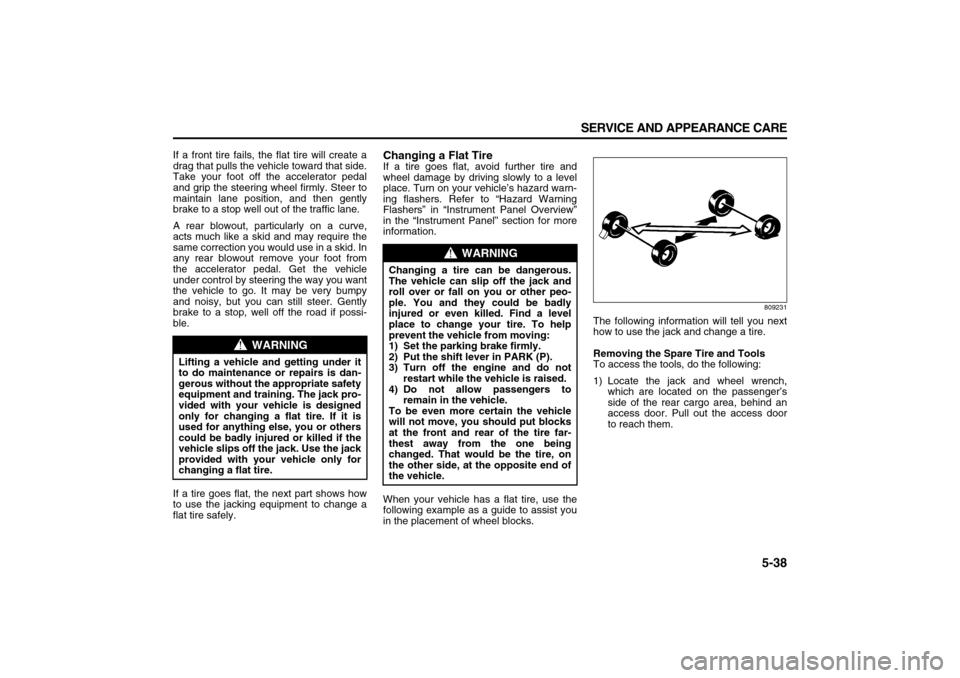
When your vehicle has a flat tire, use the
following example as a guide to assist you
in the placement of wheel blocks.
809231
The following information will tell you next
how to use the jack and change a tire.
Removing the Spare Tire and Tools
To access the tools, do the following:
1) Locate the jack and wheel wrench,
which are located on the passenger’s
side of the rear cargo area, behind an
access door. Pull out the access door
to reach them.
WARNING
Lifting a vehicle and getting under it
to do maintenance or repairs is dan-
gerous without the appropriate safety
equipment and training. The jack pro-
vided with your vehicle is designed
only for changing a flat tire. If it is
used for anything else, you or others
could be badly injured or killed if the
vehicle slips off the jack. Use the jack
provided with your vehicle only for
changing a flat tire.
WARNING
Changing a tire can be dangerous.
The vehicle can slip off the jack and
roll over or fall on you or other peo-
ple. You and they could be badly
injured or even killed. Find a level
place to change your tire. To help
prevent the vehicle from moving:
1) Set the parking brake firmly.
2) Put the shift lever in PARK (P).
3) Turn off the engine and do not
restart while the vehicle is raised.
4) Do not allow passengers to
remain in the vehicle.
To be even more certain the vehicle
will not move, you should put blocks
at the front and rear of the tire far-
thest away from the one being
changed. That would be the tire, on
the other side, at the opposite end of
the vehicle.
Page 226 of 274
5-42 SERVICE AND APPEARANCE CARE
78J00-03E
811105
9) Remove any rust or dirt from the wheel
bolts, mounting surfaces, and spare
wheel.
10)Place the compact spare tire on the
wheel-mounting surface.
11)Reinstall the wheel nuts. Tighten each
nut by hand until the wheel is held
against the hub.
1152288
12)Lower the vehicle by turning the jack
handle counterclockwise.
808642
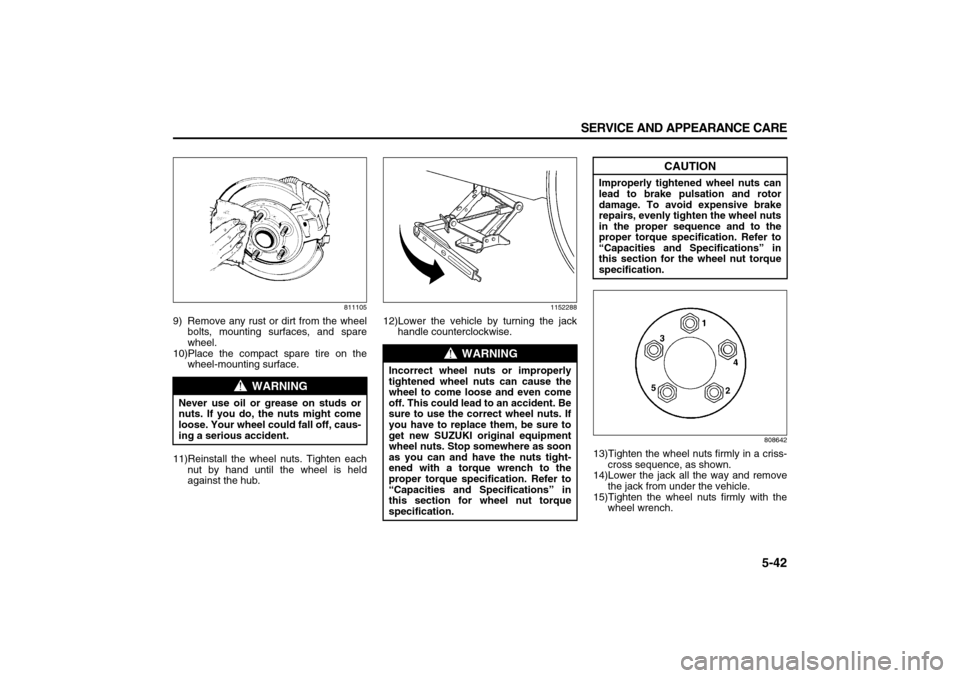
13)Tighten the wheel nuts firmly in a criss-
cross sequence, as shown.
14)Lower the jack all the way and remove
the jack from under the vehicle.
15)Tighten the wheel nuts firmly with the
wheel wrench.
WARNING
Never use oil or grease on studs or
nuts. If you do, the nuts might come
loose. Your wheel could fall off, caus-
ing a serious accident.
WARNING
Incorrect wheel nuts or improperly
tightened wheel nuts can cause the
wheel to come loose and even come
off. This could lead to an accident. Be
sure to use the correct wheel nuts. If
you have to replace them, be sure to
get new SUZUKI original equipment
wheel nuts. Stop somewhere as soon
as you can and have the nuts tight-
ened with a torque wrench to the
proper torque specification. Refer to
“Capacities and Specifications” in
this section for wheel nut torque
specification.
CAUTION
Improperly tightened wheel nuts can
lead to brake pulsation and rotor
damage. To avoid expensive brake
repairs, evenly tighten the wheel nuts
in the proper sequence and to the
proper torque specification. Refer to
“Capacities and Specifications” in
this section for the wheel nut torque
specification.
Page 239 of 274
5-55 SERVICE AND APPEARANCE CARE
78J00-03E
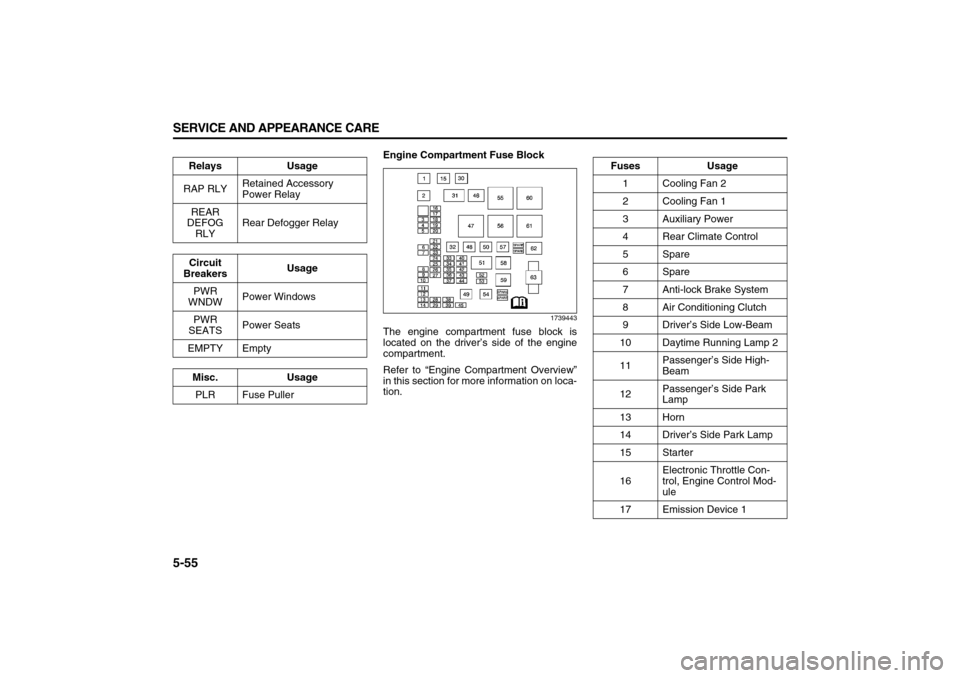
Engine Compartment Fuse Block
1739443
The engine compartment fuse block is
located on the driver’s side of the engine
compartment.
Refer to “Engine Compartment Overview”
in this section for more information on loca-
tion. Relays Usage
RAP RLYRetained Accessory
Power Relay
REAR
DEFOG
RLYRear Defogger Relay
Circuit
BreakersUsage
PWR
WNDWPower Windows
PWR
SEATSPower Seats
EMPTY Empty
Misc. Usage
PLR Fuse Puller
Fuses Usage
1 Cooling Fan 2
2 Cooling Fan 1
3 Auxiliary Power
4 Rear Climate Control
5 Spare
6 Spare
7 Anti-lock Brake System
8 Air Conditioning Clutch
9 Driver’s Side Low-Beam
10 Daytime Running Lamp 2
11Passenger’s Side High-
Beam
12Passenger’s Side Park
Lamp
13 Horn
14 Driver’s Side Park Lamp
15 Starter
16Electronic Throttle Con-
trol, Engine Control Mod-
ule
17 Emission Device 1
Page 240 of 274

5-56 SERVICE AND APPEARANCE CARE
78J00-03E
Fuses Usage
18 Even Coils, Injectors
19 Odd Coils, Injectors
20 Emission Device 2
21 Spare
22Powertrain Control Mod-
ule, Ignition
23 Transmission
24 Mass Airflow Sensor
25 Airbag Display
26 Spare
27 Stoplamp
28Passenger’s Side Low-
Beam
29 Driver’s Side High-Beam
30 Battery Main 3
32 Spare
33Engine Control Module,
Battery
34Transmission Control
Module, Battery
35 Trailer Park Lamp
36 Front Wiper
Fuses Usage
37Driver’s Side Trailer
Stoplamp, Turn Signal
38 Spare
39 Fuel Pump
40Rear Accessory Power
Outlet
41 All-Wheel Drive
42 Regulated Voltage Control
43Passenger’s Side Trailer
Stoplamp, Turn Signal
44 Spare
45 Front, Rear Washer
48 Rear Defogger
49Anti-lock Brake System
Motor
50 Battery Main 2
52 Daytime Running Lamps
53 Fog Lamps
54Climate Control System
Blower
57 Battery Main 1
63 Electric Power Steering
Relays Usage
31 Ignition Main
46Air Conditioning Compres-
sor Clutch
47 Powertrain
51 Spare
55 Crank
56 Fan 1
58Passenger’s Side Trailer
Stoplamp, Turn Signal
59Driver’s Side Trailer
Stoplamp, Turn Signal
60 Fan 3
61 Fan 2
62 Fuel Pump
Page 245 of 274

6-3 MAINTENANCE SCHEDULE
78J00-03E
Scheduled Maintenance except CANADA
Service Instruction Maintenance I Maintenance II
Change engine oil and filter. Change engine oil and filter if the light/message has not come on
at all for one year.
Refer to “Engine Oil” in “Checking Things Under the Hood” in the
“Service and Appearance Care” section.
••
Reset oil life system.
An Emission Control Service. If the system is ever reset accidentally, perform the maintenance
service within 3000 miles (5000 km) since your last service.
Refer to “Engine Oil Life System” in “Checking Things Under the
Hood” in the “Service and Appearance Care” section.
Visually check for any leaks or
damage. A fluid loss in any vehicle system could indicate a problem.
Have the system inspected and repaired and the fluid level
checked.
Add fluid if needed.••
Rotate tires and check infla-
tion pressures and wear. Rotate tires every 5000 to 8000 miles (8000 to 13000 km).
Refer to “Tire Inspection and Rotation” in “Tires” in the “Service
and Appearance Care” section and “At Least Once a Month” in
this section.••
Inspect brake system. Visually inspect brake lines and hoses for proper hook-up, bind-
ing, leaks, cracks, chafing, etc.
Inspect disc brake pads for wear and rotors for surface condition.
Inspect drum brake linings/shoes for wear or cracks (if equipped).
Inspect other brake parts, including drums, wheel cylinders, cali-
pers, parking brake, etc.
Check parking brake adjustment.••
Check engine coolant and
windshield washer fluid levels
and add fluid as needed.••
Perform any needed addi-
tional services. Refer to “Additional Required Services except CANADA” in this
section.••
Page 250 of 274

6-8 MAINTENANCE SCHEDULE
78J00-03E
For CANADA Scheduled Maintenance
Service Instruction Maintenance
Change engine oil and filter. Change engine oil and filter if the light/message has not come on at all for 10
months.
Refer to “Engine Oil” in “Checking Things Under the Hood” in the “Service and
Appearance Care” section.
•
Reset oil life system.
An Emission Control Service. If the system is ever reset accidentally, perform the maintenance service within
5000 km since your last service.
Refer to “Engine Oil Life System” in “Checking Things Under the Hood” in the “Ser-
vice and Appearance Care” section.
Visually check for any leaks or
damage. A fluid loss in any vehicle system could indicate a problem.
Have the system inspected and repaired and the fluid level checked.
Add fluid if needed.•
Rotate tires and check infla-
tion pressures and wear. Rotate tires every 8000 to 13000 km.
Refer to “Tire Inspection and Rotation” in “Tires” in the “Service and Appearance
Care” section and “At Least Once a Month” in this section.•
Inspect brake system. Visually inspect brake lines and hoses for proper hook-up, binding, leaks, cracks,
chafing, etc.
Inspect disc brake pads for wear and rotors for surface condition.
Inspect drum brake linings/shoes for wear or cracks (if equipped).
Inspect other brake parts, including drums, wheel cylinders, calipers, parking
brake, etc.
Check parking brake adjustment.•
Check engine coolant and
windshield washer fluid levels
and add fluid as needed.•
Perform any needed addi-
tional services. Refer to “Additional Required Services (For CANADA)” in this section.•
Page 255 of 274

6-13 MAINTENANCE SCHEDULE
78J00-03E
Owner Checks and ServicesThese owner checks and services should be performed at the intervals specified to help ensure the safety, dependability, and emission
control performance of your vehicle. Your dealer can assist you with these checks and services.
Be sure any necessary repairs are completed at once. Whenever any fluids or lubricants are added to your vehicle, make sure they are
the proper ones, as shown in “Recommended Fluids and Lubricants” in this section.
Check and Service Instruction Timing
Engine oil level check
Refer to “At Each Fuel Fill” in this section At each fuel fill Engine coolant level check
Windshield washer fluid level check
Tire inflation check
Refer to “At Least Once a Month” in this section At least once a month
Tire wear inspection
Starter switch check
Refer to “At Least Once a Year” in this section At least once a year Autimatic transaxle shift lock control system
check
Ignition transaxle lock check
Parking brake and automatic transaxle park (P)
mechanism check
Underbody flushing service
Page 256 of 274
6-14 MAINTENANCE SCHEDULE
78J00-03E
At Each Fuel FillIt is important to perform these underhood
checks at each fuel fill.
Engine Oil Level Check
Check the engine oil level and add the
proper oil if necessary. Refer to “Engine
Oil” in “Checking Things Under the Hood”
in the “Service and Appearance Care” sec-
tion for further details.
Engine Coolant Level Check
Check the engine coolant level and add
DEX-COOL
® coolant mixture if necessary.
Refer to “Engine Coolant” in “Checking
Things Under the Hood” in the “Service
and Appearance Care” section for further
details.
Windshield Washer Fluid Level Check
Check the windshield washer fluid level in
the windshield washer fluid reservoir and
add the proper fluid if necessary.
At Least Once a MonthTire Inflation Check
Visually inspect your vehicle’s tires and
make sure they are inflated to the correct
pressures. Do not forget to check the
spare tire. Open the driver’s door to find
the Tire Information Placard which lists the
recommended tire inflation pressures.
Check to make sure the spare tire is stored
securely. Refer to “Changing a Flat Tire” in
“Tires” in the “Service and Appearance
Care” section.
Tire Wear Inspection
Tire rotation may be required for high mile-
age highway drivers prior to the Engine Oil
Life System service notification. Check the
tires for wear and, if necessary, rotate the
tires. Refer to “Tire Inspection and Rota-
tion” in “Tires” in the “Service and Appear-
ance Care” section.
At Least Once a YearStarter Switch Check
1) Before you start, be sure you have
enough room around the vehicle.
2) Firmly apply both the parking brake and
the regular brake. Refer to “Parking
Brake” in “Starting and Operating Your
Vehicle” in the “Features and Controls”
section.
Do not use the accelerator pedal, and
be ready to turn off the engine immedi-
ately if it starts.
3) Try to start the engine in each gear.
The vehicle should start only in PARK
(P) or NEUTRAL (N). If the vehicle
starts in any other position, contact
your dealer for service.
CAUTION
It is important to check the engine oil
regularly and keep it at the proper
level. Failure to keep the engine oil at
the proper level can cause damage to
the engine not covered by your war-
ranty.
WARNING
When you are doing this inspection,
the vehicle could move suddenly. If
the vehicle moves, you or others
could be injured.
Page 257 of 274
6-15 MAINTENANCE SCHEDULE
78J00-03E
Automatic Transaxle Shift Lock Control
System Check
1) Before you start, be sure you have
enough room around the vehicle. It
should be parked on a level surface.
2) Firmly apply the parking brake. Refer to
“Parking Brake” in “Starting and Oper-
ating Your Vehicle” in the “Features
and Controls” section.
Be ready to apply the regular brake
immediately if the vehicle begins to
move.
3) With the engine off, turn the ignition to
RUN, but do not start the engine. With-
out applying the regular brake, try to
move the shift lever out of PARK (P)
with normal effort. If the shift lever
moves out of PARK (P), contact your
dealer for service.Ignition Transaxle Lock Check
While parked, and with the parking brake
set, try to turn the ignition to LOCK in each
shift lever position.
The ignition should turn to LOCK only
when the shift lever is in PARK (P).
The ignition key should come out only in
LOCK.
Contact your dealer if service is required.
Parking Brake and Automatic Transaxle
Park (P) Mechanism Check
Park on a fairly steep hill, with the vehicle
facing downhill. Keeping your foot on the
regular brake, set the parking brake.
To check the parking brake’s holding
ability: With the engine running and tran-
saxle in NEUTRAL (N), slowly remove
foot pressure from the regular brake
pedal. Do this until the vehicle is held by
the parking brake only. To check the PARK (P) mechanism’s
holding ability: With the engine running,
shift to PARK (P). Then release the
parking brake followed by the regular
brake.
Contact your dealer if service is required.
Underbody Flushing Service
At least every spring, use plain water to
flush any corrosive materials such as win-
ter road salt from the underbody. Take
care to clean thoroughly any areas where
mud and other debris can collect.
WARNING
When you are doing this inspection,
the vehicle could move suddenly. If
the vehicle moves, you or others
could be injured.
WARNING
When you are doing this check, your
vehicle could begin to move. You or
others could be injured and property
could be damaged. Make sure there
is room in front of your vehicle in
case it begins to roll. Be ready to
apply the regular brake at once
should the vehicle begin to move.
Page 258 of 274

6-16 MAINTENANCE SCHEDULE
78J00-03E
Recommended Fluids and LubricantsFluids and lubricants identified below by name, part number, or specification can be obtained from your dealer.
Usage Fluid/Lubricant
Engine OilEngine oil which meets Standard GM6094M and displays the American Petroleum Institute Certi-
fied for Gasoline Engines starburst symbol. The proper viscosity for your vehicle’s engine is an
SAE 5W-30 synthetic oil or an SAE 0W-30 oil.
Engine Coolant 50/50 mixture of clean, drinkable water and use only DEX-COOL
® Coolant.
Hydraulic Brake System Delco
® Supreme 11 Brake Fluid or equivalent DOT-3 brake fluid.
Automatic Transaxle Use only T-IV Automatic Transmission Fluid (Part No. SUZUKI ATF 3317 or Mobil ATF 3309).
Hood Latch Assembly,
Secondary Latch, Pivots, Spring
Anchor, and Release PawlLubricate Aerosol type lubricant meeting requirements of NLGI #2, Category LB or GC-LB.
Key Lock Cylinders, Hood and
Door Hinges,
Rear Folding SeatMulti-Purpose Lubricant, Superlube.
Weatherstrip Conditioning Weatherstrip Lubricant or Dielectric Silicone Grease.