tow SUZUKI XL7 2007 2.G Owner's Guide
[x] Cancel search | Manufacturer: SUZUKI, Model Year: 2007, Model line: XL7, Model: SUZUKI XL7 2007 2.GPages: 274, PDF Size: 6.12 MB
Page 197 of 274
5-13 SERVICE AND APPEARANCE CARE
78J00-03E
If No Steam Is Coming From Your
Engine
If you get an engine overheat warning, but
see or hear no steam, the problem may not
be too serious. Sometimes the engine can
get a little too hot when you:
Climb a long hill on a hot day.
Stop after high-speed driving.
Idle for long periods in traffic.
Tow a trailer.
If you get the overheat warning with no
sign of steam, try this for a minute or so:
1) In heavy traffic, let the engine idle in
NEUTRAL (N) while stopped. If it is
safe to do so, pull off the road, shift to
PARK (P) or NEUTRAL (N) and let the
engine idle.
2) Set the climate controls to the highest
heat setting and fan speed and open
the windows as necessary.If you no longer have the overheat warn-
ing, you can drive. Just to be safe, drive
slower for about 10 minutes. If the warning
does not come back on, you can drive nor-
mally.
If the warning continues and you have not
stopped, pull over, stop, and park your
vehicle right away.
If there is still no sign of steam, you can
idle the engine for three minutes while you
are parked. If you still have the warning,
turn off the engine and get everyone out of
the vehicle until it cools down. Also, see
“Overheated Engine Protection Operating
Mode” later in this section.
You may decide not to lift the hood but to
get service help right away.
Overheated Engine Protection Operat-
ing Mode
This emergency operating mode allows
your vehicle to be driven to a safe place in
an emergency situation. If an overheated
engine condition exists, an overheat pro-
tection mode which alternates firing groups
of cylinders helps prevent engine damage.
In this mode, you will notice a significant
loss in power and engine performance.
The engine coolant temperature warning
light on the instrument panel will come on
to indicate the vehicle has entered over-
heated engine protection operating mode.
The temperature gage will also indicate an
overheat condition exists. Drivingextended miles (km) and/or towing a trailer
in the overheat protection mode should be
avoided.
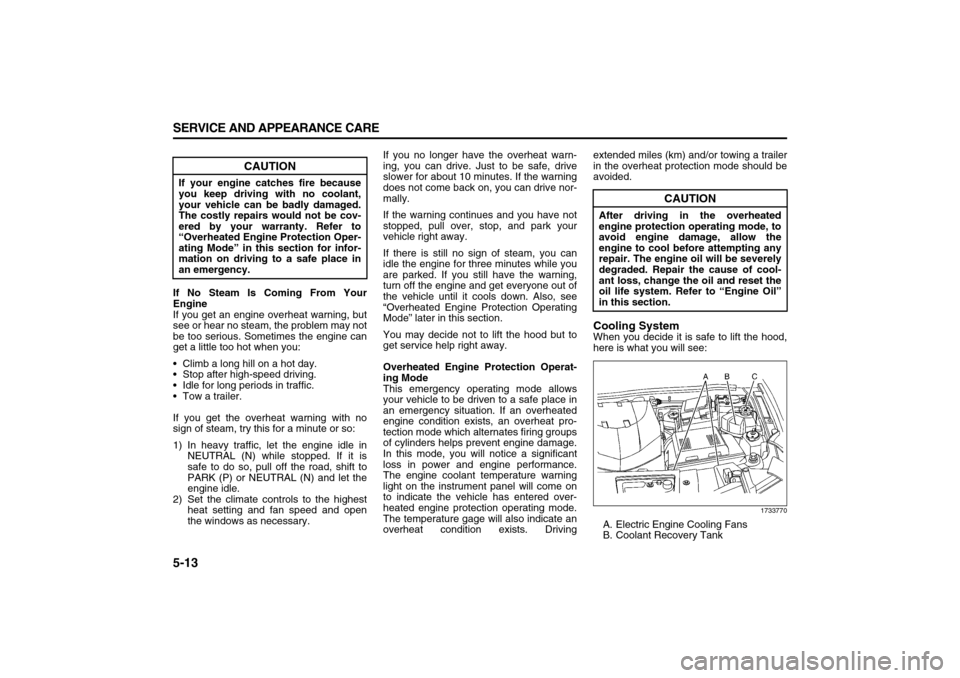
Cooling SystemWhen you decide it is safe to lift the hood,
here is what you will see:
1733770
A. Electric Engine Cooling Fans
B. Coolant Recovery Tank
CAUTION
If your engine catches fire because
you keep driving with no coolant,
your vehicle can be badly damaged.
The costly repairs would not be cov-
ered by your warranty. Refer to
“Overheated Engine Protection Oper-
ating Mode” in this section for infor-
mation on driving to a safe place in
an emergency.
CAUTION
After driving in the overheated
engine protection operating mode, to
avoid engine damage, allow the
engine to cool before attempting any
repair. The engine oil will be severely
degraded. Repair the cause of cool-
ant loss, change the oil and reset the
oil life system. Refer to “Engine Oil”
in this section.
Page 208 of 274
5-24 SERVICE AND APPEARANCE CARE
78J00-03E
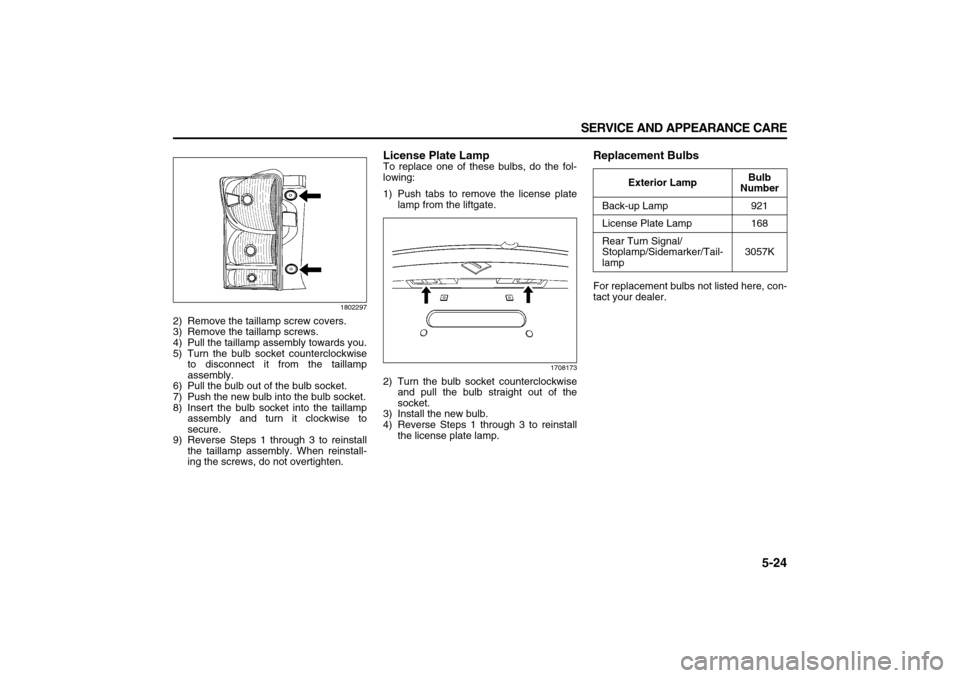
1802297
2) Remove the taillamp screw covers.
3) Remove the taillamp screws.
4) Pull the taillamp assembly towards you.
5) Turn the bulb socket counterclockwise
to disconnect it from the taillamp
assembly.
6) Pull the bulb out of the bulb socket.
7) Push the new bulb into the bulb socket.
8) Insert the bulb socket into the taillamp
assembly and turn it clockwise to
secure.
9) Reverse Steps 1 through 3 to reinstall
the taillamp assembly. When reinstall-
ing the screws, do not overtighten.
License Plate LampTo replace one of these bulbs, do the fol-
lowing:
1) Push tabs to remove the license plate
lamp from the liftgate.
1708173
2) Turn the bulb socket counterclockwise
and pull the bulb straight out of the
socket.
3) Install the new bulb.
4) Reverse Steps 1 through 3 to reinstall
the license plate lamp.
Replacement BulbsFor replacement bulbs not listed here, con-
tact your dealer.
Exterior LampBulb
Number
Back-up Lamp 921
License Plate Lamp 168
Rear Turn Signal/
Stoplamp/Sidemarker/Tail-
lamp3057K
Page 209 of 274
5-25 SERVICE AND APPEARANCE CARE
78J00-03E
Windshield Wiper Blade
ReplacementWindshield wiper blades should be
inspected for wear or cracking. Refer to
“Scheduled Maintenance” in “Mainte-
nance Schedule” in the “Maintenance
Schedule” section for more information.
Replacement blades come in different
types and are removed in different ways.
For proper type and length, refer to “Nor-
mal Maintenance Replacement Parts” in
“Maintenance Schedule” in the “Mainte-
nance Schedule” section.
Here’s how to replace the windshield wiper
blades:
1) Make sure the front wipers are turned
off.
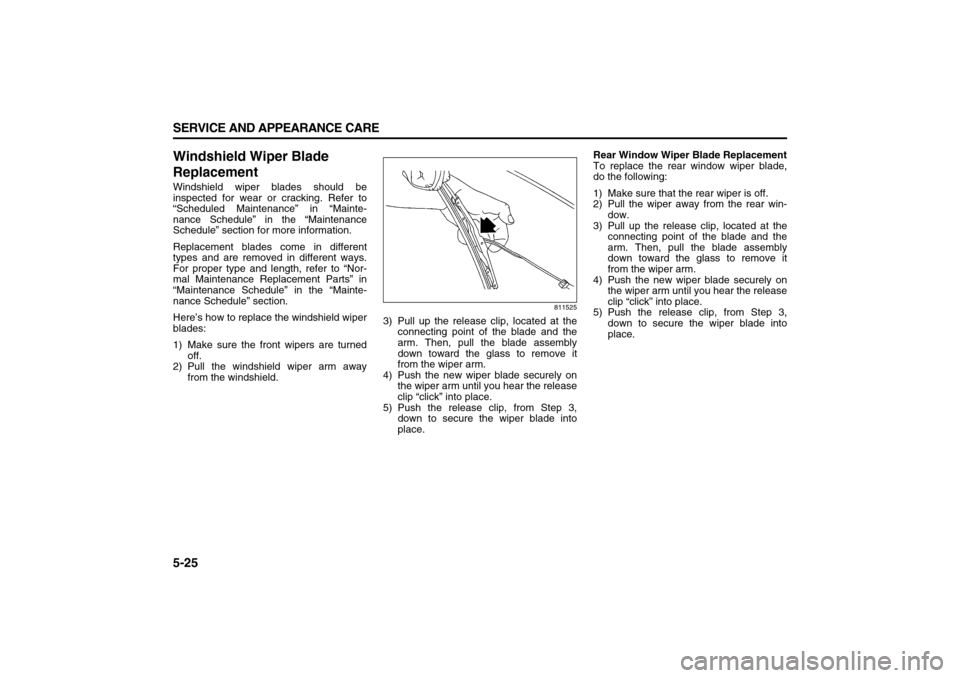
2) Pull the windshield wiper arm away
from the windshield.
811525
3) Pull up the release clip, located at the
connecting point of the blade and the
arm. Then, pull the blade assembly
down toward the glass to remove it
from the wiper arm.
4) Push the new wiper blade securely on
the wiper arm until you hear the release
clip “click” into place.
5) Push the release clip, from Step 3,
down to secure the wiper blade into
place.Rear Window Wiper Blade Replacement
To replace the rear window wiper blade,
do the following:
1) Make sure that the rear wiper is off.
2) Pull the wiper away from the rear win-
dow.
3) Pull up the release clip, located at the
connecting point of the blade and the
arm. Then, pull the blade assembly
down toward the glass to remove it
from the wiper arm.
4) Push the new wiper blade securely on
the wiper arm until you hear the release
clip “click” into place.
5) Push the release clip, from Step 3,
down to secure the wiper blade into
place.
Page 218 of 274
5-34 SERVICE AND APPEARANCE CARE
78J00-03E
Reset the Tire Pressure Monitor System.
Refer to “TPMS Sensor Matching Process”
under “Tire Pressure Monitor System” in
this section.
Make certain that all wheel nuts are prop-
erly tightened. Refer to “Wheel Nut
Torque” under “Capacities and Specifica-
tions” in this section.
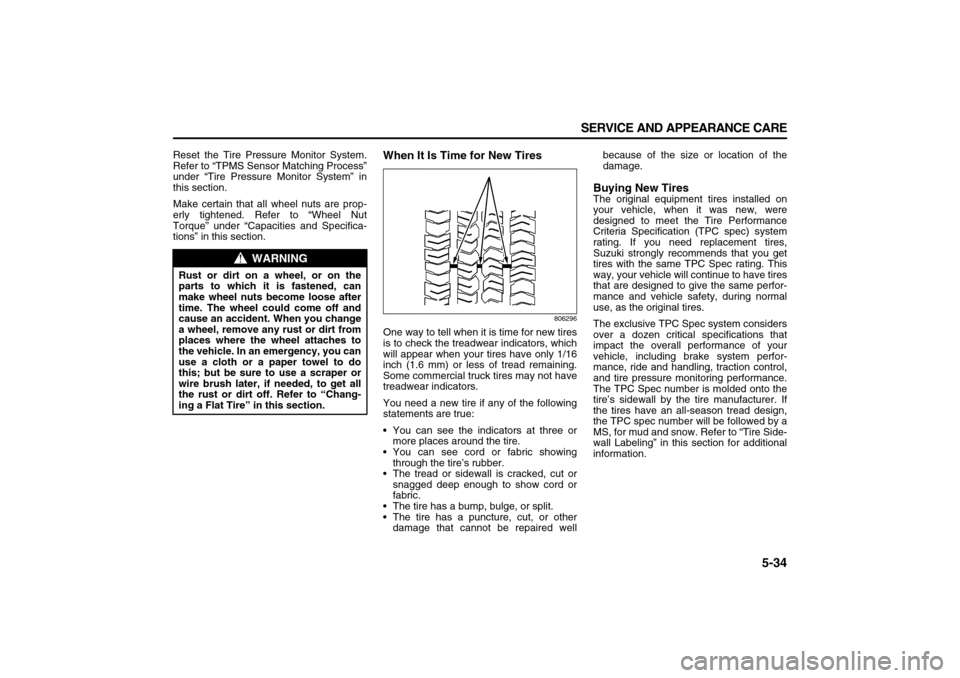
When It Is Time for New Tires
806296
One way to tell when it is time for new tires
is to check the treadwear indicators, which
will appear when your tires have only 1/16
inch (1.6 mm) or less of tread remaining.
Some commercial truck tires may not have
treadwear indicators.
You need a new tire if any of the following
statements are true:
You can see the indicators at three or
more places around the tire.
You can see cord or fabric showing
through the tire’s rubber.
The tread or sidewall is cracked, cut or
snagged deep enough to show cord or
fabric.
The tire has a bump, bulge, or split.
The tire has a puncture, cut, or other
damage that cannot be repaired wellbecause of the size or location of the
damage.
Buying New TiresThe original equipment tires installed on
your vehicle, when it was new, were
designed to meet the Tire Performance
Criteria Specification (TPC spec) system
rating. If you need replacement tires,
Suzuki strongly recommends that you get
tires with the same TPC Spec rating. This
way, your vehicle will continue to have tires
that are designed to give the same perfor-
mance and vehicle safety, during normal
use, as the original tires.
The exclusive TPC Spec system considers
over a dozen critical specifications that
impact the overall performance of your
vehicle, including brake system perfor-
mance, ride and handling, traction control,
and tire pressure monitoring performance.
The TPC Spec number is molded onto the
tire’s sidewall by the tire manufacturer. If
the tires have an all-season tread design,
the TPC spec number will be followed by a
MS, for mud and snow. Refer to “Tire Side-
wall Labeling” in this section for additional
information.
WARNING
Rust or dirt on a wheel, or on the
parts to which it is fastened, can
make wheel nuts become loose after
time. The wheel could come off and
cause an accident. When you change
a wheel, remove any rust or dirt from
places where the wheel attaches to
the vehicle. In an emergency, you can
use a cloth or a paper towel to do
this; but be sure to use a scraper or
wire brush later, if needed, to get all
the rust or dirt off. Refer to “Chang-
ing a Flat Tire” in this section.
Page 222 of 274
5-38 SERVICE AND APPEARANCE CARE
78J00-03E
If a front tire fails, the flat tire will create a
drag that pulls the vehicle toward that side.
Take your foot off the accelerator pedal
and grip the steering wheel firmly. Steer to
maintain lane position, and then gently
brake to a stop well out of the traffic lane.
A rear blowout, particularly on a curve,
acts much like a skid and may require the
same correction you would use in a skid. In
any rear blowout remove your foot from
the accelerator pedal. Get the vehicle
under control by steering the way you want
the vehicle to go. It may be very bumpy
and noisy, but you can still steer. Gently
brake to a stop, well off the road if possi-
ble.
If a tire goes flat, the next part shows how
to use the jacking equipment to change a
flat tire safely.
Changing a Flat TireIf a tire goes flat, avoid further tire and
wheel damage by driving slowly to a level
place. Turn on your vehicle’s hazard warn-
ing flashers. Refer to “Hazard Warning
Flashers” in “Instrument Panel Overview”
in the “Instrument Panel” section for more
information.
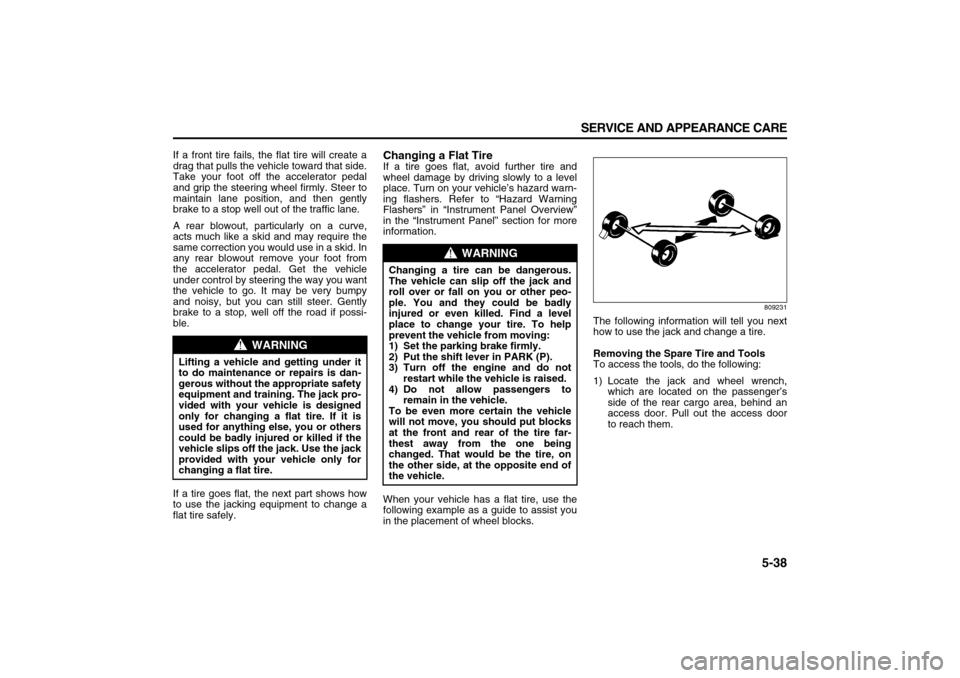
When your vehicle has a flat tire, use the
following example as a guide to assist you
in the placement of wheel blocks.
809231
The following information will tell you next
how to use the jack and change a tire.
Removing the Spare Tire and Tools
To access the tools, do the following:
1) Locate the jack and wheel wrench,
which are located on the passenger’s
side of the rear cargo area, behind an
access door. Pull out the access door
to reach them.
WARNING
Lifting a vehicle and getting under it
to do maintenance or repairs is dan-
gerous without the appropriate safety
equipment and training. The jack pro-
vided with your vehicle is designed
only for changing a flat tire. If it is
used for anything else, you or others
could be badly injured or killed if the
vehicle slips off the jack. Use the jack
provided with your vehicle only for
changing a flat tire.
WARNING
Changing a tire can be dangerous.
The vehicle can slip off the jack and
roll over or fall on you or other peo-
ple. You and they could be badly
injured or even killed. Find a level
place to change your tire. To help
prevent the vehicle from moving:
1) Set the parking brake firmly.
2) Put the shift lever in PARK (P).
3) Turn off the engine and do not
restart while the vehicle is raised.
4) Do not allow passengers to
remain in the vehicle.
To be even more certain the vehicle
will not move, you should put blocks
at the front and rear of the tire far-
thest away from the one being
changed. That would be the tire, on
the other side, at the opposite end of
the vehicle.
Page 223 of 274
5-39 SERVICE AND APPEARANCE CARE
78J00-03E
1399885
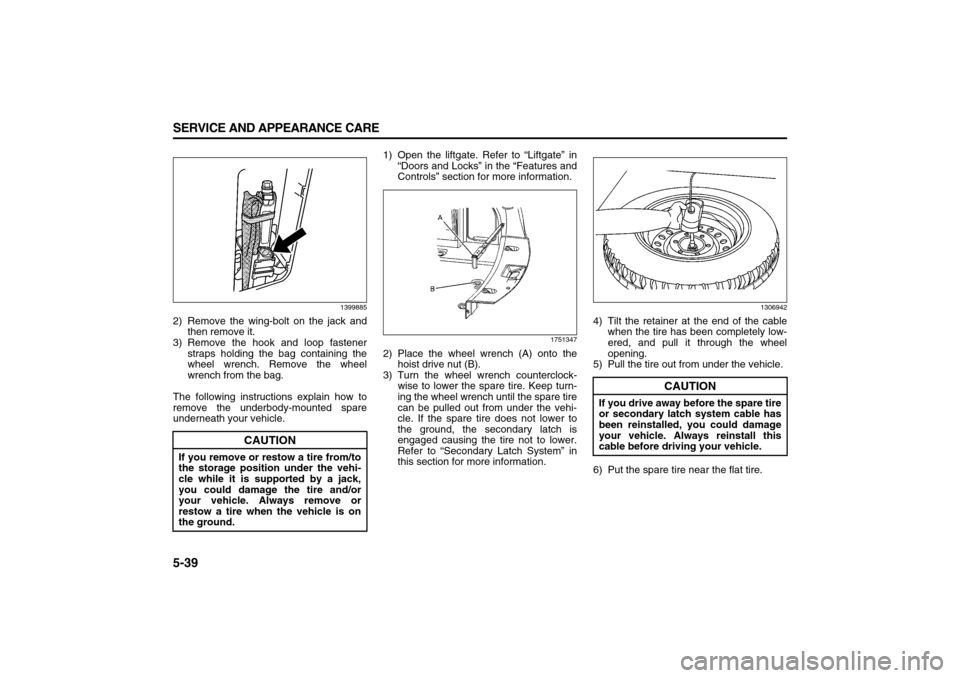
2) Remove the wing-bolt on the jack and
then remove it.
3) Remove the hook and loop fastener
straps holding the bag containing the
wheel wrench. Remove the wheel
wrench from the bag.
The following instructions explain how to
remove the underbody-mounted spare
underneath your vehicle.1) Open the liftgate. Refer to “Liftgate” in
“Doors and Locks” in the “Features and
Controls” section for more information.
1751347
2) Place the wheel wrench (A) onto the
hoist drive nut (B).
3) Turn the wheel wrench counterclock-
wise to lower the spare tire. Keep turn-
ing the wheel wrench until the spare tire
can be pulled out from under the vehi-
cle. If the spare tire does not lower to
the ground, the secondary latch is
engaged causing the tire not to lower.
Refer to “Secondary Latch System” in
this section for more information.
1306942
4) Tilt the retainer at the end of the cable
when the tire has been completely low-
ered, and pull it through the wheel
opening.
5) Pull the tire out from under the vehicle.
6) Put the spare tire near the flat tire.
CAUTION
If you remove or restow a tire from/to
the storage position under the vehi-
cle while it is supported by a jack,
you could damage the tire and/or
your vehicle. Always remove or
restow a tire when the vehicle is on
the ground.
CAUTION
If you drive away before the spare tire
or secondary latch system cable has
been reinstalled, you could damage
your vehicle. Always reinstall this
cable before driving your vehicle.
Page 225 of 274
5-41 SERVICE AND APPEARANCE CARE
78J00-03E
5) Put the compact spare tire near the flat
tire.
988777
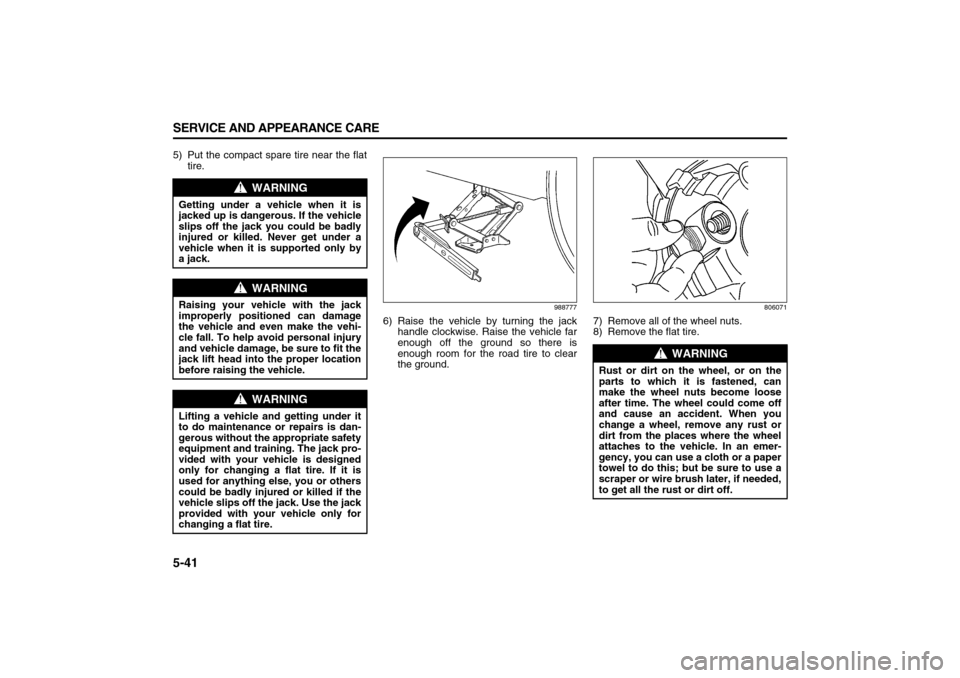
6) Raise the vehicle by turning the jack
handle clockwise. Raise the vehicle far
enough off the ground so there is
enough room for the road tire to clear
the ground.
806071
7) Remove all of the wheel nuts.
8) Remove the flat tire.
WARNING
Getting under a vehicle when it is
jacked up is dangerous. If the vehicle
slips off the jack you could be badly
injured or killed. Never get under a
vehicle when it is supported only by
a jack.
WARNING
Raising your vehicle with the jack
improperly positioned can damage
the vehicle and even make the vehi-
cle fall. To help avoid personal injury
and vehicle damage, be sure to fit the
jack lift head into the proper location
before raising the vehicle.
WARNING
Lifting a vehicle and getting under it
to do maintenance or repairs is dan-
gerous without the appropriate safety
equipment and training. The jack pro-
vided with your vehicle is designed
only for changing a flat tire. If it is
used for anything else, you or others
could be badly injured or killed if the
vehicle slips off the jack. Use the jack
provided with your vehicle only for
changing a flat tire.
WARNING
Rust or dirt on the wheel, or on the
parts to which it is fastened, can
make the wheel nuts become loose
after time. The wheel could come off
and cause an accident. When you
change a wheel, remove any rust or
dirt from the places where the wheel
attaches to the vehicle. In an emer-
gency, you can use a cloth or a paper
towel to do this; but be sure to use a
scraper or wire brush later, if needed,
to get all the rust or dirt off.
Page 227 of 274
5-43 SERVICE AND APPEARANCE CARE
78J00-03E
Secondary Latch System
Your vehicle has an underbody mounted
tire hoist assembly equipped with a sec-
ondary latch system. It is designed to stop
the compact spare tire from suddenly fall-
ing off your vehicle if the cable holding the
spare tire is damaged. For the secondary
latch to work, the tire must be stowed with
the valve stem pointing down. Refer to
“Storing a Flat or Spare Tire and Tools” in
this section for instructions on storing the
spare tire correctly.To release the spare tire from the second-
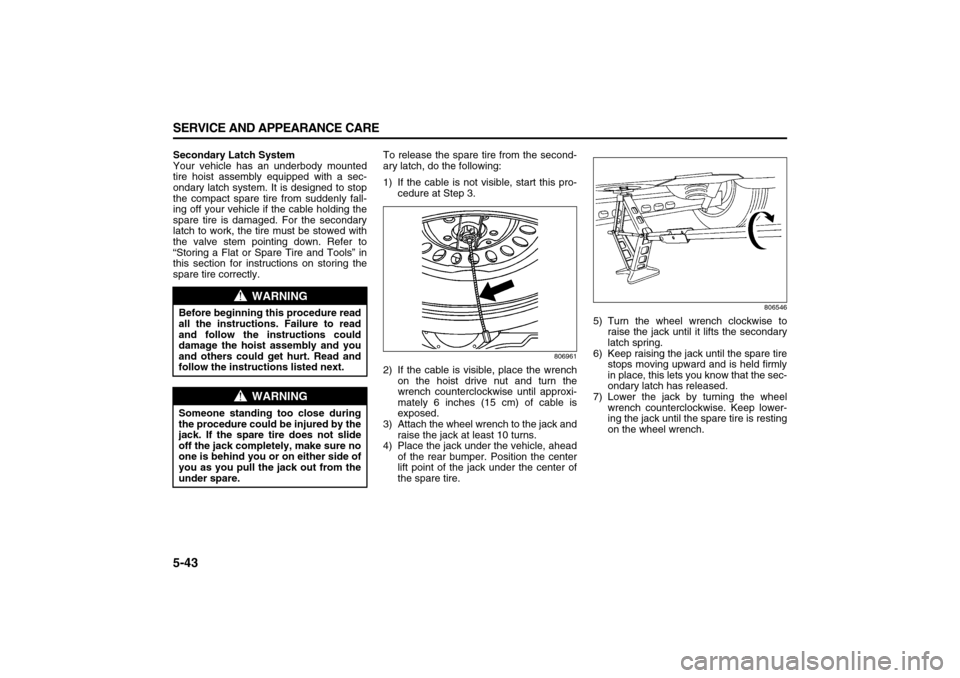
ary latch, do the following:
1) If the cable is not visible, start this pro-
cedure at Step 3.
806961
2) If the cable is visible, place the wrench
on the hoist drive nut and turn the
wrench counterclockwise until approxi-
mately 6 inches (15 cm) of cable is
exposed.
3) Attach the wheel wrench to the jack and
raise the jack at least 10 turns.
4) Place the jack under the vehicle, ahead
of the rear bumper. Position the center
lift point of the jack under the center of
the spare tire.
806546
5) Turn the wheel wrench clockwise to
raise the jack until it lifts the secondary
latch spring.
6) Keep raising the jack until the spare tire
stops moving upward and is held firmly
in place, this lets you know that the sec-
ondary latch has released.
7) Lower the jack by turning the wheel
wrench counterclockwise. Keep lower-
ing the jack until the spare tire is resting
on the wheel wrench.
WARNING
Before beginning this procedure read
all the instructions. Failure to read
and follow the instructions could
damage the hoist assembly and you
and others could get hurt. Read and
follow the instructions listed next.
WARNING
Someone standing too close during
the procedure could be injured by the
jack. If the spare tire does not slide
off the jack completely, make sure no
one is behind you or on either side of
you as you pull the jack out from the
under spare.
Page 230 of 274
5-46 SERVICE AND APPEARANCE CARE
78J00-03E
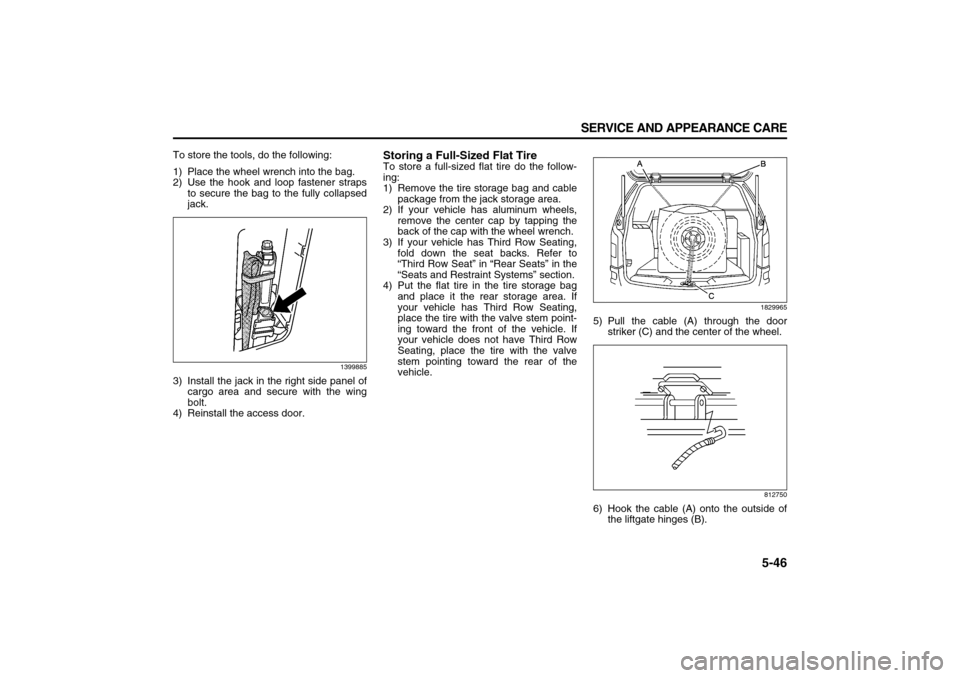
To store the tools, do the following:
1) Place the wheel wrench into the bag.
2) Use the hook and loop fastener straps
to secure the bag to the fully collapsed
jack.
1399885
3) Install the jack in the right side panel of
cargo area and secure with the wing
bolt.
4) Reinstall the access door.
Storing a Full-Sized Flat TireTo store a full-sized flat tire do the follow-
ing:
1) Remove the tire storage bag and cable
package from the jack storage area.
2) If your vehicle has aluminum wheels,
remove the center cap by tapping the
back of the cap with the wheel wrench.
3) If your vehicle has Third Row Seating,
fold down the seat backs. Refer to
“Third Row Seat” in “Rear Seats” in the
“Seats and Restraint Systems” section.
4) Put the flat tire in the tire storage bag
and place it the rear storage area. If
your vehicle has Third Row Seating,
place the tire with the valve stem point-
ing toward the front of the vehicle. If
your vehicle does not have Third Row
Seating, place the tire with the valve
stem pointing toward the rear of the
vehicle.
1829965
5) Pull the cable (A) through the door
striker (C) and the center of the wheel.
812750
6) Hook the cable (A) onto the outside of
the liftgate hinges (B).
Page 231 of 274
5-47 SERVICE AND APPEARANCE CARE
78J00-03E
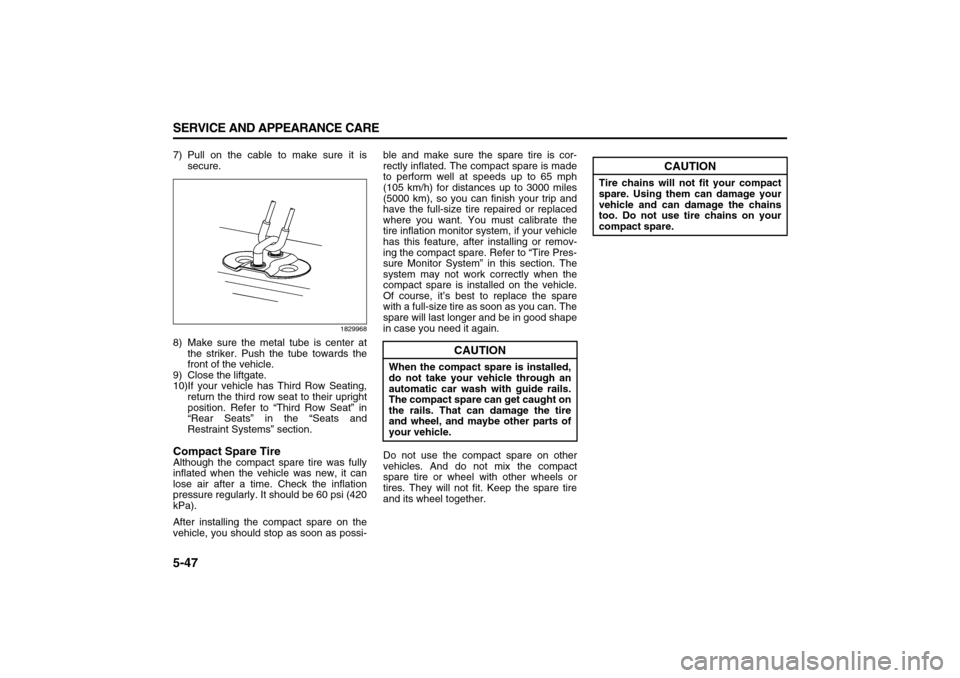
7) Pull on the cable to make sure it is
secure.
1829968
8) Make sure the metal tube is center at
the striker. Push the tube towards the
front of the vehicle.
9) Close the liftgate.
10)If your vehicle has Third Row Seating,
return the third row seat to their upright
position. Refer to “Third Row Seat” in
“Rear Seats” in the “Seats and
Restraint Systems” section.Compact Spare TireAlthough the compact spare tire was fully
inflated when the vehicle was new, it can
lose air after a time. Check the inflation
pressure regularly. It should be 60 psi (420
kPa).
After installing the compact spare on the
vehicle, you should stop as soon as possi-ble and make sure the spare tire is cor-
rectly inflated. The compact spare is made
to perform well at speeds up to 65 mph
(105 km/h) for distances up to 3000 miles
(5000 km), so you can finish your trip and
have the full-size tire repaired or replaced
where you want. You must calibrate the
tire inflation monitor system, if your vehicle
has this feature, after installing or remov-
ing the compact spare. Refer to “Tire Pres-
sure Monitor System” in this section. The
system may not work correctly when the
compact spare is installed on the vehicle.
Of course, it’s best to replace the spare
with a full-size tire as soon as you can. The
spare will last longer and be in good shape
in case you need it again.
Do not use the compact spare on other
vehicles. And do not mix the compact
spare tire or wheel with other wheels or
tires. They will not fit. Keep the spare tire
and its wheel together.
CAUTION
When the compact spare is installed,
do not take your vehicle through an
automatic car wash with guide rails.
The compact spare can get caught on
the rails. That can damage the tire
and wheel, and maybe other parts of
your vehicle.
CAUTION
Tire chains will not fit your compact
spare. Using them can damage your
vehicle and can damage the chains
too. Do not use tire chains on your
compact spare.