tow SUZUKI XL7 2007 2.G Owner's Manual
[x] Cancel search | Manufacturer: SUZUKI, Model Year: 2007, Model line: XL7, Model: SUZUKI XL7 2007 2.GPages: 274, PDF Size: 6.12 MB
Page 158 of 274

DRIVING YOUR VEHICLE
4
78J00-03E
DRIVING YOUR VEHICLEYour Driving, the Road, and Your Vehicle ........................ 4-1
Towing .................................................................................. 4-20
Page 174 of 274

4-16 DRIVING YOUR VEHICLE
78J00-03E
able from the cold. But do it as little as pos-
sible. Preserve the fuel as long as you can.
To help keep warm, you can get out of the
vehicle and do some fairly vigorous exer-
cises every half hour or so until help
comes.If Your Vehicle is Stuck in Sand,
Mud, Ice, or SnowIn order to free your vehicle when it is
stuck, you will need to spin the wheels, but
you do not want to spin your wheels too
fast. The method known as rocking can
help you get out when you are stuck, but
you must use caution.For information about using tire chains on
your vehicle, refer to “Tire Chains” in
“Tires” in the “Service and Appearance
Care” section.
Rocking Your Vehicle to Get It Out
First, turn the steering wheel left and right.
That will clear the area around the front
wheels. If your vehicle has traction control,
you should turn the traction control system
off. Refer to “Traction Control System
(TCS)” in this section. Then shift back and
forth between REVERSE (R) and a for-
ward gear, spinning the wheels as little as
possible. Release the accelerator pedal
while you shift, and press lightly on the
accelerator pedal when the transaxle is in
gear. By slowly spinning the wheels in the
forward and reverse directions, you will
cause a rocking motion that may free your
vehicle. If that does not get your vehicle
out after a few tries, it may need to be
towed out. If your vehicle does need to be
towed out, refer to “Towing Your Vehicle”
in this section.
Loading Your VehicleIt is very important to know how much
weight your vehicle can carry. Two labels
on your vehicle show how much weight it
may properly carry, the Tire and Loading
Information label and the Vehicle Certifica-
tion label.
WARNING
If you let your vehicle’s tires spin at
high speed, they can explode, and
you or others could be injured. And,
the transaxle or other parts of the
vehicle can overheat. That could
cause an engine compartment fire or
other damage. When you are stuck,
spin the wheels as little as possible.
Do not spin the wheels above 35 mph
(55 km/h) as shown on the speedom-
eter.
CAUTION
Spinning the wheels can destroy
parts of your vehicle as well as the
tires. If you spin the wheels too fast
while shifting the transaxle back and
forth, you can destroy the transaxle.
Refer to “Rocking Your Vehicle to
Get It Out” in this section.
WARNING
Do not load your vehicle any heavier
than the Gross Vehicle Weight Rating
(GVWR), or either the maximum front
or rear Gross Axle Weight Rating
(GAWR). If you do, parts on your
vehicle can break, and it can change
the way your vehicle handles. These
could cause you to lose control and
crash. Also, overloading can shorten
the life of your vehicle.
Page 175 of 274
4-17 DRIVING YOUR VEHICLE
78J00-03E
Tire and Loading Information Label
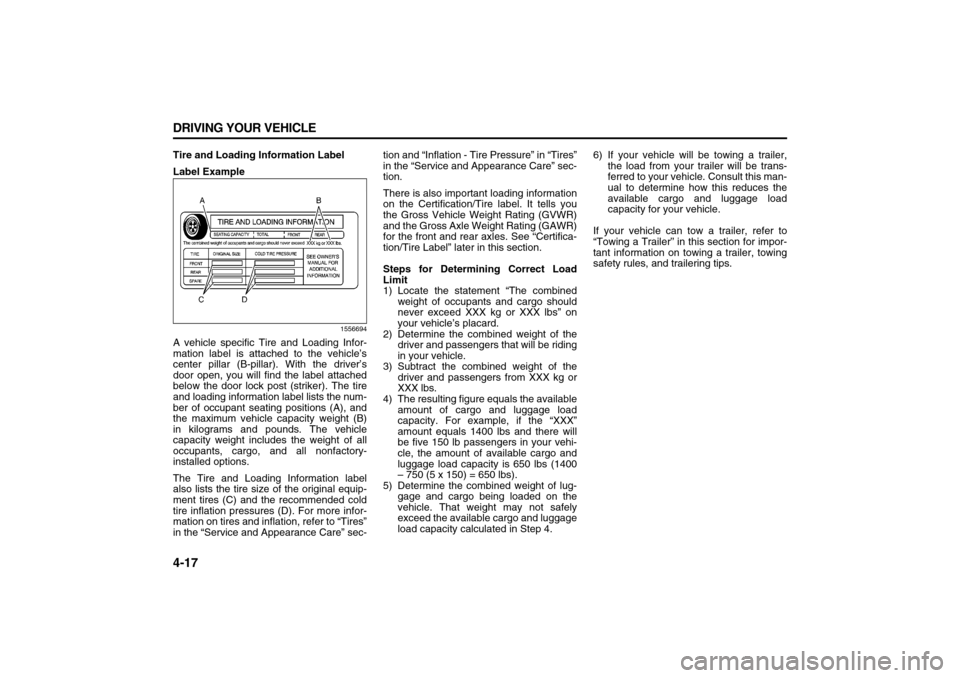
Label Example
1556694
A vehicle specific Tire and Loading Infor-
mation label is attached to the vehicle’s
center pillar (B-pillar). With the driver’s
door open, you will find the label attached
below the door lock post (striker). The tire
and loading information label lists the num-
ber of occupant seating positions (A), and
the maximum vehicle capacity weight (B)
in kilograms and pounds. The vehicle
capacity weight includes the weight of all
occupants, cargo, and all nonfactory-
installed options.
The Tire and Loading Information label
also lists the tire size of the original equip-
ment tires (C) and the recommended cold
tire inflation pressures (D). For more infor-
mation on tires and inflation, refer to “Tires”
in the “Service and Appearance Care” sec-tion and “Inflation - Tire Pressure” in “Tires”
in the “Service and Appearance Care” sec-
tion.
There is also important loading information
on the Certification/Tire label. It tells you
the Gross Vehicle Weight Rating (GVWR)
and the Gross Axle Weight Rating (GAWR)
for the front and rear axles. See “Certifica-
tion/Tire Label” later in this section.
Steps for Determining Correct Load
Limit
1) Locate the statement “The combined
weight of occupants and cargo should
never exceed XXX kg or XXX lbs” on
your vehicle’s placard.
2) Determine the combined weight of the
driver and passengers that will be riding
in your vehicle.
3) Subtract the combined weight of the
driver and passengers from XXX kg or
XXX lbs.
4) The resulting figure equals the available
amount of cargo and luggage load
capacity. For example, if the “XXX”
amount equals 1400 lbs and there will
be five 150 lb passengers in your vehi-
cle, the amount of available cargo and
luggage load capacity is 650 lbs (1400
– 750 (5 x 150) = 650 lbs).
5) Determine the combined weight of lug-
gage and cargo being loaded on the
vehicle. That weight may not safely
exceed the available cargo and luggage
load capacity calculated in Step 4.6) If your vehicle will be towing a trailer,
the load from your trailer will be trans-
ferred to your vehicle. Consult this man-
ual to determine how this reduces the
available cargo and luggage load
capacity for your vehicle.
If your vehicle can tow a trailer, refer to
“Towing a Trailer” in this section for impor-
tant information on towing a trailer, towing
safety rules, and trailering tips.
Page 178 of 274

4-20 DRIVING YOUR VEHICLE
78J00-03E
TowingTowing Your VehicleConsult your dealer or a professional tow-
ing service if you need to have your dis-
abled vehicle towed.
If you want to tow your vehicle behind
another vehicle for recreational purposes
(such as behind a motorhome), refer to
“Recreational Vehicle Towing” following.Recreational Vehicle TowingRecreational vehicle towing means towing
your vehicle behind another vehicle – such
as behind a motorhome. The two most
common types of recreational vehicle tow-
ing are known as “dinghy towing” (towing
your vehicle with all four wheels on the
ground) and “dolly towing” (towing your
vehicle with two wheels on the ground and
two wheels up on a device known as a
“dolly”).
With the proper preparation and equip-
ment, many vehicles can be towed in these
ways. See “Dinghy Towing” and “Dolly Tow-
ing”, following.
Here are some important things to con-
sider before you do recreational vehicle
towing:
What’s the towing capacity of the towing
vehicle? Be sure you read the tow vehi-
cle manufacturer’s recommendations. How far will you tow? Some vehicles
have restrictions on how far and how
long they can tow.
Do you have the proper towing equip-
ment? See your dealer or trailering pro-
fessional for additional advice and
equipment recommendations.
Is your vehicle ready to be towed? Just
as you would prepare your vehicle for a
long trip, you’ll want to make sure your
vehicle is prepared to be towed. Refer to
“Before Leaving on a Long Trip” in this
section.
Dinghy Towing
If you have an all-wheel-drive vehicle or a
front-wheel-drive vehicle, it was not
designed to be towed with all of its wheels
on the ground. It can be towed with car
carrier equipment. If you have a front-wheel-drive vehicle, it can be towed with its
two front wheels off the ground. See “Dolly
Towing” following.
Dolly Towing
If you have a front-wheel-drive vehicle, it
can be towed with the two front wheels off
the ground. To dolly tow your vehicle, do
the following:
1) Put the front wheels on a dolly.
2) Put the vehicle in PARK (P).
3) Set the parking brake and then remove
the key.
4) Clamp the steering wheel in a straight-
ahead position with a clamping device
designed for towing.
5) Release the parking brake.
If you have an all-wheel-drive vehicle, it
cannot be towed with any of its wheels on
CAUTION
Towing an all-wheel-drive vehicle
with all four wheels or even only two
wheels on the ground will damage
drivetrain or transmission compo-
nents. Towing a front-wheel-drive
vehicle with all four wheels on the
ground will damage drivetrain or
transmission components. Do not
tow an all-wheel-drive vehicle with
two or four wheels on the ground or a
front-wheel-drive vehicle if all four
wheels will be on the ground.
CAUTION
Towing an all-wheel-drive vehicle
with all four wheels or even only two
wheels on the ground will damage
drivetrain or transmission compo-
nents. Towing a front-wheel-drive
vehicle with all four wheels on the
ground will damage drivetrain or
transmission components. Do not
tow an all-wheel-drive vehicle with
two or four wheels on the ground or a
front-wheel-drive vehicle if all four
wheels will be on the ground.
Page 179 of 274

4-21 DRIVING YOUR VEHICLE
78J00-03E
the ground. It can be towed with car carrier
equipment.Level ControlYour vehicle may have this feature. This
self-adjusting type of level control is fully
automatic and will provide a better leveled
riding position as well as better handling
under a variety of passenger and loading
conditions. The system is activated when
sufficient weight is added to the vehicle,
and will automatically adjust vehicle height
thereafter. A hydraulic pump inside each
rear shock absorber raises the rear of the
vehicle to the proper height, based on
inputs from the road surface, while the
vehicle is being driven. It takes approxi-
mately two miles (3.2 km) of driving for the
leveling to complete, depending on the
road surface conditions.
If the loaded vehicle is not moved for
approximately twelve hours, the leveling
system may bleed down to a lower height.
This can be especially apparent if a trailer
is left attached to a parked vehicle for long
periods of time. The vehicle must be driven
to re-level the vehicle. If a self-equalizing
hitch is being used, the vehicle should be
driven approximately two miles (3.2 km)
with the trailer prior to adjusting (leveling)
the hitch.
Towing a TrailerTo identify the trailering capacity of your
vehicle, you should read the information in
“Weight of the Trailer” that appears later in
this section. Trailering is different than just
driving your vehicle by itself. Trailering
means changes in handling, acceleration,
braking, durability, and fuel economy. Suc-cessful, safe trailering takes correct equip-
ment, and it has to be used properly.
That is the reason for this section. In it are
many time-tested, important trailering tips
and safety rules. Many of these are impor-
tant for your safety and that of your pas-
sengers. So please read this section
carefully before you pull a trailer.
If You Do Decide To Pull A Trailer
If you do, here are some important points:
There are many different laws, including
speed limit restrictions, having to do with
trailering. Make sure your rig will be
legal, not only where you live but also
where you will be driving. A good source
for this information can be state or pro-
vincial police.
Consider using a sway control. Refer to
“Hitches” later in this section.
Do not tow a trailer at all during the first
500 miles (800 km) your new vehicle is
driven. Your engine, axle or other parts
could be damaged.
During the first 500 miles (800 km) that
you tow a trailer, do not drive over 50
mph (80 km/h) and do not make starts at
full throttle. This helps your engine and
other parts of your vehicle wear in at the
heavier loads.
WARNING
If you do not use the correct equip-
ment and drive properly, you can lose
control when you pull a trailer. For
example, if the trailer is too heavy,
the brakes may not work well – or
even at all. You and your passengers
could be seriously injured. Pull a
trailer only if you have followed all
the steps in this section. Ask your
dealer for advice and information
about towing a trailer with your vehi-
cle.
CAUTION
Pulling a trailer improperly can dam-
age your vehicle and result in costly
repairs that would not be covered by
your warranty. Always follow the
instructions in this section and check
with your dealer for more information
about towing a trailer with your vehi-
cle.
Page 180 of 274
4-22 DRIVING YOUR VEHICLE
78J00-03E
Three important considerations have to do
with weight:
Weight of the trailer
Weight of the trailer tongue
Weight on your vehicle’s tires
Weight of the Trailer
How heavy can a trailer safely be?
Your vehicle can tow up to 2,900 lbs (1300
kg) with up to five occupants or up to 3,500
lbs (1575 kg) with up to two occupants. But
even that can be too heavy.
It depends on how you plan to use your rig.
For example, speed, altitude, road grades,
outside temperature and how much your
vehicle is used pull a trailer are all impor-
tant. It can also depend on any special
equipment that you have on your vehicle,
and the amount of tongue weight vehicle
can carry. Refer to “Weight of the Trailer
Tongue” later in this section for more infor-
mation.
Maximum trailer weight is calculated
assuming only the driver is in the tow vehi-
cle and it has all the required trailering
equipment. The weight of additional
optional equipment, passengers and cargo
in the tow vehicle must be subtracted from
the maximum trailer weight.
You can ask your dealer for our trailering
information or advice, or you can write us
at our Customer Assistance Offices.Weight of the Trailer Tongue
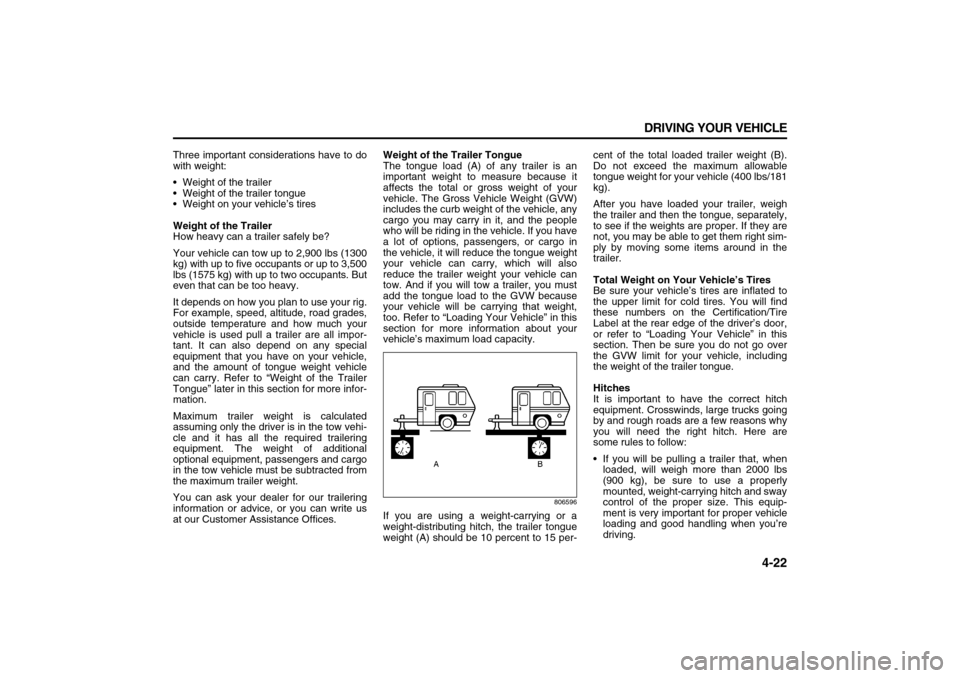
The tongue load (A) of any trailer is an
important weight to measure because it
affects the total or gross weight of your
vehicle. The Gross Vehicle Weight (GVW)
includes the curb weight of the vehicle, any
cargo you may carry in it, and the people
who will be riding in the vehicle. If you have
a lot of options, passengers, or cargo in
the vehicle, it will reduce the tongue weight
your vehicle can carry, which will also
reduce the trailer weight your vehicle can
tow. And if you will tow a trailer, you must
add the tongue load to the GVW because
your vehicle will be carrying that weight,
too. Refer to “Loading Your Vehicle” in this
section for more information about your
vehicle’s maximum load capacity.
806596
If you are using a weight-carrying or a
weight-distributing hitch, the trailer tongue
weight (A) should be 10 percent to 15 per-cent of the total loaded trailer weight (B).
Do not exceed the maximum allowable
tongue weight for your vehicle (400 lbs/181
kg).
After you have loaded your trailer, weigh
the trailer and then the tongue, separately,
to see if the weights are proper. If they are
not, you may be able to get them right sim-
ply by moving some items around in the
trailer.
Total Weight on Your Vehicle’s Tires
Be sure your vehicle’s tires are inflated to
the upper limit for cold tires. You will find
these numbers on the Certification/Tire
Label at the rear edge of the driver’s door,
or refer to “Loading Your Vehicle” in this
section. Then be sure you do not go over
the GVW limit for your vehicle, including
the weight of the trailer tongue.
Hitches
It is important to have the correct hitch
equipment. Crosswinds, large trucks going
by and rough roads are a few reasons why
you will need the right hitch. Here are
some rules to follow:
If you will be pulling a trailer that, when
loaded, will weigh more than 2000 lbs
(900 kg), be sure to use a properly
mounted, weight-carrying hitch and sway
control of the proper size. This equip-
ment is very important for proper vehicle
loading and good handling when you’re
driving.
Page 181 of 274

4-23 DRIVING YOUR VEHICLE
78J00-03E
Will you have to make any holes in the
body of your vehicle when you install a
trailer hitch?
If you do, remember to seal the holes
when you remove the hitch. If you do not
seal them, deadly carbon monoxide
(CO) from your exhaust can get into your
vehicle. Refer to “Engine Exhaust” in
“Starting and Operating Your Vehicle” in
the “Features and Controls” section. Dirt
and water can, too.
Safety Chains
You should always attach chains between
your vehicle and your trailer. Cross the
safety chains under the tongue of the
trailer to help prevent the tongue from con-
tacting the road if it becomes separated
from the hitch. Instructions about safety
chains may be provided by the hitch manu-
facturer or by the trailer manufacturer. Fol-
low the manufacturer’s recommendation
for attaching safety chains and do not
attach them to the bumper. Always leave
just enough slack so you can turn with your
rig. Never allow safety chains to drag on
the ground.
Trailer Brakes
If your trailer weighs more than 1000 lbs
(450 kg) loaded, then it needs its own
brakes, and they must be adequate. Be
sure to read and follow the instructions for
the trailer brakes so you will be able to
install, adjust and maintain them properly.Because your vehicle has anti-lock brakes,
do not try to tap into your vehicle’s brake
system. If you do, both brake systems will
not work well, or at all.Driving with a Trailer
Towing a trailer requires a certain amount
of experience. Before setting out for the
open road, you will want to get to know
WARNING
If you have the liftgate open and you
pull a trailer with your vehicle, carbon
monoxide (CO) could come into your
vehicle. You cannot see or smell CO.
It can cause unconsciousness or
death. Refer to “Engine Exhaust” in
“Starting and Operating Your Vehi-
cle” in the “Features and Controls”
section. To maximize your safety
when towing a trailer:
Have your exhaust system
inspected for leaks, and make nec-
essary repairs before starting on
your trip.
Keep the liftgate closed.
If exhaust does come into your
vehicle through a window in the
rear or another opening, drive with
your front, main heating or cooling
system on and with the fan on any
speed. This will bring fresh, out-
side air into your vehicle. Do not
use the climate control setting for
maximum air because it only recir-
culates the air inside your vehicle.
Refer to “Automatic Climate Con-
trol System” in “Climate Controls”
in the “Instrument Panel” section.
Page 182 of 274

4-24 DRIVING YOUR VEHICLE
78J00-03E
your rig. Acquaint yourself with the feel of
handling and braking with the added
weight of the trailer. And always keep in
mind that the vehicle you are driving is now
a good deal longer and not nearly as
responsive as your vehicle is by itself.
Before you start, check all trailer hitch
parts and attachments, safety chains, elec-
trical connector, lamps, tires and mirror
adjustment. If the trailer has electric
brakes, start your vehicle and trailer mov-
ing and then apply the trailer brake control-
ler by hand to be sure the brakes are
working. This lets you check your electrical
connection at the same time.
During your trip, check occasionally to be
sure that the load is secure, and that the
lamps and any trailer brakes are still work-
ing.
Following Distance
Stay at least twice as far behind the vehicle
ahead as you would when driving your
vehicle without a trailer. This can help you
avoid situations that require heavy braking
and sudden turns.
Passing
You will need more passing distance up
ahead when you are towing a trailer. And,
because you are a good deal longer, you
will need to go much farther beyond the
passed vehicle before you can return to
your lane.Backing Up
Hold the bottom of the steering wheel with
one hand. Then, to move the trailer to the
left, just move that hand to the left. To
move the trailer to the right, move your
hand to the right. Always back up slowly
and, if possible, have someone guide you.
Making Turns
When you are turning with a trailer, make
wider turns than normal. Do this so your
trailer will not strike soft shoulders, curbs,
road signs, trees or other objects. Avoid
jerky or sudden maneuvers. Signal well in
advance.
Turn Signals When Towing a Trailer
When you tow a trailer, your vehicle has to
have extra wiring.
The arrows on your instrument panel will
flash whenever you signal a turn or lane
change. Properly hooked up, the trailer
lamps will also flash, telling other drivers
you are about to turn, change lanes or
stop.When towing a trailer, the arrows on your
instrument panel will flash for turns even if
the bulbs on the trailer are burned out.
Thus, you may think drivers behind you are
seeing your signal when they are not. It’s
important to check occasionally to be sure
the trailer bulbs are still working.
Driving On Grades
Reduce speed and shift to a lower gear
before you start down a long or steep
downgrade. If you do not shift down, you
might have to use your brakes so much
that they would get hot and no longer work
well.
Parking on Hills
But if you ever have to park your rig on a
hill, do the following:
1) Apply your regular brakes, but do not
shift into PARK (P) yet.
2) Have someone place chocks under the
trailer wheels.
3) When the wheel chocks are in place,
release the regular brakes until the
chocks absorb the load.
CAUTION
Making very sharp turns while traile-
ring could cause the trailer to come
in contact with the vehicle. Your vehi-
cle could be damaged. Avoid making
very sharp turns while trailering.
WARNING
You really should not park your vehi-
cle, with a trailer attached, on a hill. If
something goes wrong, your rig
could start to move. People can be
injured, and both your vehicle and
the trailer can be damaged.
Page 183 of 274

4-25 DRIVING YOUR VEHICLE
78J00-03E
4) Reapply the regular brakes. Then apply
your parking brake, and then shift to
PARK (P).
5) Release the regular brakes.
When You Are Ready to Leave After
Parking on a Hill
1) Apply your regular brakes and hold the
pedal down while you do the following:
1. Start your engine.
2. Shift into a gear.
3. Release the parking brake.
2) Let up on the brake pedal.
3) Drive slowly until the trailer is clear of
the chocks.
4) Stop and have someone pick up and
store the chocks.
Maintenance When Trailer Towing
Your vehicle will need service more often
when you are pulling a trailer. See the
Maintenance Schedule for more on this.
Things that are especially important in
trailer operation are automatic transaxle
fluid, engine oil, belts, cooling system and
brake system. Each of these is covered in
this manual, and the Index will help you
find them quickly. If you are trailering, it is a
good idea to review these sections before
you start your trip.
Check periodically to see that all hitch nuts
and bolts are tight.
Page 191 of 274
5-7 SERVICE AND APPEARANCE CARE
78J00-03E
Engine OilChecking Engine Oil
It is a good idea to check your engine oil
every time you get fuel. In order to get an
accurate reading, the oil must be warm
and the vehicle must be on level ground.
The engine oil dipstick handle is a yellow
loop. Refer to “Engine Compartment Over-
view” in this section for the location of the
engine oil dipstick.
1) Turn off the engine and give the oil sev-
eral minutes to drain back into the oil
pan. If you do not do this, the oil dip-
stick might not show the actual level.
2) Pull out the dipstick and clean it with a
paper towel or cloth, then push it back
in all the way. Remove it again, keeping
the tip down, and check the level.When to Add Engine Oil
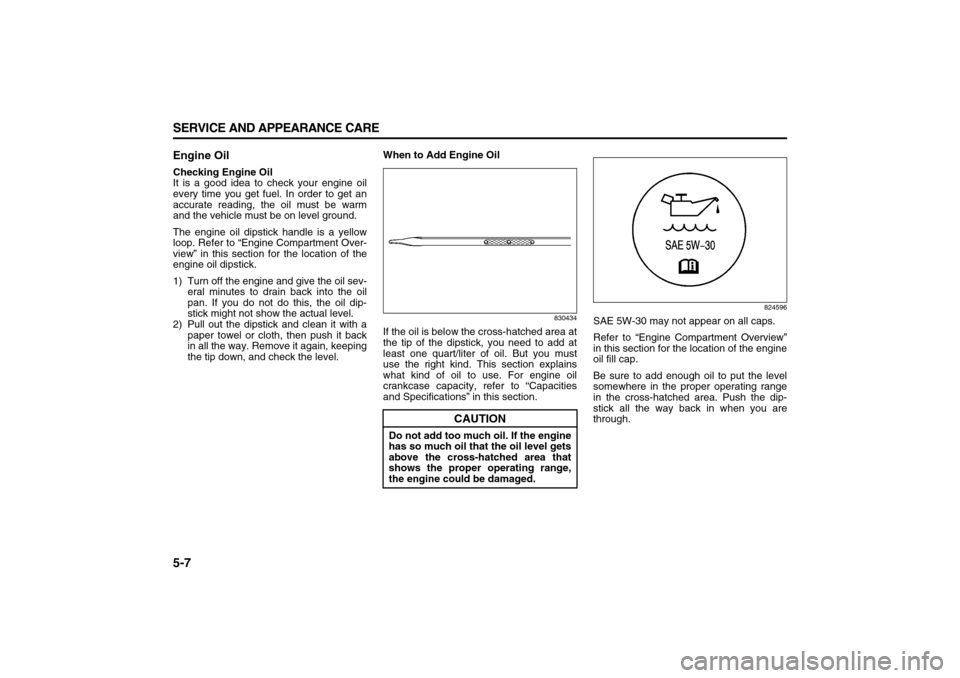
830434
If the oil is below the cross-hatched area at
the tip of the dipstick, you need to add at
least one quart/liter of oil. But you must
use the right kind. This section explains
what kind of oil to use. For engine oil
crankcase capacity, refer to “Capacities
and Specifications” in this section.
824596
SAE 5W-30 may not appear on all caps.
Refer to “Engine Compartment Overview”
in this section for the location of the engine
oil fill cap.
Be sure to add enough oil to put the level
somewhere in the proper operating range
in the cross-hatched area. Push the dip-
stick all the way back in when you are
through.
CAUTION
Do not add too much oil. If the engine
has so much oil that the oil level gets
above the cross-hatched area that
shows the proper operating range,
the engine could be damaged.