brake TATA SAFARI 2015 User Guide
[x] Cancel search | Manufacturer: TATA, Model Year: 2015, Model line: SAFARI, Model: TATA SAFARI 2015Pages: 161, PDF Size: 2.55 MB
Page 75 of 161
75
D R I V I N G
• •• •
•S SS S
S
tar tartar tar
tar
ting & st ting & stting & st ting & st
ting & st
opping the engine opping the engineopping the engine opping the engine
opping the engine
• •• •
•Preparing to drive Preparing to drivePreparing to drive Preparing to drive
Preparing to drive
• •• •
•Running-in period Running-in periodRunning-in period Running-in period
Running-in period
• •• •
•Gear change Gear changeGear change Gear change
Gear change
• •• •
•Brakes (Anti-lock brake system) Brakes (Anti-lock brake system)Brakes (Anti-lock brake system) Brakes (Anti-lock brake system)
Brakes (Anti-lock brake system)
• •• •
•T TT T
T
r rr r
r
ansf ansfansf ansf
ansf
er c er cer c er c
er c
ase asease ase
ase
• •• •
•Fuel economy Fuel economyFuel economy Fuel economy
Fuel economy
• •• •
•Four wheel driving system Four wheel driving systemFour wheel driving system Four wheel driving system
Four wheel driving system
• •• •
•Limited slip differential Limited slip differentialLimited slip differential Limited slip differential
Limited slip differential
• •• •
•Driving in adverse conditions Driving in adverse conditionsDriving in adverse conditions Driving in adverse conditions
Driving in adverse conditions
• •• •
•Driving Safety Driving SafetyDriving Safety Driving Safety
Driving Safety
This section gives you important tips on how to start the engine, how
to take care of turbo charger, operation of transmission and transfer
case. It also includes important tips on safe driving in adverse
conditions and difficult terrains.
The information on topics listed above would certainly help you in
safe and carefree driving.
ProCarManuals.com
Page 76 of 161
76
D R I V I N GST STST ST
ST
AR ARAR AR
AR
TING AND ST TING AND STTING AND ST TING AND ST
TING AND ST
OPPING OPPING OPPING OPPING
OPPING
THE ENGINE THE ENGINETHE ENGINE THE ENGINE
THE ENGINE
Starting the Engine Starting the EngineStarting the Engine Starting the Engine
Starting the Engine
Before starting
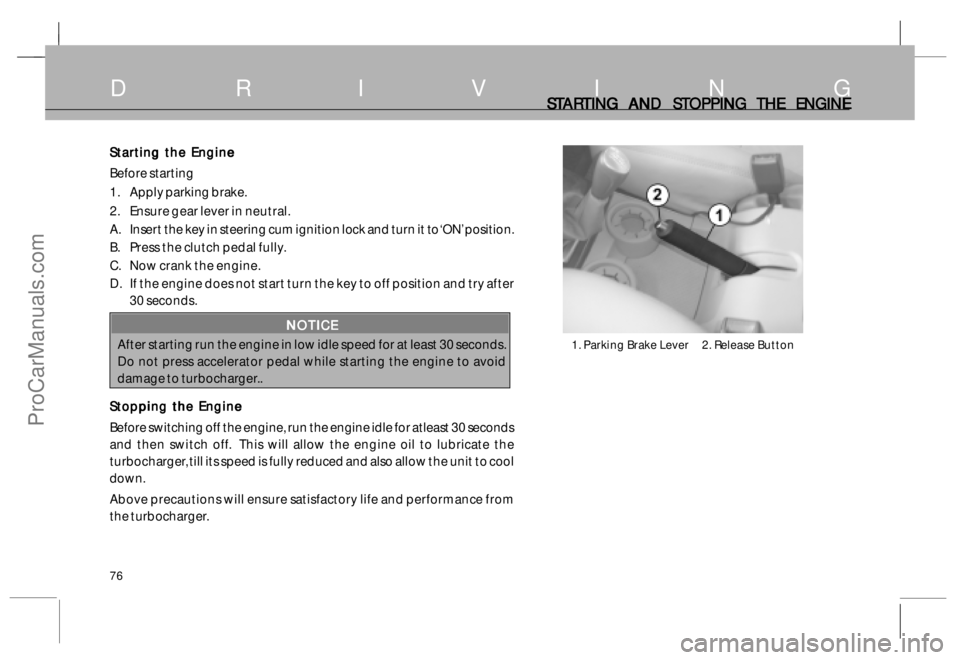
1. Apply parking brake.
2. Ensure gear lever in neutral.
A. Insert the key in steering cum ignition lock and turn it to ‘ON’ position.
B. Press the clutch pedal fully.
C. Now crank the engine.
D. If the engine does not start turn the key to off position and try after
30 seconds.
NOTICE NOTICENOTICE NOTICE
NOTICE
After starting run the engine in low idle speed for at least 30 seconds.
Do not press accelerator pedal while starting the engine to avoid
damage to turbocharger..
Stopping the Engine Stopping the EngineStopping the Engine Stopping the Engine
Stopping the Engine
Before switching off the engine, run the engine idle for atleast 30 seconds
and then switch off. This will allow the engine oil to lubricate the
turbocharger, till its speed is fully reduced and also allow the unit to cool
down.
Above precautions will ensure satisfactory life and performance from
the turbocharger.1. Parking Brake Lever 2. Release Button
ProCarManuals.com
Page 78 of 161
78
D R I V I N GGEAR BOX AND GEAR CHANGE SPEEDS GEAR BOX AND GEAR CHANGE SPEEDSGEAR BOX AND GEAR CHANGE SPEEDS GEAR BOX AND GEAR CHANGE SPEEDS
GEAR BOX AND GEAR CHANGE SPEEDS
Gear box Gear boxGear box Gear box
Gear box
Gear box has all synchromesh gears including reverse. The 5th gear is
an over drive.
When shifting the gear up or down make sure you press the clutch
pedal fully and shift to the next gear and then release the clutch pedal
gradually.
NOTICE NOTICENOTICE NOTICE
NOTICE
Do not rest your foot on the clutch pedal during driving. This can
cause clutch wear and damage.
Before shifting in to reverse gear bring your vehicle to a complete stop
and depress the clutch pedal fully.
Do not shift into reverse gear with vehicle moving forward. While
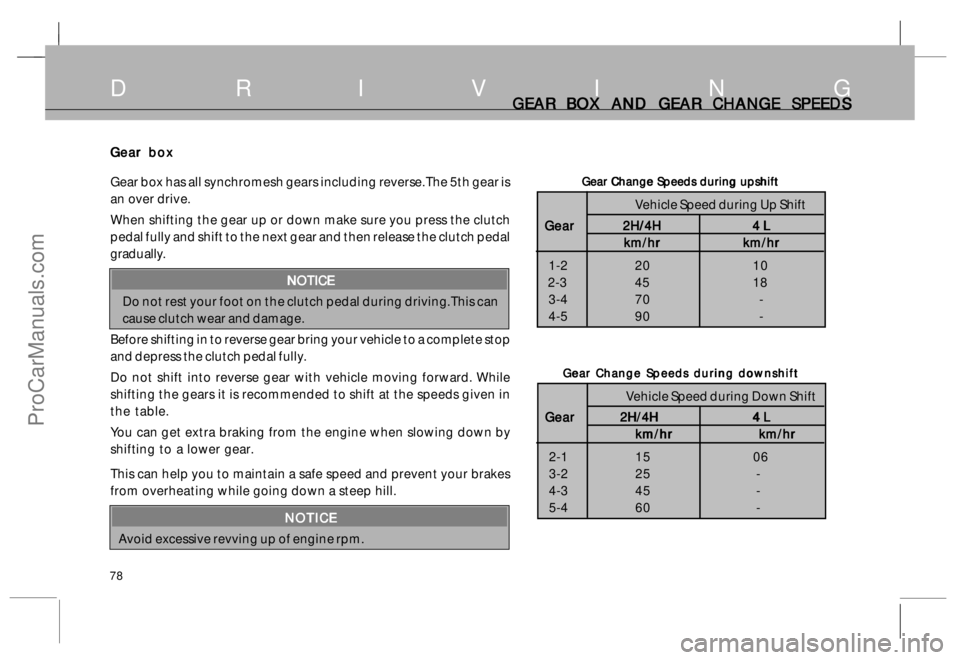
shifting the gears it is recommended to shift at the speeds given in
the table.
You can get extra braking from the engine when slowing down by
shifting to a lower gear.
This can help you to maintain a safe speed and prevent your brakes
from overheating while going down a steep hill.
NOTICE NOTICENOTICE NOTICE
NOTICE
Avoid excessive revving up of engine rpm.
Vehicle Speed during Up Shift
Gear GearGear Gear
Gear
2H/4H 2H/4H 2H/4H 2H/4H
2H/4H
4 L 4 L 4 L 4 L
4 L
km/hr km/hr km/hr km/hr
km/hr
km/hr km/hr km/hr km/hr
km/hr
1-2 20 10
2-3 45 18
3-4 70 -
4-5 90 -
Gear Change Speeds during upshift Gear Change Speeds during upshiftGear Change Speeds during upshift Gear Change Speeds during upshift
Gear Change Speeds during upshift
Vehicle Speed during Down Shift
Gear GearGear Gear
Gear
2H/4H 2H/4H 2H/4H 2H/4H
2H/4H
4 L 4 L 4 L 4 L
4 L
km/hr km/hr km/hr km/hr
km/hr
km/hr km/hr km/hr km/hr
km/hr
2-1 15 06
3-2 25 -
4-3 45 -
5-4 60 -
Gear Change Speeds during downshift Gear Change Speeds during downshiftGear Change Speeds during downshift Gear Change Speeds during downshift
Gear Change Speeds during downshift
ProCarManuals.com
Page 79 of 161
79
D R I V I N G BRAKES AND ABS (IF FITTED) BRAKES AND ABS (IF FITTED) BRAKES AND ABS (IF FITTED) BRAKES AND ABS (IF FITTED)
BRAKES AND ABS (IF FITTED)
Have your vehicle attended immediately.
Put your foot on brake pedal to apply brake. Do not ride
the brakes as they may overheat and the performance may
be impaired. The brake lights may confuse the drivers
behind you.
Use engine to assist the brakes by shifting to a lower gear
and lifting your foot from accelerator pedal.
Constant application of brakes while going down the hill
builds heat and reduces braking efficiency.
Check your brakes after driving through deep water. Apply
the brakes moderately to feel that they are normal. If not,
apply them gently and frequently until they do. With wet
brakes you should be extra cautious and alert in your driving.
Anti Lock Brake System (ABS) – if fitted Anti Lock Brake System (ABS) – if fittedAnti Lock Brake System (ABS) – if fitted Anti Lock Brake System (ABS) – if fitted
Anti Lock Brake System (ABS) – if fitted
ABS combined with the traditional hydraulic brake system pre-
vents the wheel from locking while braking by make use of
most of road to tyre grip. It also ensures better control and
stability of car while braking.
How ABS works How ABS worksHow ABS works How ABS works
How ABS works
ABS essentially consists of an Electronic Control Unit (ECU)
which reads signals from the sensors fitted to each wheel and
identifies the one which is likely to lock. ( Wheels will tend toBrakes BrakesBrakes Brakes
Brakes
Tata Safari is equipped with ventilated disc brakes on front
and drum brakes on rear wheels.
Braking system is vacuum assisted to reduce effort needed
on the brake pedal. It is a dual circuit service brake system
designed in such a way that one circuit will always work, even
if other circuit fails.
If this happens you will immediately notice that the brake
pedal goes down much farther and you need to press the
pedal harder. In such an event the stopping distance may be
longer.
In case of failure of vacuum the vehicle can still be stopped
with a higher pedal effort.
In case of vacuum failure or brake circuit failure, slow down
the vehicle by shifting to lower gear and lifting your foot
from the accelerator pedal. Pull to the side of the road as
soon as it is safe.
CAUTION CAUTIONCAUTION CAUTION
CAUTION
Brake system failure is very hazardous. It is best to have
your vehicle towed, but if you drive the vehicle in this
condition, be extremely cautious.
ProCarManuals.com
Page 80 of 161
80
D R I V I N GANTI-LOCK BRAKE SYSTEM ANTI-LOCK BRAKE SYSTEMANTI-LOCK BRAKE SYSTEM ANTI-LOCK BRAKE SYSTEM
ANTI-LOCK BRAKE SYSTEM
lock when the speed of rotation of any one wheel becomes
too low in relation to the vehicle speed.) It actuates
an
Electro Hydraulic Control Unit (HU) to reduce, maintain or
increase the pressure on the brake control cylinder in order
to prevent the wheel from locking. The ABS comes into play
when the car is braked heavily during emergency.
The driver feels the effort of the ABS through the The driver feels the effort of the ABS through theThe driver feels the effort of the ABS through the The driver feels the effort of the ABS through the
The driver feels the effort of the ABS through the
pulsating of the brake pedal and audible noise in the pulsating of the brake pedal and audible noise in thepulsating of the brake pedal and audible noise in the pulsating of the brake pedal and audible noise in the
pulsating of the brake pedal and audible noise in the
brake system. brake system.brake system. brake system.
brake system.
T TT T
T
his is absolut his is absoluthis is absolut his is absolut
his is absolut
ely N ely Nely N ely N
ely N
or oror or
or
mal. mal.mal. mal.
mal.
T TT T
T
his should not b his should not bhis should not b his should not b
his should not b
e ee e
e
in inin in
in
t tt t
t
er erer er
er
pr prpr pr
pr
et etet et
et
ed as a fault in the br ed as a fault in the bred as a fault in the br ed as a fault in the br
ed as a fault in the br
ak akak ak
ak
es eses es
es
.. ..
.
On the c On the c On the c On the c
On the c
on onon on
on
tr trtr tr
tr
ar arar ar
ar
y it y ity it y it
y it
’’ ’’
’
s ss s
s
the indic the indicthe indic the indic
the indic
a aa a
a
tion tha tion thation tha tion tha
tion tha
t the ABS is w t the ABS is wt the ABS is w t the ABS is w
t the ABS is w
or oror or
or
k kk k
k
ing inging ing
ing
.. ..
. This is an intentional
warning to the driver that a wheel or wheels are tending to lock
up due to the limit of tyre to road adhesion.
In this situation it is important to keep the brake pedal In this situation it is important to keep the brake pedalIn this situation it is important to keep the brake pedal In this situation it is important to keep the brake pedal
In this situation it is important to keep the brake pedal
depressed fully so that the ABS can regulate the brake depressed fully so that the ABS can regulate the brakedepressed fully so that the ABS can regulate the brake depressed fully so that the ABS can regulate the brake
depressed fully so that the ABS can regulate the brake
application. On No account pump the brake pedal application. On No account pump the brake pedalapplication. On No account pump the brake pedal application. On No account pump the brake pedal
application. On No account pump the brake pedal
The ABS is addition to the basic brake system.
It is activated It is activated It is activated It is activated
It is activated
automatically every time the engine is started. automatically every time the engine is started. automatically every time the engine is started. automatically every time the engine is started.
automatically every time the engine is started. If there is a
malfunction the system turns off automatically indicated by a
‘(ABS)’ ‘(ABS)’ ‘(ABS)’ ‘(ABS)’
‘(ABS)’ warning lamp on the dash board, still the ordinary brake
system continues to work.ABS Activation ABS ActivationABS Activation ABS Activation
ABS Activation
ABS activation varies with various road surfaces i.e. the
amount of traction your tyre have on a particular surface.
On dry surface you will need more pedal effort to activate
ABS. However you may feel ABS activates immediately if you
try to stop on snow, ice or slippery surface.
ABS Indicators ABS IndicatorsABS Indicators ABS Indicators
ABS Indicators
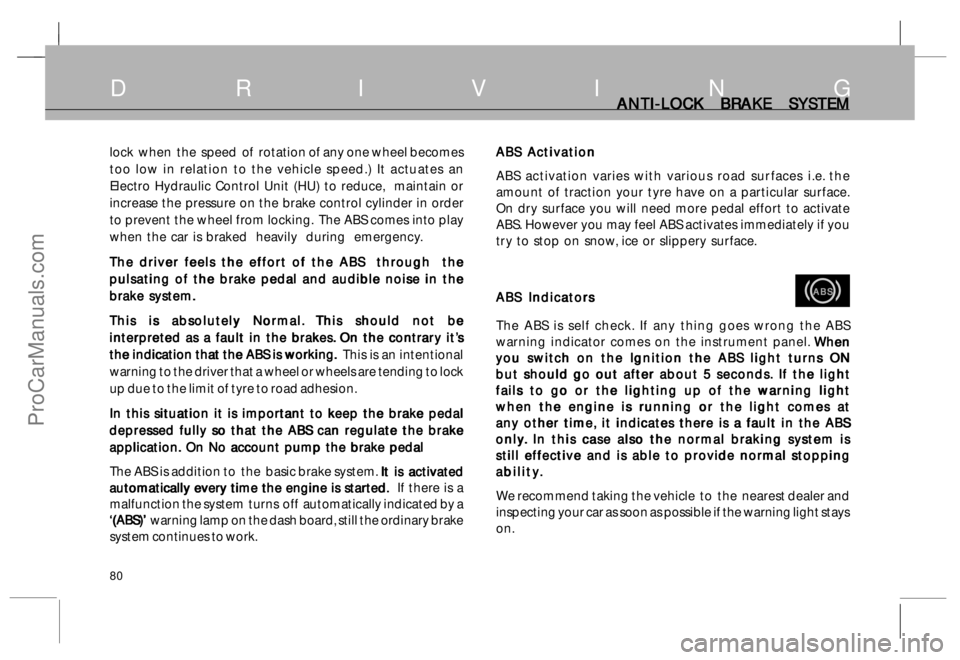
The ABS is self check. If any thing goes wrong the ABS
warning indicator comes on the instrument panel.
W WW W
W
hen henhen hen
hen
you switch on the Ignition the ABS light turns ON you switch on the Ignition the ABS light turns ONyou switch on the Ignition the ABS light turns ON you switch on the Ignition the ABS light turns ON
you switch on the Ignition the ABS light turns ON
but should go out after about 5 seconds. but should go out after about 5 seconds.but should go out after about 5 seconds. but should go out after about 5 seconds.
but should go out after about 5 seconds.
If the light If the lightIf the light If the light
If the light
fails to go or the lighting up of the warning light fails to go or the lighting up of the warning lightfails to go or the lighting up of the warning light fails to go or the lighting up of the warning light
fails to go or the lighting up of the warning light
when the engine is running or the light comes at when the engine is running or the light comes atwhen the engine is running or the light comes at when the engine is running or the light comes at
when the engine is running or the light comes at
any other time, it indicates there is a fault in the ABS any other time, it indicates there is a fault in the ABSany other time, it indicates there is a fault in the ABS any other time, it indicates there is a fault in the ABS
any other time, it indicates there is a fault in the ABS
only onlyonly only
only
.. ..
.
In this c In this c In this c In this c
In this c
ase also the nor ase also the norase also the nor ase also the nor
ase also the nor
mal br mal brmal br mal br
mal br
ak akak ak
ak
ing sy ing sying sy ing sy
ing sy
st stst
st
st
em is em isem is em is
em is
still effective and is able to provide normal stopping still effective and is able to provide normal stoppingstill effective and is able to provide normal stopping still effective and is able to provide normal stopping
still effective and is able to provide normal stopping
abilit abilitabilit abilit
abilit
y yy y
y
.. ..
.
We recommend taking the vehicle to the nearest dealer and
inspecting your car as soon as possible if the warning light stays
on.
ABS ABSABS ABS
ABS
ProCarManuals.com
Page 81 of 161
81
D R I V I N GANTI LOCK BRAKING SYSTEM ANTI LOCK BRAKING SYSTEMANTI LOCK BRAKING SYSTEM ANTI LOCK BRAKING SYSTEM
ANTI LOCK BRAKING SYSTEM
Electronic Brake Distribution (EBD) Electronic Brake Distribution (EBD)Electronic Brake Distribution (EBD) Electronic Brake Distribution (EBD)
Electronic Brake Distribution (EBD)
indicator indicatorindicator indicator
indicator
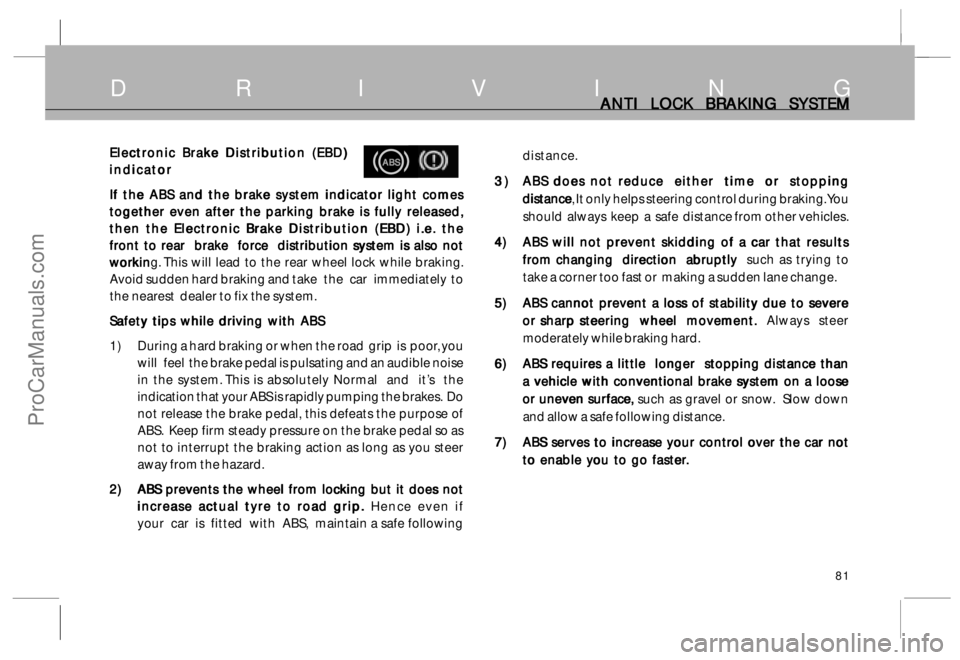
If the ABS and the brake system indicator light comes If the ABS and the brake system indicator light comesIf the ABS and the brake system indicator light comes If the ABS and the brake system indicator light comes
If the ABS and the brake system indicator light comes
together even after the parking brake is fully released, together even after the parking brake is fully released,together even after the parking brake is fully released, together even after the parking brake is fully released,
together even after the parking brake is fully released,
then the Electronic Brake Distribution (EBD) i.e. the then the Electronic Brake Distribution (EBD) i.e. thethen the Electronic Brake Distribution (EBD) i.e. the then the Electronic Brake Distribution (EBD) i.e. the
then the Electronic Brake Distribution (EBD) i.e. the
front to rear brake force distribution system is also not front to rear brake force distribution system is also notfront to rear brake force distribution system is also not front to rear brake force distribution system is also not
front to rear brake force distribution system is also not
w ww w
w
or oror or
or
k kk k
k
in inin in
ing. This will lead to the rear wheel lock while braking.
Avoid sudden hard braking and take the car immediately to
the nearest dealer to fix the system.
Safety tips while driving with ABS Safety tips while driving with ABSSafety tips while driving with ABS Safety tips while driving with ABS
Safety tips while driving with ABS
1) During a hard braking or when the road grip is poor, you
will feel the brake pedal is pulsating and an audible noise
in the system. This is absolutely Normal and it’s the
indication that your ABS is rapidly pumping the brakes. Do
not release the brake pedal, this defeats the purpose of
ABS. Keep firm steady pressure on the brake pedal so as
not to interrupt the braking action as long as you steer
away from the hazard.
2) 2)2) 2)
2)
ABS prevents the wheel from locking but it does not ABS prevents the wheel from locking but it does notABS prevents the wheel from locking but it does not ABS prevents the wheel from locking but it does not
ABS prevents the wheel from locking but it does not
increase actual tyre to road grip. increase actual tyre to road grip. increase actual tyre to road grip. increase actual tyre to road grip.
increase actual tyre to road grip. Hence even if
your car is fitted with ABS, maintain a safe followingdistance.
3) 3)3) 3)
3)
ABS does not reduce either time or stopping ABS does not reduce either time or stoppingABS does not reduce either time or stopping ABS does not reduce either time or stopping
ABS does not reduce either time or stopping
distanc distancdistanc distanc
distanc
e ee e
e, It only helps steering control during braking. You
should always keep a safe distance from other vehicles.
4) 4)4)
4)
4)
ABS will not prevent skidding of a car that results ABS will not prevent skidding of a car that resultsABS will not prevent skidding of a car that results ABS will not prevent skidding of a car that results
ABS will not prevent skidding of a car that results
from changing direction abruptly from changing direction abruptly from changing direction abruptly from changing direction abruptly
from changing direction abruptly such as trying to
take a corner too fast or making a sudden lane change.
5) 5)5) 5)
5)
ABS cannot prevent a loss of stability due to severe ABS cannot prevent a loss of stability due to severeABS cannot prevent a loss of stability due to severe ABS cannot prevent a loss of stability due to severe
ABS cannot prevent a loss of stability due to severe
or sharp steering wheel movement. or sharp steering wheel movement.or sharp steering wheel movement. or sharp steering wheel movement.
or sharp steering wheel movement. Always steer
moderately while braking hard.
6) 6)6) 6)
6)
ABS requires a little longer stopping distance than ABS requires a little longer stopping distance thanABS requires a little longer stopping distance than ABS requires a little longer stopping distance than
ABS requires a little longer stopping distance than
a vehicle with conventional brake system on a loose a vehicle with conventional brake system on a loosea vehicle with conventional brake system on a loose a vehicle with conventional brake system on a loose
a vehicle with conventional brake system on a loose
or une or uneor une or une
or une
v vv v
v
en sur en suren sur en sur
en sur
fac facfac fac
fac
e ee e
e
,, ,,
, such as gravel or snow. Slow down
and allow a safe following distance.
7) 7)7) 7)
7)
ABS ABSABS ABS
ABS
serves to increase your control over the car not serves to increase your control over the car not serves to increase your control over the car not serves to increase your control over the car not
serves to increase your control over the car not
t tt t
t
o enable y o enable yo enable y o enable y
o enable y
ou t ou tou t ou t
ou t
o go fast o go fasto go fast o go fast
o go fast
er erer er
er
.. ..
.
ABS ABSABS ABS
ABS
ProCarManuals.com
Page 84 of 161
84
D R I V I N GFUEL ECONOMY FUEL ECONOMYFUEL ECONOMY FUEL ECONOMY
FUEL ECONOMY
NOTICE NOTICENOTICE NOTICE
NOTICE
Do not engage four wheel drive mode (4H or 4L)
continuously on dry and hard road surface. It can cause
expensive damage to the vehicle transmission and the
tyres.
Four wheel drive facility is a powerful tool which enables
the vehicle to traverse terrain which is otherwise
inaccessible to two wheel drive vehicles. However, it must
be used judiciously and carefully. Do not take unnecessary
risks and attempt the impossible. Familiarise yourself
thoroughly with the vehicle and its abilities before
attempting serious off road driving.
With ignition ‘ON’ 4H & 4L indicator lamp on panel should
glow for a few seconds only & then go off. Continuous
illumination of 4L & 4H lamps indicates electrical fault.
F FF F
F
uel E uel Euel E uel E
uel E
c cc c
c
onom onomonom onom
onom
y yy y
y
A. A.A. A.
A . Drive smoothly, accelerate gradually and anticipate stops.
B. B.B. B.
B . Best fuel consumption is achieved at low engine speeds, the
highest possible gear without labouring the engine.
C. C.C. C.
C . Driving with accelerator pedal fully depressed means using
excessive fuel.
D DD D
D
.. ..
. Do not allow engine to labour. Change to lower gear when
engine no longer runs smoothly.
E. E.E. E.
E . If possible, do not idle the engine for more than 2 minutes.
Switch off the engine.
F FF F
F
.. ..
. Do not ride the clutch OR brake pedal while driving. Do not
use clutch pedal as foot rest.
G* G*G* G*
G*.When changing from 4H/4L to 2H of transfer case, 2H free
wheeling should be done.
If 2H free wheeling is not done the hub locks of front hub
remain locked causing unnecessary rotation of front drive
components and this consumes more fuel and causes wear
and tear of front axle components.
H. H.H. H.
H . Depending on traffic conditions, a constant speed should
be maintained.
The vehicle uses more fuel, every time you speed up or slow
down.
I. I.I. I.
I . Hard braking, abrupt cornering and rapid acceleration use
more fuel. Avoid these.
J. J.J. J.
J . Do not carry unnecessary weight in the vehicle.
K. K.K. K.
K . Maintain moderate speed limits, while driving.
L. L.L. L.
L . Always ensure that front wheel alignment is proper.
(*F (*F(*F (*F
(*F
or 4 or 4 or 4 or 4
or 4
WD mo WD moWD mo WD mo
WD mo
del only del onlydel only del only
del only
.) .).) .)
.)
ProCarManuals.com
Page 86 of 161
86
D R I V I N GDRIVING IN ADVERSE CONDITIONS DRIVING IN ADVERSE CONDITIONSDRIVING IN ADVERSE CONDITIONS DRIVING IN ADVERSE CONDITIONS
DRIVING IN ADVERSE CONDITIONS
Driving Through Water Driving Through WaterDriving Through Water Driving Through Water
Driving Through Water
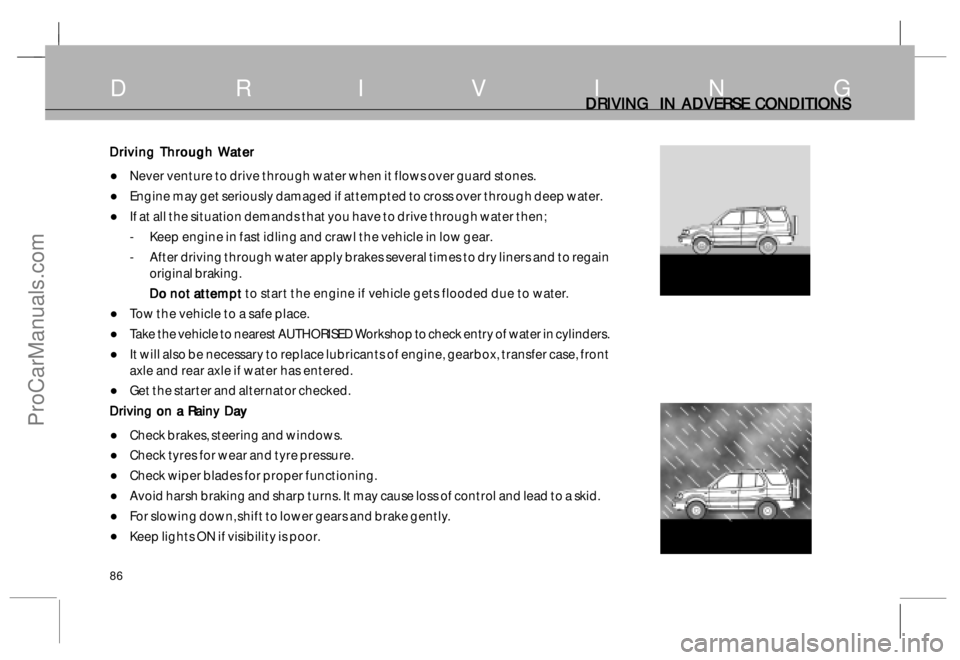
•Never venture to drive through water when it flows over guard stones.
•Engine may get seriously damaged if attempted to cross over through deep water.
•If at all the situation demands that you have to drive through water then;
- Keep engine in fast idling and crawl the vehicle in low gear.
- After driving through water apply brakes several times to dry liners and to regain
original braking.
D DD D
D
o not a o not ao not a o not a
o not a
tt tttt tt
tt
empt emptempt empt
empt to start the engine if vehicle gets flooded due to water.
•Tow the vehicle to a safe place.
•Take the vehicle to nearest AUTHORISED Workshop to check entry of water in cylinders.
•It will also be necessary to replace lubricants of engine, gearbox, transfer case, front
axle and rear axle if water has entered.
•Get the starter and alternator checked.
Driving on a Rainy Day Driving on a Rainy DayDriving on a Rainy Day Driving on a Rainy Day
Driving on a Rainy Day
•Check brakes, steering and windows.
•Check tyres for wear and tyre pressure.
•Check wiper blades for proper functioning.
•Avoid harsh braking and sharp turns. It may cause loss of control and lead to a skid.
•For slowing down, shift to lower gears and brake gently.
•Keep lights ON if visibility is poor.
ProCarManuals.com
Page 88 of 161
88
Descending Sharp Gradients Descending Sharp GradientsDescending Sharp Gradients Descending Sharp Gradients
Descending Sharp Gradients
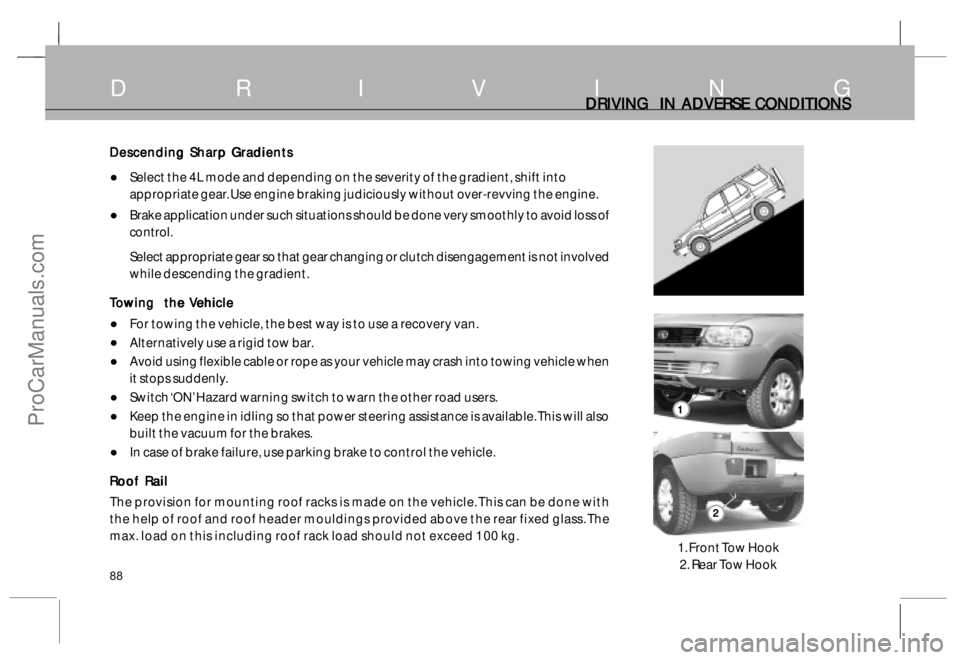
•Select the 4L mode and depending on the severity of the gradient, shift into
appropriate gear. Use engine braking judiciously without over-revving the engine.
•Brake application under such situations should be done very smoothly to avoid loss of
control.
Select appropriate gear so that gear changing or clutch disengagement is not involved
while descending the gradient.
T TT T
T
o oo o
o
wing the wing the wing the wing the
wing the
V VV V
V
ehicle ehicleehicle ehicle
ehicle
•For towing the vehicle, the best way is to use a recovery van.
•Alternatively use a rigid tow bar.
•Avoid using flexible cable or rope as your vehicle may crash into towing vehicle when
it stops suddenly.
•Switch ‘ON’ Hazard warning switch to warn the other road users.
•Keep the engine in idling so that power steering assistance is available. This will also
built the vacuum for the brakes.
•In case of brake failure, use parking brake to control the vehicle.
Roof Rail Roof RailRoof Rail Roof Rail
Roof Rail
The provision for mounting roof racks is made on the vehicle. This can be done with
the help of roof and roof header mouldings provided above the rear fixed glass. The
max. load on this including roof rack load should not exceed 100 kg.
D R I V I N GDRIVING IN ADVERSE CONDITIONS DRIVING IN ADVERSE CONDITIONSDRIVING IN ADVERSE CONDITIONS DRIVING IN ADVERSE CONDITIONS
DRIVING IN ADVERSE CONDITIONS
1 11 1
1
2 22 2
2
1. Front Tow Hook
2. Rear Tow Hook
ProCarManuals.com
Page 89 of 161
89
D R I V I N GDRIVING SAFET DRIVING SAFETDRIVING SAFET DRIVING SAFET
DRIVING SAFET
Y YY Y
Y
control of the vehicle and increase
the risk of injury yourself and
others.
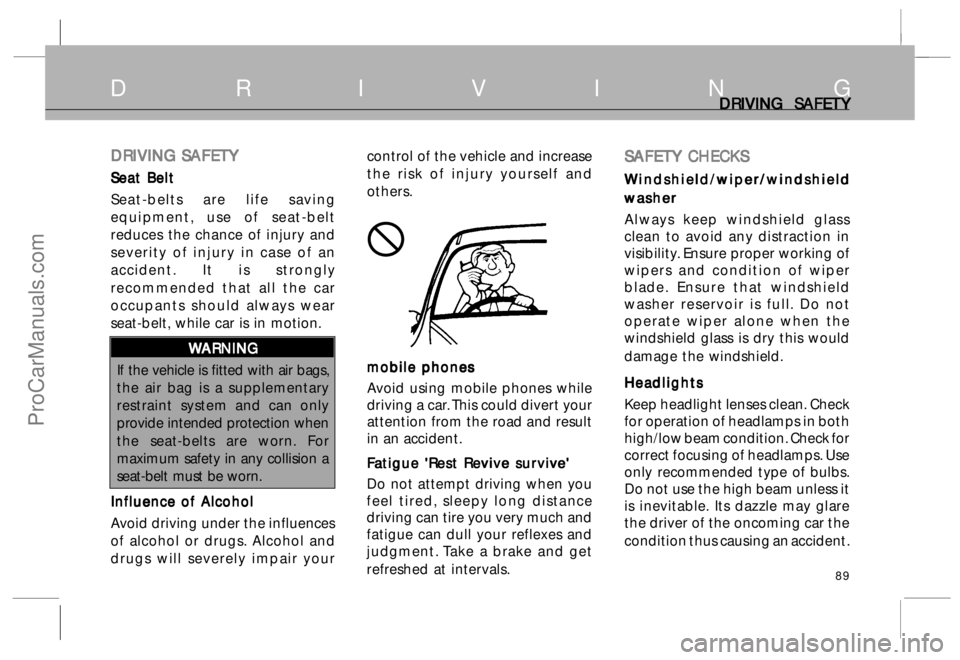
mobile phones mobile phonesmobile phones mobile phones
mobile phones
Avoid using mobile phones while
driving a car. This could divert your
attention from the road and result
in an accident.
F FF F
F
a aa a
a
tigue 'R tigue 'Rtigue 'R tigue 'R
tigue 'R
est R est Rest R est R
est R
e ee e
e
viv vivviv viv
viv
e sur e sure sur e sur
e sur
viv vivviv viv
viv
e' e'e' e'
e'
Do not attempt driving when you
feel tired, sleepy long distance
driving can tire you very much and
fatigue can dull your reflexes and
judgment. Take a brake and get
refreshed at intervals.SAFETY CHECKS SAFETY CHECKSSAFETY CHECKS SAFETY CHECKS
SAFETY CHECKS
Windshield/wiper/windshield Windshield/wiper/windshieldWindshield/wiper/windshield Windshield/wiper/windshield
Windshield/wiper/windshield
washer washerwasher washer
washer
Always keep windshield glass
clean to avoid any distraction in
visibility. Ensure proper working of
wipers and condition of wiper
blade. Ensure that windshield
washer reservoir is full. Do not
operate wiper alone when the
windshield glass is dry this would
damage the windshield.
Headlights HeadlightsHeadlights Headlights
Headlights
Keep headlight lenses clean. Check
for operation of headlamps in both
high/low beam condition. Check for
correct focusing of headlamps. Use
only recommended type of bulbs.
Do not use the high beam unless it
is inevitable. Its dazzle may glare
the driver of the oncoming car the
condition thus causing an accident.
DRIVING SAFETY DRIVING SAFETYDRIVING SAFETY DRIVING SAFETY
DRIVING SAFETY
Seat Belt Seat BeltSeat Belt Seat Belt
Seat Belt
Seat-belts are life saving
equipment, use of seat-belt
reduces the chance of injury and
severity of injury in case of an
accident. It is strongly
recommended that all the car
occupants should always wear
seat-belt, while car is in motion.
W WW W
W
ARNING ARNINGARNING ARNING
ARNING
If the vehicle is fitted with air bags,
the air bag is a supplementary
restraint system and can only
provide intended protection when
the seat-belts are worn. For
maximum safety in any collision a
seat-belt must be worn.
Influence of Alcohol Influence of AlcoholInfluence of Alcohol Influence of Alcohol
Influence of Alcohol
Avoid driving under the influences
of alcohol or drugs. Alcohol and
drugs will severely impair your
ProCarManuals.com