ECU TATA SAFARI 2015 Owners Manual
[x] Cancel search | Manufacturer: TATA, Model Year: 2015, Model line: SAFARI, Model: TATA SAFARI 2015Pages: 161, PDF Size: 2.55 MB
Page 19 of 161
19
S SS S
S
ea eaea ea
ea
t-b t-bt-b t-b
t-b
elt pr elt prelt pr elt pr
elt pr
ec ecec ec
ec
autions f autions fautions f autions f
autions f
or B or Bor B or B
or B
ab abab ab
ab
y yy y
y
,, ,,
,
small child small child small child small child
small child
,, ,,
,
P P P P
P
r rr r
r
egnan egnanegnan egnan
egnan
t tt t
t
woman and injured person : woman and injured person :woman and injured person : woman and injured person :
woman and injured person :
T TT T
T
A AA A
A
T TT T
T
A MO A MOA MO A MO
A MO
T TT T
T
ORS ORS ORS ORS
ORS strongly urges that the driver and passengers
in the vehicle be properly restrained at all times with the
seat-belts. Failure to do so could increase the chance of injury
and / or the severity of injury in accidents.
Baby or Small Child : Baby or Small Child :Baby or Small Child : Baby or Small Child :
Baby or Small Child :
Use child restraint system appropriate for the child until the
child becomes large enough to properly wear the vehicle’s
seat-belts.
If a child is too large for a child restraint system, the child should
sit in the seat and must be restrained using the vehicle’s
seat-belt.
Also use the seat-belt while the child is in the rear seat. According
to accident statistics, the child is safer when properly restrained
in the rear seat than in the front seat.
Child restraint systems are available.
T TT T
T
A AA A
A
T TT T
T
A MO A MOA MO A MO
A MO
T TT T
T
ORS ORSORS ORS
ORS
recommend the use of a type which fits to your vehicle. Before
installation, always read the manufacturer’s instructions.
Y O U R S A F E T YSEA SEASEA SEA
SEA
T-BEL T-BELT-BEL T-BEL
T-BEL
T PREC T PRECT PREC T PREC
T PREC
A AA A
A
UTIONS UTIONSUTIONS UTIONS
UTIONS
P PP P
P
r rr r
r
egnan egnanegnan egnan
egnan
t t t t
t
W WW W
W
oman : oman :oman : oman :
oman :
T TT T
T
A AA A
A
T TT T
T
A MO A MOA MO A MO
A MO
T TT T
T
ORS ORS ORS ORS
ORS recommends the use of a seat-belt. Ask your
doctor for specific recommendations. The lap belt should be
worn securely and as low as possible over the hips and not to
waist.
Injured person : Injured person :Injured person : Injured person :
Injured person :
T TT T
T
A AA A
A
T TT T
T
A MO A MOA MO A MO
A MO
T TT T
T
ORS ORS ORS ORS
ORS recommends the use of a seat-belt for injured
person. Depending on the injury, first check with your doctor
for specific recommendations.
ProCarManuals.com
Page 22 of 161
22
Y O U R S A F E T YAIR BAGS (IF FITTED) AIR BAGS (IF FITTED)AIR BAGS (IF FITTED) AIR BAGS (IF FITTED)
AIR BAGS (IF FITTED)
Air Bags (If Fitted) Air Bags (If Fitted)Air Bags (If Fitted) Air Bags (If Fitted)
Air Bags (If Fitted)
SRS (Supplementary Restraint System)
Your vehicle is fitted with an air bag for the driver, located in the steering
wheel, and a passenger air bag (if fitted) is located above the glove box
compartment. Airbag(s) can be identified by the “SRS AIR BAG” label on
the airbag cover.
The airbag is a supplementary restraint system and is designed to provide
effective protection to the belted occupants during frontal collisions.
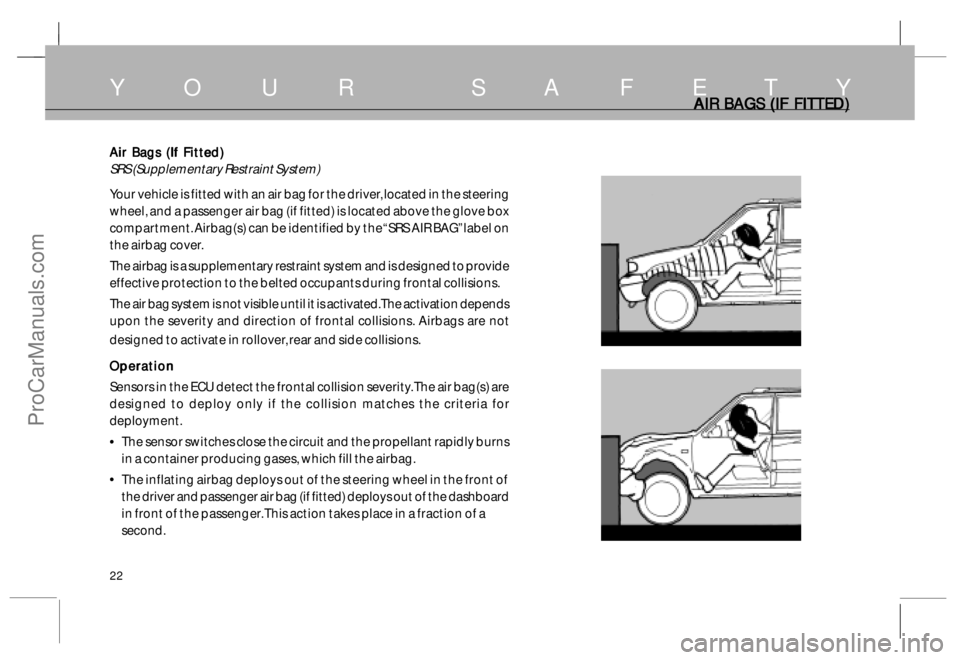
The air bag system is not visible until it is activated. The activation depends
upon the severity and direction of frontal collisions. Airbags are not
designed to activate in rollover, rear and side collisions.
Operation OperationOperation Operation
Operation
Sensors in the ECU detect the frontal collision severity. The air bag(s) are
designed to deploy only if the collision matches the criteria for
deployment.
• •• •
• The sensor switches close the circuit and the propellant rapidly burns
in a container producing gases, which fill the airbag.
• •• •
• The inflating airbag deploys out of the steering wheel in the front of
the driver and passenger air bag (if fitted) deploys out of the dashboard
in front of the passenger. This action takes place in a fraction of a
second.
ProCarManuals.com
Page 24 of 161
24
Y O U R S A F E T YAIR BAGS (IF FITTED) AIR BAGS (IF FITTED)AIR BAGS (IF FITTED) AIR BAGS (IF FITTED)
AIR BAGS (IF FITTED)
Air bag warning light : Air bag warning light :Air bag warning light : Air bag warning light :
Air bag warning light :
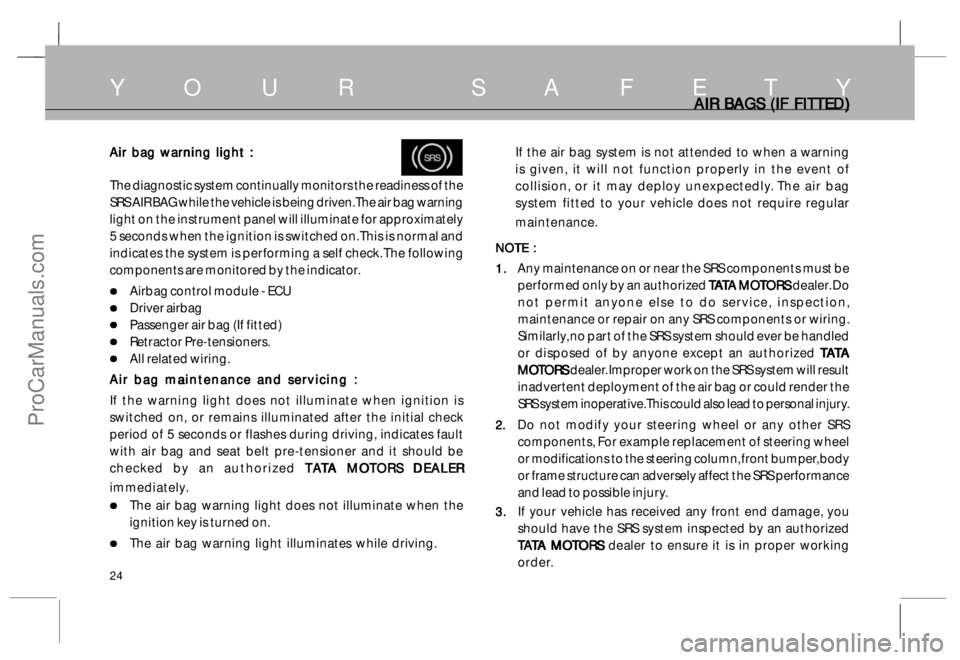
The diagnostic system continually monitors the readiness of the
SRS AIR BAG while the vehicle is being driven. The air bag warning
light on the instrument panel will illuminate for approximately
5 seconds when the ignition is switched on. This is normal and
indicates the system is performing a self check. The following
components are monitored by the indicator.
• •• •
•Airbag control module - ECU
• •• •
•Driver airbag
• •• •
•Passenger air bag (If fitted)
• •• •
•Retractor Pre-tensioners.
• •• •
•All related wiring.
Air bag maintenance and servicing : Air bag maintenance and servicing :Air bag maintenance and servicing : Air bag maintenance and servicing :
Air bag maintenance and servicing :
If the warning light does not illuminate when ignition is
switched on, or remains illuminated after the initial check
period of 5 seconds or flashes during driving, indicates fault
with air bag and seat belt pre-tensioner and it should be
checked by an authorized
TA TATA TA
TA
T TT T
T
A MO A MOA MO A MO
A MO
T TT T
T
ORS DEALER ORS DEALERORS DEALER ORS DEALER
ORS DEALER
immediately.
• •• •
•The air bag warning light does not illuminate when the
ignition key is turned on.
• •• •
•The air bag warning light illuminates while driving.If the air bag system is not attended to when a warning
is given, it will not function properly in the event of
collision, or it may deploy unexpectedly. The air bag
system fitted to your vehicle does not require regular
maintenance.
NOTE : NOTE :NOTE : NOTE :
NOTE :
1. 1.1. 1.
1.
Any maintenance on or near the SRS components must be
performed only by an authorized
T TT T
T
A AA A
A
T TT T
T
A MO A MOA MO A MO
A MO
T TT T
T
ORS ORS ORS ORS
ORS dealer. Do
not permit anyone else to do service, inspection,
maintenance or repair on any SRS components or wiring.
Similarly, no part of the SRS system should ever be handled
or disposed of by anyone except an authorized
T TT T
T
A AA A
A
T TT T
T
A AA A
A
MO MOMO MO
MO
T TT T
T
ORS ORS ORS ORS
ORS dealer. Improper work on the SRS system will result
inadvertent deployment of the air bag or could render the
SRS system inoperative. This could also lead to personal injury.
2. 2.2. 2.
2.Do not modify your steering wheel or any other SRS
components, For example replacement of steering wheel
or modifications to the steering column, front bumper, body
or frame structure can adversely affect the SRS performance
and lead to possible injury.
3. 3.3. 3.
3.If your vehicle has received any front end damage, you
should have the SRS system inspected by an authorized
T TT T
T
A AA A
A
T TT T
T
A MO A MOA MO A MO
A MO
T TT T
T
ORS ORS ORS ORS
ORS dealer to ensure it is in proper working
order.
SRS SRSSRS SRS
SRS
ProCarManuals.com
Page 31 of 161
31
D R I V I N G C O N T R O L SIMMOBILISER IMMOBILISERIMMOBILISER IMMOBILISER
IMMOBILISER
Anti-theft security system - Immobiliser (If fitted) Anti-theft security system - Immobiliser (If fitted)Anti-theft security system - Immobiliser (If fitted) Anti-theft security system - Immobiliser (If fitted)
Anti-theft security system - Immobiliser (If fitted)
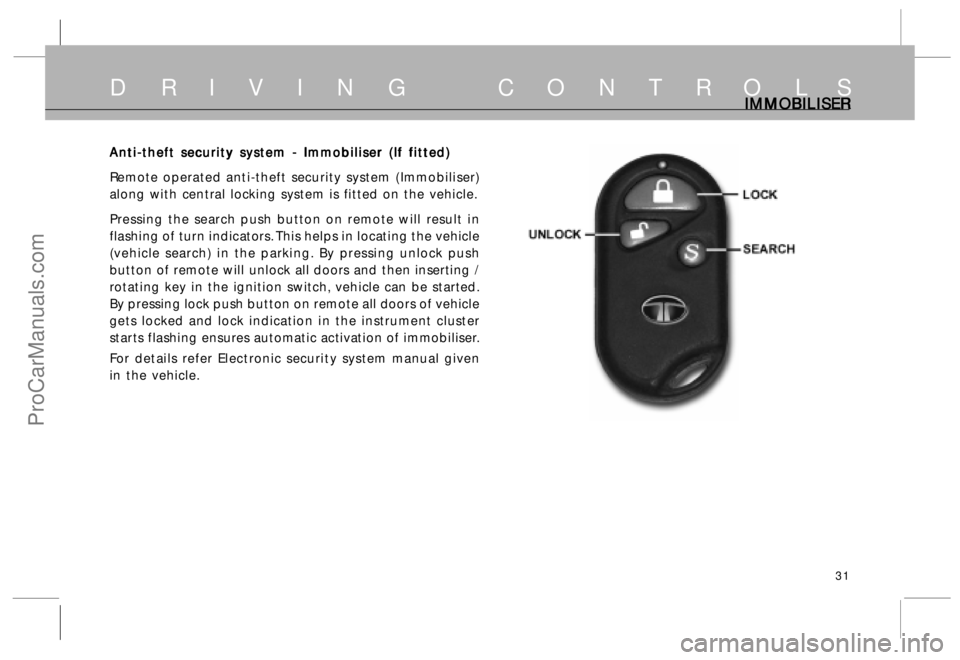
Remote operated anti-theft security system (Immobiliser)
along with central locking system is fitted on the vehicle.
Pressing the search push button on remote will result in
flashing of turn indicators. This helps in locating the vehicle
(vehicle search) in the parking. By pressing unlock push
button of remote will unlock all doors and then inserting /
rotating key in the ignition switch, vehicle can be started.
By pressing lock push button on remote all doors of vehicle
gets locked and lock indication in the instrument cluster
starts flashing ensures automatic activation of immobiliser.
For details refer Electronic security system manual given
in the vehicle.
ProCarManuals.com
Page 37 of 161
37
D R I V I N G C O N T R O L SSTEERING STEERING STEERING STEERING
STEERING
WHEEL POSITION ADJUST WHEEL POSITION ADJUSTWHEEL POSITION ADJUST WHEEL POSITION ADJUST
WHEEL POSITION ADJUST
MENT MENTMENT MENT
MENT
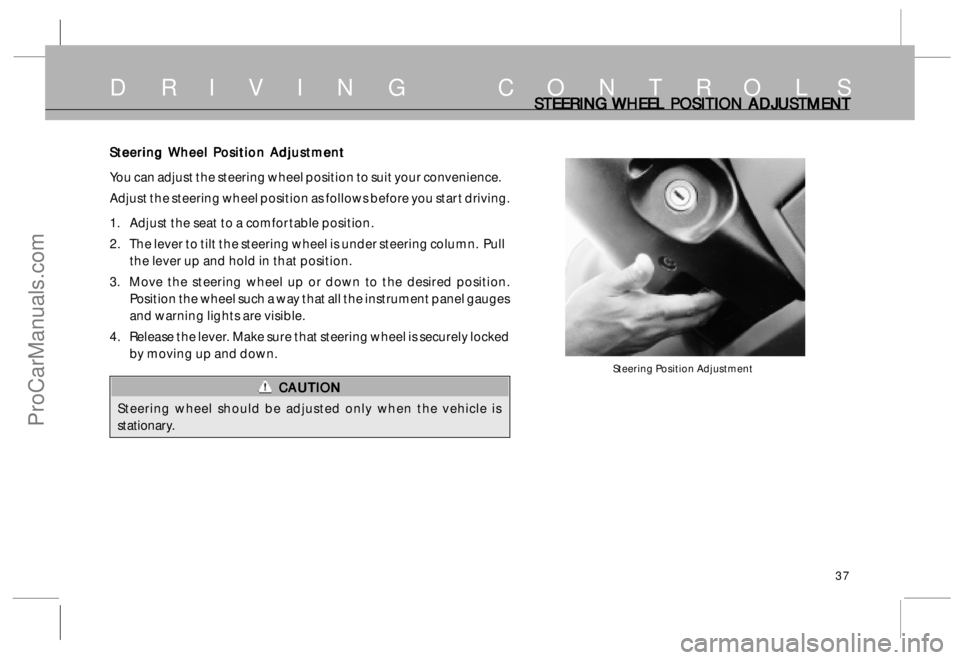
Steering Position Adjustment
Steering Wheel Position Adjustment Steering Wheel Position AdjustmentSteering Wheel Position Adjustment Steering Wheel Position Adjustment
Steering Wheel Position Adjustment
You can adjust the steering wheel position to suit your convenience.
Adjust the steering wheel position as follows before you start driving.
1. Adjust the seat to a comfortable position.
2. The lever to tilt the steering wheel is under steering column. Pull
the lever up and hold in that position.
3. Move the steering wheel up or down to the desired position.
Position the wheel such a way that all the instrument panel gauges
and warning lights are visible.
4. Release the lever. Make sure that steering wheel is securely locked
by moving up and down.
CAUTION CAUTIONCAUTION CAUTION
CAUTION
Steering wheel should be adjusted only when the vehicle is
stationary.
ProCarManuals.com
Page 73 of 161
73
Engine Coolant Check Engine Coolant CheckEngine Coolant Check Engine Coolant Check
Engine Coolant Check
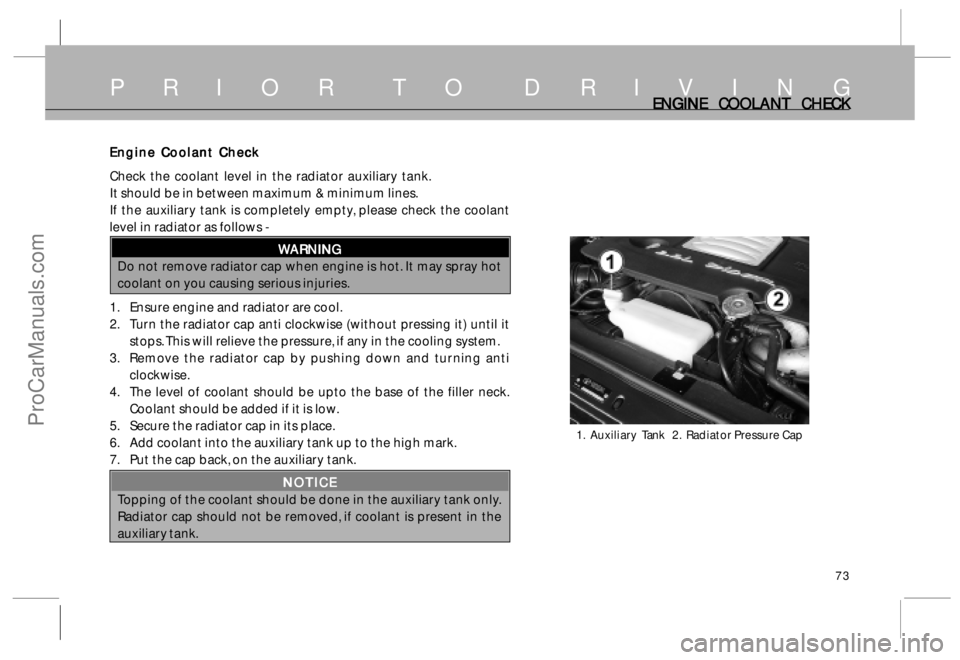
Check the coolant level in the radiator auxiliary tank.
It should be in between maximum & minimum lines.
If the auxiliary tank is completely empty, please check the coolant
level in radiator as follows -
W WW W
W
ARNING ARNINGARNING ARNING
ARNING
Do not remove radiator cap when engine is hot. It may spray hot
coolant on you causing serious injuries.
1. Ensure engine and radiator are cool.
2. Turn the radiator cap anti clockwise (without pressing it) until it
stops. This will relieve the pressure, if any in the cooling system.
3. Remove the radiator cap by pushing down and turning anti
clockwise.
4. The level of coolant should be upto the base of the filler neck.
Coolant should be added if it is low.
5. Secure the radiator cap in its place.
6. Add coolant into the auxiliary tank up to the high mark.
7. Put the cap back, on the auxiliary tank.
NOTICE NOTICENOTICE NOTICE
NOTICE
Topping of the coolant should be done in the auxiliary tank only.
Radiator cap should not be removed, if coolant is present in the
auxiliary tank.
ENGINE C ENGINE CENGINE C ENGINE C
ENGINE C
OOL OOLOOL OOL
OOL
ANT CHECK ANT CHECKANT CHECK ANT CHECK
ANT CHECK
1. Auxiliary Tank 2. Radiator Pressure Cap
P R I O R T O D R I V I N G
ProCarManuals.com
Page 77 of 161
77
D R I V I N GPREP PREPPREP PREP
PREP
ARING ARING ARING ARING
ARING
T TT T
T
O DRIVE & R O DRIVE & RO DRIVE & R O DRIVE & R
O DRIVE & R
UNNING IN PERIOD UNNING IN PERIODUNNING IN PERIOD UNNING IN PERIOD
UNNING IN PERIOD
Preparing to Drive Preparing to DrivePreparing to Drive Preparing to Drive
Preparing to Drive
The following checks and adjustments should be done
before you start driving the vehicle.
1 . Ensure all mirrors, windows and outside lights are clean
and unobstructed. Remove dust, frost, snow or ice if
any, on these.
2 . Ensure bonnet is fully closed.
3 . Check that any items you may be carrying inside with
you are stored properly or fastened down securely.
4 . Check adjustment of seat. If required adjust to your
convenience.
5 . Check adjustment of all rear view mirrors.
6 . Check adjustment of steering wheel.
7 . If the doors are not properly closed you will get a audio
warning/indicator light as soon as you insert the ignition
key in the switch. Make sure all doors are properly closed
and locked.
8 . If the seat belts of driver & co-driver are not fastened you
will get an audio warning as soon as you turn the key to
ignition position. Fasten your seat belt, ensure co-driver
seat passenger has also fastened the seat belt (see
Your Safety).9 . Check and ensure that all the gauges and indicator lights
in the instrument panel are working.
Running-in Period Running-in PeriodRunning-in Period Running-in Period
Running-in Period
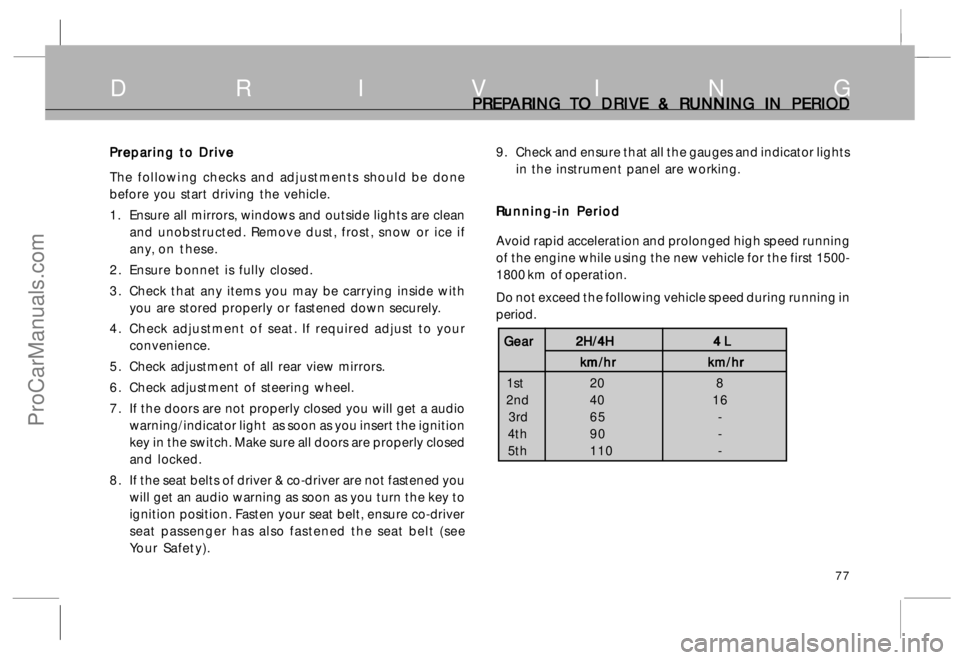
Avoid rapid acceleration and prolonged high speed running
of the engine while using the new vehicle for the first 1500-
1800 km of operation.
Do not exceed the following vehicle speed during running in
period.
Gear GearGear Gear
Gear
2H/4H 2H/4H 2H/4H 2H/4H
2H/4H
4 L 4 L 4 L 4 L
4 L
km/hr km/hr km/hr km/hr
km/hr
km/hr km/hr km/hr km/hr
km/hr
1st 20 8
2nd 40 16
3rd 65 -
4th 90 -
5th 110 -
ProCarManuals.com
Page 79 of 161
79
D R I V I N G BRAKES AND ABS (IF FITTED) BRAKES AND ABS (IF FITTED) BRAKES AND ABS (IF FITTED) BRAKES AND ABS (IF FITTED)
BRAKES AND ABS (IF FITTED)
Have your vehicle attended immediately.
Put your foot on brake pedal to apply brake. Do not ride
the brakes as they may overheat and the performance may
be impaired. The brake lights may confuse the drivers
behind you.
Use engine to assist the brakes by shifting to a lower gear
and lifting your foot from accelerator pedal.
Constant application of brakes while going down the hill
builds heat and reduces braking efficiency.
Check your brakes after driving through deep water. Apply
the brakes moderately to feel that they are normal. If not,
apply them gently and frequently until they do. With wet
brakes you should be extra cautious and alert in your driving.
Anti Lock Brake System (ABS) – if fitted Anti Lock Brake System (ABS) – if fittedAnti Lock Brake System (ABS) – if fitted Anti Lock Brake System (ABS) – if fitted
Anti Lock Brake System (ABS) – if fitted
ABS combined with the traditional hydraulic brake system pre-
vents the wheel from locking while braking by make use of
most of road to tyre grip. It also ensures better control and
stability of car while braking.
How ABS works How ABS worksHow ABS works How ABS works
How ABS works
ABS essentially consists of an Electronic Control Unit (ECU)
which reads signals from the sensors fitted to each wheel and
identifies the one which is likely to lock. ( Wheels will tend toBrakes BrakesBrakes Brakes
Brakes
Tata Safari is equipped with ventilated disc brakes on front
and drum brakes on rear wheels.
Braking system is vacuum assisted to reduce effort needed
on the brake pedal. It is a dual circuit service brake system
designed in such a way that one circuit will always work, even
if other circuit fails.
If this happens you will immediately notice that the brake
pedal goes down much farther and you need to press the
pedal harder. In such an event the stopping distance may be
longer.
In case of failure of vacuum the vehicle can still be stopped
with a higher pedal effort.
In case of vacuum failure or brake circuit failure, slow down
the vehicle by shifting to lower gear and lifting your foot
from the accelerator pedal. Pull to the side of the road as
soon as it is safe.
CAUTION CAUTIONCAUTION CAUTION
CAUTION
Brake system failure is very hazardous. It is best to have
your vehicle towed, but if you drive the vehicle in this
condition, be extremely cautious.
ProCarManuals.com
Page 99 of 161
99
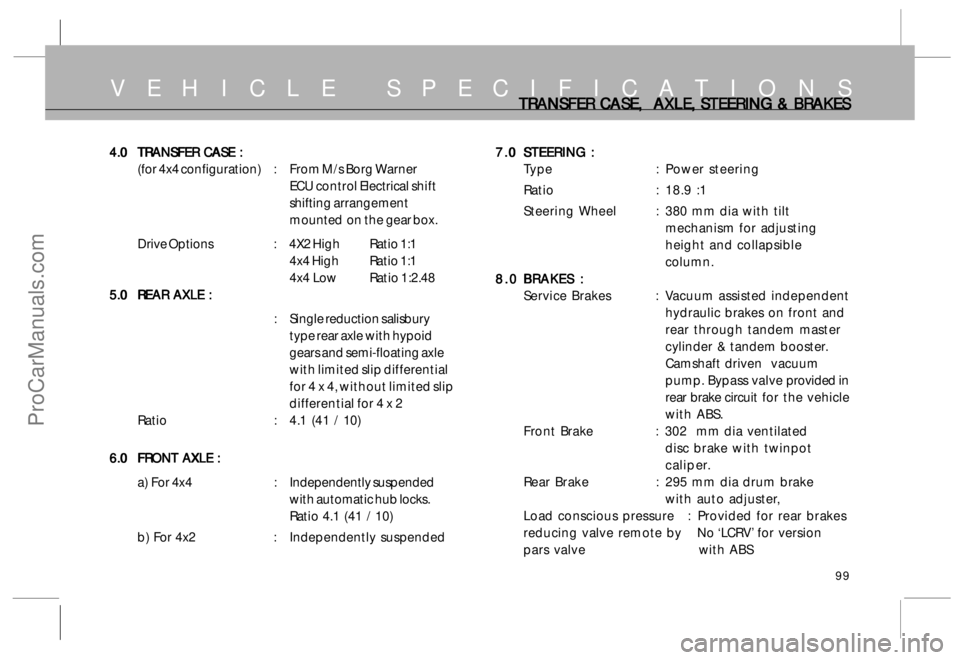
4.0 4.04.0 4.0
4.0
TRANSFER CASE : TRANSFER CASE :TRANSFER CASE : TRANSFER CASE :
TRANSFER CASE :
(for 4x4 configuration) :From M/s Borg Warner
ECU control Electrical shift
shifting arrangement
mounted on the gear box.
Drive Options : 4X2 HighRatio 1:1
4x4 High Ratio 1:1
4x4 Low Ratio 1:2.48
5.0 5.05.0 5.0
5.0
REAR AXLE : REAR AXLE :REAR AXLE : REAR AXLE :
REAR AXLE :
: Single reduction salisbury
type rear axle with hypoid
gears and semi-floating axle
with limited slip differential
for 4 x 4, without limited slip
differential for 4 x 2
Ratio :4.1 (41 / 10)
6.0 6.06.0 6.0
6.0
FRONT AXLE : FRONT AXLE :FRONT AXLE : FRONT AXLE :
FRONT AXLE :
a) For 4x4 :Independently suspended
with automatic hub locks.
Ratio 4.1 (41 / 10)
b) For 4x2 : Independently suspended
VEHICLE SPECIFICATIONSTRANSFER CASE, AXLE, STEERING & BRAKES TRANSFER CASE, AXLE, STEERING & BRAKESTRANSFER CASE, AXLE, STEERING & BRAKES TRANSFER CASE, AXLE, STEERING & BRAKES
TRANSFER CASE, AXLE, STEERING & BRAKES
7.0 7.07.0 7.0
7.0
STEERING : STEERING :STEERING : STEERING :
STEERING :
Type : Power steering
Ratio : 18.9 :1
Steering Wheel: 380 mm dia with tilt
mechanism for adjusting
height and collapsible
column.
8.0 8.08.0 8.0
8.0
BRAKES : BRAKES :BRAKES : BRAKES :
BRAKES :
Service Brakes : Vacuum assisted independent
hydraulic brakes on front and
rear through tandem master
cylinder & tandem booster.
Camshaft driven vacuum
pump. Bypass valve provided in
rear brake circuit for the vehicle
with ABS.
Front Brake : 302 mm dia ventilated
disc brake with twinpot
caliper.
Rear Brake :295 mm dia drum brake
with auto adjuster,
Load conscious pressure : Provided for rear brakes
reducing valve remote by No ‘LCRV’ for version
pars valvewith ABS
ProCarManuals.com
Page 104 of 161
104
M A I N T E N A N C EENGINE C ENGINE CENGINE C ENGINE C
ENGINE C
OMP OMPOMP OMP
OMP
AR ARAR AR
AR
T TT T
T
MENT (RHD) MENT (RHD)MENT (RHD) MENT (RHD)
MENT (RHD)
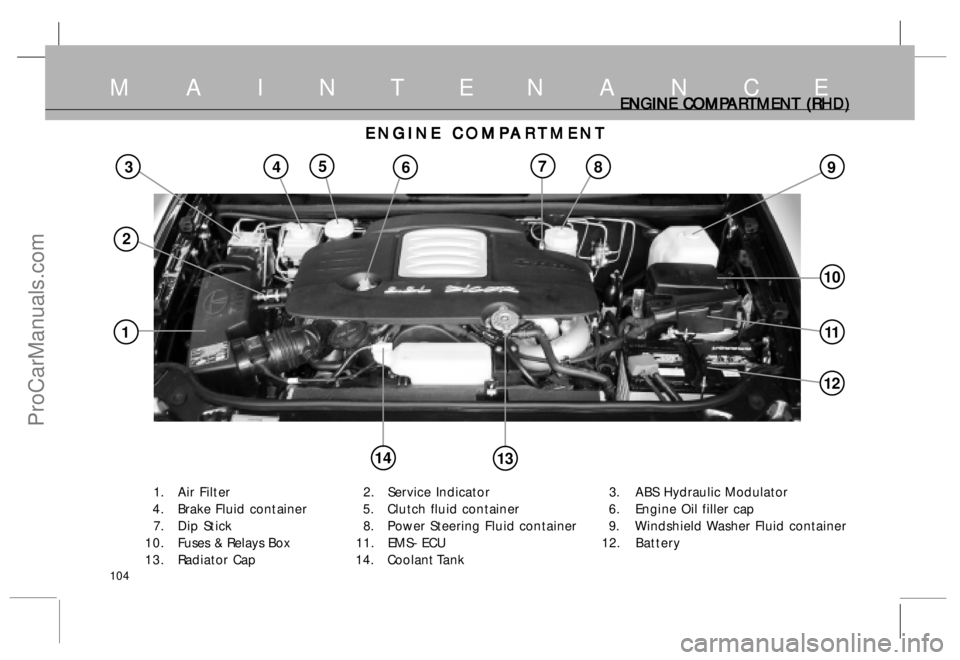
1. Air Filter 2. Service Indicator 3. ABS Hydraulic Modulator
4 . Brake Fluid container 5. Clutch fluid container 6. Engine Oil filler cap
7. Dip Stick 8. Power Steering Fluid container 9. Windshield Washer Fluid container
10. Fuses & Relays Box 11. EMS- ECU 12.Battery
13. Radiator Cap 14. Coolant Tank
ENGINE C ENGINE CENGINE C ENGINE C
ENGINE C
OMP OMPOMP OMP
OMP
AR ARAR AR
AR
T TT T
T
MENT MENTMENT MENT
MENT
38
11
9457
10
14
1
2
6
12
13
ProCarManuals.com