service TESLA MODEL S 2014 (Europe) User Guide
[x] Cancel search | Manufacturer: TESLA, Model Year: 2014, Model line: MODEL S, Model: TESLA MODEL S 2014Pages: 152, PDF Size: 17.5 MB
Page 100 of 152
Maintenance ScheduleMaintenance Schedule
7.2MODEL S OWNERS MANUAL
MAINTENANCE
Maintenance ScheduleService Intervals
Regular maintenance is the key to ensuring the
continued reliability and efficiency of your
Model S.
Take Model S to Tesla at the regularly scheduled
maintenance intervals of every 12 months, or
every 20,000 kms, whichever comes first.
Model S must be serviced by Tesla-certified
technicians. Damages or failures caused by
maintenance or repairs performed by non-Tesla
certified technicians are not covered by the
warranty.
Fluid Replacement
Do not change or top up Battery coolant and
brake fluid yourself. Tesla service technicians
replace fluids at the regularly scheduled service
intervals:
•Brake fluid - every 2 years or 40,000 kms,
whichever comes first.
•Battery coolant - every 4 years or
80,000 kms, whichever comes first.
NOTE: Any damage from opening the Battery
coolant reservoir is excluded from the warranty.
Daily and Monthly Checks
In addition to the regularly scheduled
maintenance performed by Tesla, you should
carry out a few simple checks more frequently.
Daily Checks
•Check the Battery’s charge level, displayed
on the instrument panel.
•Check that all exterior lights, horn, turn
signals, and wipers and washers are
working.
•Check the operation of the brakes,
including the parking brake.
•Check the operation of the seat belts
(see page 3.5).
•Look for fluid deposits underneath Model S
that might indicate a leak. It is normal for a
small pool of water to form (caused by the
air conditioning system’s dehumidifying
process).
Monthly Checks
•Check the condition and pressure of each
tire (see page 7.3).
•Check washer fluid level and top up if
necessary (see page 7.18).
•Check that the air conditioning system is
operating (see page 5.9).
CAUTION: Contact Tesla immediately if
you notice any significant or sudden drop
in fluid levels or uneven tire wear.
High Voltage Safety
Your Model S has been designed and built with
safety as a priority. However, be aware of these
precautions to protect yourself from the risk of
injury inherent in all high-voltage systems:
•Read and follow all instructions provided on
the labels that are attached to Model S.
These labels are there for your safety.
•The high voltage system has no
user-serviceable parts. Do not disassemble,
remove or replace high voltage
components, cables or connectors. High
voltage cables are colored orange for easy
identification.
•If an accident occurs, do not touch any high
voltage wiring, connectors, or components
connected to the wiring.
•In the unlikely event that a fire occurs,
immediately contact your local fire
emergency responders.
WARNING: Always disconnect the charge
cable before working underneath
Model S, even if charging is not in progress.
WARNING: Keep your hands and clothing
away from cooling fans. Some fans
operate even when Model S is powered off.
WARNING: Some fluids (battery acid,
Battery coolant, brake fluid, windshield
washer additives, etc.) used in motor vehicles
are poisonous and should not be inhaled,
swallowed, or brought into contact with open
wounds. For your safety, always read and follow
instructions printed on fluid containers.
Dispose of used fluids and other
chemicals at authorized waste disposal
sites. It is illegal to pollute drains, waterways or
soil.
book.book Page 2 Friday, July 19, 2013 12:53 PM
Page 105 of 152
Tire Care and Maintenance
MAINTENANCE7.7 detected, it is possible that the tire sensor has
been damaged. Contact Tesla to have the fault
repaired as soon as possible.
Replacing a Tire Sensor
If the Tire Pressure warning indicator displays
frequently, contact Tesla to determine if a tire
sensor needs to be replaced. Tire sensors must
be replaced by a Tesla service technician who
can perform a brief setup procedure. If a
non-Tesla service center repairs or replaces a
tire, the tire sensor will not work until Tesla
performs the setup procedure.
book.book Page 7 Friday, July 19, 2013 12:53 PM
Page 115 of 152
Fluid Reservoirs
MAINTENANCE7.17
Checking Brake Fluid
WARNING: Contact Tesla immediately if
you notice increased movement of the
brake pedal or a significant loss of brake fluid.
Driving under these conditions can result in
extended stopping distances or complete
brake failure.
The Brake indicator on the instrument
panel alerts you if the quantity of fluid in
the brake reservoir drops below the
recommended level. If it displays while driving,
stop as soon as safety permits by gently
applying the brakes. Do not continue driving.
Contact Tesla immediately for assistance.
Fluid Level Check
Tesla checks the brake fluid level at the
regularly scheduled maintenance intervals. To
check it yourself, park Model S on level ground.
When Model S is cool, remove the maintenance
panel (see page 7.16).
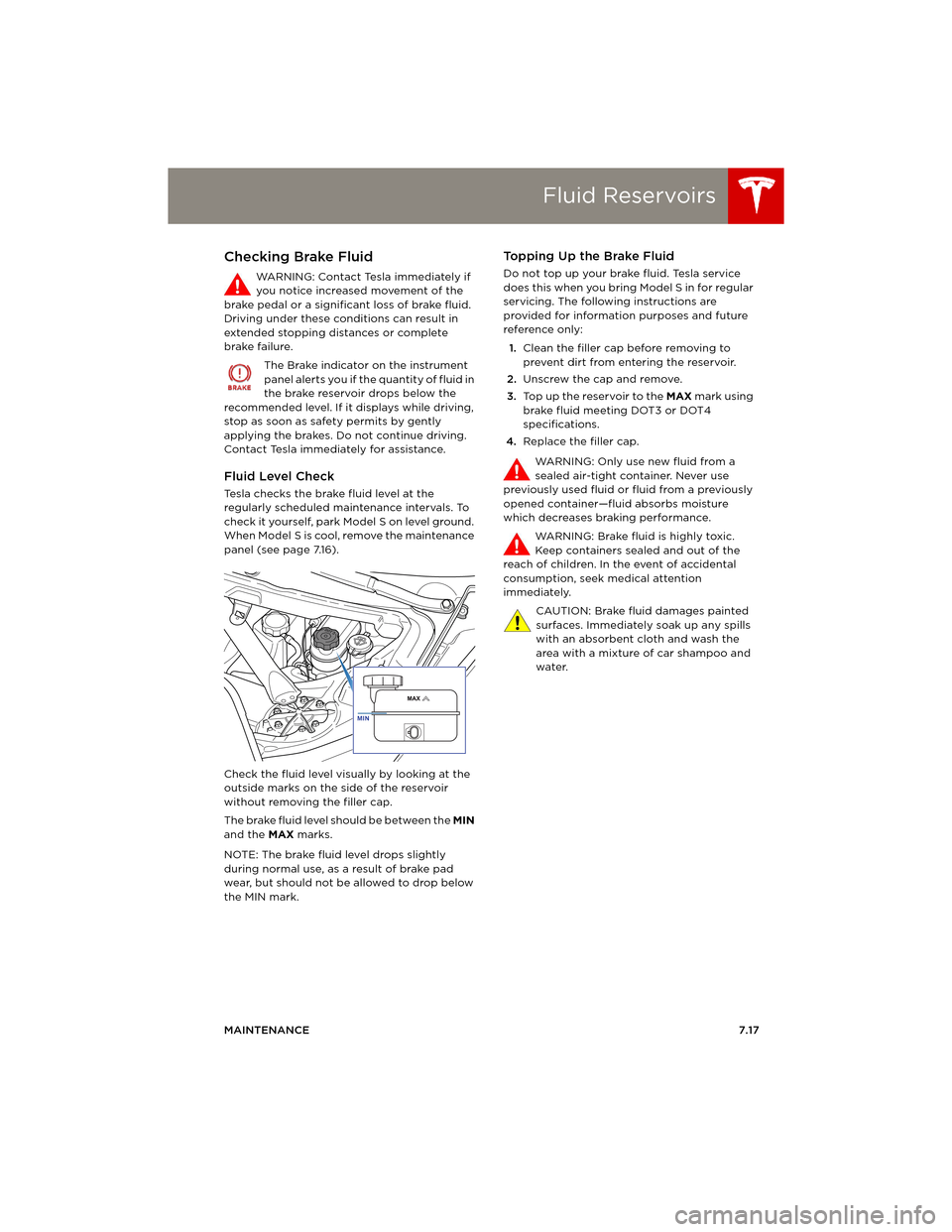
Check the fluid level visually by looking at the
outside marks on the side of the reservoir
without removing the filler cap.
The brake fluid level should be between the MIN
and the MAX marks.
NOTE: The brake fluid level drops slightly
during normal use, as a result of brake pad
wear, but should not be allowed to drop below
the MIN mark.
To p p i n g U p t h e B r a k e F l u i d
Do not top up your brake fluid. Tesla service
does this when you bring Model S in for regular
servicing. The following instructions are
provided for information purposes and future
reference only:
1.Clean the filler cap before removing to
prevent dirt from entering the reservoir.
2.Unscrew the cap and remove.
3.Top up the reservoir to the MAX mark using
brake fluid meeting DOT3 or DOT4
specifications.
4.Replace the filler cap.
WARNING: Only use new fluid from a
sealed air-tight container. Never use
previously used fluid or fluid from a previously
opened container—fluid absorbs moisture
which decreases braking performance.
WARNING: Brake fluid is highly toxic.
Keep containers sealed and out of the
reach of children. In the event of accidental
consumption, seek medical attention
immediately.
CAUTION: Brake fluid damages painted
surfaces. Immediately soak up any spills
with an absorbent cloth and wash the
area with a mixture of car shampoo and
water.
book.book Page 17 Friday, July 19, 2013 12:53 PM
Page 118 of 152
FusesFuses
7.20MODEL S OWNERS MANUAL
Fuse Box 1
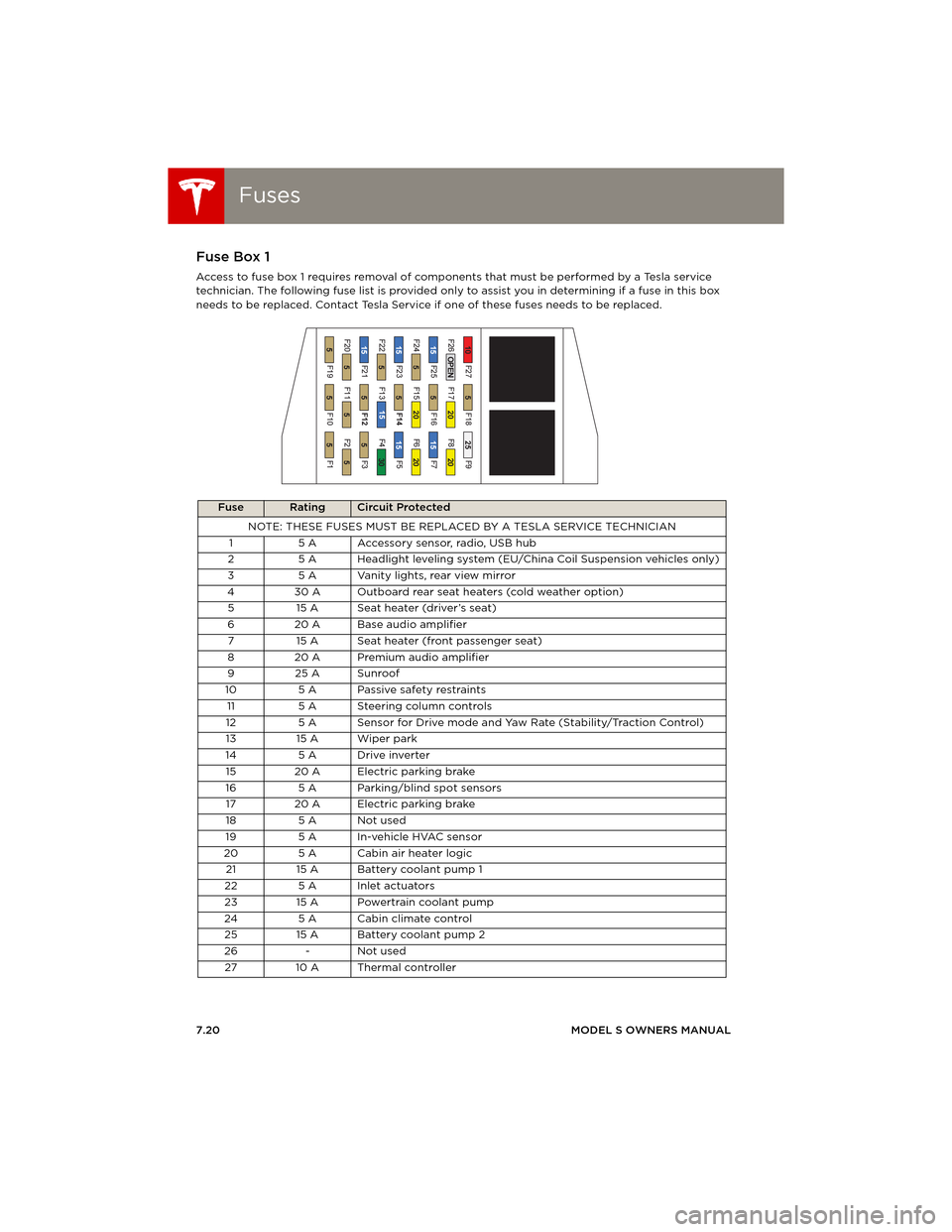
Access to fuse box 1 requires removal of components that must be performed by a Tesla service
technician. The following fuse list is provided only to assist you in determining if a fuse in this box
needs to be replaced. Contact Tesla Service if one of these fuses needs to be replaced.
Fuse RatingCircuit Protected
NOTE: THESE FUSES MUST BE REPLACED BY A TESLA SERVICE TECHNICIAN
1 5 A Accessory sensor, radio, USB hub
2 5 A Headlight leveling system (EU/China Coil Suspension vehicles only)
3 5 A Vanity lights, rear view mirror
4 30 A Outboard rear seat heaters (cold weather option)
5 15 A Seat heater (driver’s seat)
6 20 A Base audio amplifier
7 15 A Seat heater (front passenger seat)
820 APremium audio amplifier
9 25 A Sunroof
10 5 A Passive safety restraints
11 5 A Steering column controls
12 5 A Sensor for Drive mode and Yaw Rate (Stability/Traction Control)
13 15 A Wiper park
14 5 A Drive inverter
15 20 A Electric parking brake
16 5 A Parking/blind spot sensors
17 20 A Electric parking brake
18 5 A Not used
19 5 A In-vehicle HVAC sensor
20 5 A Cabin air heater logic
21 15 A Battery coolant pump 1
22 5 A Inlet actuators
23 15 A Powertrain coolant pump
24 5 A Cabin climate control
25 15 A Battery coolant pump 2
26 - Not used
27 10 A Thermal controller
book.book Page 20 Friday, July 19, 2013 12:53 PM
Page 120 of 152
FusesFuses
7.22MODEL S OWNERS MANUAL
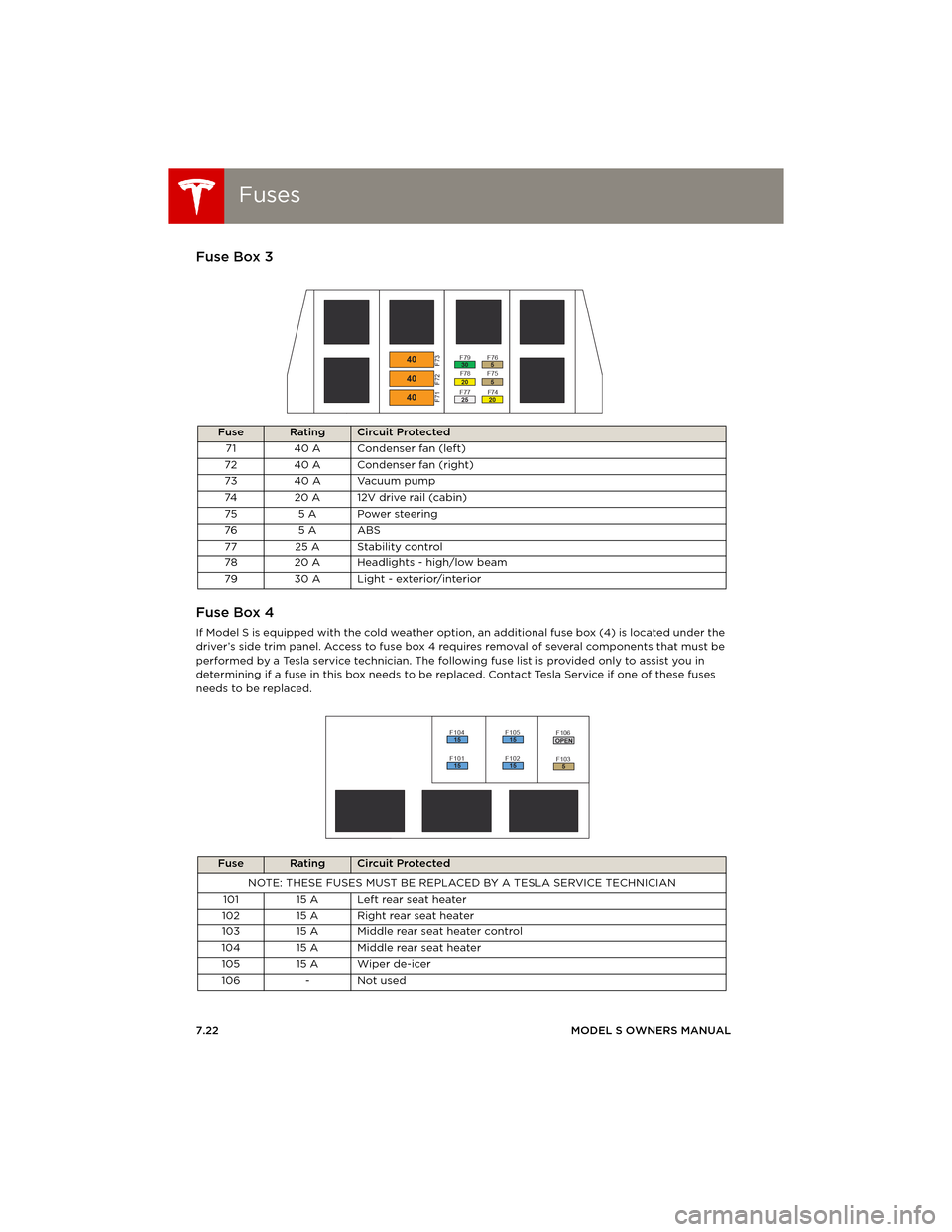
Fuse Box 3
Fuse Box 4
If Model S is equipped with the cold weather option, an additional fuse box (4) is located under the
driver’s side trim panel. Access to fuse box 4 requires removal of several components that must be
performed by a Tesla service technician. The following fuse list is provided only to assist you in
determining if a fuse in this box needs to be replaced. Contact Tesla Service if one of these fuses
needs to be replaced.
Fuse RatingCircuit Protected
71 40 A Condenser fan (left)
72 40 A Condenser fan (right)
73 40 A Vacuum pump
74 20 A 12V drive rail (cabin)
75 5 A Power steering
76 5 A ABS
77 25 A Stability control
78 20 A Headlights - high/low beam
79 30 A Light - exterior/interior
Fuse RatingCircuit Protected
NOTE: THESE FUSES MUST BE REPLACED BY A TESLA SERVICE TECHNICIAN
101 15 A Left rear seat heater
102 15 A Right rear seat heater
103 15 A Middle rear seat heater control
104 15 A Middle rear seat heater
105 15 A Wiper de-icer
106 - Not used
book.book Page 22 Friday, July 19, 2013 12:53 PM
Page 128 of 152
SubsystemsSubsystems
8.6MODEL S OWNERS MANUAL
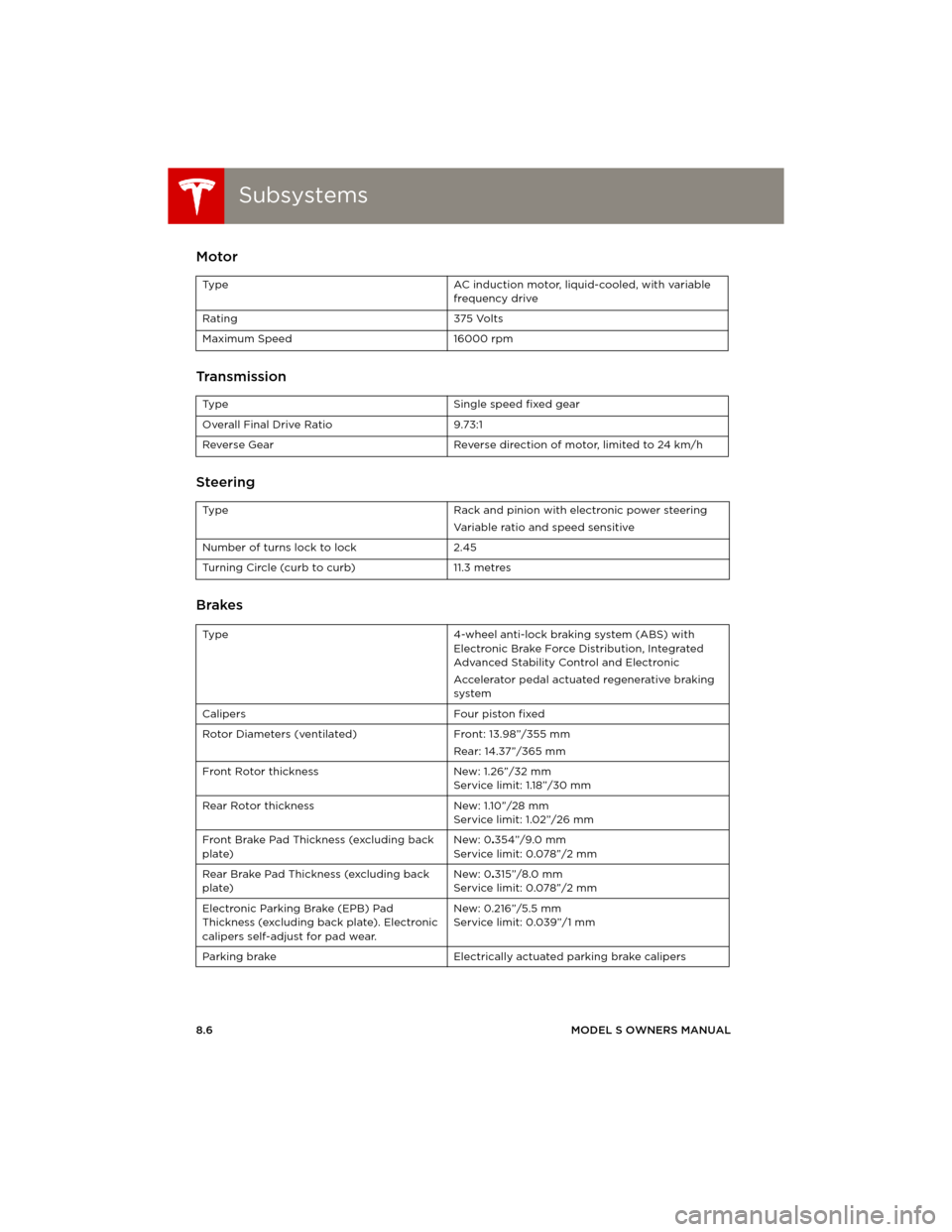
SubsystemsMotor
Transmission
Steering
Brakes
Type AC induction motor, liquid-cooled, with variable
frequency drive
Rating 375 Volts
Maximum Speed 16000 rpm
Type Single speed fixed gear
Overall Final Drive Ratio 9.73:1
Reverse Gear Reverse direction of motor, limited to 24 km/h
Type Rack and pinion with electronic power steering
Variable ratio and speed sensitive
Number of turns lock to lock 2.45
Turning Circle (curb to curb) 11.3 metres
Type 4-wheel anti-lock braking system (ABS) with
Electronic Brake Force Distribution, Integrated
Advanced Stability Control and Electronic
Accelerator pedal actuated regenerative braking
system
Calipers Four piston fixed
Rotor Diameters (ventilated) Front: 13.98”/355 mm
Rear: 14.37”/365 mm
Front Rotor thickness New: 1.26”/32 mm
Service limit: 1.18”/30 mm
Rear Rotor thickness New: 1.10”/28 mm
Service limit: 1.02”/26 mm
Front Brake Pad Thickness (excluding back
plate)New: 0.354”/9.0 mm
Service limit: 0.078”/2 mm
Rear Brake Pad Thickness (excluding back
plate)New: 0.315”/8.0 mm
Service limit: 0.078”/2 mm
Electronic Parking Brake (EPB) Pad
Thickness (excluding back plate). Electronic
calipers self-adjust for pad wear.New: 0.216”/5.5 mm
Service limit: 0.039”/1 mm
Parking brake Electrically actuated parking brake calipers
book.book Page 6 Friday, July 19, 2013 12:53 PM
Page 140 of 152
DisclaimersDisclaimers
10.2MODEL S OWNERS MANUAL
CONSUMER INFORMATION
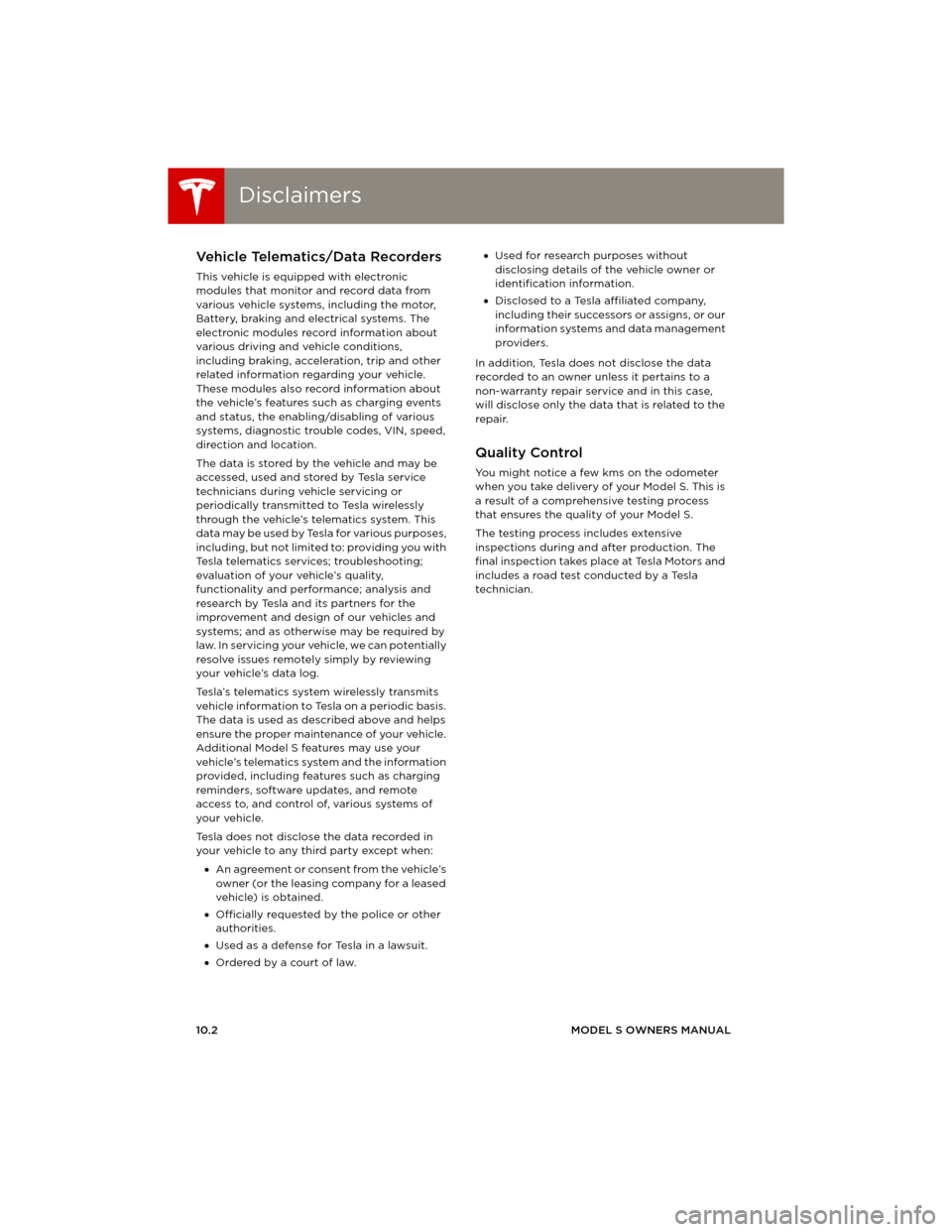
DisclaimersVehicle Telematics/Data Recorders
This vehicle is equipped with electronic
modules that monitor and record data from
various vehicle systems, including the motor,
Battery, braking and electrical systems. The
electronic modules record information about
various driving and vehicle conditions,
including braking, acceleration, trip and other
related information regarding your vehicle.
These modules also record information about
the vehicle’s features such as charging events
and status, the enabling/disabling of various
systems, diagnostic trouble codes, VIN, speed,
direction and location.
The data is stored by the vehicle and may be
accessed, used and stored by Tesla service
technicians during vehicle servicing or
periodically transmitted to Tesla wirelessly
through the vehicle’s telematics system. This
data may be used by Tesla for various purposes,
including, but not limited to: providing you with
Tesla telematics services; troubleshooting;
evaluation of your vehicle’s quality,
functionality and performance; analysis and
research by Tesla and its partners for the
improvement and design of our vehicles and
systems; and as otherwise may be required by
law. In servicing your vehicle, we can potentially
resolve issues remotely simply by reviewing
your vehicle’s data log.
Tesla’s telematics system wirelessly transmits
vehicle information to Tesla on a periodic basis.
The data is used as described above and helps
ensure the proper maintenance of your vehicle.
Additional Model S features may use your
vehicle’s telematics system and the information
provided, including features such as charging
reminders, software updates, and remote
access to, and control of, various systems of
your vehicle.
Tesla does not disclose the data recorded in
your vehicle to any third party except when:
•An agreement or consent from the vehicle’s
owner (or the leasing company for a leased
vehicle) is obtained.
•Officially requested by the police or other
authorities.
•Used as a defense for Tesla in a lawsuit.
•Ordered by a court of law.•Used for research purposes without
disclosing details of the vehicle owner or
identification information.
•Disclosed to a Tesla affiliated company,
including their successors or assigns, or our
information systems and data management
providers.
In addition, Tesla does not disclose the data
recorded to an owner unless it pertains to a
non-warranty repair service and in this case,
will disclose only the data that is related to the
repair.
Quality Control
You might notice a few kms on the odometer
when you take delivery of your Model S. This is
a result of a comprehensive testing process
that ensures the quality of your Model S.
The testing process includes extensive
inspections during and after production. The
final inspection takes place at Tesla Motors and
includes a road test conducted by a Tesla
technician.
book.book Page 2 Friday, July 19, 2013 12:53 PM
Page 146 of 152
iv
INDEXINDEX
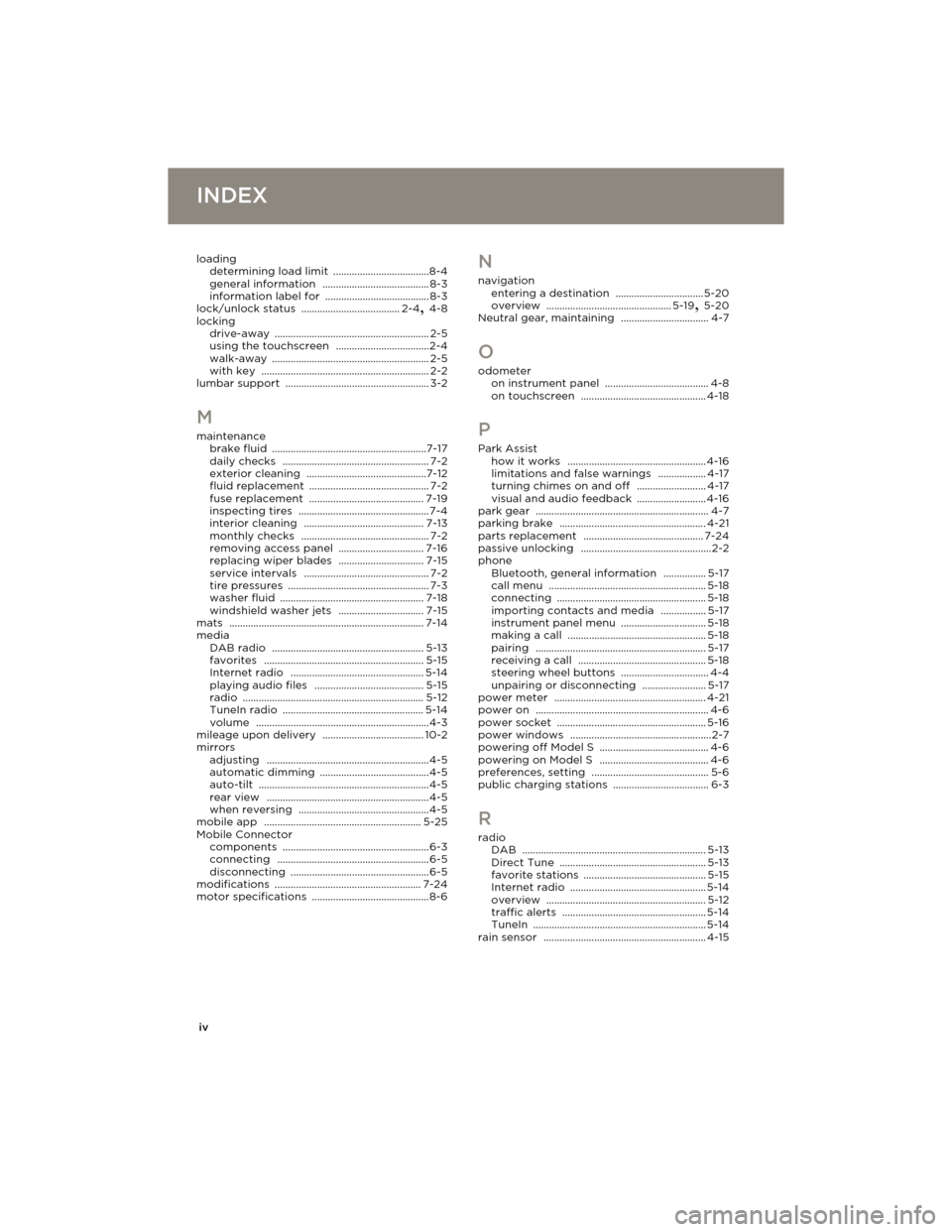
loading
determining load limit ....................................8-4
general information ........................................ 8-3
information label for ....................................... 8-3
lock/unlock status ..................................... 2-4, 4-8
locking
drive-away
.......................................................... 2-5
using the touchscreen ...................................2-4
walk-away ........................................................... 2-5
with key ............................................................... 2-2
lumbar support ...................................................... 3-2
M
maintenance
brake fluid ..........................................................7-17
daily checks ....................................................... 7-2
exterior cleaning .............................................7-12
fluid replacement ............................................. 7-2
fuse replacement ........................................... 7-19
inspecting tires .................................................7-4
interior cleaning ............................................. 7-13
monthly checks ................................................ 7-2
removing access panel ................................ 7-16
replacing wiper blades ................................ 7-15
service intervals ............................................... 7-2
tire pressures ..................................................... 7-3
washer fluid ...................................................... 7-18
windshield washer jets ................................ 7-15
mats ......................................................................... 7-14
media
DAB radio
......................................................... 5-13
favorites ............................................................ 5-15
Internet radio .................................................. 5-14
playing audio files ......................................... 5-15
radio .................................................................... 5-12
TuneIn radio ..................................................... 5-14
volume .................................................................4-3
mileage upon delivery ...................................... 10-2
mirrors
adjusting
.............................................................4-5
automatic dimming .........................................4-5
auto-tilt ................................................................4-5
rear view .............................................................4-5
when reversing .................................................4-5
mobile app ........................................................... 5-25
Mobile Connector
components
....................................................... 6-3
connecting ......................................................... 6-5
disconnecting ....................................................6-5
modifications ....................................................... 7-24
motor specifications ............................................8-6
N
navigation
entering a destination ................................. 5-20
overview ............................................... 5-19, 5-20
Neutral gear, maintaining ................................. 4-7
O
odometer
on instrument panel ....................................... 4-8
on touchscreen ............................................... 4-18
P
Park Assist
how it works ....................................................4-16
limitations and false warnings .................. 4-17
turning chimes on and off .......................... 4-17
visual and audio feedback .......................... 4-16
park gear ................................................................. 4-7
parking brake ....................................................... 4-21
parts replacement ............................................. 7-24
passive unlocking .................................................2-2
phone
Bluetooth, general information
................ 5-17
call menu ........................................................... 5-18
connecting ........................................................ 5-18
importing contacts and media ................. 5-17
instrument panel menu ................................ 5-18
making a call .................................................... 5-18
pairing ................................................................ 5-17
receiving a call ................................................ 5-18
steering wheel buttons ................................. 4-4
unpairing or disconnecting ........................ 5-17
power meter ......................................................... 4-21
power on ................................................................. 4-6
power socket ........................................................ 5-16
power windows .....................................................2-7
powering off Model S ......................................... 4-6
powering on Model S ......................................... 4-6
preferences, setting ............................................ 5-6
public charging stations .................................... 6-3
R
radio
DAB ..................................................................... 5-13
Direct Tune ....................................................... 5-13
favorite stations .............................................. 5-15
Internet radio ................................................... 5-14
overview ............................................................ 5-12
traffic alerts ...................................................... 5-14
TuneIn ................................................................. 5-14
rain sensor ............................................................. 4-15
book.book Page iv Friday, July 19, 2013 12:53 PM
Page 147 of 152
v
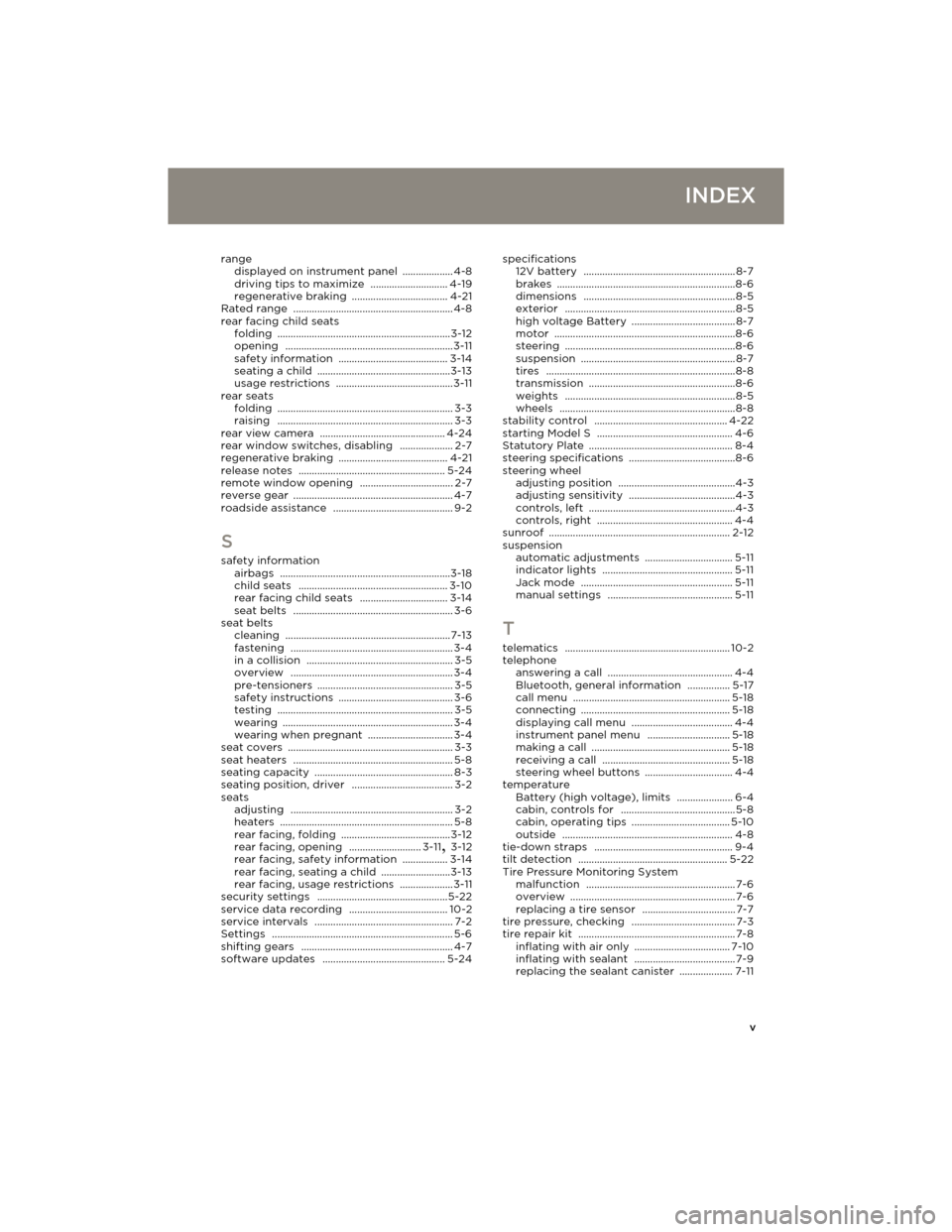
INDEX
range
displayed on instrument panel ................... 4-8
driving tips to maximize ............................. 4-19
regenerative braking .................................... 4-21
Rated range ............................................................ 4-8
rear facing child seats
folding
.................................................................3-12
opening ...............................................................3-11
safety information ......................................... 3-14
seating a child ..................................................3-13
usage restrictions ............................................3-11
rear seats
folding
.................................................................. 3-3
raising .................................................................. 3-3
rear view camera ............................................... 4-24
rear window switches, disabling .................... 2-7
regenerative braking ......................................... 4-21
release notes ....................................................... 5-24
remote window opening ................................... 2-7
reverse gear ............................................................ 4-7
roadside assistance ............................................. 9-2
S
safety information
airbags ................................................................3-18
child seats ........................................................ 3-10
rear facing child seats ................................. 3-14
seat belts ............................................................ 3-6
seat belts
cleaning
..............................................................7-13
fastening ............................................................. 3-4
in a collision ....................................................... 3-5
overview ............................................................. 3-4
pre-tensioners ................................................... 3-5
safety instructions ........................................... 3-6
testing .................................................................. 3-5
wearing ................................................................ 3-4
wearing when pregnant ................................ 3-4
seat covers .............................................................. 3-3
seat heaters ............................................................ 5-8
seating capacity .................................................... 8-3
seating position, driver ...................................... 3-2
seats
adjusting
............................................................. 3-2
heaters ................................................................. 5-8
rear facing, folding .........................................3-12
rear facing, opening ........................... 3-11, 3-12
rear facing, safety information ................. 3-14
rear facing, seating a child ..........................3-13
rear facing, usage restrictions ....................3-11
security settings .................................................5-22
service data recording ..................................... 10-2
service intervals .................................................... 7-2
Settings .................................................................... 5-6
shifting gears ......................................................... 4-7
software updates .............................................. 5-24specifications
12V battery
......................................................... 8-7
brakes ...................................................................8-6
dimensions .........................................................8-5
exterior ................................................................8-5
high voltage Battery ....................................... 8-7
motor ....................................................................8-6
steering ................................................................8-6
suspension .......................................................... 8-7
tires .......................................................................8-8
transmission .......................................................8-6
weights ................................................................8-5
wheels ..................................................................8-8
stability control .................................................. 4-22
starting Model S ................................................... 4-6
Statutory Plate ...................................................... 8-4
steering specifications ........................................8-6
steering wheel
adjusting position
............................................4-3
adjusting sensitivity ........................................4-3
controls, left .......................................................4-3
controls, right ................................................... 4-4
sunroof .................................................................... 2-12
suspension
automatic adjustments
................................. 5-11
indicator lights ................................................. 5-11
Jack mode ......................................................... 5-11
manual settings ............................................... 5-11
T
telematics .............................................................. 10-2
telephone
answering a call
............................................... 4-4
Bluetooth, general information ................ 5-17
call menu ........................................................... 5-18
connecting ........................................................ 5-18
displaying call menu ...................................... 4-4
instrument panel menu ............................... 5-18
making a call .................................................... 5-18
receiving a call ................................................ 5-18
steering wheel buttons ................................. 4-4
temperature
Battery (high voltage), limits
..................... 6-4
cabin, controls for ...........................................5-8
cabin, operating tips ..................................... 5-10
outside ................................................................ 4-8
tie-down straps .................................................... 9-4
tilt detection ........................................................ 5-22
Tire Pressure Monitoring System
malfunction
........................................................7-6
overview ..............................................................7-6
replacing a tire sensor ................................... 7-7
tire pressure, checking ....................................... 7-3
tire repair kit ........................................................... 7-8
inflating with air only .................................... 7-10
inflating with sealant ......................................7-9
replacing the sealant canister .................... 7-11
book.book Page v Friday, July 19, 2013 12:53 PM